

Author: Chidattmika Pradhan

  • Bollywood’s Ultimate Stylish Homes: Take a Look Inside

    Bollywood’s Ultimate Stylish Homes: Take a Look Inside

    Introduction

    If our lives are taped periodically and the events occurring in the course of time are the many situations that the characters face, we would choose to be the main character or play the lead role. Similarly, the supporting cast of our movie usually is housed in a place where major scenes get shot, probably that is the home we love to live in: it is somehow regarded as an admirable and crucial member of the film of life.

    Certainly, before this whole hashtag boycott Bollywood era, was a legendary era when actors and actresses were role models for the audience, and everything they did, walked, danced, drove, loved, or denied to do, helped people follow them better. So, basically, a superstar’s existence is like a limited-edition minted action figure with bullet-proof glass enveloping it for many people in the country.

    Whatever the movie is about, some iconic sets just get permanently imprinted in our minds. This piece of writing is dedicated to those great set designers, art directors, and people who selected such memorable places to shoot.

    Early Modern setting

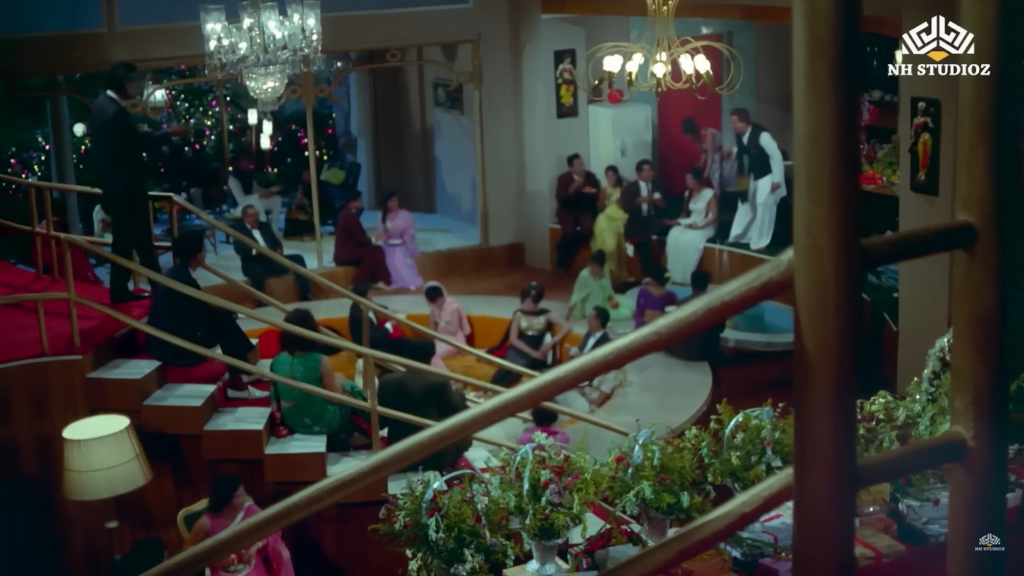
    Movies like Humraaz of 1962, had ahead-of-its-time architecture. Elaborate patio, intricate main gate details, and startling interior spaces: just exquisite high-class rich parameters. They had a sunken living room, and mauve sofa covers; color themed home, which can be seen in many contemporary homes today. Indeed, a bunch of well-off lads must have tried this kind of style in those times and like a cycle, the sunk living room model has popularized itself again. The fun part about design is that once you add something conventionally innovative it catches the onlookers’ attention and a sense of comfort engulfs the user. 
    Bollywood
    ‘Jalsa’ in Movies

    One of the most expensive houses today, Jalsa or the legendary superstar Amitabh Bachchan’s residence probably was the go-to place in the 1970s and 1980s. Due to its dual-colored distinct character, the house was food for the eye. It has a balance of both indoor and outdoor spaces, best suited for close-knit Indian families, making way for the then-emerging nuclear family concept in one of the world’s largest cosmopolitan cities. Scenes from the movies it has been in, always give a peculiar sense of flexible verticality.
    Houses of 90s

    Films like Chupke Chupke (1975), Satte pe Satta (1982), and many other chartbusters were shot in this majestic house, formerly owned by producer N.C Sippy. The two-storeyed house has a quirky garden and grand entrance, where the superstar loves to wave to his fans almost every Sunday. 

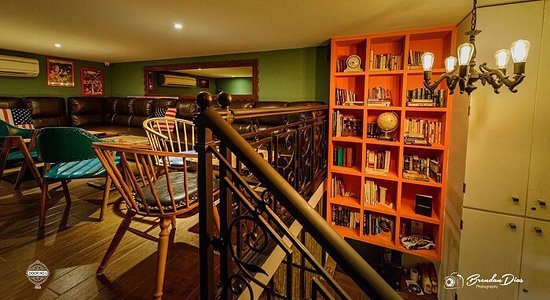
    Another similar scenario could be witnessed in the musical 1990s and the early 2000s comedies, comedy dramas, tragedies, and many other genres that took place in a modest hall of a residence in Madh. The famous Poonawala house is airy and lighted as it seems in movies like Saajan(1991), Deewana (1992), Raju Ban Gaya Gentleman (1992), Andaaz Apna Apna (1994). Wise use of light in scenes according to the scenes had different delivery for fans but the two-way staircases made similar bold statements making it more enjoyable and playful. Other movies from this era like Raju Chacha and King Uncle had a childhood urge of wanting badly to live at least a day here. 

    Sanjay Leela Bhansali’s contributions to Bollywood

    Entering the world of Bollywood and not giving an account of director Sanjay Leela Bhansali’s universe would be unfair. Period dramas with magnificent and esteemed sets are a mix the director has always made the Indian audience love the art of filmmaking even more. Be it the Lal Qila (Red fort) scenes from Jodhaa Akbar (2008), a marvel of the Mughal courtyard palace architecture, or the ghostly Shanivar Vaada of Pune from Bajirao Mastaani (2015), these huge symbols of past kingdoms and empires plays an important role in movies to build up the feel of the time the story might have taken place.

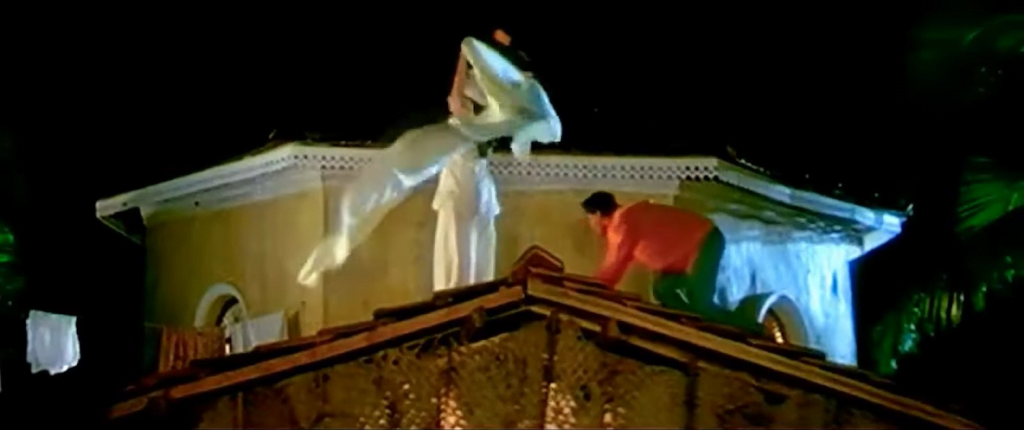
    Nobody can forget the Goan, clay-tile roofed beach house from Khamoshi (1996) nor can one forget the yellow-ochre Afghan Khilji residence from Padmavat (2018). Stories, screenplay, and attire though bring authenticity to Bhansali’s movies, but imagine if none of the above-mentioned films were shot in the exact locations would they have been so intense and worth-a-watch kind? Well, not really, isn’t it?
     Indian film industry

    The Indian film industry has seen its own evolution after much hard work and vigor in the area of special visual effects and computer-generated images. The much-celebrated list of movies is incomplete without the dubbed hindi versions of regional films where a lot of attention is given to making a believable set through virtual reality using tools and techniques. Baahubali(2015 and 2017) had its own Amar Chitra Katha-type of set design. A fictional space that everyone wished was true and visitable.

    Thanks to Sir SS Rajamouli who could gift us a monochrome city of the kingdom Maahishmati. The city felt to be inspired by Harappan civilization with aligned houses and front sitting spaces and staff supporting the roof above. Wide roads and clean settlements along the mother river were cool to watch. Groovy Dravidian temple architecture was placed at places in the palace and the chariot mimicking mandalas took the center stage in the movie. 

    Futuristic homes

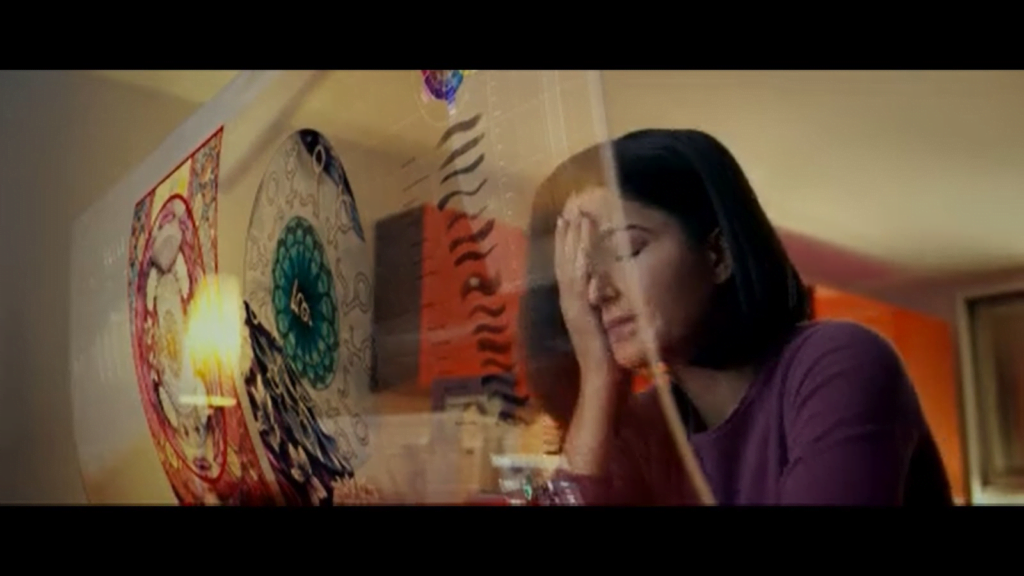
    Talking about modern technology, Nitya Mehra’s Baar baar dekho (2016) was a one-of-its-kind film to have celebrated the concept of futuristic homes, and institutions to administer a family’s future being. The protagonist sleeps at a different place to wake up in some other place in some additional time. It was great to watch but something fascinating was the touchscreen surfaces surrounding the characters every time in the future.

    Sleek furniture and advanced technology used in the houses showed how fast and easy everyone’s life may turn within a few decades. Much like the Back to the Future movie series from Hollywood with noticeable twists.  
    Futuristic homes

    An architect’s house would be visitor tour worthy, isn’t it? Well, it was but not in its actual sense in Piku (2015). The house it was set in was a weighing balance of Piku’s (daughter) and Bhaskar’s (father) personalities. Drawings rolls at one side and medicines at the other, also a subtle corner for the late mother’s remains, a tiny picture paid homage to.

    Matching one’s taste is something all interior designers should focus on like in Dear Zindagi (2016). The main character, Kiara had a photo wall in her very own Mumbai house fitting to her personality, however, her parents’ house in Goa had its own luxury-stricken elements; also her therapist’s consulting room had its library-cum-living area all matching personas of the prime user. 

    Conclusion

    A full package of action, drama, romance, and well-thought-about houses is something the common man expects to watch on the screens of Indian movie theaters. Subtle, comforting, sensible sets for films have become a new trend. Thanks to architecture in its purest and robust form, which made way for new lively spaces apart from other features in movies. 

  • Making a Home in Southeast Asia: Essential Tips and Tricks

    Making a Home in Southeast Asia: Essential Tips and Tricks

    Introduction

    Sandy golden beaches, tropical forests, and perennial rivers with paddy terrains in sultry heat create a satisfying canvas of the great Southeast Asian region. One can easily distinguish as well as picture SEA, consisting of many early civilizations of the world, not only because of the great heritage these treasure but also the culture and rituals instilled in the people of this region.

    Living in Southeast Asia

    We, as people, are carriers of many innovations including art, values, and architecture of course. In a region where stones are worshiped, water is sacred, food is more than just fuel for the body, houses hold a special emotional status for many people here. It’s not just a place to retire at night for a good night’s sleep, but they somehow breathe with the dwellers, inspire families, welcome tired souls happily, and whatnot.

    Be it the Grand Palace of Bangkok or the house on the stilts of Myanmar, the feeling instilled in the person residing is the same. The houses built here are more like static humans. A separate space for stories to recite, to cook fresh aroma, and to change attire all jam-packed in the same old house. 

    Uniqueness can be more recognized when the houses we live in are traditional, raw, and stylized with local materials. A village in South Odisha bordering Andhra Pradesh houses the Bonda tribe majorly. Primarily erected with mud and capped with clay-tile roofs homes in the village of Bhaliapadar have a distinct character. Usually, one room is used as a living area to sleep in, and the other as a kitchen. They do also have ample space for an elevated platform or verandah.

    Upon the verandah wooden staffs stand to support the roof. Although small, they are simple and minimalistic. Even some more evolved tribes like the Santhals and Gandabas in the region have kept the ancient traditions alive, which is evident in their homes. And since all the houses in a locality are similar in size and character, they directly or indirectly shape the identity of the place. Scarlett with a tint of ochre painted on the outer walls of the houses by Santhals along with thin strokes of blue for sheer detailing. 

    Southeast Asia
    Asia homes
    living

    Entirely or largely depending on agriculture as a profession and living it impacts houses in South East Asia highly. For example, in traditional Thai housing, we can witness the bamboo raised floor to avoid floods. They should be able to accommodate both goods and animals. Moreover, different kinds of bamboo, wood, and prefabricated panels were used in Siamese villages. A typical Siamese wooden dwelling has separate rooms organized under a single, huge roof. Before you step into the house, a water jar is kept at the bottom of the steps to wash feet; and all the rooms oversee a central platform. Houses were set to expand for future generations, that is extra rooms for younger ones of the family. 

    traditional Thai  housing

    The social congregation is an essential aspect of life in the island countries of Southeast Asia. Some ethnic groups in Indonesia practice such traditions even now, through their housing systems. For instance, the Karo Batak house is a meeting shelter for the bachelors of the village, who use it as a recreational space. Resembling the basic pyramid structure, the Karo Batak house is thatched with ijuk, and the roofs are decorated with painted interwoven split bamboo. Perhaps, buildings erected by this community are very complex and have highly intricate details. Thus, a few renovated heritage resorts adapted the styles of Karo Batak houses in their cottages. 

    Living in Southeast Asia
    ARCHITECTURE OF SOUTH EAST ASIA

    The sanctity and sacredness of lifestyle can today be clearly seen in villages and countryside areas of nations running towards modern systems. In a book named ‘ARCHITECTURE OF SOUTH EAST ASIA’, there is an independent section dedicated to travelogues written in villages for brief periods. One of those encounters talks about the Burmese villages of Meeryoungyai and Nyaung-U, on the banks of Irrawaddy by R. Talbot Kelly.

    The author along with his companion experienced traveling with the help of coolies, bullock gharries, and ponies to the serene deep woods. To their surprise, women and young girls carried out the loading and unloading of heavyweights to transfer them from one bumpy ride to the other. The houses or dak had typical features: primarily made of bamboo, however many had eng wood principal timbers all raised on four to six feet long piles to protect them from floods, snakes, and malaria.

    Floors weaved out of split bamboo or thatch of elephant grass, or ‘thekke’ or bamboo mats called ‘tayan’. Tayan can serve as walls for modest dwellings, though the walls nearing the streets are usually exposed, displaying the interiors of the house. The domestic arrangements are generally composed of naked young children running and jumping accompanied by pigeons, geese, and poultry underneath the houses. And as dusk hits, the sound of returning bullock gharries and carts meets the sweet aroma of Burmese kitchens. The houses are aligned with each other creating ample roads in between them.

    Although strong roots of beliefs, cultures, traditions, and linguistics of more than three hundred fifty ethnic groups reside here, many fast-paced globalization trends compel her to change and match contemporary architecture standards. Since the early twentieth century, the region has experienced many transformations because of the rapid colonization by Westerners. Powerful influences imposed on natives left a non-perishable marvel of colonized buildings then.

    Streets in old Kolkata have many solid red and white administrative buildings with tall, slender Doric columns. However, if observed closely, westernization has led indigenous construction techniques to take a back seat, and slowly vernacular architecture became sparingly known to even locals, which as a result has deteriorated the climate responsiveness and user-friendliness in our homes. 

    What we shape is given birth by what shapes us. So, the architecture of tomorrow that we need to design needs to receive and learn from the architecture of yesterday. The vernacular architecture of any place is the specific identity of that area. It’s somewhat related to traditional buildings but vernacular architecture is generally an offspring of the easily available local materials. So to respect this kind of knowledge, architects should thrive and try their best to design a worthy product to live in.