
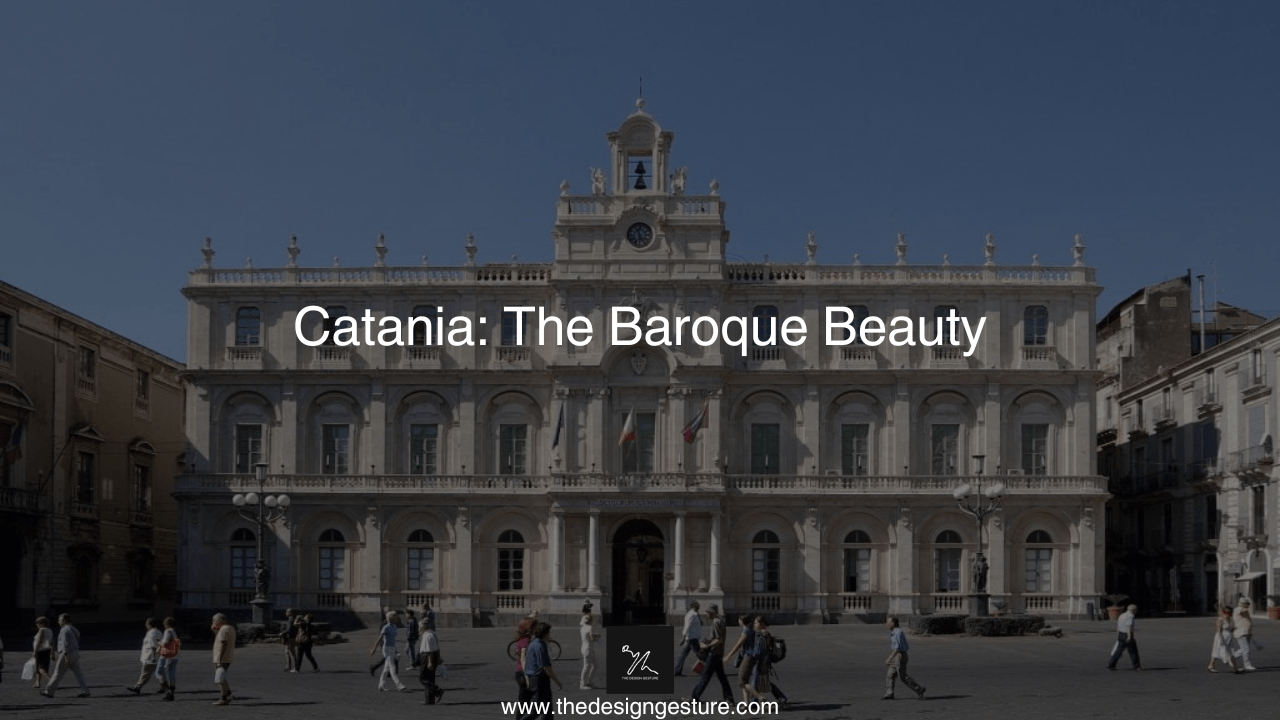
Author: Cyprian Joseph

  • Catania: The Baroque Beauty

    Catania: The Baroque Beauty

    Introduction

    If I told you of a city where the earth breaths fire, your response would be, “Oh no, fairy tales again!” Or even “Are you ever tired of myths?” Of course not, I love fairy tales, I have always loved fairy tales from my preteen days, and I still love them. I guess this is the part of me that’s never growing up. But this time it’s not about a fairy tale, while you might think it’s a scary tale, I prefer to call it a mystery tale. 

    catania sicily

    Volcano under the blue sky

    Welcome to Catania, a city along the eastern shore of Sicily,  where the most famous part has survived intact with Baroque architecture. Much of it has been rebuilt after a catastrophic earthquake in 1693. The historic center has been added to the list of UNESCO World Heritage sites because of the important example of this art: it offers grand buildings, ornate churches, and elaborate public squares. Other landmarks are the Cathedral of Sant’Agata, the Palazzo Biscari, and the always-iconic Piazza del Duomo. All of these speak to the distinctiveness of Catania in proper synergy: history, artistry, and resilience.

    catania football

    Fields near Mt Etna

    Overview of Baroque

    The Baroque period, roughly covering the late 16th century to the early 18th century, is an important period for European art, music, and architecture. It was born in Italy but spread across all of Europe, striking deep into the architectural face of the continent. Exuberance, grandeur, and attention to detail all characterize the Baroque. It developed out of a reaction to the constrained classicism of the Renaissance, urged by an idea to elicit emotion, drama, and a sense of awe. The period is often related to the Counter-Reformation during which the Catholic Church used Baroque art and architecture to help express religious themes directly and emotionally to inspire faith and devotion among the masses.

    catania fc

    Mount Etna overview of the city

    Key Features Of Baroque Architecture

    When Catania, you can’t help but see these most identifying characteristics typical of Baroque architecture, the large-scale projects, and monumentality. The buildings are huge, built to impress, and overwhelming in their size and expense. Dynamic forms characterize the style, which led away from the straight lines and symmetry frequent in Renaissance architecture, using much more curves, spirals, and complex shapes. Excess is also a decoristic element that explains the style, for it is full of lavish ornamentation with sculptures, frescoes, and gilding in the structures to produce drama and grandeur. These features are dominant in the Palazzo Biscari, Catania.

    Influence On European Architecture

    The Baroque European architecture in each area differed in using this new style. Italy was the country to see the first and most typical examples of this trend since it was the homeland of this new trend. Major architects such as Gian Lorenzo Bernini and Francesco Borromini became prominent people in this movement.

    catania airport

    History Of Catania: Dante University

    Among its iconic representations is the St. Peter Basilica at Vatican City, rich in grandiosity. In France, it evolved into a subtler and more classical form known as the Baroque Classicism or French Baroque. The best example is the Palace of Versailles. Where, Baroque’s monumental vision was to be tempered by symmetry and orderliness of the classical architecture, though it retained its lavishness and decorative richness.

    Historical Background of Catania

    Ancient Roots: 

    Catania, a port city of huge importance on the eastern coasts of Sicily, has been influenced by a changing history dating back thousands of years. Founded by the Chalcidian Greek colonizers from Naxos around 729 BC, these colonizers built Catania into a successful city-state because of its proximity to the sea and the fertility of its land enriched with the volcanic soil coming from Mount Etna.

    The earthquake increased historical importance for Catania Italy and other European cities and influenced architectural-urbanistic development. This real disaster occurred in 1693 and heavily impacted most parts of the city. A considerable amount of destruction and the loss of people’s lives took place. The massive reconstruction of this Baroque beauty (Catania) followed devastation and provided a once-in-a-lifetime opportunity to redesign with a unified architectural vision.
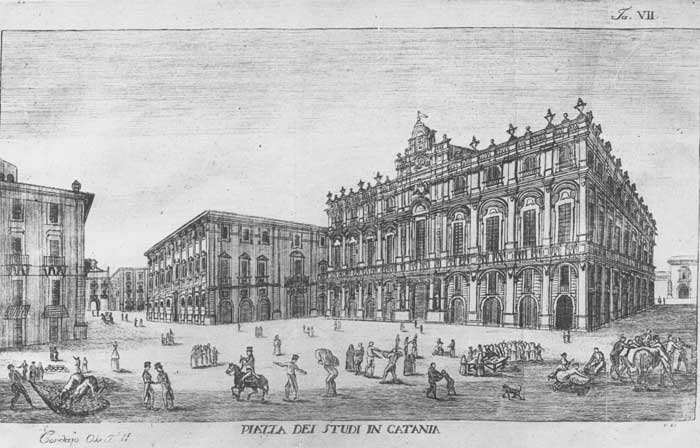
    catania italy

    History: University Of Catania

    These guiding principles of the reconstruction were in tune with the Baroque ideas that prevailed then. It was taken for granted that grandeur, dramatic contrasts, and great detail were to demonstrate the power and resilience of the city and its inhabitants. All those things mingled in the Baroque idea of grandeur: wide and straight streets, such as Via Etnea; large squares, “all’aperto”; important and impressive buildings.

    Restoration Of Key Structures

    Key structures such as the Cathedral of Sant’Agata and the Palazzo Biscari were restored and built anew in the Baroque style, with landside facades between stones of black lava—all typical of stucco decorations.  The balconies usually feature black and white decorations. Baroque in Catania Italy meant this kind of architecture, which gave back not only life but a certain Baroque character to the city and subsequently sustained it: that one thing it housed that continues to define Catania today.

    It was a destructive event, but the earthquake was the ultimate means that resulted in its transformation into one of the most architecturally important Baroque towns in Italy. Greek Period 729 BC – 476 BC The Greeks from Naxos founded Catania as “Katane” and the nearby colony. Soon after, Catania became a commercially huge city due to its access to the Ionian Sea and the fertile plains around it suitable for agriculture and particularly grain-growing.

    During the period of the Sicilian Wars, Catania was highly involved in the struggles between Greeks and indigenous Sicels, then in the broader Sicilian Wars pitting Greek city-states against each other and Carthage. During these periods, Catania changed allegiances many times and passed from ruler to ruler.

    Rebirth in Baroque

    After the disastrous earthquake in 1693, Catania underwent a dramatic change and emerged as one of the most outstanding examples of Baroque urbanism. While reconstructing the city, special care was taken to reflect all the glory and order of Baroque architecture. Wide, straight streets replaced the narrow, winding alleys of the previous city, thereby making the city both orderly and magnificent.

    Grand squares and monumental buildings were created, emphasizing symmetry and perspective. Architects used local materials that created dramatic contrasts within the city’s buildings: black lava stone from Etna and white limestone. Buildings like the Cathedral of Sant’Agata and Palazzo Biscari, an architectural style with intricate details, elaborate facades, and ornate balconies express the Baroque spirit of Catania. 

    Key Baroque Architectural Landmarks in Catania

    Catania Cathedral (Cattedrale di Sant’Agata)

    university of catania

    Catania Cathedral

    The church also known as Cattedrale di Sant’Agata, has gone through a stormy history,  was destroyed several times by earthquakes, and rebuilt again. The initial church was built around 1086 in the ruins of the Roman-era Achilliane Baths. On February 4, 1169, through an earthquake, the entire roof of the church fell intact, killing hundreds of people who had gathered there, commemorating an annual procession.

    The building was heavily damaged by fire in 1194 when Henry VI took control. In 1693, the Val di Noto disaster earthquake nearly demolished the Cathedral, with only the apse and facade proving to be parts left standing. The bell tower was also brought down. In the 18th century, the church was rebuilt. Most of the actual building in effect, dates from after the disaster.

    The interior was by architect Girolamo Palazzotto, and the facade was by Giovanni Battista Vaccarini, built between 1734 and 1761. In 1857 the construction of the bell tower was finished and the present configuration of the courtyard appeared in the 19th century.

    Architecture

    The Cathedral of Catania represents a Baroque church with a three-order façade of the Corinthian style. The first order is made of six granite columns, ancient in origin, surmounted by the coat of arms of the noble Galletti family. The second order also contains six columns, divided into two smaller lateral ones by the great central window.

    The orders are also ornamented with marble statues of Saint Agatha in the middle and above the main door, a right monument to Saint Euplius, and a left one to Saint Birillus. The wooden front door of this Catania Cathedral has thirty-two well-carved panels portraying different portraits and scenes. On each side of the central door stand marble statues of Saint Peter and Saint Paul. The church dome is from 1802, constructed on a Carmelo Battaglia project.

    The dome has columns and large windows that light up the inside. During 1867 and 1869 architect Carmelo Sciuto Patti built the actual bell tower and the dome lantern. On the other hand, it goes on to have a Latin cross plan, with a nave and two aisles. The apse belongs to the 12th against a restored building.

    Palazzo Biscari:

    catania sicily weather

    The exterior of Palazzo Biscari

    The History Of The Biscari Palace.

    The Palazzo Biscari, the residence of the Paternò Castello family, Princes of Biscari, represents not only a very eloquent example of the 18th century but also one of the most important and known ones together with the Monastery of San Nicolò l’Arena among Catania’s examples. It stands on a part of the sixteenth-century walls of the city, on which, right at the end of the earthquake of 1693, Ignazio Paternò Castello III, Prince of Biscari, obtained permission to build the Palazzo from Lieutenant General Giuseppe Lanza, Duke of Camastra, who was in charge of Catania’s reconstruction by order of the Spanish King Charles II. 

    catania italy weather

    Courtyard  of Palazzo Biscari

    The son of this king of Spain, Vincenzo IV, Prince of Biscari, who continued this work from 1685 to 1749, and his grandson, Ignazio V, did so to the end from 1714 to 1786. A great scholar, archaeologist, and lover of the arts, he played a big role in Catania’s cultural life during the eighteenth century. One of Ignazio V’s dedications in ample spaces within the Palazzo was the establishment of an archaeological, numismatic, and natural history museum open to all interested scholars.

    Description of its interior

    catania hotels

    Interior view of the Biscari Palace

    Abundance, Prosperity, Fertility, and Wisdom are the themes developed in the allegorical groups of decorations that adorn Palazzo Biscari’s exterior and most sumptuous façade facing the sea. Started in 1707, it lies over the sixteenth-century walls made by Charles V and is the entrance point of the city for those coming by sea.

    The view is amazing: the white Syracuse stone balconies and pilasters contrast with the black lava base; they are all covered with flowers, cherubs, fauns, and sculptures of telamons. The rear-facing marina has seven huge colored windows with exquisitely worked sculptures and other ornaments, all in the style of the Sicilian Baroque.
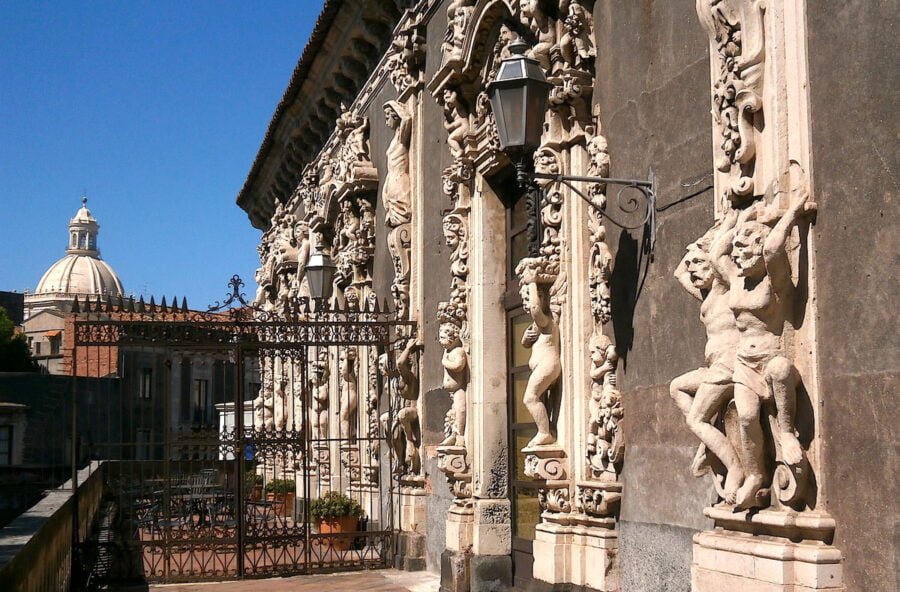
    catania sicily

    Baroque Catania

    It is so sumptuous that by comparison, the entrance facade with the sumptuousness seems austere! The front of Via Museo Biscari doesn’t possess a single holding feature unless it is the great doorway, the largest, and one of the most beautiful in Catania. It began in the early decades of the eighteenth century and reveals fully the genealogical banner of Prince Vincenzo IV.

    The guest passes through this doorway into a broad courtyard, at one time out with grouped trees and parterres and bearing pergolas aloft, though today it is unfortunately empty. A good gateway provides entry to a superb dog-legged staircase, which ascends to the great hall, one entire wall is covered with paintings representing the feudal possessions of the Biscari in Catania.

    The Orchestral Ballroom

    The Red Room, with its paintings depicting members of the Biscari family, gives access to the Salone dell’Orchestra—a fine example of Rococo style, made according to the Neapolitan way. Over the doors in the ballroom are paintings of Naples and the countryside; on the ceiling, a fresco of the Council of the Gods celebrates the family’s glory. The vault above opens onto a balcony where musicians play. In the plan, mirrors and a Neapolitan ceramic floor provide an elaborate setting, with stucco decorations symbolically linked to fire. In the ceiling fresco, there is an image of Vulcan.

    Piazza del Duomo:

    catania football

    Piazza del Dumo overlooking the cathedral’s facade

    Located in the heart of Catania, this UNESCO World Heritage Site has one notable feature that sets it apart from many others: the dramatic contrast between the city’s lava and limestone color buildings in its unique local baroque style. Dominating all is the grand Cattedrale di Sant’Agata. At the center of the piazza is the Fontana dell’Elefante (1736), with its charming Roman black-lava elephant, surmounted with an unlikely Egyptian obelisk.

    The most noticeable feature is the Fontana dell’Amenano, the southwestern corner, which designates entry to Catania’s fish market. Local myth holds that the elephant was originally the pet of 8th-century magician Eliodorus, known to have been able to place humans in animal bodies. And the obelisk is said to have powers to appease the local volcano, Mt. Etna.

    The Fontana dell’Amenano, dated to the 19th century, was made by the Neapolitan sculptor Tito Angelini; this lively fountain remembers the Amenano River, which once ran over the earth and along whose banks it is said that the Greeks founded the city of Catania, originally called Katáne.

    San Nicolò l’Arena

    catania airport

    Unfinished facade of San Nicolò l’Arena

    San Nicolò l’Arena is the monumental Benedictine monastery in Catania, Sicily,  among the biggest in Europe. Founded in 1558, it combines late Renaissance and Baroque styles, which means, it shows the hallmarks of a long history of construction and subsequent reconstructions, particularly after the disastrous earthquake of 1693. It comprises a grand church with an unfinished facade, expansive cloisters, and impressive gardens. Presently, this place hosts the Department of Humanities of the University of Catania and is usually considered a symbol of cultural and architectural heritage in this city.

    Teatro Massimo Bellini:

    catania fc

    Interior of the Teatro Massimo Bellini

    Located on the Sicilian shores in Catania, Teatro Massimo Bellini is a fine opera house named after the Catania-born famous composer Vincenzo Bellini. Founded in 1890, the theater became a gem of the Baroque Revival architecture with frescoes and gilding, covered interior, plush red upholstery; unique acoustics adorn the main hall and hence ideal for operatic events. Teatro Massimo Bellini thus assumes the role of a cultural monument, narrating not just Catania’s deep bond with music and art but classical music. 

    The Influence of Baroque Architecture on Catania’s Urban Landscape

    Street Layouts and Squares:

    Street Plans and Public Spaces: Catania’s Baroque architecture played great roles in the urban landscape, particularly in the designs of streets and squares. One important street is Via Etnea, which runs along a direct line to Mount Etna—an example of order and grandeur espoused by the Baroque in urban planning. Harmony with Nature: Catania’s architecture has blended magnificently with its natural environment, especially through the broad use of local lava stone in building materials, which easily merges the city’s structures with the volcanic landscape.

    Cultural Significance and Legacy of Baroque Architecture in Catania:

    Baroque as a Symbol of Power and Faith

    Role of the Church and Nobility: In Catania, Baroque architecture served as an important expression of the influence of the Catholic Church and the status of the local nobility. The two promoted the style intensively to show their power and devotion. Long-lasting Heritage: Baroque architecture has influenced the very soul of Catania, leaving an indelible stamp on its character. Preservation and restoration works are fundamental to the continuity of these architectural assets, so they will continue to define the historic and cultural landscape of the city.

    Conclusion

    It is rightly called the “Baroque Beauty of Europe.” Catania is one of those cities that allures visitors with its architectural heritage, steeped in Baroque origins. A strong history, sculpted by volcanic eruptions and subsequent reconstruction, has given this city an eclectic mix of grandeur and resilience.

    This city is, therefore, a must for all travellers who want to get a taste of the magnificence of Sicilian Baroque; Catania is a statement of its artistic and cultural importance through ornate churches, palaces, and squares. It becomes easy for travellers as Catania airport is one of a kind airport in Italy. Catania airport has railway station connected to it from terminal A and C.

    Its preserved beauty and lively atmosphere continuously enchant visitors with timeless charm. So if you ever heard or read about someone talking about a dragon breathing fire somewhere, just pay attention and find out where exactly it is, you might just be in the process of discovering another mystery story, a new breathing earth in Catania or might even be returning me the favor of having told you a mystery tale. So would you go explore this Southern part of Italy firsthand or are you waiting for me to another piece of secondhand info?

  • 10 Best Architecture Firms in Chennai India

    10 Best Architecture Firms in Chennai India

    Introduction

    Chennai is an interesting blend of the old and the new, hence, it is  “Detroit of India.” The capital of Tamil Nadu, Chennai is a metropolis that combines serene architectural heritage with industrial progress giving a rich mosaic of diversity and vibrancy. This nickname was given to Chennai because it has the most car manufacturing units in India. It’s not just this type of industrial area that has modern architecture such as concrete design which is efficient both in aesthetics and usage.

    The top architecture firms in Chennai must be known because Schools and universities frequently use projects from leading firms as case studies, providing real-world examples of design challenges and solutions. Leading firms often engage in public discourse on urban planning, sustainability, and architectural ethics, influencing policy and public opinion. For clients, being aware of the top firms helps them to make informed decisions that differentiate their projects in the market, potentially adding significant value to investments. 

    Ensuring this list represents these firms’ positions fairly was an uphill task due to the limited information obtained about most of these firms.  Notwithstanding, the following criteria were used to determine the position of these top architectural firms in Chennai, Tamil Nadu. The confirmation from other articles sites on excellence in providing services by these firms, the number of awards received, the number of confirmed Google reviews about the services of these firms, Projects completed and recognized by the public, and of course the firms’s reputation from their view and that of the public.

    Ansari Architect- Best Architecture Firms in Chennai

    Ansari Architects is a leading architectural firm in Chennai driven by a strong belief in innovative and sustainable design solution provision. The firm has established a name in residential, commercial, and institutional projects for providing outstanding service concerning creating spaces that interact with functionalities and aesthetics.

    Their design philosophy is a harmonious union of modern technology and traditional concepts about architecture to devise structures that will not only be visually appealing but also turn out friendly to the environment. Ansari Architects offers an incredible platform in terms of delivery: personalized and context-sensitive design to meet the specific needs of the clients enhancing the built environment.

    History

    The firm was founded in 1996 by the visionary architect Dameem Ansari.

    He obtained his architecture degree with distinction from the School of Architecture and Planning at Anna University, Guindy in 1994. He was inspired by the unique style of architects that he met during his initial consultancy. The experience he gained in his early years of practice through exposure to such architects was a major factor in developing his style and that has made his firm top the list of architectural firms in Chennai. 

    Notable Projects

    House of Voids

    It is one of the architectural firm’s prominent works, located in the KK Nagar region of South Tamil Nadu, on a plot area of 3750 sq ft designed in 2019 for a client named: Mr Ranjit.  It has a built-up area of 7516 sq ft.  They call it the introvert house for a purpose. Elements of nature are incorporated inside the interior space of the building so that the resident wouldn’t need to go outside their home to get the feel of nature. 

    Architecture Firms in Chennai
    Contemporary house in India with a striking wooden facade and bright white walls, merging elegance with modern architecture.

    Adyar Ananda Bhavan

    Located in Karaikal, an Indian Union Territory of Puducherry, this project was designed for Mubarak in 2004. It is a 6000 square foot built-up space. The main idea behind the design consisted of merging two houses into one – each with a sitting room, guestroom, master bedroom, children’s bedroom, store and Kitchen cum pantry, dining room, 2 bedrooms, and utility area – both houses sharing a common circular courtyard with water pond. The most fascinating thing about this design is the beautiful landscape enhanced by falling water. The use of such remarkable features made the company outstanding compared to other architectural firms in Chennai.

    Awards and Recognitions

    Ansari Architects has received several awards for its participation in giving the architecture of Chennai a lift. Some of these awards are The BEST HOUSES Chennai Region 2013. This award was presented by DALMIA CEMENTS & VIJAY TV,   to ‘The House of Boxes’ in KK Nagar, Chennai. This prestigious architectural firm in the region of Chenna also received the same award in 2011, it was presented to  “House of Colors” in Palawakkam, ECR. In 2014 the CEO received the  AAB Best Achievers of the Year 2014. Award

    Dwellion Architects- Best Architecture Firms in Chennai

    Dwellion has been known as one of the best architecture firms in Chennai. Consistently amazing the residents, Dwellion’s strategy relies on the use of simple design elements along with elegance to make them look modern and classic at the same time. Therefore, those constructed homes are easily enriched with a visual charm that reflects a practical way of living. The award-winning architectural firm in Chennai is constantly discovering creative relations and connecting design with the more scientific part of it like geometry to shove a client’s aspirations into a properly organized and physical thing.

    Notable Projects

    The courtyard House 

    From the beginning, the design approach aimed to harmoniously integrate contemporary aesthetics with traditional features, such as incorporating classic elements into the house. It was focused on blending the old with the new, using prominent conventional building techniques. This fusion of time-honored methods with modern design principles created a residence that showcases architectural creativity.

    A standout feature of The Courtyard House  “Mottram” (courtyard in Tamil), thoughtfully designed as a space for family gatherings. Understanding the family’s dynamics, an area envisioned that promotes connectivity and provides a seamless transition between indoor and outdoor living. An innovative automated system for closing windows and doors was implemented, offering convenience and peace of mind for the inhabitant.

    A contemporary house featuring wooden gates and lush trees, showcasing a blend of nature and modern architecture.
    A contemporary house featuring wooden gates and lush trees, showcasing a blend of nature and modern architecture.

    Awards and Recognition

    He was awarded the fourth Global Business Leadership Award – “The Best Architect of the Year, Chennai” at New Delhi in 2018 beating all other architectural firms situated in Chennai. The firm was honored with the “Top Architecture Firm Award, Chennai” from the Award for Excellence in Elementary Education 2018. It also bagged the “Top Architecture Firm Award, Chennai” in 2018 presented by the Architecture and Interior Design Excellence Awards. Also Won “The Best Luxury Interior Designers” listed by the Indian Business Awards in 2016

    OCI Architects- Top Architecture Firms in Chennai

    Renowned for its international projects and numerous awards received. Oci Architects is notably a top architectural firm in Chennai. Architect Dr. Oscar G. Concessao and Architect Dr. Ponni M. Concessao, a married couple, both graduated with a B.Arch Degree from the Regional Engineering College, which is now known as the National Institute of Technology, Tiruchirapalli, in 1986 and 1987. Following their graduation in India, Dr. Oscar G. Concessao pursued a Master’s degree in Architecture in Urban Design at the University of Oklahoma in the USA in 1987, thanks to a scholarship he received. Dr. Ponni M. Concessao also traveled to the USA with a Tata scholarship and obtained her Master’s in Architecture from Cornell University in 1989. 

    At Harvard University Dr. Oscar G. Concessao and Ponni M. Concessao completed their career-changing professional studies on advanced studies. The University of Malaysia and Universita of Milano conferred Honorary Doctorates in Modern Architecture and Architectural Science to Dr. Oscar G. Concessao and Dr. Ponni M. Concessao respectively.

    While working together as partners in various projects involving leading architects who specialized on skyscrapers, institutional buildings hotels, hospitals, and stadiums they resided in New York City for some time before moving back home where they started an architecture firm that became one of the top ten within the region due to certain notable works such as: Telangana Secretaries Hyderabad; Subregional Science Centre Rajhaymundry; Kalaignar Dr. M. Karunanhidi Museum Thiruvarur.

     A stunning view of the Telangana State Secretariat from the Necklace Road
     A stunning view of the Telangana State Secretariat from the Necklace Road

    Awards and Achievements

    Awards and achievements received by this top architecture firm in Chennai are so many that it would require an entire article to mention them. The firm received the Architecture And Interior Design Excellence Award 2020, Awards From The Indian Buildings Congress For Institutional And Hospitality Projects from Shri Hardeep Singh Puri, Hon’ble Minister Of Housing, Urban Affairs And Civil Aviation At Vigyan Bhawan, New Delhi, Architect Dr. Ponni M. Concessao Received The International Inspirational Women Awards 2020 From Dr.D.S.Chauhan, President, of the Association Of Indian Universities, at Noida, the Architecture And Interior Design Of Excellence 2019, the 

    Bic Award 2019, the Design Dialogues Award 2019 Mumbai.

    DLEA – Top Architecture Firms in Chennai

    DLEA means Design Lab for Experimenting Architecture,  is a multidisciplinary Architectural design firm based in Chennai, that designs spaces, interior design, master planning, and graphic design. The principal architect:  Ar. G.Dhayananth is a graduate of Ana University Chennai. The practice comprises experienced architects, civil engineers, structural engineers, landscape consultants, MEP consultants, and lighting consultants specializing in residential, commercial, and institutional projects. This team of experienced people helps the firm handle any scale and type of the project according to the client.

    Notable Projects

    Susendran Residence is one of the firm’s prominent works, located at Mugalivakkam in Chennai, in the Sriperumbudur taluk of Kanchipuram district in Tamil Nadu. It’s a house design project for the client: Susendran hence the name Susendran’s Residence. The three-story building has red facades that fit well with the bricks used in making it. The living room, dining area, master bedroom, and toilet are the main rooms on the first floor. The good blend of colors and the professional crafting of the interior spaces make the firm known as one of the top architecture firms in Chennai.

    A building featuring a red brick facade, exemplifying a timeless architectural style with a warm and inviting look.
    A building featuring a red brick facade, exemplifying a timeless architectural style with a warm and inviting look.

    Awards and Recognition

    It is necessary to point out that Ar.G.Dhayananth, the Principal Architect of DLEA was selected as one of the prominent architects & interior design awardees of India 2017 and as one of the “best architects in Chennai’’ for his/her use of this company which is a pioneer in this field besides being reputed for marketing research called ‘Merit Awards and Market Research (MAMR)’.

    On 24th March 2023, D.L.E.A was recognized by Construction World among its recipients of ‘Construction World – Stalwarts of the South, Chennai’ during the CW Design-Build Conclave” at Taj Vivanta in Chennai. Global Business Reconnect decided upon D.L.E.A for the distinguished Architect’s WOW Awards at The Architecture Reconnect Summit that took place on September 16th, 2022 at The Taj Wellington Mews, Chennai.

    Midori Architects- Best Architecture Firms in Chennai

    Midori Architects is a national and international award-winning firm established in 2015 under the leadership of Suraksha Acharya, a cognitive member of the sustainable architecture field in India. It’s a young team of new-age designers, planners, thinkers, and consultants from Chennai who create everlasting structures through innovative form, modern flow, and versatile function. The firm is a process-driven architectural firm in Chennai, with an uncompromising sustainable approach towards every venture taken up so far. The firm delivers quality urban space by offering clients integrated, efficient, and forward-looking solutions for the future of our projects. Using advanced technologies and simulation techniques that simplify environmental complexities,  clients can engage in a creative process leading to a much larger sustainable solution.

    History

    Suraksha Acharya, the chief designer, has been leading the way in incorporating eco-friendly techniques into contemporary architecture, highlighting the significance of visually appealing and environmentally friendly. Since starting, Mādori Architects has become known for its creative method, fusing conventional architectural concepts with modern solutions to produce distinct and environmentally friendly designs. Under the guidance of Suraksha Acharya, the company has finished numerous projects demonstrating its dedication to sustainability, such as residential, commercial, and institutional buildings gaining recognition as one of the top ten architecture firms in Chennai.

    Notable Works

    Villas By The Bay (Contemporary Living by Ocean)

    It’s a villa design for the client named: Chaitanya Builders, on a plot area of 409 m2

    located in a gated community on the coastal stretch leading into the Bay of Bengal, this beach villa combines style, comfort, and privacy. The design integrates an infinity pool on the terrace with extensive glass walls and windows, offering clear views of the Bay from every room. The villa allows residents to adjust their level of privacy with blinds that can be controlled easily. The interiors are primarily neutral, with wooden elements adding warmth and texture.

    Aeon House 

    This project is one of the prominent works of the architectural firm in Santhome, Chennai, on a plot area of 1650 sqm for the client: Varun Acharya. This distinctive and contemporary home exemplifies the fusion of modern design with sustainability and functionality. Created in response to environmental considerations, it is poised to achieve the pioneering Zero Carbon & LEED Platinum Certification while offering luxurious comfort and energy efficiency. Featuring corridors that wrap around courtyards, linking private spaces with rooms that have double-height glass walls, this home exudes understated elegance and intelligent design. The courtyards, curves, and inclinations are carefully crafted to maximize self-shading, sunlight, and ventilation, resulting in a modern aesthetic further enhanced by a wooden exterior.

    Awards and recognitions

    Participated in an architectural competition called Skyhive Skyscraper Challenge, and won 1st place (United States). Also, the firm has received the A’Design Award & Competition, Silver Winners (Italy). This top architectural firm’s selling point involves working together and combining efforts to conserve resources and attain energy self-sufficiency. Our designers, ecologists, sustainability specialists, and engineers work together to develop environmentally friendly terms of resource usage, ecological effects, and impact on the local economy and culture. We provide unique certification for green buildings on all our projects and certify buildings for consultants worldwide. It also provides consulting services through its expert sustainability team.

    MTA Architects- Architecture Firms in Chennai

    Principal Architects Ar. B. Ramesh and Ar. D. Uma Shankar

    MTA originated from a strong desire to design unique and cutting-edge environments that improve the quality and visual appeal of people’s lives. MTA was established in 2001 with locations in Chennai, Tirupur, Bengaluru, and Hyderabad. The team consists of skilled experts with the knowledge and techniques to help you reach your goals. This top architectural firm in Chennai recognizes each client’s requirements and collaborates to develop breathtaking solutions. The happiness and satisfaction of its clients are a priority because they are their most valuable assets.

    Notable Works

    Bancasella

    It’s an office interior design project located at Perungudi Chennai, with a project area of 0.75 acres it was completed in 2018. The goal of the design was to maintain the space’s advantage, enhance its visual perception, establish an information commons, and encourage continuous sharing. A completely see-through office offers a sensory experience in a shared space. An interactive environment is set up that combines physical space with technology to aid individuals in brainstorming fresh ideas and progressing with them.

    Awards and Recognition

     Was awarded “Best Architectural Firm in South India” India’s Most Prominent Architect and Design Award 2016 presented by Merit Award and Marketing Research (MAMR). The firm was honored to publish its work in “Architectural Footprints”. This was conducted by India’s Institute of Architects “Tamil Nadu Chapter” The firm also received good remarks from important figures like the Director of CDM Smith: Karthikeyan Deventhran, Shriram Properties & Infrastructure Pvt LTD, the chairman of Sify: Prasan Vidhya Mandir among others within the region for their outstanding services

    Unique Selling point

    At MTA, there’s a commitment to the community and promoting positive relationships. Therefore, strategies consisting of three levels of corporate social responsibility are implemented: economic, ecological, and social sustainability, to create a brighter future. That is to advocate for architecture as a social issue by utilizing design to bolster and uplift communities. To advance this ideal, they have performed many tasks for free. Unpaid projects include a cemetery in Coimbatore, another in Tirupur, a school block for Vanshi Manthan Vidhyashram, and so on. Additionally, staff members are urged to volunteer in established aid groups.

    Ceebros Design Works 

    CDW, one of the top architecture firms in Chennai, India, is a design practice that works across various disciplines. Established in 2013, the company is known for its skill in combining modern influences with traditional values. The company’s collection ranges from big commercial projects to personal home design and accommodation, covering every part of the project such as choosing materials, creating custom furniture, and finding sources. CDW prioritizes establishing a functional connection between nature and the built environment, emphasizing the importance of promoting a certain way of life while being mindful of the environment and how it interacts with the spaces around it.

     An interior space showcasing polished wooden floors complemented by a large, ornate chandelier above.
     An interior space showcasing polished wooden floors complemented by a large, ornate chandelier above.

    Notable Works

    An interior design project for a hotel located at Raintree Street, St Mary’s Road. The hotel’s interior was made to complement the reflective feel of the marble interior walls.

    CDW is known for its rare capacity to merge the avowed ideals of modern influences with heritage. Their portfolio ranges from large-scale developments to private residences and hospitality spaces. The distinction is carried on in every project with the material selection and custom furniture design and sourcing, creating functional interfaces where nature and the built environment coexist. Another notable work of this top architectural firm is the Experience Centre, Chennai. It involves the design of the Architecture, Landscape, and interior workspace among others.

    P8 Architects- Best Architecture Firms in Chennai

    P8 Architects is a respected design company that offers architectural and interior design services for various sectors including residential, commercial, hospitality, and healthcare. The distinguished P8 team collaborates with innovative minds to produce architectural adventures that prioritize clients and showcase excellence in every project. P8 is dedicated to meeting clients’ needs and demands without sacrificing design, standards, or service quality. Its notable works include the Commercial complex, Anjali Tower, located at Vettuvankeni on a plot size of 4200 sq ft. in the year 2024

    Agraharam Veedu, a project for a client named: Mr Raghu Snakaran, located in Thulasecdrapulam, on a plot size of 4000 sq. ft. The project was done in 2023. The firm handled the architectural design and interior design. The Agraharam Veedu was recreated with care by integrating pieces that were salvaged such as old stone and wooden pillars as well as heavy rafters, thereby creating a space that honors our traditions while accommodating modern necessities. This project shows that this architectural firm in Chennai respects traditional designs thereby preserving heritage through innovation

    Amer and Ani Architects- Architecture Firms in Chennai

    Amer & Ani Architects, ranked the top 8  Architecture firm in Chennai, is a structural, and Interior design firm based in Tamil Nadu, India since its inception in 2009. The firm has completed projects, including luxury villas, multistory residential buildings, and commercial and hospitality spaces. Amerani’s approach is to remove and manage elements and maintain the basic simplicity of areas. No matter how big or small, every project is treated with utmost detailing and artistic awareness of the short life in light, space, and form. Charting a course for the user through a unique setting; and defining graceful spaces that inspire, invigorate, and delight the senses–this is the objective of Amerani architects.

    Tamil Nadu Agricultural Export Facilitation Centre
    Tamil Nadu Agricultural Export Facilitation Centre

    Notable Project

    This top architectural firm is recognized as one of the top firms because of its project, the Tamil Nadu Agricultural Export Facilitation Centre, a project on a plot size with an area of 60,000 sq ft., located in Guindy, Chennai. The client of this project was the Tamil Nadu Govt. Another project by this prestigious firm is the Casagrand Esquire. A project covering 68,000 sq. ft, located in Perungudi, Chennai. The firm has completed projects for recognized organizations within the region like Casa Grande,  Chaitanya, Kauvery Hospital, Basshyaam, Dac promoters, Concordia, Lifestyle Housing, Radiance Realty, Voora, Urban Tree, and Akshaya among others

    Studio 7 Architects- Best Architecture Firms in Chennai

    Studio7 Architects has completed over 400 projects of different sizes, scales, and values ranging from 5 Lakhs to 500 Crores. It’s a top architectural firm in Chennai that oversees every project from start to finish with the exact Cost, Quality, and time required by our clients. Its Portfolio includes Residential Projects, Commercial, Industrial, Infrastructure, and Institutional projects. It has a diverse portfolio and the team can help with Design, Project Management, Cost Control, Legal Advisory, Financial Project Planning, Environmental Management, Marketing, and liaison needs. Studio 7 Architects has been engaged in numerous esteemed projects within the Retail and Commercial sectors. Some include Seven Stories in Colombo, Asokan Jewellers, Jeyachandran Textiles, and Hotel Le Temps in Trichy. 

    Conclusion

    Chennai’s architecture is indeed diverse. Different people have put certain endings that match the urban setting of Chennai. We have discussed the ten top architecture firms in Chennai owing to their interior designs and other things that combine modernity with the local culture. They deliver both innovative interiors and timeless exteriors in their designs.

    You can easily integrate these designs if you want a modern approach or need something from centuries ago. These architecture firms in Chennai will always be a reference point for those looking for such end products in the contemporary market. Therefore, the essence of individuality is expressed through change over time in the lives of these architects as they lead a dynamic city like Chennai into the future it deserves.

  • 13+ Amazing Facts about Architecture Of The Amalfi Coast

    13+ Amazing Facts about Architecture Of The Amalfi Coast

    Introduction

    The South of Italy has its beauty; unrivaled, this region will leave you picking your jaws from the floor again and again as long as you don’t stop staring. Stretching along the Sorrentine Peninsula in the region of Campania lies one of the most beautiful coastlines in the world—the Amalfi.

    It stretches along the Tyrrhenian Sea for almost 50 km, from the westernmost town of Positano to the easternmost one of Vietri sul Mare. The famous sweetheart of dramatic cliffs, charming villages, and breathtaking views of the Mediterranean landscapes.

    The coastal town of Amalfi in Italy, featuring its beautiful shoreline and colorful buildings against a backdrop of blue waters.

    Picturesque view Amalfi

    Now I understand why UNESCO was crazy about making it a world heritage. Would you blame them? Not! When the Amalfi Coast is mentioned, attention is drawn to one place. But that isnt the case. Thirteen towns make up the Amalfi Coast: Ravello Atrani Minori Maiori Cetara Praiano Furore Conca dei Marini Tramonti Scala Vietri sul Mare Positano and Amalfi. Each of these towns is diverse in characteristics just as each is endowed to blow your mind away.

    Purpose Of This Article

    This article presents the architectural heritage located along the Amalfi Coast, to enrich readers with the understanding of historical, cultural, and geographical factors that have determined the distinctly regional nature of architecture within the region.  It marks the junction of natural landscapes and human ingenuity in surveying how local materials, Mediterranean influences, and the region’s rich history in seafaring have contributed to its iconic structures.

    Lots of people visit Italy many times a year yet have never bothered to explore what the Southern part of Italy has to offer. This article aims to stir the curiosity to explore the hidden gem in this part of the globe.

    Amalfi Coast italy Amalfi Coast, Italy hotels  Amalfi Coast towns

    Amalfi Coast Italy

    Historical context

    A strong maritime republic the Amalfi Coast flourished during the Middle Ages. It was one of the important trade and navigational centers in the Mediterranean and encoded some of the most significant maritime laws. Much of its cultural identity has been imprinted by Byzantium and Rome, mainly apparent in its architecture and artwork, some of which is replicated in that of the Amalfi Cathedral. These days, it is one of the popular places due to its strong historical background and natural beauty that attracts many tourists.

    Amalfi Coast font southern italy amalfi coast  amalfi coast italy positano

    Amalfi Coast font

    The Key Architectural Style

    The architecture of the Amalfi Coast is truly a potpourri of different Mediterranean influences that forged this region. So, it is dominated by the Mediterranean type with whitewashed buildings, flat or very low-pitched roofs covered with terracotta tiles, arched windows, and doors. It often blended with nature itself due to bright tile works.

    In the ornate decorations, sumptuous facades, and intricate stucco ornamentation of the churches, there are historical buildings frescoes, gilded altars, and marble columns. Also, their use of domes, arches, and decorative tile patterns hints at Moorish/Arabic influence and historical Arabic traders’ and settlers’ influence, which is most evident in some of the coastal watchtowers and many of the older buildings. 

    Amalfi Coast map Amalfi Coast Tourism  Experience the Amalfi Coast

    Amalfi Coast to Rome

    In pure Norman-Arab style, pointed arches, cross-vaulted ceilings, and geometrical patterns on churches and palaces combine Norman and Arab influence. The Romanesque style is traceable in some of the oldest churches and buildings, characterized by thick walls, narrow windows, rounded arches, and symmetrical proportions.

    It is clear in the materials that vernacular architecture conveys local traditions of building. Many houses were fronting directly onto narrow, winding stairways and had been built into the face of the cliff, with their terraced gardens. These styles all combine to give the Amalfi Coast its unique look in architecture. 

    The Unique Features Of The Architecture of Amalfi Coast 

    Integration With Natural Landscapes

    Perhaps the most striking feature of the Amalfi Coast’s architecture is how these buildings seem to meet seamlessly with the dramatic natural landscape. The coastline is marked by cliffs and rugged terrain, and the towns and villages seem to cling to these cliffs, buildings cascading down toward the sea. This is an integration that not only looks good but is practical in terms of space, given the scarcity of flat land in this region. Terracing houses and gardens provided them with space to farm and build on otherwise inhospitable terrain.

    A charming Italian coastal town, showcasing vibrant architecture and tranquil sea views, embodying Mediterranean beauty.

    The buildings are in sync with the natural landscapes

    Whitewashed Houses And Colorful Tiles

    Perhaps the most recognizable aspect of Mediterranean architecture, though, is its iconic whitewashed houses, which dot the coast. Invariably simple in form, these are normally decorated with floral patterns of colorful ceramic tiles, especially at doorways, windows, and on rooftops. The white exterior reflects the strong sunlight, keeping the interiors cool, while the bright tiles bring a touch of artistry to the architecture that echoes the artistic inclinations of the region.

    A scenic panorama of the Amalfi Coast, Italy, highlighting its beautiful cliffs and the serene Mediterranean Sea.

    Amalfi shows the white washed-walls of the buildings

    Architectural Styles And Influences

    The architecture of the Amalfi Coast has tapestries that contain several historical influences, including Byzantine, Norman, and Arab-Norman. This is noticeable in the religious buildings of this region: cathedrals and churches. For example, the Cathedral of Amalfi—Duomo di Amalfi—with its facade dominated by Byzantine and Romanesque elements, mosaic inlays, and a finely decorated crypt inside the cathedral. Domed roofs, arched windows, and vaulted ceilings are common, with the mix of the various styles that have been in use here for hundreds of years easily visible.

    Amalfi Coast, Italy trip

    Amalfi Coast, Italy trip

    Terraced Gardens And Vineyards

    Besides the buildings themselves, another part of the architectural appeal of the Amalfi Coast is represented by its terraced gardens and vineyards. They are cut into hillsides, held up by dry stone walls, all green and lush foils to the whitewashed buildings and the blue sea. Among the staples grown on these terraces are lemons, olives, and grapes—the production of all three is vital to the economy and cuisine. The careful cultivation of these terraces over the centuries has created an agricultural landscape extremely complements the built environment.

    A tranquil beach scene complemented by a cluster of bright flowers, highlighting the harmony between land and sea.

    Vineyards and Terraced Gardens overlooking the sea

    Churches And Religious Buildings

    Religious architecture is particularly interesting along the Amalfi Coast, with many churches having their places situated on peaks of either cliffs or towns, with superb views of the sea. They provide spiritual and visual centers for the community. A mix of architectural influences has been reflected in such buildings, bearing testimony to the various cultures that swept through here: Greek, Roman, and Moorish.

    Frescoes adorn the interior of these churches, along with marble altars and many more artistic treasures that speak to great wealth in heritage.

    amalfi coast of italy amalfi coast to positano

    Amalfi Coast Italy Villa

    Narrow Streets, Stairways, Use Of Local Stones And Materials 

    The towns are characterized by narrow, winding streets and stairways that weave in between buildings due to steep and irregular topography. These streets are too narrow for cars, and they provide the villages with an element of pedestrian-friendliness. Moreover, the narrow passages and staircases could also make up a labyrinthine feel, and the views around every corner, when one goes exploring, are breathtaking.

    The architecture is greatly based on local materials, especially stone, quarried directly from the surrounding mountains. This stone will not only be used in buildings but also for ornamental purposes, thereby creating harmony between the constructed physical environment and nature. Moreover, the use of natural materials makes buildings long-lasting and feasible for the local climate.

    A narrow alleyway featuring a Church bell tower and several plants, creating a charming and serene urban atmosphere.

    A narrow street from the top descending to the Cathedral

    Notable Architectural Landmark

    Architectural Features

    The Exterior Facade

    Outside, it presents a confusion of Romanesque, Byzantine, Gothic, and Baroque attempts, betraying the long history of construction and reconstruction of the cathedral. The façade dates back to the 19th century, replacing the one that had fallen after an earthquake. The whole composition is replete with polychrome marble and a series of blind arches.

    And in the very focus of the front, there stands a major ensemble, consisting of enormous bronze doors, cast in distant Constantinople in 1066, with deep-hued, and intricate reliefs of a variety of saints. Above the doors is dominated greatly by a large mosaic of Christ on a throne, surrounded by small images of saints and angels.  

    places to see in amalfi coast amalfi coast attractions

    Duomo Di Sant’ Andrea

    The Campanile

    Next to the cathedral is the beautiful campanile, dating from the 12th and 13th centuries, which serves as a bell tower. It is ornamented with intricate interlaced arches topped by quite a unique, green-and-gold tiled cupola. The architecture of the tower is part Romanesque and part Arab-Norman in style, reflecting the many and varied cultural influences that have swept over Amalfi during the centuries. The Campanile overlooks the sea, making it the dominant element on the coast when viewing from the sea.

    Coastal landscape featuring buildings on a hillside towards the left and the dome of a church on the right

    The Amalfi coast showing the Campanile 

    The Atrium, Interior, and  Naive

    At the entrance, there’s a large open space called an atrium, a characteristic of most medieval Italian churches. Inside this open courtyard, lined with arches, one will see views of the town sprawling all around and the stunning Amalfi coastline. The insides of the Amalfi Cathedral are also beautiful. It has a long nave with a highly coffered ceiling that is richly decorated in gold.

    The side aisles flanking the nave have been separated by some rows of tall columns known to relate to recycled columns of an ancient Roman edifice. Superficially, it has been done in a Baroque style, that is, with fussy altars and fresco glories, mirrors, and gilded splendors, which create an enormous effect.

    Interior view of Amalfi cathedral showcasing a lofty ceiling, naive, apse and the golden decorations

    The Golden interior of the St. Andrew’s Cathedral, Amalfi

    The Crypt of St Andrew and Paradiso Cloister

    This is certainly one of the most sacrosanct areas within the cathedral; it houses the relics of their patron saint, St. Andrew. The place is the epitome of Baroque stuccoes and frescoes, lending it a solemn yet majestic touch. In the year 1208, the relics were brought to Amalfi from Constantinople, hence enhancing the importance of the cathedral as a site of pilgrimage.

    The 13th-century Cloister of Paradise lies close to the cathedral. It formerly housed the remains of Amalfi’s noble families. The Cloister forms a unique model of medieval architecture, comprising a line of pointed arches on slim columns that are intertwined with each other. White marble adorns the cloister and its serene courtyard.

    amalfi coast itinerary amalfi coast day trip from rome

    Amalfi Coast Photos

    The Apse

    The dome itself is supported by the half-round bay of the apse, which serves to heighten the accent. It is crowned with a dome containing rich frescoes or mosaics. The apse is decorated with rich works of art, like frescoes and mosaics that illustrate the life of St. Andrew and other biblical events. What the visitor will notice is mostly the 17th-century renovation in the Baroque style.

    There are several patterns and symbols over the backdrop, which may be made very ornate. Daylight from the windows or stained glass falls in the church, which adds to the beauty of the apse, altogether creating an otherworldly effect around the altar.

    amalfi coast italy villa amalfi coast cities

    Amalfi Coast Attractions

    Altar

    The main altar inside the apse is centrally located. It is made of marble, with inlays and carvings, often luxuriously decorated with gold leaf and precious stones. Above the altar, there may be a crucifix or the statue of St. Andrew to indicate the dedication of the church. On the altar itself, generally, there will always be some sort of decoration with elaborate candlesticks, flowers, or other religion-associated symbols.

    It contains the relics of St. Andrew, brought to Amalfi in the 13th century. These relics make this altar one of the most important pilgrimage places. 

    Villa Cimbrone Gardens

    13+ Amazing Facts about Architecture Of The Amalfi Coast Now I understand why UNESCO was crazy about making it a world heritage. Would you blame them? Not! When the Amalfi Coast is mentioned, attention is drawn to one place. But that isnt the case. Thirteen towns make up the Amalfi Coast: Ravello Atrani Minori Maiori Cetara Praiano Furore Conca dei Marini Tramonti Scala Vietri sul Mare Positano and Amalfi. Each of these towns is diverse in characteristics just as each is endowed to blow your mind away. Amalfi Coast

    The Teracce of Villa Cimbrone (Hotel)

    The Avenue of Immensity and Rose Garden

    Villa Cimbrone Gardens in Ravello, Italy, are most proud of having breathtaking views, thick vegetation, and deep historical importance. These gardens, which sit perched above the cliffs of the Amalfi Coast, present a breathtaking panoramic view over the Mediterranean Sea—and the sight within can be counted among the most beautiful around the world. The gardens themselves are English and Italianate, with roses, interspersed with wisteria and cypress trees, arranged with additional flora to bring a general atmosphere of peace and romance.

    amalfi coast naples

    Amalfi Coast Cities

    Terrace of Infinity

    This is the most iconic part of Villa Cibrone, it has a magnificent balcony, set with classical marble busts, overlooking the infinity of sea and sky. It is probably the most famous spot of the gardens, providing one with quiet and an almost other-worldly experience.

    Meandering paths throughout take the visitor to endless other garden rooms, among them a small but classic-style building dedicated to the Roman goddess of agriculture, Ceres, and underground, vaulted Gothic chambers known as the Crypt, where it is very cool and shady.

    A group of trourist taking selfies on the Terrace of inffinity overlooking the sea

    Terrace of Infinity

    The Classical Statues and Temples

    The grounds are sprinkled with statues, fountains, and other architectural designs that host a rich, if not mysterious, historic meaning. Hidden in it are also many benches or gazebos where you can sit alone and just meditate or soak a little in the quietness. The Villa Cimbrone Gardens are not about horticulture, though; they are the abode of history and have been the host for people such as Winston Churchill, Virginia Woolf, and Greta Garbo.

    The whole atmosphere is that of a timeless, classic-like elegance, where the balance between nature and art infuses itself into one experience that is quite unforgettable.

    Conclusion

    The architecture along Amalfi is simply breathtaking, reflecting so much of the area’s history, cultural melting pot, and natural environment. From the bright colors and intricate details of the villas in the Mediterranean style to some of the oldest churches and fortresses, standing along this coast has witnessed the evolution of the area through the ages.

    The mix of Moorish, Byzantine, and Romanesque influences is unnoticeable, and there is a junction, evident in the buildings, of cultures that have shaped this region, while the buildings themselves are in perfect harmony with the dramatic landscape outline of how the architecture merges with its environment.

    Therefore, the architecture on the Amalfi Coast is not an eyeful but a resumption of the spirit and strong will of the people. The unique architectural heritage has been ongoing, fascinating visitors and inspiring architects worldwide. Thus, it holds up the memory of the Amalfi Coast to be one of the most treasured regions in Italy.

  • Roman Architecture- The 5 Famous Monuments of Rome

    Roman Architecture- The 5 Famous Monuments of Rome

    Introduction

    Suppose you ever find yourself roaming about in Rome. In that case, it’s either because you’re dreaming or it’s just your lucky day when the wind of destiny has chosen to blow you around to discover the ancient secrets and timeless beauty of The Eternal City; A day like this is rare, it’s what many have always wished for, to see the architectural marvels of Rome where every corner whispers stories of history and arts come to life. So if you are roaming in Rome, go with the flow and live the Roman experience! And what if you don’t? Chill out, that’s why I’m here, to give you a glimpse of the complete  Rome experience within a few minutes.

    The Colosseum- Roman Architecture

    Roman architecture- Colosseum showing its dominant features: the arches
    Photo of the Colosseum showing its dominant features: the arches

    The Colosseum rome history, elliptical in shape, is a remarkable and gigantic ancient construction made from stones and concrete. It shows a detailed composition of vaults and groin vaults and has dimensions of 620 x 513 feet (189 x 156 meters). The top three tiers of the arena are decorated with beautiful arcades and columns in the Doric, Ionic, and Corinthian styles, the same styles that inspired Renaissance architecture. The primary frame and facade are constructed from travertine, the secondary walls are made from volcanic tufa, and the inner bowl and arcade vaults are composed of concrete.

    Photo showing the Ionic and Corinthian columns  on the Colosseum
    Photo showing the Ionic and Corinthian columns  on the Colosseum– Roman Architecture

    Building Elements

    As you gaze at the Colosseum, the arches catch your eye right away. You can’t talk about Rome’s architectural marvels without bringing up arches.

    It is the signature of the Roman architecture. The Colosseum has 240 arches, there are 80 arches on each tier. The first tier consists of  Doric-style columns and was built especially for the wealthy class of Rome. The second tier provided seating space to the noblemen and middle class of the Roman Empire. The columns used on this tier are of the ionic order. The third tier was open to the public since it offered the least view of the arena. It consists of columns of the Corinthian order. 

    Below the first tier is the Hypogeum, the underground floor of the Colosseum. It consists of a system of tunnels that open into two major corridors. The structure below the earth had no ventilation openings. This is where slaves and animals that fought in the arena were kept.  It was left open so visitors could see what used to be a nightmare for the captives, and surprisingly it is an architectural marvel for a lot of visitors to the Colosseum

    Photo of the Hypogeum showing the system of tunnels
    Photo of the Hypogeum showing the system of tunnels

    There are 80 entrances into the Colosseum,  the public used 76 to access the structure the remaining 4, were the main entrances; the magistrates used the North entrance, the South by the emperor and senators, and the  East entrance was the gate of life and participants came into through this entrance, but only ones that survived returned to their chamber through the same entrance. The West gate was called the gate of death, participants who died in the arena were exited from this entrance.

    Visitors Experience 

    The Colosseum is always a busy place, no one wants to miss the chance to see this Architectural Marvel when in Rome. Three weeks ago, I was standing on the cobble-stoned way by the structure, my neck hurt from excessively looking up, and I didn’t even care as if I was on a quest, very close to finding a hidden treasure. Some visitors preferred to move further away from the base of the structure to avoid looking up at the sky and to get a better view for selfies.

    The Pantheon Rome

    Photo of the Pantheon from the Piazza della Rotunda
    Photo of the Pantheon Rome from the Piazza della Rotunda

    Description

    The Pantheon in Rome is another architectural marvel of Rome. This piece of architecture reflects the ingenuity and vision of Roman engineering. Its most striking feature is the huge dome, a perfect hemisphere of concrete that was revolutionary. 

    A round hole at the peak of the dome, The kind of a circle you would hardly notice since it’s always filled with light, serves two functions – it reduces pressure on the structure and lets illumination into the room making lines of brightness and dark all the time. The structure is round but has a Portico attached to it. On the Portico is an inscription in Latin: “M·AGRIPPA·L·F·COS·TERTIVM·FECIT” which translates into, Marcus Agrippa, son of  Lucius made this.

    Building Design

    The dome of the Pantheon Rome is the largest ever built with masonry and unreinforced concrete having a diameter of 43.44 meters,  with a height of 21.75 meters. Believe it or not, there’s something glorious about massive edifices that leave us swooning, call it an architectural marvel of Rome and I won’t have a thing to add than nod in agreement. It weighs 5000 metric tonnes, with a thickness of 5.9 meters at the base and 1.4 meters on the top. The interior of the dome has square-shaped panels called coffers. There are 28 of them arranged in rolls of 5. Their function was not only for decorative purposes, they made the dome lighter.

    The drum, also known as the rotunda is the round part of the Pantheon on which the dome sits. It measures a height of approximately 33 meters with a base thickness of 6.4 meters. The base was made this thick to withstand the weight of the dome. The Portico is the entrance that leads into the Pantheon. It faces the Piazza della Rotunda. It is a Pediment held up in place by granite columns of the Corinthian order, there are 8 of these columns on the first roll and two groups of 4 behind.

    Photo showing Squared coffers reduce in size towards the Oculus
    Photo showing Squared coffers reduce in size towards the Oculus

    Visitors Experience

    There’s everything to marvel at about the architecture of Rome, and that’s why Rome attracts more tourists every year. When visitors approach the Pantheon, the large portico with massive Corinthian columns immediately attracts attention. The sheer size of the façade combined with the lively atmosphere of the Piazza della Rotonda creates the conditions for an impressive experience. The imposing bronze doors, a rare surviving feature from antiquity, invite visitors into a space that has been a focal point of spiritual and architectural significance for almost two millennia.

    The massive bronze doors, a surviving relic from ancient times welcome guests into an area that has stood as a center of spiritual and architectural importance for two thousand years. As people step inside, the sudden shift from Rome’s bright sun to the shadowy interior often amazes them. The building’s size, with its flawless proportions and balanced design, creates a feeling of wonder.

    The Oculus, a 27-foot-wide hole at the dome’s peak, catches the eye right away letting natural light pour in. This sky-like feature does more than just light up the inside. It links the world below to the heavens above highlighting the Pantheon’s first purpose as a tribute to all Roman gods. This same fact makes it one of Rome’s architectural marvels.

    The Basilica of St Peter

    The Basilica of St Peter 
    The Basilica of St Peter 

    Description

    Growing up in a catholic family, it was my big dream to see the Basilica of St Peter. This place holds great significance for Christendom. It was the first church built in memory of St Peter after his martyrdom. St Peter’s Basilica better called the Basilica of St Peter, was built under the reign of Emperor Constantine I. It is an important building in the history of Rome and obviously, the designers did it justice in its creation as the significance of this place is felt at first glance.

    This edifice is an architectural marvel in Vatican City, an example of Renaissance and Baroque design. Its grand façade has tall Corinthian columns and a balcony known as the Loggia of Blessings. The expansive nave, flanked by side aisles and chapels, leads to the main altar under Bernini’s ornate bronze baldacchino. The majestic dome by Michelangelo, supported by massive pillars and crowned by a lantern, dominates the silhouette. The cruciform floor plan of the basilica includes a prominent transept and an apse, which houses the Cathedra Petri. 

    The Interior dome of the Basilica of St Peter
    The Interior dome of the Basilica of St Peter

    Building Elements

    The entrance used to be a passage through an atrium surrounded by fountains. St Peter’s Basilica just like other Roman churches, had 5 aisles, a central naive, and two small aisles. 

    The ancient Basilica of St.Peter had a weirdly balanced and harmonized, blended with nature yet standing out among other structures of its time. It might have looked as if it was constructed of general bricks and wood but decorated with marble, colorful mosaics, and extravagantly painted frescos on top of its walls. In terms of its size, this church could contain between three thousand people and four thousand. Its windows displayed frescoes depicting great patriarchs, prophets, and scenes from the Bible.

    The interior of the Basilica was where the architectural marvel existed the most. It was made of many mosaic frescoes, some notable works are the Navicella showing St Peter when he walked on water, epiphany, and a standing Madonna. Most of the columns used in the Construction of the Basilica were taken from previous Roman Buildings, they were a mixture of different materials like red granite and white granite. The Basilica was built over the tomb of St Peter, a small shrine was built above the grave and was considered his official tomb. With time more tombs were made next to it, and this was all due to the importance of St Peter.  

    Visitors Experience

    For individuals eager to have an aerial perspective of Rome, climbing to the top is an unforgettable experience. It is characterized by narrow corridors and a winding staircase that extends upward; but once at the apex, you are treated to an architectural marvel – a panoramic view of the whole City and splendid Vatican Gardens. Many visitors attend mass or spend time in silent prayer and find a spiritual connection in this sacred place. The sound of choirs, the sight of devoted pilgrims, and the presence of clergy performing rituals all contribute to a deep sense of spirituality.

    Trevi Fountain

    Photo of the Trevi Fountain
    Photo of the Trevi Fountain

    Description

    The name “Trevi Fountain” might be new to you but I’m sure you must have seen it in movies or posts on Facebook and Instagram. It’s a sculpted grand figure, standing in front of a grand building with huge Corinthian columns, a vault opening to the facade as an arch, and water streaming down on the rocks where the figure stands into a large basin. The statue of Neptune, that is the god of the ocean is encircled by figures representing prosperity and fitness. This fountain is known for the custom of throwing coins over one’s back if one desires to go back to Rome.

    Building Elements

    The fountain is approximately 26.3 meters high and 49.15 meters wide, making it the largest Baroque fountain and also an architectural marvel in Rome. It is made of travertine, a limestone deposited by mineral springs. The central section of the fountain is designed to resemble a triumphal arch, a typical Baroque feature. This arch covers the figure of Oceanus and the surrounding sculptures. The fountain includes several niches and Corinthian columns, adding depth and structure to the design. On the top of the columns are placed statues that represent the four seasons.

    Photo Showing Triton and one of the horses
    Photo Showing Triton and one of the horses

    Visitors Experience

    Movies and books about myth and romance sell well for a purpose. There is an immense mystery surrounding the Trevi Fountain, which they say got its start in 1954 with a film known as Three Coins in the Fountain. According to tradition, throwing just one coin into it guarantees that you will return to Rome.

    If two coins are tossed, people will find their love here. However, tossing three coins means that the person met should be married  (if at all). Isn’t this an incredible marvel of Rome? You get to see the beautiful sculpted figures come to life as the dripping water sounds from the fountain sending you to an ethereal state, you even get to be granted three wishes.  This has got to be the greatest Architectural marvel of Rome!

    The Villa Borghese

    Photo showing Villa Borghese
    Photo showing Villa Borghese

    Description

    At the core of Rome Castle, there is a vast area occupied by Villa Borghese Park. Famous artists from various art movements like Baroque, Neoclassicism, and Eclecticism were involved in creating the buildings, sculptures, monuments, and fountains located in the villa.

    These artistic treasures are set amidst ancient trees, ponds, Italian gardens, and extensive open spaces, all of which have been carefully designed. Cardinal Scipione Borghese, the nephew of Pope Paul V, commissioned Flaminio Ponzo and his student Giovanni Vasanzio to build this architectural marvel, which was taken over by Girolamo Rainaldi in 1621. Domenico Savino da Montepulciano designed the gardens. The projects initiated by Scipione Borghese lasted from 1608 until he died in 1633.

    Building Elements

    Spanning over the famous seven hills of Rome, Villa Borghese’s park is located within the Aurelian walls. Today, this hill features a beautiful park with wide avenues and tree-lined paths decorated by busts of internationally known artists which make it a stunning place. The Pincio Terrace provides magnificent views across all of Rome’s main sites from Piazza del Popolo to the St Peter Basilica dome offering an astonishing panorama you cannot find elsewhere.

    Roman Architecture- The 5 Famous Monuments of Rome It is the signature of the Roman architecture. The Colosseum has 240 arches, there are 80 arches on each tier. The first tier consists of  Doric-style columns and was built especially for the wealthy class of Rome. The second tier provided seating space to the noblemen and middle class of the Roman Empire. The columns used on this tier are of the ionic order. The third tier was open to the public since it offered the least view of the arena. It consists of columns of the Corinthian order.  Amalfi Coast
    More photos of Borghese Park

    Visitor Experience

    For those people wishing to see a breathtaking panorama of Rome, Pincio Terrace is very famous. It looks down on the city and has fantastic views of well-known sites such as St. Peter’s Dom and the Vittoriano Dome. When the sun goes down, the sky turns into a pallet of colors that bring forth peace inside you and make your photos more special or for taking some time out to have quiet thoughts in your head.

    Villa Borghese Park is not only known for its beautiful sceneries but also as it combines artistry with nature thereby nicknamed as an architecture marvel found in Rome. You cannot miss visiting Villa Borghese if you are either an art devotee or one who loves nature or just requires tranquility around them.

    Castel Sant’ Angelo

    Photo showing the Mausoleum of Hadrian from the bridge
    Photo showing the Mausoleum of Hadrian from the bridge

    Description

    Castel Sant’Angelo is famously known as the Mausoleum of Hadrian – a true work of art situated in Rome, on the right side of the River Tiber, close to Ponte Sant’Angelo bridge which is not very far from Vatican City. The monument is located between the Borgo and Prati districts. A fortified passageway called the “Passetto” connects the castle with the Vatican. Over the years, the castle was heavily m

    Building Elementsodified during the Middle Ages and the Renaissance.

    The magnificence of Roman engineering especially combined with later styles and influences can be seen in the architecture of Castel Sant’Angelo. This architectural marvel reflects the totality of Roman design. The lower part consists of a huge round form made out of concrete and brick, while the upper part joins a square building with more statues and other artistic details that signify Baroque mannerisms. The lowest level signifies the antiquity of Roman decorative arts. The cylindrical section was made from bricks having a thickness of three meters.

    Photo showing the Mausoleum of Hadrian and the bridge
    Photo showing the Mausoleum of Hadrian and the bridge

    On the other hand, the top layer at Castel Sant’ Angelo is one great example of Baroque-style architecture. It is square in shape and built with different ornaments and statues. The figures depict angels, emperors, and other people who held significant positions over time indicating all the different roles that this castle had at various moments. In Rome, there isn’t any bridge like the Bridge of Castel Sant’ Angelo; an architectural marvel like this is just beyond compare.

    It was constructed by Emperor Hadrian in the year AD 134 to join up his mausoleum situated within the city of Rome which now serves as Castel Sant’Angelo. This structure was called Pons Aelius which is derived from Hadrian’s family name as well as five arcs spanning the Tiber River adorned with the statues of angels carved out from marble stones done by Bernini in the 17th century.

    Visitors’s Experience

    Undoubtedly the terrace is a highlight of this visit to the architectural wonder. Upon exiting this building, you will witness a spectacular panorama of Rome. In front of you is an expanse that features monuments such as St. Peter’s Basilica, the Vatican, and hills beyond them. Here one can stand still for a moment lost in thought before the majesty of the palace and city that it has kept under surveillance for so many years.

    Conclusion

    In conclusion, this article wants us to be immersed in the everlasting beauty and historical importance of Rome’s iconic structures. From the splendor of the Colosseum to the minute details in the Pantheon, these architectural marvels are not just a reflection of ancient civilizations’ creativity and design skills but also continue to inspire today’s artistic and engineering works.

    While exploring what Roman architecture has to offer, I encourage you to visit these places or read more about them so that you can understand their significance. Let whatever you know about Roman architecture fuel your interest in history, art, or whatever remains active within humanity. Be on board with this adventure if you want to rejoice at what Rome embodies!