
Author: Kalpana

  • Astronomical Spaces: Enhancing User Experience and Unconventional Learning

    Astronomical Spaces: Enhancing User Experience and Unconventional Learning

    Overview

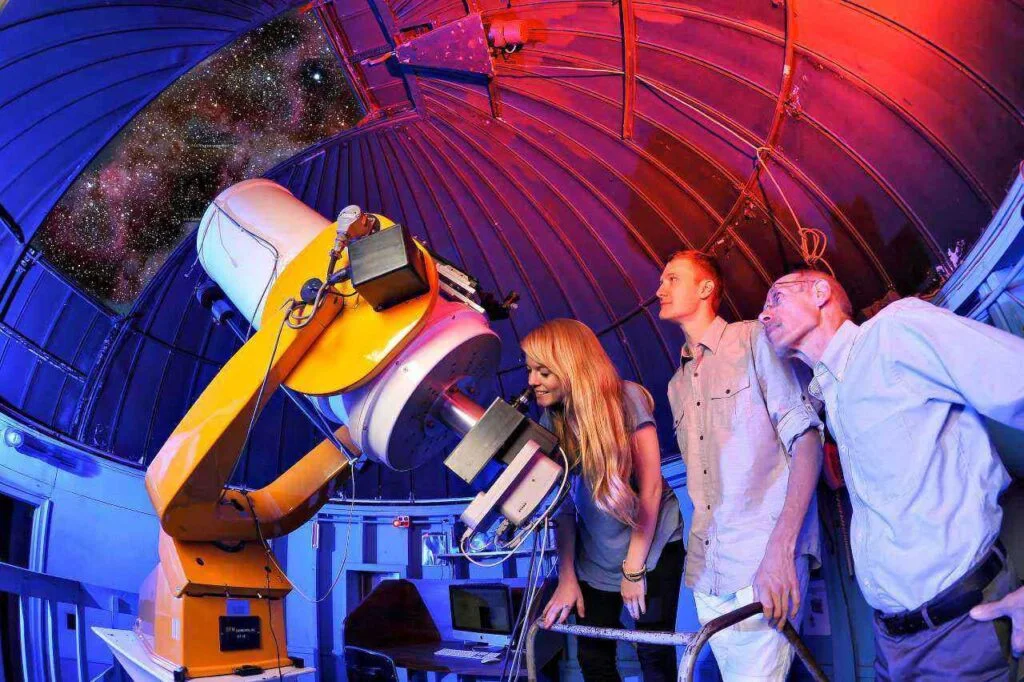
     A planetarium is a structure dome-like, which offers a space where people can watch the night sky. The solar system, other celestial bodies, and constellations can be witnessed closely in planetariums. Some planetariums also have telescopes through which people can look into space.

    Astronomical spaces
    Photo by Tobias Bjørkli from Pexels

    Planetariums are the world’s cosmology study halls and theaters of open science instruction that have served maybe a billion people during the previous century. There are 3000 planetariums, including over 100 nations around the globe. Planetariums likewise were used to prepare early astronauts in heavenly route methods. By indicating the interesting revelations in cosmology and space investigation, planetariums are a significant device for expanding science education.

    Challenges

    According to the current scenario, planetariums are often monotonous in the design aspect. They have a room with a screen on which repetitive shows related to astronomy are displayed.

    User Experience

    Due to the lack of variations and real-time user experience, not a large crowd is attracted to these locations.

    Educational Aspect
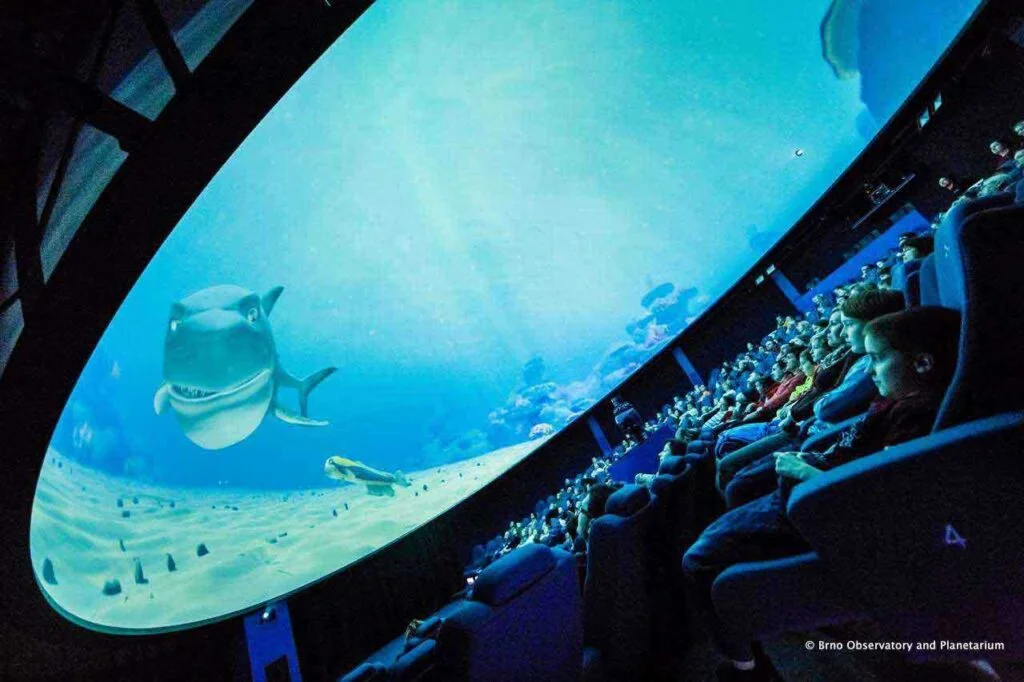
    Planetariums: An outstanding journey through the Universe
    Planetariums: An outstanding journey through the Universe

    Educational aspect: Since the planetariums do not offer an appropriate learning environment, students cannot link the written educational data to the actual natural phenomena. They are not provided with opportunities to experiment and learn themselves.

    Versatile Crowd

    Few planetariums are based on universal design; therefore, visually impaired people, old or specially abled cannot visit them. Therefore, research needs to work upon alternative mediums through which specially abled can also enjoy and benefit from these astronomical spaces.

    Pre-existing Standards

    International Planetarium Society

    Digital Domes

    Digital domes permit the planetarian to explore the night sky with freedom, zooming in on deeper sky objects, visualizing the paths of celestial objects, and randomly switching to any period. Digital planetariums also operate as large format cinemas, showing astronomical simulations, archeoastronomy sites in three dimensions, and diversity of science and entertainment programming. 

    Some companies offer two types of screens for geodesic domes: tilted and non-tilted, based on the size and the purpose of the dome required. The laser modules are being made that will be used with a high-powered laser illuminated projector. The precise color of green, or red and blue, and their precise intensity can be accurately determined with its use. Now the IMAX will also be incorporated into planetariums for a better real-time experience of astronomical spaces.  

    Immersive Audio resources

    This is used to create space between audio objects. The sound elements become more confused if more elements are jammed into two stereo channels. A side effect of this spatialization is that you can also place the sound in a spatial location in the room to simulate the location that can be heard in the real world. This is called “imaging”.

    Portable/ Mobile Domes
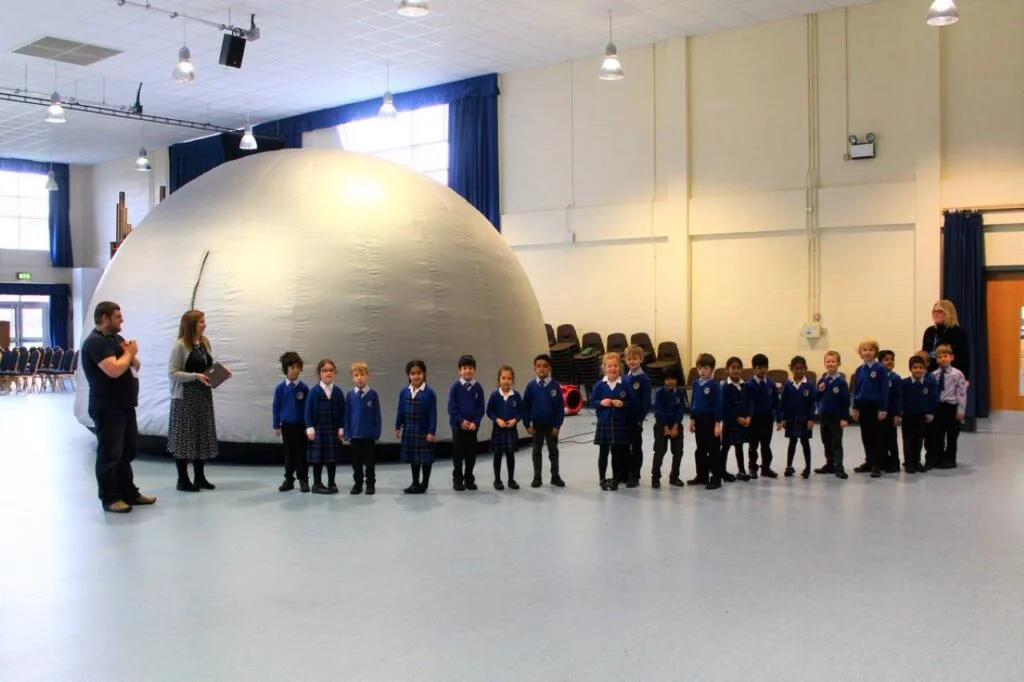
    The portable planetarium dome is made of high tensile strength fabric. They are opaque, light and non-crease. They are made of multiple layers of fabric and are suitable for projection in a full-dome digital planetarium. These mobile planetarium domes are suitable for indoor use. These domes will not be squashed, nor will they squirm. Access is via a 6-foot vertical zipper system. 
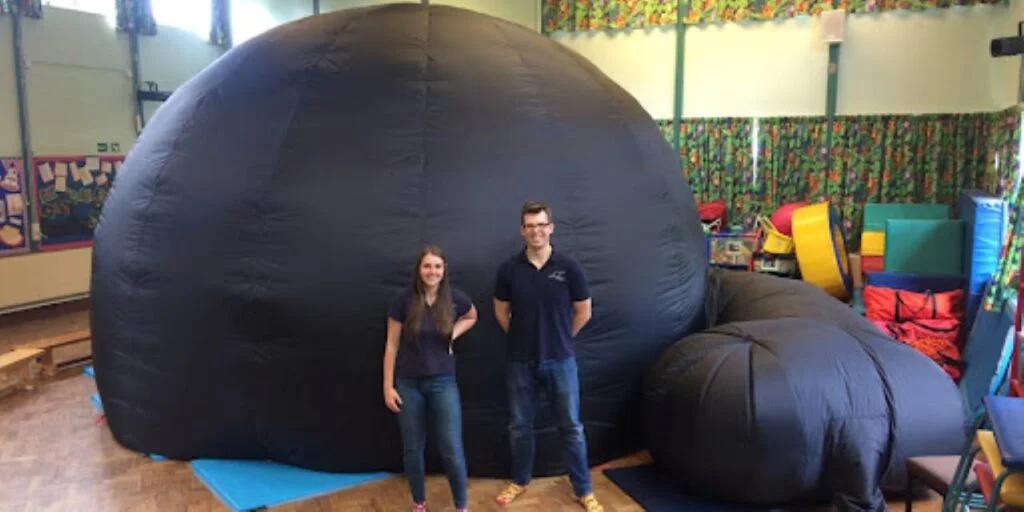
    The inner projection surface of ‘Digidome’ is gray, which is helpful for night sky projection. The portable dome is available in three different standard sizes and diameters, 5 meters 6 meters, and 7 meters. 

     Even if the entrance or exit is open indefinitely, these portable planetarium domes will not shrink or sag. This is important because it helps minimize the time between two consecutive performances.

    Reference and sales materials in planetariums

    Reference and sales material play an important part in the educational use of planetaria. A reference library for staff use is essential. For members and the public, a reference and lending library is desirable. Sales materials can represent an excellent selection of books, pamphlets, and star charts for persons who are interested in astronomy. A review of materials in a reference library at a planetarium includes books for all ages and levels of interest.

    Indian Planetarian Society

    Indian Planetarian Society

    It was established in 2000 by Dr. J.J. Rawal. The aim of the Indian Planetarian Society is to popularize Planetary Science, Solar Physics, Astrophysics, and unified subjects by arranging short courses, meetings, symposia, classes, and workshops for students, educators, specialists, and the public. 

    National Council of Science Museums

    The National Council of Science Museum (NCSM) is an autonomous body under the Ministry of Culture of the Government of India. It was established on April 4, 1978. Today, it manages 25 science centers and museums in India.

    Science City, Kolkata, Bella Museum of Industry and Technology (BITM), Kolkata, Nehru Science Center, Mumbai, Vishvesvraya Museum of Industry and Technology (VITM), Bangalore, and Delhi National Science Centre are national NCSM centers. At the regional level, there are regional centers called “satellite units” (SU).  

    Architectural requirements to meet the aim of planetarium

    Planetarium buildings- design and construction
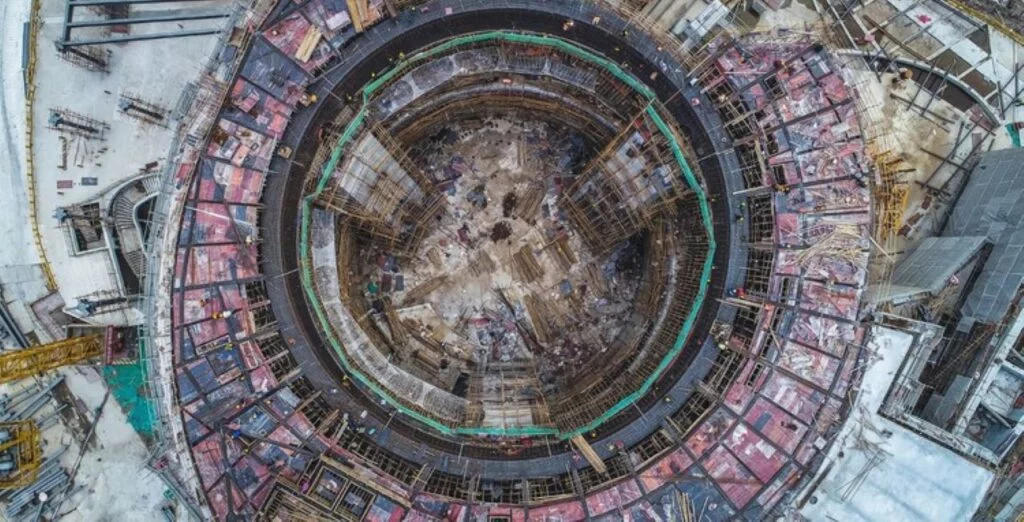
    One of the key problems facing any institution considering a planetarium program is the most efficient use of space. In several recently constructed planetariums, the radius of the planetarium chamber is several feet greater than the radius of the dome. This provides a rather interesting cosmetic situation and, in several cases, has improved both the acoustics and the air conditioning situation. The other architectural feature that can affect the public intake of planetariums is its facade.

    The common notion of people is that planetarium is an unpleasant structure. Therefore, if the facade of the planetarium building is worked upon and design interventions are done to create an aesthetic sense, a distinctive structure would be created. The people of the particular area would certainly be attracted to it. The structure would act as a city landmark.

    Architectural problems in small planetariums

    The small planetarium gains economic and educational advantages when they are attached to or built in a larger institution; the effectiveness of the planetarium instrument depends on the design of the room in which it is housed, and if plans and materials for this room were standardized, it would help new planetariums to secure the best use of the instrument. These studies of large and small planetariums show their common needs, regardless of size. 

    Innovative techniques for enhancement of user experience

    Educational Aspect

    Planetarium and secondary education
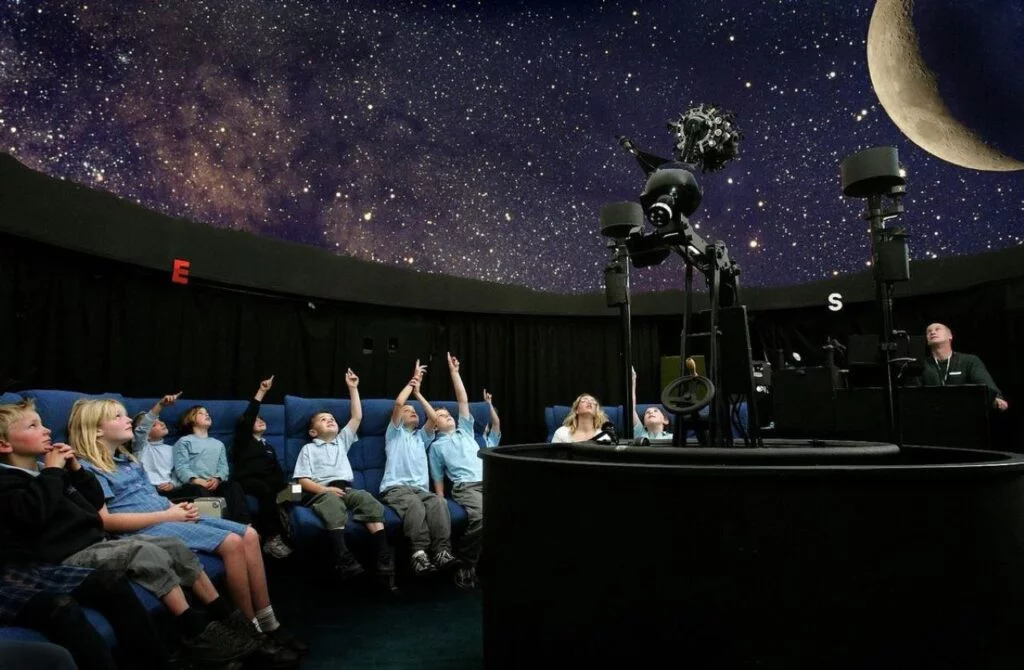
    Elementary school science is now being recognized as a basic subject and not just a hobby. We all concur that to make younger students interested in space science, we have to make the subject intriguing and genuine to them by utilizing many visual guides and by related field trips. In the region of space science, kids can figure out how to watch, measure, draw, and record. 

    Cosmology is now a universe of imagination for young students. The issue is to keep his psyche supported with adequate, exact data so that in the wonder of the planetarium, his rich creative mind can work independently.

    Planetarium and adult education

    For however much a child may enjoy a synthetic experience, it denies him the opportunity to be personally creative. The average adult, on the contrary, whose imagination is atrophied and whose mind is clouded with worries and pains, needs to have his imagination stimulated before it can operate at all. In program planning, it is indicated that the child’s program needs to be led from the specific, astronomical idea toward the related areas. 

    The adult program needs to be directed from the related areas (philosophy, the arts, history, literature, etc.) toward the scientific. Of course, one advantage of a series of adult programs is the more academic approach available to the lecturer.

    Experiential Learning
    Children usually enjoy doing role plays and getting engaged in activities that are fun to do. Therefore, there can be activities introduced in planetariums that let children dress up like astronauts and pretend to go on a moon or say mars mission. This would let them experience a similar scenario and make them learn practical concepts easily through fun activities. Spaces for these activities can be created such that they replicate a similar environment at these satellites or planets. 

    Adults can be given chances to experiment with the science concepts to understand them. It must be clearly indicated that a person compulsorily need not have a physics background to understand astronomical spaces. Astronomy is an experience that can be understood over time through various activities. Even people who have a pretext of astronomy can also benefit from these activities, since the universe is infinite and there is always a lot to know about it.

    Universal Design in Planetarium 

    Specially abled people are denied the privilege of participating in a unique educational experience because of their special problems. The installation of accessible exhibits, tactile explanations, hearing loops, step-free access, changing places, toilets, sensory rooms, and other accessibility guides are being included in recent developments of the planetarium.

    Muscular dystrophy
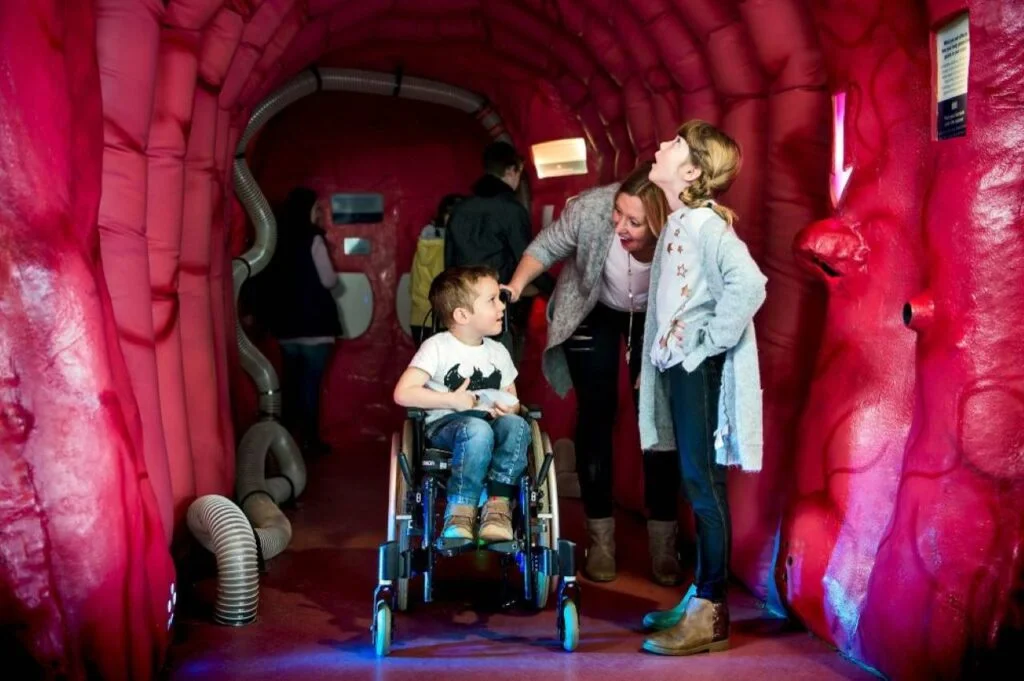
    Accessible Galleries in Winchester Planetarium
    Accessible Galleries in Winchester Planetarium

    In cases of muscular dystrophy or polio groups, there must be enough space in the planetarium to allow space for wheelchairs and special braces. The planetariums can also be designed with the provision of ramps. Roll-on roll-off lifts have been provided between the two floors of the exhibition in many planetariums for easy access.

    Visually impaired

    For the visually impaired and blind people, the advantages of sound systems can be taken. The L’Hemispheric planetarium at Valencia (Spain) has seven different speakers that are distributed over the 24m-diameter spheric screen lets the visitors identify the direction from which the sound is arriving. Each constellation and the special star has a specific sound associated with it.   

    Mentally retarded groups

    While speaking to mentally retarded groups which occasionally visit the planetarium, a simplified presentation must be given to make the sky show easily comprehensible. If some knowledge of the intelligence level of the class is obtained beforehand, the talk can then be patterned according to the capabilities and interests of the particular group. 

    Presentation techniques and special effects

    Sound effects in the planetarium
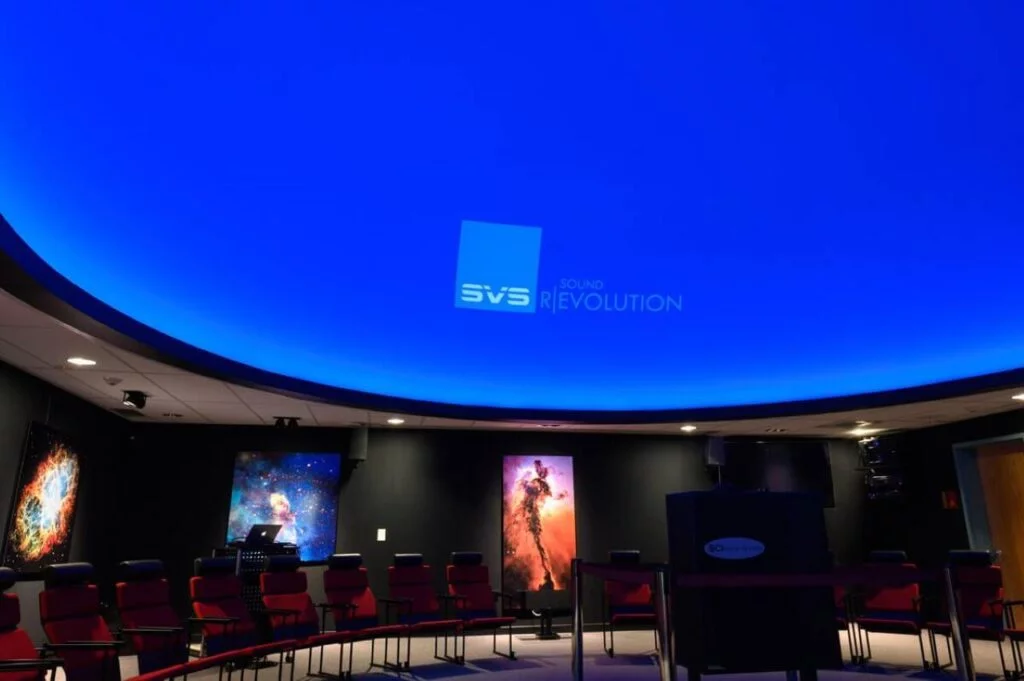
    A good sound system can add tremendously to the effectiveness of planetarium programs, but there is room for discussion about the appropriateness of its use in certain areas. It is unnecessary to point out that music is a great mood-setter and can begin its work at the very beginning of a planetarium program. A few minutes of music before a program starts can make the waiting period more pleasant for the adults and seem to hold back the restlessness of the children.

    Development and use of auxiliary devices in the planetarium

    Auxiliary projection devices can contribute to a planetarian demonstration. Some devices may only lend a bit more drama to the performance, such as a sunrise or sunset, while others are as valuable as teaching aids, such as a projector model of Cepheid variable or the appearance of a nova.

    Use of black light in the planetarium

    Nowadays, it is used in crime investigation, advertising, and as an ornamental medium of many uses. The armed forces are using it extensively in their various training programs. As a visual teaching aid, it has many applications. In the museum and planetarium field, the importance of black light as a dramatic medium for astronomical spaces and different natural science exhibits has rarely been explored except by a few artists and technicians.

    Fluorescent painting has been not used practically in the past; it has been just the use of pure colors which lack the sense of light and shade. Many expensive and huge mistakes have been made in using this medium because it has fallen into wrong hands. Most of the use has been experimentation and there is quite little data available on fluorescent painting. The “black light” produced when fluorescent pigments are exposed to ultraviolet radiation lends dramatic intensity and translucency to planetarium exhibits.

    Public Engagement
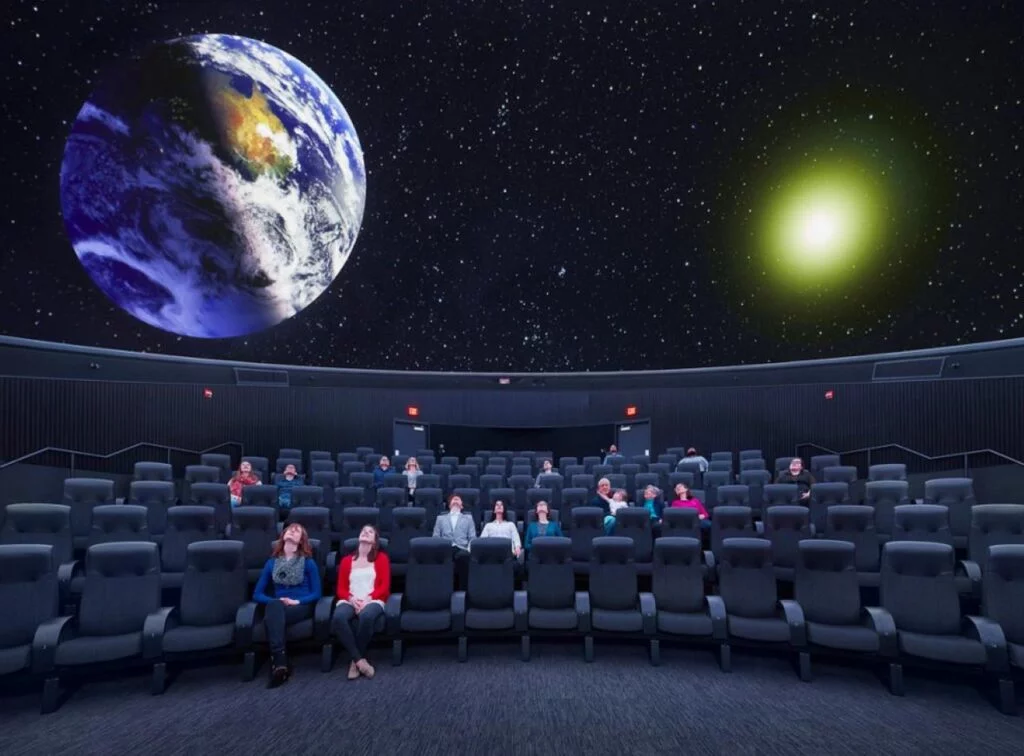
    Astronomy is often taken as a serious science topic by the public. The entertainment aspect of planetariums is usually ignored. They find it difficult to understand astronomical space concepts and thus do not seem attracted to them. If they are provided a platform where they can experiment, enjoy and learn science that too with the professional help of specialists in this field, the audience count would experience an escalation.

     Therefore, mass gatherings must be organized that can either be in an enclosed area or under a natural sky where people of different age groups and categories would meet to have a soothing and fun experience of astronomical phenomena. This would further make people visit the planetariums to experience a detailed version of the universe.

    Planetariums around the world that use innovative techniques and design interventions

    Adler Planetarium, Chicago
    Overview

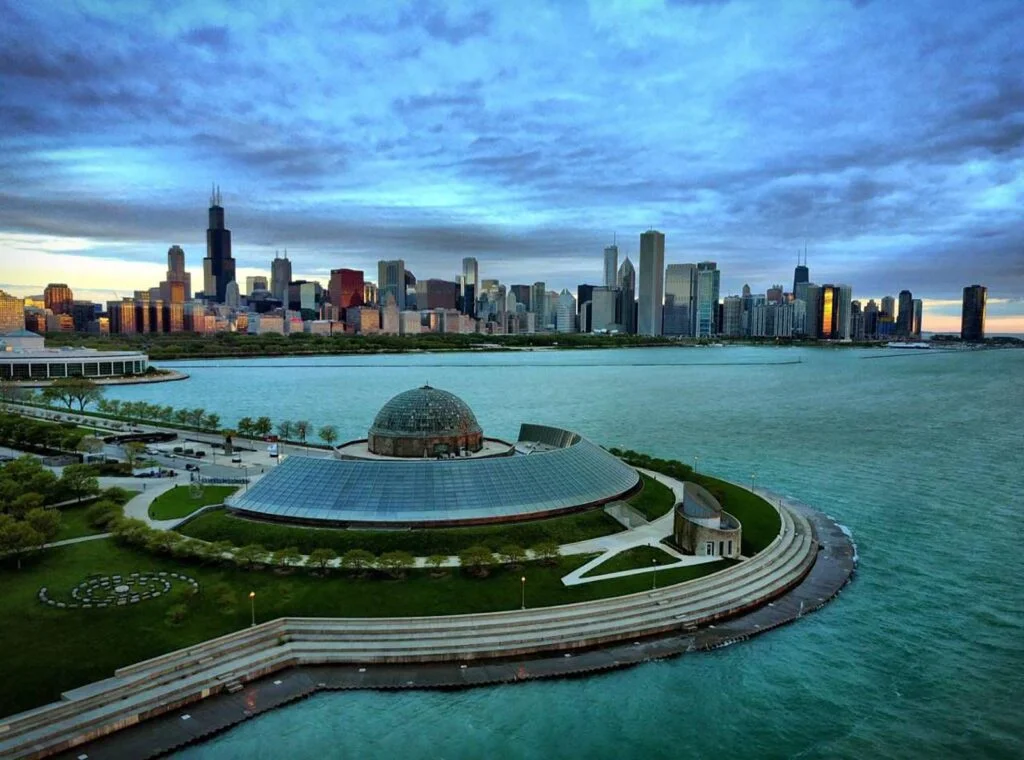
    This planetarium is constructed at the shore of Lake Michigan in Chicago, Illinois. It is one of the finest planetariums in the United States since it fulfills the basic parameter that is the user experience. It has attractive galleries that have been designed in such a way that it creates a surprise element and interests the visitors.

    Accessibility

    We can access the planetarium through public transit and personal vehicle.

    Circulation

    The circulation of this building is circular and radial, following the shape of a dome. The other spaces are quite complex, but signage makes it easier to navigate.

    Construction materials

    The building has a dodecagonal base structure of rainbow granite with a lead covering as the topping. The dome is made of perforated aluminum panels suspended from the ceiling and adjacent walls. 

    Lighting and colour
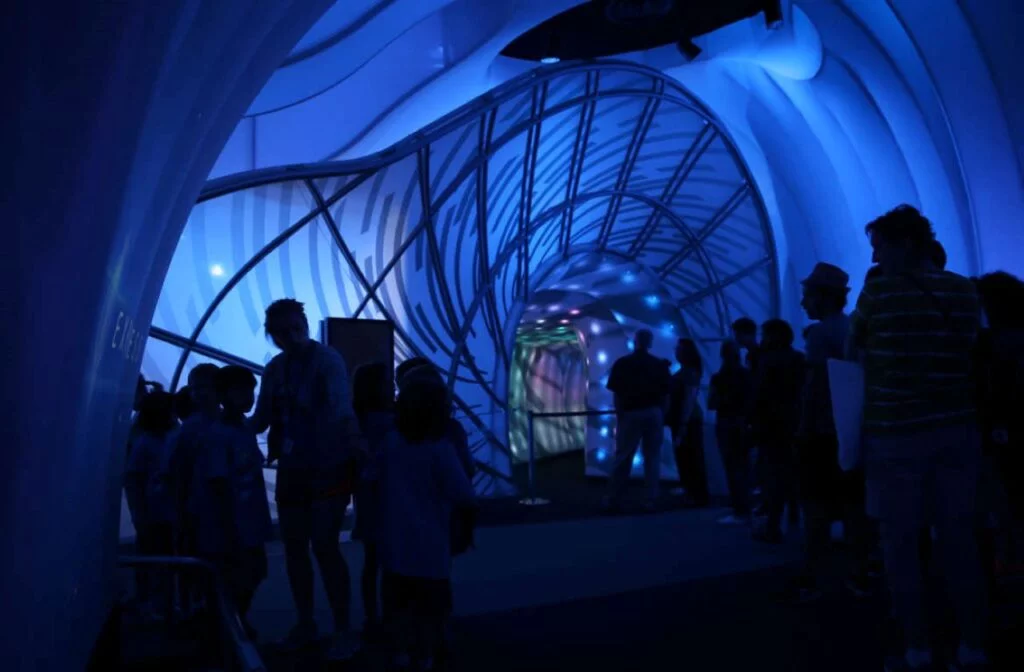
    Natural lighting is the dominant source of lighting within the facility. Artificial lighting has been provided or special exhibits. Welcome Gallery space is lit with the use of backlighting and projection. Cool-toned colours that are connected with the universe have been used in the facility.

    Services

    The building is HVAC controlled. It has underground parking available for visitors.

    Community Design lab

    In this section of the planetarium, visitors can have hands-on experience and learn science concepts by experimenting. Various methods like drawing, painting, game activities, space missions are used to interpret or form an image of one’s own unique personal connection to the astronomical space.

    Chicago Night sky Exhibitions
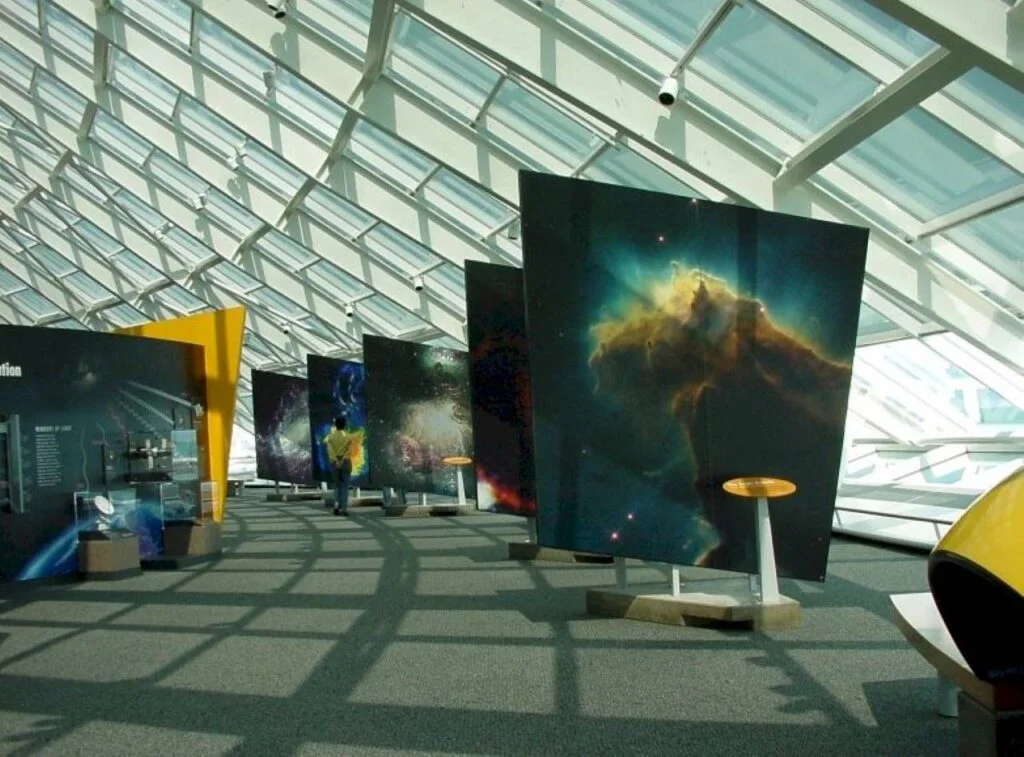
    This feature of the planetarium uses digital interactive technology to create constellations in the sky. Lighting design is also experimented with in the planetarium to analyze better lighting.

    Space Visualization Labs
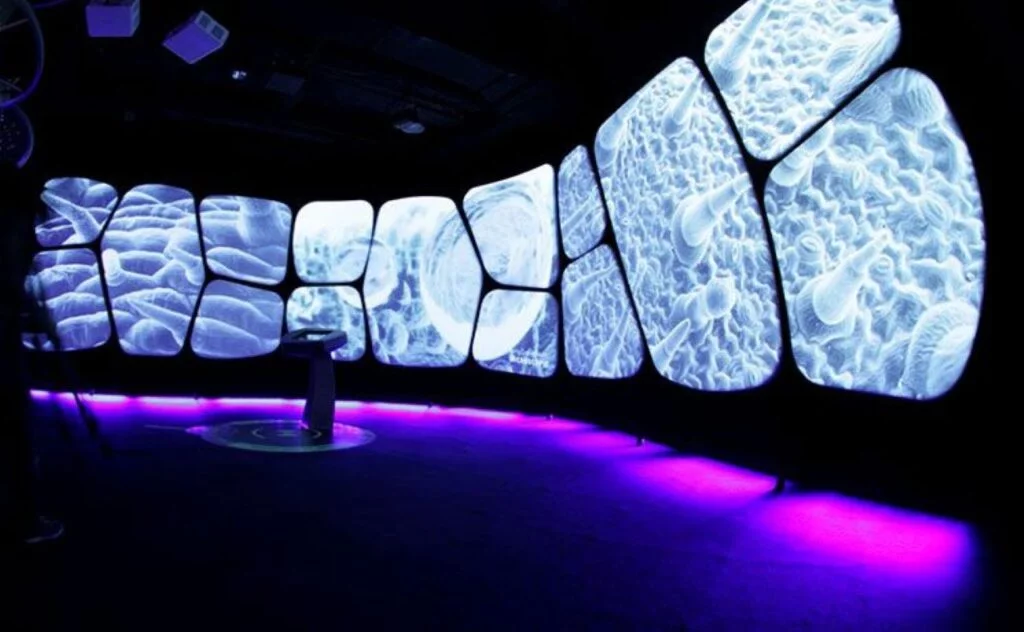
    Space Visualization Labs

    The space visualization lab (SVL) is a space of the planetarium where SVL assistants ensure the high-quality experience of the visitors by researching and making the projects of the planetarium accessible to people. Scientists, technicians, and educators work together in this laboratory to find new ways for people to explore the universe. 

    L’hemispheric Planetarium, Spain

    Overview

    The concept of the planetarium is based on an eye. It compares the wide range of wisdom that an eye sees to the wisdom and information that a planetarium offers. It has been designed in a way that the eye is seen closing and opening. There is also a pond around the eye-shaped building in which the reflection of the building is formed. This creates a mesmerizing view for the visitors, especially at night because of the application of light.
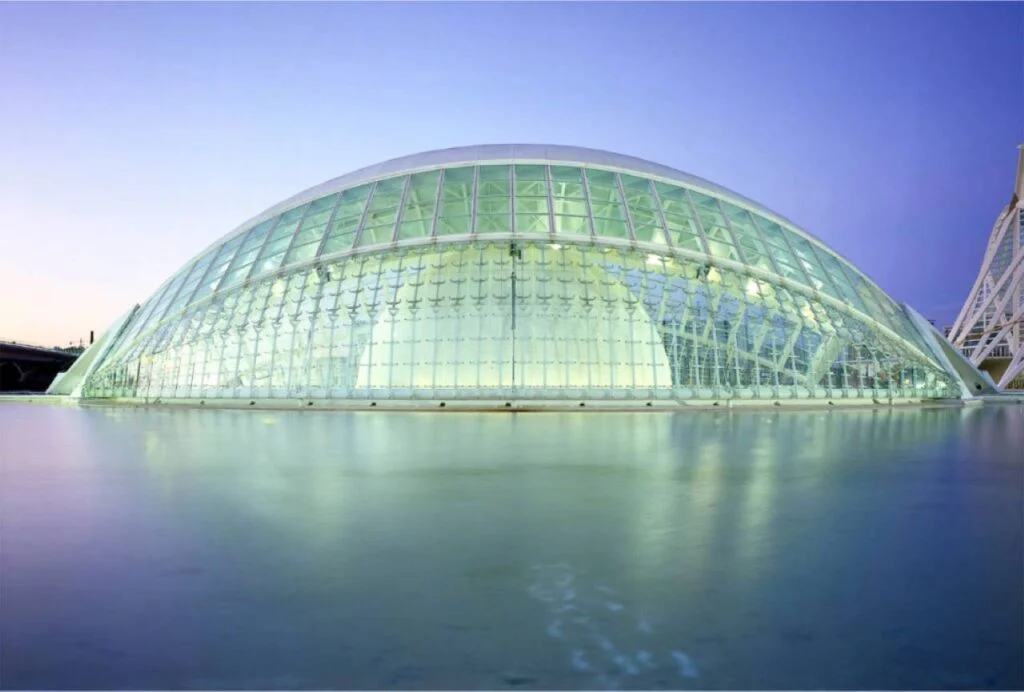
    Accessibility

    The planetarium building is well connected through bus and metro routes. The nearest metro station is 15 minutes away from the planetarium.

    Façade and Landscaping
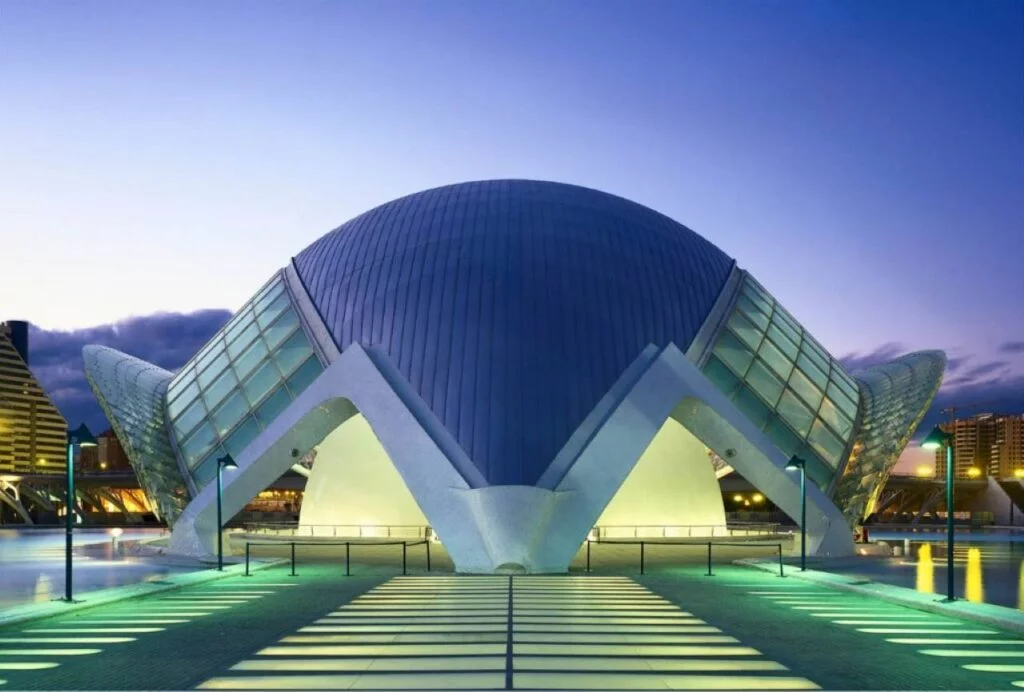
    The landscaping of the planetarium has a water body in it which surrounds it. The entrance walkway is lit with the use of artificial lighting, which gives it a grand look.

    Construction materials
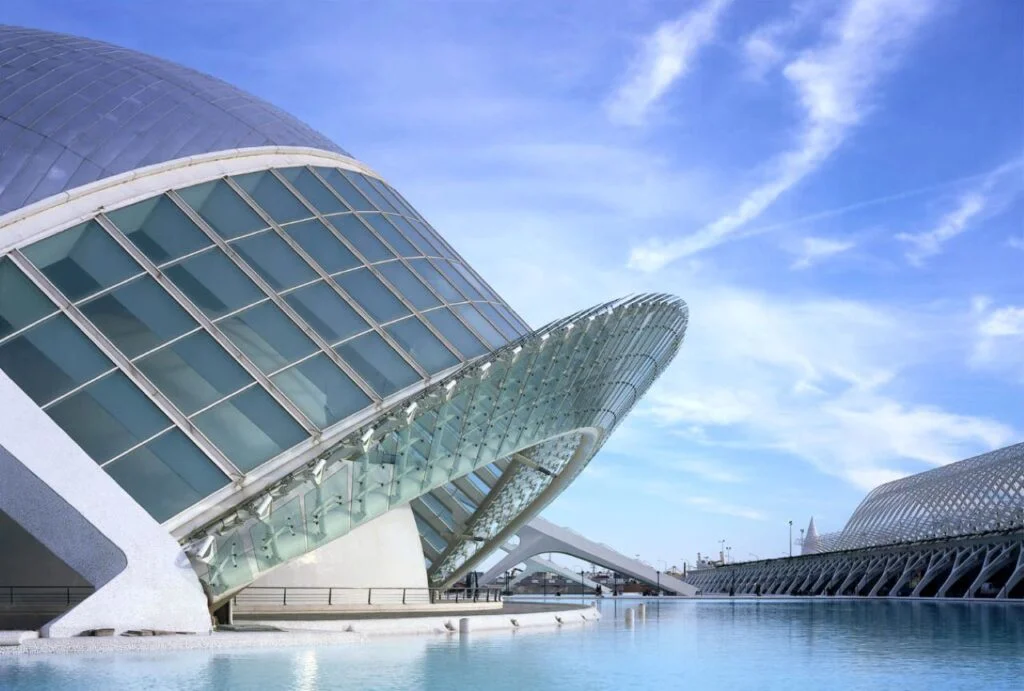
    The main construction materials are concrete and steel-framed glass curtain walls. The metallic covering comprises five arches supported by tripods. The arches are connected through laminated beams. The shutter built to represent the closing of the eye is made of expanded aluminum sheets that fold upward to form a roof that opens along the curved axis of the eye.

     Lighting and colour
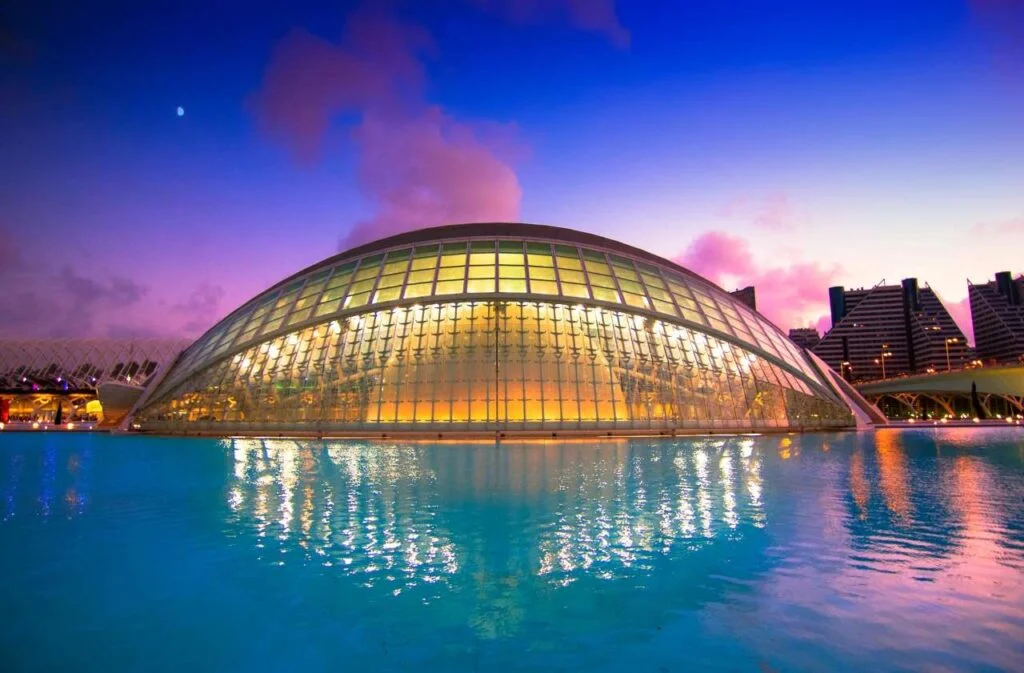
    An eye-catching architectural Masterpiece
    An eye-catching architectural Masterpiece

    Natural lighting is the primary source of lighting because large windows and artificial lighting is used in spaces that do not have adequate lighting. White is the primary color throughout the facility. During the day, the water pond has reflections on it, and lights at the night project colours on the building.

     Services

    There is an underground parking facility provided. The planetarium campus also has a cafeteria where visitors can relax and eat. It has a shopping section where astronomical souvenirs are available for sale. The building is HVAC controlled.

    Hayden Planetarium, New York
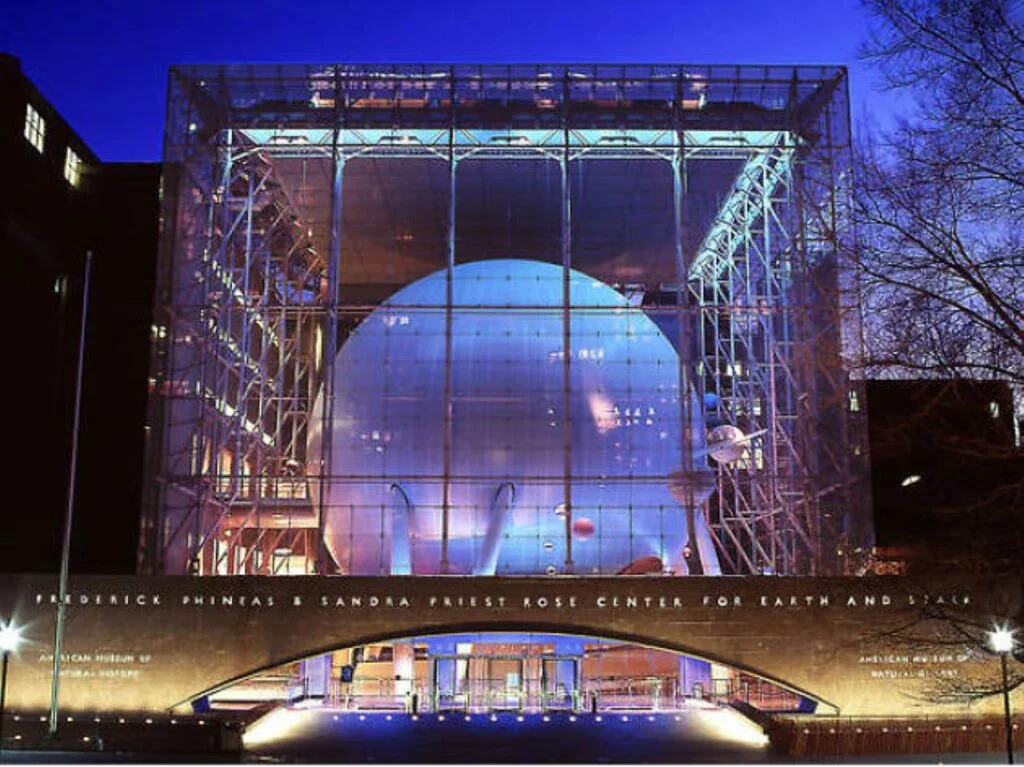
    Overview

    This planetarium is in the upper half of Rose Center for Earth and Space in New York, USA. The planetarium has a walkway that showcases the timeline of the Universe from the Big Bang to the present. At the bottom of the cosmic pathway, visitors can stop to look at exhibits of geology, weather in the Hall of Planet Earth.

    Accessibility

    The planetarium has well-defined public transit connectivity. Visitors can use the bus routes and trains to reach the planetarium.

    Architectural details

    The planetarium building has 5 floors. Planetarium spaces are on the first three floors and the other floor levels have archaeological exhibits. The ground floor of the building has parking on the lower level, which is accessed from the first floor. It has a food court, school lunchrooms and a shopping facility. There is a black hole theatre on this floor. The first floor has exhibits spaces for meteorites and a cosmic pathway. The second floor has the Hayden Big Bang theatre.

    Universal design
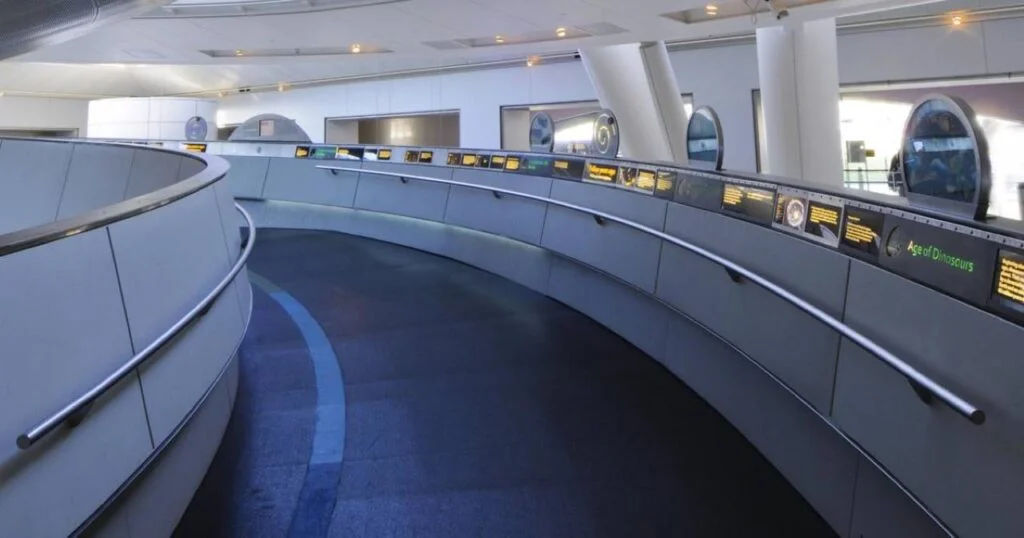
    Cosmic Pathway
    Space planning: Cosmic Pathway

    The planetarium is wheelchair accessible. It has ramps provided in the exhibit spaces that are accessible by variant people. The shows also have caption devices that help impaired people to experience the astronomical space. Show translations are available in various languages that make it accessible for people from different cultures. It is wheelchair accessible and has no obstructions, such as turnstiles or steps that would hinder any specially-abled person.

    Social and Environment stability

    The planetarium also has an open green space attached to it. This develops a sense of connection between the indoor and outdoor space. The green open space adds a contrast to the planetarium in a spatial context.

    Winchester Planetarium

    Overview
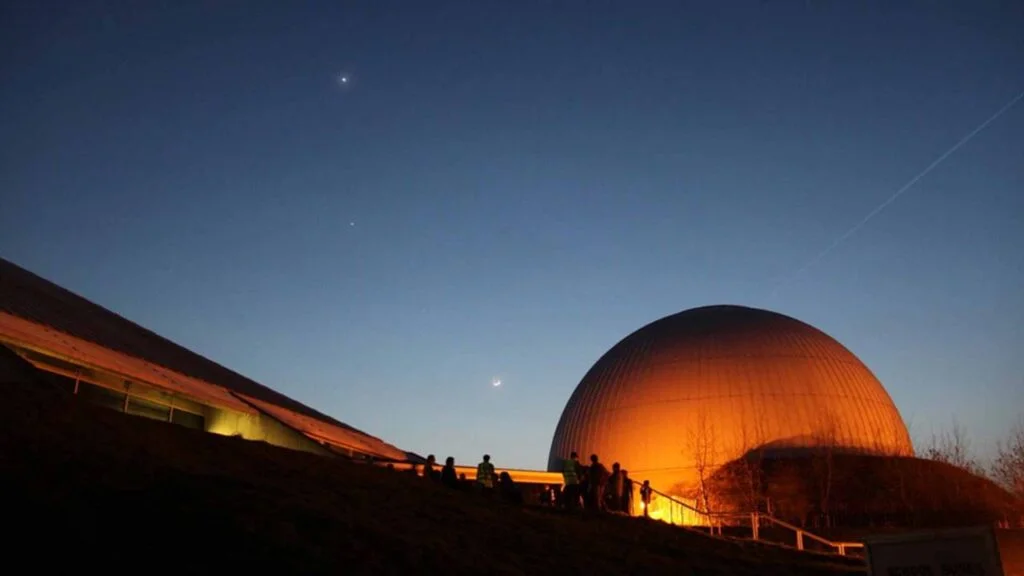
    Winchester Science Centre is an accessible planetarium for all who believe in science. It focuses on STEM (Science, Technology, Engineering, and Maths) for young people and their families, especially those with disabilities and impairments. They are working to make the Science Centre and Planetarium accessible, inclusive, and a design for all buildings. 

    Invention Studio
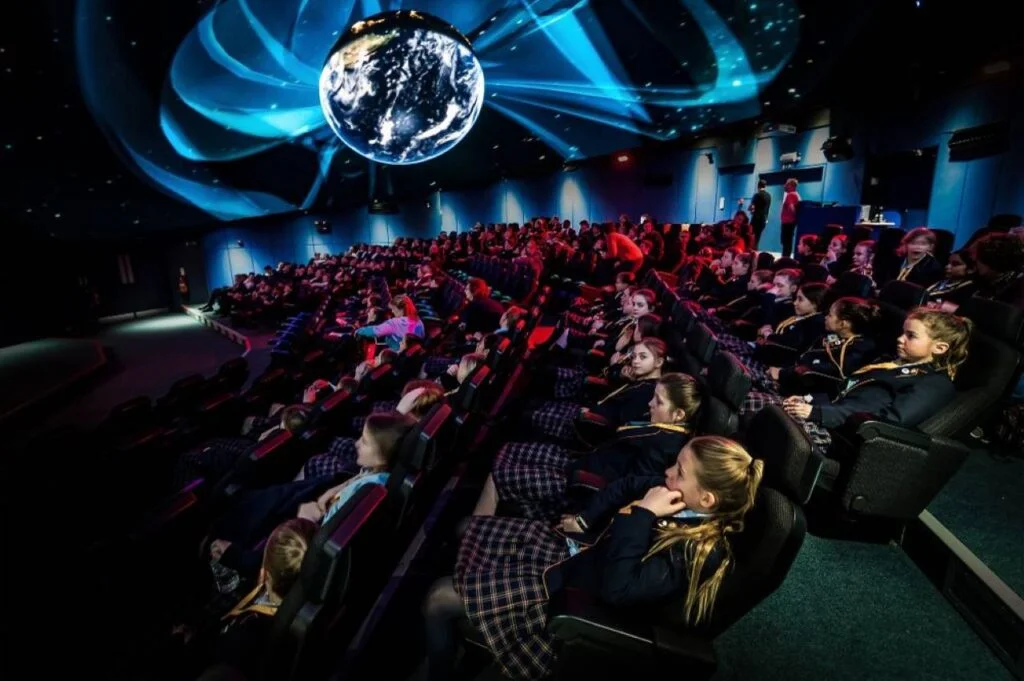
    School Group in the sky theatre
    School Group in the sky theatre

    The invention studio is open on weekends and school holidays for students and other people to come and explore science through experiments and science-themed challenges. These studios have different activities through which people can learn about astronomical phenomena, space missions, and other science concepts.

    Universal Design

    They have designed especially the shows for old-age people, keeping in mind their perspective and accessibility. Changing rooms are wheelchair accessible. Special tactile objects have helped blind people also feel the experience of astronomical space. The ‘After Dark’ events are designed for adults. The projection rooms have spaces dedicated to wheelchair users. Space is provided to accommodate wheelchairs if the users want to transfer on the seats.
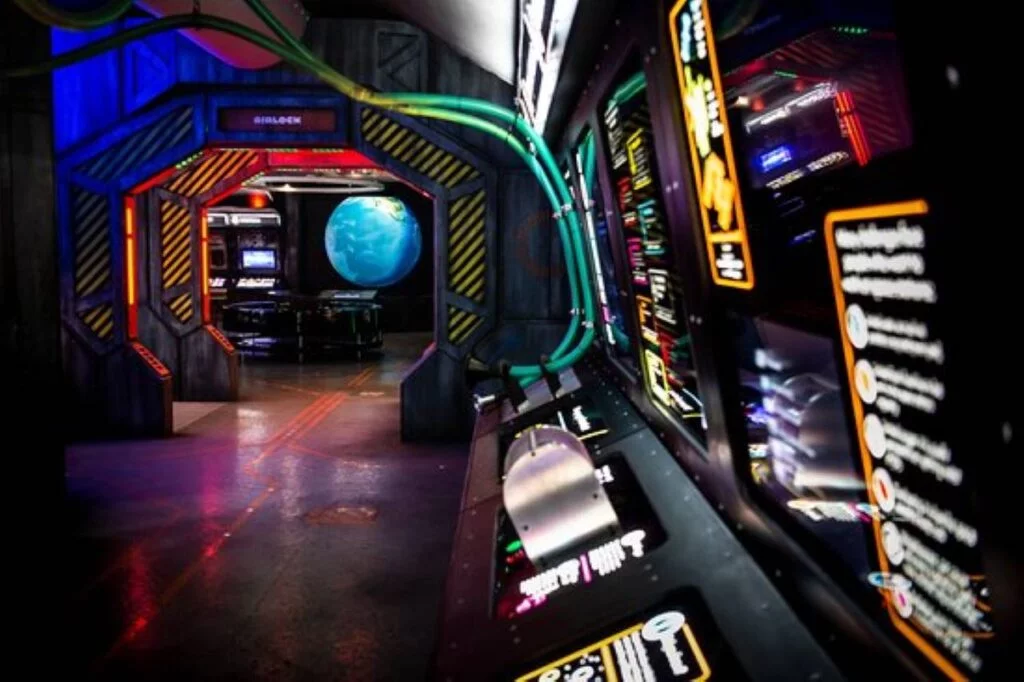
    Explorer zone
    Explorer zone

    The planetarium also has quiet hour shows are dedicated to people who want to experience the astronomical phenomena in absolute silence. This show includes adjustments such as controlling lights, sound and swaying around the area, being able to sit wherever one likes. There are specific shows that are available with subtitles. 

    Birla Planetarium, Chennai

    Overview
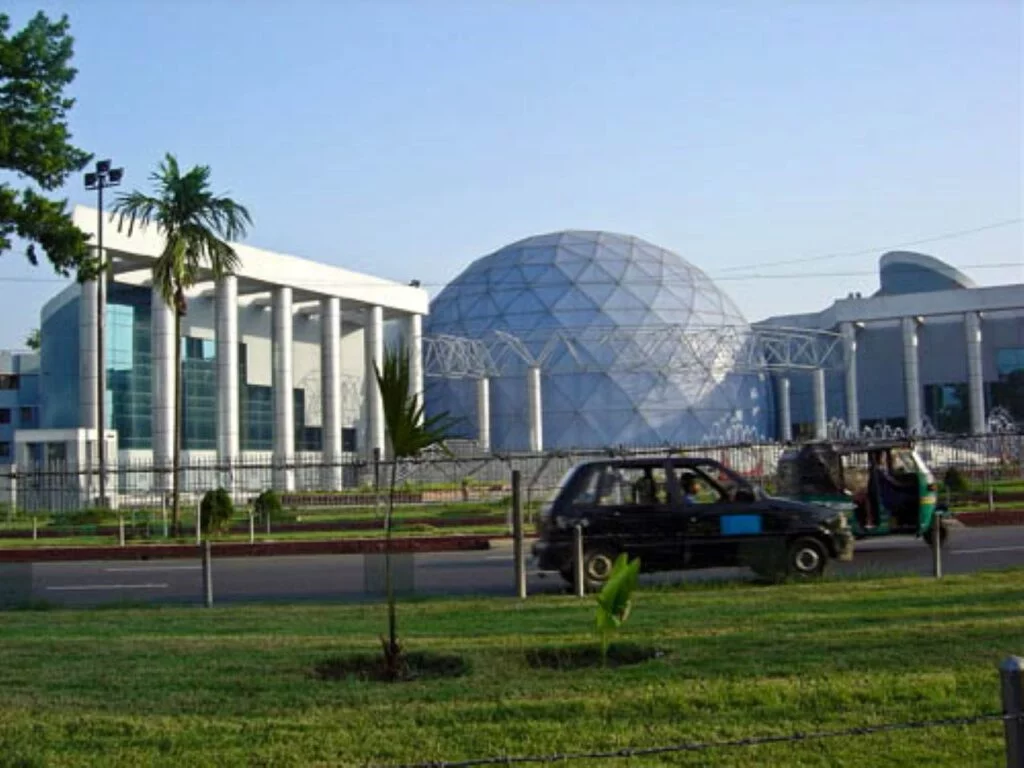
    Birla Planetarium, Chennai

    Birla Planetarium is in Chennai, India. It has 8 galleries, Physical Science, Electronics and Communication, Energy, Life Science, Innovation, Transport, International Dolls, and Children and Materials Science.

    Accessibility

    The railway station and bus stops are at a maximum of 2 kilometres from the planetarium.

    Architectural Details

    The planetarium has a hall of fame surrounding the major theatre and contains portraits, photos of scientists, celestial bodies, and space missions. The hemispherical inner dome of the planetarium is made from aluminium.

    Technological aspect

    Birla Planetarium renovation
    Birla Planetarium renovation

    The planetarium has a multifunctional optical-mechanical Starfield projector GOTO GM II, a special effects projector, and an XY table system for simulating various space phenomena. The GM II projector can perform annual, latitudinal, and precessional movements. A 6-segment multimedia projection system and 360-degree sky theatre were introduced.

  • Climatology in Architecture: An Important Aspect of Every House Design

    Climatology in Architecture: An Important Aspect of Every House Design

    Climatology is the scientific study of climate. Climatology in architecture is a study related to the climate and the built environment. Buildings do not exist in isolation; they exist in a specific geographic environment. As a scientific discipline, architecture strives to ensure the harmony and unity of architecture and the surrounding geographic environment. If this is not possible, the building will not produce maximum comfort for the user, thus it will not achieve its purpose.

    Climatology in Architecture
    Climate Responsive Architecture

    Climatic zones in India

    climatic zones in india
    Climatic Zone map of India– Climatology in Architecture

    India has a wide variety of climates. It can be roughly divided into five climate zones. The climate in India classified for different types of buildings is helpful to the functional design of buildings. Our country is divided into different regions, so the climatic difference from one region can be reflected in the Indian style house design, which justifies some special regulations for each region. The significant differences in climate data between these regions define unique thermal comfort requirements for buildings located in different areas.

    Hot and Dry

    house design
    House Design Strategies for Hot and dry Climate– Climatology in Architecture

    The hot and dry climate is characterized by the average monthly maximum temperature exceeding 30 ºC. The areas in this climatic zone in India are usually flat and the soil conditions are sandy or rocky. In this climate, it is imperative to control the movement of solar radiation and hot wind. Therefore, building design standards should provide adequate shade, reduce exposed area and increase heat capacity.

    Warm and Humid

    house design
    Passive design strategies for Warm and humid climate– Climatology in Architecture

    The warm and humid climate is characterized by high relative humidity, around 70-90%, and high rainfall, around 1200 mm per year. The temperature in summer usually oscillates between 25 and 35 ºC, in winter the temperature varies between 20 and 30 °C. The design of houses in India in this climate should aim to reduce heat gain by providing shade and promote heat loss by maximizing cross ventilation. It is also necessary to dissipate moisture to reduce discomfort.

    Temperate

    Temperate climates are characterized by temperatures that are neither too hot nor too cold. Total annual precipitation usually exceeds 1000 mm. Winter in this area is very dry. The design of houses in India in this climate requires reducing heat gain by providing shade and promote heat loss through ventilation.

    Cold

    house design
    Considerations when building a house in a cold climate– Climatology in Architecture

    Areas located in cold climates are at high altitudes. The temperature in summer oscillates between 20 -30 ºC, in winter it can oscillate between 3 ºC and 8 ºC, which makes it very cold. Cold weather requires the design of houses in India to have adequate insulation and penetration to resist heat loss and promote heat absorption by directly absorbing and capturing solar radiation in the living space.

    Composite

    Except for the fact that the composite area experiences higher humidity levels during the monsoon, most of the characteristics of the composite area are similar to those of the hot-dry climatic zone in India. Standards of design of houses in India standards are roughly the same as those for hot, dry weather (adequate shade, reduced exposure area, and increased heat capacity), except for the need to maximize cross ventilation during the monsoon.

    Impact of climatic factors on Building Design

    The climate in India affects the design of houses through various climatic factors. The five climatic zones in India as discussed earlier are influenced by the below-discussed factors. Even small variations in these factors cause major alterations in the design of houses in India. Therefore climatology in architecture plays an important role. Architecture and climate have always been linked in a way of mutual influence. As a provider of the shelter, the building deliberately changed the climate of the neighbouring area; traditionally, its design was shaped by the pressures and opportunities inherent in the regional climate.

    Topography

    The strength, direction, and moisture content of the airflow are greatly affected by terrain. Air can be diverted or channeled through mountains. Airflow is diverted upward, and when it cools, the releases its moisture. The descending air mass rarely produces precipitation, so precipitation characteristics vary greatly between locations on the windward and lee slopes of mountains. Air humidity will vary with the rate at which the moisture evaporates from the surface below, that is, it depends on the availability of water to evaporate.

    Solar Radiation

    climatology
    Solar control techniques– Climatology in Architecture

    The amount of light reaching any particular point on the ground depends on the time of day, the day of the year, the number of clouds, and the latitude of that point. The intensity of the sun changes with the time of day, peaking at noon and reaching a minimum at dusk. The solar energy naturally falling on the building can be used to heat the building without special equipment to capture or collect sunlight. Passive solar heating uses building materials such as large windows facing the sun and bricks that slowly absorb and release solar heat.

    The design of houses in India should be such that the longest wall extends from east to west and provides long exposure to the south, allowing solar energy to enter the home in winter. Well-insulated buildings with this structural feature can absorb energy from the sun and reduce heating costs by as much as 50%. Passive solar systems involve designing the structure itself in a way that uses solar energy for heating and cooling. The passive solar design also includes natural ventilation for cooling.

     Curtains and overhangs can also reduce the heat in summer while allowing plenty of sunlight in winter. Active solar heating systems involve the installation of special equipment that uses energy from the sun to heat or cool existing structures.

    Wind

    climatology in architecture
    House of light and wind– Climatology in Architecture

    The wind is air in motion. It is because of horizontal variations in air pressure. The greater the difference in air pressure amongst any places at equal altitudes, the stronger the wind will be. The triumphing wind is the wind direction most often determined for the duration of a given period. Wind tempo is the charge at which the air moves past a table sure object. The wind is the important factor of air float in houses. The pressure of many of the building envelopes and the outdoor environment differ, and that is why air float is possible.

    climate in india
    Airflow in House Design– Climatology in Architecture

    Adequate fenestration is wanted to harness this. Prime of the destructive effects is that of wind-load on high-upward thrust houses. In the format and introduction of high-upward thrust houses, the impact of wind-load should be taken into cognizance. Adequate provisions have to be made withinside the idea format and the load-bearing framework of the houses to make certain true sufficient energy and help in competition to wind-load.

    Humidity

    Humidity is the quantity of water vapour within the atmosphere. Relative Humidity ratio is taken among the real quantity of water vapour within the air and the most quantity of water vapour that the air can preserve at that given air temperature.

    Relative humidity refers to the relationship between the humidity in the air and the maximum acceptable humidity, expressed in percentage. The higher the relative humidity ratio, the more likely it is that water droplets will form on physical objects including buildings and other buildings, such as bridges, streets, etc. on the surface of the earth.

    In coastal areas and islands, climate and humidity are high, and the design of houses in India is based on the high adverse effects of water. They must be designed and constructed by method to minimize adverse physical and chemical effects of water to the minimum or even zero. This can be done by choosing waterproof and anti-corrosion materials and equipment.

    Precipitation

    climatology in architecture
    Moisture Management Strategies– Climatology in Architecture

    Rainfall is one of the most decisive factors that need to be considered in the design of houses in India, especially in the ceiling design. In rainy areas, the roof of the building should be designed as a gable roof to reduce the erosion of water and minimize the accumulation of water on the roof due to damage. Otherwise, the adverse effects of rainwater and its infiltration into buildings will increase. Information of precipitation rate, especially in the design of dams and other structures is required to determine the size of the spillway, etc.

    Sound

    climatology
    Noise control in Buildings

    If a site is provided, the designer selects the location of the building and there is a source of noise on one side of the site (such as a busy road), it is recommended to place the building as far away as possible from the noise source. For every doubling of the distance, the noise level will decrease by 6 dB. Architectural acoustics help reduce the impact of acoustic disturbances, which can negatively affect health, well-being, and overall quality of life.

    The noise in the space where the sound source is located can be divided into two parts: direct noise and reverb noise. If the screen is placed between the source and the listener, direct noise can be reduced. It is better to place the screen closer to the source. The use of sound-absorbing materials on room surfaces can reduce reverb noise.

    Application in various Climatic Zones

    Climatology in architecture is crucial in the design of houses in India since the climate in India is diverse. Special care and attention are required while designing houses in India to ensure that they respond to various climates. Comparison of climate data and thermal comfort requirements provides a basis for selecting building forms and building components suitable for the climate to create the necessary internal comfort.

    house design
    Passive House Design– Climatology in Architecture

    Building Design in Hot and Dry climate

    Planning

    In this climatic zone in India, outdoor conditions are very harsh and thus buildings and outdoor living spaces should be protected as much as possible from strong solar radiation and hot, dusty wind. A closed building compactly planned and introvert is best suited. When site conditions permit, the larger size of the building is better for facing north and south, because these elevations receive the lowest heat load from solar radiation.

    Roofs and Walls

    The use of overhanging roofs, balconies, shading equipment, surrounding trees and walls, and buildings are familiar techniques in the design of houses in India. By aligning the buildings close to each other, especially if the east and west walls are placed close to the other, mutual shading will reduce heat gain from external walls. For this reason, in the hot and dry climate, there is a tendency to have a cluster of the building complex, narrow roads and streets, porches, colonnades, and enclosed small courtyards to obtain maximum shade and freshness.

    Ventilation

    climatic zones in india
    Air movement in traditional house design- Climatology in Architecture

    During the day, the opening should be closed and covered. For hygienic reasons, the ventilation should be kept to an absolute minimum to minimize the entry of hot air outside the house.

    Traditional shelter

    Traditional shelters found in most desert areas have heavy earth walls, bricks or stones, and roofs of the same material, usually supported by beams that do not use vaults. Thick walls provide good heat capacity and safety and noise protection. During the long warm season, these structures tend to be too hot at night. During these times, the roof and patio were often used for sleeping outdoors.

    Building Design in Warm and Humid climate- Climatology in Architecture

    climatology
    Importance of Cross-ventilation in a warm and humid climate

    Under such climatic conditions, the design of houses in India often uses elongated open floor plans with rooms in a single row to achieve cross-ventilation. These rooms can be accessed from balconies or open balconies and also provide shade. Window and door openings are or should be as large as possible to allow air to pass freely. Sunshade and unobstructed air circulation are two basic requirements. The development density of hot and humid areas is always much lower than that of warm climate for three reasons:

    1. Allows air to circulate freely in the space between buildings
    2. Provides remote privacy because walls and screens cannot be used for this purpose
    3. Many activities are carried out outdoors

    Due to the considerable rainfall in these areas, pitched roofs are most often covered with corrugated iron, fiber cement, or shiny aluminum.

    Traditional Shelter

    In places where wood is scarce, single-story houses with earthen walls, the roof of wood, bamboo, or palm leaves, covered with straw, are typical. Wide protruding eaves obscured the walls. In areas where wood or flooring is more suitable for construction, traditional shelters are generally erected on stilts, constructed from local lumber or bamboo frames with woven mats and wood, or bamboo walls, floors, doors and shutters.

    Building Design in Composite climate

    Courtyard houses must be constructed in such a climatic zone in India. Buildings should be grouped in a way that takes advantage of the prevailing breeze in a short period when air movement is required. The medium density low rise development is suitable for these climates. This will ensure the protection of the outer space, mutual shading of external walls, shelter from the wind in cold seasons, shield against dust, and reduce the surface area exposed to sunlight. Radiation In hot and humid seasons, large and wide eaves are required.

    Balconies are used as outdoor residential areas to reduce sky glare, rain and shade, and can also become active in the dry season. It is only necessary to maintain a low wall temperature at night in the hot, dry season, but the same thermal performance will be useful in the cold season to keep the daytime heat during an uncomfortable cold night. Roof and external walls should be constructed of solid masonry or concrete to ensure a 9-12 hour heat transfer. Whether it is a cold or dry season, the heat capacity will have an advantage.

    Building Design in Cold climate

    Household wraps, moisture impermeable barriers, and effective caulking details are essential. Ventilation of the home is also essential to remove moisture from exterior walls and roof sheathing. Choose a construction site and home layout, and place your living room windows in the sun – that is, although bedroom windows may face north, they are within 30 degrees of true south. Choose a simple home plan with a steep roof, such as a standard gable.

    design of houses in india
    Building design in cold climate

    Slate and tile roofs are less prone to snow. Design of houses in India should have a roof with fewer skylights or skylight openings, vents, and chimneys near roof ridges or peaks must be used. The passive solar design also uses darker colored roofs to absorb heat and “thermal mass” products such as concrete, bricks, stones, and tiles that retain heat from sunlight during the day and release heat at night. Other items may include electronic sensing devices such as differential thermostats, operable dampers and vents, operable Low-E blinds, shutters, and insulated awnings. Plans with a sunroom are very suitable for capturing solar heat.

  • Interesting Peep into Tiny Homes: Portable and Functional House Design

    Interesting Peep into Tiny Homes: Portable and Functional House Design

    Concept of Tiny Homes

    Tiny House Movement

    Tiny homes
    Photo by Maria Orlova from Pexels

    This is an architectural and social movement aimed at providing a simpler life in a smaller space. The people of all areas of life have determined that a large house, and more specifically, the great cost of the resulting life, is not necessary and harmful to their happiness. These people prefer tiny homes to reduce the financial and emotional weight of things.

    Types of Tiny homes

    Recreational Vehicles

    It is a motor vehicle or a trailer that includes houses designed for accommodation. RV types include coaches, campers, and caravans.

    Recreational Vehicles
    Photo by Kampus Production from Pexels

    The typical amenities of a camper include a kitchen, a bathroom, and one or more available to sleep. The RVs may vary from the basic bedrooms and kitchen, in luxurious, with features such as air conditioning (AC), water heaters, satellite televisions, and quartz receptors, and false ceilings, for example. Most campers are single.  

    Accessory Dwelling Unit

    Accessory Dwelling Units
    Accessory Dwelling Units

    Accessory dwelling units are also known as accessory apartments, second units, or granny flats— are additional lodging on single-family lots that are independent of the first dwelling unit. The separate living spaces are equipped with kitchen and loo facilities and might be either attached or detached from the residence

    Shipping Containers

    Built from multiple shipping containers, a shipping container house is designed often architecturally with all the amenities found in traditional home construction. This includes fully functional wet areas like kitchens, bathrooms, and laundry, plus a lounge or two, a business office, bedrooms, and verandas.

    South coast Shipping container House
    South coast Shipping container House

    Each home is uniquely designed to support the positioning, architectural plan requirements, and budget of the homeowner or builder. Shipping containers do an amazing job of keeping goods protected against wind and water. They will also heat up very quickly if there’s nothing to permit the nice and cozy air inside to flee. 

    Yurts

    Magical Yurt with spiral staircase
    Magical Yurt with spiral staircase

    Originally, a yurt may be a portable round, insulated tent used by nomadic groups of central Asia. They’re designed to be easily moved and are capable of keeping people comfortable in extreme weather. Due to its economic construction and high functionality, Yurt has gained a lot of fame recently. With the power to form all types of shapes and sizes, yurts provide you with flexibility over the look process and permit you to make it to best fit your needs. We’ve seen yurts in backyards of homes within the city and deep within the wilderness. They’re a good choice to consider when going tiny.

    Bus Conversion

    School bus Tiny Home
    School bus Tiny Home

    A school bus allows lots of natural light into your space because the walls are lined with windows. For times after you want more privacy, you’ll be able to add curtains. Many bus conversions cover their windows to feature insulation and privacy. This bus conversion takes advantage of the big amount of windows by keeping the coverings translucent. They add coverage, but also allow the taste of some light.

    Dimensions of Tiny Houses

    In recent years, tiny house plans have become more and more popular due to their versatility and environmental protection. They can be configured in any size, shape, and design to meet the needs of the owner. You can even build tiny homes on a trailer so you can take it home wherever you go. Although houses less than 1,000 square feet are considered tiny homes less than 400 square feet are considered small. They cannot exceed 8.5 inches wide, 40 inches long, and 13.5 inches high to be towed away.

    Layouts and Guidelines

    Apartments under 400 square feet are considered tiny homes, they vary in shape and size. The design and execution of tiny house plans are based on the needs of the owner. For example, a person might choose to live in tiny homes with wheels measuring 50 square meters. However, families with children can choose a larger model. A 350-square-foot house may have a roof that doubles as a deck to provide additional leisure space.

    Tiny House Plans
    Architecture design for home: Tiny House Plans

    A popular size is about 200 square feet, about the size of a dormitory. Tiny Homes prioritize the needs and wishes of owners who can build to their specifications. Living in a public micro-family environment also affects the size of the house. In many communities, facilities such as shared bathrooms and kitchens can change needs and thereby change the size of the home. However, despite the flexibility and customization options, not everyone is suitable for living in tiny house plans.

    Wall size

    If your house is less than 100 square feet or on a trailer, you can bypass certain building codes. In many cities, tiny house plans are not subject to the “Land Use Law” because they are too small to live in. In either case, for your safety, they must be structurally sound.

    Tiny House interior
    Tiny House interior

    The width of a standardized wall is:

    • A 2 × 4 is actually 3.5 inches wide.
    • A piece of oriented strand board or plywood packaging is approximately “thick”.
    • The outer cover (for aesthetic reasons) may vary, but 3/4 inch is average.
    • The thickness of the plasterboard on the inner wall is ½ inch.

    The inner wall is thinner than the outer wall. They are made of 2 x 4 plus 1/2 inch gypsum board on each side, for a total of 4.5 inches.

    Budget of Tiny Homes

    The budget of building a tiny house is based on various factors like materials, interior building materials, and tiny house appliances. Let’s compare the prices of standard houses, RVs, and tiny homes (or trailers). Tiny houses fall between these categories.

    Materials for building tiny homes
    Materials for building tiny homes

    If you plan to build your small house on wheels or on a piece of land, you will find that you will end up saving money and using less energy compared to most other living situations. It cannot be bypassed, but you should give priority to one of them. After you have decided which household features are most important to you and made a small house design plan, you can take the next step.

    Each type of tiny home caters to different preferences and needs, and the 6×12 enclosed trailer adds a unique dimension to the tiny house movement by emphasizing portability and compact living.

    Whether you are looking for the cheapest, lightest, or most environmentally friendly small house materials, making a list of materials before you start construction will save you a lot of trouble. The bill of materials can not only help you develop a meaningful budget, but also give you an idea of ​​the overall timeline of the project.

    Pros and cons of Tiny Houses

    Positive Facts


    Mortgage-Free

    If you are a millennial-focused on minimizing debt, it is not surprising that you are attracted to small RVs. The catch is that you simply must have enough savings to finance and build your own residence since most lenders typically won’t give loans for such small structures.

    Flexibility and Mobility

    Tiny homes could easily become a small manufactured home so it is moved easily, thus providing you with, the homeowner, the liberty to choose up and go – wherever and whenever.
    Customized Options

    Tiny houses made from recycled materials
    Tiny houses made from recycled materials

    Tiny homes can be customized with decor materials like granite, recycled glass, quartz, or mosaic tile for a fraction of what it’d cost to create during a traditional home. Luxury tiny homes are far more realistic than luxury homes.
    Low Utility Costs

    Electric, water, and gas bills are minimal since you’re living in such a little space. You’ll reduce or eliminate your bills completely if you select to put in solar panels.

    Challenges
    Limited Living Space

    Although builders have gotten creative with making the foremost of the space, living tiny means having barely enough room for you and your family to stay comfortably.
    Limited Storage

    Tiny House storage
    Tiny House storage

     If you have got 50 pairs of shoes or are someone who hoards books or video games, a little home might not be right for you. Living within your means and streamlining your possessions to only have what you utilize is vital to “living tiny.”

    Difficult to Entertain

    Hosting large parties or perhaps having some friends over for dinner may prove challenging in a very tiny home. The most suitable choice is to make an outside elbow room for entertaining guests.

    Tiny House Design in India

    Cuckoo’s Nest, Karnataka

    Architecture Firm: Between Spaces

    Area: 313.5 sq. mt.

    Location: Bangalore, Karnataka, India

    Cuckoo’s Nest/ Between Spaces
    Tiny house design in India: Cuckoo’s Nest/ Between Spaces

    It is built on a corner lot with roads on the west and north edges, a closed system, surrounded by silver areas and some palm trees. The task is to design a simple, practical, and modern tiny house plan for the elderly parents of the owner, the owner himself, and their two sons. The entire narrative of this house is structured around the idea of ​​playfulness and pragmatism.

    Tube Well House, Maharashtra

    Architecture Firm: Atelier Shantanu Autade

    Area: 400 sq. ft.

    Location: Ambajogai, Maharashtra, India

    Tube well House/ Atelier Shantanu Autade
    Tiny house in India: Tube well House/ Atelier Shantanu Aubade

    The structure of the west-facing front facade creates a posture similar to that of Indian Havelis. Mesh windows, protruding lattice boxes, and large overhangs can reduce surface temperature and regulate wind flow. In terms of structure, the vertical volume formed by slender pillars and long overhanging walls indicates the grandeur of the entrance.

    White Skube House, Kerala

    Architecture Firm: Srijit Srinivas-ARCHITECTS

    Area: 232 sq. mt.

    Location: Thiruvananthapuram, Kerala, India

    White Skube House/ Srijit Srinivas Architects
    White Skube House/ Srijit Srinivas Architects

    The curved shape of the finite floor plan makes it possible to organically create a curved cuboid. The architecture design of the home is painted white to increase the tranquility of the transformed Platonic form-highlighted by the chaos of the busy environment. The functional requirements of the narrow area are particularly demanding, including a car balcony that can accommodate two cars, a living and dining area, a kitchen and an adjacent work area, four bedrooms with en suite bathrooms, and a family suitcase on the upper floor.

  • Vastu Shastra Tips To Keep In Mind To Promote Positivity

    Vastu Shastra Tips To Keep In Mind To Promote Positivity

    Vastu Shastra establishes the principles of design, measurement, land preparation, layout, spatial arrangement, and spatial geometry of houses or any building structure; sometimes combined with traditional Hindu (or even Buddhist) religious beliefs. Vastu theory provides the harmony between living space and nature. The concept of Vastu Shastra is the organization of spaces and forms in a room or a group of rooms or structures, based on their functions connected with each other, and their purpose and use.

    History

    Origin of Vastu Shastra

    The origin of Vastu Shastra in India. Vastu Shastra originated from Sthapatya Veda, which is part of Atharva Veda. This science was limited to architects in ancient times, called Sthapathis, and was transmitted orally or in handwritten monographs. Vastu Shastra is also mentioned in our ancient scriptures, such as Mahabharata and Ramayana. The Setu Bridge built by Lord Ram is based on the Vastu principle. The Harappa and Mohenjodaro excavations also showed that Vastu Shastra had an impact on the Indus Valley civilization.

    Importance of Sun path

    The first principles were written according to the rays of the sun and their different positions in different periods. Vastu Shastra considered the change of sunlight intensity in different places, from sunrise to sunset, and between seasons in the architectural design.

    Relation with Human body

    Vastu Shastra Tips To Keep In Mind To Promote Positivity Vastu Shastra establishes the principles of design, measurement, land preparation, layout, spatial arrangement, and spatial geometry of houses or any building structure; sometimes combined with traditional Hindu (or even Buddhist) religious beliefs. Vastu theory provides the harmony between living space and nature. The concept of Vastu Shastra is the organization of spaces and forms in a room or a group of rooms or structures, based on their functions connected with each other, and their purpose and use. vastu shastra,kitchen vastu,vastu of bedroom,vastu for home
    Vastu Purusha Mandala
    1. The Vastu Purusha Mandala, reflects how Vastu Purusha was fixed down by Brahma and 44 gods. The head faces northeast and feet face southwest.
    2. The graph is divided into 9×9 = 81 parts. It shows the positions of the 45 gods (32 in the outer circle and 13 in the inner circle) holding Vastu Purusha. These symbolic gods control all aspects of life and have certain internal qualities.
    3. The functions of the rooms located in each area of ​​the house are determined by the nature of the god who manages that particular area.

    Panchbhutas(Five elements)

    The Earth

    Earth is the first element of Vastu Shastra. Because Earth has gravity and magnetic quality, it affects human life.

    Water

    Water or Jal is considered the second most important factor in Vastu after Earth. However, water is one of the most important elements of our body and two-third of the earth’s surface is composed of water.

    Fire

    After Earth and Water, Fire or Agni is Vastu’s most important factor. Fire is connected to the sun, which is known for its vitality and strength. The sun is a source of natural light and an important source of energy.

    Air

    Air or Vayu is an important factor of nature without which all life reaches at the end. The air element is related to our touch and solid sense. This element has an appropriate direction in Vastu in the direction of the northwest. Air contains several gases on Earth, which are essential for human lives, such as oxygen, nitrogen, hydrogen, and carbon dioxide.

    Space

    There is no limit to spaces or Akash. This element is related to our auditory sense. Space is full of galaxies, stars, sun, moon, constellation, and all nine planets. The space affects human life and Vastu, providing adequate guidelines for space, which is that the construction of the house is to bring the light to the center of the house.

    Nava-Dikpala(Cardinal Directions)

    East (Purva): This direction is governed by Lord Indra, who is called the King of the Gods. It grants wealth and joy of living.

    SouthEast (Angneya): This direction is ruled by Agni, Lord of Fire. He gave us a good personality and all the good things in life. Fire is a source of health because it is related to fire, cooking, and food.

    South (Dakshin): This direction is the death god Yama. He is the embodiment of Dharma, eliminating evil and blessing. It is a source of wealth and happiness.

    SouthWest (Nairutyaa): This direction is led by the god Niruti who protects us from evil enemies. It is the source of cases of character, behavior, longevity, and death.

    West (Paschima): This address is commanded by Lord Varun, Lord of Rain. He bestows his blessings in the form of natural rain, which brings prosperity and joy to life.

    NorthWest (Wayavya): This place is commanded by Lord Vayu, who brings us health, strength, and longevity. It is the source of change in the course of business, friendship, and hostility.

    North (Uttara): This direction is controlled by the God of Kuber.

    NorthEast (lshaanya): This place is overseen by Lord Eeshaan and is the source of wealth, health, and success. It brings us wisdom and knowledge, freeing us from all suffering and misfortune.

    Maharishi Vastu Architecture

    Maharishi Vastu architecture uses Vedic principles to ensure that the building has a positive impact on its occupants. They are as follows:

    1. Correct direction
    2. Correct room arrangement:
    3. Right Proportion
    4. Non-toxic natural materials and solar energy
    5. Maharishi Vastu also considered other important influencing factors, such as:
    6. The slope of the earth
    7. The shape of the earth
    8. The unobstructed sun
    9. The impact on the environment, including bodies of water
    10. auspicious hours

    Materials

    When building a new house, only new bricks, wood, and materials should be used. Artificial materials like plastics and asbestos are unacceptable building materials. The reason is that inorganic materials are not considered adequate conductors of cosmic energy. Old building materials should not be used to construct new buildings. Otherwise, those old materials can repeat the negative events that happened in the old house. Using old things in new buildings can lead to loss of wealth.

    • High-quality soil and cement should be used.
    • To live in a healthy home, you need to build your home with natural, non-toxic materials.
    • Wood from thorn trees should not be used because it will have a negative effect.
    • You should also not use materials that have been stored for a long time.
    • The iron frame should only be used when necessary.
    • Wood is more magnetic under the action of the energy of the earth, which makes the building more dynamic.

    Top of Form

    Bottom of Form

    Feng Shui

    The philosophy of Feng Shui is to organize the living space to create a balance with the natural world. The goal is to use energy power and establish harmony between the individual and his environment.

    Origin

    Feng Shui is composed of two Chinese words, Feng and Shui which mean wind and water respectively. This idea is taken from an ancient poem, which defines that human life is connected with the surrounding environment.

    The Feng Shui Bagua Map

    Bagua is a Chinese word that means eight areas. Each of these eight areas is related to a different living environment, such as family, wealth, or career. Each of these areas has corresponding shapes, colors, seasons, numbers, and earth elements.

    The Five Elements

    The five elements, earth, metal, water, wood, and fire, come from the Taoist traditions. These elements are five interrelated stages of life and work together to create a complete system. Under normal circumstances, feng shui practice can balance these five aspects of your home and each of your life areas or Bagua.

    Difference between Vastu shastra and Feng Shui

    Vastu Shastra and Feng Shui are ancient sciences and have a common purpose that is to harmonize energy with the environment. Vastu Shastra originated in India; Feng Shui is an ancient Chinese philosophy that balances the forces of the universe in architectural space.

    In Feng Shui, the main elements that must be coordinated in the architectural space are water, wood, fire, gold, and earth. In Vastu Shastra, “wood” and “metal” are replaced by air and space respectively. The process of balancing the above-mentioned main elements and using treatment/remedial measures in a specific area of ​​a building or living space is different for both sciences.

    Vastu in Homes

    Buying a plot/house

    The external environment and surrounding environment of the house may have a significant impact on the proprietor’s providence. Therefore, it is important to lay a solid foundation by choosing the right location with open space in a pleasant green environment, as this will promote peace, good health, good luck, and positivity when you enter your new home. 

    • The bungalow or villa is directly connected to the surface of the land, so the land should be chosen wisely. 
    • Compared with apartment owners, independent owners are more likely to build houses that meet Vastu standards. 
    • According to Vastu Shastra, the shape of your house should never have an irregular design, because irregular shapes will attract negative emotions. Therefore, when building a new house, always choose the asymmetric design because it will bring prosperity, peace, and health. 
    • In Vastu Shastra, it is believed that the spiral staircase attracts negative energy, therefore the staircase must always be straight to attract positive energy.

    Main Entrance

    The front door is like an opening through which any energy can enter your home; therefore, the entrance to the house must always be in a favorable direction. 

    • The front door should open in a clockwise direction. 
    • Your front door exit should face east, north, or northeast to bring positivity, good luck, and prosperity. 
    • Avoid blocking obstacles in fronts, such as shoe racks, trash cans, or water-based decorations, as this will restrict positive energy from entering your home. 
    • Use high-quality wood to construct the front door
    • The size of the front door should be large because it is considered a victory door to success, health, and good luck. 
    • Always make sure that the front door has bright lights because it will generate positive energy.
    • Avoid painting the front door black, because black will attract negative energy, and use bright paint on the front door because it attracts positive energy.
    • Avoid hanging antiques or animal faces on the front door, because it will bring boredom and doom.

    Living Room

    The living room is the center point of most family and social gatherings. Therefore, always keep it clean and make the living room look more spacious.

    • According to Vastu, the living room should face north, northeast, east, or northwest. 
    • According to Vastu Shastra, heavy furniture should be placed on the southwest or west side, while electronic equipment should be placed on the southeast of the living room. 
    • The living room is considered the face of your home, so it is important to decorate it vigorously and ensure that all corners of the living room are well lit, because the corners are a powerful source of energy. 
    • Apply a mix of vibrant colors and earth in the living room to create a balanced atmosphere in the room. 
    • According to Vastu Shastra, the mirror in the living room should be placed in the north.
    • Decorate the living room with a beautiful crystal chandelier, as it generates a large amount of light by attracting.

    Drawing Room

    • Never place rafters or beams on the ceiling in the living room, because sitting under it can cause confusion and stress. 
    • Paint the walls white or light green, to promote a sense of unity and affection between guests and residents. 
    • Window and door light curtains are used on the northeast wall of the living room, and thick curtains are used on the southwest wall of the living room. 
    • The northeast corner of the living room should be clean and tidy.
    • Leave some space in the northeast corner of the room.
    • To generate positive energy and enhance emotions, display paintings representing the beauty of nature or landscapes to add tranquility to the room. 
    • Hang a heavy chandelier on the south or west side of the room. Avoid hanging it in the exact center of the room(Brahmasthan).
    • The guests must sit in the northwest of the room. 

    Bathroom

    • Ideally, the bathroom can be placed in the east of the house. 
    • Drain pipes must be installed in the northeast area. 
    • Restrooms must be constructed on the west or northwest side of the building. 
    • The shower and bathroom faucet can be installed on the north wall which also fits the mirror.
    • If the bathroom has an attached toilet, the toilet should be on the west or northwest side, a few inches off the ground. 
    • Geyser is best located in the southeast corner. 
    • The bathtub must be in the west and the sink can be in the northeast. 
    • There must be windows or ventilation equipment in the east or north. 
    • The bath must take the west side. 
    • Choose bright, soothing colors for your bathroom walls. 
    • The mirror should be placed on the east wall. 
    • If there is a closet, it should always be on the southwest side of the bathroom. 
    • The slope of the bathroom floor must be north and east for the water to flow to the northeast side of the bathroom. 

    Bedroom

    A bedroom is a place where you want to spend exclusive quality time. Vastu Shastra has been used for many years to design a balanced and organized equation in the environment to absorb positive and progressive energy, which will have a significant impact on your health, wealth, and interpersonal relationships.

    • According to Vastu Shastra, to achieve good health, prosperity, and strong bonds in your relationship, please make sure that the direction of the bedroom is southwest instead of northeast or southeast.
    • Children’s rooms must not be located in the southwest, since it affects their health and education. Make sure that the room is not under the kitchen or bathroom, as it can cause illness. 
    • Always use neutral or earth colors to promote the tranquility and pleasure of the bedroom, and do not paint the bedroom walls dark or black.
    • Make sure your bed faces southwest and your head faces west, but avoid sleeping under the rafters of the house. 
    • Avoid placing mirrors or any reflective objects in front of the bed as it will affect your sleep and negatively affect your relationships. 
    • The balcony should be built in the east or north of the house. The ideal location for the balcony is north and east, where there is constant sunlight from morning to night.
    • The west and south sides are too hot to sit on, so they should be avoided.

    Kitchen

    The kitchen has a great impact on our health and interpersonal relationships because it contains the main energy resources of life’s food. Therefore, your kitchen should always radiate positivity through its decoration. 

    • According to Vastu Shastra’s advice, the kitchen windows should face north, northeast, or east. 
    • Apply bright colors to exude more positivity in the kitchen environment. 
    • A kitchen is a place made up of all the “Panchbhootas” earth, fire, water, air, and spirit. 
    • According to the advice of Vastu Shastra, Agni is the main source of energy for the kitchen, and Agni is prevalent in the southeast of any house; therefore, the kitchen should be located in the southeast of the house. 
    • If the kitchen is located in the north, northeast, or southwest, it will damage interpersonal relationships and can cause strong differences of opinion between family members. 
    • According to Vastu Shastra, facing to the east while cooking will transfer positive energy to the food, reflecting your health, happiness, and peace of mind. 
    • According to Vastu Shastra, all electrical kitchen appliances are strongly recommended to be placed in the southeast area of ​​the kitchen. 
    • According to Vastu Shastra, do not place sinks or sinks parallel to or adjacent to kitchen appliances such as gas or microwave ovens. Because the nature of fire and water are different. 

    Pooja Room

    Pooja rooms should always be located on the north, east, or northeast side of the house. 

    • When worshiping, look east/north.
    • The height of the idol should not be greater than 9 and less than 2. 
    • Pooja rooms should not be built on the bedroom or wall adjacent to the bathroom wall.

    Study Room

    A study is a place where a person sits quietly and concentrates on studying. This room must be located in the correct location and direction, following the principles of Vastu. 

    • The study room should be located on the northeast/east or west side of the home. 
    • Students should face east/north when studying. 
    • When studying, the beam should not go over your head. 
    • The study room should be well lit, and you should not look up at the blank wall or window while studying. 
    • It is better not to have a toilet in the study room.

    Guest Room

    • The guest room should be built in the northwest of the house. It is a clear and suitable place for guests to stay at home. You can also plan to build south-facing guest rooms. 
    • The northeast door faces east; the northeast door faces north; the southeast door faces south and the northwest door faces west are the best options.
    Vastu Shastra Tips To Keep In Mind To Promote Positivity Vastu Shastra establishes the principles of design, measurement, land preparation, layout, spatial arrangement, and spatial geometry of houses or any building structure; sometimes combined with traditional Hindu (or even Buddhist) religious beliefs. Vastu theory provides the harmony between living space and nature. The concept of Vastu Shastra is the organization of spaces and forms in a room or a group of rooms or structures, based on their functions connected with each other, and their purpose and use. vastu shastra,kitchen vastu,vastu of bedroom,vastu for home
    Vastu shastra for Home-Guest room

    Storeroom

    The storage room is a place to store garbage items, but the room should not increase garbage items. If it is put in the wrong place, the amount of garbage will increase or it may be permanent. 

    • The storage room should be located in the north western part of the home because it helps to provide good storage space and minimizes the possibility of grain shortage. 
    • The door to this room can be built in any direction except the southwest and should have two shutters. 
    • The window in this room should be to the east or west. 
    • The color selected in the warehouse must be white, yellow, or blue.

    Courtyard

    The courtyard is a good place to create a space for rest and relaxation.

    • Depending on the house, the center of vastu shastra is the best location for the courtyard.
    • The courtyard floor can be concrete, cobblestone or stone.
    • Wood or cane furniture in a courtyard is advisable.

    Modern Application of Vastu

    Modern Indian architecture is based on our ancient architectural forms and practices, combining traditional techniques with modern technology. The application of Vastu Shastra is a Vedic science and construction technique, which has nothing to do with time, but eternal.  The structural engineering and building techniques that were used by ancient architects are still used today, so the obsolescence or redundant problems of Vastu Shastra do not arise. It can be said that the Vedic classics of modern architecture are similar to ancient science, but the difference lies in the treatment of the concepts.

  • Transit Oriented Development: A Solution for Better Town Planning

    Transit Oriented Development: A Solution for Better Town Planning

    What is Transit oriented development (TOD)?

    Transit-oriented development (TOD)
    Photo by Elena Saharova from Pexels

    Transit oriented development (TOD) is a planning and design strategy that involves promoting compact, mixed-use, pedestrian, and bike-friendly urban development that is closely linked to local transportation by adding workplaces, apartments, services, and facilities for public stops. It contains a high-quality, walkable pedestrian environment that integrates the street design. The transit hub is also at the center of a diverse and mixed-use development destination. The parking lot is carefully located, designed, and managed. The most important thing is that the municipality has good quality transportation and public services.

    Need for Transit oriented development

    Rapid growth of traffic congestion

    Need for Transit-oriented development: Rapid growth of traffic congestion
    Photo by suzukii xingfu from Pexels

    As cities experience rapid growth, transportation systems such as the subway, BRTS are being implemented to meet the growing demand for travel. Therefore, Transit oriented development is unavoidable for all cities that have or plan to have an existing transit system. This should help federal states and cities recognize public transportation infrastructure as the core element around which future expansion of urban development areas is planned and investments in public transportation should be oriented accordingly.

    Desire for quality lifestyle

    Town and country planning
    Photo by Tima Miroshnichenko from Pexels

    The urban quality of life (QoL) is the general well-being of the individual and the society that lives in cities. Quality of life plays a very important role in social development. An individual is part of the family. Quality of life is effective for every member of the family.

    Degradation of environment

    Need for Transit-oriented development: Vehicular Pollution
    Vehicular Pollution

    Public transport is one of the most efficient ways to save energy. The excessive number of cars entering a city has harmful effects on nature and human health. Using public transportation rather than using private vehicles is one of the best ways to reduce emissions and protect the environment.

    Principles of Transit oriented development (TOD)

    Walk

    Develop neighbourhoods that encourage walking 

     TOD principles: Walk
    TOD principles: Walk

    Cycle

    Prioritization of non-motorized transport networks

    Connect

    Create dense road and road networks

    TOD principles: Connect
    TOD principles: Connect

    Transit

    Location development near high-quality public transportation

    Mix

    Mixed-Use Planning

    TOD principles: MIxed used planning
    TOD principles: Mixed used planning

    Densify

    Density and transport capacity optimization

    Compact

    Create regions with brief trips

    Shift

    TOD principles: Shift
    TOD principles: Shift

    Regulation of parking and use of the road to enhance mobility

    Benefits of TOD

    Higher Quality of life

    Transit oriented development results in neighbourhood places which are better to live, work and play. With a better transit system, the lifestyle of people becomes healthier due to increased walking and cycling habits further resulting in little stress. The people can spend on more important things since they need to spend less on private transportation and can make use of transit system.

    Reduced traffic congestion

    Mixed-use development
    Mixed-use development

    The traffic congestion on the roads is minimized since the transit helps to reduce the use of personal vehicles. This results in greater mobility with the ease of moving around. Motor vehicle accidents also minimize because of the Transit oriented development.

    Reduced environmental damage

    Reduced environmental damage

    Environmental pollution is reduced because of lesser vehicles on the road. Cycling uses minimal fossil fuels and is a pollutant-free mode of transportation. Bicycles reduce the need to build, maintain, and dispose of cars. Cycling preserves the road surface and living space and therefore offers opportunities for less concrete and more greenery in urban areas.

    Less Expensive

    Mixed-income Transit-oriented development
    Mixed-income Transit oriented development

    The use of transit will reduce our dependency on foreign oil, road maintenance, and the expenditure of households on fuel. Improving the quality of transport facilities leads to greater market access and efficient transport is cheaper, thus more means of transport are used. Large transport infrastructure projects will have an indirect impact on the local economy. The multiplier effect occurs and promotes the growth of logistics companies. Public transportation can save you up to four times more money than commuting in your private car. Regular use of your car incurs maintenance costs and other additional fees, such as parking fees, emissions penalties, and speeding tickets.

    Planning Process of Transit oriented development (TOD)

    Identification of problems, opportunities, and limitations

    Development of a master vision plan

    Development of traffic plans, transportation or transit access, and parking plans

    Development of design standards and design characteristics of the road space

    Development of recommendations for the promotion of traffic

    Recommendations for implementation priorities, possible financing partnerships, and project phases

    Variants of Transit oriented development (TOD)

    Transit Adjacent Development (TAD)

    Traffic Adjacent Development (TAD) is a development that is physically close to traffic but does not take advantage of that proximity to promote transit driving and other economic benefits. Some examples of such developments are the Uttam Nagar areas in West Delhi and the Laxmi Nagar and Nirman Vihar areas in East Delhi, which have been subject to disorderly development since the arrival of the Delhi Metro.

    Development Oriented Transit (DOT)

    Development Oriented Transit is defined as a process in which transit is integrated after development. DOT is defined as putting development first, while TOD is defined as putting transit.

    Transit Joint Development (TJD)

    The basic idea of TJD is that development is associated with transit and not before or after transit. The DOT benefits are a consideration between the public sector (a transportation company) and a developer; but the parameters that improve the quality of life in a Transit oriented development (TOD), such as town planning, trails, and bike paths, affordable housing are not addressed. A competitive real estate market, high-quality public transportation infrastructure, and a framework for sustainable town planning standards help develop a joint transit development into a transit oriented development.

    Implementation of TOD in Indian Cities

    From the cases discussed further, densities in a Transit oriented development are complemented by significant diversity, easy accessibility, enough living space for different income groups, and good town planning. These cases also illustrate the importance of context-based Transit oriented development (TOD) implementation, the need for strategic planning, and strong institutional support.

    They represent different types of public transport and different development approaches. While some cases illustrate success because of deliberate planning and prolonged strategic growth management, others show accidental successes because of the juxtaposition of high-quality traffic, a combination of land use, and high population density.

    Delhi (Bus rapid Transit system)- Transit Oriented Development

    Delhi plans smart growth around transit
    Delhi plans smart growth around transit

    Over the past 60 years, Delhi’s urban footprint has dramatically expanded to nearly 1,500 square kilometers and now extends into a national capital region that includes parts of the surrounding states. Much of this growth has been accompanied by road construction and has resulted in an over-reliance on cars to get around. Since the late 1990s, Delhi has invested heavily in mass rapid transit systems, primarily Metro Rail and an old bus rapid transit system to reverse traffic congestion and deteriorating air quality.

    In 2015, the planning authority (Delhi Development Authority or DDA) attempted to develop a comprehensive traffic-oriented development policy in order to rehabilitate railway station areas and neighborhoods along the corridors of the subway. Implementation of Transit oriented development policy guidelines in the underground corridor pilot areas is expected to halt the highway-driven spatial development model and the areas within the city limits may later be condensed.

    Mumbai (Railway guided development)

    The Mumbai metropolitan area comprises a former archipelago of seven islands, which are connected by lowlands to form a megalopolis through land reclamation and the expansion of the rail network. Each of the satellite cities is home to both jobs and residents and follows node-based growth around S-Bahn stations. The city of Greater Mumbai has several employment centers. The transportation infrastructure connects them to satellite cities through a complex interplay of S-Bahn, U-Bahn, monorail, public buses, auto-rickshaws, and major pedestrian routes. Mumbai is an example of a traffic-oriented development based on corridors with extremely high proportions of public transportation modes.

    Ahmedabad (Bus based TOD- Janmarg)

    BRTS Janmarg
    BRTS Janmarg

    Ahmedabad illustrates an incremental approach to implementing TOD. After Ahmedabad struggled with falling public transport passenger numbers, Ahmedabad introduced a modern bus rapid transit system called “Janmarg”. Janmarg’s operational success has catalyzed the use of policy guidelines that the BRT uses to implement Transit oriented development. The aim of the city is to curb urban sprawl by promoting a compact and denser urban structure in areas with good connections to local public transport. The city’s development plan emphasizes mixed land use, high density, public transportation, a network-based pedestrian circulation network, and a market-driven approach to land use for the development of the city’s central business district (CBD).

    Conclusion

    Transit-oriented development

    Transit oriented development is an urban development and demand management strategy used in many metropolitan cities in India; some of them are discussed in this post. Transit oriented development controls urban growth by spatially limiting development in the transit’s vicinity area. This is done by placing higher densities in areas close to transit stations and corridors.

  • Delhi Metro: A Solution for the Transit-Oriented Development in Delhi

    Delhi Metro: A Solution for the Transit-Oriented Development in Delhi

    Background

    Delhi, also known as the National Capital Territory of Delhi (NCT Delhi), is the second-most populous urban area in the country after the Mumbai metropolitan area. According to the 2011 census, the population exceeded 16.7 million people. Much of the growth in Delhi took place along the outskirts of the city, such as East Delhi, Noida, Ghaziabad, and Gurgaon. The Delhi Metro has transformed the features of public transport in Delhi.

    The NCT Delhi covers an area of 1,484 km² and has an average population density of 11,289 inhabitants / km². Density varies from just 4,000 inhabitants / km² in the inner core of the New Delhi district (Lutyens Delhi) to 36,000 inhabitants / km² in some peripheral areas, such as the donut-shaped spatial structure of the northeast district. The outward growth of Delhi has occurred in an unplanned manner, dominated by unapproved colonies, slum settlements, and urban villages.

    Spatial Growth and Public Transportation

    In 1969, a study on the characteristics of traffic and travel revealed the need for a massive high-speed rail system for Delhi. Although buses were the common mode of transportation until the late 1970s, the increasing affordability of private vehicles changed modal trends. Lack of safety for pedestrians, non-motorized transportation, and poor public transportation conditions led people to choose private motorized vehicles.

    The number of vehicles in Delhi increased dramatically between 2000 and 2011 (Delhi Development Authority, 2010). The number of buses increased from 15,514 to 34,251, but the number of motorized vehicles far exceeded this (29.51 lakhs in 2000 to 70.01 lakhs in 2011) (Delhi Economic Survey, 2012-13). Private motorized vehicles increased, although Delhi has an inexpensive and affordable transportation system.

    Modes of Transit

    Failure of Ring network of Railways

    Ring Railway is a circular railway network in Delhi and runs parallel to the Inner Ring Road. This service began operating in 1975 for freight trains but was upgraded to transport passengers in the city center in 1982 during the Asian Games. Multiple Electric Units (EMUs) work clockwise and counterclockwise on your circuit. In the following years, Delhi expanded well beyond the ring road and thus reduced its passengers.

    Today, this railway system is almost forgotten in Delhi. The reasons for the failure of this rail network are:

    Lack of integration with road traffic

    Railway stations that are not well connected with high-density crossings

    Local public transport, NMT and poor pedestrian infrastructure

    Industrial and low-density areas along the considerable length of the railway line ring

    Station exits infrastructure (water, toilets, lighting)

    Unsafe conditions at many stations

    Today, the network is used as a freight corridor, although during peak hours, limited EMU trains are available to transport passengers. It is not being used the way it is intended to be

    Impact of Delhi Metro   

    The Delhi Metro Rail Corporation (DMRC) opened its first corridor between Shahdara in East Delhi and Tis Hazari in North Delhi on December 25, 2002. Since then, the DMRC network is spread over Noida, Ghaziabad, and Gurgaon. The system kept over 3.9 lakh of vehicles off the roads in 2014, resulting in a saving of fuel consumption, reduction of environmental pollution, lost jobs and fuel consumption because of decongestion, and other benefits.

    The metro network emerged in response to the reduction in high-demand travel patterns along Delhi’s major thoroughfares, but it did not change travel patterns; it eased highway congestion by accommodating the increasing number of commuters along existing corridors.

    Bus Rapid Transit system in Delhi                                        

    Delhi has one of the largest bus transportation systems in India. Delhi Transport Corporation (DTC) controls the bus system. Buses are the most popular mode of transportation, making 27% of all trips in Delhi (GNCTD, 2010). Since 80% of trips in Delhi are less than 10km and are efficient, a high-capacity bus network can also help car owners to the metro for longer trips. The bus system has a greater geographic reach and provides access to areas outside of Delhi. Despite this importance, Delhi’s bus system has gaps in service quality, as seen below:

    The gap between the number of buses needed and the actual number of buses operating in a mega-region like Delhi is considerable. Estimates show that while 10,000 buses are required (including as ordered by the Supreme Court on July 27, 1998) to provide regional and last-mile connectivity, the existing fleet only includes 6,088 buses on 773 routes, and only 34% of the fleet meets the specifications of urban buses.

    Poor operational and maintenance quality of the bus fleet leads to frequent breakdowns and insufficient utilization of the bus fleet, which reduces the frequency. Some estimates show that the average waiting time for buses in Delhi is 70 minutes.

    These two factors and the congestion of the streets of Delhi make the bus a less preferred means of transport compared to the metro, despite the greater penetration of the bus network in the streets of Delhi.

    To change the culture of the city‘s buses, the government planned a bus rapid transit system. In April 2008, Delhi started its first dedicated bus corridor, which was only 5.8 km long, from Moolchand to Ambedkar Nagar along JBT Marg in South Delhi. Because of its limited length, the corridor was designed as an open system with no dedicated buses that only run on the route.

    The system began with problems related to extended queues lanes due to 4-minute signal cycles at peak hours, accidents and deaths from reckless crossing and over-inflated buses, and the lack of reliability of the bus because of breakdowns and lack of training of the bus driver.

    Components of Transit-Oriented Development in Delhi

    Pedestrian and Non-Motorized Transport

    Create street-level activity and vibrant urban spaces.

    Provision of facilities and infrastructure for pedestrians, cyclists, NMTs, and users of public transport

    All streets and public spaces must be accessible.

    Pedestrian Safety

    Connectivity and Network Density

    Distribute heavy traffic on a road network instead of concentrating traffic on a few major streets and intersections.

    Provide the shortest direct route for pedestrians and non-motorized modes to the train station and between individual buildings/complexes.

    Integration of infrastructure development and travel demand management strategies (TDM), eg bus lanes, train station seats, intersection improvements, etc.

    Multi-modal Interchange

    Minimize travel time and costs for most travelers.

    Offer multiple mode options for all walks of life with security and affordability. Ensure reliable, frequent, and affordable public transportation systems/networks throughout the city.

    Minimize the number and time required to change modes for up to travelers.

    Give preference to pedestrians, public transport, medium public transport (IPT), and NMT modes over private transport in the design and management of urban spaces.

    Inducing Modal Shift

    Locate public transportation stops, apartments, workplaces, and public facilities as far as possible in an area that is accessible to each other, in order to create incentives for walking and biking / NMT use, especially for short distances.

    There are no incentives to use private vehicles. Limit the availability and prices of private parking lots to spaces to avoid the use of private vehicles in transit-oriented development zones.

    Placemaking and ensuring safety

    Create a safe, vibrant, and comfortable urban “space” by providing active streets and ancillary rooms to relax 24 hours a day. Introducing mixed land use and other informal street activities, such as vendors to promote activities and also promote informal surveillance.  

    Minimize boundary walls and connection holes and build up to the edge of the street line. Transparent street walls, buildings constructed on the edges, minimal setbacks, and non-opaque fences all contribute to the natural surveillance of public spaces.

    High Density, Mixed Use, Mixed Income Development near Stations

    For the development of new land, higher density, lower infrastructure costs per kilometer.

    Allow for a balanced combination of workplaces and living space along the MRTS corridors, combined with parking space restrictions, increased apartment affordability through design and technology options, and improved efficiency and equity in the resulting

    Factors of Transit-Oriented Development in Delhi

    Influence Zone Demarcation

    The catchment area along the MRTS corridor is developing as an intensively developed zone with possibilities to restructure the city and better plan the station areas. The idea is to bring a sizeable population of residents to the MRTS corridor while providing facilities and employment opportunities for people that would improve their quality of life.

    The traffic-oriented development concept will be adopted for developments within the catchment area, so that a maximum number of people can live, work or find leisure opportunities within walking/cycling distance of MRTS corridors/stations.

    Amalgamation

    Consolidation and reconstitution of lots for town planning purposes is allowed in all redevelopment plans, including transit-oriented development. To participate in transit-oriented development, an individual/ group of homeowners may need to work with other adjacent homeowners/ owners to form a Development Company and prepare a single contiguous scheme of at least 1 acre.

    Edges

    The outskirts can be defined in terms of the visual limit of space. It is a transition zone that facilitates the exchange of information between the areas. Within the policy of transit-oriented development in Delhi, the idea is to have permeable edges, reducing the emphasis on the concept of setbacks.

    Far & Density

    The floor space quota (FAR) represents the total floor area of the building as a fraction of the total area of the property in which the building is located. Government agencies use it in the area code as a tool to control the density of a location by enforcing acceptable FAR standards. The minimum lot size for development is 3000 m² in the case of mass rapid transit system but all other development standards must be followed.

    Land use mix

    An indicative mix of uses within the Transit-Oriented Development zone
    An indicative mix of uses within the Transit-Oriented Development zone

    A minimum of 30% of overall FAR shall be mandatory for residential use, a minimum of 5% of FAR for commercial use, and a minimum of 10% of FAR for community facilities in all integrated schemes. According to Zonal development plan use, there shall be at least 50% of the total FAR.

    Parking Standards

    In transit-oriented development zones, the allowed ECS (equivalent spaces allowed for cars) per 100 square meters base is 1.33.

    Roads         

    Depending on the ground conditions, the road network (i.e. the distance c / c between rows) within the Regulation Area of transit-oriented development in Delhi can be relaxed by a maximum of 10%. Only pedestrian / NMT networks as walkways running through/under buildings are considered as long as they are kept open to the public.

    Street Design Regulations

    Based on the general mobility, safety, and environmental objectives of the city, the following:

    Regulation must be followed for the town planning, construction, management, and maintenance of all highways.

    To promote the preferential use of Transit-Development in Delhi

    For the safety of all traffic routes through design

    For the safety, comfort, and convenience of pedestrians on all roads

    For climatic comfort for all road users

    To ensure universal accessibility and convenience for all

    To reduce the urban heat island effect and support natural rainwater management

    Green Public Space

    Urban green spaces such as gardens, parks, forests, green roofs, and bodies of water offer critical ecosystem services. Green spaces also promote physical activity, mental well-being, and public health for city dwellers.

    Social Infrastructure

    Social infrastructure
    Urban Development Social infrastructure

    Social infrastructure comprises those assets that provide a service to society. The growth of such infrastructure since is vital for the development of any country, as it helps improve the quality of life and scores high on human development indices.

    Conclusion

    The transit-oriented development in Delhi and redevelopment policies provide opportunities to correct accessibility issues while making policy changes to the existing development control ordinance. In Delhi, the lack of decent and affordable housing has forced citizens to travel long distances or live illegally close to where they work.

    The transit-oriented development in Delhi addresses the need for affordable housing within walking distance of transit stations. The Delhi Metro serves only a part of the city therefore attention has to be given to the regional transport system.

    Although buses represent 27% of the mode of transport, the lines were not realigned to complement the metro system. The effectiveness of the transit-oriented development in Delhi, which allows for higher density by increasing the FARs allowed around MRTS stops, is being diluted in the city by the redevelopment and pooling directive that allows similar limits on the FARs allowed. When multiple agencies work together, such as with the DMRC and DDA, coordination plays an important role in resolving conflicts of interest.

  • Gender Pay Gap: The controversial discourse in Architecture Industry

    Gender Pay Gap: The controversial discourse in Architecture Industry

    Introduction

    The gender pay gap in design industries has been reported for a long. Concerned organizations have also tried to find the loophole and address it. The American Institute of Architects (AIA) published a guide for equitable practice in 2018, and the Royal Institute of British Architects (RIBA) published a similar document in 2019.

     According to RIBA documents, practices that seek to close the wage gap between men and women can hire more females in junior positions, hoping they will be promoted to leadership positions in the future. However, he warns that if this is being adopted by other practices, it will not improve the overall situation of women in vocational managerial positions. This hints that there are not enough older female architects to go around.  

    As the RIBA document points out, there have been few female graduates in the past. As of 2021, only 17% of females have been registered as architects. RIBA accepts the idea that architectural firms do not appear to be sexist if there are several iconic female executives, as the female shortage is because of factors beyond their control.  

    However, the AIA document denies the RIBA document’s allegations and states that the wage gap does not close naturally. Looking at the gender pay gap between women and men, it was close to 60% in the United States in the 1960s. It is 80%, between 1980 and 1998. Most progress has been made in bridging the gap, but it has slowed significantly since then. 

    Bridging the gap between education and experience played a major role in this convergence, but it is no longer the wages of men and women. It does not contribute significantly to the gap. Currently, the gap is small at the beginning of the career in architecture and maximum at high salary levels later in the career. These institutions do not seem to agree that the shortage of women in architecture is due to the shortage of past graduates.

    According to RIBA’s Gender Pay scale Data 2020:

    The median gender pay gap went to 9.49% from 12.58% in the previous year.

    The mean gender pay gap went to 18.33% from 19.60% in the previous year.

    1.65% men and 0.5% women received a bonus payment.

    The mean bonus gender pay gap was 94.93%.

    The median bonus gender pay gap was 90.11%.

    Why Women Are Paid Less?

    What is the reason for women’s low income? There are various answers. The RIBA report recommends practical actionable measures that can be taken to enable hired women to continue working, reach higher levels and close the gender pay gap.

    The RIBA report highlights two main reasons for the gender pay gap in architecture. In these practices, wages play a prominent role. The women in the organization are in the lower half of the wage distribution because: 

    • Females are relatively low in the architecture firm. Paid management and support features dominate. 
    • The distribution of female professionals is younger than the distribution of male professionals. 
    Gender Pay Gap: The controversial discourse in Architecture Industry The gender pay gap in design industries has been reported for a long. Concerned organizations have also tried to find the loophole and address it. The American Institute of Architects (AIA) published a guide for equitable practice in 2018, and the Royal Institute of British Architects (RIBA) published a similar document in 2019. vastu shastra,kitchen vastu,vastu of bedroom,vastu for home
    Gender Gap is Widening

    However, the AIA report makes a clearer claim than RIBA about overt sexism. The average salary of men is higher than the average salary of women in each profession, and the difference in average starting salary is thousands of dollars, further diverging to about 15 percent in subsequent work life. Income is most commonly cited as a major factor in professional success for both men and women, with a lack of compensation (as wages, promotions, opportunities, professional development, and meaningful work).

    RIBA’s report avoids this problem, while AIA’s report states that women are quitting their jobs because of persistent demoralization and low wages.

    Childcare

    Most women with children believe that starting a family has a negative impact on their professional development. Architecture is still a profession where female architects feel they have to sacrifice their career in architecture to start a family.

    According to respondents, 40% share the responsibility of caring for their children and relatives equally, but only 8% say they have less than the same share. Statistics confirm that the combination of work and family responsibilities continues to carry a great deal of weight among women. It’s a shame that the recently introduced childcare leave hasn’t changed the situation significantly.

    Career Milestones

    Architectural education is a long series of milestones. First, the education process takes around 5 years to complete, after which professionals need additional years to set up their practice. This is a very complex and strategic process, and it is not surprising that female architects are planning to have children around these milestones. The profession is still oriented towards a linear and rising career path.

    Men follow this traditional path, while women pursue typical or flexible career paths with some interruptions, different intensities, and changing roles throughout their careers. This has a negative impact on many women, regardless of talent, dedication, knowledge, or experience. It also means that women are unlikely to change these structures. The building industry really needs to rethink about its course structure and professional practice in architecture.

    Working Hours

    Long working hours have been a problem in architecture since college, and challenges continue at all levels. Surprisingly, when architects climb the corporate ladder, their work-life balance seems to deteriorate.

    Overall, two-thirds of female architects and building assistants estimate a good work-life balance. This goes back to 50% of associates and 45% of associate directors, but over half of directors and partners/principals find a good work-life balance.

    Women with individual practices become more flexible in their time. However, the results of the survey show that among the self-employed architects surveyed, those with children are less likely to report good work-life balance compared to 63% of those without children. Architectural practices are tough and require a disproportionate amount of time and commitment. We certainly need to know that excessive working hours are unsustainable and that a balanced working lifestyle benefits everyone.

    Revelations of Gender Pay gap by leading Architecture firms

    Zaha Hadid Architects

    Gender Pay Gap: The controversial discourse in Architecture Industry The gender pay gap in design industries has been reported for a long. Concerned organizations have also tried to find the loophole and address it. The American Institute of Architects (AIA) published a guide for equitable practice in 2018, and the Royal Institute of British Architects (RIBA) published a similar document in 2019. vastu shastra,kitchen vastu,vastu of bedroom,vastu for home

    Zaha Hadid Architects announced that women’s salaries are 19.6% less than men’s based on the median employee salary. The London studio, currently operated by Patrik Schumacher, is one of several British construction companies that had to publish figures for the gender pay gap after the change in the law. The figure shows that the median gender pay gap is 19.6%. It was calculated by comparing actual middle-income male and female salaries, a common indicator for measuring wage inequality. 

    The average pay gap for Zaha Hadid Architects is slightly higher, at 20.9%. The studio argues that the wage gap is due to numerous men in senior positions in the company. This wage gap exists because most of the longest-serving team members who have built up practice with Zaha Hadid in the last 30 years are men and have run the company since her death in 2016. This is why the percentage of women is lower than men in high-pay scale managers today.

     Mouzhan Majidi, managing director of Zaha Hadid Architects, said that employees in the same position at Zaha Hadid Architects receive the same compensation. Men and women in the same position at Zaha Hadid Architects are paid the same. He said, “We are gender-conscious and have an equal opportunity to recognize the significant contributions of all members of the team. 

    The practice also said that it set up a mentoring program across the practice and increased maternity allowances to close the gender wage gap. The statement said that they will implement a working system tailored to everyone and enable more women in architecture to realize all ambitions.

    Studio Gang closes the Gender Pay Gap

    Architect Jeanne Gang closed the gender pay gap between the company’s studio gangs and called on others to “correct wage inequality.” After investigating the issue, the gang announced it found that male employees in her company were paid slightly more than female employees. Therefore, the architect solved the difference by raising the salary this year. 

    In an article written for the Fast Company, according to Jeanne Gang, “The Great Injustice of Architecture is part of a key promotion to improve gender equality and women’s awareness among Studio Gang employees.

    Dezeen has also launched an initiative called Move the Needle to help drive the diversity of the building and design industry in response to this change. Gangs encourage Construction and Design Companies to deal with age inequality. Gangs are now encouraging other construction and design companies to do the same, the most “concrete” to create equality in the workplace.

     “We can start by looking at the fundamental issue of respect in the workplace: wages,” the gang said in an article. “In contrast to other measures of value, salary is a number. It’s concrete and objective. “By taking the first step towards equality through wages, we can move forward together and tackle the more complex challenges we face. 

    Now the gang movement is part of an important impetus for improving gender equality in the workplace by increasing support for women in the community. She joined many female architects campaigning for equal rights in the profession and attended a flash mob for gender equality at the Venice Architectural Biennale earlier this year. 

    Elizabeth Diller pointed out the issue of women’s college-to-work ratio and publicly talked about the need to increase the number of working women compared to men. Architect and filmmaker Beverly Willis also recently released a new film aimed at raising awareness of the women who built the project in New York City. 

    Boogertman + Partners join to support equal wages

    Boogertman + Partners, Africa’s largest construction company, has promised to close the gender pay gap in response to Dezeen’s Move the Needle initiative. South African studio has accepted after Dezeen’s simple calculator. This shows that the pay scale of females is 19% less per hour than male employees. Boogertman + Partners saw Move the Needle not only as an opportunity to be an industry leader in publicly advocating change but also as an opportunity to introduce regional challenges into ongoing discussions on a global scale. 

    Employing 96 registered architects and 260 employees, this office creates a gender imbalance not only within the enterprise but also among conference speakers, judges, and major industry award winners. Following Dezeen’s initiative to emphasize, it is the latest promise of change.

    Foster + Partners 

    Foster + Partners has announced that women are paid 10.5% less per hour than men, based on the median salary of their employees. The 10.5% gender wage gap for the UK’s largest construction company was calculated by determining middle-income earners. This is a commonly used statistic to show the typical gender gap in a company. When calculating the average salary, we see an even larger gender pay gap. It’s 23.8 percent. 

    Norman Foster needed to disclose figures because every UK company with over 250 employees needs to publish the gender pay gap each year. The number also shows that the median premium for women is 33% lower than that for men, while the median premium is 72% lower. 

    According to Foster + Partners, the difference in wages is mainly because more men are working in managerial positions. “Our wage gap is not a matter of equal pay”. Foster & Partners said in a statement released with numbers that men and women are equal to jobs of equal value throughout the practice.

     “Our analysis of the gender pay gap shows that there are more men than women and more men in higher positions.” Foster + Partners says of gender diversity. Working to promote Last year, Dezeen announced women make up only 10% of the best managers in the world’s largest construction company. Foster + Partners has a strong senior management team of 29 women, including Executive Chairman, Senior Executive Partners, and Senior Partners. 

    “It’s clear that there is a wage gap. To fill this gap, we are promoting gender diversity at the management level,” said Matthew Streets, managing partner of Foster + Partners. “Practice understands that this is a complex subject, and it takes time to strike the right balance. We understand we will close gender disparities and ensure diversity and inclusion at all levels. I promise. “He continued. 

    Foster + Partners is one of the first major British construction companies to announce its number. All architects who employ over 250 people are required to publish figures for the gender pay gap by April every year. Global construction and engineering company AECOM released its figures lately. 

    Conclusion

    An initiative to promote equal wages

    In recent times, architecture firms are aware of this situation and working towards the betterment. We, as architectural students, professionals and consultants, need to make people aware of this subject and contribute to make it better. This is a gradual process which will improve over time. Female architects need to mark their presence in the architecture field even more than before. Architecture must be introduced at school levels and girls must be encouraged to pursue their career in architecture and hence increase the college female student’s ratio. The big change is yet to be made!

  • 10 Best Books for Aspiring Urban Designers: Enhancing your Knowledge and Perspective

    10 Best Books for Aspiring Urban Designers: Enhancing your Knowledge and Perspective

    Books for Urban Designers

    For aspiring urban designers, immersing oneself in the world of books is an invaluable way to gain knowledge, broaden perspectives, and refine design skills. With the complex and ever-evolving nature of urban environments, staying informed and inspired is essential. In this article, we have curated a list of 10 essential books that every aspiring urban designer should read. From seminal works to contemporary masterpieces, these books offer a diverse range of insights into urban design theory, practice, and the social, cultural, and environmental aspects of cities. So, grab a book and embark on a journey to enhance your understanding of urban design.

    The Death and Life of Great American Cities

    books

    Jane Jacobs’ “The Death and Life of Great American Cities” is a groundbreaking critique of 1950s urban planning policies and a champion for vibrant, diverse neighborhoods. Here are the main points:

    • Critique of Top-Down Planning: Jacobs challenges the dominance of “top-down” urban planning in the post-war era. She argues that these plans, often led by powerful architects and planners, ignored the organic needs and social fabric of existing neighborhoods. They prioritized large-scale demolitions and sterile, modernist designs over the existing, messy vitality of city life.
    • Importance of Diversity: The book champions diversity in all aspects of city life – mixed-use buildings with residences and businesses on the same street, a variety of incomes and ethnicities within neighborhoods, and a range of building ages and styles. This diversity, Jacobs argues, fosters a sense of community, safety through constant eyes on the street, and a vibrant urban economy.
    • Eyes on the Street: Jacobs emphasizes the importance of “eyes on the street” for safety. She argues that well-used sidewalks with active storefronts, open living spaces, and a mix of residents (including families with children) naturally deter crime by keeping public spaces populated with watchful eyes.
    • Importance of Small-Scale Urbanism: Jacobs advocates for a focus on small-scale, incremental changes driven by the needs of residents. She argues that bottom-up planning that empowers local communities to shape their neighborhoods leads to more livable and sustainable urban environments.
    • Examples and Case Studies: The book draws heavily on Jacobs’ own observations of her New York City neighborhood, Greenwich Village. She contrasts the vitality of this diverse, mixed-use area with the sterile planned communities taking shape at the time. Her arguments are grounded in real-world examples, showcasing the positive and negative outcomes of different planning approaches.

    “The Death and Life of Great American Cities” remains a highly influential book, credited with shaping urban planning practices and advocating for a more people-centered approach to city design. This book is a must-read for understanding the human-scale elements that shape successful urban spaces.

    The Image of the City

    10 Best Books for Aspiring Urban Designers: Enhancing your Knowledge and Perspective For aspiring urban designers, immersing oneself in the world of books is an invaluable way to gain knowledge, broaden perspectives, and refine design skills. With the complex and ever-evolving nature of urban environments, staying informed and inspired is essential. In this article, we have curated a list of 10 essential books that every aspiring urban designer should read. From seminal works to contemporary masterpieces, these books offer a diverse range of insights into urban design theory, practice, and the social, cultural, and environmental aspects of cities. So, grab a book and embark on a journey to enhance your understanding of urban design. vastu shastra,kitchen vastu,vastu of bedroom,vastu for home

    In “The Image of the City,” Kevin Lynch explores how people mentally map and navigate their surroundings. Here are the key takeaways:

    • Mental Maps: The book argues that people don’t experience cities as objective landscapes, but rather construct personal, mental maps based on their experiences. These mental maps help us navigate, orient ourselves, and develop a sense of place.
    • Five Elements of Imageability: Lynch identifies five key elements that contribute to a city’s “imageability,” or its ease of being mentally mapped:
      • Paths: These are the routes for movement, like streets, sidewalks, or canals.
      • Edges: These are boundaries that define different areas, such as rivers, freeways, or park borders.
      • Districts: These are areas with a distinct character, like a historic district, a bustling commercial area, or a quiet residential neighborhood.
      • Nodes: These are intentional destinations or points of concentration, like squares, plazas, or major intersections.
      • Landmarks: These are easy-to-recognize and memorable elements that serve as reference points, such as monuments, towers, or unique buildings.
    • Importance of Clarity and Coherence: The book emphasizes that a city’s layout should be clear and well-organized for residents to easily form mental images. Strong imageability helps people navigate, feel comfortable in their surroundings, and develop a sense of attachment to the city.
    • Beyond Physical Form: While physical form is important, Lynch acknowledges that other factors like social activities, historical significance, and personal memories also contribute to how we perceive and experience a city.

    “The Image of the City” has been highly influential in urban design and planning. By understanding how people mentally map their surroundings, designers can create cities that are not just functional but also clear, memorable, and foster a strong sense of place for residents.

    Graphics for Urban Design

    10 Best Books for Aspiring Urban Designers: Enhancing your Knowledge and Perspective For aspiring urban designers, immersing oneself in the world of books is an invaluable way to gain knowledge, broaden perspectives, and refine design skills. With the complex and ever-evolving nature of urban environments, staying informed and inspired is essential. In this article, we have curated a list of 10 essential books that every aspiring urban designer should read. From seminal works to contemporary masterpieces, these books offer a diverse range of insights into urban design theory, practice, and the social, cultural, and environmental aspects of cities. So, grab a book and embark on a journey to enhance your understanding of urban design. vastu shastra,kitchen vastu,vastu of bedroom,vastu for home

    “Graphics for Urban Design” by Bally Meeda is a guide specifically aimed at those involved in creating visual representations of urban design projects.

    Here’s a breakdown of the book’s key points:

    • Importance of Visual Communication: The book emphasizes the crucial role of graphics in effectively communicating urban design ideas. Clear and compelling visuals can help stakeholders understand complex plans, generate excitement for a project, and facilitate public engagement.
    • Types of Graphics: It explores various graphic techniques used in urban design, ranging from hand-drawn sketches and illustrations to computer-generated models and renderings. The book discusses the strengths and weaknesses of each approach, guiding readers on when and how to use different techniques for maximum impact.
    • The Design Process: “Graphics for Urban Design” goes beyond just showcasing visuals. It delves into how graphics are integrated throughout the entire urban design process. This includes using visuals for initial brainstorming, for presentations to clients and communities, and for creating final reports and development proposals.
    • High-Quality Communication: The book emphasizes the importance of creating high-quality and effective graphics. This involves principles like clarity, accuracy, and appropriateness for the target audience. It should be visually engaging while still remaining honest and representative of the proposed design.
    • Examples and Best Practices: The book showcases numerous examples of successful graphics used in urban design projects. By highlighting best practices and common pitfalls, it equips readers with the knowledge and skills to create impactful visual communication for their own urban design endeavors.
    10 Best Books for Aspiring Urban Designers: Enhancing your Knowledge and Perspective For aspiring urban designers, immersing oneself in the world of books is an invaluable way to gain knowledge, broaden perspectives, and refine design skills. With the complex and ever-evolving nature of urban environments, staying informed and inspired is essential. In this article, we have curated a list of 10 essential books that every aspiring urban designer should read. From seminal works to contemporary masterpieces, these books offer a diverse range of insights into urban design theory, practice, and the social, cultural, and environmental aspects of cities. So, grab a book and embark on a journey to enhance your understanding of urban design. vastu shastra,kitchen vastu,vastu of bedroom,vastu for home

    Overall, “Graphics for Urban Design” is a valuable resource for urban designers, planners, architects, and anyone involved in presenting and communicating urban design ideas.

    Urban Design Reader

    10 Best Books for Aspiring Urban Designers: Enhancing your Knowledge and Perspective For aspiring urban designers, immersing oneself in the world of books is an invaluable way to gain knowledge, broaden perspectives, and refine design skills. With the complex and ever-evolving nature of urban environments, staying informed and inspired is essential. In this article, we have curated a list of 10 essential books that every aspiring urban designer should read. From seminal works to contemporary masterpieces, these books offer a diverse range of insights into urban design theory, practice, and the social, cultural, and environmental aspects of cities. So, grab a book and embark on a journey to enhance your understanding of urban design. vastu shastra,kitchen vastu,vastu of bedroom,vastu for home

    The Urban Design Reader, edited by Michael Larice and Elizabeth Macdonald, is a comprehensive anthology that explores the history, theory, and practice of urban design. It accomplishes this through a collection of essays and writings by key figures in the field.

    Here’s a breakdown of the book’s structure and key themes:

    • Historical Context: The book starts by introducing foundational writings that explore the historical precedents of city-making, tracing the evolution of urban design concepts throughout the centuries.
    • Foundational Theories: Part Two dives into the writings that shaped the field of urban design from the late 1950s to the mid-1990s. These essays offer critical perspectives on design professions and advocate for an urban design approach focused on creating vibrant and lively public spaces.
    • Placemaking and Identity: The third section features selections that explore strategies for reinforcing local identity and creating memorable places. These writings often address concerns about the lack of character and placeness in some contemporary urban development.
    • Contemporary Issues: The Reader then delves into key issues facing urban design today. This includes discussions on sprawl, density, community health, public space, and how design can contribute to a positive everyday life experience in cities.
    • Global Perspective: The second edition of the book incorporates new selections that highlight important international urban development trends, particularly in regions like the Middle East and China.

    By bringing together these diverse perspectives, The Urban Design Reader provides a valuable resource for students, practitioners, and anyone interested in understanding the complexities of urban design. It offers a historical grounding, showcases theoretical frameworks, and explores the challenges and opportunities facing contemporary cities.

    Cities for People

    10 Best Books for Aspiring Urban Designers: Enhancing your Knowledge and Perspective For aspiring urban designers, immersing oneself in the world of books is an invaluable way to gain knowledge, broaden perspectives, and refine design skills. With the complex and ever-evolving nature of urban environments, staying informed and inspired is essential. In this article, we have curated a list of 10 essential books that every aspiring urban designer should read. From seminal works to contemporary masterpieces, these books offer a diverse range of insights into urban design theory, practice, and the social, cultural, and environmental aspects of cities. So, grab a book and embark on a journey to enhance your understanding of urban design. vastu shastra,kitchen vastu,vastu of bedroom,vastu for home

    In “Cities for People,” Danish architect Jan Gehl argues for a revolution in urban design, prioritizing people over cars and concrete. Here are the key takeaways:

    • Human-Centered Design: Gehl critiques cityscapes dominated by cars and prioritizes designing cities on a human scale. He emphasizes creating spaces that cater to pedestrians and cyclists, encouraging interaction and fostering a sense of community.
    • The Importance of Public Space: The book highlights the crucial role of public spaces like streets, squares, and parks in creating vibrant and livable cities. Gehl argues that well-designed public spaces encourage people to walk, linger, interact, and ultimately contribute to a city’s vitality.
    • Lively, Safe, Sustainable, and Healthy Cities: Gehl outlines his vision for successful cities, focusing on four key aspects: livability, safety, sustainability, and health. He argues that by prioritizing people and creating human-centered spaces, cities can achieve all these goals.
    • Focus on the Senses: The book emphasizes the importance of designing cities for all five human senses, not just sight. This includes creating spaces with interesting architectural details, diverse textures, and opportunities for people to hear street music, smell flowers in parks, and taste food from local vendors.
    • Case Studies and Examples: Gehl uses real-world examples of city transformations around the world. He showcases how cities like Copenhagen and Melbourne revitalized public spaces through design changes, leading to increased pedestrian activity and a stronger sense of community.
    • A Call to Action: “Cities for People” is ultimately a call for architects, urban planners, and policymakers to shift their focus. By prioritizing people over cars and creating cities designed for walking, cycling, and interaction, we can create more livable, sustainable, and enjoyable urban environments.

    By advocating for a people-centric approach to urban design, Gehl’s book offers a blueprint for creating cities that are not just functional but also foster a strong sense of community, wellbeing, and connection for all residents.

    A Pattern Language

    10 Best Books for Aspiring Urban Designers: Enhancing your Knowledge and Perspective For aspiring urban designers, immersing oneself in the world of books is an invaluable way to gain knowledge, broaden perspectives, and refine design skills. With the complex and ever-evolving nature of urban environments, staying informed and inspired is essential. In this article, we have curated a list of 10 essential books that every aspiring urban designer should read. From seminal works to contemporary masterpieces, these books offer a diverse range of insights into urban design theory, practice, and the social, cultural, and environmental aspects of cities. So, grab a book and embark on a journey to enhance your understanding of urban design. vastu shastra,kitchen vastu,vastu of bedroom,vastu for home

    A Pattern Language: Towns, Buildings, Construction by Christopher Alexander is a unique book that proposes a new way to design our built environment. Here’s a breakdown of its key points:

    • Pattern Language: The book introduces the concept of a pattern language. Instead of a rigid set of rules, it offers a collection of 253 interconnected “patterns” that describe problems and solutions for design elements at various scales. These range from designing a whole town down to doorknobs.
    • Human-Centered Design: The core philosophy is that people should be actively involved in shaping their surroundings. The patterns are meant to be a guide, not a prescription, allowing for flexibility and adaptation to local needs and preferences.
    • Timeless Solutions: The book argues that some design solutions are universally beneficial and have been rediscovered throughout history. These “timeless” patterns address fundamental human needs for things like light, shelter, community, and beauty.
    • Incremental Design: A Pattern Language doesn’t advocate for large-scale, top-down planning. It encourages an incremental approach where individual design decisions can build upon each other, creating a more organic and holistic whole.
    • Interconnectedness: Each pattern is linked to others, forming a language where solutions in one area can inform design decisions in another. This interconnectedness allows for a more cohesive and harmonious built environment.
    • Beyond Architects and Planners: The book is intended for a broad audience, not just architects and planners. It empowers individuals and communities to participate in shaping their environment, fostering a sense of ownership and placemaking.

    Design with  Nature

    10 Best Books for Aspiring Urban Designers: Enhancing your Knowledge and Perspective For aspiring urban designers, immersing oneself in the world of books is an invaluable way to gain knowledge, broaden perspectives, and refine design skills. With the complex and ever-evolving nature of urban environments, staying informed and inspired is essential. In this article, we have curated a list of 10 essential books that every aspiring urban designer should read. From seminal works to contemporary masterpieces, these books offer a diverse range of insights into urban design theory, practice, and the social, cultural, and environmental aspects of cities. So, grab a book and embark on a journey to enhance your understanding of urban design. vastu shastra,kitchen vastu,vastu of bedroom,vastu for home

    Ian McHarg, a landscape architect, argues for a design philosophy that works with nature, not against it. This approach leads to more sustainable, resilient, and harmonious built environments.

    Key takeaways:

    • Ecological Literacy: The book emphasizes the importance of understanding ecological processes and systems. McHarg believes that designers and planners should have a strong foundation in ecology to make informed decisions that minimize negative impacts on the environment.
    • Site Analysis: A crucial aspect of McHarg’s design process is a deep analysis of the natural features and processes of a site. This includes studying factors like sunlight, wind patterns, water flow, vegetation, and soil conditions.
    • Design with Nature’s Patterns: Instead of imposing rigid structures, McHarg advocates for designing with nature’s patterns in mind. This involves using natural systems and processes to our advantage, for example, designing buildings to optimize sunlight or using wetlands for natural water filtration.
    • Minimizing Environmental Impact: The book highlights strategies for reducing the negative impact of built environments. This includes minimizing land use, preserving natural habitats, and using sustainable materials and construction techniques.
    • Creating Livable Places: McHarg argues that designing with nature can lead to the creation of more livable places for people as well. This includes fostering a connection with the natural world, improving air and water quality, and promoting human health and well-being.
    • Case Studies: The book showcases real-world examples of projects that successfully implemented design with nature principles. These examples demonstrate the practical application of McHarg’s ideas and their positive environmental and social outcomes.

    “Design with Nature” is considered a foundational text in the field of ecological design. It has significantly influenced landscape architecture, urban planning, and other design disciplines, promoting a more sustainable and nature-centric approach to shaping our built environment.

    Public Places – Urban Spaces

    10 Best Books for Aspiring Urban Designers: Enhancing your Knowledge and Perspective For aspiring urban designers, immersing oneself in the world of books is an invaluable way to gain knowledge, broaden perspectives, and refine design skills. With the complex and ever-evolving nature of urban environments, staying informed and inspired is essential. In this article, we have curated a list of 10 essential books that every aspiring urban designer should read. From seminal works to contemporary masterpieces, these books offer a diverse range of insights into urban design theory, practice, and the social, cultural, and environmental aspects of cities. So, grab a book and embark on a journey to enhance your understanding of urban design. vastu shastra,kitchen vastu,vastu of bedroom,vastu for home

    Public Places – Urban Spaces, written by Matthew Carmona, dives into the world of urban design, specifically focusing on the principles, theories, and practices that go into creating successful public spaces. It caters to those new to the field and those seeking a more systematic understanding.

    The book emphasizes urban design as an ongoing process of shaping places, influenced by global, local, and ever-changing power dynamics. At its core, it explores eight key dimensions that influence urban design theory and practice:

    • Temporal: How a space functions and feels throughout different times of day, seasons, and over time.
    • Perceptual: How people experience a space through their senses.
    • Morphological: The physical form and layout of a space.
    • Visual: The aesthetics and what people see within a space.
    • Social: How a space fosters interaction and community.
    • Functional: How a space serves the needs of users
    • Design Governance: The processes and frameworks used to design and manage public spaces.
    • Place Production: The methods and practices used to create and maintain public spaces.

    By examining these dimensions, the book equips readers with a well-rounded understanding of what makes successful public spaces that enhance the overall urban experience.

    Life Between buildings

    10 Best Books for Aspiring Urban Designers: Enhancing your Knowledge and Perspective For aspiring urban designers, immersing oneself in the world of books is an invaluable way to gain knowledge, broaden perspectives, and refine design skills. With the complex and ever-evolving nature of urban environments, staying informed and inspired is essential. In this article, we have curated a list of 10 essential books that every aspiring urban designer should read. From seminal works to contemporary masterpieces, these books offer a diverse range of insights into urban design theory, practice, and the social, cultural, and environmental aspects of cities. So, grab a book and embark on a journey to enhance your understanding of urban design. vastu shastra,kitchen vastu,vastu of bedroom,vastu for home

    In “Life Between Buildings,” Danish architect Jan Gehl argues for a fundamental shift in urban design: prioritizing the needs and experiences of pedestrians in public spaces.

    Here are the key takeaways:

    • The Importance of Public Space: Gehl emphasizes the crucial role public spaces like streets, squares, and parks play in fostering social interaction, community building, and overall well-being. He views them as the “outdoor living rooms” of a city.
    • People-Centered Design: The book critiques modernist architecture that often prioritized aesthetics and functionality over human interaction. Gehl advocates for design that encourages people to linger, engage with their surroundings, and connect with others.
    • Observation and Analysis: Gehl stresses the importance of observing how people actually use public spaces. He uses case studies from around the world to illustrate how seemingly minor design changes can dramatically impact the vibrancy and usability of an area.
    • Examples and Solutions: The book showcases successful public spaces designed with pedestrians in mind. Gehl provides practical recommendations for architects, planners, and city officials to create more inviting and people-friendly urban environments.
    • Impact on Quality of Life: “Life Between Buildings” ultimately argues that well-designed public spaces contribute to a higher quality of life. They encourage physical activity, boost social connections, and create a more vibrant and engaging city experience for all.

    Collage City

    10 Best Books for Aspiring Urban Designers: Enhancing your Knowledge and Perspective For aspiring urban designers, immersing oneself in the world of books is an invaluable way to gain knowledge, broaden perspectives, and refine design skills. With the complex and ever-evolving nature of urban environments, staying informed and inspired is essential. In this article, we have curated a list of 10 essential books that every aspiring urban designer should read. From seminal works to contemporary masterpieces, these books offer a diverse range of insights into urban design theory, practice, and the social, cultural, and environmental aspects of cities. So, grab a book and embark on a journey to enhance your understanding of urban design. vastu shastra,kitchen vastu,vastu of bedroom,vastu for home

    Collage City, published in 1978, is a critical look at modern urban planning and architecture. The authors, Colin Rowe and Fred Koetter, challenge the grand utopian visions of “total planning” and “total design” that dominated much of the 20th century. Instead, they propose a new concept: the collage city.

    Here are the key takeaways from Collage City:

    • Critique of Modernism: The book critiques the modernist movement for its focus on grand, singular visions of urban design. Rowe and Koetter argue that these utopian plans often resulted in sterile, inhuman environments that failed to consider the richness and complexity of existing cities.
    • The Collage City: Instead, the book proposes the concept of the collage city. This city is not a unified whole but rather a collection of fragments – different architectural styles, historical periods, and social spaces existing side-by-side. This collage, the authors argue, reflects the messy reality of urban life and allows for a more diverse and vibrant city.
    • Embracing Complexity: Collage City celebrates the inherent complexity of cities. It recognizes that cities are constantly evolving and that their character is shaped by a multitude of factors, not just a single design plan.
    • Finding Value in the Past: The book argues against the modernist tendency to demolish the past in favor of the new. Instead, it encourages finding value and inspiration in existing urban fabric, even if it appears messy or inconsistent.
    • Focus on Juxtaposition: A key aspect of the collage city is the juxtaposition of different elements. This can create a sense of surprise, delight, and discovery for people who experience the city.
    • Not a Prescription: It’s important to note that Collage City doesn’t provide a rigid set of rules for designing cities. Rather, it offers a new way of thinking about urban design, one that embraces complexity, celebrates the past, and encourages a more organic and layered urban experience.

    While initially controversial, Collage City has become a seminal work in architectural theory. It has influenced the way architects and planners think about urban design, encouraging a more nuanced and context-sensitive approach to shaping our cities.

    Conclusion

    Aspiring urban designers can expand their knowledge and perspective by delving into the world of books. The 10 essential books mentioned above provide a rich tapestry of insights into urban design theory, practice, and the social, cultural, and environmental dimensions of cities. From the groundbreaking works of Jane Jacobs and Kevin Lynch to contemporary masterpieces by Jeff Speck and Jan Gehl, these books offer a diverse range of perspectives and practical strategies for creating vibrant, sustainable, and people-centric urban environments. So, grab a book, immerse yourself in the world of urban design, and let these authors inspire and guide you on your path to becoming a successful urban designer.

  • The Most Effective Vastu Tips for Commercial Spaces

    The Most Effective Vastu Tips for Commercial Spaces

    In the present day, businesses are flourishing and thus new commercial spaces, offices, educational institutes, and hospitals are opening up. Vastu shastra guidelines are important to be taken care of before building these facilities to achieve profits and prosperity.

    Vastu tips for Offices

    The establishment of the office is for overall success and good profit along with maintaining the staff. Vastu shastra guidelines in office, maintain economic growth, attract employees, helps keep the environment calm and positive, and removes business barriers. 

    Commercial spaces
    Photo by fauxels from Pexels
    • The east-facing office is considered good and rich. 
    • Avoid irregular shapes of plots
    • Square or rectangular shapes are more suitable for office structures. 
    • Resources or water features (if any) must be located or installed in the northeast of the office. 
    • The boss or owner of a business organization should face north when working or dealing with customers. 
    • The north or east side is suitable for administrative staff and other personnel. 
    • Office management and other senior staff should sit south or west, and face north or east when sitting in the office. 
    • The northeastern part of the office should be vacant and water resources should be installed. 
    • Toilets should be built on the west or northwest side, avoiding southeast, northeast, and east toilets. 
    • Storage room must be built in the southeast. 
    • Stairs are best located in the south, southwest, or west.
    • The reception desk must be designed in the northeast. 
    • If there is a temple it should be in the northeast of the building. 
    • Do not allow employees to sit under the beam. 
    • A waiting room can be built in the northwest or northeast. 
    • The office color should be bright, without spreading sadness.

    Vastu tips for Hotels

    The good infrastructure of the hotel attracts a large number of tourists, which increases profits and makes the hotel more comfortable. Vastu shastra plays a vital role in inviting guests and earning money because the location of a hotel and the address of a particular hotel room are directly related to the arrival of guests. 

    The Most Effective Vastu Tips for Commercial Spaces In the present day, businesses are flourishing and thus new commercial spaces, offices, educational institutes, and hospitals are opening up. Vastu shastra guidelines are important to be taken care of before building these facilities to achieve profits and prosperity. vastu shastra,kitchen vastu,vastu of bedroom,vastu for home
    Photo by Pixabay from Pexels
    • According to the Vastu Shastra chart, hotels should choose regular shapes like rectangles and squares but should avoid shapes like hexagons, triangles, or ellipses to get benefits. 
    • The hotel location must have at least two or more roads, especially on the north or east side. 
    • When building the hotel, keep the north and east parts open. 
    • The hotel should be well ventilated, well lit, and spacious. 
    • The storage room or kitchen should face the southeast corner.
    • The kitchen can only be built on the first floor. 
    • The guest room should be arranged in the southwest of the hotel, with the bed facing south or west, and the head facing south or east when sleeping. 
    • The balcony of the hotel room faces east or north.
    • Toilets should be located in the northwest or west. 
    • Hotel facilities must be spacious and open to maintain the flow of positive energy.

    Vastu tips for Institution

    The design of educational institutions should allow students studying there to focus on their studies and career prospects. Universities can range from education to professional organizations to deliver academic training, and each of those universities needs proper analysis to ensure goodwill and results.

    The Most Effective Vastu Tips for Commercial Spaces In the present day, businesses are flourishing and thus new commercial spaces, offices, educational institutes, and hospitals are opening up. Vastu shastra guidelines are important to be taken care of before building these facilities to achieve profits and prosperity. vastu shastra,kitchen vastu,vastu of bedroom,vastu for home
    Photo by Max Fischer from Pexels
    • All colleges must have an east entrance or a northeast entrance. 
    • Leave more space to the east and northeast, while other parts such as the south, west, and southwest must be used for construction. 
    • The entrance must be on the east and the blackboard on the west. 
    • The beams in the classroom must be carefully constructed to ensure that no students are sitting under the beams. 
    • The staff lounge must be built in the northwest. 
    • The bathroom should also be built in the northwest. 
    • The Institute pantry should be built in the southeast corner. 
    • The owner’s or director’s office must be built in the southwest or south so that they can sit facing north. 
    • The meeting room should be located on the north door facing east. 
    • The outdoor playground should be built in the east. 
    • Window opening must be provided in northern or eastern direction.
    • Reception and cashier rooms must be located on the east or north side. 
    • The library can be built in the west.

    Vastu tips for Hospitals

    The structure of the hospital must be such that people who come there to recover must recover as soon as possible with the positive ambiance of the facility. However, it seems to be quite difficult now, because hospitals are being built everywhere regardless of address, location, layout, etc. This is the main reason for the late recovery. Basic guidelines and standards, such as proper location, room addresses, and plots of the entire building, external and internal layout must be followed according to the Vastu Shastra.

    The Most Effective Vastu Tips for Commercial Spaces In the present day, businesses are flourishing and thus new commercial spaces, offices, educational institutes, and hospitals are opening up. Vastu shastra guidelines are important to be taken care of before building these facilities to achieve profits and prosperity. vastu shastra,kitchen vastu,vastu of bedroom,vastu for home
    Photo by Andrea Piacquadio from Pexels
    • The best location for a doctor’s cabin is in the southwest, south, and west. Facing the northeast is advised to improve concentration when treating patients. Looking east is also allowed. 
    • The construction of the operating room should be in the west of the hospital. 
    • All medical equipment should be placed in the southeast of the ward. 
    • Wards should have proper ventilation, with window opening on the east side. 
    • The hospital warehouse should be placed on the ground, and all equipment, medicines, appliances, etc. should be placed on the ground. They must be placed in the southwest or west. 
    • ICUs and rehabilitation rooms should be built in the southwest of the hospital to achieve rapid recovery. 
    • Disposal water should be in the northeast. 
    • The toilet should be built in the northwest or west.
    • The kitchen of the hospital should be located in the southeast. 

    Vastu tips for Commercial complex

    In this era of rapid development and population growth, small towns are transforming into metropolises. As the population increases, the shortage of land for residential and commercial activities is increasing rapidly. Therefore, multi-story buildings for commercial spaces are being constructed, increasing the number of such complexes. Vastu shastra guidelines must be followed strictly for such buildings to ensure profit.

    The Most Effective Vastu Tips for Commercial Spaces In the present day, businesses are flourishing and thus new commercial spaces, offices, educational institutes, and hospitals are opening up. Vastu shastra guidelines are important to be taken care of before building these facilities to achieve profits and prosperity. vastu shastra,kitchen vastu,vastu of bedroom,vastu for home
    Photo by Charles Parker from Pexels

    Vastu Tips Commercial spaces

    • The main building should be located on the south / west side of the area. 
    • Generators and other electrical equipment should always be located in the southeast corner. 
    • Stairs must be located in the southwest direction and the upward direction must always be clockwise. 
    • Borewell, the underground tank should be in the northeast. 
    • It is advisable to develop lawns with abundant large trees in the south and west and to plant lawns with young plants and more water in the north or east. 
    • A small temple can be built in the northeast corner or the center of the building. The temple can be entered and exited from all sides or the east and north, but it should be noted that the temple door should not be in front of the doors of any building or shop. 
    • Restrooms must be built in the northwest corner or west corner, not the northeast corner. 
    • The slope of the land must face north or east. 
    • Compared to the south and west walls, the north and east walls should have many windows. 
    • The shape of the building must always be regular.

    Vastu tips for Banks

    Vastu in the bank becomes important for safety and security reasons; if built according to Vastu principles, the bank may never face robbery or theft. 

    The Most Effective Vastu Tips for Commercial Spaces In the present day, businesses are flourishing and thus new commercial spaces, offices, educational institutes, and hospitals are opening up. Vastu shastra guidelines are important to be taken care of before building these facilities to achieve profits and prosperity. vastu shastra,kitchen vastu,vastu of bedroom,vastu for home
    Photo by Pixabay from Pexels
    • It is ideal for positioning the bench in a north or east direction, as this direction is ideal for construction. 
    • Avoid any obstacle at the main entrance of the bank, it is recommended that the entrance be oriented to the east, northeast, or north. 
    • The southeast corner of the bank should be used as the manager’s office, facing people sitting to the north. 
    • The cash counter should be located in the north, with the cashier facing east or northeast. 
    • Use the wooden counter to withdraw money. 
    • Bank employees or staff must sit in the West End. 
    • The main box where all cash is stored should be placed in the south or southwest and open to the north. 
    • There should be some water sources in the Northeast since they are auspicious. 
    • Color plays an important role in creating and stabilizing wealth, yellow is a prominent color. 
    • Documents, papers, and other junk items must be kept at Southwest. 
    • The stationery can be placed in the northwest corner. 
    • The cash deposit counter must be located north of the bank. 
    • Stairs can be placed on the west, southwest, or southeast.

    Vastu tips for Hostels

    The use of Vastu for the construction of hostels is essential to maintain peace, prosperity, and success. This is an infrastructure where students come from various geographical locations to learn, if the structure is not made according to Vastu specifications, then they may face unavoidable problems. The Vastu for hostels is very important to the study and life of the students, and it should be built in a way that does not cause problems such as failures and suicides. Hostel design must balance energy in the right direction to make this place give students a comfortable life.

    The Most Effective Vastu Tips for Commercial Spaces In the present day, businesses are flourishing and thus new commercial spaces, offices, educational institutes, and hospitals are opening up. Vastu shastra guidelines are important to be taken care of before building these facilities to achieve profits and prosperity. vastu shastra,kitchen vastu,vastu of bedroom,vastu for home
    Photo by cottonbro from Pexels

    Some general hostel guidelines are as follows: 

    • The hostel building should be of regular shapes, such as rectangle or square, any irregular shape on the lot can be unfortunate and cause loss of reputation and goodwill. 
    • Stairs must be built in the south or west.
    • Administrators, staff, and directors must be on the southwest part of the hostel. 
    • Hostel rooms must be built in the northwest.
    • Ventilation must be provided on east direction through large window opening to allow morning sunlight inside the room.
    • The toilet must be in the Northwest Region.
    • The canteen can be built on the southeast side.
    • The northeast area should be reserved as a lawn or garden area.

    Vastu tips for Multiplex

    Nowadays, with the new trend, the city is almost flooded with many movie theaters. We may have seen that some movie theaters are full, while others are waiting for customers. After major investment and construction, if they will not succeed, the site can be transformed into a residential or commercial complex. Therefore, before constructing large-scale projects such as movie theaters/cinema theaters, please consult Vastu to correct and find defects in the plot in time.

    The Most Effective Vastu Tips for Commercial Spaces In the present day, businesses are flourishing and thus new commercial spaces, offices, educational institutes, and hospitals are opening up. Vastu shastra guidelines are important to be taken care of before building these facilities to achieve profits and prosperity. vastu shastra,kitchen vastu,vastu of bedroom,vastu for home
    Photo by Pixabay from Pexels
    • The theater should have a slope or seating arrangement so that the screen is in the north or east. 
    • The restaurant is best in the southwest of the building, and the kitchen is best in the southeast. 
    • Air conditioning (AC) equipment is best installed in the southeast. 
    • Electrical installation of generators and transformers must also be carried out in the southeast. 
    • The toilet must be in the northwest. 
    • Landscape and man-made fountains or waterfalls can be built in the northeast, north, or east of the entire site. 
    • The central part of the building must have sufficient roof (skylight) lighting and ventilation.

    Vastu tips for Marriage Halls

    The marriage hall must be built with the right part in the right direction to ensure more satisfied customers and better business as well as more profits and goodwill. 

    The Most Effective Vastu Tips for Commercial Spaces In the present day, businesses are flourishing and thus new commercial spaces, offices, educational institutes, and hospitals are opening up. Vastu shastra guidelines are important to be taken care of before building these facilities to achieve profits and prosperity. vastu shastra,kitchen vastu,vastu of bedroom,vastu for home
    Photo by Joel Paim from Pexels
    • The stage is best located on the west side so that the couple sitting on it faces east. 
    • The entrance is ideal on the east or north. 
    • The shape of the plot of the banquet hall should be regular, such as square or rectangular, and round or oval banquet halls should be avoided. 
    • Electrical equipment, including dance floors, music systems, and even transformers, must be located in the southeast. 
    • The parking lot must be built in the northwest or southeast. 
    • Food and snack arrangements should face northwest or north. 
    • The seating arrangement of guests must be in the southwest or north. 
    • The Mandap should be arranged in the northeast corner (Ishaan corner) and the fire should burn in the southeast corner. 
    • The bathroom must be in the northwest or west. 
    • The owner’s room is best built in the Southwest. 
    • According to Vastu, the stairs in the room can be located in the south, west, or southwest.

    Vastu tips for Restaurants

    The location of the restaurant should be appropriate, and rectangular plots should be selected. By following the Vastu criterion, positivity can be attracted in a given space. 

    • The entrance to the restaurant must face north or east. 
    • According to the restaurant’s Vastu guidelines, customers’ seating arrangements should be on the ground floor. 
    • It is important to prioritize customers, which is why they should be received on the ground floor.
    • Window opening must be provide on east to ensure positivity.
    • According to Vastu Shastra, the restaurant kitchen should face southeast. This is considered the best location to keep the burner. 
    • The restroom should not be near the kitchen, as it will create an unpleasant environment. It should be in the west or northwest of the restaurant.
    • The colors of the walls should be very attractive. It is necessary to avoid the dark tones of the restaurant. Orange, blue, yellow, green, and neutral colors are quite auspicious for restaurants. 
    • The water source is considered good when placed in the northeast direction.
    • The restaurant reception and cashier must face north or east.

    Vastu tips for Factories

    Vastu Shastra said that building factories according to Vastu rules can generate huge profits and prevent losses and accidents.

    • Factory entrance: The main entrance must be large and located in the east, north or northeast to attract large profits.
    • Factory Office: There is always an office in the factory for business transactions and negotiations. The best location to build an office is to the north or east.
    • Composite wall: The compound wall acts as a support system for the factory. According to Vastu, the south and west sides of the factory are considered favorable for the separation wall.
    • Maintenance: There is always a repair shop in the factory for repairs. Vastu recommends building workshops in the south or southwest, strictly avoiding the northeast and the center.
    • Heating equipment: The factory involves a lot of heating equipment. Equipment such as boilers, electric meters, furnaces, transformers, and generators should be kept in the southeast direction.
    • Toilet location: There may be one or more toilets in the factory, depending on the size and personnel of the factory. The toilet must be built in the southeast or northeast.
    • If a septic tank is needed, it must be placed between the north and northwest or between the east and southeast.
    • Light machinery: When placing lights and auxiliary equipment, the east or north direction works best.

    Vastu tips for Parking

    • According to Vastu Shastra, the ideal parking location is the southwest corner, facing west or south.
    • Make sure the garage walls are made of concrete.
    • According to Vastu shastra garage rules, white, blue, and yellow are ideal colors. Light colors reflect positive energy, allowing you to have a clear vision while driving. However, you should avoid using dark colors like gray, red, black, or purple to paint your garage.
    • In regards to the Vastu rule for car garages, the optimal garage size should be within 2-3 feet of the car. This improves the light in the garage.
    • The best direction to open the garage is north or east.
    • Except for the northeast corner of the east-facing house, people can park their two-wheelers anywhere. There is nothing to worry about when parking two-wheelers or bicycles, because it will not have any major adverse effects on your home. 
  • Art Set Designing: A Trendy New Venture for an Architect

    Art Set Designing: A Trendy New Venture for an Architect

    Overview

    A set designer is a person who designs and creates sets for movies, television, and theatre. Set designers use various aids to create scenes: visual script, thumbnail sketches, detailed sketches, and scene models.

    The crossover of Set design and Architecture

    Set designing

    Common traits

    Both architects and set designers use flat two-dimensional construction drawings to convey the content of the three-dimensional structure. Set designing has a similar ability, which can trigger specific emotions and create a mood through the use of perspective, space, proportions, light, color, details, and proportions. It helps define the role and promote the ideas of the playwright.

    The Differences

    Unlike architecture, set designers must consciously create a short-term, mobile, and non-rigorous architectural environment, and usually only observe from one direction. Theater sets do not need to have complete integrity in the structure they represent. The set designing and lighting create a three-dimensional illusion, which can manipulate time and place. The public will not go through the room to experience the quality, proportion, mood, and emotion created by their space. The set designer developed a world for the play, and the world became a real construction project, finally presenting the world they imagined to the audience.

    How to proceed?

    Research

    The first step in starting any career should be research and brainstorming. Before embarking on any profession, it is important to understand its pros and cons. Creative careers like set design and architecture require a lot of effort and time. It’s even more difficult to change specialization. Therefore, it is important to conduct a thorough investigation and consult with the people associated with these occupations.

    Strengthen the skill set

    Every profession requires a set of skills. It is very important to list them and work harder to take up a successful career. Here are some of the skills that are preferable in set designing:

    • Artistic knowledge
    • Design skills and knowledge
    • Deep and meticulous, attention to detail
    • Ability to use initiative
    • Ability to cooperate with others
    • Accepting criticism and working under pressure
    • Excellent oral communication
    • Skilled in computers and knowledge of working in major software packages with confidence

    Institutions that offer related courses

    Ramesh Sippi Academy of Cinema and Entertainment, Mumbai

    Ramesh Sippi Academy of Cinema and Entertainment, Mumbai

    Film and Television Institute of India, Pune

    Film and Television Institute of India, Pune

    National Institute of Design, Ahmedabad

    National Institute of Design, Ahmedabad

    Gain professional experience

    You can start with a set designer’s assistant, an intern in the art department, a prop maker, or a runner in film or television, and then gradually improve. You need to find practical experience and build your portfolio of design work to show off to potential employers. You can gain relevant experience by participating in the following activities:

    • Theater or cinema for students
    • Local or community theater for amateurs
    • Independent low-cost cinema

    Renowned Set Designers

    Sabu Cyril

    Sabu Cyril is an Indian film art director and production designer, mainly engaged in Hindi film work. He has also worked in Malayalam, Telugu, and Tamil films. He won the Best Production Designer category at the National Film Awards for his films “Enthiran”, “Om Shanti”, “Kaalapani” and “Yuva”. He also won several Filmfare Awards for Best Art Direction for his films Anniyan and Hey Ram.

    Bahubali set
    Bahubali set

    Nitin Desai

    Nitin Chandrakant Desai has raised the art direction and set design standards for the Indian entertainment industry. His career began when he helped the famous art director Nitish Roy star in the soap opera “Tamas” (1987). It was released under the direction of Vidhu Vinod Chopra, 1942: Love Story. He is widely regarded as a master of setting scenes for period dramas. He has won the National Film Art Director Award in Hum Dil De Chuke Sanam (1999), Dr. Baba Saheb Ambedkar (2000), Lagaan (2001), Devdas (2002), admirals of Filmfare, IIFA, and Screen Awards, including the Maharashtra Film Award for Harishchandrachi Factory (2009).

    His other famous works are Akele Hum Akele Tum (1995), Vijeta, Maachis (1996), Pyaar Toh Hona Hi Tha (1998), Mission Kashmir (2000), The Legend of Bhagat Singh (2002), Munnabhai MBBS (2003) ), Mangal Pandey: The Rising (2005), Lage Raho Munna Bhai (2006), Gandhi, My Father (2007), Jodhaa Akbar, Fashion (2008) and Once in Mumbai (2009). These 2018 projects include Farzand’s Digip Lanjekar, a drama based on the life of Kondaji Farzand.

    Sharmishta Roy

    Sharmishta Roy is an art director and set designer who has won a three-time Filmfare Award for Best Art Direction. The super talented art director also has a national award in her award-winning repertoire; won the award for his work on Meenaxi: A Tale of Three Cities (2003).

    After her debut as a freelance art director, Yeh Dillagi (1994) has appeared in more than 30 movies over the years. Some of her famous works as an artistic director include Dilwale Dulhania Le Jayenge (1995), Dil To Pagal Hai (1997), Kuch Kuch Hota Hai (1998), Mohabbatein (2000), Koi Mil Gaya (2003), Ta Ra Rum Pum (2007) and Ok Kanmani (2015). In addition to the art direction, Sharmishta Roy has also served as a production designer for many films and has performed in Meenaxi: Tale of 3 Cities (2004) and Bunty Aur Babli (2005).

    David Rockwell

    Curve’s Stage
    photo credit: Blondeno

    American architect and designer David Rockwell is the planner of adult playgrounds. His creations cover high-end restaurants, luxury hotels, penthouses, cultural institutions, and dazzling theatrical setting designs, which have a clear hedonistic nature and cater to hedonists from all over the world.

    Frank Gehry

    The architect Frank Gehry used 80 rolls of paper to transform a place that is not suitable for theatrical performances. Architect Frank Gehry filled the stage with crumpled paper for Mozart’s opera “Don Juan” recently produced. The performance was held at the Walt Disney Concert Hall in Los Angeles, which was designed by Gehry and opened in 2003. Scattered among the crumpled papers, the white platform can be moved, forming a massive staircase in the center of the room of the concert stage.

    Signature centre
    Signature centre

    The orchestra surrounds the performance from behind rather than in front, drawing the audience closer to the action. Architect Frank Gehry inserted a theater at the bottom of a tower in New York City.

    Third performance stage
    Third performance stage

    The architectural set design in Indian cinema

    Bajirao Mastani

    Set in the 17th century, the love story of Bajirao and Mastani in Marata has an impact on the architectural set design. A set designer for the film Sujeet Sawant spoke about the hard work behind the huge set. He told the basic task given was to create the magnificence of Maratha. The series has been studied for 89 years and a total of 23 ensembles have been created. The most difficult task is to create Shaniwaar Wada in Pune that no longer exists.

    Now it is just a ruined room, and we must extract from the ruined room how it looked in the 17th century. They created this complete wada in the movie city of Mumbai to shoot 3 courtyards.”

    Discussing the set design work, Sujeet told that there were 500-600 people working every day 45 days per stage.

    The Great Gatsby

    The architectural set design of this movie is inspired by Art-deco. The design of the house is based on the great houses of the early 20th century on the north shore of Long Island-Oheka Castle, La Selva, and the lighthouse. The design of the residence is based on the great houses of the early 20th century on Long Island’s North Coast: places like Oheka Castle, La Selva, and the lighthouse.

    Although Gatsby’s bedroom has traditional arched windows, the decor is the latest 1920s charm, with polished wood, harlequin silk wallpaper intertwined with wood ribbons, and Martin-designed gray and gold Art Deco rugs. The magnificence of Gatsby’s mansion is in stark contrast with Nick’s neighboring residence, which is considered a cozy country house.

    Outside, a porch with an Adirondack swing overlooks flower beds and small lawns, while Stickleyesque furniture, quarter-cut oak beams, and moss-green tiles evoke an atmosphere of art and craftsmanship inside. “This is to find what we think is the typical pattern of Long Island,” Martin explained and materials that reflect Nick’s innocent nature. Then there is a Georgian red-brick mansion, where Nick’s cousin Daisy and Gatsby’s obsessive Daisy lives with her unfaithful husband Tom.

    Partly inspired by the Old Westbury Gardens on Long Island, this home (its exterior was built in a recording studio and added digital enhancements) immediately conveys the state of establishment. Martin said that the luxurious Hollywood Regency and decontamination furniture in the living room, contemporary art, and formal gardens are designed to “contrast Daisy with the new money fantasy Gatsby.” The details and craftsmanship are awe-inspiring.

    Bahubali

    Bahubali Mahishmati Interior
    Bahubali Mahishmati Interior

    Sabu Cyril talks about the hard work and details of creating SS Rajamouli’s fantasy epic. The film has a heavyweight Telugu cast and extensive use of CGI, but one of the most compelling aspects is the evocative scenes of Cyril. They include waterfalls that reach into the clouds, the kingdom of Mahishmati, and exquisite weapons and accessories. Waterfall dominates the opening shots of the film, featuring the character of Bahubali, trying to conquer the water wall and the water source mountain.

    When Baahubali balances with one hand next to the rock and dances on the rock like a goat, the question arises as to how much of the rock surface is real and how much is the result of a computer-generated illusion that extends its height. “We photographed the waterfall in Kerala, and 30 meters is real,” Cyril revealed. “We recreated 8 slices at Ramoji Cinema City and combined these slices with actual waterfalls.” Fibers were used to simulate rocks, and a huge water tank deployed five high-pressure pumps to make water flow over and over again. The water is recycled throughout the shooting process.

    Art Set Designing: A Trendy New Venture for an Architect Both architects and set designers use flat two-dimensional construction drawings to convey the content of the three-dimensional structure. Set designing has a similar ability, which can trigger specific emotions and create a mood through the use of perspective, space, proportions, light, color, details, and proportions. It helps define the role and promote the ideas of the playwright. vastu shastra,kitchen vastu,vastu of bedroom,vastu for home

    There were other wonders beyond the waterfall, such as valleys full of flowers and frost. Cyril told they imported 6 million rupees worth of artificial flowers from China.  Another key part was the Mahishmati Kingdom and its palace, which features penis statues and multi-layered structures with subtle but intricate carvings. The production design was extended to accessories such as thrones, weapons, and armors. For example, the metal inlay on the throne emphasizes its robustness, while the lines of the armor are simple and bold to highlight its liveliness.