
Author: Pooja Swain

  • Memphis Design: Return of 80s Remarkable Décor Trend

    Memphis Design: Return of 80s Remarkable Décor Trend

    Memphis Design is making a comeback in a big way. The loud 80s look is back and it’s aesthetic is in vogue again, thanks in part to Gen Z and Millennial nostalgia and the 40th anniversary of its debut. It’s ubiquitous now, from fashion and graphic design to commercial packaging and branding.

    One of the most identifiable design trends is the Memphis Style! Bright neon, primary and pastel colours, geometric designs, and bold, repetitious patterns are all hallmarks of the style. You can’t dispute the Memphis Group’s influence on contemporary interior design, whether you love it or despise it. 

    Memphis design is one of those trends that would have sounded ludicrous in the early 2000s, but is now back in vogue among tastemakers and influencers.

    One of the most unlikely success stories in design history is the Memphis Design Movement. It began as a strategy for its authors to rail against and confuse elite perceptions, as so many artistic replies do. The outcome was an innovative aesthetic that continues to inspire today.

    What is Memphis Design?

    In the early 1980s, the famed Memphis Design collective of Milan-based designers created an important postmodern style known as Memphis Design. It was founded by the great Italian designer Ettore Sottsass (1917-2007), and it had a huge influence on 80s design, pushing for change with its bold mix of styles.

    With its vibrant colours, clashing patterns, and radical attitude to design, Memphis Design was a contentious style that was not for the faint of heart. Today, Memphis Design is the subject of museum exhibitions and continues to inspire interior designers, fashion houses, graphics and typography designers, set and costume designers, and others.

    Memphis Design is known today as the defining aesthetic of the 1980s, and understanding it completely requires a knowledge of the era in which it was born. Let’s take a look at Memphis Design’s history, as well as the people and influences who shaped it.

    History  

    Ettore Sottsass, an Austrian-born Italian architect and designer, founded the Memphis Design Group in his Milan living room in 1980, bringing together a group of adventurous individuals from all over the world who shared a desire to disrupt the design world. With 55 pieces that premiered at Milan’s Salone del Mobile (now called the Milan Furniture Fair) in 1981, they unveiled their eye-catching, provocative, rule-breaking style, generating a buzzy love-it-or-hate-it kind of style that became instantly famous around the world.
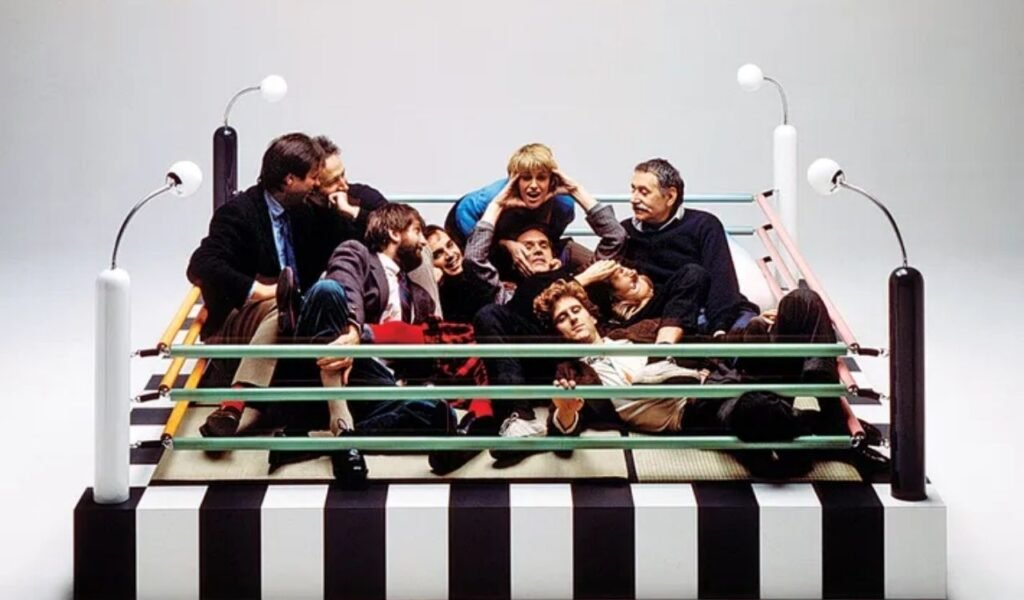
    memphis design
    Photo by Curbed.com

    Memphis Design was a reaction against the clean, linear midcentury modern design of the 1950s and 1960s, as well as the minimalism of the 1970s, with its decorative style filled with pop culture and historical references. Starting with the 1960s, Sottsass was involved in the Radical Design and Anti-Design movements in Italy.

    His early work includes sculptural furniture he dubbed “totems,” which are now on display at prestigious worldwide museums such as the Metropolitan Museum of Art in New York City. Memphis Design was influenced by a resurgence of interest in the Art Deco movement of the 1920s, as well as mid-century Pop Art, both of which were popular trends in the 1980s, with a dash of 1950s kitsch tossed in for good measure.

    Memphis Design was a hit with some people. Others thought it was obnoxious. “A shotgun wedding between Bauhaus and Fisher-Price,” as one critic phrased it.

    Sottsass and his collaborators created unusual, whimsical, rule-breaking designs for decorative glass and metal objects, home accessories, ceramics, lighting, textiles, upholstery, structures, interiors, and brand identities. Sottsass famously quipped, “All we ever heard about when I was young was functionalism, functionalism, functionalism, it isn’t sufficient, sensual and engaging design is also important.”

    memphis design
    Rendered Image of Karl Lagerfeld Bedroom

    Legendary fashion designer Karl Lagerfeld and David Bowie were both huge supporters of the design style in the 1980s. But Memphis Design wasn’t for everyone, and by the end of the decade, the collective had disbanded, with Sottsass quitting in 1985 and several of the group’s other major designers pursuing solo careers after the band disbanded for good in 1988. Alberto Bianchi Albrici bought the Memphis-Milano brand in the 1990s and continues to produce the collective’s original 1980s designs.

    Memphis Design has become a fountain of influence for multi-disciplinary designers, encompassing fashion giants such as Christian Dior and Missoni, as well as new generations of interior designers, type designers, filmmakers, and more, since the early 21st century, as nostalgia for 1980s style has returned.

    So, what was the significance of the name Memphis Design for this Italian-born design movement? Its name is a pun on the Bob Dylan song “Stuck Inside of Mobile with the Memphis Blues Again” from his 1966 Blonde on Blonde album, which was playing on repeat in Sottsass’ living room the night the Memphis Design group had its first official meeting.

    Memphis Design’s Defining Characteristics

    • Shattered preconceived notions of what constitutes excellent taste. 
    • Defamed the Bauhaus design idea of form following function.
    • Unafraid to be loud, outspoken, passionate, playful, and unconstrained. 
    • Created to elicit a strong emotional reaction 
    • Uninhibited, loud, bold, passionate, playful 
    • Colors in unusual combinations are used. 
    • Bold, contrasting designs are used on purpose. 
    • Simple geometric shapes are employed. 
    • Black-and-white graphics are used in this project. 
    • Edges and curves that have been rounded 
    • Squiggles are something I’m fond of. 
    • Terrazzo and plastic laminate are examples of materials used in varied finishes. 
    • Unconventional shapes, like as round table legs, are used to defy expectations.

    In What Way Is Memphis Style Returning?

    In Los Angeles, Memphis design resurfaced in 2005. A year before his death, the LACMA displayed a survey of Sottsass’ creations. 

    Following Sottsass’ death, there was a surge in interest in the Memphis sound. It impacted high-fashion brands Missoni, Karl Lagerfeld, and Christian Dior, with the latter’s 2011 collection serving as a catalyst for the style.
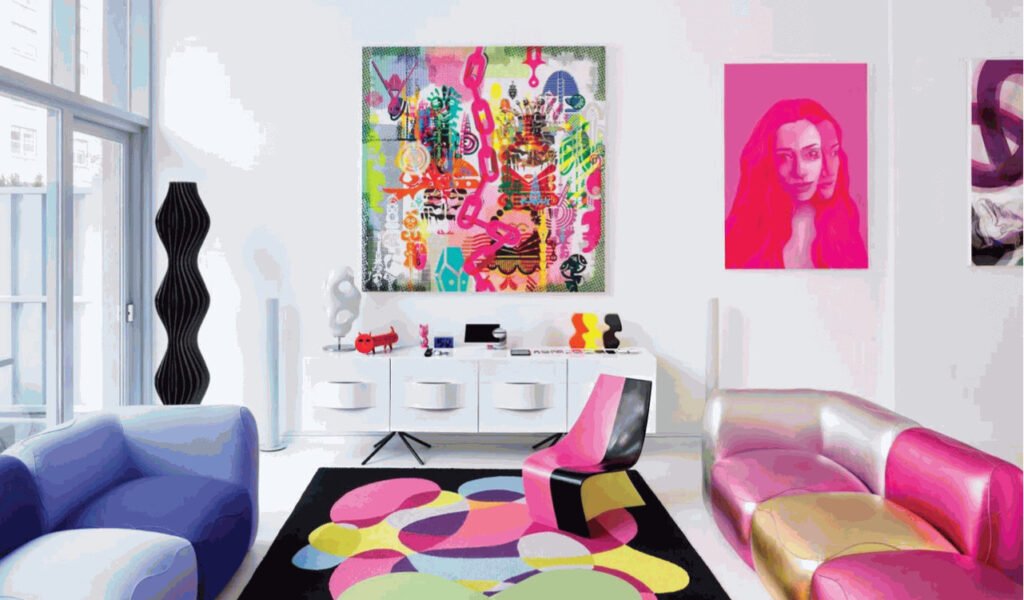
    los angeles
    Karim Rashid’s Home by Curbed.com

    Nathalie Du Pasquier, a founding member of the group, designed a range of patterns for American Apparel several years later in 2014. 

    Alessandro Mendini, who debuted in the first Memphis exhibition, designed a range of skate decks and clothes for Supreme in 2016. 

    West Elm debuted a line from contemporary Du Pasquier-inspired business Dusen Dusen in 2017, bringing the trend to a big box shop. 

    As minimalism took root in the 1990s, Memphis design fell out of favour. Despite this, some 40 years after its revolutionary debut, the “Less is Bore” design philosophy is back in style.

    How To Apply Memphis Design In Today’s World

    For better or worse, Memphis Design is deliberately dramatic, which can make it difficult to work with. It’s also one of those fashions that’s inextricably linked to its epoch, making the distinction between fashionably retro and antiquated a fine one to walk. Despite these challenges, designers all across the world are demonstrating that the style is more adaptable than you may think. Let’s take a look at some of the more recent Memphis Design variations.

    Memphis Design As A Background

    One of the most common methods to incorporate a Memphis Design pattern into the background is to use it as a background. Memphis was designed to call attention to itself, but the bright colours and chaotic patterns can also help foreground things stand out via sheer contrast. 

    A typical strategy is to create a kind of framing for the composition’s subject within the Memphis Design images. Alternatively, a background explosion of abstract colour can be created by scattering shapes directly behind the subject.

    Memphis Miniature Artwork

    Making a solid first impression has always been a priority for Memphis Design. It’s so potent that, like spicy sauce, a small amount is sometimes all you need to give your project a boost. 

    This is why, rather than relying only on showy visuals, many designers these days prefer to use small, scattered forms and lines to evoke Memphis Design. As a result, they are able to replicate some of Memphis’ joyous energy without all of the obnoxious show.

    Memphis Design With Texture

    Although traditional Memphis Design features flat colours and simple black-and-white graphic patterns, several modern designers have added additional variegated textures to the aesthetic. 

    Watercolour and acrylic paints, layered sketch illustrations, rough paper cut-out edges, and gradient are some examples. The technique not only lends a sense of 3D reality to a design that was already springing off the page, but it also creates shading that reduces the severity of Memphis Design.

    Typography Using Memphis Design

    Letterforms are good, predictable shapes for containing Memphis Design’s craziness. Consistent lettering, like a star, can serve as a focal point for the surrounding graphic elements, drawing them in and centring them. 

    Memphis design is frequently layered over the letters themselves. This is especially beneficial when working with 3D writing, as it provides the artist far more surface areas to work with when applying Memphis patterns. This style is best suited to artistic word-marks or hand-lettering projects that can afford to be colourful and inventive at the sacrifice of intelligibility.

    Memphis Design With Organic Touch

    Although Memphis Design was originally known for its harsh geometry, a common reassessment has attempted to incorporate flowing, oblong organic patterns back into contention. These are a logical extension of the wavy lines and spherical shapes that were popularised with the classic Memphis, instead of a significant departure. 

    While some may consider this to be a departure from typical Memphis design, that was never the objective. Memphis was known for violating the rules, so it’s only natural that it would break a few of its own.

    Some Real-Life Examples of Memphis Design

    Paradiso Ibiza Art Hotel

    modernism
    Photo by TheSpace

    Inside the Paradiso Ibiza Art Hotel, Miami modernism and the Memphis Group collide, creating a new hangout that puts art front and centre. The 60-room hideaway, located in San Antonio Bay on the island, is part of the Concept Hotel Group and features brilliantly coloured decor by Ilmio Design. 

    The curving Art Deco-style façade of the hotel has a pair of vertical pink fantails that appear as they belong in South Beach. Inside the flamingo pink foyer, guests will encounter an undulating, sunken seating area with curved forms and sweet colours. Above the aqua-blue-tiled reception counter, neon tube lighting hangs from the ceiling, with a wavy Memphis-style design that recurs throughout the hotel’s interiors. Pop art is displayed throughout the Paradiso Ibiza Art Hotel.

    The Paradiso Ibiza Art Hotel has an art gallery that is open to both guests and the general public, as well as a residency programme called “Zero Suite.” In exchange for putting their expertise on display and taking over the hotel’s social media channels, creatives are housed in a transparent micro workstation cube in the lobby where they may work and live for free. 

    A library with modern art publications, an outdoor theatre, and a tattoo studio are available to guests who want to depart with a permanent souvenir of their stay at the Ibiza hotel.
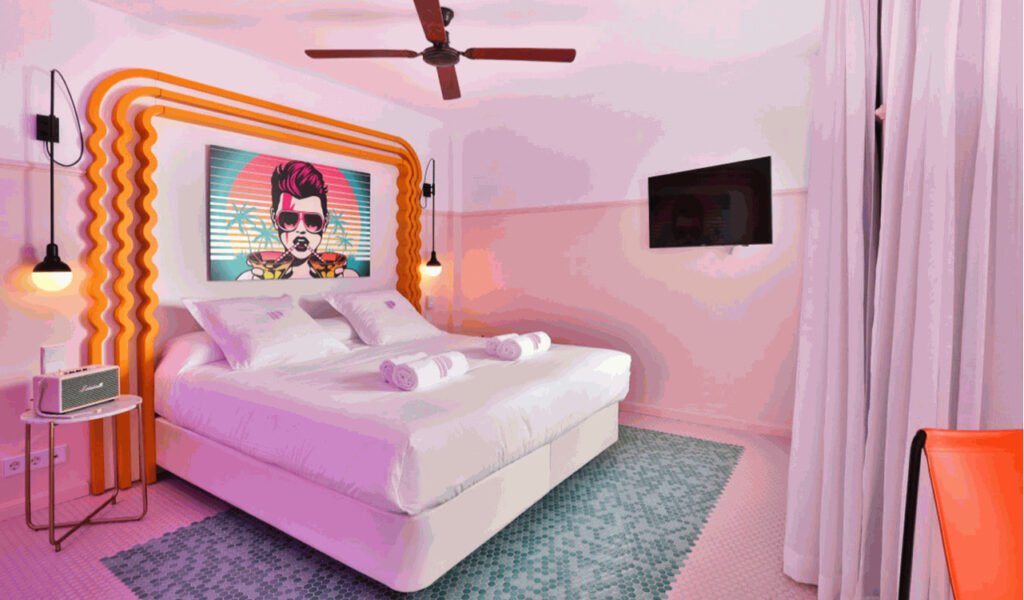
    private guest room

    The private guest rooms of the Paradiso Ibiza Art Hotel are just as vibrant as the lobby, with bursts of yellow, pink, and green that reflect the 1970s theme. They were designed as an extension of the gallery space and are decorated with a changing display of artworks, while the furniture pays homage to Ettore Sottsass’ Memphis designs with bold curves and whimsical nature. 

    The hotel’s rosy-hued swimming pool and lavender tropical vegetation, on the other hand, are on point for the Instagram age.

    Game Over Pizza

    los angeles
    Photo by M-Rad

    At this Los Angeles eatery, diners are transported to a Memphis fever dream, where they may order pizza slices with a heavy dose of nostalgia. 

    Everything from the huge arcade games to the squiggly patterned walls bears homage to a bygone era, with neon-lit Hollywood strip malls serving as inspiration.

    The interiors were designed by M-RAD, who used pink and blue neon lights, a tubular couch, and terrazzo-patterned tables straight from the Saved By the Bell canteen. The aesthetic is completed by a glass brick counter lined with stainless steel and leather stools. 

    interiors

    Diners can devote themselves to Game Over’s collection of ancient arcade machines or whatever 80s cult blockbuster is playing on its big-screen TVs that night after indulging in a 20″ pie.

    Saved By The Bell

    bell themed decor

    With its Saved By The Bell-themed décor and old VHS collection, this time capsule apartment in Texas transports you back to the 1990s. 

    Guests are watched over by New Kids On The Block posters while they sleep under Memphis-patterned bed covers before tucking into a bowl of Lucky Charms for breakfast.

    The owner of the two-bedroom US vacation rental – which starts at £197 per night – has filled the flat with vintage mementos such as an N64 system and a Talk-boy cassette player, as well as 90s music magazines. 

    An accurate reproduction of The Max cafe from the cult TV show Saved By The Bell serves as the main point. The postmodern features, such as the zig-zag door handle and the colourful vinyl-covered benches, will appeal to fans of the show. 

    Don’t worry if all of this makes you nostalgic for the past. A collection of Saved By The Bell videos is also available in the flat.

    The Ultrafragola Mirror
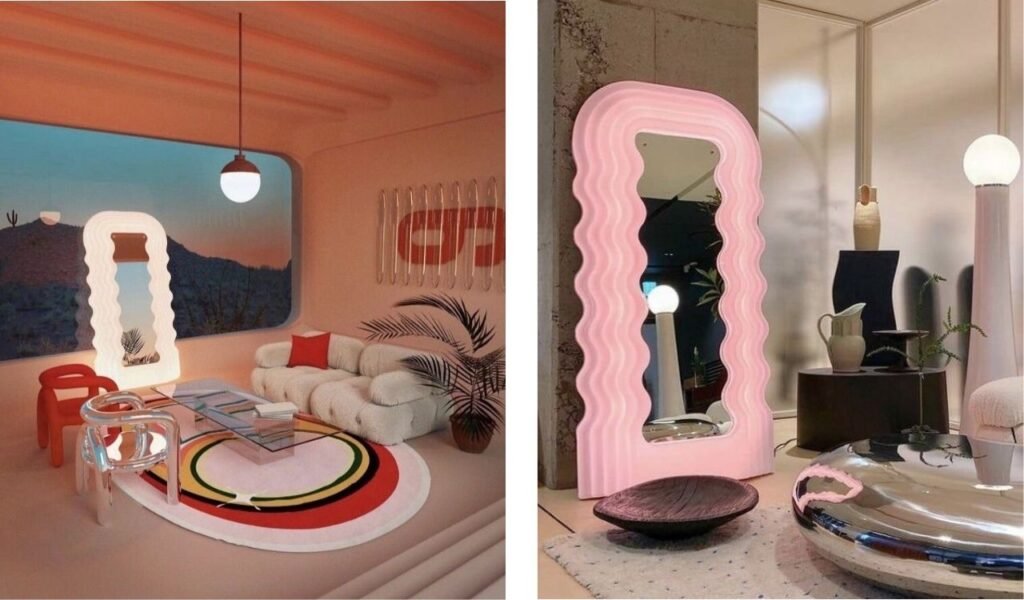
    selfie mirror

    The ultimate selfie mirror that was showcased at Raquel Cayre’s Dream House exhibit in 2018 and has since been owned by celebrities like Katherine Bernahardt, Bella Hadid, Lena Dunham, Kim Jisoo of Blackpink and many more and is also the mirror that inspired this article. 

    Mobili Grigi, a far-out bedroom series designed by architect Ettore Sottsass, was unveiled by Florentine manufacturer Poltronova at the Eurodomus 3 trade show in Milan in 1970. It was part of the brand’s ambition to bring revolutionary industrial materials, which had previously changed nautical and automobile design, into the house, and it was made of smooth, vacuum molded plastic and cast fibreglass. With one exception: the neon-lit pink mirror known as Ultrafragola, or “the ultimate strawberry,” the radical collection was made in a very limited quantity.

    The thermoformed plastic reflector (which appeared a decade before Sottsass founded the Memphis Group) was designed to highlight femininity—the contours of a woman’s figure, the waves of her hair, and a few other key features of her anatomy. That’s what we’d call objectification nowadays. However, women all over the world have flocked to the mirror ($10,500; now available in LED), which is still handcrafted using the original 1970 mould.

    The Memphis Uprising Continues To Gain Momentum

    Memphis Design was more than just a wild guess or a prank by bored designers. It was a defining moment for a decade and an inspiration for a generation. Its energy, freedom, and bright colours are still relevant today, which is why so many people find it so appealing. However, because of its boldness, it can be divisive. Make sure you’re dealing with a professional designer who understands your audience’s “bad taste” if you want to use Memphis Design to excite them in the correct way.

  • Top 10 Best B.Arch Colleges in India

    Top 10 Best B.Arch Colleges in India

    Introduction

    Architecture is the study of the art and the science of building. It is the practice employed to attain both practical and expressive requirements to meet the aesthetic ends. The need for education in the field of architecture is to learn and develop skills to work professionally and cater to the demands of society by making fully functional and aesthetic buildings.

    Listed below are some of the top B.Arch colleges in India that offer a bachelor’s degree.

    Top B.Arch colleges in India that offer a bachelor’s degree.

    1.   IIT Kharagpur

    B.Arch Colleges in India: Photo of Indian Institute of Kharagpur, India
    Photo of Indian Institute of Kharagpur, India

    Course Duration: 5 Years, 10 Semesters

    Tuition Fees: ₹82,000 per Semester

    Admission process: Through JEE main followed by JEE Advanced with AAT (Architecture Aptitude Test)

    Indian Institute of Technology, Kharagpur ensures a holistic integration of science and technology with cultural dimensions of the society. IIT Kharagpur is considered to be one of the best architecture colleges in India. The department of Architecture and Regional planning was introduced in 1952 for an undergraduate course and later in 1959, their first post-graduate degree started. This department claims one of its strengths is to blend modern building design concepts with Indian vision hence providing their students with a culturally rich education for designing buildings.

    Students who want to get admission in this department must have passed class 12 with Physics, Chemistry, and Mathematics as their main subjects. They must have a minimum score of 70% in the 12 board exams to be eligible for giving the next set of entrance exams to get into IIT Kharagpur.

    2.   IIT Roorkee

    Top 10 Best B.Arch Colleges in India Photo of Indian Institute of Technology, Roorkee B.Arch Colleges in India,Best architecture college in India,Top architecture colleges in India,Architecture and design,Architecture colleges in India
    Photo of Indian Institute of Technology, Roorkee

    Course duration: 5 years with 10 semesters.

    Tuition fees: Detailed course fee structure

    Admission process: JEE mains then JEE Advance plus Architecture Aptitude Test

    Among the two prestigious IIT’s that offer a Bachelor’s degree in Architecture, IIT Roorkee comes second having started the program in 1956, and stands among the top architecture colleges in India. There are facilities like a Climatology Lab and Art workshops and recently they introduced their newest addition including a virtual reality lab, laboratory of inclusive design, urban dynamics lab, civic design lab, and industrial design lab.

    With the total number of seats being only 331, the competition is very tough to get into IIT Roorkee. After successfully clearing JEE mains and advance, candidates are required to participate in the state-level counseling process to get admission.

    3.   School of Planning and Architecture, New Delhi

    Architecture colleges in India: Photo of SPA New Delhi
    Architecture colleges in India: Photo of SPA New Delhi

    School of Planning and Architecture Delhi is a Deemed to be University recognized as an Institution of National Importance under an Act of Parliament, 2015. This college ranks 7th among the best B.arch colleges in India.

    School of Planning and Architecture provides two undergraduate courses including B.arch and B.Planning. Admission to SPA is entrance based and the eligibility criteria for admission is that the candidate must have scored at least 50% in their 12 board exams and must include Physics, Maths, and Chemistry ad their major subjects. The application mode for the undergraduate courses is online.

    The course duration is 5 years with 10 semesters. SPA Delhi has provision for 122 students in every batch for the B.Arch program and candidates are selected on the basis of their JEE mains score. The course fee for the first year is ₹1.22 Lakhs.

    4. 
    Sir JJ College of Architecture, Mumbai

    Architecture colleges in India: Photo of Sir JJ College of Architecture by Architectural Digest
    Architecture colleges in India: Photo of Sir JJ College of Architecture by Architectural Digest

    Among all the other Architecture colleges in India, Sir JJ College of Architecture is one of the oldest and most reputed institutions. The Jamsetji Jejeebhoy College of Architecture is an important part of the large campus of the JJ School of Arts. It was set up in 1913 and is located on Dadabhai Naoroji Road. This college was architectured by George Wittet a Scottish architect, who happens to have also designed the Gateway of India.

    Students interested to take admission to Sir JJ College of Architecture must have passed their 12th board with at least 50% marks and should also clear the NATA exams with the minimum required score being 80. Candidates must clear the CET entrance exam of Maharashtra to get admission into this college as they do not consider the results of any other exam for admission.

    Even though the course fee is very low compared to other Architectural Schools in India, ₹17,400 for the first year, Sir JJ College of Architecture also provides plenty of scholarships for the needy.

    5.   National Institute of Technology, Tiruchirappali, Tamil Nadu

    Architecture colleges in India: NIT Trichy, Tamil Nadu
    Architecture colleges in India: NIT Trichy, Tamil Nadu

    NIT Trichy is a Government institute and is considered one of the top architecture colleges in India. Just like the above-mentioned IIT colleges, NIT Tiruchirappalli accepts students who have cleared JEE Mains with Physics, Chemistry, and Maths being the major subjects.

    The duration of this program is 5 years with 2 semesters each year. This institute provides ample materials and resources to a student for successfully completing their degree. They prepare students to be intellectuals and professionals in the field of Architecture and Design.

    6. Jamia Millia Islamia, New Delhi

    Jamia Millia Islamia, New Delhi
    Photo of Jamia Millia Islamia, New Delhi

    Jamia Millia Islamia had a good reputation among all the B.arch colleges in India established in the year 2001. With a limited number of seats, a total of 80, the competition to get into the department of Architecture and Ekistics is tough. This program spans over a duration of 5 years with 10 semesters and a fee of ₹74,690 is to be paid each year.

    7. Chandigarh University

    Chandigarh University
    Photo of Chandigarh University

    Chandigarh University is a private university established in the year 2012 and has secured its position in the list of top architecture colleges in India. It charges a fee of ₹8.04 lakh for the bachelor’s program in Architecture. There are many modern provisions like projectors in every classroom, audiovisual rooms, computer labs with all the softwares pre-installed for a convenient workflow for students.

    The minimum requirement to get admission into the university is for the candidate to have scored at least 50% in their 12th board with Physics, Chemistry, and Mathematics as major subjects. For all  UG courses in this University, there is an entrance exam CUCET, Chandigarh University Common Entrance Test. Candidates have to take this test for merit-based admission and with a good score, the candidate can also bag a  scholarship for the applied course. Along with this entrance, candidates must have cleared the NATA exam with a minimum score of 40%.

    8. Birla Institute of Technology, Mesra

    Photo of BIT, Mesra
    Photo of BIT, Mesra

    Birla Institute of Technology believes in making leaders by providing a knowledge hub to the best students in the country and is known to be one of the best architecture colleges in India. They believe in transforming students into future leaders who can make a significant contribution to society. BIT Mesra is known for providing its students with the best technology for efficient work and training them in the field of Architecture and Design.

    For admissions into the BIT department of architecture, candidates must clear JEE Paper 2 and also score a minimum of 40% in NATA.

    9.  Centre for Environmental Planning and Technology University, Ahmedabad

    Photo of CEPT University by DNA
    Photo of CEPT University by DNA

    Established in the year 1962, CEPT University provides a number of degree courses among which their Architecture course is the most famous one. They are known for specializing in different aspects of the natural and developed environment of human society. They take pride in the list of successful architects they have as their alumni and have links with architectural programs in Europe, the USA, and Australia, promising a bright future with unparalleled opportunities to aspiring students who want to attain a B.Arch degree from CEPT University.

    Along with a Bachelor’s program in Architecture, they also have separate bachelor’s in Interior Design, Construction Technology, Urban Design, and Design. CEPT University is widely known for proving its excellence in teaching Architecture and Design.

    The tuition fee per semester for a bachelor’s program is ₹1,60,000. There are a total of 80 seats for a B.Arch degree. For admissions, candidates can directly apply on the college website. A fee of ₹1500 will be charged to apply for any bachelor’s program.

    10.  Manipal Institute of Technology, Manipal

    Top 10 Best B.Arch Colleges in India Photo of Indian Institute of Technology, Roorkee B.Arch Colleges in India,Best architecture college in India,Top architecture colleges in India,Architecture and design,Architecture colleges in India

    The architecture course at Manipal Institute of Technology is considered to be the most advanced in terms of technology. It is a private university whose approach to architecture is considered cosmopolitan. Manipal Institute is considered to be one of the best architecture colleges in India, having provision for both bachelor’s and master’s programs in architecture that is proven to be one of the best in the country.

    Candidates have to go through the Manipal Entrance Test to get admission into MIT. This entrance test is a computer-based one and takes place in a span of 2 hours and 30 minutes. There are a total of 200 questions and include questions testing Physics, Chemistry, Mathematics, English, and Logical Reasoning. It is an 800 mark test where every correct answer will be given 4 marks and for a wrong answer, there will be a deduction of 1 mark.

    FAQ

    Q: What are the top 10 colleges in India for architecture?
    A: Some of the top 10 architecture colleges in India include IIT Kharagpur, IIT Roorkee, School of Planning and Architecture (SPA) in New Delhi, Sir JJ College of Architecture in Mumbai, National Institute of Technology (NIT) in Tiruchirappalli, Jamia Millia Islamia in New Delhi, Chandigarh University, Birla Institute of Technology (BIT) in Mesra, Centre for Environmental Planning and Technology (CEPT) University in Ahmedabad, and Manipal Institute of Technology in Manipal.

    Q: What are the best architecture colleges in India?
    A: The best architecture colleges in India are subjective and can vary based on individual preferences and criteria. However, some of the most renowned and highly regarded institutions include IIT Kharagpur, IIT Roorkee, SPA in New Delhi, Sir JJ College of Architecture in Mumbai, NIT in Tiruchirappalli, and CEPT University in Ahmedabad, among others.

    Q: How can I get admission to the best colleges for architecture in India?
    A: Admission to the best architecture colleges in India is typically based on entrance exams such as JEE mains followed by JEE Advanced with AAT (Architecture Aptitude Test), NATA (National Aptitude Test in Architecture), and other state-level or university-specific entrance exams. Candidates must also meet the eligibility criteria set by the respective colleges, which often include scoring a minimum percentage in their 12th board exams and meeting specific subject requirements.

    Q: What are the fees for studying architecture in the best colleges in India?
    A: The tuition fees for studying in top 10 colleges in India for architecture can vary depending on the institution. For example, IIT Kharagpur charges approximately ₹82,000 per semester, while SPA in New Delhi charges around ₹1.22 lakhs for the first year. It’s advisable to check the respective college websites for the most up-to-date fee information.

    Q: Are there scholarships available for studying architecture in India?
    A: Yes, many colleges offering architecture courses in India provide scholarships and financial assistance to deserving and needy students. For example, Sir JJ College of Architecture in Mumbai offers scholarships for eligible students. It’s recommended to visit the college websites or contact the admissions office for more information on scholarship opportunities.

    Q: What is the duration for the best colleges for architecture in India?
    A: The duration of the Bachelor of Architecture (B.Arch) course in India is typically five years, divided into 10 semesters. However, the exact duration and structure of the course may vary slightly from one institution to another.

    Q: Can I apply for best architecture courses online in India?
    A: Yes, many colleges and universities offering architecture courses in India allow candidates to apply online through their official websites. Online application processes are usually straightforward and require candidates to fill out the application form, upload necessary documents, and pay the application fee online.

    Q: What are the career prospects after completing a degree in architecture from a top college in India?
    A: Graduates from the top architecture colleges in India have excellent career prospects in various fields such as architecture firms, construction companies, urban planning departments, interior design firms, and more. They can work as architects, urban planners, interior designers, project managers, and consultants, among other roles. Additionally, they can also pursue higher studies or research in specialized areas of architecture.

  • New York City Architecture: Architecture hub of the 21st Century

    New York City Architecture: Architecture hub of the 21st Century

     “To be young and in love in New York City” – I like me better by Lauv was on every playlist a while ago and so is moving to New York, on every millennial and gen z vision board. Every one is infatuated with New York and for all good reasons. Moving to a New York City apartment is on many bucket lists, quite frankly including mine. New York City is famous for its beautiful skylines and glistening evenings. However, in this post, we will look at the New York City architecture, some of which is well-known throughout the world and some of which is hidden in plain sight.

    New York City Architecture is as varied as the folks who reside there. Few cities are as at ease with architectural variation as New York, a metropolis that has always remade itself while never abandoning its history. As a result, it has one of the world’s most vibrant architectural mixtures, with several flagship specimens of their periods. New York City boasts one of the world’s biggest collections of structures, with a diverse variety of architectural styles spanning various historic and cultural periods.

    Not just architecture with great historic significance, NYC houses some supremely aesthetic modernist buildings with brilliant interiors ranging from small cafes to public libraries, even a french bookshop has one of the prettiest ceiling murals in the city. 

    Evolution of New York City Architecture

    New York City has long welcomed people and ideas from all over the world, solidifying its status as a symbol of power, riches, and liberty. New York City architecture symbolizes the city’s transformation from a Danish fur-trading port to a worldwide destination where people from all over the world influenced — and shaped — the city. 

    New York’s architectural language has developed to reflect its evolving requirements and its reciprocal impact on the rest of the globe. From downtown to uptown, the city displays influences from close and distant.

    1800-1900

    Neoclassicism, which lasted from 1780 to 1820, was the first architectural style connected with New York City. Colonnades and arches are two of the most prevalent elements in Neoclassical architecture. The overall building design and space planning generally follow the traditional column pattern: a prominent base with a dramatic entrance, asymmetrical shaft with little ornamentation, and a pronounced summit.

    The Gothic Revival style, which lasted from 1820 to 1860, is similar to the Greek Revival in that it has strong associational values, but instead of tying into politics, it contained religious and natural connotations. This elaborate space planning is famously linked with churches, but it was also employed for houses. It was created with the intention of instilling goodness in the wicked. St. Patrick’s Cathedral, Trinity Church, and Tavern on the Green are some of the most famous Gothic Revival architecture.

    Grand Central Terminal
    Grand Central Terminal

    The Beaux-Arts Classicism trend continued to have an impact on New York City architecture in the early 1900s. From approximately 1890 to 1920, the Beaux-Arts style exaggerated classical references to genuinely super-grandiose dimensions, as seen in the Custom House at Bowling Green, Grand Central Terminal, and the New York Public Library.

    New York City architecture: New York Public Library by RTF
    New York City architecture: New York Public Library by RTF

    1900 – 2000s

    From landmark cultural centres to gleaming glass Modernist buildings, the twentieth and twenty-first centuries have seen a wide range of architectural styles. As the train moved underground, New York made greater use of the precious street-level space left behind, constructing trendy urban projects like Grand Central Terminal and The Barclay, which is now the InterContinental New York Barclay. Projects including Rockefeller Center, which houses the Radio City Music Hall, and Lincoln Center, which both aesthetically and culturally elevated the city, were part of this urban redevelopment.

    Conversely, Frank Lloyd Wright’s Guggenheim Museum design, with its white, curving inverted ziggurat, enhanced New York City’s architecture vocabulary by producing a building that stood up while yet blending in with the physical landscape.

    The early twentieth-century setback style evolved into Art-Deco, which returned to the use of decorative features found in previous architectural styles. However, in the latter part of the twentieth century, a shift to International Style emerged, which had a matchbox form and simple elements. Modern style architecture like Trump Tower, Madison Square Garden, and the World Trade Center Twin Towers are all examples of famous International Style structures that added to the New York Skyline.

    During this time, several of New York’s most iconic buildings were erected. When it was finished in 1930, the location known as 40 Wall Street became the world’s tallest skyscraper, a distinction it only maintained for a few weeks. The Chrysler Structure, an Art Deco architectural landmark that reached 40 Wall Street the same year, was only then eclipsed by the Empire State Building, which had held the title of the tallest building in the world for over four decades.

    In New York City Architecture, the high-rise tendency persists to this day. However, the city is not just growing; it is also redefining its urban landscapes with new icons such as the High Line. The architectural history of New York City is as diverse as the city’s inhabitants. The buildings’ varied designs and rich history were inspired by people from all over the world, and it is ingrained in the city’s fundamental composition.

    The skyscraper, which first appeared at the turn of the twentieth century, changed the New York City skyline forever, simply taking it to new heights. New York, like the structures that make up this incredible city, persists to be a location where ideas become reality, are questioned, and reinvented.

    Iconic Buildings in NYC

    The stability and relevance that New York has offered over the city’s lengthy history distinguish it from all other metropolises. The Brooklyn Bridge, Lady Liberty, and One World Trade Center are just a few of New York’s iconic landmarks and structures. All of these structures are located in New York and have a long history. You might claim that New York is the birthplace of classic Americana fashion, and you would be correct. It’s home to a variety of new structures and modern style architecture, including the breathtaking Oculus, which has received a lot of publicity.

    The significance of New York’s monumental architecture rests in the fact that it has been the source of inspiration for a wide range of projects. The architectural landscape of New York has had a significant impact on other cities; for example, Gurgaon has architectural characteristics that are similar to the New York City architecture and is one of the most identifiable aspects in the globe.

    Globally Known Architecture of NYC

    One Wall Street

    Inside and out, Ralph Walker’s limestone-clad 1 Wall Street is a work of art. The Irving Trust Company originally inhabited the 50-story skyscraper, which was erected around the same time as the Empire State and Chrysler buildings. It has Art Deco setbacks and vertical patterns carved into the faceted exterior, but it’s the interior space planning that makes it truly unique.

    Hildreth Meniere created a magnificent space in the building’s towering double-height lobby on Wall Street, which served as the bank’s first reception room. The Red Room is constructed out of a mosaic of red, gold, and orange tiles produced in Berlin. The Times describes the viewing area on the 49th level as “a gaspingly lofty chamber,” with arched ceilings covered with Philippine shells. Developer Harry Macklowe is currently converting the structure into a residence.

    70s Pine Street

    70 Pine, designed by Clinton & Russell, Holton & George in 1930 for CITGO, was formerly the world’s third-highest building. By today’s standards, it is still rather tall at 952 feet. According to Robins, the structure “rises in subtle setbacks like an ornate, elongated faceted diamond of Indiana limestone and white brick to a glass-enclosed solarium with a lighted lantern” that can be seen from up to 20 miles away.

    The décor and space planning are also noteworthy, with “polychromatic marble, rippling marble walls, coffered plaster ceilings, and stunningly beautiful, abstract geometric Art Deco aluminum metalwork on anything from elevator doors to mailboxes” on display in the lobby spaces following the tower’s recent transformation to rentals.

    Empire State Building

    The Empire State Structure, which was the world’s tallest building when it was completed in 1931, sets the tone for the New York City skyline—but, as Robins points out, the building “has become such an icon beyond its architectural design that its style seems almost beyond the purpose.” The crucial word here is near, because the Shreve, Lamb, and Harmon design incorporate the geometric motifs that are so popular in Art Deco architecture. This is notably evident in the building’s window columns here framed in aluminum.

    Chrysler Building

    When it was opened in 1930, the Chrysler Building was the world’s tallest structure for a brief period of time, but it is now remembered for its beautiful Art Deco architecture. The Chrysler was designed by William Van Alen and is noted for its beautiful, sunburst-patterned crown, majestic eagles on the 61st storey, and radiator caps on the 31st floor, which pay respect to the business whose name graces the structure. It is the second building that holds great significance in the New York City Skyline.

    Paramount Building

    The heritage-listed Paramount Building, located at 1501 Broadway, was erected in 1927 as Paramount Pictures’ headquarter. The building features a stepped-back exterior in keeping with the era, with Art Deco details on its distinctive arched doorway. The Hard Rock Café now occupies a space in this building which plays an important role in New York City architecture.

    30s Rockefeller Plaza

    Rockefeller Plaza

    30 Rock, designed by Raymond Hood and a group of other notable architects of the period, became the focal point of the grandiose Rockefeller Center project. “The skin is simple, contemporary, and unfettered by the desire for stylishness—but stylish nonetheless,” according to the AIA Guide to New York. Perhaps New York City’s most enigmatic modern style architecture landmark. The building, which was once RCA’s headquarters, is currently owned by Comcast.

    New York Public Library


    The New York Public Library, also recognized as the Stephen A. Schwarzman Building and frequently referred to as the main branch of the library system, performs a better job than other world-famous libraries in inspiring and teaching curious minds. It is an essential source of study, a renowned New York City Architecture, and an outstanding Beaux-Arts gem, standing on Fifth Avenue between 40th and 42nd Street.

    New York Public Library
    New York Public Library

    Many New York City architects, notably Carrere & Hastings, attended the Ecole des Beaux-Arts in Paris during the 1880s. The massive library building was also created in the manner of the Ecole des Beaux-Arts. In the early twentieth century, when the term “Beaux-Arts” was not as commonly used, this style was dubbed the “American Renaissance.”

    It blends the ideas of classical Greek architecture and Roman Renaissance ideals. Symmetry, grandeur, ornate decoration, and visual hierarchy are characteristics of the style. Carrere & Hastings used complex decorative elements, lavishly adorned interiors, and magnificent stairways, among other things, to bring the Beaux-Arts style to life in their space planning.

    Flatiron Building

    In 1902, the Flatiron Building, a 22-story steel-framed structure, was finished. Its wedge form, designed by architect Daniel Burnham, fits well within the triangle plot in New York City Architecture that connects Broadway and Fifth Avenue. Whereas many buildings at the period had massive, reinforced bases, the Flatiron is constant from the bottom-up, rendering the architecture all the more attractive.

    MET Museum

    The Metropolitan Museum of Art, created by Richard Morris Hunt, a founding trustee, and architect, opened to the public in late 1902. The Beaux-Arts building on Fifth Avenue in Manhattan became the first public institution to purchase a painting by Henri Matisse in 1910. The two-million-square-foot structure now houses tens of thousands of artworks and artifacts and also hosts the ell-known Met Gala to raise funds. 

    MET Museum
    MET Museum by CNN.COM

    Architecture Details in NYC that goes Unnoticed

    New York City Architecture has several jewels concealed in plain view, despite its frantic pace, neon lights, enormous billboards, and soaring buildings. Let’s look at some of those details that will inspire architects for their next project.

    Informal Walls in Formal Setting

    In the 1970s, when the city was impoverished and crime was rampant, street art and graffiti became popular in New York City Architecture. Kids from the Bronx and Brooklyn who grew up in that atmosphere marked subway trains and buildings, despite the fact that it was reckless and wrong. Their new art genre eventually expanded throughout the world and into NYC museums and art galleries. Ironically, street art is a legitimized activity supported by business owners, community organizations, and even architects.

    Graffiti walls have become a common sight in the streetscape of New York City and one can enjoy this art form almost anywhere in the city. Graffiti Wall of fame, 11th street, and first avenue are some of the many streets to find some spectacular art pieces in the city.

    Cast Iron District

    SOHO
    SOHO by Pinterest

     The Cast Iron District, which comprises 26 blocks and roughly 500 structures, is commonly known as the SoHo district of lower Manhattan. The neighborhood grew into a commercial centre in the nineteenth century, and the bulk of the structures were made of cast iron. Cast iron was found to be more cost-effective than granite and marble, and it could even be used to create decorative exterior components. It was also durable and generally fire-resistant, making it a popular choice in modern style architecture.

    The neighbourhood had deteriorated by the early twentieth century, with the majority of its companies and rich folks have left. This was the time when a significant number of artists flocked to these vast loft spaces, which were very inexpensive for their homes. These artists were instrumental in preserving the neighborhood’s identity. The Landmarks Preservation Commission finally recognized the district, which is largely dominated by retail businesses, as a New York City Architecture landmark.

    Brownstone Buildings

    A trip around Manhattan’s Upper East Side reveals charming vistas of chocolate brown houses. The famous yellow taxis zipping around the city and Manhattan’s sky-high buildings are as distinctive to New York City Architecture as these brownstone residences. Brownstone originally appeared in the United States in the 1780s, at a period when Federal Style building was popular. Brownstone was used at the base and stoop of true Federal Style homes, just below the main door.

    The most well-known Brownstone style in New York City, however, was erected in the late 1800s in the Italianate style. Brownstone is a kind of sandstone that darkens in colour when exposed to air. The bulk of New York City’s brownstone originated from Portland, Connecticut, making it both simple to ship and less expensive than limestone, marbles, and granite. Brooklyn Heights, Fort Greene, Park Slope, and Bedford Stuyvesant are just a few of the Brooklyn areas with a lot of brownstones. These brownstone townhouses are integral parts of some of Manhattan’s and Brooklyn’s most beautiful homes.

    Fire Escapes

    Fire Escapes
    Photo by Sandynoto

    Because fire escapes are such an important element of New York City’s architecture, it’s difficult to overlook them. Around 1860, metal stairwells began to emerge on building facades as a legal requirement at a period when many structures were prone to deadly fires. Some buildings used pulley systems to allow occupants down in baskets before the enforcement of a real metal stair, and other structures utilized ropes to escape before the enforcement of an actual metal stair. The outdoor fire stair has to be built on the street-facing side of the building, with rigorous usage guidelines.

    In quest of additional room, New Yorkers began repurposing the extra balcony space for a variety of uses. They are frequently glorified in films, although they are actually quite filthy rather than glamorous. These fire escapes are proven to be community builders for neighbourhoods in today’s environment, where city people are urged to stay indoors. During times of quarantine, many New Yorkers have transformed this little area into a mini paradise.

    Juliet Balconies

    Juliet balconies are generally long and narrow outdoor platforms accessible through glass doors or big windows. Juliet balconies are not huge protuberances by definition. They might barely be a few feet or even inches long. It’s sometimes possible to stand on them, and the larger can even accommodate a couple of outdoor chairs. The tiniest, on the other hand, can’t even accommodate a plant, let alone a human, and are only used to visually open up the space. For safety reasons, they are always bordered by railings or
    a barrier. Also, for aesthetic reasons, the railings might be extremely ornate.

    Juliet Balconies
    Source

    You are certain to notice unusual architectural elements in the New York City Architecture if it allows you to glance up from its typical turmoil without being rushed in your way. Juliet Balcony is one of these elements. A Juliet balcony is a very thin metal balcony installed outside French windows. The name derives from Shakespeare’s famous heroine Juliet. They were mostly included for aesthetics, but because they were just a few inches broad, they were essentially worthless. There have been numerous debates concerning the necessity of these balconies, however, when a Juliet balcony is present, the facades of certain buildings are embellished with an appeal.

    New York City’s multi-faceted and dynamic personality would be incomplete without these architectural subtleties that adorn, enrich, and enhance it. New York City is not a city with a uniform architectural style, which is one of the qualities that makes it so spectacular. However, plenty of the city’s most recognizable structures have a common theme: Art Deco architecture, as seen in the Chrysler and Empire State Buildings, to list a few.

    New York is the birthplace of concepts, architects, and accomplishments. All of these accomplishments have been achieved in the past, are being made now, and will continue being made in the future.

  • Top 10 Best M.Arch Colleges in India

    Top 10 Best M.Arch Colleges in India

    Introduction

    Learning is essential and never-ending part of our existence. We learn in order to gain knowledge and skills that bring us opportunities and advancement professionally. Learning is a way to nourish our minds and become confident individuals.

    After completing a bachelor’s program many students get into a Master’s program in order to enhance their knowledge on the subject of their interest. Getting a Master’s will help individual gain expertise in a particular field which will help one grow professionally and move into a financially secure future.

    After finalizing to study further and getting a Master’s in the subject of interest you will need a list of M.Arch colleges in India and this article presents to you with a list of architecture colleges in India that offer a Master’s program and all the details one would need to get admission into these colleges.

    Top M.Arch colleges in India that offer a bachelor’s degree.

    1. IIT ROORKEE

    M.Arch Colleges in India
    INDIAN INSTITUTE OF TECHNOLOGY, ROORKEE

    In IIT Roorkee, one of the top architecture colleges in India, offer two different Masters program which includes a Master’s in Architecture and a Master’s in Urban and Rural planning.

    M.ARCH

    The minimum educational qualification for getting in their Master in Architecture program is for the candidate to have successfully completed B.Arch with at least 6 CGPA on a 10 point scale. Candidate must have qualified GATE Exam as the selection is 70% based on GATE score and 30% on merit.

    The application is to be filled online and for the PG form, a fee of ₹300 will be charged.

    The tuition fee is around INR 1.5 Lakhs to 2 Lakh per annum.

    Students are advised to thoroughly go through their PG Brochure and keeping all the required documents and copies beforehand for successfully applying to IIT Roorkee.

    M.U.R.P

    For applying for a Master in Urban and Rural Planning, a candidate must have completed B.arch or Bachelors in Civil engineering/B.Planning. Apart from this, all other requirements are similar to their M.Arch program.

    2. CEPT, Ahmedabad

    CEPT, Ahmedabad
    CEPT, Ahmedabad

    Centre of Environmental Planning and Technology offers multiple Master’s programs to choose from. CEPT is considered the best architecture college in India as it not only provides its students an in-depth understanding of all processes involved in the construction and design of a building but also provides them with a vast number of research centers to develop professional-level skills. This University focuses on developing students to work and produce socially beneficial buildings. They train students into professionals who give importance to both Architecture and Design.

    Students are offered five different programs to choose from Faculty of Architecture, Faculty of Planning, Faculty of Design, Faculty of Technology, and lastly Faculty of Management.

    Faculty of Architecture

    The Faculty of Architecture at CEPT believes an architect has the most impact on a societal change hence they aim at providing their students a broad cultural exposure transforming them into responsible and critical thinkers.

    Aspiring candidates are offered four independent Master’s degrees to choose from namely

    • Architectural Design

    Students with a Bachelor’s in Architecture or any equivalent course credited by COA can apply to this program. There is a minimum requirement of 55% marks in the bachelor’s degree to be eligible for admission. Candidates can apply online for selection. Students need to provide a portfolio of their academic and professional work, a list of references, and a CV along with a bachelor’s mark sheet while submitting the application. Once a candidate’s application is selected they are informed to give an interview as the next step followed by a test with multiple-choice questions based on their specialist selection.

    Course fee ranges between INR 3.5 Lakhs to 4 Lakhs per annum. CEPT prioritizes education and provides multiple scholarships between 25% to 75% of the tuition fee to its students. Candidates who need scholarships have been given a test in order to receive this scholarship.


    • Architectural History and Research
    Architectural History and Research
    Source Unsplash

    Through this program, they aim to prepare students to analyze and critique buildings and other forms of architectural practices. They equip students with skills that will help them narrate their vision in an engaging way to fascinate both academic and non-academic audiences. They prepare students for the next step that is to carry out a Ph.D. research.

    The eligibility criteria and admission process remain the same as mentioned above under the Faculty of Architecture section.

    • Conservation and Regeneration

    The course duration for Masters in Conservation and Regeneration is two years. The main focus of this course will be educating its students about the history of built environments, urban areas, and community engagement in order to explore the relationship between conservation practice and urban regeneration. They aim to help students learn and develop an understanding of the evolving conservation practices.

    • Landscape Architecture

    It is one of the most common courses found in colleges offering a Master’s across the country. CEPT has been teaching this program for the past 28 years and preparing its students for both natural and man-made design challenges.

    3. SPA, New Delhi

    SPA, New Delhi
    SPA, New Delhi by CareerWorld

    School of Planning and Architecture was founded in 1941. They aim at teaching students the cultural aspects of architecture.

    They offer a Master’s in Urban Design, Industrial Design, Landscape Architecture, and Building Engineering and Management. Candidates are eligible to apply if they have scored at least 55% in their bachelor’s degree and have a completion certificate of Bachelor’s in Architecture.

    Students have to apply online for a Master’s program and should provide their bachelor’s performance sheet, academic and professional portfolio, letters of recommendation, and a statement of purpose.

    4. Sir JJ College of Architecture, Mumbai

    Sir JJ College of Architecture
    Sir JJ College of Architecture by Shiksha.com

    Sir JJ College of Architecture was established in 1913 and has a very good reputation when it comes to training its students in the field of Arts and Architecture. Their students are trained to design in a highly vivid and visual way to communicate their thoughts through Architecture.

    Sir JJ College of Architecture offers a Master’s specialization in Housing Projects, both urban and rural, Industrial projects, Institutional projects, Commercial projects, Infrastructure Projects, and Urban Design. They also provide specializations in urban renewal, interventions in heritage precincts, environmental design projects, and hybrid building projects. Their style of teaching is more research-based with architectural research as one of the subjects in all four semesters. Course details for each semester can be found at this link.

    For admissions, candidates have to apply online and will be selected through Maharashtra CET. The entrance test is called MAH-M. ARCH CET and once the candidate clears the test they will have to go through a GD-PI round and clearing that will ensure their seat for the desired course. A total of only 12 seats are available for M.arch in Sir JJ College of Architecture. The annual fee is around ₹18000.

    5. Chandigarh College of Architecture, Chandigarh

    Chandigarh College of Architecture
    Chandigarh College of Architecture by career360

    Chandigarh College emphasizes training its students to become critical thinkers with a better understanding of the environment. They provide a course that aims at addressing the various advanced subjects which are important in the current context of Architecture. Chandigarh College prepares its students to be good decision-makers with efficiency in their work. Training students to have a holistic approach towards establishing the new normals in building design with sustainability being the main focus.

    For the Master’s program, a total of 20 seats are available and students who have scored a minimum of 55% in their Bachelor’s degree are eligible for applying to Chandigarh College of Architecture.

    6.  Manipal School of Architecture and Planning , Manipal

    Manipal University
    Manipal University

    The two-year Master’s program offered by Manipal School of Architecture and Planning specializes in Urban Design and Development. A student is qualified to apply if a minimum of 50% score in B.arch is obtained by them. Candidates can easily apply online for admissions. Selection into this program is merit-based upon qualifying GATE exam and one must also submit a statement of purpose and portfolio of their past work while submitting their application online.


    The tuition fee for one year in this institution is ₹ 1,90,000 but a student who has scored 70% or above can apply for scholarships provided by the university.

    7.  Jawaharlal Nehru Architecture and Fine Arts University, Hyderabad

    Jawaharlal Nehru School of Architecture
    Jawaharlal Nehru School of Architecture

    Established early in the year 1940 as Nizam College of Fine Arts and Architecture, this institute evolved over the years and finally emerged as the School of Planning and Architecture in the year 1989. They offer a Master’s in three different sectors Urban and Regional Planning, Environmental Design, and Interior Design. The Urban and Regional Planning program falls under M.Tech and the other two are considered M.Arch programs.

    M.Arch in Environmental Design

    This program focuses on helping students learn the history of environmental design in order to reach maximum excellence while designing for society. They provide education encompassing all of the urban design, landscape design, and environmental design-related issues. Research methodologies are highly encouraged for preparing research papers as a part of the curriculum.

    Eligibility criteria for admission state for the candidate to have completed their Bachelor’s in Architecture from a COA credited college. And for final selection after application students have to pass the entrance exam conducted by the University.

    M.Arch in Interior Design

    For a Master’s in Interior Design, a student is expected to be highly passionate about this subject and the rest is taken care of. Jawaharlal Nehru School of Architecture and Planning offers a studio-based approach to encourage students to work in a professional and highly functional environment. Its fast-paced nature prepares students to make better quicker and efficient decisions in the future.

    The admission and application process remains the same as the Masters in Environmental Design.

    Course Fee for M.Arch here is ₹70,000 per year with the course duration being two years in total.

    8. Rizvi College of Architecture, Mumbai

    Rizvi College of Architecture, Mumbai
    Source ihindustan

    Rizvi College of Architecture was established in 1992 and offers a Bachelor’s program as well as a Master’s program in Architecture. They thrive to work towards excellence and Sustainable humane development.

    To get into their Master’s program students have to complete a Bachelor’s in Architecture with a minimum of 50% from a recognized university. There are four different courses in their Master’s program for students to choose from – Architecture, Urban Design, Urban and Regional Planning, and Environmental Architecture. There are a total of 20 seats for Masters. Admissions are offered both online and offline but a student must clear the NATA exam before applying for Rizvi’s Master’s Degree. An application fee of ₹800 will be charged after applying online.  

    The course fee will be around ₹ 1.95 Lakhs for the first year. Candidates must carry legal documents mentioned in their application form while visiting for admissions.

    9.  SRM University, Chennai

    SRM University by sify
    SRM University by sify

    Sri Ramaswamy Memorial Institute of Science and Technology, formerly known as SRM University was established in the year 2002 and has since reached milestones that very few universities could. They claim to provide the most innovative programs across the country which prepares graduates to tackle all the challenges that come their way.

    M.Arch program offered by SRM is structured in a way to educate students who have aspirations for creating large-scale projects and metro-level urban facilities. This program trains scholars to specialize in designing and constructing high-rise structures, airports, stadiums, and environmental planning of large spaces. M.Arch program in SRM is considered one of India’s most comprehensive programs in Architecture as it focuses on handling the contemporary issues of the present-day, like sustainability and urban redevelopment.

    Minimum qualification for enrolling into SRM requires students to have scored at least 50% in their bachelor’s program. Admissions are done based on a student’s qualifying entrance exam score as well as the institute’s own entrance test. SRM Chennai takes pride in the plethora of achievements their students bring to their university making it really tough for every aspiring candidate to get admission into this college. Students are required to do thorough research and prepare themselves before applying to this university.

    10. Sushant School of Arts and Architecture, Gurgaon

    Sushant School of Art and Architecture
    Sushant School of Art and Architecture by Facebook

    Started as a flagship higher education institute of Chiranjiv Charitable trust in 1989, Sushant School of Art and Architecture has proved to be one of the top architecture colleges in the country. What makes this university stand out among others is them offers new programs with the intention of filling the gaps perceived in this architecture industry. Not only do they offer a UG and PG program but also have ongoing summer and winter school programs in order to train high schoolers about architecture and its education.

    M.Arch program here in SAA aims at taking in students and transforming them into leaders with the talent of critical thinking that will enable them to engage in evolving research and design techniques. The coursework includes design studio, critical thinking tracks, writing research papers, discursive seminars, and choice-based electives providing immense opportunities to expand and deepen the learning and understanding in the field.

    M.Arch in Built Heritage

    This program aims at educating graduates about built heritage and how it can be sustained. They help students learn by participating in real-world situations by involving private investors, government and non-government agencies.

    M.Arch in Interior Architecture

    It aims to inform the students by helping them understand the principles underpinning the design and how they should influence their choices of systems, materials, and construction methods. The main emphasis will be on spatial design as well as surface embellishments.

    M.Arch in Landscape Architecture

    They help graduates in establishing the best in the given environment and designing high-quality built and natural landscapes.

    M.Arch in Urban Design

    The program identifies the role of the urban designer in redefining the 21st-century urban landscape and develops new paradigms of research, practice, and pedagogy to meet the challenges of urbanization with a focus on sustainability and heritage. They provide students with opportunities to work closely with the city’s development authorities and address the concerns as part of the Master’s program.

    For all the above-mentioned Masters’s courses, the eligibility criteria are for candidates to have scored 50% marks in their bachelor’s degree and must clear the GATE entrance exam. Students with qualifying marks in GATE will be provided ₹7000 as a scholarship amount. After successfully completing the application process candidates will be required to sit for a personal interview only after that will the student be given admission into SAA.

  • Parisian Design: Indian Apartments inspired from Parisian Interiors

    Parisian Design: Indian Apartments inspired from Parisian Interiors

    Paris is without a doubt one of the world’s most glamorous cities. The French capital understands how to make everything look uber elegant, whether it’s clothes or furnishings. So we don’t turn down a chance to see inside a Parisian home.

    French style appears to be ever-so-stylish. After all, with its envious fashion, gastronomy, design, and lifestyle, Paris is the epicentre of luxury. And, of course, there are the magnificent French châteaux. Whether it’s a living room, dining room, or foyer, each space has its own je ne sais quoi, distinct personality.

    Vintage furniture with gold accents, sumptuous tapestries, and towering chandeliers—not to forget a fresh bouquet for a splash of colour, just a few of the touches that give these spaces character and a particularly Parisian feel.

    In this article, I will tell you how some designers have transformed Indian apartments into chic Parisian pied-à-terre. 

    Parisian Interiors

    What comes to mind when you imagine a quintessential Parisian apartment, it’s most likely a traditionally magnificent 19th-century Haussmanian architecture with high ceilings, big French windows, finely carved mouldings, marble fireplaces, herringbone oak flooring, with wrought-iron balconies. Anything looks good in a room with those great bones.

    Many Parisians, however, live in a considerably fewer movie set apartments and manage to create stylish, dreamy spaces with an approach that is as much about attitude and style as it is about space.

    What will follow is a list of factors that make a Parisian apartment chic and desirable. 

    Blend old and new

    The French can give a sense of sleek refinement to any environment by combining old and new elements. Restore old furniture with classic style and free-flowing lines with a coat of paint and new paisley upholstery. Parisians adore one-of-a-kind, fashion-forward goods. It’s all about the details that make a difference.

    Simply defined, the key to mastering the Parisian modern look is contrast. It is imperative to integrate a variety of design styles and materials. Always include a few edgier pieces to create visual interest and avoid going too delicate, feminine, or classic. Consider an elegant gilt mirror next to a modern accent chair, or a sculptural chandelier above an antique dining table.

    Maintain the Au Naturale state of things

    Over the contrived and over-styled, Parisian contemporary embraces all things natural. It’s okay, if not preferred, for rooms to feel a little unfinished, just like that perfectly imperfect, messy bun they’ve perfected. Consider vases packed with a particular fresh flowers, half-burned candles strewn about, and slightly crumpled linens. Instead of like a museum, your workplace should be warm and inviting.

    A Neutral Colour Palette

    French decorators keep their walls low key to keep the focus on the decor items. White is the most popular colour, but subtle pastel colours like rich cream or silken beige are also popular. In French artistic sensibilities, bright or vivid colours have no place. This decorating style expertly combines colours, tints, and hues to add visual poetry. After all, it’s not for nothing that Paris is known as the world’s design centre!

    parisian

    Celebrate Architecture

    Good bones are the foundation of the Parisian style. With a canvas like this, it’s no surprise that Parisian modern spaces feel so refined. Herringbone floors, ornate moldings, and elaborate fireplaces Installing architectural features like picture moulding, a fireplace, and natural wood flooring may transform your home substantially if you’re up for a labour of design love.

    Floral Arrangements

    Fresh flowers can be found in plenty in France, whether as a posy on a street corner or large buckets of garden roses on a table. Bring a little touch of Paris into your home with a beautiful vase of flowers that will brighten up your space and lift your spirits. Allow the blooms to blossom to their full potential; you can never have too much beauty in your life!

    Take note of lighting

    In French design, lighting is crucial. Ornate chandeliers with crystals and delicate ironwork ornamentation are commonly used to light ceilings. Table lamps with pleated shades and ruffled valances, as well as wall sconces with elaborate decorations, can add French touches to your house.

    architecture
    Photo on Unsplash

    Elegant Drapes and Complimenting Rugs

    Free-flowing silky curtains that soak into the floor and are held back by fluted valances and tie backs can establish the scene in these residences, which are high on luxury. Pleated details, lacey edges, and romantic designs are all the rage right now. Rugs and carpets that complement your walls will add to the sense of muted sophistication.

    Gilded Mirror

    Mirrors are a must-have in a French-inspired home, and the more the better! These mirrors come in a variety of shapes and sizes, with frames that are decorated in enamel, wrought iron, or even gold or bronze. For a sense of sophistication, hang them or prop them against the walls. If you’re going for the full French experience, add some mirrors to your French kitchen for a unique twist.

    Add a little bit of YOU!

    People prefer the Parisian Modern style because it appears to be curated and collected rather than cookie-cutter. Make room for treasured heirlooms and valued antique treasures as a general rule, whether it’s a broken tea collection from your granny or a vintage work of art that appeals to you. Take the time to accumulate meaningful objects and decor.

    Some Design Ideas to transform Your Indian Home into a Chic Parisian Pied-á-Terre

    • Even in your French kitchen, use warm, neutral colours that go well together. 
    • Maintain a straightforward colour scheme. Small splashes of colour here and there add to the overall look, although harsh colours are discouraged. 
    • Let your life experiences to affect your décor by combining vintage and additional elements. 
    • Plants, wall hangings, artwork, and books can all be used as accents.
    • Pay close attention to the smallest elements on the walls, ceiling, and floor. 
    • Add wall panels to add elegance and texture
    • Choose items with opulent textures and patterns that evoke a sense of opulence. 
    • Choose draperies and rugs that are lush and sumptuous. 
    • There should be no element that takes precedence over the others; they are all equally vital.

    Indian Homes with Parisian Interiors

    Netflix hit Emily in Paris inspired Mumbai Apartment

    Emily in Paris, a Netflix smash, allowing viewers to escape for a little time into a city that is a moving postcard amid a pandemic. Paris, oh, Paris! Not only did the presentation highlight the protagonist’s Chanel-heavy clothing, but it also highlighted the city’s magnificent architecture! 

    Designer Noorein Kapoor set out to create an interior design story for a 913-square-foot property in Mumbai, which has two bedrooms for a couple expecting a baby, with this romantic theme in mind. The Paris theme worked brilliantly because the lady of the house works for a Mumbai-based French company, so what Kapoor set out to accomplish was met with a great streak of serendipity.

    The Doorway 

    The home’s first appearance, like the show, is spectacular and appealing. The wall mouldings, together with the stylish black door and the chequered flooring, provide a lasting impact. The designer used monotone in the entrance foyer to create the impression of a jewel box.

    The patterned flooring provides depth to the motif, while the white passageway walls help create the feeling of spaciousness. They took off the old flooring and replaced it with black-and-white marble stone from Topstona, Jaipur. Mouldings or wainscotings are a vital part of all Parisian-style residences, and the designer used colours to flow from one space to the next while keeping the wall adornments consistent.


    The Space In Between

    design
    Living Room Photo on AD

    The swing chair, herringbone flooring, ornamental ceiling, and chandelier add refinement to the area, giving it a parlour-like feeling as if it were designed for great tea parties. The curved sofa was necessary for two primary reasons: one, to stay loyal to the design aesthetic, and two, to make room in the living room for a dining table. A small eating space is within the living room. The little but unexpectedly sophisticated area is the ideal utilitarian addition to any home.

    parisian

    The Way Through

    The lengthy, art-filled hallway leads to the bedrooms, and the bird lights serve as sculptural illumination, illuminating the path throughout the apartment. The home’s monochrome aesthetic is complemented with tiny black-and-white images on the walls.

    The Bedroom

    bedroom

    The blue walls, the four-poster bed, and the floor-to-ceiling windows are all whimsical aspects in this cocoon-like refuge. The bedroom’s wall colour was influenced by Emily’s meeting room in Paris. Terra Luna is a blue colour from Asian Paints. The bed was Kapoor’s unique endeavour, as she designed it herself in their workshop with the help of their in-house crew.

    A Parisian-chic Pied-á-Terre in Mumbai

    This home by Jason Wadhwani Design Studio is a French-style paradise, filled with fine artworks, à la mode furnishings, and a definitely French feel. The strong dosage of monochrome is the first thing you’ll notice when you walk into this Mumbai home. As a house for a millennial couple, it has a modern feel while still preserving some quirkiness. The architect drew inspiration from Parisian design and made white wainscoting and French wall mouldings the apartment’s unifying theme.

    The Entrance

    entrance
    Photo by AD

    A lengthy passage leads to the living room and dining room, defining the entrance. The waiting area is anchored to the left by a charcoal wall, which serves as an appropriate backdrop for the bespoke leather chaise longue. The basic backdrop is given an attractive, impressionistic twist by art prints from a local artist in Lisbon.

    The Living Room

    living room

    The living area is transformed into a luminous paradise by a rolling expanse of pure white marble. The area has a typical country chateau feel to it, thanks to the French-style mouldings on the walls. The room’s focal point is the TV unit, which is flanked by two glass-front etageres, while modest wall sconces offer a layer of understated elegance. Wadhwani created a mix of store-bought and custom-made items for the furnishing plan.

    The Dining Room

    dining room

    Broad strokes of indigo and white are used to accent the dining room. All eyes are drawn to the end of the room by the veneer-topped wooden dining table and blue upholstered seats. The main point of the room is a stunning monochrome sideboard that Wadhwani custom-designed.

    The Bedroom

    The main bedroom has a bespoke bed and side tables made of wood and brass. The slate grey headboard is set back from the wall, enabling the panelled wall above to take centre stage. The pared-back design is complemented by a brass display cabinet by the window.

    Parents Room

    The parents’ bedroom is opulently decorated in rich jewel tones. The wall above the headboard is accented with a mottled, moss-effect wallpaper overlaid by a wooden grid, while the wall opposite is enlivened by a neon graphic art poster. The room is finished with an emerald-upholstered headboard and a black-and-white striped Josmo recliner.

    Dressing Room for Parents

    The parent’s dressing room, encased in jade, leaf-printed wallpaper, exudes a distinct tropical vibe. With its crazy charm, the mirror, a geometric spin on Mediterranean arches, steals the show.

    Den

    The den is designed to be a cosy refuge as a multipurpose area. A tufted beige sofa gives abundant space for lounging, reading, and movie evenings, while a sleek study surface is provided by a bijou workstation on the opposite wall.

    A Parisian styled Bangalore Home

    Natural light, golden, elusive, and amorphous, has a way of enveloping a space in various ways at dawn and twilight, by daytime and moonlight, dazzling and fading before disappearing entirely. When Shernavaz Bharucha was building a couple’s two-bedroom nest in the Garden City, she was inspired by this phenomena of altering light.

    The Entrance 

    entrance
    Photo by AD

    Perhaps it’s the piano-key marble tiles that bring harmony to the foyer, or the traditional mouldings highlighted with enormous mirrors, but there’s something about the foyer that harkens back to a black-and-white, silent-movie-era Paris. While a sculptural chandelier by Aura blossoms from the ceiling, an artwork adds a splash of colour to the muted monochrome.

    The Living room

    living room

    Indigo and white dominate the formal living room, leaving no room for pomp or whimsy. The seating space is anchored by Goodlines sofas, while a hole in the elevator serves as a stunning art installation.

    The Dining Room

    A custom circular dining table by Goodlines balances out the angular definitions on the periphery of the room. Tufted seats by BoConcept are arranged around the table, and a chandelier hangs over it. A corrugated storage box serves as the dining room’s backdrop.

    The Master Bedroom 

    The main bedroom features a subtle duet of grey and royal blue, with clean lines and muted accents that inspire comfort. A deep-blue upholstered tableau frames the bed, which is flanked by grey panels. Goodlines designed the bed and nightstands. 

    The Master Bathroom

    In the main bathroom, pewter marble creates a calm, yet sophisticated atmosphere. The mirrored wall multiplies the quadrangular floor patterns.

  • The architecture of Luxury Stores

    The architecture of Luxury Stores

    Flagship shops are retail venues where the experiential, cultural, and branding elements take precedence over sales. The branding duties of luxury stores are critical in establishing new markets, cultivating current relationships, and instilling brand devotion among followers. Several marketing and architectural tactics are used by brands to achieve this goal.

    “Fashion is like Architecture, it is a matter of proportions,” said Coco Chanel. The relationship between fashion and architecture has always been strong, as evidenced by recent collaborations between brands and well-known architects: consider the Whitney Bag, designed by Renzo Piano in collaboration with Max Mara, but most notably the Virgil Abloh for IKEA collection of home objects.

    Since the architects became archistars, this conversation has been even more heated. As a result, many fashion businesses have enlisted the help of several well-known designers to create the interiors of their high-end boutiques. So, what was the outcome? A collection of art installations that resemble stores around the globe.

    Louis Vuitton

    Louis Vuitton luxury store in Tokyo

    luxury store
    Photo by NSS Magazine

    In early 2021, the new Louis Vuitton boutique building in Tokyo, designed by Jun Aoki and Peter Marino, was officially unveiled. The new building, which is located in Ginza’s historic district, on the same street corner where the brand’s boutique has been since 1981, has an external glass surface that imitates water waves with iridescent reflections; the same aquatic and wavy theme is replicated in the interiors, which are decorated by a giant jellyfish sculpture and equipped with a wavy staircase. Inside, the store is divided into four levels, with a VIP lounge on the fourth floor.

    store

    New York, 5th Avenue

    New york

    At the intersection of Fifth and 57th Streets, Louis Vuitton is right at home, not far from Central Park yet smack in the thick of Manhattan’s midtown shopping.

    What was previously an Art Deco structure has been turned into a modern near to facade that is “a playfully elegant meditation on crystalline transparency and cloudy translucency,” according to architect Jun Aoki.

    The three-story “Feature Wall,” which runs from the base to the top of the retail volume, is the focal point of the New York interior. The luminous wall can switch from vivid jewel tones to hazy pastels, and it may also be used as a display for still photos and films. 

    The cantilevered bronze-clad staircase and a hovering wall of vintage trunks are only two examples of the store’s light and fluidity, as well as its history and tradition.

    Beirut

    louis vuitton
    Photo by LV

    In the heart of Beirut’s bustling downtown district, Louis Vuitton is located. The periphery is lined with restored souks, cultured locals mingle with international visitors, and the golden architecture breathes life into the atmosphere. 

    The beautifully restored 1920s townhouse where Louis Vuitton calls home evokes a bygone era’s elegance.

    Classic Vuitton signatures were imported into the restored townhouse by architect Peter Marino, including beige and brown marble stone floors, off-white bleached Aniegre wooden panelling, a metal ring netting posing as the monogram flower, and a collection of vintage trunks and luggage pieces displayed on the ground floor. It comprises two storeys with a total area of 270 square metres.

    Vendome in Paris

    Vendome
    Photo by THE SPACES

    The Place Vendôme, like the Château de Versailles, is among the most stunning specimens of 17th-century French creativity. It was only right for Louis Vuitton, as the worthy heir to this history, to build workshops and present its products in the heart of Place Vendôme, guaranteeing that the legacy lives on for future generations.

    It commemorates the House’s triumphant return to the neighbourhood where, in 1854, a young Louis Vuitton launched his first store, kicking off a legacy that spans over 150 years.

    The façade, designed by Jules Hardouin-Mansart, the architect of the Palace of Versailles, has been meticulously restored to its original architectural cadence.

    The Maison Louis Vuitton Vendôme is housed in two hotels particuliers that New York-based architect Peter Marino has lovingly restored to its former splendour. The Vendôme Maison Louis Vuitton is a sophisticated blend of neo-classical proportions and contemporary forms, traditional materials and innovative processes, rich details and breathtaking artworks. 

    The Maison is a testament to savoir-faire and the force of restrained simplicity, from the street-level show windows and ironwork doors to the phenomenally high ceilings that give the first floor its sense of luminous expanse.

    London

    London
    Photo by THE SPACES

    The building’s façade has been transformed into a kaleidoscopic explosion of the brand’s monograms, while the interior has been redesigned as a double-height gallery-cum-store. Sarah Crowner, Jim Lambie, Josh Sperling, and Farhad Moshiri are among the 43 site-specific artworks and installations strewn across the 17,500 sq ft store.

    Staircase

    A striking double helix-shaped staircase runs the length of the store, anchoring the retail floor. It features an oak offset centre with concrete, pine, ash, acrylic, and LED lighting stacks by artist Matt Gagnon. Marino has also developed seating and furniture for the Louis Vuitton London Maison, as well as curating its antique collection. 

    The colourful ground floor is home to Virgil Abloh’s ready-to-wear clothes and shoe designs, which are overseen by Alex Gursky’s Dusselstrand, while the third floor is home to James Turrell’s color-changing Tall Glass LED screen artwork.

    Dior pop-up store

    Italy

    Dior established a pop-up store in Capri in June, confirming her enthusiasm for the colours and atmospheres of the Italian summer: a one-of-a-kind boutique erected on the cliff and overlooking the Mediterranean. “We’ve emphasised the space’s correlation with the verdant world that surrounds it, leaving creepers free to access and widening the sea wide open,” Claudia Campone, founder of the THiRTYONE architecture studio, clarified. “The outcome is an en-plain-air store that offers an interactive customer experience.”

    Italy
    The architecture of Luxury Stores Flagship shops are retail venues where the experiential, cultural, and branding elements take precedence over sales. The branding duties of luxury stores are critical in establishing new markets, cultivating current relationships, and instilling brand devotion among followers. Several marketing and architectural tactics are used by brands to achieve this goal. B.Arch Colleges in India,Best architecture college in India,Top architecture colleges in India,Architecture and design,Architecture colleges in India

    Seoul, South Korea

    The Dior flagship store in Seoul, South Korea, is nothing like the summer shop in Capri, which blends in with the Mediterranean scrub’s creepers. It is, on the contrary, a far more lavish and commanding structure. The store, which opened in the summer of 2015, has a white sculptural exterior constructed of resin glass and fibreglass that is supported by a sail-shaped structure. Customers have guided up a staircase to the top floor, where their shopping day concludes with a drink at Café Dior.

    Dolce and Gabbana, Italyscrub

    Dolce & Gabbana is not known for its restraint. It has created the impression of a new Italian aesthetic in the globe over the years, thanks to its baroque and exaggerated attitude. Their store at Rome’s Piazza di Spagna, the Eternal City’s core, the centre of Italian culture and history, could not be more perfect. The shop, which is housed within the walls of a magnificent sixteenth-century palace, resembles a real Roman sanctuary with marble, ceramics, and frescoes. It was created with architect Eric Carlson and spans two levels.

    luxury

    Burberry

    Mykonos, Greece

    The Burberry pop-up store in Nammos Village, Mykonos is a plunge in the Mediterranean aesthetic, yet is inspired by the spirit and attitude of the Regent Street store in London.

    burberry

    The structure is presented in a palette of pistachio and beige tones, with blue and pink summer shades thrown in for good measure. Fixtures and decorations are made of various materials and textures throughout the store, ranging from plywood to mirrored and glossy finishes. The outside deck has TB Summer Monogram blue panelling and a wooden pergola inspired by traditional Mykonos structures. 

    Jeju, South Korea

    Burberyr
    Photo by THE SPACES

    Burberry’s pop-up event space on the South Korean island of Jeju takes on landscape architecture with a spin: the mirrored structure reflects the contour of the Hallasan mountain. 

    Envisioned Landscapes is the first in a series of site-specific pop-ups by the company to exhibit their clothing, and it examines the convergence of environment and technology.

    The volcano-like structure has reflecting, undulating facades that are stepped, simulating topographic points on a map, and it’s the first of its kind on Jeju Island. 

    Three films by artists Maotik, Cao Yuxi, and Lia Jiayu, all addressing the relationship between nature and digital technologies, are being screened alongside the outerwear line within the pop-up building. 

    Visitors can browse the Burberry collection prior to ascending to the observation deck, which offers a panoramic view of the island’s south shore and Sanbangsan mountain.

    Hermes, Tokyo

    Hermes

    The French group Hermès had already come into contact with the world of architecture for the development of its Japanese headquarters, in the Ginza district of Tokyo, before opening the Parisian boutique in Rue de Sèvres, transforming the Art Deco spaces of the Lutetia public swimming pool into a shop.

    The infrastructure project (6000 square metres of commercial space, Art déco, offices, exhibition and multimedia areas, and a French-style roof garden) was entrusted to an Italian team: architect Renzo Piano and Seves – Divisione Vetroarredo di Firenze, which created an unconventional glass brick to cover the entire exterior of the building. “Architect Piano’s proposal for the Hermès residence in Tokyo constitutes the highest contribution of the twentieth century to glass brick architecture,” said Enrico Basso, then-CEO of Seves.

  • Interesting Peep into a European House Design: An Off-Grid Experience

    Interesting Peep into a European House Design: An Off-Grid Experience

    “There is a certain history, tradition, and continuity that you can see in European Architecture”- Spela Videcnik.

    European House Design

    European Architecture

    Europe has had a great influence in the field of architecture, unlike any other continent. Europe has a long tradition of architecture that dates back to ancient times which helped in providing unique solutions for problems related to various nations of Europe. In the early 20th century, European architecture was driven by a mix of styles namely art deco, art nouveau, De Stijl, modernism, futurism, brutalism, deconstructivism, and postmodernism.

    European architecture mostly showcases greatly ornamented facades, columns, and pilasters, arches, vaults, domes, windows, and walls made of brick or stone

    European House Design
european design house


    Some great examples of European architecture are – The Hagia Sophia in Istanbul, Royal Summer Palace in the Czech Republic, House of the Schumann family in Gdansk, Poland, and Palace of West Minster in London, United Kingdom.

    European House

    European house designs are a perfect blend of old-world European architecture and modern-style architecture that provides the features and convenience a family needs from their house architecture. Typically European house designs feature accents of the old world Europe. These homes will show us the past with their splendid styling and elegance but at the same time provide homeowners a floor plan that delivers to all their needs in the modern-day.

    house european design
european small house design

    With their great diversity of design components, European houses exude charm and character. There are different types of European house designs but most of them are grand in size and have massive interior plans that are well suited for large lots. European houses provide generously proportioned rooms and high ceilings that convey a sense of grandeur and European ambiance.

    In European house design, both exteriors and interiors are decorated with architectural ornamentation, arches, columns, stylish keystones, decorative quoins, turrets, impressive ironwork, and tall windows. These elements are known to have stood the test of time and deliver a blend of luxury and comfort in a unique way that is quite popular across the design board.

    Some Common Characteristics of European House Design

    • Roof designs that are diverse, complicated and interesting
    • Traditional architectural elements and principles of high quality
    • Open floor plan concept
    • Homes that are one to two stories tall, with exteriors that are generally richly adorned with stucco, brick, or stone materials. 
    • Dormers above the ceilings and high ceilings 
    • Archways, wrought-iron balconies, and courtyard entrances are all featured. 
    • Roofs made of clay tiles 
    • Facades with asymmetry 
    • Entry and exit points for French doors are located throughout the house. 
    • Floors and other surface design materials of high quality and rich texture

    Design Style and Sizes

    European house exteriors are frequently made of brick, stucco, and/or stone. European home plans are easily identified by their steeply sloped rooflines, swooping rooflines, balconies, and arched entries. Most of these mansions include rich architectural features such as copper roofs above bay windows, exquisite keystones, and decorative quoins accenting the corners, giving them the appearance and feel of a castle. European style house plans share certain aspects with Luxury home designs, Craftsman homes, and Mediterranean house plans.

    When it comes to portraying an image of European house designs, there are clearly subsets and similarities. These subgroups include English, Tudor, French, Italian, Spanish, and the colorful dwellings of the Mediterranean, which span the European continent and include the warm seas of the sea. Small Ranch designs, simple chalets, and storybook cottages to enormous, magnificent villas and sumptuous manors are all possible.

    European House Design- Exteriors

    european exterior house design
european house design ideas
    Photo by Don Gardner

    Exteriors with European houses are frequently extremely decorative and exquisite, with visually appealing design aspects that give the property a lot of curb appeal. With wide facades, complex roof design, archways, and many series of huge and tall windows, these luxury exteriors can be striking. They might have courtyard garage entrances as well as plenty of asphalt parking. In addition to the utilitarian courtyard space, many courtyard entertaining areas are positioned adjacent to the interior rooms and can be accessible by exquisite French doors, sliders, or single door access points.

    On the exterior of the European house, organic design materials such as smooth stucco, brick, or stone are commonly used. Turrets are miniature towers that can be used as a library, dining room, or sitting room within a home’s interior and provide fantastic window views for a light and open environment. A porte-cochere is a covered entrance large enough for vehicles to pass through, usually leading to a courtyard and maybe allowing passengers to disembark from cars.

    Many European house designs are functional and acceptable for vast, narrow property lots, despite their expansive and enormous exteriors. Obviously, these homes will be built from the inside out, but there will still be lots of opportunities to include intriguing gables, rooflines, ornate and magnificent facades, and spacious, comfortable floor layouts.

    European House Design- Interiors

    European house designs, regardless of regional influence, provide intrigue and visually pleasant touches to your home, not simply on the exterior. Many big European homes have textured wall surfaces, interior ironwork, organic building materials, interior archways, and towering ceiling heights. Large, well-designed floor plans often include separate sleeping and private spaces for family members, as well as ample space for entertaining in style.

    European House Design
house european design
modern european house design
    Photo by Stonewood

    Elegant formal spaces such as libraries, conservatories, and salons, as well as grand foyers with sweeping staircases, offer rich and brilliantly constructed classic rooms from bygone ages. The opportunity to choose between different foundations, such as a crawl space, slab, or basement foundation, is included in this vast range of interior floor layouts.

    European house plans with terrace-level living highlight the unlimited possibilities for additional family space, whether it’s for an in-law suite, casual entertainment space, additional bedrooms, and baths, or plenty of storage.

    European House designs are influenced by a wide range of design styles and concepts found across the continent and along the Mediterranean sea but they all provide the comfortable blend of elegance and refinement that homeowners seek.

    European House Design- Roof Design

    The basic forms of the European houses were initially simple, often symmetrical with moderately steep to very steep roof design. These were generally hip roofs with dormers breaking through the fascia into the roofline. Eventually, gables were utilized creating a more complex and interesting structure. Upper levels are often concealed with the steep roof and expressed with dormers and similar elements.

    In European houses, clay tile or slate were the most used roofing materials. On curved vertical sides and radiused roof forms, dormers and decorative vents of copper and zinc were employed.

    Climatic Factors affecting European House Design

    Climate is the biggest factor that affects the architecture of any continent. How hot or cold a place determines the size and number of windows in a house, roof design is affected by whether the place receives heavy rainfall or snowfall.

    European House Design
contemporary european house designs
    Source

    Europe has a temperate climate and gets heavy snowfall during the latter half of the year which is why most European house has roof design with steep gabled roof and use roofing materials like clay tile. Stone and brick are the most common materials used for exteriors as they help maintain the temperature indoors.

    Most European houses designs have chimneys in the roof and fireplaces in their interiors to help in maintaining an optimal temperature during heavy snowfall. Northern Europe gets heavy snowfall hence their house architecture has steep gable roofs and as we move south the steepness steadily decreases.

    Different Types of European House Architecture

    Tudor

    European House Design
european style house design
    Source

    The Tudor architectural style was the final phase of the medieval building from 1485 and 1603. During this time, England’s Renaissance architecture was also being tentatively introduced. As a result, Tudor house architecture may have flourished structurally between 1500 and 1560, following the Late Gothic Perpendicular style, until being superseded by Elizabethan building in 1560.

    Tudor houses are constructed of brick and/or stucco, with decorative half-timbers exposed on the exterior and interior. The buildings include steeply pitched roofs, lengthy rows of casement windows, and rubble work masonry.

    Country

    home design in europe
european exterior house design
    Source

    Country homes, often known as manor houses, are huge European houses or mansions with extensive gardens. The surrounding property was once owned by the feudal estate, while the house was owned by the landowner. 

    A country house, also known as a manor house, was historically the capital dwelling within a manor, which was the primary unit of territorial organization in the feudal system of Europe. The lord of the manor lived here as well, and it was used for manorial courts and banquets with manorial tenants. The word is now loosely applied to country mansions that are much smaller than their origins in the late medieval era when nobles used to live there.

    English Cottage

    European House Design

    This is a little European house or an old-fashioned dwelling that was previously known as a “house” before being renamed a “cottage” in England; a typical house with a ground floor and bedrooms that fit inside a roof space. 

    Amongst today’s house architecture, a cottage refers to a small, cozy home that is generally built-in rural or semi-rural settings. In the United Kingdom, the term cottage refers to a traditionally built modest dwelling, while it can also refer to modern constructions that imitate traditional styles, known as fake cottages, while in the United States, the term cottage refers to a small vacation home.

    French Country

    French country architecture is one of the country’s many accomplishments. The founding of the first institution in Europe, the Academy of Architecture, in 1671, demonstrates the unique significance of architecture in France, as does the establishment of the Prix de Rome architectural competition in 1720, which is a national interest competition, financed by the government, and a prize that is highly sought after.

    Asymmetrical exteriors are common in French house architecture with a mix of ornamental components to complete the design.

    Georgian

    European House Design
home design in europe
    Source

    Andrea Palladio’s designs and Inigo Jones’ work influenced the Palladian style of Georgian house architecture. Elegant house architecture with symmetrical facades and intricate ornamentation was popular throughout this time period. In the late 18th and early 19th centuries, Greek themes were also quite popular. Two-story residences with asymmetrical, center-entry façade. The common characteristics discovered are an infusion of the two-room-deep center-passage floor layout.

    Mediterranean

    European House Design
contemporary european house designs
    Photo by homestratosphere

    The sun-drenched countries that line the Mediterranean Sea’s rims influenced the Mediterranean design dwelling. The Italian and Greek styles are the key contributors to the Mediterranean style house architecture, however, this may have incorporated certain principles from Spain and is also referred to as Spanish Modern. The characteristics that distinguish a Mediterranean home are occasionally reflected in the internal landscaping and decorations, which are also a terrific addition to the overall style. 

    The outside walls and roofs of this design are frequently stuccoed, with sloping roofs covered with tiles. White or sunny neutrals such as salmon, peach, or yellow are frequent wall colors, while red roofs create a cheery and vibrant façade.

    Modern

    European House Design
modern european house design
    Photo by Trendir

    Modernist house architecture has resurfaced in recent years. The eco-friendly and minimalist living is popular, leading in homes with open plan interiors, exposed steelwork, and lots of glass that prioritize sunlight with solar panels and are energy efficient.

    Victorian

    European House Design
european design house
    Photo by homestratosphere

    Victorian house architecture was built from 1837 to 1901, during Queen Victoria’s reign, often known as the Victorian era. A Gothic Revival in house architecture style for the dwelling occurred throughout the Industrial Revolution. Key figures in this movement included Augustus Pugin and John Ruskin. Several Victorian houses were also erected during the Industrial Revolution, and they are now a distinctive feature in most of Britain’s towns and cities.

    Asymmetrical homes with pointed arches and patterns were popular throughout the Victorian era. The material of choice was brick. The increasing middle classes used ornate designs and costly decorations to flaunt their riches and rank. Terraces were widespread in this design, as were typical building materials such as brick or local stone.

    Queen Anne

    European House Design

    The Queen Anne Style, which was inspired by the Dutch-designed buildings popular in Britain from the 1680s to the 1720s, was popular among the residences of this period.

    The Queen Anne design was a versatile style that quickly gained favor because it could be utilized for homes of any size. The design was modular and could be built out of brick, stone, or wood.

    Queen Anne house architecture, which was most popular in London, had timber hoods over the doors and windows with glazing bars and were reminiscent of old farmhouses. Terracotta tiles and panels were common, as were rich red bricks. Steep roofs, large bay windows, towers/turrets, gables, ornate carving, and more characterize the style.

    Art Deco

    European House Design
    Photo by Architectural Digest

    The Art Deco style started in France in the mid-to-late 1910s, reached maturity during the 1925 Exposition Internationale des Arts Décoratifs et Industriels Modernes in Paris, and became a dominant style in western Europe and the United States in the 1930s. 

    Several influences were included in the most popular Art Deco house architecture. During this period, several architects experimented with novel materials and concepts. Open interiors, flat roofs, plain white walls, and Egyptian-style themes were all featured prominently in the designs.

    Evolution of European House Design

    The industrial revolution cleared the path for vertical living by introducing new techniques and materials, as well as advancements in indoor plumbing systems. The evolution of house architecture in Europe took place between 1760 and 1939, at a period when a flux of population was driven to cities and social class divisions were being questioned.

    Europe was dealing with a massive population shifting to cities without any dwelling space. The change started with back-to-back housing solutions like garden cities in north England moving on to vertical living like the Haussmannien block in Paris in mid 19th century.

    Next came the biggest change in European house design in Amsterdam where the population increased by three times. As a result, smaller housing units started emerging out where every family had to live in 20 square meters spaces with bed cubicles and a kitchen. The term used for such houses was “alcove housing.”

    The final big change was seen in Russia with Transition type house architecture. The Narkomfin, designed by Moisei Ginzburg, a key philosopher of Soviet Constructivism and completed between 1928 and 1930, is a transitional building. It was an attempt to turn the individual into common property. It provided a well-thought-out and planned comfortable quality of living, with standard rooms and plenty of natural light from the continuous ribbon windows.

    FAQs

    Q. What is European house design?
    A. European house design combines old-world European architecture with modern elements to create homes that blend historical elegance with contemporary convenience.

    Q. What are some common characteristics of European style house design?
    A. European style house design often feature steeply sloped rooflines, decorative exteriors with stucco, brick, or stone, and ornamental elements like arches, columns, and turrets. They typically have open floor plans, high ceilings, and large windows.

    Q. What are some examples of home design in Europe?
    A. Examples of European house designs include Tudor, Country, English Cottage, French Country, Georgian, Mediterranean, Modern, Victorian, Queen Anne, and Art Deco styles, each with its own unique features and charm.

    Q. What are some examples of modern European house design?
    A. Examples of modern European house designs include Tudor, Country, English Cottage, French Country, Georgian, Mediterranean, Modern, Victorian, Queen Anne, and Art Deco styles, each with its own unique features and charm.

    Q. How does climate affect home design in Europe?
    A. The temperate climate of Europe influences the design of its houses, with steep gabled roofs and materials like brick, stone, and clay tiles being common to withstand heavy snowfall and maintain comfortable temperatures indoors.

    Q. What are some key elements of European exterior house design?
    A. European exteriors house designs are often decorative and visually appealing, featuring wide facades, complex roof designs, archways, and large windows. Materials like stucco, brick, and stone are commonly used to create a timeless and elegant look.

    Q. How do European house interiors differ from other styles?
    A. European house interiors are characterized by textured wall surfaces, interior ironwork, organic building materials, and towering ceiling heights. They often include elegant formal spaces like libraries and salons, as well as grand foyers with sweeping staircases.

    Q. What are some popular European house design ideas?
    A. Popular European house design ideas include incorporating traditional elements like wrought-iron balconies, courtyard entrances, and clay tile roofs, as well as creating open floor plans, high ceilings, and large windows to maximize natural light and views.

    Q. How does European small house design reflect cultural values and societal norms?
    A. European small house design reflects cultural values and societal norms through its use of traditional architectural elements, high-quality materials, and attention to detail. Homes are designed to be functional and elegant, providing a comfortable blend of old-world charm and modern convenience.

    Q. What defines contemporary European house designs?
    A. Contemporary European house designs blend modern architecture with traditional European elements, creating homes that are both stylish and functional. These designs often feature clean lines, minimalist aesthetics, and innovative use of materials, while still incorporating classic European elements.

    Q. How has European design house evolved over time?
    A. European design house has evolved from simple, symmetrical structures to more complex and interesting designs, influenced by factors like the industrial revolution, population growth, and advancements in construction techniques and materials.

  • Cycladic Architecture: An Alluring Architecture of Mykonos

    Cycladic Architecture: An Alluring Architecture of Mykonos

    White as the sun, blue as the sea, and enthralling as legends from the past. Mykonos, like the rest of the Cycladic islands, has a distinct architectural style based on simple materials and lines. Its structures were built to meet the demands of the original occupants, but now they blend seamlessly with the Aegean Sea’s natural beauty. 

    Mykonos is perhaps the most cosmopolitan of the Cyclades islands and one of the most beautiful examples of ancient Cycladic architecture. Classical and cubic houses featuring flat roofs, wooden coloured doors, and windows generate a distinctive ambiance that reflects the primary aspects of the traditional design, which is now famous worldwide. Despite its expansion as a tourist destination, Mykonos has a distinct Cycladic identity.

    Mykonos, as the most visited island in the Cyclades, is credited with popularizing Cycladic architecture around the globe. Mykonian architecture is a blend of Greek traditional and Venetian forms, with a cubic and basic aesthetic.

    What is Cycladic Architecture?

    Cycladic Architecture: An Alluring Architecture of Mykonos Mykonos is perhaps the most cosmopolitan of the Cyclades islands and one of the most beautiful examples of ancient Cycladic architecture. Classical and cubic houses featuring flat roofs, wooden coloured doors, and windows generate a distinctive ambiance that reflects the primary aspects of the traditional design, which is now famous worldwide. Despite its expansion as a tourist destination, Mykonos has a distinct Cycladic identity. B.Arch Colleges in India,Best architecture college in India,Top architecture colleges in India,Architecture and design,Architecture colleges in India
    Photo by The Aficionados

    The remarkable Cycladic architecture interior that distinguishes the islands that make up this wonderful Aegean archipelago situated between Athens and Crete is modest and austere, but completely gorgeous and unique. Each of the Cyclades islands has its own charm and personality, from popular Mykonos and postcard-perfect Santorini to Venetian-flavoured Naxos and the peaceful, lesser-known islands of Amorgos and Sifnos.

    The native architecture, which gleams in beautiful whites and blues under the magnificent Mediterranean sun, is dominated by flat roofs, cubic shapes, and dazzling whitewashed walls. Interestingly, the majority of these one-of-a-kind towns were created in an unintentional manner with inexpensive resources.

    The Cycladic house style provides inspiration in constructing some of today’s most stunning settings, despite the fact that art and aesthetics have never been a priority for the islands’ residents, with the main objective being to meet the people’s requirements.

    Where White Buildings Meet Vibrant Gardens

    Some of the most distinctive features of cyclades architecture are the completely white buildings with vibrant gardens, stone-paved roads, and light blue churches. The majority of the structures are extremely basic and minimalistic in design, as well as being built relatively far from the coast and with few windows.

    That is part of the defense against pirates, which used to be a serious issue for the islanders, and it is also why certain islands’ residences and villages are surrounded by strong stone walls.

    Cycladic Architecture: An Alluring Architecture of Mykonos Mykonos is perhaps the most cosmopolitan of the Cyclades islands and one of the most beautiful examples of ancient Cycladic architecture. Classical and cubic houses featuring flat roofs, wooden coloured doors, and windows generate a distinctive ambiance that reflects the primary aspects of the traditional design, which is now famous worldwide. Despite its expansion as a tourist destination, Mykonos has a distinct Cycladic identity. B.Arch Colleges in India,Best architecture college in India,Top architecture colleges in India,Architecture and design,Architecture colleges in India
    Photo by The Ace Vip

    While they are erected southeast, the majority of the structures have only one level and their timbers never exceed 3 meters. The walls are 60-80cm wide, and the windows are modest, with only one on the north side, as previously described. People developed these characteristics simply because they wanted to maintain desirable temperatures throughout the year, chilly in the summer and warmer in the winter.

    White and Blue: The Iconic Colors of Cycladic Architecture

    White certainly plays a significant part in Cycladic architecture for the same reason. Apart from the apparent fact that white and blue are the signature colours of Greece and appear on the Greek flag in fact, Greek Prime Minister Loannis Metaxas ordered all Cycladic houses to be painted with those colours in 1936 to represent the white foam of the Aegean sea and the unique blue of the Greek sky, white is also considered the least solar absorbent, resulting in a cool temperature inside the houses during the summer.

    Cycladic Architecture: An Alluring Architecture of Mykonos Mykonos is perhaps the most cosmopolitan of the Cyclades islands and one of the most beautiful examples of ancient Cycladic architecture. Classical and cubic houses featuring flat roofs, wooden coloured doors, and windows generate a distinctive ambiance that reflects the primary aspects of the traditional design, which is now famous worldwide. Despite its expansion as a tourist destination, Mykonos has a distinct Cycladic identity. B.Arch Colleges in India,Best architecture college in India,Top architecture colleges in India,Architecture and design,Architecture colleges in India
    Lemkes village, typical Cycladic architecture and colors, Paros, Cyclades Islands, Greek Islands, Greece, Europe

    White is also considered to be the least solar absorbent, thus maintaining Churches are inextricably linked to the Cycladic history and are constructed in the same way. They’re almost entirely white, symbolising purity, with blue domes on occasion, and their beauty is undeniable!

    Windmills and Architectural Diversity in the Cyclades

    Even while there is a general concept running through all of the Cycladic structures, each island has its own distinct characteristics based on its demands. On the highlands of Mykonos, Ios, and Paros, for example, some windmills that were once used to crush grain can still be found. Even if they are no longer useful, they are still a stunning sight to behold, and making a visit would be an unforgettable experience.

    Mykonos
    Photo by Greeka

    Mykonian Architecture Explained

    When a tourist asks for directions, the locals joke that they’ll find it next to the white house with blue windows. Of course, this suggestion is useless because nearly every house on the island has the same design. The ‘character’ of Mykonos is made up of cubic whitewashed cottages without roofs, blue shutters, churches with colourful domes, stunning windmills, and innumerable narrow alleyways.

    A Blend of History and Inspiration

    Mykonos used to be surrounded by castles to protect themselves from robbers and pirates. Mykonos has some impressive architecture to show off, with alleys narrow enough to dissuade pirates from raiding the cities and small dwellings placed one atop the other for the same reason.

    Small buildings were compelled to be built due to a lack of essential building materials at the time, and their cubic shape and characteristic white hue were a response to the unusual weather circumstances.

    The dwellings were shielded from the fierce Meltemi winds by the square forms. White-washed walls protected against the blazing temperatures by reducing heat absorption while allowing the eye to follow the undulations of the surfaces and see the shapes as a whole. All of this occurs in Mykonos Town, or Chora as it is known among the locals.

    Cycladic Architecture: An Alluring Architecture of Mykonos Mykonos is perhaps the most cosmopolitan of the Cyclades islands and one of the most beautiful examples of ancient Cycladic architecture. Classical and cubic houses featuring flat roofs, wooden coloured doors, and windows generate a distinctive ambiance that reflects the primary aspects of the traditional design, which is now famous worldwide. Despite its expansion as a tourist destination, Mykonos has a distinct Cycladic identity. B.Arch Colleges in India,Best architecture college in India,Top architecture colleges in India,Architecture and design,Architecture colleges in India
    Photo by Trendir

    Mykonos in the countryside has a unique perspective to offer. Simplistic, bare cottages with cell-like accommodations and dappled patios ensconced amidst huge fields, each adorned with pens for farm animals, a well, a water cistern, a winepress, a wood-fired oven, and in a few instances, a beautiful church, all built with astounding, in-depth expertise of the principle of space.

    Where every little cube is so accurately centered and brilliantly placed in just the right part of the surrounding field, achieving what is known The plan was to build a house large enough to fit in while still owning a field that stretched as far as the eye could see.

    It appears that these individuals have captured the essence of life, where wealth is not measured by the size of one’s home. Instead, people’s riches came from basic, daily things and the pleasure of appreciating what Mother Nature had to provide in abundance in this Mediterranean location.

    Adapting to Nature: The Evolution of Mykonian Architecture

    The residents’ distinct demands influenced the evolution of Mykonian architecture. One of them has been shielding from the island’s unique weather, which included practically daily northern winds and scorching summer sun. Building the dwelling facing south was a simple but clever solution for the winds. The white tint reflects the sun’s rays, keeping the interior of the home cool.

    The houses have to be modest and simple due to a lack of building materials on the island. The cubic shape is the most efficient approach to save the materials that are so much needed. The Mykonians’ ingenuity and poverty combined to produce the remarkable architecture we enjoy today.

    Harmony with Nature: Mykonos’ Architectural Brilliance

    Many architects attempted to impose their perspective on Mykonos’ powerful scenery and manipulate nature to their benefit. They were a colossal failure. Those who were able to adapt to the island’s natural pre-existing landscape circumstances and design structures that were completely in tune with the island’s beating heart and general vibe were able to taste what basic intelligence implies.

    scenery
    Little Venice in Mykonos. Photo by Culturetrip

    Everything in this place has been meticulously planned. Consider how the Mykonians protected their homes from the harsh northern winds by positioning them with their backs to the north. This means that on a windy day, you may stand on the front veranda of an ancient house and be completely safe!

    We couldn’t overlook Paraportiani when it came to distinctiveness. The two-level cluster of five churches, which has been designated as an important monument for its one-of-a-kind architecture, is a unique landmark of the island.

    Cycladic Architecture: An Alluring Architecture of Mykonos Mykonos is perhaps the most cosmopolitan of the Cyclades islands and one of the most beautiful examples of ancient Cycladic architecture. Classical and cubic houses featuring flat roofs, wooden coloured doors, and windows generate a distinctive ambiance that reflects the primary aspects of the traditional design, which is now famous worldwide. Despite its expansion as a tourist destination, Mykonos has a distinct Cycladic identity. B.Arch Colleges in India,Best architecture college in India,Top architecture colleges in India,Architecture and design,Architecture colleges in India
    Photo by Culturetrip

    It was named after the northwest gate of Mykonos’ Middle Age fortification, which translates to “paraporti” in Greek. The modest, arched bell tower on the eastern face aesthetically completes this unique complex and speaks clearly of the architecture of the Cycladic castles.

    Windmills, on the other hand, were formerly a major contributor to the island’s economic success. Presently, it is a well-photographed Mykonos icon, a proud memory of happier older times.

    The Eco-Friendly Structures of Mykonos 

    The structures on Mykonos Island fit in harmoniously with the surrounding landscape, demonstrating the utmost regard for the soil while remaining completely environmentally friendly. Seaweed and sand were often used to insulate flat roofs. Humidity and heat loads are reduced via small openings on the northern sides of the homes. Every classic structure has smooth asymmetrical curves on the corners for a reason.

    Cooling is achieved by using shady regions with lush flora and stone barriers outside. Nothing about the distribution of the homes’ volumes in relation to the direction of the winds and their exposure to them is a coincidence. Different heights, recesses, inner yards, and different forms of semi-open spaces, such as alcoves and verandas, all play an important role.

    Cycladic Architecture: An Alluring Architecture of Mykonos Mykonos is perhaps the most cosmopolitan of the Cyclades islands and one of the most beautiful examples of ancient Cycladic architecture. Classical and cubic houses featuring flat roofs, wooden coloured doors, and windows generate a distinctive ambiance that reflects the primary aspects of the traditional design, which is now famous worldwide. Despite its expansion as a tourist destination, Mykonos has a distinct Cycladic identity. B.Arch Colleges in India,Best architecture college in India,Top architecture colleges in India,Architecture and design,Architecture colleges in India
    Photo by Estate Developer

    However, in more recent years, something fresh and wonderful occurred when the architectural committee voted to allow non-white dwellings to be built under very special circumstances.

    The committee gave the go light to construct non-white hilltop mansions after architect Dimitris Mantikas provided them with studies proving that a huge white house on a hill would detract from its surroundings and appear pretentious (i.e. built from rock, which blend in so perfectly that they almost disappear into the hill). The same architect developed and built the double walls that preserved the ancient Cycladic style and architecture by bringing much of the shapes of the old farmhouses.

    Today’s Makeover

    Much has changed and evolved, pushed by the requirements of the day, from those long ago times to the stunning homes with revitalising private pools perched atop every little slope. New components have been introduced to what we now refer to as typical Cycladic character over the years. The house was turned from a place to meet the fundamental necessities of individuals who lived there to a vessel that served opulent vacations.

    castle

    We now see buildings made with modern materials that architects of the past would never have imagined. The location known as Little Venice is located between Alefkadra and the centre of the old Castle. It is not typical of Cycladic architecture, but it is a truly unique corner of Mykonos. There are brilliant colours painted on the sea-washed (literally!) dwellings, as well as wooden open-air balconies. 

    Mykonos, though, has maintained its allure and individuality. In fact, since 2005, the island has been legally designated as a place of natural, peculiar beauty, with dry earth patches, round boulders, and small chapels with red-arched roofs strewn about like a dreamland.

    Overall, despite the fact that Mykonos is an island of loud displays of wealth, it has managed to preserve ancient Cycladic architecture principles and shapes free of modernity and excess because to urban planning rules and architects’ respect for the land and its past. 

    Cycladic Architecture: An Alluring Architecture of Mykonos Mykonos is perhaps the most cosmopolitan of the Cyclades islands and one of the most beautiful examples of ancient Cycladic architecture. Classical and cubic houses featuring flat roofs, wooden coloured doors, and windows generate a distinctive ambiance that reflects the primary aspects of the traditional design, which is now famous worldwide. Despite its expansion as a tourist destination, Mykonos has a distinct Cycladic identity. B.Arch Colleges in India,Best architecture college in India,Top architecture colleges in India,Architecture and design,Architecture colleges in India
    Photo by Flickr

    In areas like Portes and Lino, the colourful people that go to Mykonos every summer may still see the ruins of the once majestic castles that once stood like restless guardians over the Mykonians.

    The whitish, flat-roofed, cubic buildings, with their flowery balconies and wooden windows and doors painted in various hues of Aegean blue, like a cluster of white grapes and greet visitors with the warmth of the scorching Mediterranean sun and an enchanted network of paved small alleyways, crystal clear seas, and golden beaches.

    FAQs

    Q. What is Cycladic architecture?
    A. This architecture refers to the traditional building style found on the Cyclades islands in Greece. Cyclades houses are identified by its simplicity, use of basic materials, and unique aesthetic, with buildings often featuring whitewashed walls, flat roofs, and minimalistic design elements.

    Q. What are some key features of ancient Cycladic architecture?
    A. Ancient architecture are very popular for its cubic shapes, flat roofs, and whitewashed walls. These features were designed to help buildings withstand the island’s very harsh and cruel climate, including strong winds and intense sunlight.

    Q. How does Cycladic architecture influence interior design?
    A. Cycladic interior design often reflects the same principles as the exterior, with a focus on simplicity, minimalism, and natural materials. Interiors are typically bright and airy, with whitewashed walls and blue accents that mimic the colors of the sea and sky.

    Q. What are some examples of Cycladic house design?
    A. Cycladic houses are typically small and simple, with a focus on functionality and practicality. They often feature cubic shapes, flat roofs, and small windows to protect against the elements. Houses are usually painted white to reflect the sun’s heat and keep interiors cool.

    Q. How does Cycladic architecture differ from other architectural styles?
    A. Architecture cycladique is unique in its simplicity and minimalism, which is a result of the islands’ limited resources and harsh climate. Unlike more ornate architectural styles, Cycladic architecture focuses on practicality and efficiency, with an emphasis on blending into the natural landscape.

    Q. What is the significance of architecture in Mykonos and the Cyclades?
    A. Architecture in Mykonos and the Cyclades is not just about aesthetics; it also plays a practical role in protecting against the elements. in architecture Mykonos the whitewashed walls and flat roofs of Cycladic buildings help keep interiors cool in the summer and protect against the wind and rain.

  • Architecture Of Aarhus: A Magnificent City In Denmark

    Architecture Of Aarhus: A Magnificent City In Denmark

    If the Architecture of Aarhus isn’t already on your radar, it should be. Aarhus, a design lover’s oasis with historical buildings dating back to the 18th century, midcentury modern architecture, independent boutiques selling goods by local makers, and a massive new waterfront neighbourhood anchored by futuristic apartment buildings, was founded by the Vikings around 1,000 years ago.

    Aarhus’ 2017 European Capital of Culture title resulted in a record-breaking 11.2 million overnight visitors, nearly 2,000 new employment, and a 159.1 million Euro increase in revenue for local businesses. Despite the fact that Aarhus and the central Danish region have seen enormous growth in recent decades, the European Capital of Culture has given us a huge boost that has rippled internationally.

    The port town of Aarhus, which was created as a harbour hamlet on the banks of the river Aarhus, has grown from being one of Denmark’s fastest-growing commercial hubs to the country’s second-largest metropolis. It has seen it all, from early Christian churches to the stormy Viking era, and has steadily regenerated itself from the ravages of political and geographic forces, dating back to the early eighth century when the port city of Aarhus was christened Aros, which means “the mouth of the river.”

    Whilst people of Aarhus endured constant wars and plagues during the 1600s, trade took a back seat, and Copenhagen became the centre of power. The Industrial Revolution, on the other hand, brought with it an opportunity for economic and cultural resurrection, which fuelled rapid population expansion, outperforming regional rivals and allowing Aarhus to climb above its status as Copenhagen’s “poor cousin.”

    History

    Architecture of Aarhus: The Viking Age

    Aarhus is one of Denmark’s oldest cities, with a Viking era that dates back to the early eighth century, but virtually little of it survives now. The town, which comprised of wooden dwellings known as “Pit Houses” and “Longhouses,” was centred on the bank of a fjord at the mouth of the river Aarhus. 

    To safeguard the town from recurrent invasions and political strife, the pristine old town was fortified with mud ramparts and a moat. With the fjord to the south and the coast to the east, the moat surrounds the present-day Aarhus Cathedral and Store Tory.

    The amazing constructions like St. Nicholas Church, St. Olaf’s Church, and the wooden Christian cemetery were built using wood, which was the primary building material during the Viking era, that traced the impact of Viking city’s culture. 

    The Middle Ages and Aarhus

    During the early and mid-12th centuries, the Church’s expanding power converted Aarhus, along with its bishopric, into a flourishing religious centre. The Church had the upper hand when planning out the construction of a new city during much of the thirteenth century in what was originally known as Aros, with the Church having the upper hand while laying out the structure of a new city. The majority of churches and civic buildings constructed at this time were Romanesque in design.

    With lavishly ornamented pedestals, motifs, and rounded arches, the Church of Our Lady and the Aarhus Cathedral are two of the most well-known examples of Danish Romanesque architecture from the Middle Ages. However, in the latter centuries of the mediaeval era, most Romanesque churches were transformed into Gothic structures.

    The St. Clements Cathedral in Aarhus was converted to a “hall church” form in the mid-1400s, with rib vaults added to the choir and nave. The Romanesque rounded arches were replaced with Gothic pointed arches, and the steeple roof was made Octagonal, all of which were typical of Danish Gothic architecture at the time.

    The city of Aarhus regained its commercial prominence in the late 1400s, during which time spatial growth accelerated and moats and ramparts were repurposed and destroyed to meet the increase in people. The flaming Renaissance movement throughout Europe influenced the formative years from the early 1500s until the mid-1800s, with Aarhus being renovated as a “Market Town.” 

    Merchants flocked to Immervald and the eastern side of Vestergaard, resulting in a new wave of peripheral districts such as Studsgade and Mejlgade, as well as the primary entrance points to the old market place. This was also the beginning of the era of aristocracy and prosperity, as well as the transition from timber-framed to brickwork construction, but it was still a small town and Aarhus had a scarcity of large-scale structures in the 18th century.

    The Ascension of National Romanticism

    Between the late 1800s and the mid-1900s, Denmark experienced a period of nationalism that culminated in an elaborate representation of the Art Nouveau variant National Romanticism in Aarhus, which was defined by the use of indigenous materials such as brick, limestone, and granite. 

    The Aarhus Customs House, erected in 1898, the old State Library, built in 1902, and the Aarhus Theatre, completed in 1900, are the architectural highlights of Aarhus’ National Romanticism. Many public schools were built in Aarhus at this time. Hack Kampmann’s “red building” of the Aarhus Cathedral School was a prime example of National Romantic School architecture.

    This popular design style was frequently combined with other styles of the time to create an innovative design vocabulary. The Aarhus Fire Station, which fused National Romanticism and Renaissance Revival in 1904, and the Ole Rmer Observatory, which incorporated the Arts and Crafts Movement in 1911, are two of the best examples of this fusion.

    The Age of Hack Kampmann and Nordic Classicism

    The wildly popular period of National Romanticism was followed by a period of Neoclassicism, which was characterised by precision, reasoning, and artistic collaboration, with the Danish architect Christian Frederik Hansen as its mascot, as a reaction to the decorative and deeply ornamental styles that preceded it. The new generation of architects was concerned with socio-political concerns and tried to create more affordable and appealing communities, institutions, and architecture.

    Architecture of Aarhus
    The Aarhus Theatre. Photo by RTF

    Hack Kampmann, a renowned Danish architect, was a leading proponent of National Romanticism until the 1920s, when he switched to Neoclassicism and became one of its key pioneers. He came in Aarhus in 1892 and was responsible for the construction of a number of big, monumental public structures, notably the Royal Family’s vacation house, the Marselisborg palace, which was completed between 1899 and 1902. The Aarhus Theatre and the Danish National Business Archives are just a couple of Kampmann’s other prominent work in Aarhus.

    Place with Historical Significance

    Taking A Stroll Through Møllestien

    The charming cobblestone lane in the heart of Aarhus, with hollyhocks and wild roses climbing against little ancient half-timbered houses, oozes old-world charm and dates from the early Middle Ages. The beautiful Mllestien’s unique dwellings, known as “outhouses” or “booths,” were erected in the 1700s and are generally one-story with an aperture or a window, making them the ideal vacation to bygone Danish days.

    The Historic Town: Den Gamle By


    From 1864 until 1974, the ancient town of Aarhus known as “Den Gamle By” is a national open-air “living” museum of Danish urban history and culture. Den Gamle By’s streets depict the Danish way of life throughout the centuries, not just via impeccably kept buildings and ethos, but also through people’s clothes and atmosphere.

    sidewalk
    Photo by RTF

    From the sidewalk and cobblestone roads to the interiors, people’s lifestyles, and authentic Danish spirit, walking through the streets transports you back in time. The pathways are lined with traditional relocated dwellings, parlours and salons, stores and businesses, as well as a schools, post office, telephone exchange, and jazz bar in their natural state, unaffected by the drastically futuristic surrounds.

    A New Era Of Danish Functionalism

    The Stockholm Exhibition

    The Stockholm exhibition of 1930 had a huge impact on Danish architectural expression, opposing historicist principles and paving the way for a new type of design known as Functionalism. With the rising concept of mass production in construction, the use of decoration and ornamentation was reduced to a minimum and was replaced by an emphasis on materials to reflect modern lifestyle through form, function, and technology. 

    The University Of Aarhus

    Danish

    The University of Aarhus, designed by C.F. Mller, Kay Fisker, and Povl Stegmann in 1933, is one of the most prominent examples of Danish Functionalism on the list of architectural landmarks in Aarhus and is included in the Danish Culture Canon.

    Aarhus City Hall

    Another prominent example of Functionalism is the Aarhus City Hall, designed by Arne Jacobsen and Erik Mller in 1941. With its blue-green marble façade and distinctive clock tower, it is one of the city’s most recognisable sights.

    Architecture of the Modern, Post-Modern and Contemporary Periods in Aarhus

    Nordic architecture has been directed by a dialogue between modernity and tradition since the Second World War, motivated by a mutual respect for their local environment and social customs. Since the 1960s, Aarhus has served as a testing ground for aspiring architects and designers, who have made their mark on the city with a wide range of architectural styles inspired by global modernist icons. 

    Many global architectural titans have their headquarters in Denmark, including BIG, C.F. Mller Architects, Schmidt Hammer Lassen, and others. They made a substantial contribution to Aarhus’ modernist and contemporary skyline. The Musikhuset Aarhus, designed by Kjr & Richter, and the Henning Larsen Architects-designed Moesgrd Museum in Aarhus are two instances of modernist architecture.

    Contemporary architecture in Denmark at the turn of the century prioritised the optimal use of natural light, sustainable energy systems, and building a pleasant environment, but with distinctive shapes and geometry, making it popular around the world. 

    With their futuristic and interesting designs, the irregular Isbjerget (iceberg), a unique Architectonic treasure in the middle of the city, and the new public library, Dokk1, are two of the most remarkable instances of Contemporary architecture in Denmark.

    One example is the Schmidt Hammer Lassen-designed ARoS Aarhus Kunstmuseum, which is the city’s principal destination and one of Scandinavia’s largest museums. The unique Olafur Eliasson glass ring on the roof, which offers a colourful panorama of the city, is one of the primary sights here.

    library
    Dokk1– A Public Library in Aarhus, Denmark

    But Aarhus (also known as Aarhus Island), a new community on what Mayor Bundsgaar describes as “Aarhus’ most appealing development site,” is the largest and most ambitious project. It includes an AD100 firm Bjarke Ingels Group’s futuristic apartment building and Harbor Bath, as well as Cebra’s Iceberg housing complex. Several other buildings, including a new hotel, are still under construction.

    The number of notable examples across Aarhus is endless, ensuring that it lives up to its nickname of “the City of Smiles” and serves as an architectural jewel on the outskirts of Continental Europe. With a blend of Nordic old-world charm and stark modernist harshness, Aarhus is one of the top destinations for architectural connoisseurs across the world, and provides something for everyone, be it history enthusiasts or tech geeks.

  • Luxurious Apartment Complex: Everything to know about luxury house design.

    Luxurious Apartment Complex: Everything to know about luxury house design.


    This article will interest those fond of luxury, comfort, and aesthetics as this article talks about a Luxurious Apartment Complex, the perfect residential option for people seeking quality and comfort.

    Luxury and Architecture  

    Modern-day Concept of Luxury

    “The days of luxury being more of a flamboyant style are waring.” – Stuart Narofsky, FAIA. Luxury is a feeling, a state of comfort and elegance, usually involving expensive things. For some luxury can be owning a set number of penthouses looking out to an amazing beach view and for some, it can be owning a single house.

     In today’s world luxury signals personal wellness and dynamic experiences, it is no longer about opulence. Luxury is subjective to every individual but generally is considered to be expensive.

    Luxury in Architecture and Design


    What comes to your mind when we refer to luxury in terms of architecture? A Fancy House Design, something most likely to be grand, glam, and ornamental. But we live in a world where luxury is no longer tagged unattainable and continues to evolve every single day. Hence there is no particular definition for luxurious architecture. It can be something highly ornamented or just a simple room with a lot of natural light.

    Luxurious Apartment complex
    Photo by Architectural Digest

    Today, Luxury is more about being an experience and less about possessions. 

    Luxury Apartments

    Luxury Architecture and Design of a Home

    It is a dwelling that intends on providing its occupant with a higher than average amount of comfort, convenience, and quality. In simple terms luxury apartment is a residential unit that goes above and beyond to satisfy the needs and wants of its occupants. Luxurious apartment complex caters to the needs of high-end society as they typically comprise high-end features like modern-day appliances that provide more leisure and high security, top-notch building materials that pertain to the concept of quality over quantity.

     Not only are the apartment units luxurious and filled with the best quality furniture and facilities, but luxurious apartments are also located in developed urban areas where the cost of land is high and this luxurious apartment complex features a wider range of state-of-the-art amenities and services.

    Luxurious Apartment complex
    Photo by Will Truettner on Unsplash

    Architecture and Design of a Luxurious Apartment Complex are generally designed to be grand, spacious, and elegant. Luxurious house design focuses on providing an ample amount of natural light by providing the floor-to-ceiling windows with a higher than regular ceiling level and generally ranges between 10 feet to 15 feet per floor. Common areas like living and dining spaces are mostly double the height to give a sense of grandeur.

    Luxurious Apartment complex
    Source Architects and Interiors

    Luxurious Apartment Complexes are mostly located in a neighborhood that promises privacy and convenience for tenants to have access into market places, educational institutions, dine-in spots, offices and generally provide occupants with a good view.

    How to differentiate a Luxurious Apartment from a Regular Apartment?

    Advertising an apartment as luxury is a very common marketing technique used to appeal to the high paying customers even though these apartments lack the basic luxury features in reality. It is vital to understand what constitutes a luxury community so on to find the right apartment that will cater to all your needs regardless of the branding scheme any property uses. To avoid confusion you must be well informed about the differences between a luxurious house design and a regular one.

    Expense

    The pricing of a dwelling in a luxurious apartment complex starts from INR 1 Crore and can range up to INR 20 Crore or more depending on the amenities provided in the complex. To that, an approximate 5% can be added as an annual appreciation rate. As for rental pricing, luxury apartments fetch 40% higher rates than regular apartments.

    On the other hand in metropolitan cities, the demand for regular apartments are high among the middle class and migrants from a rural area. The rental rates are fairly cheap in comparison and serve the majority. Pricing of regular apartments starts from INR 30 Lakhs and goes up to INR 90 Lakhs.

    Value of Investment

    In an upscale neighborhood, luxurious apartment complexes are a performing asset. They bring an avenue that is 40% higher than regular apartments even though the number of luxury apartments is noticeably smaller than regular apartments. Regular apartments bring a consistent income for investors as the majority of the population prefers regular apartments over fancy houses designs. Even though the requirement and demand of regular apartments are more in numbers, the profit percentage is higher in luxury apartments owing to its high pricing.

    Neighborhood

    Luxurious Apartment complex
    Photo by GQIndia

    Luxurious apartment complex are built in the posh and upscale neighborhood which benefits the builder and the occupant as well. Residing in a posh area will be a high-status symbol for the occupant and the builder will put a very high price tag on the units from the beginning. The location is a very important marketing factor when advertising for a fancy house design as the builder can use fancy syllables like CEO Colonies as the main tagline. On the other hand, regular housing units have been emerging in developing areas that presently lack the convenience of posh areas.

    Area

    The architecture and design of a home is considered luxurious if there are a lot of grand spaces. The very basic difference between a luxurious apartment complex and a regular apartment complex is the square feet that a dwelling unit offers. When the minimum area provided in a luxury apartment is at least 1800 square feet, the minimum area in a regular apartment is 700 square feet which is less than half of the area provided in a luxurious house design.

    Amenities


    Luxurious apartment complex offers amenities that spoils you for choice, starting from the rooftop infinity pool to private movie theatres, the amenities are king size in comparison to the basic amenities provided in the regular apartment complex like a gymnasium and a swimming pool.

    Luxurious Apartment complex
    Source

    Security

    While there is the provision of high tech security and 24 hour-long guarding system in a luxurious apartment complex, there barely is any security management in a regular apartment. With rent being low for regular apartments there is little budget left for security.

    Type of Luxury Apartments

    Penthouse in a Luxurious Apartment Complex

    A penthouse apartment is the dwelling on the topmost floor of a luxurious apartment complex. It is a fancy house design that gives its tenants the most stunning and unobstructed views of the city. But with every passing day, the definition of a penthouse has been evolving and currently stands as the best apartment in the building.

    Luxurious Apartment complex
    Photo by propertymash

    Developers recently have been using the term Penthouse unobjectionably to define exclusive units in any luxurious house design project. These units are said to have more opulent features than the rest of the units. The penthouse market has seen a surge in India since 2019 as people are drawn to its exclusivity and equate it as a status symbol. These units provide the comforts of a private residence while still living in a community with locational advantages and amenities.

    Luxurious Apartment complex

    Loft in a Luxurious House Design

    Traditionally, lofts are former industrial buildings turned into modern apartments that often feature high ceilings and exposed pipes, beams, and brick walls. These days the concept of a loft design is emerging and being used in luxurious house design. Lofts are generally enormous and hence expensive making it a perfect fit for being a part of a luxurious apartment.

    Luxurious Apartment complex
    Source Architecture Art Design

    Lofts are popular among the rich single people in India who need a space for themselves to enjoy.

    Architecture and Design of a Condo


    A condominium or condo is a large property that is divided into small units. It is a part of an apartment complex but is owned and managed entirely by the owner with no interference from management of the complex. It benefited from the general security provided for the luxurious apartment complex and enjoys all the locational advantages as well but the owner has no say in the functioning of the larger complex.

    Luxurious Apartment complex
    Source New York Times

    High-Rise Luxurious Apartment Complex- Skyscraper

    A skyscraper is a high rise building that stands at a minimum height of 150 metres. Originally buildings that were 20 stories high were termed skyscrapers but off lately the unusually tall buildings with multiple floors have become the definition of skyscrapers. Louis Sullivan was the man behind the aesthetics of early skyscraper design but William LeBaron Jenny was the first architect to design one.

    High rise luxury apartment complex have been emerging out rapidly because of a rise in demand for luxury apartments and with limited land availability an easy solution is to build tall multi-storey apartments to cater to everyone’s needs and wants.

    Luxurious Apartment complex
    Source

    Facilities Provided in a Luxurious Apartment Complex

    A luxurious apartment complex not only provides a living quarter but also has provision for a whole host of other facilities to take advantage of.

    Amenities on-site

    Along with a dwelling unit the luxurious apartment complex comes with a lot many over the top amenities that are usually not available in a standard apartment. Some common amenities you are likely to find is a roof top pool, various other swimming pools in clubs and some ultra luxurious apartment complex even has provision for private unit pools, multiple fitness centre with top grade equipment, private parking for multiple vehicles, dog parks, multiple kids playground and day care facilities, some banquet halls and retail stores.

    Some luxurious apartment complex level up by providing private movie screening rooms, car lift for personal floor parking and a restaurant inside the complex to make it convenient for tenants to reduce stepping out but not make compromises with their social life. Trash pick and laundry services are also some extra benefits provided for the price an owner pays in a fancy house design.

    Luxurious Apartment complex
    Source

    Location

    These apartments are ideal for people who enjoy exclusivity and need private secure spaces to reside in. People need a space to unwind after a hard day of hustle and luxury apartments are located in just the right places where you are not far from the city life and your every day responsibilities yet somehow distanced from the unpleasant traffic noises and crowd. These apartments are typically located in an upscaled posh neighborhood targeting buyers who are willing to pay a fortune to enjoy a king sized lifestyle.

    Luxurious Apartment complex
    Source

    Other than the peace, comfort and privacy benefits of these posh areas there are many locational advantages of a luxurious apartment complex. The unobstructed view of the city or nature comes as a plus for the tenants. As for the builders, they benefit from the preferential location charges (PLC) which is currently ranges from ₹ 50 to ₹100 per square feet.

    Higher Level Security

    Luxurious apartment complex provide there residents with many perks and one of them is 24/7 surveillance. It provides security that is unmatched with providing multiple guards, doorman and security lights the management ensures their tenants feel secure and safe. Along with guards there are high tech locks around the complex for added security.

    High End Interiors

    Stylish, high end and technically equipped, luxurious apartment complex comes with a luxurious house design to provide it’s residents with an interior space they would enjoy waking up to every morning.

    • Living Rooms are high rise with good quality furniture and entertainment units. Most luxury apartments play with levels in their design to provide a mix of services to their tenants.
    Luxurious Apartment complex

    • Kitchen in a luxury apartment will include modern pre installed appliances like ovens, refrigerator and dishwasher. Chimneys and cooking stations are first rate as well. The luxurious house design includes kitchen island with granite or marble tops that add to its beauty.
    Luxurious Apartment complex
    • Bedroom will have provision for a double king size bed with walk-in closets and spacious bathrooms. Architecture and design in a luxurious bedroom is modern and elegant.
    Luxurious Apartment complex
    Luxurious Apartment complex
    Source Behance

    Along with all these rooms ,there is provision for multiple guest rooms, office and library spaces, entertainment and game rooms as well as wine cellars.

    Luxurious Apartment complex
    Source Architectural Digest

    Rising Market

    Why are people opting for luxurious apartment complex?

    There is an insane surge in the real estate market as seen in the last couple of years. People have opted out of buying land and owning a single house because even though it gives them complete ownership, it also comes with a lot of responsibilities tasks and headaches on the initial days of the project. Building a single house needs a lot of money, time, attention and effort for one person to manage.

    Luxurious Apartment complex

    Hiring an architect and contractor doesn’t guarantee a good house as the end product, the owner has to be on-site every single day and check the progress which is not only tiresome but heavily time-consuming that people can barely invest in.

    Apartments come as an easy and ready-made option as everything starting from construction to interiors are taken care of in a luxurious house design. The tenant just needs to go through their option and choose from the options a single unit that caters to all their needs and wants. It is an ideal option for people who like to change things up and move now and then as they can simply rent for a couple of years and then move to the next one.

    Another reason for a greater demand for apartments is people today want hotel like features in their homes along with a good community and sense of security which is served to them in a luxurious apartment complex.

    Apartments that are Redefining Luxury in India

    Luxurious Apartment Complex in India

    As Indian economy is steadily growing, there is an increasing demand from people of means for luxurious apartments for living there as well as for investment purposes.

    Listed below are some of the most luxurious apartment complex across India that have set a new landmark in terms of real estate business.

    Phoenix Kessaku, Bangalore

    Located in the premium area of Bangalore, Rajaji Nagar, Phoenix Kessaku is in close proximity to malls, schools, hospitals, metro stations and the world trade centre. This luxurious apartment complex is a single apartment building that holds five different blocks which showcase five important parts of human existence.

    The main concept behind this luxurious house design is simplicity in complexity which is also known as ‘Shibui’ in Japanese. Each block have a distinct and unique plan incorporated in the design with provision for 3 BHKs and go upto 11 BHKs. The Phoenix Kessaku precinct offers five exclusive towers Sora, Niwa, Mizu, Faia and Zefa & the privilege of two clubhouses- Midori – The Garden Club and Kaze – The Sky Club.

    Source Kessaku

     Trump Towers


    Trump towers have started construction in four important states in India, Delhi, Mumbai, Pune and Kolkota. These luxurious apartment complex have a modern and elegant look to them with a full glass exterior and are located in upscale areas promising a stunning view to every tenant.

    Luxurious Apartment complex
    Trump Towers Kolkata

    Trump Towers Kolkata is a landmark for the city that has a stunning lake view in front. A steep glass façade and refined architecture are inspired from the first Trump Tower in New York. The apartments in this building have everything that speaks luxury from floor to ceiling windows, stunning views to ultra modern amenities. This project is still under construction and will be completed by the year 2022.

    Three Sixty West

    The 360 West is located Worli Mumbai and is a mixed-use architecture that comprises of two towers, Tower A that stands tall at a height 256 m. and Tower B which is 362 m. high. The two skyscrapers are linked at the ground level through a podium. Tower B is a luxurious residential space that is expected to be the tallest skyscraper in India after completion, while Tower A will house The Ritz-Carlton Hotel. 

    Luxurious Apartment complex
    Three Sixty West Towers

    World One

    World one is a high rise luxurious apartment complex with a height of 291 meters. It is estimated at 32 crores USD and designed by Pei Cobb Freed and Partners. With 76 floors in this fancy house design, the interiors are extravagant and customised to suit every owner’s taste and provides them a hint of royalty.

    Luxurious Apartment complex
    World One Mumbai

    M3M St. Andrews

    Luxurious Apartment complex
    M3M St. Andrews

    M3M St. Andrews is a part of the largest luxury gold-themed group housing development. Located in Sector 65, Gurgaon M3M Apartment is spread over 75 acres of land. All apartments at St Andrew’s offer a breathtaking views of an executive golf course. They provide 5 tier security to their tenants and a beautifully landscaped rooftop. There are floors dedicated to amenities likes a game room, gym, and spa for bringing convenience to
     the doorstep.

    Conclusion

    It might be difficult to fathom which side of the real estate market the scale tips, the demand for both luxury and regular apartments are on the rise. It all comes down to making a choice that fits your needs and meets your standards both economically and emotionally.