
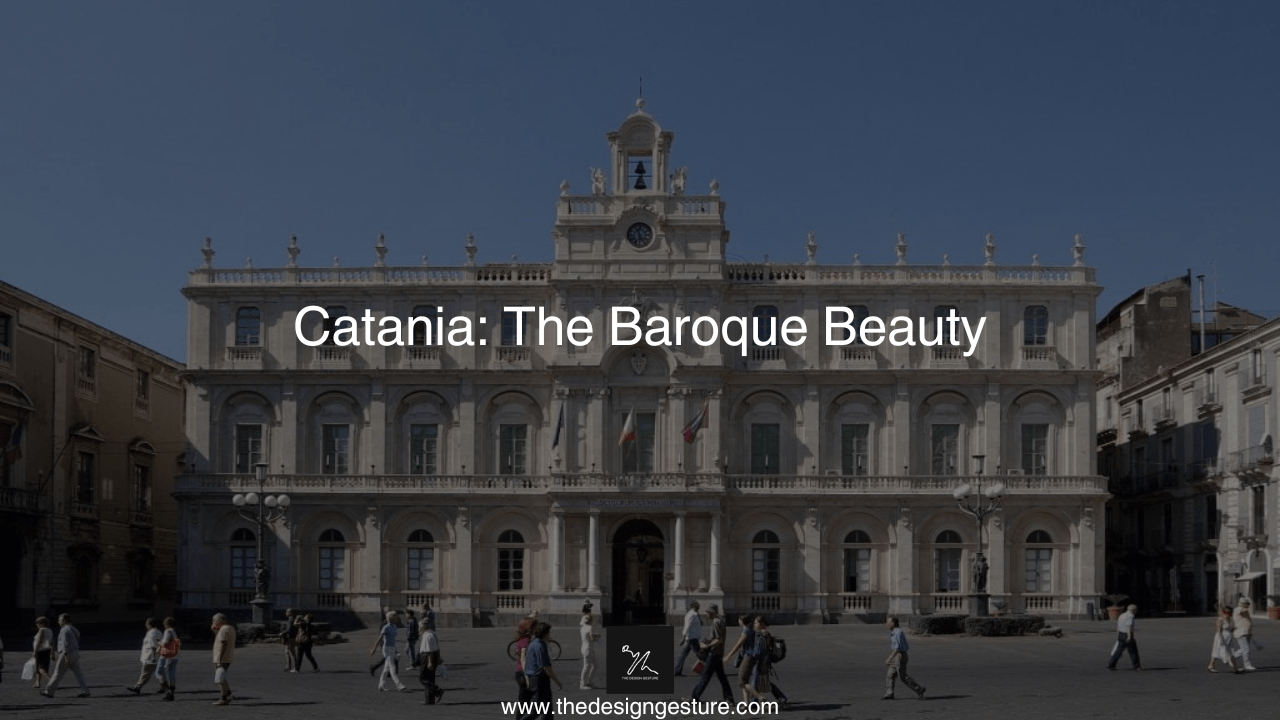
Category: City Architecture

  • Catania: The Baroque Beauty

    Catania: The Baroque Beauty

    Introduction

    If I told you of a city where the earth breaths fire, your response would be, “Oh no, fairy tales again!” Or even “Are you ever tired of myths?” Of course not, I love fairy tales, I have always loved fairy tales from my preteen days, and I still love them. I guess this is the part of me that’s never growing up. But this time it’s not about a fairy tale, while you might think it’s a scary tale, I prefer to call it a mystery tale. 

    catania sicily

    Volcano under the blue sky

    Welcome to Catania, a city along the eastern shore of Sicily,  where the most famous part has survived intact with Baroque architecture. Much of it has been rebuilt after a catastrophic earthquake in 1693. The historic center has been added to the list of UNESCO World Heritage sites because of the important example of this art: it offers grand buildings, ornate churches, and elaborate public squares. Other landmarks are the Cathedral of Sant’Agata, the Palazzo Biscari, and the always-iconic Piazza del Duomo. All of these speak to the distinctiveness of Catania in proper synergy: history, artistry, and resilience.

    catania football

    Fields near Mt Etna

    Overview of Baroque

    The Baroque period, roughly covering the late 16th century to the early 18th century, is an important period for European art, music, and architecture. It was born in Italy but spread across all of Europe, striking deep into the architectural face of the continent. Exuberance, grandeur, and attention to detail all characterize the Baroque. It developed out of a reaction to the constrained classicism of the Renaissance, urged by an idea to elicit emotion, drama, and a sense of awe. The period is often related to the Counter-Reformation during which the Catholic Church used Baroque art and architecture to help express religious themes directly and emotionally to inspire faith and devotion among the masses.

    catania fc

    Mount Etna overview of the city

    Key Features Of Baroque Architecture

    When Catania, you can’t help but see these most identifying characteristics typical of Baroque architecture, the large-scale projects, and monumentality. The buildings are huge, built to impress, and overwhelming in their size and expense. Dynamic forms characterize the style, which led away from the straight lines and symmetry frequent in Renaissance architecture, using much more curves, spirals, and complex shapes. Excess is also a decoristic element that explains the style, for it is full of lavish ornamentation with sculptures, frescoes, and gilding in the structures to produce drama and grandeur. These features are dominant in the Palazzo Biscari, Catania.

    Influence On European Architecture

    The Baroque European architecture in each area differed in using this new style. Italy was the country to see the first and most typical examples of this trend since it was the homeland of this new trend. Major architects such as Gian Lorenzo Bernini and Francesco Borromini became prominent people in this movement.

    catania airport

    History Of Catania: Dante University

    Among its iconic representations is the St. Peter Basilica at Vatican City, rich in grandiosity. In France, it evolved into a subtler and more classical form known as the Baroque Classicism or French Baroque. The best example is the Palace of Versailles. Where, Baroque’s monumental vision was to be tempered by symmetry and orderliness of the classical architecture, though it retained its lavishness and decorative richness.

    Historical Background of Catania

    Ancient Roots: 

    Catania, a port city of huge importance on the eastern coasts of Sicily, has been influenced by a changing history dating back thousands of years. Founded by the Chalcidian Greek colonizers from Naxos around 729 BC, these colonizers built Catania into a successful city-state because of its proximity to the sea and the fertility of its land enriched with the volcanic soil coming from Mount Etna.

    The earthquake increased historical importance for Catania Italy and other European cities and influenced architectural-urbanistic development. This real disaster occurred in 1693 and heavily impacted most parts of the city. A considerable amount of destruction and the loss of people’s lives took place. The massive reconstruction of this Baroque beauty (Catania) followed devastation and provided a once-in-a-lifetime opportunity to redesign with a unified architectural vision.
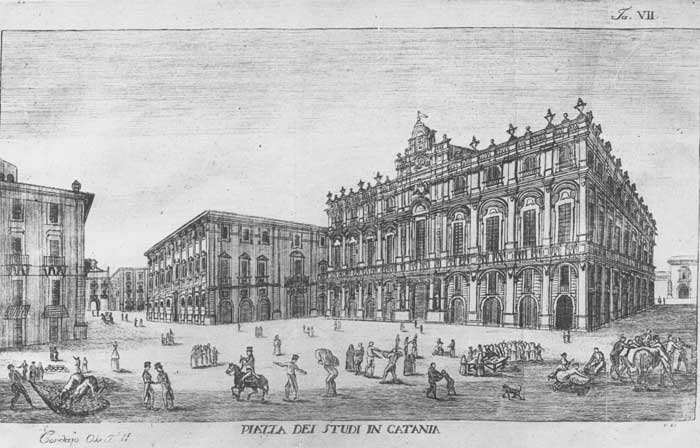
    catania italy

    History: University Of Catania

    These guiding principles of the reconstruction were in tune with the Baroque ideas that prevailed then. It was taken for granted that grandeur, dramatic contrasts, and great detail were to demonstrate the power and resilience of the city and its inhabitants. All those things mingled in the Baroque idea of grandeur: wide and straight streets, such as Via Etnea; large squares, “all’aperto”; important and impressive buildings.

    Restoration Of Key Structures

    Key structures such as the Cathedral of Sant’Agata and the Palazzo Biscari were restored and built anew in the Baroque style, with landside facades between stones of black lava—all typical of stucco decorations.  The balconies usually feature black and white decorations. Baroque in Catania Italy meant this kind of architecture, which gave back not only life but a certain Baroque character to the city and subsequently sustained it: that one thing it housed that continues to define Catania today.

    It was a destructive event, but the earthquake was the ultimate means that resulted in its transformation into one of the most architecturally important Baroque towns in Italy. Greek Period 729 BC – 476 BC The Greeks from Naxos founded Catania as “Katane” and the nearby colony. Soon after, Catania became a commercially huge city due to its access to the Ionian Sea and the fertile plains around it suitable for agriculture and particularly grain-growing.

    During the period of the Sicilian Wars, Catania was highly involved in the struggles between Greeks and indigenous Sicels, then in the broader Sicilian Wars pitting Greek city-states against each other and Carthage. During these periods, Catania changed allegiances many times and passed from ruler to ruler.

    Rebirth in Baroque

    After the disastrous earthquake in 1693, Catania underwent a dramatic change and emerged as one of the most outstanding examples of Baroque urbanism. While reconstructing the city, special care was taken to reflect all the glory and order of Baroque architecture. Wide, straight streets replaced the narrow, winding alleys of the previous city, thereby making the city both orderly and magnificent.

    Grand squares and monumental buildings were created, emphasizing symmetry and perspective. Architects used local materials that created dramatic contrasts within the city’s buildings: black lava stone from Etna and white limestone. Buildings like the Cathedral of Sant’Agata and Palazzo Biscari, an architectural style with intricate details, elaborate facades, and ornate balconies express the Baroque spirit of Catania. 

    Key Baroque Architectural Landmarks in Catania

    Catania Cathedral (Cattedrale di Sant’Agata)

    university of catania

    Catania Cathedral

    The church also known as Cattedrale di Sant’Agata, has gone through a stormy history,  was destroyed several times by earthquakes, and rebuilt again. The initial church was built around 1086 in the ruins of the Roman-era Achilliane Baths. On February 4, 1169, through an earthquake, the entire roof of the church fell intact, killing hundreds of people who had gathered there, commemorating an annual procession.

    The building was heavily damaged by fire in 1194 when Henry VI took control. In 1693, the Val di Noto disaster earthquake nearly demolished the Cathedral, with only the apse and facade proving to be parts left standing. The bell tower was also brought down. In the 18th century, the church was rebuilt. Most of the actual building in effect, dates from after the disaster.

    The interior was by architect Girolamo Palazzotto, and the facade was by Giovanni Battista Vaccarini, built between 1734 and 1761. In 1857 the construction of the bell tower was finished and the present configuration of the courtyard appeared in the 19th century.

    Architecture

    The Cathedral of Catania represents a Baroque church with a three-order façade of the Corinthian style. The first order is made of six granite columns, ancient in origin, surmounted by the coat of arms of the noble Galletti family. The second order also contains six columns, divided into two smaller lateral ones by the great central window.

    The orders are also ornamented with marble statues of Saint Agatha in the middle and above the main door, a right monument to Saint Euplius, and a left one to Saint Birillus. The wooden front door of this Catania Cathedral has thirty-two well-carved panels portraying different portraits and scenes. On each side of the central door stand marble statues of Saint Peter and Saint Paul. The church dome is from 1802, constructed on a Carmelo Battaglia project.

    The dome has columns and large windows that light up the inside. During 1867 and 1869 architect Carmelo Sciuto Patti built the actual bell tower and the dome lantern. On the other hand, it goes on to have a Latin cross plan, with a nave and two aisles. The apse belongs to the 12th against a restored building.

    Palazzo Biscari:

    catania sicily weather

    The exterior of Palazzo Biscari

    The History Of The Biscari Palace.

    The Palazzo Biscari, the residence of the Paternò Castello family, Princes of Biscari, represents not only a very eloquent example of the 18th century but also one of the most important and known ones together with the Monastery of San Nicolò l’Arena among Catania’s examples. It stands on a part of the sixteenth-century walls of the city, on which, right at the end of the earthquake of 1693, Ignazio Paternò Castello III, Prince of Biscari, obtained permission to build the Palazzo from Lieutenant General Giuseppe Lanza, Duke of Camastra, who was in charge of Catania’s reconstruction by order of the Spanish King Charles II. 

    catania italy weather

    Courtyard  of Palazzo Biscari

    The son of this king of Spain, Vincenzo IV, Prince of Biscari, who continued this work from 1685 to 1749, and his grandson, Ignazio V, did so to the end from 1714 to 1786. A great scholar, archaeologist, and lover of the arts, he played a big role in Catania’s cultural life during the eighteenth century. One of Ignazio V’s dedications in ample spaces within the Palazzo was the establishment of an archaeological, numismatic, and natural history museum open to all interested scholars.

    Description of its interior

    catania hotels

    Interior view of the Biscari Palace

    Abundance, Prosperity, Fertility, and Wisdom are the themes developed in the allegorical groups of decorations that adorn Palazzo Biscari’s exterior and most sumptuous façade facing the sea. Started in 1707, it lies over the sixteenth-century walls made by Charles V and is the entrance point of the city for those coming by sea.

    The view is amazing: the white Syracuse stone balconies and pilasters contrast with the black lava base; they are all covered with flowers, cherubs, fauns, and sculptures of telamons. The rear-facing marina has seven huge colored windows with exquisitely worked sculptures and other ornaments, all in the style of the Sicilian Baroque.
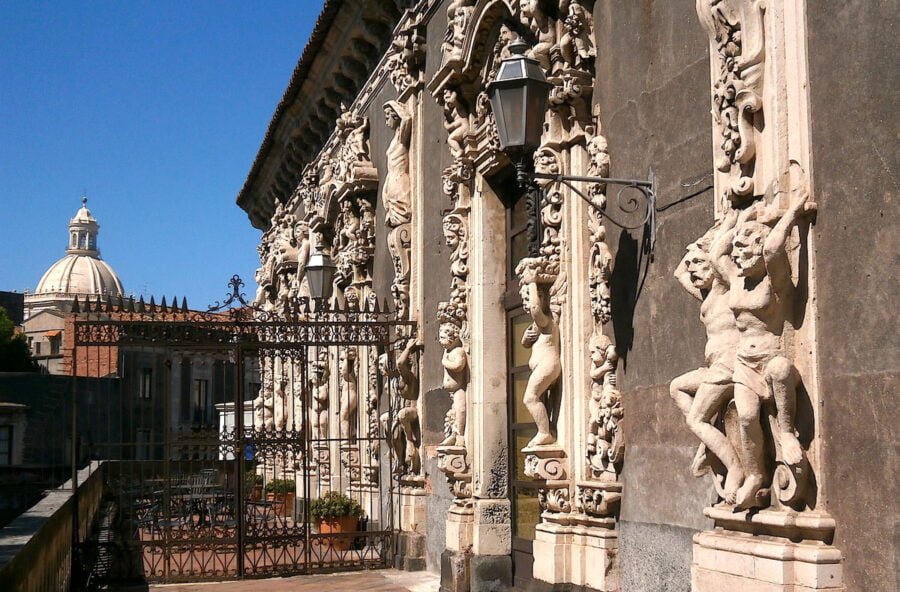
    catania sicily

    Baroque Catania

    It is so sumptuous that by comparison, the entrance facade with the sumptuousness seems austere! The front of Via Museo Biscari doesn’t possess a single holding feature unless it is the great doorway, the largest, and one of the most beautiful in Catania. It began in the early decades of the eighteenth century and reveals fully the genealogical banner of Prince Vincenzo IV.

    The guest passes through this doorway into a broad courtyard, at one time out with grouped trees and parterres and bearing pergolas aloft, though today it is unfortunately empty. A good gateway provides entry to a superb dog-legged staircase, which ascends to the great hall, one entire wall is covered with paintings representing the feudal possessions of the Biscari in Catania.

    The Orchestral Ballroom

    The Red Room, with its paintings depicting members of the Biscari family, gives access to the Salone dell’Orchestra—a fine example of Rococo style, made according to the Neapolitan way. Over the doors in the ballroom are paintings of Naples and the countryside; on the ceiling, a fresco of the Council of the Gods celebrates the family’s glory. The vault above opens onto a balcony where musicians play. In the plan, mirrors and a Neapolitan ceramic floor provide an elaborate setting, with stucco decorations symbolically linked to fire. In the ceiling fresco, there is an image of Vulcan.

    Piazza del Duomo:

    catania football

    Piazza del Dumo overlooking the cathedral’s facade

    Located in the heart of Catania, this UNESCO World Heritage Site has one notable feature that sets it apart from many others: the dramatic contrast between the city’s lava and limestone color buildings in its unique local baroque style. Dominating all is the grand Cattedrale di Sant’Agata. At the center of the piazza is the Fontana dell’Elefante (1736), with its charming Roman black-lava elephant, surmounted with an unlikely Egyptian obelisk.

    The most noticeable feature is the Fontana dell’Amenano, the southwestern corner, which designates entry to Catania’s fish market. Local myth holds that the elephant was originally the pet of 8th-century magician Eliodorus, known to have been able to place humans in animal bodies. And the obelisk is said to have powers to appease the local volcano, Mt. Etna.

    The Fontana dell’Amenano, dated to the 19th century, was made by the Neapolitan sculptor Tito Angelini; this lively fountain remembers the Amenano River, which once ran over the earth and along whose banks it is said that the Greeks founded the city of Catania, originally called Katáne.

    San Nicolò l’Arena

    catania airport

    Unfinished facade of San Nicolò l’Arena

    San Nicolò l’Arena is the monumental Benedictine monastery in Catania, Sicily,  among the biggest in Europe. Founded in 1558, it combines late Renaissance and Baroque styles, which means, it shows the hallmarks of a long history of construction and subsequent reconstructions, particularly after the disastrous earthquake of 1693. It comprises a grand church with an unfinished facade, expansive cloisters, and impressive gardens. Presently, this place hosts the Department of Humanities of the University of Catania and is usually considered a symbol of cultural and architectural heritage in this city.

    Teatro Massimo Bellini:

    catania fc

    Interior of the Teatro Massimo Bellini

    Located on the Sicilian shores in Catania, Teatro Massimo Bellini is a fine opera house named after the Catania-born famous composer Vincenzo Bellini. Founded in 1890, the theater became a gem of the Baroque Revival architecture with frescoes and gilding, covered interior, plush red upholstery; unique acoustics adorn the main hall and hence ideal for operatic events. Teatro Massimo Bellini thus assumes the role of a cultural monument, narrating not just Catania’s deep bond with music and art but classical music. 

    The Influence of Baroque Architecture on Catania’s Urban Landscape

    Street Layouts and Squares:

    Street Plans and Public Spaces: Catania’s Baroque architecture played great roles in the urban landscape, particularly in the designs of streets and squares. One important street is Via Etnea, which runs along a direct line to Mount Etna—an example of order and grandeur espoused by the Baroque in urban planning. Harmony with Nature: Catania’s architecture has blended magnificently with its natural environment, especially through the broad use of local lava stone in building materials, which easily merges the city’s structures with the volcanic landscape.

    Cultural Significance and Legacy of Baroque Architecture in Catania:

    Baroque as a Symbol of Power and Faith

    Role of the Church and Nobility: In Catania, Baroque architecture served as an important expression of the influence of the Catholic Church and the status of the local nobility. The two promoted the style intensively to show their power and devotion. Long-lasting Heritage: Baroque architecture has influenced the very soul of Catania, leaving an indelible stamp on its character. Preservation and restoration works are fundamental to the continuity of these architectural assets, so they will continue to define the historic and cultural landscape of the city.

    Conclusion

    It is rightly called the “Baroque Beauty of Europe.” Catania is one of those cities that allures visitors with its architectural heritage, steeped in Baroque origins. A strong history, sculpted by volcanic eruptions and subsequent reconstruction, has given this city an eclectic mix of grandeur and resilience.

    This city is, therefore, a must for all travellers who want to get a taste of the magnificence of Sicilian Baroque; Catania is a statement of its artistic and cultural importance through ornate churches, palaces, and squares. It becomes easy for travellers as Catania airport is one of a kind airport in Italy. Catania airport has railway station connected to it from terminal A and C.

    Its preserved beauty and lively atmosphere continuously enchant visitors with timeless charm. So if you ever heard or read about someone talking about a dragon breathing fire somewhere, just pay attention and find out where exactly it is, you might just be in the process of discovering another mystery story, a new breathing earth in Catania or might even be returning me the favor of having told you a mystery tale. So would you go explore this Southern part of Italy firsthand or are you waiting for me to another piece of secondhand info?

  • Amer Fort: A Magnificent Gem of Rajasthan Tourism

    Amer Fort: A Magnificent Gem of Rajasthan Tourism

    Rajasthan Tourism

    Rajasthan is India’s largest state. It epitomizes regality and history. It was home to several powerful Rajput dynasties and hence it is referred to as the ‘Land of Kings’. Rajasthan features plateaus and plains, particularly in the eastern and southeastern parts of the state. These areas support agriculture and are home to several rivers, including the Chambal and Banas.

    Rajasthan’s western region is a desert with dunes that move and chilly evenings illuminated by the moon. With its catchphrase, “Padharo Mhare Desh (Welcome to my land),” Rajasthan Tourism draws tourists with its medieval forts, palaces, artwork, and culture. The state also boasts diverse wildlife, with Ranthambore National Park providing a habitat for the elusive Bengal tigers. The sacred town of Pushkar, nestled around a holy lake, hosts the annual Pushkar Camel Fair, a vibrant cultural extravaganza.

    Every visitor has an immersive experience thanks to the friendly inhabitants, the timeless stories revealed by the old forts, and the airborne echo of traditional folk music. Every moment spent in this majestic country is like a new chapter in a spellbinding tale, whether you’re seeing the architectural marvels, watching the sunset over the Thar Desert, or reveling in the fine intricacies of Rajasthani art.

    Rajasthan Tourism
    City Palace in Udaipur

    From the spiritual ambiance of Ajmer Sharif Dargah to the hill station charm of Mount Abu, Rajasthan unfolds as a diverse and captivating destination. Udaipur’s picturesque lakes, including Lake Pichola, make it a romantic destination.The City Palace and Jag Mandir are architectural masterpieces. Jodhpur is famous for Jaswant Thada and Umaid Bhawan Palace are other notable landmarks. Jaisalmer, with its golden-hued sandstone architecture, is known for the stunning Jaisalmer Fort and the intricately carved Patwon Ki Haveli.

    rajasthan fort
    Royal Bengal tiger in Ranthambhore National Park

    Nature enthusiasts flock to Ranthambore to spot the majestic Bengal tigers in their natural habitat. Bikaner is known for its well-preserved Junagarh Fort and the unique Karni Mata Temple, home to thousands of rats. Exploring the culinary wonders of the state unveils a gastronomic tapestry abundant in flavors. Individuals Indulge in Rajasthani cuisine, known for its rich flavors, and explore traditional handicrafts, including block-printed textiles and exquisite jewelry.

    Amer Fort- The pioneer of Rajasthan Tourism

    amer fort viewpoint
    Amer fort 

    The journey to Amer Fort Jaipur begins with a majestic ascent through the Sun Gate, a grand entrance that sets the tone for the regal experience ahead. Once inside, the Diwan-i-Aam, or Hall of Public Audience, captures the essence of royal gatherings with its impressive array of pillars and a raised platform where the Maharaja held court. The intricately designed Ganesh Pol, a gateway dedicated to Lord Ganesh, leads to the private quarters of the rulers.

    Amer Fort, the crown gem of Rajasthani tourism, is perched atop the rough Aravalli Hills and is a symbol of both architectural magnificence and historical significance. Beyond just its construction, Amer Fort is magnificent since guests may ride an elephant to get to the fort, giving it a regal air. Amer Fort’s strategic location provides panoramic views. As day transitions into night, Amer Fort Jaipur undergoes a magical transformation, illuminated by a warm glow that accentuates its architectural details.

    History 

    In 1592, Raja Man Singh I laid the foundation stone, marking the commencement of the fort’s journey into architectural magnificence. The initial purpose behind building Amer Fort was primarily defensive, aligning with the strategic considerations of the time. The fort’s construction was strategically planned to serve as a stronghold against potential invasions and attacks.

     Its hilltop location provided a natural advantage. Under subsequent rulers, especially Raja Jai Singh I, who expanded and renovated the fort in the early 17th century, Amer Fort Jaipur evolved into a grand amalgamation of Rajput and Mughal architectural styles. The fort became a symbol of cultural synthesis. However, Amer Fort Jaipur transformed from a defensive fortress to a sprawling and opulent palace complex as the years progressed.

    Elephant Ride Experience

    Jaipur fort
    Elephant Ride Experience

    One of the most enchanting and culturally immersive experiences at Amber Fort Jaipur is the option for visitors to embark on an elephant ride as they ascend toward the majestic fort entrance. The elephants, bedecked in vibrant and ornate colors, stand as magnificent symbols of the regal history that surrounds Amer Fort. The sight of these elegantly moving, decorated elephants against the Aravalli hills creates the perfect atmosphere for an incredibly beautiful and unforgettable climb up to the Amber fort.

    As visitors climb aboard these majestic creatures, they are transported into an era where such grand entrances are a commonplace spectacle for royalty. The slow and deliberate pace of the elephant ride allows for a leisurely appreciation of the surrounding landscapes and the intricate architectural details of Amer Fort Jaipur. The Elephant Ride Experience provides a scenic and comfortable journey to the Amber fort Jaipur and imparts a sense of connection to the traditions and customs.

    Ganesh Pol

    rajasthan tourism
    Ganesh Pol

    Ganesh Pol, also known as Ganesh Gate, stands as a magnificent testament to the exquisite craftsmanship that graces Amer Fort. This grand gateway is dedicated to the revered Hindu deity Lord Ganesh. It serves as an eloquent showcase of intricate frescoes and meticulously sculpted details. As visitors pass through Ganesh Pol, they are enveloped in a visual tapestry that narrates tales of devotion and artistic brilliance.

    The elaborate decorations on Ganesh Pol are a testament to the cultural richness and devotion prevalent during the reign of the Rajput rulers. The finely detailed sculptures and vibrant frescoes adorn the gateway. Ganesh Pol, with its fusion of religious symbolism and architectural finesse, stands as a vibrant portal that transports visitors to an era where art and spirituality seamlessly converged in the royal courts of Amer Fort.

    Palace of Raja Mansingh

    amber fort Jaipur
    Palace of Raja Mansingh

    Raja Mansingh, a prominent ruler of Amer, played a pivotal role in the fort’s construction, and his palace serves as a splendid manifestation of his regal taste and influence. The palace reflects a blend of Rajput and Mughal styles. The Palace of Raja Mansingh is strategically positioned, providing panoramic views. One of the palace’s most remarkable features is the Sheesh Mahal, which has elaborate mirror work on its walls that produces a stunning dance of light. 

    The palace’s deliberate positioning inside the fort complex emphasizes its significance as a representation of strength, wealth, and defense. The monarch had about 12 consorts or spouses. Everybody got their rooms. He discreetly utilized covert routes to visit whichever spouse he desired to spend the night with. There was no malice or envy among the queens.

    Sheesh Mahal Amer Fort (Hall of Mirrors)

    sheesh mahal amer fort
    Sheesh Mahal Amer Fort

    The Sheesh Mahal Amer Fort is a symphony of reflective surfaces, where the walls and ceilings are adorned with an intricate mosaic of mirrors. Each piece is meticulously placed to catch and amplify the flickering candlelight, creating a breathtaking and almost otherworldly ambiance. The play of light against the mirrored surfaces transforms the hall into a dazzling spectacle, reminiscent of a starlit sky.

    Beyond its aesthetic allure, the Sheesh Mahal served a practical purpose. The strategic placement of mirrors was a clever way to illuminate the space with the limited candlelight available. The result is a hall that enchants its visual splendor and reflects the ingenuity of Rajput architecture. The Sheesh Mahal Amber Fort stands as a must-visit highlight within Amer Fort. This iconic hall continues to be a symbol of the grandeur and sophistication of Rajput architecture.

    Diwan-i-Aam and Diwan-i-Khas

    amber fort photos
    Diwan-i-Aam

    Amer Fort stands as a testament to the regal splendor of the Rajput rulers, boasting two magnificent audience halls. Each of these halls encapsulates the grandeur and ceremonial significance integral to the royal lifestyle. The Hall of Public Audience served as the platform where the Maharaja addressed the public. This expansive hall is characterized by a series of delicately crafted pillars. The Maharaja would engage with the citizens, creating a spectacle that underscored the ruler’s accessibility and authority.

    Diwan-i-Khas

    In contrast, the Diwan-i-Khas, or Hall of Private Audience, was reserved for more intimate and exclusive gatherings. This hall reflects an even greater degree of opulence. The Diwan-i-Khas served as the venue for confidential discussions. The architectural detailing in this hall, including its intricate jali work and mirrored ceilings, highlights the meticulous craftsmanship that defined the artistic legacy of Amer Fort. Both halls stand as eloquent expressions of the royal lifestyle, offering insights into the ceremonies, interactions, and cultural richness that characterized the courtly life of the Rajput rulers.

    Kesar Kyari Bagh

    amber fort jaipur
    Kesar Kyari Bagh

    Nestled within the expansive fort complex of Amer, the Kesar Kyari Bagh stands as a horticultural gem with a rich history. This historic garden is renowned for its cultivation of saffron. It adds a touch of regal elegance to the already opulent surroundings of Amer Fort. The Kesar Kyari Bagh translates to the “Saffron Bed Garden,” and its significance lies in its floral beauty and its cultural and economic importance. 

    Saffron growing gives the garden a pop of color and represents the wealth and refinement of the Rajput emperors with its vivid orange-red flowers. Beyond its economic significance, the Kesar Kyari Bagh offers a serene retreat within the fort premises. As visitors stroll through the Kesar Kyari Bagh, they are transported to an era where the fusion of nature and human artistry is celebrated. The garden stands as a living testament to the multifaceted legacy of Amer Fort.

    Suraj Pol and Chand Pol

    Jaipur fort
    Suraj Pol 

    Amer Fort, a testament to the architectural prowess of the Rajput rulers, boasts two magnificent gates that serve as both entrances and strategic elements in its defense architecture – Suraj Pol (Sun Gate) and Chand Pol (Moon Gate). Suraj Pol, also known as the Sun Gate, stands as the primary entrance to Amer Fort and is a striking example of Rajput military architecture. 

    The gate is named after the Hindu Sun God, symbolizing the radiant energy and power associated with sunlight. Suraj Pol is an imposing structure characterized by a massive gateway with intricate frescoes and detailed craftsmanship. The gate’s elevated position and robust construction enhanced its visual appeal and played a crucial role in the fort’s defense strategy.

    Chand Pol
    Chand Pol

    Chand Pol, or the Moon Gate, serves as another significant entry point into Amer Fort. As the name suggests, it is named after the Moon, reflecting a celestial balance with Suraj Pol. The gate is adorned with artistic embellishments. It presents a breathtaking sight with its arched entrance and detailed ornamentation. Chand Pol, strategically located, complements Suraj Pol in fortifying the defensive capabilities of Amer Fort.

    The historical significance of these gates extends beyond their architectural beauty. Suraj Pol and Chand Pol, strategically positioned along the fortification walls, served as formidable barriers against potential invaders. The design elements, including narrow passages and sharp turns, were crafted to confound assailants. As visitors pass through Suraj Pol and Chand Pol, they not only traverse the physical thresholds of Amer Fort but also step into a world where architectural brilliance converges with military strategy, creating an immersive experience that transports them back to the era of Rajput valor and ingenuity. 

    Amer Fort Light and Sound Show

    amer fort light and sound show
    Amer fort light and sound show

    The Amer Fort, bathed in the soft glow of evening lights, offers visitors a captivating journey through history with its renowned Sound and Light Show. The show is meticulously designed to highlight key historical events. With carefully orchestrated light sequences that accentuate the intricate details of the fort’s structures and a narrative that resonates through the ancient walls, the Sound and Light Show transforms the Amer Fort into a living chronicle of Rajasthan’s royal past. 

    For visitors, this immersive experience offers entertainment and a deeper understanding of the historical significance of Amer Fort. As the illuminated fort becomes a spectacle against the night sky, the Sound and Light Show weaves a magical tapestry that brings the tales of Amer Fort to life. 

    Jaigarh Fort Connection

    Connection between Amer Fort and Jaigarh Fort
    Connection between Amer Fort and Jaigarh Fort

    The historical connection between Amer Fort and Jaigarh Fort is more than just proximity; it is a testament to the strategic and architectural prowess of the Rajput rulers. These two forts are linked through well-preserved passages. The passages that connect Amer Fort and Jaigarh Fort are not mere walkways; they are corridors that echo with the footsteps of the warriors, rulers, and inhabitants who once traversed them centuries ago.

    Jaigarh Fort is renowned for its colossal cannon. The connection between Amer Fort and Jaigarh Fort allows visitors to seamlessly explore the historical narrative that unfolds across both forts. It’s a journey where each step unveils the tales of valor, architectural marvels, and the strategic brilliance of the Rajput rulers. Visitors often choose to visit Amer Fort and Jaigarh Fort in conjunction, as the combined experience provides a holistic understanding of the region’s history and military architecture.

    FAQ

    Q. What is Sheesh Mahal in Amer Fort?
    A. Sheesh Mahal Amer Fort, also known as the Hall of Mirrors, is a stunning hall within Amer Fort adorned with intricate mirror work on its walls. It creates a dazzling effect as the mirrors reflect light, making it a must-visit attraction within the fort.

    Q. What is the significance of Amer Fort’s architecture?
    A. Amer Fort’s architecture is a blend of Rajput and Mughal styles, showcasing the cultural synthesis prevalent during its construction. The fort’s strategic location and defensive features reflect its historical significance.

    Q. What are the Amer Fort timings?
    A. The best time to visit Amer Fort is during the early morning or late afternoon to avoid the crowds and enjoy the fort’s beauty in a more peaceful setting. Additionally, visiting during the cooler months of October to March is advisable.

    Q. Can I attend the Amer Fort light and sound show?
    A. Yes, Amer Fort offers a captivating light and sound show in the evening, which narrates the history of the fort and the region. It is a popular attraction and provides a unique way to experience the fort’s heritage.

    Q. How can I reach Amer Fort Jaipur ?
    A. Amer Fort is located in Jaipur, Rajasthan, and is easily accessible by road from Jaipur city. Visitors can hire a taxi or auto-rickshaw to reach the fort, or opt for public buses that ply to the fort from various locations in Jaipur.

    Q. Are there any other attractions near Amber Fort Jaipur?
    A. Yes, Jaipur is home to several other attractions near Amber Fort Jaipur, including the Jaigarh Fort, Nahargarh Fort, and the City Palace. These attractions offer a glimpse into Jaipur’s rich history and architectural marvels.

    Q. What is the history behind Amer Fort’s construction?
    A. Amer Fort was built in 1592 by Raja Man Singh I and later expanded and renovated by Raja Jai Singh I. The fort’s construction was primarily defensive, serving as a stronghold against potential invasions.

    Q. Can I explore Amer Fort and Jaigarh Fort together?
    A. Yes, Amer Fort and Jaigarh Fort are connected by well-preserved passages, allowing visitors to explore both forts in conjunction. The combined experience offers a comprehensive understanding of Jaipur’s history and architecture.

  • Chicago Architecture: A Fascinating Destination for Cultural Enthusiasts

    Chicago Architecture: A Fascinating Destination for Cultural Enthusiasts

    Introduction

    The buildings and architecture of Chicago have influenced and reflected the history of American architecture. The man-made environment of Chicago reflects the city’s history and multicultural heritage, featuring prominent buildings in a variety of styles by many important architects. Chicago buildings are noted for their originality rather than their antiquity. Many architects have constructed landmark buildings of varying styles in Chicago. Among them are the so-called “Chicago 7”: James Ingo Freed, Tom Beeby, Larry Booth, Stuart Cohen, James Nagle, Stanley Tigerman, and Ben Weese.

    History of Chicago

    The Great Chicago Fire in 1871 killed 300 people, destroyed about 3.3 square miles, and left over 100,000 residents homeless. However, by that time Chicago had become the world’s fastest-growing city and its population had risen over 300,000 inhabitants. The fire meant these ambitious citizens had to start again. With admirable strength, the city was reborn from the ashes and some of Chicago’s best architecture was constructed immediately after. Since then, Chicago has only continued adding value to its urban grid and new buildings have been progressively enhancing the city’s beautiful skyline. 

    Frank Lloyd Wright’s Prairie School influenced both building design and the design of furnishings. In the early half of the 20th century, popular residential neighbourhoods were developed with Chicago Bungalow style houses, many of which still exist. A two-flat includes two apartments, each of which occupies a full floor, usually with a large bay window and with a grey stone or red brick facade. The apartments typically have the same layout with a large living and dining room area at the front, the kitchen at the back, and the bedrooms running down one side of the unit.

    Architecture, design, and art lovers, here’s a list of all the mesmerizing places in the city of Chicago that will make you plan a vacation ASAP.

    Examples of famous Chicago Architecture

    Modern Wing, Art Institute of Chicago

    Brief

    The Art Institute of Chicago, one of the oldest and largest museums in the United States, was founded in 1879. The new Modern Wing is being built between Michigan Avenue and Columbus Drive; at the northeast corner of the block the Art Institute of Chicago currently occupies. The addition will complete the cultural, urban campus of the museum. On the first floor, a day-lit court is flanked by new educational facilities, public amenities, galleries, and a garden. The second and third floors are dedicated to art and the viewing of art. The third floor will be completely lit by natural light.

    Design Process/Style

    Limestone, a material used in the construction of the entire museum from its original Beaux arts palace to recent additions, rises from the ground like a topographic relief, massive and solid, as though it has always been there. The Modern Wing shelter will give the museum what it needs in terms of light, much as the open lattice of the Pritzker Pavilion gives shelter to the Great Lawn in terms of sound. Flying above the art pavilion will be a shelter that filters the sun to create the natural shaded light conditions ideal for the enjoyment of art.  

    Aqua Tower

    Brief

    The best 21st-century addition to Chicago’s skyline, Aqua Tower starts with a venerable and well-worn Chicago high-rise trope: the Modernist glass box. But Gang’s design adds sculptured whorls of concrete floor slabs that extend beyond the glass facade. The design was inspired by the striated limestone outcroppings common in the Great Lakes area. But this sinuous shape is not just a mere formal gesture, but it is also a strategy to extend the views and maximize solar shading.

    Design Process/Style

    These concrete slabs are fenced off as balconies for the building’s apartments, offices and hotel units. Each is custom-designed to give visitors and residents better access to skyline views of the surrounding Loop and Lake Michigan. Together, across 82 stories, they appear to ripple like water. It has got the following amenities: 82-story mixed-use residential tower (819 ft), 215 hotels rooms, 476 rental residential units, 263 condominium units and penthouses, 55,000 sq. ft of retail and office space and 6 levels of underground parking.

    Apple Store, Michigan Avenue

    Brief

    Inspired by the pulse of Chicago’s artistic energy, designed by Architects Fosters+Partners, Apple has created a new platform for performance in a city charged by music. Pioneer Court is an urban plaza steeped in Chicago history. It is the spot where Point de Sable–the founding father of Chicago–first lived and worked. Apple Michigan Avenue sits atop a wide new public stair, created to lead down from the plaza to the river. The gentle descent of levels creates active spaces where people can connect, create, and experience the city and river together.

    Design Process/Style

    As the interior steps down to the river, it acts as a seating space around the Forum–the hub of Today at Apple and a live source of creativity, education and entertainment. The stairway transitions seamlessly between the outside and inside. It passes through the building’s walls–dematerialized to pure glass–and connects to the store’s buzzing centre, sheltered by an impossibly thin carbon fibre roof, supported on slender stainless-steel columns.  

    Apple Michigan Avenue is about removing boundaries between inside and outside, reviving important urban connections within the city. It unites a historic city plaza that had been cut off from the water, giving Chicago a dynamic new arena that flows effortlessly down to the river. The design of Apple Michigan Avenue embodies this in its structure and materiality with a glass wall that dissolves into the background, revealing the only visible element of the building–its floating carbon fibre roof.

    Robie House

    Brief

    One of Frank Lloyd Wright’s most favoured projects, the Robie House in Hyde Park, is a culmination of his long-simmering meditation on Midwestern landscapes, and precedes when he departed off to more abstracted experiments such as Fallingwater. It has become emblematic of the architect’s Prairie Style. The Robie House creates a clever arrangement of public and private spaces, slowly distancing itself from the street in a series of horizontal planes. By creating overlaps of the planes with this gesture, it allowed for interior space expanded towards the outdoors while still giving the space a level of enclosure.  

    Design Process/Style

    The prairie has a beauty of its own and we should recognize and accentuate this natural beauty, its quiet level. Hence, gently sloping roofs, low proportions, quiet sky lines, suppressed heavy-set chimneys and sheltering overhangs, low terraces and out-reaching walls sequestering private gardens. As is seen in many of Wright’s project, the entrance of the house is not clearly distinguishable at first glance because Wright believed the procession towards the house should involve a journey.

    Inside is a classic Wright composition of dark wood, stained glass and custom-designed high-backed chairs. The house was built for a bicycle and motorcycle manufacturer and was included on the very first National Register of Historic Places list in 1966. Made of artfully composed horizontal lines of red brick and limestone, the strong terraced layers resemble stratified rock. The protrusions of windows on the East and West facade, along with low ceilings, emphasized the long axis of the house and directed views towards the outside. These windows were also stretched on French doors along the entire south wall on the main level, opening up to a balcony.

    Willis Tower

    Brief

    Towering over the windy city of Chicago, the Willis Tower was once the tallest building in the world upon its completion in 1973. The design also had to incorporate extra office space for the expected future growth of the company. The building is 108 stories tall, rising 1,450 feet above the city. The height of the building is because of spacial needs. The company analysed their current spacial needs, as well as the space needed for growth up to the year 2003, being as meticulous as determining the number of desks for personnel.

    Design Process/Style

    The different heights allow for the building to step back, meeting setback regulations and creating the iconic staggering effect that the building is known for. The structure system also saved ten million dollars in steel costs. Aluminium cladding was used for the structure, and the entire rest of the building was clad in bronze-tinted vision glass panels which allowed the skyscraper to receive ample natural lighting and views from every exterior wall. Completing the tower at the peak of its height are antennas that allow for local radio and television broadcasts.

    The 103rd floor of the tower is the location of the famous Skydeck Chicago, which is visited by 1.3 million tourists a year. In just 60 seconds tourists can soar to the Skydeck to experience the swaying of the skyscraper on a windy day and as of 2009, look at the city beneath their feet from glass boxes that protrude from the deck.

    IIT McCormick Tribune Campus Center

    Brief

    The McCormick Tribune Campus Center is one of only a few non-Mies designed buildings at the Illinois Institute of Technology. It also was Rem Koolhaas’ first American project. The entire complex squats under an elevated rapid-transit rail line and contains a bookstore, auditorium and food court. A stainless-steel tunnel dampens the roar of passing trains. The site was previously a heavily used student parking lot with tracks of the Green Line passing overhead. Koolhaas tracked movements of students across the lot, which led to diagonal passageways as the centre’s interior thoroughfares. Campus functions which had been spread around campus, such as the student bookstore and a post office, were relocated between these pathways. 

    Design Process/Style

    With its canted lines, bright orange-tinted glass, and free-form intersecting planes, the building is easy to cast as an arrogant boom-era misfit. But despite Koolhaas’ intellectual Deconstructivist rigour, the structure shows true reverence for Mies van der Rohe’s university campus. A major design challenge was the noise of the Green Line tracks passing over the lot. The solution was to enclose a 160 m section of the tracks in a stainless-steel tube passing over the building. The tube’s support structure is completely independent of the building’s, to minimize vibration passing between them.

    Rectilinear right angles have broken apart and reconfigured to create a procession of sculptural spaces, creating quiet study nooks, as well as bright public spaces. A small patch of prairie grasses on a depressed roof garden (visible from the inside) provides relief from the building’s raw, rough materials and dot-matrix glass murals. The university wanted an architecturally significant building to add onto its original main campus, which is home to the densest concentration of buildings designed by Ludwig Mies van der Rohe in the world.

    Rookery Building

    Brief

    Designed by architects Daniel Burnham and John Wellborn Root of Burnham and Root in 1888, it is one of their masterpiece buildings, and was once the location of their offices. This is an 11-storey office, featuring a red granite base with a Romanesque entrance arch. The building is essentially a cube with a hollow core. Its hybrid structural system uses both load-bearing masonry and steel framing. The building is 181 feet in height, 12 stories tall, and is considered the oldest standing high-rise in Chicago. It has a unique construction style featuring exterior load-bearing walls and an interior steel frame, providing a transition between accepted and new building techniques.

    Design Process/Style

    Prodigiously using light and ornamentation, Root and Burnham designed a central light court to serve as the focal point for the entire building and provide daylight to interior offices. Rising two stories, the light court received immediate critical acclaim. A reinforced concrete slab that provided the building’s weight with a solid platform atop Chicago’s notoriously swampy soil. The term for the type of foundation that Root designed is grillage foundation, a foundation where iron rails and the structural beams are combined in a crisscross pattern and encased in concrete to support the building’s immense weight without heavy foundation stones.

    The building is a combination of Roman Revival and Queen Anne styles that embraced Richardsonian Romanesque architecture. Aside from the first two floors of metal-framed perimeter walls, the walls are all masonry. The building is known for its semi-circular staircase west of the light court.

    Jay Pritzker Pavilion

    Brief

    Designed by Architects Gehry Partners, Jay Pritzker Pavilion is an open-air venue featuring performances by the Grant Park Symphony Orchestra, as well as jazz, blues, and other world music performances. The Pavilion is a highly sculptural design element clad in stainless steel panels. Large glass doors allow the Pavilion to be used during winter months for public functions including banquets, receptions, and lectures. A decorative lighting system enhances the Pavilion with coloured light washes and projections during evening performances.

    Design Process/Style

    The main seating area accommodates up to 4,000 people in fixed seats and is located immediately next to the Pavilion. Beyond the main seating area, a lawn area can seat up to an additional 7,000 people in a more informal seating. The Pavilion is located atop a 3-level underground parking structure. A bus way and metro rail tracks which run next to Millennium Park pass beneath the Pavilion at the lowest level of the parking structure.

    Joe & Rika Mansueto Library

    Joe & Rika Mansueto Library
    Source

    Brief

    Designed by Architects Murphy/Jahn this site in the centre of the University of Chicago Campus is surrounded by a variety of different buildings with a mixture of styles, ranging from the gothic quadrangle to the south, the Limestone Brutalism of Netsch’s Regenstein Library to the east, the Henry Moore monument and Legorreta’s colourful Student Housing to the north. The people-oriented spaces could thus be at grade in a minimal elliptical glass dome, which fits the context, because it defies conventional relationships.

    Design Process/Style

    The structural grid-shell of 120 x 240 feet and the insulated glazing represent a very minimal and intelligent system for mediating between the varying exterior conditions and the desired interior comfort. At the interior, there is a seamless integration between lighting, air supply and furnishings, which were fabricated in solid European White Oak.

    Sullivan Center

    Brief

    The Sullivan Center, formerly known as the Carson, Pirie, Scott and Company Building, is a commercial building at 1 South State Street at the corner of East Madison Street in Chicago. This commercial behemoth by Louis Sullivan embodies many design traditions that have made Chicago an architectural epicentre. Formerly the Carson Pirie Scott and Co. Building, the structure is clad in white terracotta. It is one of the best examples of the city’s embrace of this fire-resistant material after the Great Fire of 1871.

    Design Process/Style

    The building is remarkable for its steel-framed structure, which allowed a dramatic increase in window area created by bay-wide windows, which in turn allowed for the greatest amount of daylight into the building interiors. This steel framed structure uses the post-and-lintel technique to provide a strong, light, and fireproof steel skeleton. The exterior of the building consists of a grid of piers and spandrels that reveals the post-and-lintel technique that supports the building. The ground floor is covered in a dark cast iron swirl of nature-inspired reliefs, creating a three-dimensional mural of abstracted leaves, branches, and fruits.  

  • New York City Architecture: Architecture hub of the 21st Century

    New York City Architecture: Architecture hub of the 21st Century

     “To be young and in love in New York City” – I like me better by Lauv was on every playlist a while ago and so is moving to New York, on every millennial and gen z vision board. Every one is infatuated with New York and for all good reasons. Moving to a New York City apartment is on many bucket lists, quite frankly including mine. New York City is famous for its beautiful skylines and glistening evenings. However, in this post, we will look at the New York City architecture, some of which is well-known throughout the world and some of which is hidden in plain sight.

    New York City Architecture is as varied as the folks who reside there. Few cities are as at ease with architectural variation as New York, a metropolis that has always remade itself while never abandoning its history. As a result, it has one of the world’s most vibrant architectural mixtures, with several flagship specimens of their periods. New York City boasts one of the world’s biggest collections of structures, with a diverse variety of architectural styles spanning various historic and cultural periods.

    Not just architecture with great historic significance, NYC houses some supremely aesthetic modernist buildings with brilliant interiors ranging from small cafes to public libraries, even a french bookshop has one of the prettiest ceiling murals in the city. 

    Evolution of New York City Architecture

    New York City has long welcomed people and ideas from all over the world, solidifying its status as a symbol of power, riches, and liberty. New York City architecture symbolizes the city’s transformation from a Danish fur-trading port to a worldwide destination where people from all over the world influenced — and shaped — the city. 

    New York’s architectural language has developed to reflect its evolving requirements and its reciprocal impact on the rest of the globe. From downtown to uptown, the city displays influences from close and distant.

    1800-1900

    Neoclassicism, which lasted from 1780 to 1820, was the first architectural style connected with New York City. Colonnades and arches are two of the most prevalent elements in Neoclassical architecture. The overall building design and space planning generally follow the traditional column pattern: a prominent base with a dramatic entrance, asymmetrical shaft with little ornamentation, and a pronounced summit.

    The Gothic Revival style, which lasted from 1820 to 1860, is similar to the Greek Revival in that it has strong associational values, but instead of tying into politics, it contained religious and natural connotations. This elaborate space planning is famously linked with churches, but it was also employed for houses. It was created with the intention of instilling goodness in the wicked. St. Patrick’s Cathedral, Trinity Church, and Tavern on the Green are some of the most famous Gothic Revival architecture.

    Grand Central Terminal
    Grand Central Terminal

    The Beaux-Arts Classicism trend continued to have an impact on New York City architecture in the early 1900s. From approximately 1890 to 1920, the Beaux-Arts style exaggerated classical references to genuinely super-grandiose dimensions, as seen in the Custom House at Bowling Green, Grand Central Terminal, and the New York Public Library.

    New York City architecture: New York Public Library by RTF
    New York City architecture: New York Public Library by RTF

    1900 – 2000s

    From landmark cultural centres to gleaming glass Modernist buildings, the twentieth and twenty-first centuries have seen a wide range of architectural styles. As the train moved underground, New York made greater use of the precious street-level space left behind, constructing trendy urban projects like Grand Central Terminal and The Barclay, which is now the InterContinental New York Barclay. Projects including Rockefeller Center, which houses the Radio City Music Hall, and Lincoln Center, which both aesthetically and culturally elevated the city, were part of this urban redevelopment.

    Conversely, Frank Lloyd Wright’s Guggenheim Museum design, with its white, curving inverted ziggurat, enhanced New York City’s architecture vocabulary by producing a building that stood up while yet blending in with the physical landscape.

    The early twentieth-century setback style evolved into Art-Deco, which returned to the use of decorative features found in previous architectural styles. However, in the latter part of the twentieth century, a shift to International Style emerged, which had a matchbox form and simple elements. Modern style architecture like Trump Tower, Madison Square Garden, and the World Trade Center Twin Towers are all examples of famous International Style structures that added to the New York Skyline.

    During this time, several of New York’s most iconic buildings were erected. When it was finished in 1930, the location known as 40 Wall Street became the world’s tallest skyscraper, a distinction it only maintained for a few weeks. The Chrysler Structure, an Art Deco architectural landmark that reached 40 Wall Street the same year, was only then eclipsed by the Empire State Building, which had held the title of the tallest building in the world for over four decades.

    In New York City Architecture, the high-rise tendency persists to this day. However, the city is not just growing; it is also redefining its urban landscapes with new icons such as the High Line. The architectural history of New York City is as diverse as the city’s inhabitants. The buildings’ varied designs and rich history were inspired by people from all over the world, and it is ingrained in the city’s fundamental composition.

    The skyscraper, which first appeared at the turn of the twentieth century, changed the New York City skyline forever, simply taking it to new heights. New York, like the structures that make up this incredible city, persists to be a location where ideas become reality, are questioned, and reinvented.

    Iconic Buildings in NYC

    The stability and relevance that New York has offered over the city’s lengthy history distinguish it from all other metropolises. The Brooklyn Bridge, Lady Liberty, and One World Trade Center are just a few of New York’s iconic landmarks and structures. All of these structures are located in New York and have a long history. You might claim that New York is the birthplace of classic Americana fashion, and you would be correct. It’s home to a variety of new structures and modern style architecture, including the breathtaking Oculus, which has received a lot of publicity.

    The significance of New York’s monumental architecture rests in the fact that it has been the source of inspiration for a wide range of projects. The architectural landscape of New York has had a significant impact on other cities; for example, Gurgaon has architectural characteristics that are similar to the New York City architecture and is one of the most identifiable aspects in the globe.

    Globally Known Architecture of NYC

    One Wall Street

    Inside and out, Ralph Walker’s limestone-clad 1 Wall Street is a work of art. The Irving Trust Company originally inhabited the 50-story skyscraper, which was erected around the same time as the Empire State and Chrysler buildings. It has Art Deco setbacks and vertical patterns carved into the faceted exterior, but it’s the interior space planning that makes it truly unique.

    Hildreth Meniere created a magnificent space in the building’s towering double-height lobby on Wall Street, which served as the bank’s first reception room. The Red Room is constructed out of a mosaic of red, gold, and orange tiles produced in Berlin. The Times describes the viewing area on the 49th level as “a gaspingly lofty chamber,” with arched ceilings covered with Philippine shells. Developer Harry Macklowe is currently converting the structure into a residence.

    70s Pine Street

    70 Pine, designed by Clinton & Russell, Holton & George in 1930 for CITGO, was formerly the world’s third-highest building. By today’s standards, it is still rather tall at 952 feet. According to Robins, the structure “rises in subtle setbacks like an ornate, elongated faceted diamond of Indiana limestone and white brick to a glass-enclosed solarium with a lighted lantern” that can be seen from up to 20 miles away.

    The décor and space planning are also noteworthy, with “polychromatic marble, rippling marble walls, coffered plaster ceilings, and stunningly beautiful, abstract geometric Art Deco aluminum metalwork on anything from elevator doors to mailboxes” on display in the lobby spaces following the tower’s recent transformation to rentals.

    Empire State Building

    The Empire State Structure, which was the world’s tallest building when it was completed in 1931, sets the tone for the New York City skyline—but, as Robins points out, the building “has become such an icon beyond its architectural design that its style seems almost beyond the purpose.” The crucial word here is near, because the Shreve, Lamb, and Harmon design incorporate the geometric motifs that are so popular in Art Deco architecture. This is notably evident in the building’s window columns here framed in aluminum.

    Chrysler Building

    When it was opened in 1930, the Chrysler Building was the world’s tallest structure for a brief period of time, but it is now remembered for its beautiful Art Deco architecture. The Chrysler was designed by William Van Alen and is noted for its beautiful, sunburst-patterned crown, majestic eagles on the 61st storey, and radiator caps on the 31st floor, which pay respect to the business whose name graces the structure. It is the second building that holds great significance in the New York City Skyline.

    Paramount Building

    The heritage-listed Paramount Building, located at 1501 Broadway, was erected in 1927 as Paramount Pictures’ headquarter. The building features a stepped-back exterior in keeping with the era, with Art Deco details on its distinctive arched doorway. The Hard Rock Café now occupies a space in this building which plays an important role in New York City architecture.

    30s Rockefeller Plaza

    Rockefeller Plaza

    30 Rock, designed by Raymond Hood and a group of other notable architects of the period, became the focal point of the grandiose Rockefeller Center project. “The skin is simple, contemporary, and unfettered by the desire for stylishness—but stylish nonetheless,” according to the AIA Guide to New York. Perhaps New York City’s most enigmatic modern style architecture landmark. The building, which was once RCA’s headquarters, is currently owned by Comcast.

    New York Public Library


    The New York Public Library, also recognized as the Stephen A. Schwarzman Building and frequently referred to as the main branch of the library system, performs a better job than other world-famous libraries in inspiring and teaching curious minds. It is an essential source of study, a renowned New York City Architecture, and an outstanding Beaux-Arts gem, standing on Fifth Avenue between 40th and 42nd Street.

    New York Public Library
    New York Public Library

    Many New York City architects, notably Carrere & Hastings, attended the Ecole des Beaux-Arts in Paris during the 1880s. The massive library building was also created in the manner of the Ecole des Beaux-Arts. In the early twentieth century, when the term “Beaux-Arts” was not as commonly used, this style was dubbed the “American Renaissance.”

    It blends the ideas of classical Greek architecture and Roman Renaissance ideals. Symmetry, grandeur, ornate decoration, and visual hierarchy are characteristics of the style. Carrere & Hastings used complex decorative elements, lavishly adorned interiors, and magnificent stairways, among other things, to bring the Beaux-Arts style to life in their space planning.

    Flatiron Building

    In 1902, the Flatiron Building, a 22-story steel-framed structure, was finished. Its wedge form, designed by architect Daniel Burnham, fits well within the triangle plot in New York City Architecture that connects Broadway and Fifth Avenue. Whereas many buildings at the period had massive, reinforced bases, the Flatiron is constant from the bottom-up, rendering the architecture all the more attractive.

    MET Museum

    The Metropolitan Museum of Art, created by Richard Morris Hunt, a founding trustee, and architect, opened to the public in late 1902. The Beaux-Arts building on Fifth Avenue in Manhattan became the first public institution to purchase a painting by Henri Matisse in 1910. The two-million-square-foot structure now houses tens of thousands of artworks and artifacts and also hosts the ell-known Met Gala to raise funds. 

    MET Museum
    MET Museum by CNN.COM

    Architecture Details in NYC that goes Unnoticed

    New York City Architecture has several jewels concealed in plain view, despite its frantic pace, neon lights, enormous billboards, and soaring buildings. Let’s look at some of those details that will inspire architects for their next project.

    Informal Walls in Formal Setting

    In the 1970s, when the city was impoverished and crime was rampant, street art and graffiti became popular in New York City Architecture. Kids from the Bronx and Brooklyn who grew up in that atmosphere marked subway trains and buildings, despite the fact that it was reckless and wrong. Their new art genre eventually expanded throughout the world and into NYC museums and art galleries. Ironically, street art is a legitimized activity supported by business owners, community organizations, and even architects.

    Graffiti walls have become a common sight in the streetscape of New York City and one can enjoy this art form almost anywhere in the city. Graffiti Wall of fame, 11th street, and first avenue are some of the many streets to find some spectacular art pieces in the city.

    Cast Iron District

    SOHO
    SOHO by Pinterest

     The Cast Iron District, which comprises 26 blocks and roughly 500 structures, is commonly known as the SoHo district of lower Manhattan. The neighborhood grew into a commercial centre in the nineteenth century, and the bulk of the structures were made of cast iron. Cast iron was found to be more cost-effective than granite and marble, and it could even be used to create decorative exterior components. It was also durable and generally fire-resistant, making it a popular choice in modern style architecture.

    The neighbourhood had deteriorated by the early twentieth century, with the majority of its companies and rich folks have left. This was the time when a significant number of artists flocked to these vast loft spaces, which were very inexpensive for their homes. These artists were instrumental in preserving the neighborhood’s identity. The Landmarks Preservation Commission finally recognized the district, which is largely dominated by retail businesses, as a New York City Architecture landmark.

    Brownstone Buildings

    A trip around Manhattan’s Upper East Side reveals charming vistas of chocolate brown houses. The famous yellow taxis zipping around the city and Manhattan’s sky-high buildings are as distinctive to New York City Architecture as these brownstone residences. Brownstone originally appeared in the United States in the 1780s, at a period when Federal Style building was popular. Brownstone was used at the base and stoop of true Federal Style homes, just below the main door.

    The most well-known Brownstone style in New York City, however, was erected in the late 1800s in the Italianate style. Brownstone is a kind of sandstone that darkens in colour when exposed to air. The bulk of New York City’s brownstone originated from Portland, Connecticut, making it both simple to ship and less expensive than limestone, marbles, and granite. Brooklyn Heights, Fort Greene, Park Slope, and Bedford Stuyvesant are just a few of the Brooklyn areas with a lot of brownstones. These brownstone townhouses are integral parts of some of Manhattan’s and Brooklyn’s most beautiful homes.

    Fire Escapes

    Fire Escapes
    Photo by Sandynoto

    Because fire escapes are such an important element of New York City’s architecture, it’s difficult to overlook them. Around 1860, metal stairwells began to emerge on building facades as a legal requirement at a period when many structures were prone to deadly fires. Some buildings used pulley systems to allow occupants down in baskets before the enforcement of a real metal stair, and other structures utilized ropes to escape before the enforcement of an actual metal stair. The outdoor fire stair has to be built on the street-facing side of the building, with rigorous usage guidelines.

    In quest of additional room, New Yorkers began repurposing the extra balcony space for a variety of uses. They are frequently glorified in films, although they are actually quite filthy rather than glamorous. These fire escapes are proven to be community builders for neighbourhoods in today’s environment, where city people are urged to stay indoors. During times of quarantine, many New Yorkers have transformed this little area into a mini paradise.

    Juliet Balconies

    Juliet balconies are generally long and narrow outdoor platforms accessible through glass doors or big windows. Juliet balconies are not huge protuberances by definition. They might barely be a few feet or even inches long. It’s sometimes possible to stand on them, and the larger can even accommodate a couple of outdoor chairs. The tiniest, on the other hand, can’t even accommodate a plant, let alone a human, and are only used to visually open up the space. For safety reasons, they are always bordered by railings or
    a barrier. Also, for aesthetic reasons, the railings might be extremely ornate.

    Juliet Balconies
    Source

    You are certain to notice unusual architectural elements in the New York City Architecture if it allows you to glance up from its typical turmoil without being rushed in your way. Juliet Balcony is one of these elements. A Juliet balcony is a very thin metal balcony installed outside French windows. The name derives from Shakespeare’s famous heroine Juliet. They were mostly included for aesthetics, but because they were just a few inches broad, they were essentially worthless. There have been numerous debates concerning the necessity of these balconies, however, when a Juliet balcony is present, the facades of certain buildings are embellished with an appeal.

    New York City’s multi-faceted and dynamic personality would be incomplete without these architectural subtleties that adorn, enrich, and enhance it. New York City is not a city with a uniform architectural style, which is one of the qualities that makes it so spectacular. However, plenty of the city’s most recognizable structures have a common theme: Art Deco architecture, as seen in the Chrysler and Empire State Buildings, to list a few.

    New York is the birthplace of concepts, architects, and accomplishments. All of these accomplishments have been achieved in the past, are being made now, and will continue being made in the future.

  • Thanjavur City: Experience the Amazing Architecture of Chola Dynasty

    Thanjavur City: Experience the Amazing Architecture of Chola Dynasty

    Thanjavur Tamil Nadu

    Thanjavur City also known as Tanjore is reminiscent of the Chozha reign, Dravidian civilization, and Tamil heritage, every brick and stone in Thanjavur speaks of the legacy of its past. Thanjavur celebrated as a center of heritage and religious tourism, is a magnificent city with plenty of heritage sites to visit, authentic art and cultural festivals to experience, and a variety of shrines to endow the pilgrims with devotion. Thanjavur has thrived under various rulers of disparate dynasties and has been the capital of the Chozhas, the Mutharayars, and the Marathas that the monuments and the architecture of Thanjavur reflect.

    However, another institution often associated with Thanjavur is SASTRA. Discussing the contemporary Thanjavur without mentioning the SASTRA University is an abridged account. In 1984, Shanmugha College of Engineering was established in Thanjavur spreading across over a sprawling 1.5 million square feet. The University has acquired national attention since its inception and was renamed later as Shanmugha Arts, Science, Technology and Research Academy abbreviated as SASTRA.

    Thanjavur City is located on the eastern coast of Tamil Nadu in the Cauvery (River Kaveri) Delta. Its geographic location near the river Cauvery has played a major role in nourishing the land, facilitating agriculture on its fertile soil, and developing an agriculture-based economy since ancient times. Paddy, coconut, sugarcane, and rice all thrive in the Thanjavur soil. Besides being an abode of heritage, arts, and culture, Thanjavur is also known as the ‘Rice Bowl of Tamilnadu’. It is no secret that Thanjavur boasts a rich cultural heritage and traditional architecture that has also caught the attention of UNESCO.

    UNESCO has listed Thanjavur’s Architectural marvel, the Brihadeeshwara temple in Thanjavur as one of the three temples under the ‘Great Living Chola Temples’ besides the Brihadeeshwara Temple at Gangaikonda Cholapuram and the Airavatesvara Temple at Darasuram. The traditional Thanjavur dolls rendered in exotic colors and the classic Thanjavur paintings that glisten in gold foils and studded gems demonstrate the richness of the traditional art and crafts of Thanjavur. The cultural music and dance festivals held in Thanjavur annually are a symphony of sound and sight exemplifying the cultural heritage of Thanjavur. 

    The History of the Thanjavur City

    Old Photograph of Brihadeeshwara Temple
    Old Photograph of Brihadeeshwara Temple_thanjavurtourism

    The History of the Thanjavur city is inseparable from the Chozhas and their reign during which the city flourished. The Thanjavur city became prominent during the 12th and 13th centuries under the Chozha patronage when art, literature, and architecture thrived. The Chozha rule was marked by important interventions beginning with the establishment of Sangam Literature, the expansion of Thanjavur territory, and the construction of temples and monuments not to mention the Brihadeeshwara Temple.

    However, the Chola reign declined during the period of 1120CE to 1163CE and was overthrown by the Pandya Kings who the Vijayanagara Kings ousted. Under the Vijayanagara King, the Thanjavur Nayaks ruled over Thanjavur. Again in 1674, Thanjavur faced a change of power and this time it was the Marathas who conquered Thanjavur until Thanjavur was taken over by the British rulers by the Treaty of 1799.

    The Cultural Festivals of Thanjavur City

    Thanjavur, since the Chozha period has always supported and promoted literature, art, music, and dance. Even the Brihadeeswarar Temple located in the once capital city of the Chozhas, Thanjavur is said to have drawn musicians, scholars, craftsmen, and merchants and especially served as a platform for dancers who excelled in the traditional dance form of Sadir also known as Bharathanatyam. Modern-day cultural festivals like The Natyanjali Dance Festival, Madras Music Season, and Thiruvaiyaru Thyagaraja Aradhana pay homage to the arts that flourished in the region in the past and ensure the subsistence of these traditional arts. 

    Thanjavur temple
     172nd Tyagaraja Aradhana at Thiruvaiyaru_thehindu

    These festivals merely reflect Thanjavur’s rich cultural heritage. Thanjavur city has not only celebrated art, music, and dance but has also paved the way for novel interventions in music and dance and hosted some of the finest artists of the period in Carnatic Music; Syama Sastri, Muthuswami Dikshithar, and Tyagharaja Bhagavathar and the founders of Bharatanatyam; Ponnayya, Chinnayya, Shivanandam, and Vadivelu known as the ‘Tanjore Quartet’. The 72 Melakarta system and the Thanjavur Veena or Raghunatha Nayaka Mela Veena also emerged from this land of arts, culture, and heritage.

    Natyanjali Festival
    Natyanjali Festival_utsav.gov.in

    The Natyanjali Dance Festival is celebrated in the Chidambaram town of Thanjavur and is dedicated to Lord Nataraja on the sacred day of Mahasivarathri. The festival provides a chance for classical dance experts to exhibit their excellence. Thiruvaiyaru Thyagaraja Aradhana is a 6-day event on the banks of the river Cauvery in Thanjavur. During this festival over 500 musicians from various regions take part annually to sing the Thiruveetuvar’s compositions dedicated to Lord Shiva.

    Arts, Crafts, and Architecture of Thanjavur City

    The city is a hub of artistic and cultural heritage, celebrated for its traditional arts and crafts such as unique Thanjavur painting and Thanjavur dolls, as well as ancient crafts like bronze icon-making, art plate production, and bell-metal casting. Additionally, the region is known for its ornamental fans, mats, and traditional musical instruments like the Veena discussed above. Thanjavur city is also a prominent center for handloom silk and cotton sarees, making it a treasure trove of South Indian craftsmanship.

    Thanjavur Painting_indiamart
    Thanjavur Painting_indiamart

    Thanjavur Painting usually used to depict gods and goddesses, are one of the significant traditional art forms that are renowned for the inlay work with glass beads semi-precious stones, and gold foil. Thanjavur dolls are also locally known as Thalaiyatti Bommai; Thalaiyatti means “shaking head” and Bommai means “doll”. This is an exclusive art and craft entity of the city believed to have emerged due to Maratha King Serfoji’s passion for colors and art.

    The doll comes as two or three separate pieces; the lower body, the upper body, and the head which are attached temporarily together such that it oscillates due to which the doll seems to dance. The dolls come in various colors, sizes, and characters that mimic Manipuri dancers, Kathakali dancers, Bharatanatyam dancers, and merchant couples. These Thanjavur dolls are sold extensively during the Navaratri Season but they also serve as perfect gifts and showpieces or decor items.

    Thanjavur City owes its splendid architecture, towering vimanas, intricately carved stone gopurams, and its overall urban ambiance to the Chozha Dynasty. As a norm of the past, Kings, and Emperors relied on architecture to exhibit their authority and legacy, and the Chozha kings and their Dravidian architecture weren’t an exception.

    Following the Pallavas who were at the peak in producing granite temples, notably the present-day UNESCO-recognized rock-cut cave temples at Mahabalipuram of the 6th century, and the massive granite temples at Kanchipuram, once the Chozhas gained power, they intended to surpass the limits of the Pallavas and to establish their supremacy with tangible entities and thus, the Dravidian temples made solely with granite mushroomed in the Chozha Empire and of course their capital city of Thanjavur. The renowned Brihadeeshwara temple is one such initiative and Thanjavur was an abode of Chozha architecture, some of which is discussed below. 

    The Legacy of Brihadeeswarar Temple, A Shaivite Hindu Temple

    Brihadeeshwarar Temple, also known as Rajarajeshwarar Kovil, Peruvudaiyar Kovil, and Thanjai Periya Kovil takes pride in its sound structure and brilliant architecture that stood intact for over a thousand years. According to the inscriptions on Dakshina Meru, the Chozha King, Arulmozhivarman popularly known as Raja Raja Chozha I, the son of Sundara Chozha and Vanavan Mahadevi, conceived the temple, inaugurated its construction, and consecrated the Shaivite Temple in his 25th regal year in 1010 CE. It is believed that King Raja Raja Chozha built this temple upon dreaming of establishing a huge temple for Lord Shiva after visiting the Pallava Rajasimha Temples in Kanchipuram.

    brihadeeswarar temple architecture
    Thanjavur Periya Kovil Schematic diagram_thedecorjournalindia

    What sets this temple apart from other temples? Firstly, its massive scale, granite architecture, and carved sculptures are remarkable. The whole temple complex symmetric and axially layed out, is carved out of granite which is extracted approximately 60 kilometers to the west of the temple. The Garbagriha or the sanctum is located in the center of the farther half of the complex encircled by a colonnaded prakara or circumambulating corridor. The prakara is adorned with sub-shrines dedicated to the ashatadikpalas and consists of the Raja Rajan Tiruvasal, the main entrance to the shrine with a gopura.

    The vimanam or the temple tower is 66 meters high making it the tallest in the world. The Kumbam or the bulbous structure on the top of the temple vimana is carved out of a single rock weighing around 80 tons. The big statue of Lord Nandi (a sacred bull) situated at the entrance of the temple is carved out of a single rock measuring about 4.9 meters long and 4.0 meters high. Secondly, the temple marked the emergence of a new style of Chola architecture like the multifaceted columns along with projecting signals of square capitals in the prakara.

    Thanjavur city
    Thanjai Periya Kovil_thedecorjournalindia

    As Thanjavur Tamil Nadu was subject to the reign of various dynasties of different linguistic preferences, it saw continuous extensions. The Maratta and Nayaks rulers constructed various shrines and gopurams of the temple and carried out various other interventions. For instance, the fort walls of the Sivaganga Little Fort surrounded by a moat, and the Sivaganga Tank outside the temple enclosure were constructed by the Nayak rulers. The temple was known as Rajarajeshwaram or Rajarajeshwara temple during the Chozha period but later during the Maratha reign as Sanskrit was more popular the temple was renamed in Sanskrit as Brihadisvaram. As of today, the temple is better known as Thanjai Periya Kovil.

    Architectural Review of Thanjai Mamani Kovil, A Lord Vishnu Shrine

    Among the Shaivite Temples built during the Chozha reign, a temple complex dedicated to Lord Vishnu was also built on the banks of the Vennaaru River in Thanjavur, the Thanjai Mamani Koil. It is considered to be a divyadesham, one among the significant 108 Vishnu temples worshipped by the Alvars, the 12 poet saints. The unique feature of this temple is that it is an abode of three Vishnu temples that lie within the temple complex not just one. An Indo-Dravidian style is dominant in the temple Architecture. Similar to other Chozha temples the Thanjai Mamani Kovil is constructed with granite stones.

    The Schwartz Church, Illustrating the Inclusive History

    The Schwartz church is one of the oldest known churches in India built during the colonial period situated only 500 meters away from Brihadeeshwara temple. The Schwartz Church exemplifies the tolerance that prevailed in Thanjavur despite being known as a temple town. The church embodies an amalgamation of indigenous and European architecture built by the great Maratha King, Raja Serfoji in display of his respect and gratitude for the Danish missionary Reverend Schwartz, who was also his mentor and tutor in the 18th century.

    A stark French influence can be found in the arches, the gateway, and the foreground heights. Though it was built during the British reign, the Schwartz Church is still seen as a symbol of secularism, and the rulers’ courtesy displayed towards various religious beliefs.

    Understanding the Thanjavur Maratha Palace

    The Thanjavur Maratha Palace complex also locally known as Thanjavur Aranmanai features the Saraswati Mahal Library, the Mahratta Darbar Hall, the bell tower, and the Saarjah Madi. The Marathas did not build the Palace as the name suggests, instead, it was the Nayaks who built the complex that was later subjected to additions and renovations following the conquest by the Marathas. The construction of the Thanjavur Aranmanai began in 1534 and was completed in 1535 with intensive labor of the local prisoners.

    thanjavur big temple
    The Thanjavur Maratha Palace Complex_thanjavurtourism

    The Saraswathi Mahal Library hosts more than 49,000 manuscripts, both on paper and on palm leaves in various languages like Sanskrit, Tamil, Telugu, Marathi, and Manipravalam. The library is divided into two sections, a library and a museum which houses rare collections of old medical manuals, the Ramayana, the Mahabharata, and other Sanskrit writings. In addition to books and manuscripts, a statue of the Goddess Saraswathi, a large picture of Rama Pattabhishekam, a few stunning paintings of Lord Ganesha and Goddess Lakshmi, miniatures of several Tanjore Maratha Kings, and two enormous portraits of Sarfoji II is found in the hall. The library is open to the general public and concerned authorities are engaged in the preservation of the priceless manuscripts.

    FAQ

    1. How to reach Thanjavur tamil nadu?

    Thanjavur is well connected by road, rail and the nearest airport is in Tiruchirappalli, which is about 55 km away. Buses and taxis are readily available for local transportation within the city.

    1. Are tourists entertained within the Brihadeeshwarar Temple?

    Yes, tourists can visit the Brihadeeswarar Temple and the temple is open from 6:00 AM to 12:30 PM and then from 4:00 PM to 8:30 PM. However, visitors are advised to check the current timings before their visit as they can change on special occasions or festivals. There is no entrance fee to enter the Brihadeeswarar Temple. However, if tourists wish to take photos or videos, they may have to pay a small camera fee.

    1. How are Thanjavur paintings made?

    There are many steps involved in the creation of a Thanjavur Painting, the primary involves drawing the preliminary sketch of the image on the bottom. the bottom is created of an artifact, that is glued over a wood base. The second step consists of blending chalk powder or zinc oxide with soluble adhesive and applying it to the bottom. Thereafter, the drawing is created and ornate with glassware, pearls, and even semi-precious stones. Laces or threads may additionally be wont to beautify the painting. To augment the result, wafer skinny sheets of gold are glued in relief on some elements of the painting, whereas the opposite elements are painted in bright colors.

  • Blissful Queen of the Deccan: Pune Maharashtra

    Blissful Queen of the Deccan: Pune Maharashtra

    Pune is regarded as the cultural capital of Maharashtra, despite Mumbai being the state capital. Pune Deccan, which is roughly three hours southeast of Mumbai, is home to much of the state’s cultural legacy. Its long and varied history dates back approximately 2,000 years. Notably, the 300 years of Islamic control, the revolutionary Marathas’ reign, and the British era all had an impact on the city’s architecture and customs.

    Pune was the birthplace of famous Maratha warrior and monarch Chhatrapati Shivaji Maharaj. He created a distinct Maratha empire and battled valiantly against the Mughals. Pune saw great prosperity in the 18th century when it was made the capital of the Maratha Empire by the Peshwas and the political hub of the Indian subcontinent.  The city served as the capital during the Indian Independence Movement. 

    Lately, Pune has become the center for education and culture, however Indian Prime Minister, Jawaharlal Nehru said Pune to be the Oxford of India. Lately, the city has grown immensely, with industrial suburbs with a great road network connecting Mumbai, Ahmadanagr, Solapur, and Satara. However, the old city is the residential and commercial heart. 

    Pune: History 

    Pune derives from the word punya, which means holy. The first written records of the city that is now known as Pune date back to copper plates that date to about 768 and 758 A.D. The Rashtrakuta king Krishna I is credited with creating these copper plates. The area is known as “Punaka Vishaya” and “Puny Vishaya,” respectively. Around this period, the stunning and well-known Pataleshwar rock-cut temple was constructed.

    The Yadava Empire of Deogiri once governed Pune in the ninth century. After the Yadavas were overthrown in 1317 by the Khalji Dynasty of Delhi, Pune came under Islamic administration for the following three centuries. The Tughlaqs took the place of the Khalji. The majority of non-Muslim people resided outside the town halls during this period, except a small number of Muslims and non-Muslim military.

    Pune gained notoriety mostly as a Maratha stronghold. Although authority continued to alternate between the Bhosale dynasty, the Mughals, and the Adilshahi until the 1700s, the first Maratha rule started in the early 1600s. Maloji Bhosale’s grandson was Shivaji, who went on to build the Maratha kingdom. Shivaji and his mother Jijabai spent ten years living in the Lal Mahal, which was constructed by his father, Shahaji Bhosale. Shivaji also vanquished Shahistekhan, the enemy of Aurangzeb, here.

    deccan

    After Shivaji died in the late 1600s, Aurangzeb returned to power. Later, Peshwa Balaji Vishwanath, the newly appointed Maratha, was given charge of Pune. The region remained under his family’s rule until Bajirao II, the great-grandson of Balaji Vishwanath, was defeated by the British in the early 1800s.

    Pune rose to a prominent position under the rule of Bajirao II, or Nana Saheb. After the Battle of Panipat in 1761, the influence of the Maratha on the region was reduced to a great extent. Nana Saheb built many important landmarks in the city, such as the lake in Katraj and the underground aqueduct that brings water from the lake to Shaniwar Wada, an underground sewage system, and the temple on Parvati Hill.

    Along with Delhi, Pune developed into a significant political hub after the British took over. During the British administration, these two cities were the first to gain prominence. Pune made a stride towards becoming a center of learning in 1851 when Deccan College was established. The famous Khadakwasla Dam and the Pune-Mumbai railway link were constructed a few years later, in 1857. Deccan College, Fergusson College, and the College of Engineering—some of the most well-known universities in the city—were established. 

    Blissful Queen of the Deccan: Pune Maharashtra Pune is regarded as the cultural capital of Maharashtra, despite Mumbai being the state capital. Pune Deccan, which is roughly three hours southeast of Mumbai, is home to much of the state's cultural legacy. Its long and varied history dates back approximately 2,000 years. Notably, the 300 years of Islamic control, the revolutionary Marathas' reign, and the British era all had an impact on the city's architecture and customs. City Architecture

    Deccan College was the educational home of notable historical figures like Gopal Krishna Gokhale and Bal Gangadhar Tilak. In addition, Tilak founded the New English School in 1880 and Fergusson College in 1885.

    Blissful Queen of the Deccan: Pune Maharashtra Pune is regarded as the cultural capital of Maharashtra, despite Mumbai being the state capital. Pune Deccan, which is roughly three hours southeast of Mumbai, is home to much of the state's cultural legacy. Its long and varied history dates back approximately 2,000 years. Notably, the 300 years of Islamic control, the revolutionary Marathas' reign, and the British era all had an impact on the city's architecture and customs. City Architecture

    Pune, the second-biggest city in Maharashtra, is a major center for corporate jobs and education nowadays. Pune, which is surrounded by several stunning hill stations and has a relatively young population, has managed to maintain its traditional past while embracing modernity. Not only is it India’s ninth most populous city, but it’s also one of the most livable cities nowadays.

    Blissful Queen of the Deccan: Pune Maharashtra Pune is regarded as the cultural capital of Maharashtra, despite Mumbai being the state capital. Pune Deccan, which is roughly three hours southeast of Mumbai, is home to much of the state's cultural legacy. Its long and varied history dates back approximately 2,000 years. Notably, the 300 years of Islamic control, the revolutionary Marathas' reign, and the British era all had an impact on the city's architecture and customs. City Architecture

    Architecture: Historical Structures of the Deccan

    Architecturally, Queen of the Deccan is very rich with significant historical structures belonging to the Maratha and British periods. The Maratha period had wadas as their significant structures. The wadas, a traditional housing practice of the state with a typical approach as central as the courtyard surrounded by rooms for various purposes. 

    The walls of the wadas were constructed of brick and stone, and the roof was covered in thatch or clay tiles. The homes had ornate wooden balconies, columns, and beams that were painstakingly carved with a variety of patterns and styles. The purpose of the wadas’ construction was to endure the frequent high rains in Maharashtra, as well as earthquakes. Additionally, the houses were made to be warm in the winter and cool in the summer.

    Pune’s ancient wadas, or traditional homes, serve as a reminder of the city’s rich architectural and cultural legacy. The elaborate woodwork carvings, large courtyards, and exquisite architecture of these wadas are well-known. The ancient wadas in Pune remain towering and act as memories of a bygone period, even in the face of the city’s fast industrialization and surge in high-story construction. They serve as a reminder of the city’s history as well as the architectural and cultural legacies passed down from earlier generations.

    Pune’s rich history and cultural legacy are revealed by the several wadas that have been conserved and transformed into museums, art galleries, and cultural hubs. The Shaniwar Wada, the Peshwa Museum, and the Raja Dinkar Kelkar Museum are a few of Pune’s most well-known wadas.

    Shaniwar Wada

    Peshwa BajiRao I, the Maratha Empire’s prime minister from 1700 to 1740, constructed Shaniwar Wada. The name of the wada comes from the fact that it was founded on a Saturday, January 10, 1730; the word “Shaniwar” means Saturday, while the word “wada” refers to a residential complex. Before the Peshwas were vanquished by the British in the Third Anglo-Maratha War, they lived there for 86 years. 

    Blissful Queen of the Deccan: Pune Maharashtra Pune is regarded as the cultural capital of Maharashtra, despite Mumbai being the state capital. Pune Deccan, which is roughly three hours southeast of Mumbai, is home to much of the state's cultural legacy. Its long and varied history dates back approximately 2,000 years. Notably, the 300 years of Islamic control, the revolutionary Marathas' reign, and the British era all had an impact on the city's architecture and customs. City Architecture
    Image Source

    With five gates and nine bastioned walls, Shaniwar Wada occupied 6.25 acres. It had 22 structures, including the Gokak Diwankhana, Asmani Mahal, Arse Mahal, and Badami Mahal. These were constructed around 17 courtyards and embellished with 14 fountains and other water features. The wadas are huge complex with every possible thing. 

    Peshwa Museum 

    The Peshwa dynasty’s legacy and heritage are the focus of the Peshwa Museum. Situated atop Parvati Hill, the museum occupies a portion of the Peshwa Palace, which Nanasaheb Peshwa constructed in 1795. Today, the Peshwa Museum is housed in a portion of this palace.

    Blissful Queen of the Deccan: Pune Maharashtra Pune is regarded as the cultural capital of Maharashtra, despite Mumbai being the state capital. Pune Deccan, which is roughly three hours southeast of Mumbai, is home to much of the state's cultural legacy. Its long and varied history dates back approximately 2,000 years. Notably, the 300 years of Islamic control, the revolutionary Marathas' reign, and the British era all had an impact on the city's architecture and customs. City Architecture
    Image Source

    Vishrambaug Wada, Pune

    Peshwa Bajirao II lived at Vishrambaug Wada, which was constructed in 1807. The property was as magnificent as a palace at its prime. Superb woodwork covers the balcony and the wada entry, giving the residential complex a unique appearance and elegance. One of the most intriguing historical locations in Pune is the three-story building.

    There are extremely few wadas that are inhabited; the majority are conserved as museums or shrines. The wadas have had a significant influence on Maharashtra’s architectural landscape because its decorations and desires were not only established but also influenced by Chinese, Rajasthani, and Indo-Saracenic architectural styles. A few well-known wadas are Purandare Wada in Pune, Sarkar Wada in Nashik, Dhepe Wada, Nana Wada, Vishrambaug Wada, Kesari Wada, Raste Wada, Bhor Rajwada, Gaikwad Wada, and Juna Wada in Kolhapur. These wadas have withstood the test of time and are frequently featured in films to depict ideal scenes.

  • Marine Drive: Where Architecture Meets Mumbai’s Charming Coast

    Marine Drive: Where Architecture Meets Mumbai’s Charming Coast

    Mumbai-Bombay

    Chhatrapati Shivaji Maharaj Terminus
    Chhatrapati Shivaji Maharaj Terminus

    Imagine a Bollywood movie set in the colorful streets of Mumbai, where the actors eat vada pav, the city’s favorite street food, while navigating past famous architectural sites like the Gateway of India and the Chhatrapati Shivaji Terminus. The protagonists get a kick out of every mouthful of hot vada pav, and this enthusiasm helps them go through song-and-dance performances set against the colorful architecture of Mumbai.

    Mumbai’s architectural environment reflects its multicultural nature, from the sweeping lines of modern skyscrapers to the imposing grandeur of structures from the colonial past. As a melting pot of traditions and lifestyles, Mumbai has absorbed diverse architectural styles, each adding layers to its urban fabric. From the majestic Gothic Revival of Victoria Terminus to the elegant Art Deco facades along Marine Drive, Mumbai showcases a spectrum of architectural wonders that stand as enduring symbols of its past.

    Colonial Heritage

    Bombay High Court
    Bombay High Court

    Mumbai’s architectural heritage bears witness to its colonial past, with buildings dating back to the British Raj. The Bombay High Court epitomizes the colonial impact on Mumbai’s legal system with its unique Indo-Gothic exterior and soaring central dome. These structures from the colonial era represent the lasting heritage of Mumbai’s colonial history and demonstrate the architectural brilliance of their era. Their historical significance and ageless elegance never fail to enthrall tourists.

    The Rajabai clock tower was designed by renowned watchmaker Lund & Blockley. 24 sculptures in the tower portray the everyday lives of Indians living under the British colonial era. The clock tower and arched doorway are two features that draw tourists to the institution from all across Mumbai. Meanwhile, the Bombay High Court is renowned for its Indo-Gothic facade, blending European Gothic revival elements with indigenous architectural motifs. The central dome symbolizes the intersection of colonial governance and Indian tradition.

    Vernacular Architecture

    Kotachiwadi 
    Kotachiwadi 

    Known for their distinctive fusion of regional materials, building methods, and cultural influences, vernacular architecture can be found in neighborhoods such as Khotachiwadi, Bandra, and Fort. In the center of South Mumbai, Khotachiwadi is well known for its charming Portuguese-style houses with elaborate woodwork and vivid colors. Similarly, Bandra’s narrow lanes are dotted with traditional chawls, and multi-story tenements built during the early 20th century to accommodate the city’s burgeoning population. These communal residences feature shared courtyards and common amenities, fostering a sense of community among residents.

    Since Khot, a Goan immigrant, founded the town in the 19th century, the architecture of Khotachiwadi has combined Portuguese and indigenous elements. Urban construction has threatened Khotachiwadi’s distinctive architectural identity, yet the area has managed to draw tourists eager to get a close-up look at Mumbai’s rich cultural legacy. Mumbai’s history precincts have a wide variety of architectural forms, from classic chawls (tenements) to quaint vintage dwellings. Precincts including Khotachiwadi, Bandra, and Fort provide a window into the past while showcasing the city’s rich architectural legacy. 

    Urban Redevelopment

    Mumbai’s urbanization and expanding population have fueled several urban rehabilitation initiatives, which have been essential to improving infrastructure and reviving older areas. The Bandra Worli Sea Link, a cutting-edge technical feat that links Bandra and Worli and dramatically cuts travel times and relieves traffic congestion, is one well-known example. This famous bridge represents Mumbai’s advancement and growth in addition to being an essential transit route. Mumbai’s urban environment has also been significantly altered by the redevelopment of milllands. 

    Modern Skyscrapers

    marine drive
    Skyline

    The remarkable collection of modern architectural wonders that can be seen in places like Worli, Lower Parel, and Bandra Kurla Complex (BKC) is noteworthy.  Worli, located along the Arabian Sea coast, features a skyline punctuated by iconic skyscrapers like The Imperial Towers and Lodha Park. Meanwhile, Bandra Kurla Complex (BKC) has emerged as a premier business district. Mumbai’s skyline has been redefined by these contemporary towers, which also represent the city’s goals for expansion, innovation, and worldwide competitiveness. 

    The Imperial Towers is located in Tardeo, South Mumbai, The Imperial Towers are twin residential skyscrapers soaring over 60 stories high which are designed by renowned architect Hafeez Contractor. Situated in Lower Parel, World One is a 117-story tall residential skyscraper and part of the World Towers complex which boasts luxurious apartments, high-end facilities, and a distinctive cylindrical design. 

    Art Deco

    Soona Mahal
    Soona Mahal

    Clustered predominantly within the Marine Drive and Colaba districts, these edifices epitomize the city’s embrace of the Art Deco movement, which thrived worldwide between the tumultuous interwar periods. Stepped shapes drawn from nature, industry, and ancient cultures are common features of Mumbai’s Art Deco structures. The vertical emphasis seen in Mumbai’s Art Deco buildings is a distinctive feature, mirroring the constraints of land availability and the necessity to maximize space in a swiftly evolving urban environment.

    Established in 1929 in Bombay, the Indian Institute of Architects played a pivotal role in spearheading the widespread This institute arranged the ‘Ideal Home Exhibition’ in November 1937. ‘The Journal of the Indian Institute of Architects pronounced it a success as a consequence. The industrial modernity that Art Deco promised captivated Indian architects, who were driven by a desire to imitate the West. “In Malabar and Cumbala hills, magnificent Art Deco residences were constructed to house the wealthy”.

    Marine Drive 

    Marine Drive 
    Marine Drive 

    Mumbai, India’s Marine Drive is a prominent metropolitan boulevard that runs parallel to the Arabian Sea shoreline. One notable figure associated with the early development of Marine Drive is the British architect and urban planner, Sir Robert Grant. In addition to its architectural significance, Marine Drive is home to several landmarks and attractions. These include the Taraporewala Aquarium, Girgaum Chowpatty Beach, and Wilson College.

    Regal Cinema

    Regal Cinema
    Regal Cinema

    Regal Cinema, attributed to the architectural prowess of Charles Stevens, boasts a distinct Art Deco aesthetic that defines its iconic appearance. It has presented innumerable great films, acted as a venue for premieres, and supported independent and mainstream cinema over the years. Art Deco architecture is typified by the geometric shapes adorning Regal Cinema’s facade, such as sunburst patterns, chevrons, and zigzags. Because of these components, the Art Deco movement has a dynamic and dynamic quality that is reminiscent of its spirit of invention and advancement.

    The facade, characterized by its curves exudes an aura of a sense of elegance and sophistication. This architectural masterpiece achieves a sleek and contemporary aesthetic through the judicious use of polished materials. Sunrays in shades of jade green and pastel orange adorned the main auditorium’s design. The spacious, calm, and airy feeling that its interiors evoked was intended to blend harmoniously with the exterior’s contemporary minimalism. The Regal had an underground parking area for guests, and air conditioning, and was entirely constructed out of reinforced concrete cement. At the time, the elevator that went up from the parking lot was a significant invention.

    Eros Cinema 

    Eros Cinema
    Eros Cinema

    Eros Cinema, located near Churchgate station along Marine Drive, is a celebrated example of Art Deco architecture in Mumbai. The cinema was designed by architect Sohrabji Bhedwar. This building is painted cream and has red Agra sandstone on some of its facades. The stepped facade of Eros Cinema stands as a hallmark of its architectural design, imparting a feeling of vertical movement and energy. This stepped design, adds visual interest to the exterior of the cinema and contributes to its iconic silhouette.

    This Art Deco building’s two wings come together in the middle block. The top floor is accessed via marble staircases featuring railings made of chrome. Indian architecture is shown in the paintings’ subdued color palette. Two massive columns with gold stripes surrounded the stage and a big relief sculpture adorned the proscenium arch. Although it was assured that no pipe organ would be installed, organ chambers were included in the design.

    National Centre for the Performing Arts (NCPA)

    NCPA
    NCPA

    The NCPA complex was designed by renowned architect Philip Johnson in collaboration with Indian architect Charles Correa. The architecture of the NCPA reflects a blend of international modernism with elements of Indian design and cultural motifs. The main edifice boasts sleek lines, geometric forms, and a subdued color scheme, exuding a contemporary elegance. Inside, expansive lobbies welcome patrons with their grandeur, while sweeping staircases lead to impeccably designed performance venues.

    Promenade Design

    Marine Drive
    Marine Drive Beach

    The promenade features strategically placed benches and lounging places that provide tourists with chances for leisure, social contact, and expansive views. The seating placements blend in with the surrounding environment. The strategic placement of these seating elements along the promenade allows individuals to pause and admire the breathtaking vistas stretching across the Arabian Sea. Whether it’s locals taking a stroll, these seating areas provide inviting respites amid the bustling cityscape.

    The lamp posts that line Marine Drive’s promenade stand as iconic symbols of the area’s allure, offering more than just illumination after sunset. These fixtures serve as timeless elements of charm and character, contributing to the unique ambiance of the waterfront setting. Their designs, spanning from classic to modern interpretations, reflect both the historical legacy and contemporary sensibilities of Marine Drive’s surroundings. At nightfall, the gentle glow emanating from these lamp posts transforms the promenade into a magical realm.

    ’Marine Drive
    Marine Drive

    These pathways are essential for ensuring smooth movement and safety along the waterfront. In addition to providing a stable footing, signage and markings play a vital role in guiding pedestrians and delineating specific areas for different activities. Clear and informative signage helps visitors orient themselves, highlighting points of interest, amenities, and safety instructions. Meanwhile, markings on the pathways designate lanes for walking, jogging, or cycling, promoting orderly movement and reducing the risk of conflicts between pedestrians and cyclists.

    Tall trees create calm areas where guests may unwind and take in the breathtaking views of the Arabian Sea by blocking the sun. Shrubs and flower beds enhance the overall biodiversity of the region by providing texture and variation to the environment while blossoming with seasonal flowers that draw birds and butterflies. Carefully curated plantings complement the architectural elements and urban infrastructure, softening hard edges and integrating natural elements seamlessly into the surroundings.

    Tetrapods
    Tetrapods

    Tetrapods, formidable concrete structures, play a crucial role in fortifying shorelines against the formidable forces of waves and currents. Deployed strategically as a key component of coastal protection strategies, these robust barriers effectively mitigate the erosive impact of incoming waves. Tetrapods stabilize coasts by distributing wave energy, which reduces the likelihood of beach erosion and protects important coastal infrastructure from the damaging effects of coastal erosion.

    Nightlife

    Nightlife
    Nightlife

    As dusk descends and urban luminosity emerges, Marine Drive’s iconic skyline undergoes a mesmerizing metamorphosis. Marine Drive’s promenade remains bustling with activity well into the night. Numerous street food vendors and stalls line the promenade. From Mumbai’s famous street food like pav bhaji, bhel puri, and vada pav to freshly squeezed juices and ice creams, there’s something to tantalize every taste bud. The illuminated skyline, reflections in the water, and bustling promenade provide endless opportunities for capturing stunning nighttime shots.

    IAF airshow 

    marine drive beach
    IAF Airshow

    Marine Drive offers ample space for spectators to gather and witness the aerial displays. These displays may include formation flying, aerobatics, precision maneuvers, and flypasts, showcasing the agility and precision of the IAF’s aircraft fleet. The airshow draws a substantial audience of aviation enthusiasts. The airshow draws a substantial audience converging along Marine Drive to witness the spectacle. Fighter jets streak across the sky, executing intricate maneuvers with pinpoint precision, showcasing the agility and formidable power of modern military aircraft. 

    Sunday street

    Sunday Street
    Sunday Street

    Talented individuals and groups set up makeshift stages or performance spaces along the promenade. Marine Drive often hosts live music performances for local musicians and ensembles. The music offers visitors a delightful soundtrack as they stroll along the shore. Whether it’s a chalk art project where passersby can contribute their creative designs or a collaborative music jam session where anyone can join in, these interactive elements enhance the sense of community and camaraderie on Marine Drive.

  • GB Road and its intriguing architecture in Delhi

    GB Road and its intriguing architecture in Delhi

    Introduction 

    The architecture of old Delhi has always been a topic of my interest. When we talk about Old Delhi the places that strike us are Chandi Chowk, Chawri Bazaar, Lahori gate, Ajmeri gate, Nai Sadak, etc. But we neglect or deliberately ignore the most visited yet not an appropriate topic of discussion…. YES, it’s the GB ROAD.

    History

    GB Road
    GB Road
    1863 map of Delhi. Garstin Bastion was located on the northern part of the city walls
    GB Road
    GB Road

    One of the oldest brothels in New Delhi. During British colonial rule, when New Delhi came up there were 3 brothels, two in the north of Delhi, one in Kashmere gate, and the square opposite the red fort. The third one is the chawri bazaar which lord Hardinge, the viceroy, didn’t close as he thought would be enough as it closed the new cantonment.

    But as per Wikipedia, the history of the GB road dated back to the Mughal era and had five red light areas. The red light areas were consolidated into one area which is known as GB road now renamed swami shradhanand Marg. There are more than 100 brothels now. It is the home of more than 4000 sex workers.GB Road is one of the largest brothels in India after songachi, Kolkata, and kamathipura, Mumbai.

    Commercial hub

    GB Road

    The road starts from Ajmeri gate up to Farash Khana . The planning of the building structure along the road is done in such a way that the ground floor has a commercial market which is famous for hardware, machinery, automobile parts, and tools. It is one of the largest markets in the capital. Businessmen from all over India travel here to do business. The first and the second floor have brothels which are active during the night. The streets at the back of the houses in the back are residential areas.

      Planning & Architecture

    The brothels along the road in GB Road are low-rise structures constructed in a row. The building is an 80-100 years old structure with very poor maintenance. The building has an open sewage pipe running along the building. There is a narrow staircase that starts from the ground floor and goes to the terrace. The width of the staircase is less than 750mm with no provision for light and ventilation making accessibility difficult.

    GB Road
    Dark and Dingy staircase of GB Road.

    The slope of the staircase is also not as per the standards. The material used on the staircase is concrete which is in a dilapidated state now. There are no building standards followed in the construction of these structures. The first and the second floor have room on either side of the staircase with approximately 10-12 women and girls living in the brothel.

    Interior 

    The interior of the brothel is planned without any basic understanding of the space and its usage. The interior is an open plan. The entrance door is alongside the staircase landing. There is an open kitchen towards the left with an open drain running alongside it.

    Exterior

    Talking about the street plan is very haphazard. There is no street story, and a lack of dynamism and hygiene in the area. My dissertation topic was ‘’Understanding Indian streets as social public spaces’’.One of the streets that I can choose was GB road, Delhi.Based on the street activities the functions of the street have five principal functions:

     Place

    The place of work is basically what recognizes a road from a street. The feeling of the place is key to a more extravagant and additionally satisfying condition. It comes generally from making a solid connection between the road and the structures and spaces that cause it.

    Movement

    Arrangement for development along a road is indispensable, yet it ought not to be viewed as autonomously of the road’s different capacities. The need to provide food for engine vehicles is surely known by transport organizers, yet the section of individuals by walking and cycle has regularly been neglected.

    Walking and cycling are critical methods of movement,offering a more manageable option in contrast to the auto, making a positive commitment to the general character of a place, general well being and to handling environmental change through decreases in carbon outflows.

    Parking

    Stopping is a key capacity of numerous roads, in spite of the fact that it isn’t generally a prerequisite. An all-around structured course of action of on-road stopping gives advantageous access to frontages and can add to the imperativeness of a road. On the other hand, ineffectively structured stopping can make wellbeing issues and diminish the visual nature of a road

    Drainage, utilities and street lighting

    Roads are the fundamental conductors for seepage and utilities. Covered administration scan majorly affect the plan and upkeep prerequisites of avenues. Economical seepage frameworks can bring ecological advantages, for example, surge control, making untamed life living spaces and proficient wastewater reusing.

    Pedestrian Street

    A person on foot is characterized as one that basically disallows engine vehicles movement, besides developing access and time-constrained basic exercises, for example,waste get and benefits conveyances, this is not quite the same as shared road or space which permits engines vehicles to go at low speed.

    Types of Pedestrian Street
    • Full-time Pedestrian Street: –

    Full-time pedestrian streets are those that have very less vehicular movement, just crisis vehicles are permitted, and conveyances are allowed during off-crest hours.

    • Part-time Pedestrian Street: –

    Part-time pedestrians are those that permit some engine vehicle activity at low speed and a few times vehicles are permitted just in a particular period with no parking spot aside from stacking sound.

    •Traffic Calm Street: –

    Traffic calm roads are those that have no confinement to vehicle however pathways are broadened with few stopping spaces. This kind of road can be found principally in institutional zone and place where there is workplaces.

    GB Road
    GB Road

    The street activity of the place determined the function of the building and the people using it. It is very important to understand the street space before designing it. Unplanned street space leads to chaos and disruption in routine activities.

     
    Conclusion

    The buildings and streets of GB Road just like any other place requires redevelopment of the building with adequate street planning. The lack of these two requirements is one of the major reasons for rising criminal activities on GB road. Government should be sensitive to the needs and demands of the people of their work, culture, caste, status, etc., and not isolate them from the rest of the population.

    Trapped in claustrophobic cubbyholes opening into ‘pan’-stained corridors, many sex workers, robbed of chances to exercise choice in their lives, expressed disillusionment, saying they have little or no hope from any of the parties that knock at their doors every five years.

    The quint

  • 13+ Amazing Facts about Architecture Of The Amalfi Coast

    13+ Amazing Facts about Architecture Of The Amalfi Coast

    Introduction

    The South of Italy has its beauty; unrivaled, this region will leave you picking your jaws from the floor again and again as long as you don’t stop staring. Stretching along the Sorrentine Peninsula in the region of Campania lies one of the most beautiful coastlines in the world—the Amalfi.

    It stretches along the Tyrrhenian Sea for almost 50 km, from the westernmost town of Positano to the easternmost one of Vietri sul Mare. The famous sweetheart of dramatic cliffs, charming villages, and breathtaking views of the Mediterranean landscapes.

    The coastal town of Amalfi in Italy, featuring its beautiful shoreline and colorful buildings against a backdrop of blue waters.

    Picturesque view Amalfi

    Now I understand why UNESCO was crazy about making it a world heritage. Would you blame them? Not! When the Amalfi Coast is mentioned, attention is drawn to one place. But that isnt the case. Thirteen towns make up the Amalfi Coast: Ravello Atrani Minori Maiori Cetara Praiano Furore Conca dei Marini Tramonti Scala Vietri sul Mare Positano and Amalfi. Each of these towns is diverse in characteristics just as each is endowed to blow your mind away.

    Purpose Of This Article

    This article presents the architectural heritage located along the Amalfi Coast, to enrich readers with the understanding of historical, cultural, and geographical factors that have determined the distinctly regional nature of architecture within the region.  It marks the junction of natural landscapes and human ingenuity in surveying how local materials, Mediterranean influences, and the region’s rich history in seafaring have contributed to its iconic structures.

    Lots of people visit Italy many times a year yet have never bothered to explore what the Southern part of Italy has to offer. This article aims to stir the curiosity to explore the hidden gem in this part of the globe.

    Amalfi Coast italy Amalfi Coast, Italy hotels  Amalfi Coast towns

    Amalfi Coast Italy

    Historical context

    A strong maritime republic the Amalfi Coast flourished during the Middle Ages. It was one of the important trade and navigational centers in the Mediterranean and encoded some of the most significant maritime laws. Much of its cultural identity has been imprinted by Byzantium and Rome, mainly apparent in its architecture and artwork, some of which is replicated in that of the Amalfi Cathedral. These days, it is one of the popular places due to its strong historical background and natural beauty that attracts many tourists.

    Amalfi Coast font southern italy amalfi coast  amalfi coast italy positano

    Amalfi Coast font

    The Key Architectural Style

    The architecture of the Amalfi Coast is truly a potpourri of different Mediterranean influences that forged this region. So, it is dominated by the Mediterranean type with whitewashed buildings, flat or very low-pitched roofs covered with terracotta tiles, arched windows, and doors. It often blended with nature itself due to bright tile works.

    In the ornate decorations, sumptuous facades, and intricate stucco ornamentation of the churches, there are historical buildings frescoes, gilded altars, and marble columns. Also, their use of domes, arches, and decorative tile patterns hints at Moorish/Arabic influence and historical Arabic traders’ and settlers’ influence, which is most evident in some of the coastal watchtowers and many of the older buildings. 

    Amalfi Coast map Amalfi Coast Tourism  Experience the Amalfi Coast

    Amalfi Coast to Rome

    In pure Norman-Arab style, pointed arches, cross-vaulted ceilings, and geometrical patterns on churches and palaces combine Norman and Arab influence. The Romanesque style is traceable in some of the oldest churches and buildings, characterized by thick walls, narrow windows, rounded arches, and symmetrical proportions.

    It is clear in the materials that vernacular architecture conveys local traditions of building. Many houses were fronting directly onto narrow, winding stairways and had been built into the face of the cliff, with their terraced gardens. These styles all combine to give the Amalfi Coast its unique look in architecture. 

    The Unique Features Of The Architecture of Amalfi Coast 

    Integration With Natural Landscapes

    Perhaps the most striking feature of the Amalfi Coast’s architecture is how these buildings seem to meet seamlessly with the dramatic natural landscape. The coastline is marked by cliffs and rugged terrain, and the towns and villages seem to cling to these cliffs, buildings cascading down toward the sea. This is an integration that not only looks good but is practical in terms of space, given the scarcity of flat land in this region. Terracing houses and gardens provided them with space to farm and build on otherwise inhospitable terrain.

    A charming Italian coastal town, showcasing vibrant architecture and tranquil sea views, embodying Mediterranean beauty.

    The buildings are in sync with the natural landscapes

    Whitewashed Houses And Colorful Tiles

    Perhaps the most recognizable aspect of Mediterranean architecture, though, is its iconic whitewashed houses, which dot the coast. Invariably simple in form, these are normally decorated with floral patterns of colorful ceramic tiles, especially at doorways, windows, and on rooftops. The white exterior reflects the strong sunlight, keeping the interiors cool, while the bright tiles bring a touch of artistry to the architecture that echoes the artistic inclinations of the region.

    A scenic panorama of the Amalfi Coast, Italy, highlighting its beautiful cliffs and the serene Mediterranean Sea.

    Amalfi shows the white washed-walls of the buildings

    Architectural Styles And Influences

    The architecture of the Amalfi Coast has tapestries that contain several historical influences, including Byzantine, Norman, and Arab-Norman. This is noticeable in the religious buildings of this region: cathedrals and churches. For example, the Cathedral of Amalfi—Duomo di Amalfi—with its facade dominated by Byzantine and Romanesque elements, mosaic inlays, and a finely decorated crypt inside the cathedral. Domed roofs, arched windows, and vaulted ceilings are common, with the mix of the various styles that have been in use here for hundreds of years easily visible.

    Amalfi Coast, Italy trip

    Amalfi Coast, Italy trip

    Terraced Gardens And Vineyards

    Besides the buildings themselves, another part of the architectural appeal of the Amalfi Coast is represented by its terraced gardens and vineyards. They are cut into hillsides, held up by dry stone walls, all green and lush foils to the whitewashed buildings and the blue sea. Among the staples grown on these terraces are lemons, olives, and grapes—the production of all three is vital to the economy and cuisine. The careful cultivation of these terraces over the centuries has created an agricultural landscape extremely complements the built environment.

    A tranquil beach scene complemented by a cluster of bright flowers, highlighting the harmony between land and sea.

    Vineyards and Terraced Gardens overlooking the sea

    Churches And Religious Buildings

    Religious architecture is particularly interesting along the Amalfi Coast, with many churches having their places situated on peaks of either cliffs or towns, with superb views of the sea. They provide spiritual and visual centers for the community. A mix of architectural influences has been reflected in such buildings, bearing testimony to the various cultures that swept through here: Greek, Roman, and Moorish.

    Frescoes adorn the interior of these churches, along with marble altars and many more artistic treasures that speak to great wealth in heritage.

    amalfi coast of italy amalfi coast to positano

    Amalfi Coast Italy Villa

    Narrow Streets, Stairways, Use Of Local Stones And Materials 

    The towns are characterized by narrow, winding streets and stairways that weave in between buildings due to steep and irregular topography. These streets are too narrow for cars, and they provide the villages with an element of pedestrian-friendliness. Moreover, the narrow passages and staircases could also make up a labyrinthine feel, and the views around every corner, when one goes exploring, are breathtaking.

    The architecture is greatly based on local materials, especially stone, quarried directly from the surrounding mountains. This stone will not only be used in buildings but also for ornamental purposes, thereby creating harmony between the constructed physical environment and nature. Moreover, the use of natural materials makes buildings long-lasting and feasible for the local climate.

    A narrow alleyway featuring a Church bell tower and several plants, creating a charming and serene urban atmosphere.

    A narrow street from the top descending to the Cathedral

    Notable Architectural Landmark

    Architectural Features

    The Exterior Facade

    Outside, it presents a confusion of Romanesque, Byzantine, Gothic, and Baroque attempts, betraying the long history of construction and reconstruction of the cathedral. The façade dates back to the 19th century, replacing the one that had fallen after an earthquake. The whole composition is replete with polychrome marble and a series of blind arches.

    And in the very focus of the front, there stands a major ensemble, consisting of enormous bronze doors, cast in distant Constantinople in 1066, with deep-hued, and intricate reliefs of a variety of saints. Above the doors is dominated greatly by a large mosaic of Christ on a throne, surrounded by small images of saints and angels.  

    places to see in amalfi coast amalfi coast attractions

    Duomo Di Sant’ Andrea

    The Campanile

    Next to the cathedral is the beautiful campanile, dating from the 12th and 13th centuries, which serves as a bell tower. It is ornamented with intricate interlaced arches topped by quite a unique, green-and-gold tiled cupola. The architecture of the tower is part Romanesque and part Arab-Norman in style, reflecting the many and varied cultural influences that have swept over Amalfi during the centuries. The Campanile overlooks the sea, making it the dominant element on the coast when viewing from the sea.

    Coastal landscape featuring buildings on a hillside towards the left and the dome of a church on the right

    The Amalfi coast showing the Campanile 

    The Atrium, Interior, and  Naive

    At the entrance, there’s a large open space called an atrium, a characteristic of most medieval Italian churches. Inside this open courtyard, lined with arches, one will see views of the town sprawling all around and the stunning Amalfi coastline. The insides of the Amalfi Cathedral are also beautiful. It has a long nave with a highly coffered ceiling that is richly decorated in gold.

    The side aisles flanking the nave have been separated by some rows of tall columns known to relate to recycled columns of an ancient Roman edifice. Superficially, it has been done in a Baroque style, that is, with fussy altars and fresco glories, mirrors, and gilded splendors, which create an enormous effect.

    Interior view of Amalfi cathedral showcasing a lofty ceiling, naive, apse and the golden decorations

    The Golden interior of the St. Andrew’s Cathedral, Amalfi

    The Crypt of St Andrew and Paradiso Cloister

    This is certainly one of the most sacrosanct areas within the cathedral; it houses the relics of their patron saint, St. Andrew. The place is the epitome of Baroque stuccoes and frescoes, lending it a solemn yet majestic touch. In the year 1208, the relics were brought to Amalfi from Constantinople, hence enhancing the importance of the cathedral as a site of pilgrimage.

    The 13th-century Cloister of Paradise lies close to the cathedral. It formerly housed the remains of Amalfi’s noble families. The Cloister forms a unique model of medieval architecture, comprising a line of pointed arches on slim columns that are intertwined with each other. White marble adorns the cloister and its serene courtyard.

    amalfi coast itinerary amalfi coast day trip from rome

    Amalfi Coast Photos

    The Apse

    The dome itself is supported by the half-round bay of the apse, which serves to heighten the accent. It is crowned with a dome containing rich frescoes or mosaics. The apse is decorated with rich works of art, like frescoes and mosaics that illustrate the life of St. Andrew and other biblical events. What the visitor will notice is mostly the 17th-century renovation in the Baroque style.

    There are several patterns and symbols over the backdrop, which may be made very ornate. Daylight from the windows or stained glass falls in the church, which adds to the beauty of the apse, altogether creating an otherworldly effect around the altar.

    amalfi coast italy villa amalfi coast cities

    Amalfi Coast Attractions

    Altar

    The main altar inside the apse is centrally located. It is made of marble, with inlays and carvings, often luxuriously decorated with gold leaf and precious stones. Above the altar, there may be a crucifix or the statue of St. Andrew to indicate the dedication of the church. On the altar itself, generally, there will always be some sort of decoration with elaborate candlesticks, flowers, or other religion-associated symbols.

    It contains the relics of St. Andrew, brought to Amalfi in the 13th century. These relics make this altar one of the most important pilgrimage places. 

    Villa Cimbrone Gardens

    13+ Amazing Facts about Architecture Of The Amalfi Coast Now I understand why UNESCO was crazy about making it a world heritage. Would you blame them? Not! When the Amalfi Coast is mentioned, attention is drawn to one place. But that isnt the case. Thirteen towns make up the Amalfi Coast: Ravello Atrani Minori Maiori Cetara Praiano Furore Conca dei Marini Tramonti Scala Vietri sul Mare Positano and Amalfi. Each of these towns is diverse in characteristics just as each is endowed to blow your mind away. City Architecture

    The Teracce of Villa Cimbrone (Hotel)

    The Avenue of Immensity and Rose Garden

    Villa Cimbrone Gardens in Ravello, Italy, are most proud of having breathtaking views, thick vegetation, and deep historical importance. These gardens, which sit perched above the cliffs of the Amalfi Coast, present a breathtaking panoramic view over the Mediterranean Sea—and the sight within can be counted among the most beautiful around the world. The gardens themselves are English and Italianate, with roses, interspersed with wisteria and cypress trees, arranged with additional flora to bring a general atmosphere of peace and romance.

    amalfi coast naples

    Amalfi Coast Cities

    Terrace of Infinity

    This is the most iconic part of Villa Cibrone, it has a magnificent balcony, set with classical marble busts, overlooking the infinity of sea and sky. It is probably the most famous spot of the gardens, providing one with quiet and an almost other-worldly experience.

    Meandering paths throughout take the visitor to endless other garden rooms, among them a small but classic-style building dedicated to the Roman goddess of agriculture, Ceres, and underground, vaulted Gothic chambers known as the Crypt, where it is very cool and shady.

    A group of trourist taking selfies on the Terrace of inffinity overlooking the sea

    Terrace of Infinity

    The Classical Statues and Temples

    The grounds are sprinkled with statues, fountains, and other architectural designs that host a rich, if not mysterious, historic meaning. Hidden in it are also many benches or gazebos where you can sit alone and just meditate or soak a little in the quietness. The Villa Cimbrone Gardens are not about horticulture, though; they are the abode of history and have been the host for people such as Winston Churchill, Virginia Woolf, and Greta Garbo.

    The whole atmosphere is that of a timeless, classic-like elegance, where the balance between nature and art infuses itself into one experience that is quite unforgettable.

    Conclusion

    The architecture along Amalfi is simply breathtaking, reflecting so much of the area’s history, cultural melting pot, and natural environment. From the bright colors and intricate details of the villas in the Mediterranean style to some of the oldest churches and fortresses, standing along this coast has witnessed the evolution of the area through the ages.

    The mix of Moorish, Byzantine, and Romanesque influences is unnoticeable, and there is a junction, evident in the buildings, of cultures that have shaped this region, while the buildings themselves are in perfect harmony with the dramatic landscape outline of how the architecture merges with its environment.

    Therefore, the architecture on the Amalfi Coast is not an eyeful but a resumption of the spirit and strong will of the people. The unique architectural heritage has been ongoing, fascinating visitors and inspiring architects worldwide. Thus, it holds up the memory of the Amalfi Coast to be one of the most treasured regions in Italy.

  • 5 Awesome Airbnb Bangalore for a Perfect Getaway

    5 Awesome Airbnb Bangalore for a Perfect Getaway

    5 Awesome Airbnb Bangalore for a Perfect Getaway

    Introduction

    Bangalore is one of India’s most developed cities, with a pleasant climate, modern metro, vibrant dining, and great Airbnb Bangalore stays. Its creature comforts are a blessing to the weary traveler who has done the hard yards off the beaten route, and it’s an excellent place for mixing with locals at craft beer bars or eccentric small eateries. Though there are no world-class attractions, you will find magnificent parks and striking Victorian-era buildings.

     airbnb bangalore office airbnb bangalore electronic city

    Bangalore (Source Link)

    airbnb bangalore near airport

    Airbnb Bangalore

    Luxurious Villa by Calista Chateaux 

    Together with first-rate amenities and services this luxurious villa has tasteful furniture and décor. The home boasts an amazing outdoor patio lounge with a faux waterfall a landscaped garden area and a great roof deck with a bar and BBQ area. Calista’s residence is approximately 12 kilometers from Kempe Gowda International Airport.

    airbnb bangalore whitefield airbnb bangalore with pool

    Airbnb Bangalore with Pool

    Small Minimal Apartment 

    The apartment has its style with all amenities. This one-bedroom suite includes a Queen-size bed, high-TC sheets, and a soft orthopedic mattress. It contains a spacious bedroom and a workplace. The flat receives plenty of natural light and has been designed with a minimalist aesthetic. The flat also includes a small kitchenette, fridge, fresh coffee grounds, and tea.

    bangalore airbnb regulations

    Airbnb Bangalore HSR Layout

     Japanese Inspired Apartment

    The inspired flat combines Japanese simplicity and minimalism with Scandinavian comfort and coziness. During your stay, you will enjoy Japanese-style low seats and a balcony overlooking vegetation. Airbnb is conveniently located 10 minutes from Christ University, Lalbagh, and the Jayanagar Metro station. 

    A distinct refuge on a quiet dead-end street.

    Koramangala Apartment 

    This one-of-a-kind destination has its distinct style. It is conveniently located in the heart of Koramangala and has easy access to the entire city! It is also located above the city’s famous “The Hole in the Wall Cafe” – so a delicious supper is just a few steps away! Nathan and Lynn will warmly host you and make your stay as comfortable as possible.

    Jayanagar Apartment 

    Together with first-rate amenities and services this luxurious villa has tasteful furniture and décor. The home boasts an amazing outdoor patio lounge with a faux waterfall a landscaped garden area and a great roof deck with a bar and BBQ area. Unwind in the large living area which has a dedicated desk lightning-fast Wi-Fi and a Smart TV. Comes with a spotless bathroom furnished with necessities. The fully equipped kitchen provides essential ingredients, high-quality appliances, and dinnerware for your culinary excursions.

    The vibrant colors in the spaces add to the overall experience of the people. 

    Glass House 

    Surrounded by beautiful greenery and outfitted with all modern facilities, this glass house is ideal for you and your guests to relax during the weekend. The house features a wonderfully built terrace for hosting parties and formal gatherings.

    airbnb jayanagar bangalore

    Airbnb Bangalore with Private Pool

    The Courtyard House 

    The Courtyard House is your greatest choice if you’re hoping to get away from the bustle of the city for a short while. Small private parties are perfect at Bangalores Courtyard House which is situated on a peaceful alley off Sarjapur Road.

    best airbnb in bangalore for couples

    Best Airbnb in Bangalore for Couples

    Tamariand Tree Villa 

    Tamarind Tree Villa, nestled in a five-acre garden of gorgeous trees, combines old and new traditions to create a lovely tapestry. With a colonial bandstand, a natural pond, exquisite pavilions, and plenty of open space, the Tamarind Tree Villa is unlike any other.

    Jade 375 

    From a private pool to a jacuzzi, Jade 735 is the ultimate luxury. The villa has five distinctively built guest bedrooms, a living room, a kitchen and a kitchenette, three dining areas, a swimming pool, a waterfall, two gazebos, a gym/yoga hall, lushly planted grounds, and a vegetable garden inside the home.

    Lakeview Penthouse 

    The Lakeview Penthouse represents the pinnacle of boutique living. This period residence features dark wooden floors, exposed timber beams, and towering ceilings. The visitors will have the entire property to themselves, including private access to the roof for rest, relaxation, and entertainment!

    FAQs

    What is Bangalore famous for?

    Bangalore the nations largest exporter of information technology (IT) is referred to as the Silicon Valley of India or the IT capital of India.

    What are famous places in Bangalore for tourists?

    Cubbon Park Nandi Hills Bangalore Palace Tipu Sultans Palace Lal Bagh Botanical Garden ISKCON Temple and the National Gallery of Modern Art are a few of the citys well-liked tourist destinations.

    Which is the best time to visit Bangalore?

    Bangalore is most enjoyable in the winter from October to February when the weather is cool and comfortable. Bangalore which is in southern India benefits from a temperate climate with pleasant summer and wintertime temperatures.