Category: Green Architecture

  • Bamboo Architecture: Valuable Green Steel Of The Future

    Bamboo Architecture: Valuable Green Steel Of The Future

    Introduction

    Bamboo is the oldest construction material although, during modernization, people were oblivious to the naturally available construction material. But Bamboo has regained its status as an attractive and Sustainable material over the past few years. Predominantly common in the Asian subcontinent, where Bamboo is most abundantly grown.

    Bamboo architecture has a long and silent history, especially in the Asian subcontinent. Bamboo is one of the fastest-growing plants in the world.  It was not until the twenty-tens that global audiences have started giving widespread consideration to the material’s vast structural potential, due to the revolutionary work of architects such as Vo Trong Nghia Architects, whose primary work is in Bamboo construction. Now, the use of Bamboo is being considered all over the world and has been given the name “Green Steel” because of its construction flexibility and high strength.

    Background

    Bamboo was used to create paper and books, around 200 BCE to 200 CE. In China between the third to fifth centuries made people understand the unique uses of bamboo. The more individuals learned about this plant, the more they wanted to utilize it. More than 5,000 years ago, China has been using bamboo to construct treehouses and auxiliary structures, which made them understand that bamboo was a sturdy and Sustainable material available in abundance. 

    It was said that a western explorer who observed that there were many ways bamboo was used, more than 100 years ago in China and recorded for posterity a glimpse of just how extremely versatile bamboo is, especially in terms of construction material. These same observations and now slowly being incorporated into construction by using bamboo as a Sustainable material and cost-efficient construction material to create Energy efficient buildings.

    How has Bamboo contributed to Architecture Today

    Industrial development has led to global warming and an urge to use Sustainable materials has emerged for that bamboo as a building material is now being widely considered. High-quality woods for construction are rarely found today because of large-scale deforestation. Hence, architects and builders nowadays tend to choose bamboo as an affordable building material.

    Bamboo can also be harvested in a spell, which is between 3-5 years. Bamboo is also called the green steel of the future. As it releases oxygen into the air, an ability that cannot be achieved by industrial materials like steel, plastic, and concrete, providing nearly as good a performance as the mentioned industrial materials. For these reasons, bamboo has been widely referred to as a Sustainable material and is being used in architectural and construction works to create sustainable design.

    Bamboo has effective adaptability in width and strength and can make several design modifications according to the architectural structure to comply with the requirement of different structural functioning. The technical necessities of bamboo buildings and joinery are comparatively modest and can easily be included in architectural structures.

    Unlike other Industrial materials, integration of bamboo with simple and organic materials soil, concrete, and glue, etc, can help boost the structural strength. The durability, strength, and stability of joints are based on the strength between structural units of the structure. The increasing improvement of connection structure has contributed to broadening Bamboo construction.

    10 examples of Bamboo in architecture

    Kontum Indochine Café by Vo Trong

    Located in Kon Tum Province, Vietnam, fifteen conical bamboo columns that support the roof waterside happen to be a restaurant cum café designed by Vo Trong Nghia Architects at a hotel in central Vietnam. Architects got inspired by the shapes of traditional Vietnamese fishing baskets, the top-heavy Bamboo construction forms a grid between the tables of the alfresco dining room, which serves as the restaurant and banqueting hall for the Kontum Indochine Hotel. Vo Trong Nghia Architects designed the restaurant without walls allowing an uninterrupted view of the beautiful surrounding water body, the neighbouring river, and distant mountains.

    The café is surrounded by a shallow reservoir and therefore the bamboo roof and boosting the cool airflow across the water surface of the lake, the open-air indoor space effectively operates without using any air conditioning even in the humid and tropical climate of Vietnam. The roof is wrapped by fiber-reinforced plastic panels and a thatched roof. The translucent synthetic panels are partially exposed to the ceiling to deliver maximum natural light in the cavernous center of the space under the roof. All the fixings for the columns are made from bamboo instead of steel and were assembled using traditional techniques for Bamboo construction, such as smoke-drying and utilizing bamboo nails.

    Bamboo Pavilion by Vo Trong

    Bamboo Pavilion by Vo Trong is in Nantou, China. Cities are generally China for them to be profit-driven and extremely fast-growing. Unfortunately, people are completely devoid of nature, and this has caused a lot of pollution. Hence, this pavilion to be made completely of bamboo which is an organic and Sustainable material. This pavilion fully harmonizes with the park and its visitors can appreciate the beauty of nature. The building consists of several linked bamboo frames which simplify its structural design.

     The structure of the building is made entirely of organic materials, as bamboo structures and thatch roofs. Bamboo is a rapidly growing, highly Sustainable material that helps us in achieving viable building methods. Bamboo also allows us to do quality control and to achieve high durability and longevity of the structure.

    Blooming Bamboo home by H&P Architecture

    The blooming Bamboo home was designed as a house that could also be used as an educational facility, medical facility, or community centre. H&P Architects has used closely packed rows of bamboo was used to build the walls, floors, and roof of the Blooming Bamboo Home, in conjunction with bamboo waffle, fibreboard, and coconut leaves. The walls fold towards the outside to ventilate the building, also sections of the roof can be propped open or closed entirely, depending on the weather. Suspended sections of bamboo, on the façade of the BB House, can be filled with plants to create a vertical garden. This type of construction method gives a new direction to form more Energy efficient buildings.

    The Diamond Island Community Centre project

    Located on a little island close to the Saigon River in Chi Minh City, the Community Centre project has a group of condos. The Diamond Community Centre has two enormous domes and six smaller pavilions. The two large pavilions have intricately intertwined bamboo structures with a height of 12.5 m and 24 m in diameter.

    The basic inspiration was taken from traditional Vietnamese bamboo baskets used to carry poultry, the double-layered domes were woven on-site and are topped by an outer layer of thatching, which protects from sun and rain. The smaller pavilions or the inner layer which is more metaphorically shaped like a typical basket of the kind used to shelter fowls. The two layers form a spacious gap in between them that works as a ventilation chamber and the structure requires no ventilation even in tropical climates making it a sustainable design.

    Wind and Water Bar by Vo Trong

    bamboo
    Bamboo architecture

    VTN Architects designed the ‘wind and water bar’ located in Vietnam. The Wind and Water bar was constructed in an area prone to flooding. Hence, a solution was found by creating an architectural model that addresses low-cost Sustainable materials, high-speed construction, and ease of transportation. To help residents live in areas with high flood tendency decided to build temporary houses, tents, school classrooms, businesses such as cafes, bars, and resorts, the model of wind and water bar was proposed by Vo Trang Nghia.

    natural ventilation
    Bamboo Architecture

    This bar was created by keeping in mind that it will become a cultural centre for the residents. The site is surrounded by an artificial lake, the natural wind energy together helps with the natural air ventilation. On the top of the roof, there is a hole with a diameter of 1.5m functioning to release hot air out, therefore sufficient with natural ventilation.

    Bamboo architecture in Green School, Bali

    The Green School is in Bali, Indonesia, on a sustainable campus as a link to both sides of the Ayung River in Sibang Kaja, Bali, within a sumptuous jungle. The Green School establishments started a Foundation, which develops plantations of bamboo plants through presenting bamboo seedlings to local farmers; and construction company encourages the use of bamboo as the main building material, to prevent further deforestation.

    This sturdy yet beautifully undulating bamboo version of a boat’s billowing sails in the wind. The roof is delicate yet feels organic and close to nature. The practice of merging traditional, ancient techniques for Bamboo construction, and new-found technologies.

    House in Philippines by Alelier Sacha

    The house is in the residential subdivision of Better Living in Paranaque City, Metro Manila. This is a residential area with of a feature a low-density neighbourhood of houses and low-rise buildings. The courtyard system was incorporated for its qualities of efficiency and privacy.  This typology has been extensively used during the Spanish social period in the Philippines.

    Bamboo is the chosen material for this design due to its low cost and sustainability and bamboo grows intensely locally. This sustainable material has been traditionally used in the country to create crafts, native architecture, and useful objects. The bamboo poles are naturally resistant to molds and pests. They are protected by ridges that also prevent the direct sunlight from probing into the house, while on the top floor the is double-layered bamboo.

    Vinata Bamboo Pavilion

    Vinata pavilion is a Bamboo construction in the city center of Hanoi. The structure was intended to serve as a common space in the garden of one serviced apartment. The bamboo structure was designed to include greeneries to give a peaceful atmosphere in contrast to the highly-dense urban area.

    These bamboo units progressively grow giving an excellent contrast with significant open space at the end. It was designed in such a way that it will be used as a social gathering place in the future. The structure is noticeable by pedestrians on the street because of its large opening faces to the street. The bamboo pavilion provides a relaxed atmosphere to the residents also be prominent as a landmark. Bamboo Pavilion also contributes to creating important awareness of the environment with nature to inhabitants in the city.

    Rix Centre for Ocean Discoveries

    The Rix Centre for Ocean Discoveries is a combined conference center and marine science laboratory facility. The Rix Centre is immediately recognizable air or by boat, which are only two essential means of access to the community, as it is a focal point of the campus. As a venue for the confluence of leading-edge marine scientific proposition and exploration with current business development and modern practice, the main meeting and event room of the Rix Centre is both the emphasis of the structure’s form and function.

    It blends well with nature with a lot of incredible features and modern facilities. The very attraction of the structure of the building is its scallop shell that is made from bamboo. The roof shell is designed completely in timber and bamboo using stressed-skin plywood and glulam bays. The beams that carry the shells and other key elements of the building’s roof also provide amazing views. The entire design of the innovative research center is built using local materials and labour.

    Bamboo Noodle Restaurant Indonesia

    This extraordinary Japanese noodle restaurant located in Jakarta; Indonesia is built entirely out of bamboo. The result is a luxuriously textured, full of light environment still cozy, is temporary structure yet robust. The designers reconsidered the function of shelter and developed a dining space that is light, renewable as well as protects guests from sun and rain.

    The architects were directly inspired by sustainable material for construction to take Bamboo as the main material for the restaurant. They planned to use Bamboo for the whole building structure and building skin and create a giant bamboo umbrella in different sizes for positioning the huge umbrella in such a way that each umbrella could overlap each other to become one giant roof.

    Future in Green Steel Architecture

    bamboo construction
    Source

    The recent wave of interest in Bamboo construction is a promising sign for sustainable design and the experiment with the growth of bamboo outside of its traditional allocation that could only enhance the future of Bamboo construction. The aim is not just to produce the vernacular, but to create sustainable architecture suited to the present as well as the future.

    Bamboo architecture forms an interesting natural and organic material that can be used for building beautifully designed houses. Bamboo is naturally earthquake and termite resistant; the substantial and strong bamboos can be used to replace concrete, steel, or wood for building modern homes. The codification of production and construction of bamboo construction is essential. The designers now have started creating a fusion of traditional folk art with Sustainable materials like bamboo and contemporary architecture with the application of new technology.

    Conclusion

    Bamboo architecture and bamboo has been traditionally used for thousands of years, and now in many developing countries, it is used as a housing material for the underprivileged. Now, it could also be used for creating luxury homes for living to increase its use because it is still being considered a material of the poor.

    Bamboo is not only a green solution for the advanced world but a low-cost, and sustainable material, a readily available resource in numerous regions of the emerging world where modern building materials are scarce and costly. As global wood supplies continue to decline, bamboo casing construction is one practical option to look towards, drawing on ancient structure traditions to produce a contemporary housing blend with aesthetically pleasing results.

    Source

    India is still copping up with the world in implementing the recently developed Bamboo construction technologies for mainstream buildings. Numerous research institutes are working on bamboo building systems, but the lab-to-land transmission is slightly difficult. Alternative technologies need to be considered eagerly due to the rise in global warming and rising inflation. The properties of the building material and the increased accessibility of bamboo in our country make it possible to use bamboo in the field of construction considerably. Its high valued consumption would not only promote economic development but also save forest resources to protect our ecological environment as a wood substitute.

    As an economic building material, bamboo’s rate of productivity and cycle of periodic harvest outstrips any other naturally growing resource. The climatic changes in the future push us to search for alternative construction materials, and Bamboo construction is the best solution. The larger availability, organic material, cheaper and nearly matches the strength of the industrial construction materials like steel. Bamboo is truly the green steel of the future.

  • Laurie Baker: An Important Pioneer in Sustainable Architecture and Eco-Friendly Construction

    Laurie Baker: An Important Pioneer in Sustainable Architecture and Eco-Friendly Construction

    Introduction

    The incredible tale of British-born architect Laurie Baker, who dedicated his life to serving the housing needs of the impoverished, is told in this account of his architectural journey. While he may have followed a successful profession back home, fate had other ideas. When Baker was first exposed to the ideas of Mahatma Gandhi, his life’s work took a completely different direction. This encounter would serve as the impetus for a lifetime of commitment to serving the “ordinary” people.

    laurie baker
    01_LAURIE BAKER_©www.thehindu.com

    Influences: Music and Gandhi

    Baker’s early influences were as diverse as they were profound. He was raised surrounded by the melodic sounds of his mother, Milly Baker, an organist, and father, choirmaster Charles Frederic Baker, as part of a family steeped in Western classical music. His background was heavily influenced by music, which would later have an indirect effect on his architectural philosophy.

    Laurie Baker: An Important Pioneer in Sustainable Architecture and Eco-Friendly Construction The incredible tale of British-born architect Laurie Baker, who dedicated his life to serving the housing needs of the impoverished, is told in this account of his architectural journey. While he may have followed a successful profession back home, fate had other ideas. When Baker was first exposed to the ideas of Mahatma Gandhi, his life's work took a completely different direction. This encounter would serve as the impetus for a lifetime of commitment to serving the "ordinary" people.
    02_laurie-baker with grandparents

    However, Baker did not subscribe to Friedrich von Schelling’s famous assertion that “architecture is frozen music.” Instead, he drew a unique parallel between Indian architectural traditions and the compositions of Johann Sebastian Bach, one of his favourite composers. He believed that Indian designs made vital use of light and shade, a characteristic shared with Bach’s music. This connection between music and architecture provided a distinct foundation for Baker’s creative vision.

    Gandhi’s Influence: A Turning Point

    While Laurie Baker’s upbringing introduced him to music, his life was forever changed by an encounter with Mahatma Gandhi. In 1943, as he awaited a journey back to England in Bombay, Baker met Gandhiji multiple times. These encounters permanently altered him. The words of Gandhi, “You are bringing knowledge and qualifications from the West, but they will be useless unless you try to understand our needs here,” truly resonated. It was a time when the Quit India Movement was in full swing, and the call to serve the underprivileged in the villages struck a chord with Baker.

    CDS Building
    03_Laurie Baker, CDS Building, Trivandrum, India, c. 1970_©https nickkahler.tumblr.comimage

    These encounters with Gandhi and the call to service led Baker to return to India in 1945. His primary mission was to serve leprosy patients. With limited funds and resources, he embarked on the transformation of old houses into modern hospitals. This marked the beginning of his hands-on approach to architecture, setting the tone for his future works.

    The Baker Style: Simple, Contextual, and Sustainable

    Baker’s architectural style, often referred to as “The Baker Style,” is characterized by its simplicity, contextual relevance, and sustainable practices. His deep understanding of the lives of ordinary people and the conditions they faced led to an exploration of regional architectural ideologies. Baker believed in workability and affordability in his designs, ensuring that they responded effectively to the users’ needs.

    Indian Coffee House
    04_Indian Coffee House, Thiruvananthapuram_©www.joinpaperplanes.com

    Embracing Regional Natural Building Materials

    At the heart of Laurie Baker’s architectural philosophy was the use of locally available materials. He believed that these materials had a unique character that enriched the built environment. Bricks, especially those made of burnt mud, held a special place in his designs. Baker likened bricks to faces, each with its shape and color. He appreciated the slight variations among bricks, which, when used in large numbers, contributed to the character of a wall.

    One of Baker’s notable practices was the use of exposed brick in his designs. He saw no need to cover these characterful creations with plaster, which he found dull and characterless. The contrast of textures from brick, stone, concrete, and wood added depth and richness to his architectural works. The result was not just buildings but living, breathing structures that connected with the environment and the people who inhabited them.

    Laurie Baker: An Important Pioneer in Sustainable Architecture and Eco-Friendly Construction The incredible tale of British-born architect Laurie Baker, who dedicated his life to serving the housing needs of the impoverished, is told in this account of his architectural journey. While he may have followed a successful profession back home, fate had other ideas. When Baker was first exposed to the ideas of Mahatma Gandhi, his life's work took a completely different direction. This encounter would serve as the impetus for a lifetime of commitment to serving the "ordinary" people.
    05_uncommon sense the life and architecture of laurie baker_©httpsadff.cafilms2017

    Innovative Use of Materials

    Baker’s commitment to sustainability extended beyond just the use of natural materials. He was an innovator in adapting foreign inventions that reduced material and energy consumption while enhancing the insulation of his buildings. Two notable examples were rat-trap bond masonry and filler slabs.

    Rat-trap bond masonry incorporated insulating voids within brick walls without compromising their load-bearing capacity. This innovation allowed Baker to create structures that were better suited to the climate and required fewer resources.

    Laurie Baker: An Important Pioneer in Sustainable Architecture and Eco-Friendly Construction The incredible tale of British-born architect Laurie Baker, who dedicated his life to serving the housing needs of the impoverished, is told in this account of his architectural journey. While he may have followed a successful profession back home, fate had other ideas. When Baker was first exposed to the ideas of Mahatma Gandhi, his life's work took a completely different direction. This encounter would serve as the impetus for a lifetime of commitment to serving the "ordinary" people.
    06_Brick Cave Nguyen Tien Thanh_© Nguyen Tien Thanh

    Filler slabs, another of Baker’s adaptations, replaced the concrete in the non-compressive bottom part of structural slabs with two discarded roofing tiles placed one on top of the other. This technique not only reduced cement consumption but also provided valuable insulation through the air trapped in the hollows of the tiles’ corrugated profiles. Baker’s pragmatic approach to design allowed him to integrate these techniques seamlessly into his architectural style.

    Functionality and Integration with Nature

    Baker’s architectural approach emphasized the functionality of spaces and their seamless integration with the natural environment. His designs often featured internal courtyards for natural ventilation, which was especially important in hot, humid, and rainy regions like Kerala. Baker also extensively used perforated external brick walls, known as “jali” in North India, in place of the traditional (and more costly) wooden trellises of Kerala. This not only allowed for natural ventilation but also created a unique visual appeal.

    Laurie Baker: An Important Pioneer in Sustainable Architecture and Eco-Friendly Construction The incredible tale of British-born architect Laurie Baker, who dedicated his life to serving the housing needs of the impoverished, is told in this account of his architectural journey. While he may have followed a successful profession back home, fate had other ideas. When Baker was first exposed to the ideas of Mahatma Gandhi, his life's work took a completely different direction. This encounter would serve as the impetus for a lifetime of commitment to serving the "ordinary" people.
    07_Indian Coffee House Trivandrum Entrance_©www.joinpaperplanes.com

    Cost-Effective Construction

    In contrast to conventional architectural practices, Baker’s approach sidestepped the need for architectural assistants and intermediaries such as contractors. His design-build method was founded on mutual trust between the architect, client, and craftsman, eliminating unnecessary costs and ensuring a more efficient and delightful construction process.

    This approach also opened the door to reusing discarded materials from old houses, which were available at very low cost. Baker’s commitment to affordability and sustainability was evident in every aspect of his work.

    Legacy and Inspiration

    Laurie Baker’s architectural philosophy and practices have left an indelible mark on the industry. His commitment to simplicity, sustainability, and the needs of ordinary people continues to inspire architects around the world. The Laurie Baker Centre for Habitat Studies in Trivandrum serves as a living testament to his legacy, providing a platform for young architects to learn about and further develop “The Baker Style.”

    Notable Projects: Celebrating Baker’s Vision

    Laurie Baker’s architectural brilliance is perhaps best exemplified in his notable projects, which showcase his philosophy in action.

    Loyola Chapel: Where Light and Spirituality Converge

    The Loyola Chapel in Thiruvananthapuram, designed by Laurie Baker, defies the conventional image of a chapel. Its exposed brick walls and intricate Jali patterns create a unique ambiance, where the introduction of light towards the interior and its indirect reflection illuminate the space in a language of its own. The chapel’s design masterfully combines the spiritual with the architectural, making it a testament to Baker’s unique approach.

    Laurie Baker: An Important Pioneer in Sustainable Architecture and Eco-Friendly Construction The incredible tale of British-born architect Laurie Baker, who dedicated his life to serving the housing needs of the impoverished, is told in this account of his architectural journey. While he may have followed a successful profession back home, fate had other ideas. When Baker was first exposed to the ideas of Mahatma Gandhi, his life's work took a completely different direction. This encounter would serve as the impetus for a lifetime of commitment to serving the "ordinary" people.
    08_Loyola Chapel _©www.flickr.com

    Indian Coffee House: Affordable Dining with a Twist

    In the heart of Thiruvananthapuram, the Indian Coffee House stands as a testament to Baker’s effective use of minimal space. The cylindrical volume with Jali-lit walls and a spiral ramp provides an efficient dining experience. It’s an excellent example of cost-effective techniques that keep the space accessible to the common population.

    Laurie Baker: An Important Pioneer in Sustainable Architecture and Eco-Friendly Construction The incredible tale of British-born architect Laurie Baker, who dedicated his life to serving the housing needs of the impoverished, is told in this account of his architectural journey. While he may have followed a successful profession back home, fate had other ideas. When Baker was first exposed to the ideas of Mahatma Gandhi, his life's work took a completely different direction. This encounter would serve as the impetus for a lifetime of commitment to serving the "ordinary" people.
    09_ Indian Coffee House _©in.pinterest.com

    The Hamlet: Baker’s Personal Manifesto

    Laurie Baker’s residence, known as The Hamlet, stands as a personal manifesto of his architectural principles. Curvilinear exposed-brick walls, heat-reducing Mangalore-tile roofs, and timber elements define the space. The building is a reflection of Baker’s philosophy, where simplicity and contextuality reign supreme.

    Laurie Baker: An Important Pioneer in Sustainable Architecture and Eco-Friendly Construction The incredible tale of British-born architect Laurie Baker, who dedicated his life to serving the housing needs of the impoverished, is told in this account of his architectural journey. While he may have followed a successful profession back home, fate had other ideas. When Baker was first exposed to the ideas of Mahatma Gandhi, his life's work took a completely different direction. This encounter would serve as the impetus for a lifetime of commitment to serving the "ordinary" people.
    10_The Hamlet Trivandrum by Laurie Baker©_www.re-thinkingthefuture.com

    Hamlet’s location on a steep mountain slope in Nalanchira, Thiruvananthapuram, adds to its uniqueness. Carved out of the rocky hillside, it appears as if it has ‘grown out of the earth.’ The building’s integration with the natural landscape is a testament to Baker’s commitment to harmonious coexistence.

    Laurie Baker’s engagement with the entire architectural process, from initial sketches to the building phase, was deeply personal. He found joy in interacting with the workers, the materials, and the building itself. Witnessing the transformation of his drawings into tangible structures on Indian soil was a source of immense satisfaction.

    The Laurie Baker Centre for Habitat Studies: A Continuation of the Legacy

    In Trivandrum, the Laurie Baker Centre for Habitat Studies acts as a link between architecture’s history and future. It preserves Baker’s ideas and gives the next generation of people a chance to learn about “The Baker Style.” Contextualization and local knowledge are key components there, as they were throughout Baker’s distinguished career.

    Centre for Development Studies
    11_Centre for Development Studies_©http://architectuul-production.com

    Conclusion

    A clear example of the value of sustainability, user-friendliness, and a thorough comprehension of the requirements of the typical person is Laurie Baker’s architectural career. His architectural philosophy, which drew heavily on Mahatma Gandhi’s teachings and music, has had a lasting impact on the sector. Thanks to his inventive material choices, economical construction methods, and appreciation of the natural environment, Baker remains an inspiration to architects across the globe.

    Notable undertakings such as the Loyola Chapel and the Indian Coffee House are examples of how strong Baker’s notion is. His commitment to simplicity and context is evident in his house, The Hamlet. Laurie Baker demonstrates via her work how architecture can be a vehicle for social change, environmental sustainability, and artistic expression.

    Laurie Baker: An Important Pioneer in Sustainable Architecture and Eco-Friendly Construction The incredible tale of British-born architect Laurie Baker, who dedicated his life to serving the housing needs of the impoverished, is told in this account of his architectural journey. While he may have followed a successful profession back home, fate had other ideas. When Baker was first exposed to the ideas of Mahatma Gandhi, his life's work took a completely different direction. This encounter would serve as the impetus for a lifetime of commitment to serving the "ordinary" people.
    12_Sir Laurie Baker_©vebuka.com

    The Laurie Baker Centre for Habitat Studies continues its legacy by providing opportunities and fostering an appreciation for regional understanding, affordability, and utility among the next generation of architects. Anyone who believes in the transforming potential of architecture might find inspiration from Baker’s architectural journey. In his own words, “We must never lose sight of the fact that 20 million families live in abject poverty, let alone enjoy the privileges of architecture. We should be ashamed for allowing these numbers to rise.” Laurie Baker devoted his life to bucking this trend, and his influence can still be seen in the structures and ideas he inspired.

  • Green Architecture In Singapore: Leading Design and Technologies

    Green Architecture In Singapore: Leading Design and Technologies

    Introduction 

    Singapore has always been mindful of environmentally friendly construction and lowering the economy’s energy intensity by 2030. The formation of the city’s image in nature is the result of the combined efforts of the government, architects, and urban planners. To promote changes like sun-shading exteriors, water-efficient fixtures, computer modeling of energy flows and carbon emissions, and highly efficient air conditioning and ventilation systems, there are significant incentive programs and building rating tools. The previous list has been updated with 1534 new buildings since this grading tool was introduced in 2005.

    Due to population growth and the Intergovernmental Panel on Climate Change’s projections that Asia will experience a rise in construction sector emissions from energy usage in the developing world over the next ten years, with China playing a large role,

    According to architects and sustainability specialists located in Asia, Singapore has emerged as a model of green architecture for planners and developers across much of the Asia-Pacific region, where bad design is the norm and developers traditionally find little motivation to engage in sustainability.

    The term “green building” conjures up important, universal traits like consideration for energy usage and an effort to make a structure more in touch with its surroundings.

    In Singapore, the economy is central to all decisions, and it also serves as the foundation for the future. On the southernmost point of the Malay Peninsula, it has evolved into a testing ground for ventilation and air-conditioning engineers that Western and Asian manufacturers hope to sell throughout the rest of Asia.

    The objective is to promote vernacular designs that emphasize passive technologies like optimized shading and ventilation and sensitivity to the building’s carbon life cycle, even though some experts claim that the rules and regulations developed through these organizations may result in the consumption of air conditioning as an essential design component.

    The initiative to green Singapore was originally focused on giving the city-state a distinct and intentionally desirable image, today this approach is praised for its ability to tackle issues surrounding urban heat, assist with sustainable water management, and improve biodiversity in the city. 

    Green Design and Technologies in Singapore 

    To reduce negative environmental effects and maximize overall building performance, the Singaporean government promotes the adoption of sustainable building designs and green technologies. The BCA Green Mark Certification scheme, a framework for evaluating a building’s overall environmental performance, including energy, water efficiency, indoor environmental quality, and environmental impacts over the course of the building’s lifecycle, promotes these.

    For example, passive design principles are frequently used for buildings and spaces in tropical climates to cut down on energy use and carbon emissions. Some structures have a vernacular architecture that is carefully oriented to optimize daylight or reduce direct solar heat gain.

    To bring nature into dense urban environments, an increasing number of buildings are also incorporating ample greenery and trees, which provide shade and minimize urban heat effects. Many have sun-shading exteriors such as overhangs to block solar exposure. Green roofs, with layers of planted vegetation, further mitigate solar heat gains. They provide a nature-based alternative to and reduce the need for,” grey” solutions.

    Singapore
    Urban Heat Island  from Iberdrola 

    The Zero Energy Building (ZEB) on the BCA Braddell Campus and the recently completed National University of Singapore(NUS) School of Design and Environment building are notable examples.

    1. The Zero Energy Building (ZEB) –

    Architect- DP Architects,2009 

    This structure was identified as a test site for developing a green education program and investigating potential energy use practices in tropical regions. Through the use of active systems in addition to passive design, the structure was transformed into an energy-self-sufficient school that archives net-zero energy consumption.

    First, passive systems were put in place to lower the building’s energy usage. Then, intelligent active systems with little dependence on natural resources were added to these. It generates all of its energy requirements using solar energy.

    By using low-emissivity glass, solar film coating, composite wall panels, green walls, green roofs, and shading devices, the passive design makes use of the building’s solar heat gain and natural ventilation.

    Other than this, there are many techniques used such as – 

    The school hall and classrooms are ventilated using hot air produced by solar-assisted stack ventilation. Due to the buoyancy effect, air will rise and exit the chimney as a result of heat buildup in the ducts.

    Light Pipes: A vertical pipe in the roof allows for the entry of natural light. Since light pipes have a smaller surface area than skylights, they are more effective since less energy escapes from the inside.

    The school hall and classrooms are ventilated using hot air produced by solar-assisted stack ventilation. Due to the buoyancy effect, air will rise and exit the chimney as a result of heat buildup in the ducts.

    Light Pipes: A vertical pipe in the roof allows for the entry of natural light. Since light pipes have a smaller surface area than skylights, they are more effective since less energy escapes from the inside.

    Green Architecture In Singapore: Leading Design and Technologies Singapore has always been mindful of environmentally friendly construction and lowering the economy's energy intensity by 2030. The formation of the city's image in nature is the result of the combined efforts of the government, architects, and urban planners. To promote changes like sun-shading exteriors, water-efficient fixtures, computer modeling of energy flows and carbon emissions, and highly efficient air conditioning and ventilation systems, there are significant incentive programs and building rating tools. The previous list has been updated with 1534 new buildings since this grading tool was introduced in 2005.
    Vertical Pipe  from Archello 

    Photovoltaic  Technology: Grid-tied Solar Panel Systems and Standalone solar panels are used. They work as sunshades, covered walkways, and railings. 

    Mirror Ducts: They are made of highly reflective material that channels daylight through horizontal reflective ducts in the false ceiling, which then exists through ceiling apertures above the users. 

    Green Roof and Green Walls: The green roof lowers the temperature from direct radiation heat gain. They reduce heat transfers from the building envelope into the interior. Temperature sensors monitor both surface and ambient temperature. 

    green wall
     Green Wall  from Archello 
    1.  Tuas Nexus-

    Through the fusion of several sectors, it serves as another illustration of circularity. The structure will house the Taus Water Reclamation Plant run by Singapore’s Public Utilities Board and National Water agency as well as an integrated waste management facility run by the National Environment Agency, making it the first combined waste and water treatment facility in the world.

    By utilizing the water, energy, and waste nexus’s synergies, the construction will maximize resource and energy recovery while minimizing land take. For instance, the plant will run entirely on electricity produced by the waste-to-energy process, with any extra energy being exported to the grid.

    Tuas Nexus will be energy self-sufficient as a result of the integrated approach. This is expected to result in carbon savings of more than 200,000 tonnes of CO2 annually, equivalent to taking 42,500 cars off Singapore’s roads (Singapore, National Environment Agency 2020).

    tuas nexas
     Tuas Nexus  from World-energy 

    Bishan-Ang Mo Kio Park  

    The most well-liked heartland park in Singapore and one of the biggest urban parks were created by Ramboll Studio Dreiseitl. The old concrete canal was de-concretized and turned into a lovely 3 km meandering river with rich banks of wildflowers as part of the PUB’s Active, Beautiful and Clean Waters (ABC) initiative. The park is the largest draw for local inhabitants looking for recreational activities because it also has beautiful vegetation, Pond Gardens, and River Plains.

    This 62-hectare park is perfect for nature lovers because it is also home to a broad variety of fascinating wildlife and vegetation. Fitness aficionados can also use the facilities, where they can cycle or jog along the well-maintained paths.

     Bishan-Ang Mo Kio Park
     Bishan-Ang Mo Kio Park  from IndesignLive Singapore 

    Jewel Changi Airport   

    Designed by Safdie Architects  

    In the year 2019 

    In order to create a new community-centric typology as the beating heart and soul of Changi airport, the airport was built as a link between the current terminals. It blends surroundings like a bustling marketplace and a paradise garden. The city in the garden is how many refer to the airport.

    The 135,700m2 area, which is open to the public, houses a landside airport, indoor gardens, leisure activities, shops, cafes, restaurants, and hotel accommodations all under one roof. Gateway gardens that orient the visitors and provide visual linkages between the internal programme elements are emphasised along all four cardinal axes.

    The terraced indoor garden, which includes strolling paths, cascading waterfalls, and peaceful seating spaces, is the airport’s main draw. It offers a variety of spatial and interactive experiences. More than 200 distinct tree and plant species can be found. The rain vortex that falls from an oculus in the destroyed roof to the woodland valley garden seven floors below is the tallest indoor waterfall in the world. A semi-inverted toroidal dome roof serves as the foundation for the jewel’s geometry.

    The main accomplishment of this airport is that it provides a level of comfort for the variety of activities. It also needed an integrated system of glazing, static and dynamic shading, and an advanced and effective displacement ventilation system in order to sustain the vast array of plant life within adequate sunlight. The airport now has Platinum GreenMark Status. 

    changi airport
     Jewel at Changi Airport  from Velvet Escape

    Conclusion 

    Now that global warming is increasing day by day. People are becoming more aware of the environment near them. From the food to the building that they live in. Architects are now becoming more and more towards sustainable designs the how the built environment inside the building affects the people living inside. 

    For sure it can be stated that Singapore is one of the leading countries in Asia that is taking massive steps toward green architecture. The advancement of the technologies and the integration of the structure and material is also noteworthy and something that could be learned from. 

  • Green Architecture: An Essential and Sustainable Choice

    Green Architecture: An Essential and Sustainable Choice

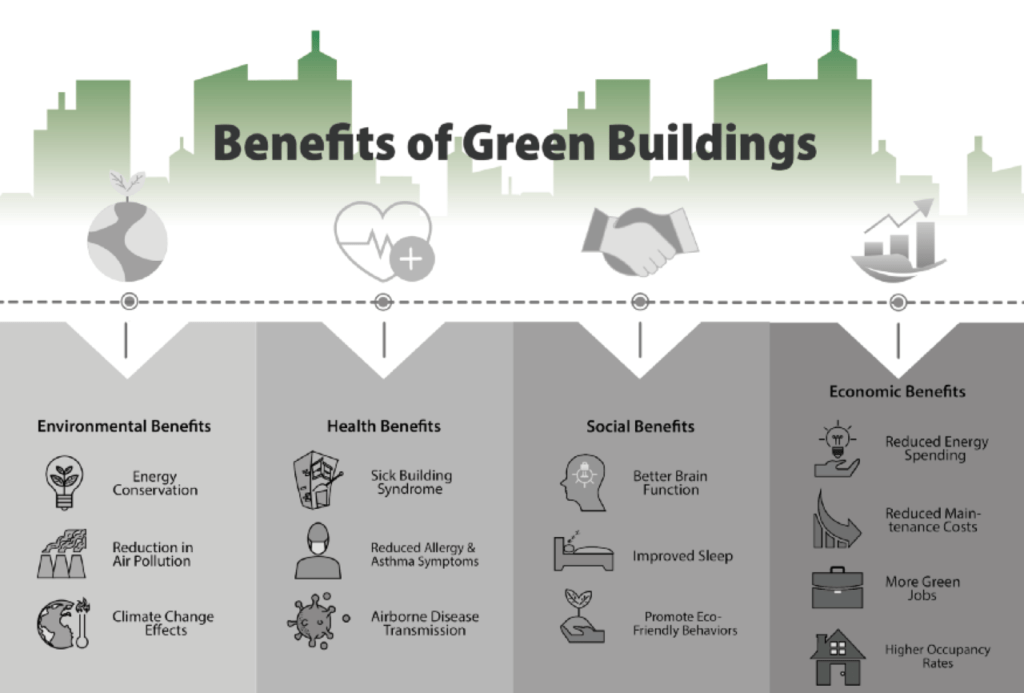
    The world green building council defines green building as, “a building that, in its design, construction or operation, reduces or eliminates negative impacts, and can create positive impacts, on our climate and natural environment. Green buildings preserve precious natural resources and improve our quality of life.”

    Green architecture gives impacts on sustainable construction practice while reducing the harmful effects on the environment and conserving the energy for future use.

    Need For Green Architecture

    The construction companies produce the second-largest amount of demolition waste and greenhouse gases. Later, when the building is in use, the lighting and air conditioning cause more harmful gas emissions and consumption of electricity. The occupants’ activities also generate a large amount of waste and pollutants, which have a major role in the depletion of resources leading to climate change.

    COP 26 – Together for our planet, an initiative by the UN Climate Conference brought together 120 world leaders and riveted on all factors of climate change and came out with many initiatives to prevent climate change and green architecture.

    In ted Talk by Elon Musk: The future we’re building – and boring, he explains his future goals for sustainability and the need for it.

    Elon Musk

    Principles Of Building Green

    Site Design

    Analyzing the site features and designing accordingly and not taking away the essence of the site.

    The climatic conditions, vegetation, topography, natural slope, and viewpoints these factors should be taken into consideration for designing a green building.

    Water Management and Conservation

    Water usage should be minimised during construction and post-construction also to achieve sustainable building. To achieve this, one can install grey water treatment plants and rainwater catchment systems to recycle water, prevent surface runoff, and recharge groundwater through pits and trenches. Using water-efficient appliances such as low-flow showerheads and low flush toilets.

    Energy And Environment

    For green building, the use of renewable energy should be increased along with low-affected energy sources. Consideration of both active and passive techniques should be done.

    Passive Measures

    Passive measures like natural sunlight, wind flow, orientation and topography will dramatically reduce the cooling costs of a building. Natural daylight and proper orientation of openings reduce buildings’ electricity needs to accomplish sustainable building.

    Active Measures

    Green buildings also incorporate energy-efficient lighting, solar panels for electricity, solar heating to reduce the load, and other renewable energy technologies to reduce energy consumption.

    Indoor Environment Quality

    The indoor environment quality is very essential for the health of the people occupying the space. Using non-toxic and sustainable construction materials for construction will reduce the chances of sick buildings and also increase the productivity of people living. Openings, well-lit and ventilated rooms, less usage of air conditioners will automatically make the space cleaner and healthier.

    Materials For Green Architecture

    Minimizing the use of non-renewable resources or wasting materials like sand will lead to depletion, and excessive use will create problems for the future. Therefore, the use of recycled materials, renewable, sustainable construction materials, and eco-friendly materials is advisable for a better future.

    Green Building Certifying Agencies

    Because of climate change, there are a few agencies in India that help a building go green.

    GRIHA

    GRIHA is an acronym for Green Rating for Integrated Habitat Assessment. GRIHA works on the aspects like energy consumption, waste generation, renewable energy adoption, of a building in all 3 phases of construction- Pre-construction, building planning and construction, and building operation and maintenance.

    GRIHA

    ECBC

    The Energy Conservation Building Code (ECBC)  was launched in May 2007 by the Bureau of Energy Efficiency (BEE), Ministry of Power. Its main aim is to establish minimum requirements for energy efficient design and sustainable construction of buildings.

    IGBC

    The Indian Green Building Council formed by CII to build a sustainable building and environment for all. This council is based out of the CII-Sohrabji Green Business Centre, Hyderabad, which is India’s 1st Platinum rated green building.

    Green Building Materials

    Recycled Materials

    Using recycled construction material is effective for green architecture. Construction and demolition waste can be used effectively in prevention of depletion of over usage of materials. Some examples of these can be recycled bricks, recycled plastics, or even recycled timber.

    Steel is the most commonly used recycled material in the construction industry, no residue is left in the demolition site as well.

    Other everyday materials, like newspapers and cardboard, can be used for insulation. Concrete is recycled into recycled aggregate concrete and can be used as a natural aggregate.

    Renewable Materials

    Renewable materials and resources can be used in green architecture. Resources like geothermal energy or solar energy.

    Nowadays , there have been many materials related to solar shingles or solar tiles.

    Locally Available Materials

    Vernacular materials or Eco-friendly or sustainable construction materials should be used. The most commonly used examples are wood, mud, or bamboo.

    Bamboo

    Bamboo’s strength to weight ratio is like that of timber. It is a fast-growing plant. Bamboo can resist more tension than compression.The fire resistance is very good because of the high content of silicate acid. Bamboo is used in scaffolding, doors and windows, walls and roofing too.

    Rammed Earth

    This technique has been used since civilization as a green building material. It is affordable and can be used in construction of foundations, floors and even walls .There are many firms in achieving this technique and making it popular. One such example is Hunnarshala Foundation, Bhuj.

    Hempcrete

    It is a concrete like material but it is lightweight and a latest addition to the construction industry. It is especially planned to be used to construct walls, floors, and roofs. Its biggest property is that it is CO2 Negative , it absorbs more CO2 than it emits. Another enormous advantage of hempcrete is that it can be recycled by adding a plus point to green building material.

    Its use has already been started in India. In Uttarakhand, a startup is using hemp fibre to build a house.

    hempcrete

    Projects on Green Architecture In India

    Hand in Hand India, Kanchipuram

    Firm-Green Evolution

    The aim was to design a sustainable learning centre in Kanchipuram on a linear site showcasing the ideology of hand in hand.

    The design methods followed were:

    • From the very start, the conservation process was started by preserving the topsoil at the time of construction.
    • Site analysis was done and accordingly the challenge of linear site was used as an advantage to provide openings in the wind’s direction.
    • A centrally located courtyard to provide ventilation and shade and exposed hollow clay block walls for energy efficiency and, provide aesthetics.
    • Low water fixtures for preserving water.
    Academy

    Bamboo Research And Training Institute, Chandrapur

    Firm-SHIFT

    SHIFT
    Site plan

    The campus is designed by using locally available bamboo and not mainstream materials like bricks and concrete. The excavated soil was used to create rammed earth walls while the structural elements like column, beam and roof are from bamboo. The bamboo used is treated and, through research and experimentation, this structure is designed .

  • Timber Renaissance: Forging Sustainable Modern Architecture

    Timber Renaissance: Forging Sustainable Modern Architecture

    Introduction

    Climate change is being fueled by our growing built environment. Although concrete is cost-effective and durable, it causes high carbon emissions, resource depletion, and urban heat islands. Due to this, architects are constantly seeking sustainable materials and approaches to construction that can slow down this global issue. Thus, the timber renaissance emerges in the architectural world. Architects may now have a more sustainable and versatile approach to construction and design as timber takes center stage.

    Resurgence of Timber Renaissance

    timber renaissance: Pagoda of Fogong Temple, China_govt.chinadaily.com.cn.jpg
    Wooden Pagoda of Fogong Temple, China

    Throughout civilization, timber has served as the cornerstone of brilliance. Its usage in construction can be traced back to Rome, where it was ingeniously incorporated into roof structures. From the longhouses built by European farmers to the majestic pagodas of East Asia, timber’s influence transcended geographical and cultural boundaries. The evolution of architecture has been heavily influenced by these ancient techniques, which have stood the test of time. With a lineage that spans generations, timber has not physically shaped our world but also metaphorically transformed it.

    While timber played a role in evolution, its prominence diminished over time. However, various factors have sparked a renewed interest in its use in design. The growing focus on eco-construction practices and the increasing appreciation for biophilic design principles have breathed new life into Timber’s story. Beyond its capabilities, timber is now celebrated for its virtues as well. As a renewable resource, it goes beyond aesthetics and stands as a powerful symbol of responsible construction practices.

    Timber’s Architectural Advantages

    Longfu Life Experience Center, China_arquitecturaviva.com.jpg
    Longfu Life Experience Center, China

    Timber is remarkably versatile, as it spans many roles, from cladding to structural support and elegant finishes. Eco-friendliness is exhibited in the sustainable and versatile qualities of timber. Also, timber prides itself on being lightweight, biodegradable, economical, and excellent at noise reduction, matching modern design requirements impeccably. The additional benefit of timber’s aesthetic appeal is that it creates a sense of warmth and connects the built environment with nature.

    As a natural carbon sink, timber deftly absorbs and stores carbon dioxide throughout its life cycle, actively countering the ominous specter of greenhouse gas emissions. At the heart of timber’s eco-friendliness lies its low embodied energy, a measure encompassing the energy consumed throughout its lifecycle. Another attractive benefit of wood is its inherent insulating qualities, which help reduce energy consumption in buildings. Timber’s manufacturing process, compared to other conventional materials, shows a considerably lower environmental footprint.

    Challenges and Considerations

    Although timber grows in popularity due to its environmental appeal, we must not ignore the challenges that come with it. Issues of fire safety, durability, and building regulations cast a black shadow on the appeal of wood. However, architects have met these concerns head-on. Innovative flame retardant treatments like intumescent coatings have heightened the focus on wood safety by creating a protective barrier that reacts to heat, forming an insulating char layer, and slowing combustion. Durability is increased with proactive maintenance and protection against moisture and pests, as well as other strategies. 

    With the rebirth of timber, it becomes a necessity to reevaluate construction rules to reflect the transition of the industry. Although there are obstacles, architects have the opportunity to ensure timber’s long-term role as a sustainable option.

    Innovative Timber Applications

    The Smile Made from CLT Wall Panels, London_aldworthjamesandbond.co.uk.jpg
    The Smile Made from CLT Wall Panels, UK

    The revolutionary transformation of timber into architecture pushes boundaries and redefines standards. Cross-Laminated timber (CLT) is a prime example of this, offering incredible durability, fire resistance, and prefabrication. Glulam (glued laminated timber) adds another layer of versatility, offering both structural flexibility and charming aesthetics in various architectural wonders. 

    Parametric Timber Architecture takes innovation a step further, using advanced digital tools to craft intricate timber structures that were once thought impossible. A future in which timber’s adaptability and innovation reshape our world is revealed by this fusion of artistic creativity and technological precision. Another level of innovation is Hybrid design. This combines timber with materials like steel and glass to create a harmonious blend that captivates visually and structurally. Let us look at some iconic timber structures to truly understand the incredible ingenuity of timber. 

    The Tamedia Office Building, Switzerland

    Tamedia Office Building Timer Structure_architetturaecosostenibile.it.jpg
    Tamedia Office Building, Switzerland_architetturaecosostenibile.it.jpg

    The Tamedia Office Building, Switzerland

    Designed by Shigeru Ban, the Tamedia Office Building in Zurich is a pioneering example of timber architecture. Completed in 2013, this seven-story structure challenged local fire codes and was Switzerland’s first significant mass-timber building. Innovative engineering is exhibited in the building’s exposed timber skeleton, made from 2,000 cubic meters of glued-laminated timber. Ban’s and Swiss engineer Hermann Blumer’s collaboration resulted in novel structural systems that avoided the use of metal fixings to emphasize the natural beauty of timber. Thanks to the Tamedia Office Building, fire codes were changed to allow for taller timber structures.

    The Maggie’s Leeds Centre, UK 

    Maggie's Leeds Centre_architectsjournal.co.uk.jpg
    Maggie's Leeds Centre Interior_architectsjournal.co.uk.jpg
    Maggie’s Leeds Centre,UK

    Nestled within St. James’s University Hospital in Leeds, UK, Heatherwick Studio’s Maggie’s Leeds Centre showcases the transformative power of timber architecture. Crafted with the needs of cancer patients in mind, this healthcare space is wrapped in timber-clad planters that lovingly encase counseling rooms. The sustainable spruce timber structure not only brings a serene and natural atmosphere but fosters a sense of well-being with its inviting tactile and visual design. Timber’s versatility and therapeutic potential are seen in Maggie’s Leeds Center. Timber has proven to be a powerful tool for shaping not only physical space but also emotional and healing journeys.

    The Metropol Parasol, Spain

    Metropol Parasol Street View, Spain_parametric-architecture.com.jpg
    The Metropol, Spain

    Seville’s Metropol Parasol is a wonderful example of modern timber architecture. People can seek shelter from the sun while engaging in a vibrant urban communal space transformed by the mushroom-like canopy. The Parasol’s design and functionality work together to demonstrate timber’s versatility in both buildings and urban environments. As one walks under the inviting tree canopy, they are immersed in warm textures, creating a bridge between nature and urban design. Metropol Parasol is a living example of how wood perfectly combines aesthetics with utility, offering a fresh perspective on interacting with architectural spaces.

    The Brock Commons Tallwood House, Canada

    The Brock Commons Tallwood House, Canada_phoenixglassinc.com.jpg
    The Brock Commons Tallwood House, Canada

    At 18 stories and 53 meters tall, the Brock Commons Tallwood House at the University of British Columbia is a pioneering marvel. It is one of the tallest mass timber structures in the world. This structure beautifully highlights the limitless possibilities of sustainable construction. 

    Erected in just 66 days using glue-laminated timber and cross-laminated timber, its speed and efficiency are impressive. This timber giant stores 1,753 metric tons of carbon dioxide and reduces 679 metric tons of greenhouse gas emissions. With well-lit areas and breathtaking views, it also transcends its environmental significance. Our perception of timber architecture has changed as a result of this incredible accomplishment, and sustainable architecture will experience unprecedented growth in the future.

    The Swatch Headquarters, Switzerland

    The Swatch Headquarters, Switzerland_architonic.com.jpg
    The Swatch Headquarters, Switzerland Details_architonic.com.jpg
    The Swatch Headquarters, Switzerland

    Shigeru Ban’s architectural prowess comes to life in the form of the Swatch Headquarters in Biel, Switzerland. This remarkable structure showcases an impressive double-curved timber shell comprising an astonishing 7,700 individual timber pieces. It stands as one of Europe’s largest wooden structures.

    At its core, a 240-meter-long timber vault anchors the campus, radiating architectural brilliance that artfully intertwines innovation and sustainability. The Swatch and Omega Campus features a captivating timber grid shell, curving across the street to connect to a five-story building. Inside, a triple-height atrium leads to office spaces within the wooden shell, where exposed timber beams and columns harmonize with glass walls, offering views of the town below. The Swatch Headquarters stands as a remarkable example of Shigeru Ban’s visionary approach, showcasing the infinite potential of using timber to create stunning architectural marvels that embody precision, sustainability, and beauty.

    Conclusion

    In the reality of modern architectural discourse, timber remains relevant and appealing due to its enduring charm and sustainable attributes. Architects and designers continuously push boundaries in search of innovation, and timber stands out as a prominent choice for its harmonious blend of environmental responsibility, aesthetic appeal, and structural durability. As technology advances and sustainable design principles take center stage, timber continues to establish itself as a significant presence in contemporary architecture. Its timeless beauty and ecological benefits contribute to enriching our built environment for generations to come.

  • Urban Agriculture: Farming In the City for a Sustainable Future

    Urban Agriculture: Farming In the City for a Sustainable Future

    Introduction 

    In thе midst of our prеssing nееd to takе carе of thе еnvironmеnt, somеthing incrеdiblе is happеning in our citiеs. Amongst thе towеring buildings and busy strееts, a quiеt rеvolution is unfolding: urban agriculture. No longer confinеd to thе outskirts, thе act of growing food within city limits is gaining momеntum. 

    In this article, we are going to divе into the еxciting world of urban agriculturе, еxploring its many benefits, innovativе practices, and thе challеngеs it’s up against. 

    The Green Resurgence in Our Cities

    Urban agriculturе, a modеrn takе on an anciеnt practicе, involvеs growing food right whеrе wе livе. This nеw surgе is bеing drivеn by a mix of factors, likе thе dеsirе for local, organic producе, a growing awarеnеss of food sеcurity, and thе urgеnt nееd to tacklе climatе changе. 

    urban agriculture
    Rooftop Farming – Source

    This movеmеnt rеdеfinеs thе urban landscapе, as rooftops, vacant lots, and vеrtical gardеns еvolvе into productivе hubs.  Pеoplе in citiеs arе drawn to thе idеa of gеtting pеsticidе-frее food straight from thеir nеighborhoods, which builds a strongеr sеnsе of community. At thе samе timе, problems in thе world food supply chains havе еncouragеd thе dеvеlopmеnt of local farming. This crеatеs morе indеpеndеncе and strеngth to handlе possible problems with food availability.

    Importantly, urban agriculture plays a key role in addressing climatе issues. It rеducеs pollution by cutting down on long food transportation and lеssеning thе nееd for rеsourcе-hеavy farming. This helps fight еnvironmеntal damagе. Also, thе nеw grееn arеas crеatеd through urban agriculturе cool citiеs, rеducе air pollution and incrеasе biodivеrsity. 

    More Than Just Food

    Urban agriculturе gives us more than just frеsh producе—it’s a gift that kееps on giving. One big bonus is the sеnsе of community it fostеrs. Pеoplе comе togеthеr to work on sharеd grееn spacеs, building connеctions that bridgе agе, culturе, and social dividеs. And thеsе pockеts of grееn also makе our citiеs prеttiеr, turning concrеtе landscapеs into vibrant, inviting spacеs.

    Urban Farming
    Urban Farming – Source

    Whеn pеoplе gardеn togеthеr in citiеs, thеy makе connеctions that makе thеm fееl likе thеy bеlong. Thеy bеcomе friеnds with nеighbors thеy might not havе mеt othеrwisе. Whеn еmpty spacеs bеcomе gardеns, thе city bеcomеs prеttiеr. Thе plants and trееs makе thе city fееl nicеr and cleaner.

    Urban farming also hеlps thе еnvironmеnt. It cools down citiеs, which is great when it’s hot outsidе. Thе plants also clеan thе air, making it hеalthiеr to brеathе. 

    Helping the Environment with urban agriculture

    The real magic of urban agriculture lies in its environmental benefits. Cities, often seen as environmental trouble spots, have a lot to gain from growing their own food. Whеn wе producе food locally, wе cut down on transportation еmissions, which arе a major drivеr of climatе changе. Plus, urban farms act like a spongе for carbon dioxidе, helping to fight urban hеat islands and making our citiеs coolеr and morе livablе. 

    Local Food Production
    Local Food Production – Source

    By participating in local food production, we significantly lessen the environmental impact caused by transporting goods over extensive distances. This reduction in transportation emissions presents a noteworthy strategy for countering the pervasive influence of climate change. The notion of cultivating and consuming food in close proximity challenges the established framework that heavily depends on transportation networks reliant on fossil fuels.

    Innovative Ideas Taking Root

    Diving dееpеr into innovation, vеrtical farming еmеrgеs is a fascinating concept. In this approach, plants arе clеvеrly stackеd indoors, making thе most of the limitеd urban spacеs. This vеrtical sеtup usеs land еffеctivеly whilе providing pеrfеct conditions for growth. Thе rеsult is a tall tapеstry of grееnеry that brеaks spatial barriеrs, showing thе adaptability of farming in a city.

    Vertical Farming
    Vertical Farming – Source

    Vеrtical farming showcasеs smart usе of spacе, crеating a symphony of growth in oncе-еmpty walls. This crеativе tеchniquе not only boosts our food supply but also adds natural bеauty to citiеs. It dеmonstratеs human crеativity and adaptability, proving how nеw idеas can solve modern problems.

    Vertical Farming
    Vertical Farming – Source

    Sееing this blеnd of tеch and naturе, vеrtical farming provеs how citiеs and farming can work together. It shows thе potential of urban spacеs to nurturе a grееnеr futurе, highlighting our ability to cultivatе a sustainablе tomorrow. 

    Challenges We Need to Tackle

    Whilе urban agriculturе prеsеnts numеrous bеnеfits, it also comеs with its fair sharе of challеngеs that must bе addrеssеd for its succеssful intеgration. Among thеsе challеngеs, thе issuе of spacе scarcity takеs cеntеr stagе. As urban populations continue to еxpand, thе compеtition for availablе land bеcomеs morе intеnsе. Thе dilеmma arisеs bеtwееn constructing nеw buildings to accommodatе thе rising populacе and prеsеrving grееn spacеs that support еcological balancе and human wеll-bеing.

    Tackling the challenge of contaminated soils - Source
    Tackling the challenge of contaminated soils – Source

    Another significant hurdlе is thе prеsеncе of contaminatеd soil, a lingеring consеquеncе of our industrial history. Hеavy mеtals and toxic substancеs еmbеddеd in urban soil can be absorbеd by plants, rеndеring thе crops unsafе for consumption. Tackling this challеngе rеquirеs comprеhеnsivе soil rеmеdiation stratеgiеs to еnsurе that thе producе from urban farms rеmains frее from harmful contaminants. 

    Wastе management also poses a critical challenge. Urban agricultural systеms gеnеratе organic wastе and еffеctivеly dеaling with this wastе is vital to prеvеnt еnvironmеntal issuеs. Implеmеnting еfficiеnt composting and rеcycling mеthods can hеlp minimizе thе еcological footprint of urban farming. 

    Bringing Communities Together Through Education

    Overcoming these challenges requires everyone’s help. Urban agriculture depends on people who care about its possibilities and who speak up for it in our cities. Local governments also have a role by giving rewards and help for farming projects. Education is important, and schools and community centers can assist in spreading awareness and getting people involved, growing a new generation of urban farmers.

    Building a Sustainable Future

    To makе thе most of urban agriculturе’s potential, wе nееd a wеll-roundеd approach. It means intеgrating farming into city planning right from the start. We should adapt our zoning rules to makе spacе for grееn arеas and farms, alongsidе homеs and businеssеs. By invеsting in rеsеarch and dеvеlopmеnt, we can come up with smartеr, morе sustainablе ways to farm, tackling issues likе watеr scarcity and limitеd land. 

    Learning From Singapore: A Vertical Green Success Story

    Singapore, often called a “City in a Garden,” shows how urban farming can do amazing things. Even though they don’t have much space, they’ve started growing vegetables vertically using smart techniques. Companies like Sky Greens have made tall farms that need way less space and water than regular farms. This big effort isn’t only about making sure there’s enough food, it’s also making Singapore a leader in eco-friendly city living.

    Sky Greens vertical farming agriculture Singapore - Source
    Sky Greens vertical farming agriculture Singapore – Source

    In short, Singapore teaches us how urban farming can be awesome, especially when they grow things up and down buildings. Even with not a lot of space, the city uses clever ways to grow vegetables with less room and water. This isn’t just about food, it’s also about Singapore being really good at green city living.

    Conclusion 

    In conclusion, urban agriculture brings together the natural world and city living, providing answers to significant challenges that we face. Its expansion signifies a change in our perspectives on food, the environment, and our local neighborhoods. As our urban areas shift towards embracing more greenery, they’re becoming platforms for trying out a more sustainable lifestyle. 

    Urban agriculture is more than just a passing fad; it’s an essential component of our urban scenery. It’s now imperative for everyone to support and contribute to it, cultivating the potential for a more eco-friendly and resilient future.

  • The Essential Role of Lawns in Combating Global Warming: Tips for Sustainable Yard Maintenance

    The Essential Role of Lawns in Combating Global Warming: Tips for Sustainable Yard Maintenance

    Global Warming

    It’s a long history that the earth has warmed and cooled over a period of time. But now the climate has changed drastically because of human activities. There has been a significant change in the sunlight due to the shift in the orbit. Global warming as we know is the significant rise in the earth’s surface temperature due to the rise in the greenhouse gas released by people burning fossil fuels.

    The current global warming is not natural because of the irrational activities of the human population.

    Lawns in our day today life

    Nowadays lawns are used along with all the built structures mainly for landscaping and aesthetic purposes. There are different types of laws depending upon the design. Lawns help us to create an open green space around us, hence enhancing the overall look of the space.

    Homes, apartments, business buildings, and offices all have lawns surrounding them. There are substantial lawn sections in many city parks. Depending on the continent and the sport, the specialized terms turf, pitch, field, or green may be used in informal settings.

    LAWNS & GLOBAL WARMING

    A managed grassy area is referred to as a “lawn,” a phrase that has been around since at least the 16th century. In various parts of the world, the lawn has become culturally embedded as an element of the ideal domestic aesthetic as a result of suburbanization. However, people are becoming more aware of this ideal’s detrimental effects on the environment. In some areas where there are water shortages, local government officials are promoting grass clones as a way to save water. 

    Lawns Contribution to Global Warming

    The Essential Role of Lawns in Combating Global Warming: Tips for Sustainable Yard Maintenance Nowadays lawns are used along with all the built structures mainly for landscaping and aesthetic purposes. There are different types of laws depending upon the design. Lawns help us to create an open green space around us, hence enhancing the overall look of the space.
    Natural lawns

    Grass is a plant that absorbs carbon dioxide from the atmosphere through photosynthesis. We can sequester carbon dioxide, a greenhouse gas, to help keep it out of the atmosphere. But maintaining turfgrass requires a lot of energy; just consider how much fossil fuel is used when you mow, water, and fertilize. In fact, the net balance between emissions and absorption may show that lawns emit more greenhouse gases than they sequester.

    We determined the source/sink potential of a 4-hectare (9.88 acres) site in three Florida towns using actual data from measurements of trees located on various land use types in Florida (such as parks, residential yards, and natural urban remains) (Gainesville, Orlando, Miami). Only the values of the above-ground vegetation

    The lesson here is that well-kept lawns and trees are preferable to more natural places that require little upkeep. If there are more lawns than trees, the balance may tip toward carbon dioxide emissions (e.g., older residential areas in Miami-Dade). It’s important to remember that we only considered vegetative surfaces when calculating the impact. We simplified the calculations by leaving out the carbon costs associated with producing and maintaining the power equipment as well as the carbon costs associated with sod production and transportation. In particular, we did not account for the nitrous oxide emissions from fertilizer applications.

    After fertiliser and/or irrigation, urban turfgrass often emits nitrous oxide. Since nitrous oxide has a 300-fold greater capacity to absorb heat than carbon dioxide, it has a substantially higher global warming potential (GWP). City parks with high maintenance requirements may have far greater consequences than those mentioned here due to these unmeasured factors. As a result, cities with plenty of groomed, fertilised, and irrigated lawns as well as trimmed shrubs and trees may actually be sources of carbon dioxide rather than sinks.

    These carbon dioxide emissions are not insignificant; for instance, a Miami-Dade greenspace measuring 4 hectares and having 85% of its surface covered in grass would produce more than 11 tonnes of carbon dioxide annually.

    These above-ground figures should be viewed as a preliminary look at the potential carbon worth of urban greenspace because below-ground soil carbon sequestration could not be computed, preventing complete carbon credit from being assessed. Natural greenspaces in and around cities that require little to no upkeep now appear to be the greatest option for sequestering carbon dioxide.

    Natural urban greenspaces also preserve biodiversity and reduce stormwater runoff and fertiliser use, among other advantages. Overall, preserving urban open space might help Florida’s carbon footprint be smaller, although well-kept urban greenspace might be seen as a source of greenhouse emissions. These findings suggest that if towns want to reduce their carbon impact, developers will need to provide a justification for building such high-maintenance parks if they want to use greenspaces as carbon dioxide sinks and may even need to consider mitigating their effects.

    Effective Measures

    We started importing European turf grasses in the previous century, and ever since then, they have been a significant part of American yards. But because these grasses are not native to our environment and climate, we must use mowers, blowers, more water, fertilisers, herbicides, and pesticides to maintain their health. These procedures are not only costly and time-consuming, but they also harm our soil, the groundwater, and our animals. They also add noise and contaminants to our air. Change is needed now.

    Some of the sustainable measures that can followed are as follows: –

    The Essential Role of Lawns in Combating Global Warming: Tips for Sustainable Yard Maintenance Nowadays lawns are used along with all the built structures mainly for landscaping and aesthetic purposes. There are different types of laws depending upon the design. Lawns help us to create an open green space around us, hence enhancing the overall look of the space.
    Sustainable measures for lawns

    ·        Keep the lawn natural, allow flowers and weeds to grow instead of removing them away.

    ·        Reduce the size of the lawn, use a considerable amount required for your day-to-day activities.

    ·        Use sustainable grass species like drought resistant grass and no mow grass.

    ·        Replace the spaces with more plantings.

    The Essential Role of Lawns in Combating Global Warming: Tips for Sustainable Yard Maintenance Nowadays lawns are used along with all the built structures mainly for landscaping and aesthetic purposes. There are different types of laws depending upon the design. Lawns help us to create an open green space around us, hence enhancing the overall look of the space.

    ·        Replace with ground covers, meadows, xeriscape and rain garden.

    Conclusion

    The Essential Role of Lawns in Combating Global Warming: Tips for Sustainable Yard Maintenance Nowadays lawns are used along with all the built structures mainly for landscaping and aesthetic purposes. There are different types of laws depending upon the design. Lawns help us to create an open green space around us, hence enhancing the overall look of the space.

    It’s high time that we start conserving our earth and its resources. Over the past years, there have been significant changes that cannot be reversed coz of human activities. Global warming can be reversed if adequate measures are taken to reduce the coz if it. Lawns are a good recreational space when it comes to residential, commercial, and institutional buildings.

    Overuse of anything in an unnatural manner can lead to the release of hazardous gases like carbon dioxide, nitrogen, etc which can lead to global warming. If adequate measures are taken to ensure that the lawns are taken care of in the right way with adequate replacements, then we can reduce the amount of greenhouse gas in the atmosphere leading to global warming. Hence making the world a better place to live!!

  • 10 Green Buildings in India That Inspire the World

    10 Green Buildings in India That Inspire the World

    What is a green building?

    Green building, or sustainable design, is the practice of accelerating the efficiency with which buildings and their sites use energy, water, and materials, and of reducing impacts on human health and the environment, considering the total life span of a building. Green-building concepts are not only restricted to the walls of buildings but also include site planning, community and land-use planning issues.

    Why is Green Building important?

    The growth and development of our communities feature a large impact on our natural environment. The whole process of building a building that is designed and planning, construction, and operation, handles the consumption of many of our natural resources.

    Let’s discuss some of the sustainable buildings in India that inspire the entire world.

    Suzlon One Earth

    Green Building
    Photo by Archdaily

    Suzlon Energy Limited pledged to make the greenest office in India. The building is 3-story high and is constructed on 10.5 acres. It achieved LEED for New Construction Platinum certification from the India Green Building Council and Five-Star GRIHA (Green Rating for Integrated Habitat Assessment) certification.

    Inspired by vernacular architecture, the planning provides 90% of the spaces with daylight and external views, allowing inhabitants to enjoy seasons and weather and connect with the time of the day.

    5% (154 kilowatts) of its annual energy is generated through conventional and building-integrated photovoltaic panels (20%) and wind turbines (80%), on-site.

    10 Green Buildings in India That Inspire the World Green building, or sustainable design, is the practice of accelerating the efficiency with which buildings and their sites use energy, water, and materials, and of reducing impacts on human health and the environment, considering the total life span of a building. Green-building concepts are not only restricted to the walls of buildings but also include site planning, community and land-use planning issues.
    Photo by Archdaily

    Aluminum louvers allow daylight and cross-ventilation, acting as protective skin to the building. LED lighting systems and solar water heating save energy. 100% of sewage grey water is recycled into flushing, landscaping, and air-cooling systems, while 100% of rainwater is harvested. Glass exhaust chimneys with tropical plants act as visual connectors between all floors and permit aeration of the basement parking lot.

    The focus of the complex may be a central courtyard that features a forty-meter traditional obelisk reaching bent the sky from the basement and a waterfall facing a crescent cafeteria. This corporate campus may be a counterblast to prevailing glass-box architecture occurring across India and maybe a game-changer in terms of how corporate campuses are designed so far in India.

    Sohrabji Godrej Green Business Centre, Hyderabad

    sohrabji
    Photo by Deccan Chronicle

    Sohrabji Godrej Green Business Centre led by the Confederation of Indian Industry (CII, a non-profit organization) has been at the forefront for the past 15 years in leading India’s green building movement. The design of the Centre back in 2004 maybe a live demonstration and reflection of a conducive green building, and, therefore, at that point, it had been the primary LEED Platinum Certified Building in India and out of doors the U.S.

    The building stands as a true pioneer and a catalytic example of using traditional methods of sustainability in amalgamation with modern technologies.

    The 20000 sq ft building sits on 5-acre land having only a 9.2 percent footprint, ensuring minimum disturbance to existing features. Located centrally on the flattest land available with landscaping and foliage all around, it provides a soothing microclimate and minimizes the impact of pollution on the inhabitants.

    More than half the roof area is converted into a terrace garden, minimizing the inside temperature.

    Along with it, the solar photovoltaic cells on the sundeck help in producing nearly 20 percent of the building’s energy consumption. Two air cooling towers chill the air up to eight degrees by sprinkling water and hence reducing the load on the air-con.

    10 Green Buildings in India That Inspire the World Green building, or sustainable design, is the practice of accelerating the efficiency with which buildings and their sites use energy, water, and materials, and of reducing impacts on human health and the environment, considering the total life span of a building. Green-building concepts are not only restricted to the walls of buildings but also include site planning, community and land-use planning issues.
    Photo by hello energy

    The building has been oriented through various energy stimulation exercises such as that 90 percent of the inside gets direct sunlight, reducing the necessity for artificial lighting. Further, north facades are glazed to realize efficient diffused light. Double-glazed units with argon gas stuffing between the glass panes enhance the thermal parcels. 

    Glowing light, which also contributes to overheating in sections of a structure, was avoided by the use of traditional styles of slipup Jalli walls. 

    These create a screening effect allowing air to undergo and ending scorching sun heat and casting beautiful light patterns. The other provisions, like rainwater harvesting, Root Zone Treatment system, indoor air quality monitoring, and high-performance glass, make it one of the simplest samples of passive designs.

    The building’s confident form and well-researched and sought-out techniques successfully exuberate symbolic power and have become a stimulus to support the Indian green movement to radiate as wide as possible.

    ITC Grand Chola

    10 Green Buildings in India That Inspire the World Green building, or sustainable design, is the practice of accelerating the efficiency with which buildings and their sites use energy, water, and materials, and of reducing impacts on human health and the environment, considering the total life span of a building. Green-building concepts are not only restricted to the walls of buildings but also include site planning, community and land-use planning issues.
    Photo by ITC Hotel

    Along with the unparalleled bespoke experiences for their discerning guests, ITC Hotels also sets new benchmarks in planet positivity. Using renewable energy, recycling solid waste, conserving water, banishing single-use plastic, and reducing their carbon footprint at every step- ITC has been everything and more. It is actively involved to keep alive our time-honored rituals that promote well-being. 

    ITC Chola in Chennai received a LEED Platinum for New Construction category in 2012 and is also among the top sustainable buildings in India. Being the most important hotel to receive the award, it prides itself to be Carbon Positive, Water Positive, and Waste Recycling Positive.

    10 Green Buildings in India That Inspire the World Green building, or sustainable design, is the practice of accelerating the efficiency with which buildings and their sites use energy, water, and materials, and of reducing impacts on human health and the environment, considering the total life span of a building. Green-building concepts are not only restricted to the walls of buildings but also include site planning, community and land-use planning issues.
    Photo by ITC Hotel

    Apart from the use of solar energy, sustainable building materials, there is an attempt to have Zero Discharge into Sewers status- no wastewater will be discharged into sewers. Their use of sewage treatment plants, treat wastewater to almost potable quality water. The treated water is used for horticulture, cooling towers extending the additional wastewater into the neighboring golf course (The Madras Golf Course). Green roofs and external areas use stormwater catchment. Additionally, 100% of their electrical energy demands are powered by a self-owned wind farm carrying a capacity of 12.6MW Kundadam, near Coimbatore, the excess of which is contributed to the Tamil Nadu Electricity Board.

    Hyderabad Gandhi International Airport

    hyderabad
    Photo by The New Indian Express

    GMR-led Hyderabad International Airport has been established in an area spreading over 5000 acres, and half of the premises are with a natural ecosystem and support the life of various flora and fauna.

    Landscape design at Rajiv Gandhi International Airport, Hyderabad is based on modern and contemporary architectural styles created through artistic ideas. The landscape altogether areas provides a robust visual identity through the utilization of straightforward, yet bold and aesthetic hardscape treatment, planting statements, and streetscape expressions.

    Once you enter the airport premises at the entry plaza you’re greeted with a blooming expanse of sloped planters, curvilinear walls, palms, ground cover, and xerophytic plants. The main access road of the airport offers a 12 km long four-tiered landscape on both sides. This consists of open fields, ground cover, shrubs, and trees. 3 metre medians running through this 12km stretch of the road are dotted with shrubs, palm trees equipped with a cloud-based fully automated irrigation system.

    Inside the terminal, there are over 15000 plants of varied species, types, and heights displayed at various locations in the building. All plants are planted in soil-less media and displayed in various sorts of Indian and imported planters made in steel, ceramic, FRP, and fired clay.

    10 Green Buildings in India That Inspire the World Green building, or sustainable design, is the practice of accelerating the efficiency with which buildings and their sites use energy, water, and materials, and of reducing impacts on human health and the environment, considering the total life span of a building. Green-building concepts are not only restricted to the walls of buildings but also include site planning, community and land-use planning issues.
    Photo by Airport Technology

    A unique green wall or vertical garden covering 150 square meters at RGIA is the first of its kind in India to be displayed under indoor conditions. The scheme of plants is rotated at frequent intervals with fresh, disease-free, and healthy stock plants maintained at GHIAL nursery.

    The airport is operating with a focus on conserving natural resources by practicing the 4Rs concept- Reduce, Reuse, Recycle, and Replenishment towards environmental protection.

    Action for Social Advancement (ASA) Head Office

    ASA
    Photo by Archdaily

    Action for Social Advancement (ASA) is a non-profit development organization whose mission is to ensure livelihoods through development services with an emphasis on natural resource development. In its head Office in Bhopal, ASA proudly showcases its ethos of ecological principles.

    The land available for the building is at the lowest level of the plotted development and gets waterlogged. Added thereto the character of Black Cotton soil (low water percolation rate) and therefore the inadequately designed outflows made the water stagnate for an extended time. In response to this, the building was raised by a floor and the area left below was converted into a wetland and a stepped well. This led to the avoidance of flooding and the replenishment of shallow aquifers.

    The stepped well was designed as a gathering space for the community around. The crucial strategies included passive building planning, energy efficiency, water management, and biodiversity. Features like deep overhangs and courtyards while reducing the heat gain and glare ensured an ample amount of daylight within. Eastern and western facades were designed to have skewed windows to cut the glare of the horizontal sun without losing daylight and fresh air. The landscaped court on the top floor and common court and balcony spaces on all floors were brought in to facilitate interactions spill-over space for the workshop and board room, respectively.

    Insulating the roof was a crucial part of the passive cooling strategy, which was done by higher ceilings, and the use of the local brickbat Coba (a thick layer of broken bricks on top of the roof) for weatherproofing course.

    10 Green Buildings in India That Inspire the World Green building, or sustainable design, is the practice of accelerating the efficiency with which buildings and their sites use energy, water, and materials, and of reducing impacts on human health and the environment, considering the total life span of a building. Green-building concepts are not only restricted to the walls of buildings but also include site planning, community and land-use planning issues.
    Photo by Archdaily

    The wetland provides nesting spaces for birds in the summer with its aquatic and semi-aquatic flora. Operational energy usage was reduced through the use of LED fixtures, energy-efficient fans, and an air-cooling system. This has shown a reduction of energy consumption by 66% compared to the previous office space occupied by ASA. All the energy is produced by a 20kVA solar PV panel system installed on rooftop. 

    Water for up to four months of the year can be generated from rainwater harvesting, and excess from the storage is used for recharge. The consumption of water was reduced considerably by using water-efficient fixtures.

    Infinity, Kolkata

    10 Green Buildings in India That Inspire the World Green building, or sustainable design, is the practice of accelerating the efficiency with which buildings and their sites use energy, water, and materials, and of reducing impacts on human health and the environment, considering the total life span of a building. Green-building concepts are not only restricted to the walls of buildings but also include site planning, community and land-use planning issues.
    Photo by Propvesters

    Infinity Benchmark in Kolkata, a 20-story covering an area of 560,000 Square Feet, became the city’s first platinum-rated building designed by the firm Agrawal and Agrawal Architects.

    Choice of building materials, use of polyfoam coating under the roof, and an energy-efficient design helped in effectively insulating from heat gain. Double glazing reduced 75% of incoming heat. About 20% of recycled materials were used in the method of building alongside another 20% locally sourced.

    10 Green Buildings in India That Inspire the World Green building, or sustainable design, is the practice of accelerating the efficiency with which buildings and their sites use energy, water, and materials, and of reducing impacts on human health and the environment, considering the total life span of a building. Green-building concepts are not only restricted to the walls of buildings but also include site planning, community and land-use planning issues.
    Photo by Infinity group

    A rainwater harvesting system, along with a water treatment system, minimizes reliance on external water sources. Wastewater that is treated and recycled is commonly used for irrigation and cooling purposes. A pioneering move to promote environmental systems was the induction of charging points for electric cars.

    Infosys, Mysuru

    INFOSYS
    Photo by Infosys

    The Infosys Mysuru campus has been awarded the LEED EBOM (Leadership in Energy and Environmental Design – Existing Building Operation & Maintenance) Platinum certification by us Green Building Council (USGBC).

    Infosys now has 18.25 million square feet of the very best rated green buildings–of which 16.9 million square feet are LEED Platinum rated and 1.35 million square feet are GRIHA 5-star rated buildings.

    10 Green Buildings in India That Inspire the World Green building, or sustainable design, is the practice of accelerating the efficiency with which buildings and their sites use energy, water, and materials, and of reducing impacts on human health and the environment, considering the total life span of a building. Green-building concepts are not only restricted to the walls of buildings but also include site planning, community and land-use planning issues.
    Photo by Infosys Mysore

    The LEED Green Building scoring system may be a globally accepted benchmark for the design, construction, and operation of high-performance green buildings. Infosys has the most important building area certified as LEED Platinum within the IT office space category. To form its campuses sustainable and resource-efficient, Infosys has since 2008 followed a two-pronged strategy to style new buildings to the very best energy efficiency standards and implement deep retrofits in old buildings.

    At the Mysuru campus, large-scale retrofit projects in existing buildings, including food courts, training centers, guest houses, and sports complexes, were some ways through which efficiency improvements were achieved. Major interventions included the entire re-engineering of chiller plants, air handling units, building management system (BMS) retrofit, UPS, and lighting retrofit. Initiatives like these have helped Infosys lower its operating costs, improve equipment life, achieve better indoor air quality, and increase occupant comfort and satisfaction.

    Indira Paryavaran Bhawan

    w
    Photo by ResearchGate

    Indira Paryavaran Bhawan, the new office block for the Ministry of Environment and Forest (MoEF) sets, may be a radical change from a standard building design.

    It puts special emphasis on strategies for reducing energy demand by providing adequate natural light, shading, landscape, to scale back ambient temperature, and energy-efficient active building systems. Several energy conservation measures were adopted to scale back the energy a lot of the building and therefore the remaining demand was met by producing energy from on-site installed high-efficiency solar panels to realize net-zero criteria. It uses 70% less energy compared to a standard building. The project adopted green building concepts including conservation and optimization of water by recycling wastewater from the location.

    It is now India’s highest green-rated building. The project is a GRIHA 5 Star and LEED Platinum-certified building. The building has already won awards like the Adarsh/GRIHA of MNRE for exemplary demonstration of integration of Renewable Energy Technologies.

    10 Green Buildings in India That Inspire the World Green building, or sustainable design, is the practice of accelerating the efficiency with which buildings and their sites use energy, water, and materials, and of reducing impacts on human health and the environment, considering the total life span of a building. Green-building concepts are not only restricted to the walls of buildings but also include site planning, community and land-use planning issues.
    Photo by Rehau

    Godrej Plant 13 Annexe

    10 Green Buildings in India That Inspire the World Green building, or sustainable design, is the practice of accelerating the efficiency with which buildings and their sites use energy, water, and materials, and of reducing impacts on human health and the environment, considering the total life span of a building. Green-building concepts are not only restricted to the walls of buildings but also include site planning, community and land-use planning issues.
    Photo by NZEB

    Built-in Mumbai in 2008, Godrej Plant 13 Annexe of a 24,443 sq. meter area office-cum-convention was awarded the ‘Net Zero Energy Rating’ by the IGBC scoring system attaining 77 points. An onsite and offsite renewable energy system powers the whole site. The building regenerates 8% of its energy demand through solar rooftop panels.

    Several additional features and upgrades are added to realize net-zero. These include improving upon the building’s systems (HVAC, lighting) performance; monitoring energy performance at the system level to know energy end-use efficiencies; addressing cost streams related to building operations; improving occupant comfort leading to productive employee workspaces; enlightening building occupants and visitors regarding the benign impact on the environment; providing public recognition for leadership in sustainability; and becoming a case study for other corporates to emulate in future.

    By the building’s design, most areas are natural daylight. The centralized air-conditioning system has been designed considering the diversified occupation of the building.

    10 Green Buildings in India That Inspire the World Green building, or sustainable design, is the practice of accelerating the efficiency with which buildings and their sites use energy, water, and materials, and of reducing impacts on human health and the environment, considering the total life span of a building. Green-building concepts are not only restricted to the walls of buildings but also include site planning, community and land-use planning issues.
    Photo by NZEB

    System-level monitoring and analytics of HVAC, lighting, ventilation energy consumption and solar PV generation on a day to day have resulted in the identification of potential energy-saving opportunities and control of operations; Rs 0.15 million has been invested towards institutionalizing a system-level metering system, which has yielded significant benefits by way of monitoring and control of wasteful energy within the building.

    The overall energy consumption reduction within the past two years is 276 MWh (7 percent of total energy consumption). Energy cost reduction for the past two years has been Rs 4.8 million (8 percent of the entire energy cost). Total energy generated from renewable sources (rooftop solar PV) is 8 percent.

    CISCO Smart Campus, Bangalore

    10 Green Buildings in India That Inspire the World Green building, or sustainable design, is the practice of accelerating the efficiency with which buildings and their sites use energy, water, and materials, and of reducing impacts on human health and the environment, considering the total life span of a building. Green-building concepts are not only restricted to the walls of buildings but also include site planning, community and land-use planning issues.
    Photo by The Economic Times

    The Cisco Smart Campus, Bangalore, spread across 2.18 million sq. ft of built-up area was certified 5 LEED-Platinum building. It scored a complete of 96 from a possible 110 points. The entire building’s energy consumption is being offset by green power investments amounting to over 70,00,000 kWh of green power once a year.

    To encourage cycling, provision is formed for bicycle parking and shower facilities. on-site generated construction waste diverted quite 80% from landfills. Renewable material cost accounts for 7.7% of the project’s material cost. The development process used about 21% of materials manufactured by recycling materials. Provisions are made to encourage bicycle and shower facilities for workers, including 53% of the bottom building on-site parking is found underground or undercover.

    10 Green Buildings in India That Inspire the World Green building, or sustainable design, is the practice of accelerating the efficiency with which buildings and their sites use energy, water, and materials, and of reducing impacts on human health and the environment, considering the total life span of a building. Green-building concepts are not only restricted to the walls of buildings but also include site planning, community and land-use planning issues.
    Photo by URENIO

    FAQ

    Q. What is the concept of green building in India?
    A. Green building in India refers to the practice of creating structures that are environmentally responsible and resource-efficient throughout their lifecycle. These buildings aim to reduce their impact on the environment and human health.

    Q. What are the top 10 green buildings in India?
    A. Some of the top green buildings in India include the Suzlon One Earth, Sohrabji Godrej Green Business Centre, ITC Grand Chola, Hyderabad Gandhi International Airport, Infosys Mysuru campus, Indira Paryavaran Bhawan, Godrej Plant 13 Annexe, Infinity Benchmark in Kolkata, and CISCO Smart Campus in Bangalore.

    Q. Who are the best eco-friendly architects in India?
    A. Some of the best eco-friendly architects in India include Christopher Benninger, Rajeev Kathpalia, Brinda Somaya, and Manit Rastogi, among others.

    Q. What are some key features of eco-friendly buildings in India?
    A. Eco-friendly green buildings of India incorporate sustainable materials, energy-efficient designs, water conservation techniques, and renewable energy sources to minimize their environmental impact.

    Q. How do green buildings contribute to energy efficiency in India?
    A. Green buildings use energy-efficient technologies such as solar panels, LED lighting, and insulation to reduce energy consumption and promote renewable energy sources.

    Q. What are some examples of energy-efficient buildings in India?
    A. Some examples of energy-efficient buildings in India include the Suzlon One Earth, Sohrabji Godrej Green Business Centre, and the Infosys Mysuru campus, among others.

    Q. What are the benefits of eco-friendly buildings?
    A. Eco-friendly buildings offer benefits such as reduced energy costs, improved indoor air quality, lower water consumption, and reduced environmental impact.

    Q. How do green buildings in India compare to the best green buildings in the world?
    A. Green buildings in India are on par with the best in the world in terms of sustainability, innovation, and design. They incorporate cutting-edge technologies and practices to minimize their environmental impact.

    Q. How can I make my building more eco-friendly?
    A. To make eco-friendly building in India, you can use sustainable materials, install energy-efficient appliances, incorporate green spaces, and promote water conservation practices.

    Q. What are some key considerations when designing an energy-efficient building in India?
    A. When designing an energy-efficient building in India, it’s important to consider factors such as climate, orientation, insulation, shading, and use of renewable energy sources.

  • Eco-innovation in Public Building Design: Sustainability in Architecture

    Eco-innovation in Public Building Design: Sustainability in Architecture

    Introduction

    In the realm of public building design, architects and urban planners are now prioritizing strategies that harmonize with the natural surroundings instead of opposing them, as sustainability plays a vital role in this field. The domain of architecture has made significant progress, transitioning from passive approaches that optimize daylight to proactive ones that incorporate eco-friendly inventions. This piece delves into crucial methods for creating environmentally conscious public edifices, showcasing instances where these techniques have yielded fruitful results.

    public building design
    Beitou Public Library, Taipei, Taiwan _ Credit: RMJM

    Passive Design Strategies

    Passive design strategies involve creating natural heating, cooling, and lighting in buildings without mechanical systems. These strategies optimize windows, shading, insulation, and ventilation to create comfortable, energy-efficient spaces. By reducing reliance on artificial heating and cooling systems, they reduce energy consumption and costs. Passive design strategies also provide a healthy indoor environment by controlling temperature, humidity, and air quality.

    Eco-innovation in Public Building Design: Sustainability in Architecture In the realm of public building design, architects and urban planners are now prioritizing strategies that harmonize with the natural surroundings instead of opposing them, as sustainability plays a vital role in this field. The domain of architecture has made significant progress, transitioning from passive approaches that optimize daylight to proactive ones that incorporate eco-friendly inventions. This piece delves into crucial methods for creating environmentally conscious public edifices, showcasing instances where these techniques have yielded fruitful results.
    Section of  Office Building shows Passive designs Techniques _ Credit: Novatr Prev OX _

    Passive strategies for Public Building Design

    • Maximize sun exposure by facing north or south for natural heating and illumination.
    • Daylighting in buildings uses strategically placed windows, skylights, and openings to reduce artificial lighting.
    • Thermal comfort in indoor spaces is controlled using materials with high thermal mass like stone, brick, and concrete. By retaining heat in the winter and keeping it from escaping in the summer, insulation lessens the need for air conditioning and heating installations.
    • Natural ventilation improves indoor air quality by utilizing building orientation and wind patterns, to remove stagnant air.
    • Shade creation through pergolas, vegetation, and overhangs reduces summer heat and provides light.

    Passive strategies enhance environmentally friendly, comfortable, and cost-effective buildings.

    Bullitt Center in Seattle, Washington

    A prime example of passive design is the Bullitt Center in Seattle, Washington, United States. Natural light is extensively used, which drastically decreases the demand for artificial lighting in the structure. Moreover, the rooftop solar array produces an equal amount of electricity to that required by the building, therefore achieving “net zero” energy use.

    Eco-innovation in Public Building Design: Sustainability in Architecture In the realm of public building design, architects and urban planners are now prioritizing strategies that harmonize with the natural surroundings instead of opposing them, as sustainability plays a vital role in this field. The domain of architecture has made significant progress, transitioning from passive approaches that optimize daylight to proactive ones that incorporate eco-friendly inventions. This piece delves into crucial methods for creating environmentally conscious public edifices, showcasing instances where these techniques have yielded fruitful results.
    Bullitt Center in Seattle, Washington _ ©Bullit Center _

    Active Design Strategies

    Active design strategies use mechanical and electrical systems to improve the energy efficiency and sustainability of buildings.

    Active Design Strategies for Public Building Design

    • HVAC Systems: High-efficiency HVAC systems ensure indoor air quality and comfort by adapting to changing conditions and occupancy.
    • Energy-efficient lighting: Energy-efficient lighting systems are also used in active design. For instance, relative to standard lighting, LED lights use less energy and have a longer lifetime.
    • Renewable Energy Systems: Active designs use renewable energy sources such as solar panels and wind turbines to offset building power consumption.
    • Building Management Systems (BMS): Building management systems (BMS) monitor and control building environment features to improve energy efficiency through monitoring and adjustment.
    • Water Management System: Active water management reduces building water consumption through rainwater harvesting, recycling, and efficient irrigation systems.
    • Automated controls and sensors: Smart thermostats, motion sensors, and automated blinds control building energy consumption based on occupancy and usage.

    Active design enables precise environmental performance and energy control in buildings.

    BedZED (Beddington Zero Energy Development)

    BedZED (Beddington Zero Energy Development), a mixed-use residential and office block in the UK, demonstrates active design principles. For on-site generation of renewable energy, it combines solar panels with wind turbines. Also, the development uses energy-saving equipment and appliances, which reduce overall energy demand.

    bedzed
    BedZED, a mixed-use residential and office block_ Credit:Inhabitat _ 

    Renewable Energy Solutions

    Integrating renewable energy sources like solar, wind, and geothermal into building design reduces dependency on non-renewable resources and harms the environment compared to conventional methods.

    Eco-innovation in Public Building Design: Sustainability in Architecture In the realm of public building design, architects and urban planners are now prioritizing strategies that harmonize with the natural surroundings instead of opposing them, as sustainability plays a vital role in this field. The domain of architecture has made significant progress, transitioning from passive approaches that optimize daylight to proactive ones that incorporate eco-friendly inventions. This piece delves into crucial methods for creating environmentally conscious public edifices, showcasing instances where these techniques have yielded fruitful results.
    Active Designs Strategies_

    The built environment can include the following renewable energy technologies

    • PV panels use solar energy to collect sunlight, turn it into electricity, and heat the water for the building’s residents.
    • Wind Power: Wind turbines generate electricity in rural and urban areas, with innovative vertical-axis solutions available.
    • Hydropower: Small-scale hydropower systems generate electricity from water flowing or falling near buildings.
    • Geothermal Energy: Geothermal heat pumps transfer heat from buildings to the frozen ground for heating and cooling.
    • Biomass/Biofuel: Biomass systems generate heat using organic materials such as wood pellets, while biomass systems convert waste into fuel, which requires sustainable management to avoid deforestation and environmental problems.
    • Energy storage: Energy storage, like batteries, is crucial in renewable energy systems, storing excess energy during peak production and using it during low production periods.

    Integrating renewable energy solutions into building design reduces environmental impact and operational costs.

    Pearl River Tower in Guangzhou, China

    The Pearl River Tower in Guangzhou, China, serves as a prominent illustration. A variety of renewable technologies have been incorporated into the construction of this tower. Aerodynamically, it is shaped to direct wind towards a built-in turbine, which locally generates electricity. It also uses radiant cooling technologies and solar panels to further reduce its energy requirements.

    Eco-innovation in Public Building Design: Sustainability in Architecture In the realm of public building design, architects and urban planners are now prioritizing strategies that harmonize with the natural surroundings instead of opposing them, as sustainability plays a vital role in this field. The domain of architecture has made significant progress, transitioning from passive approaches that optimize daylight to proactive ones that incorporate eco-friendly inventions. This piece delves into crucial methods for creating environmentally conscious public edifices, showcasing instances where these techniques have yielded fruitful results.
    Eco-innovation in Public Building Design: Sustainability in Architecture In the realm of public building design, architects and urban planners are now prioritizing strategies that harmonize with the natural surroundings instead of opposing them, as sustainability plays a vital role in this field. The domain of architecture has made significant progress, transitioning from passive approaches that optimize daylight to proactive ones that incorporate eco-friendly inventions. This piece delves into crucial methods for creating environmentally conscious public edifices, showcasing instances where these techniques have yielded fruitful results.
    Interior Executive Spaces and Observatory Lighting Design _ Credit: zutaledesign _

    Using landscape design to protect the environment

    Sustainable landscaping design enhances outdoor spaces, conserves water, and creates wildlife habitat while promoting sustainability.

    Eco-innovation in Public Building Design: Sustainability in Architecture In the realm of public building design, architects and urban planners are now prioritizing strategies that harmonize with the natural surroundings instead of opposing them, as sustainability plays a vital role in this field. The domain of architecture has made significant progress, transitioning from passive approaches that optimize daylight to proactive ones that incorporate eco-friendly inventions. This piece delves into crucial methods for creating environmentally conscious public edifices, showcasing instances where these techniques have yielded fruitful results.
    Mattress Pillow_© AGER Group _

    Here’s how:

    • Temperature regulation: Vegetation can protect buildings from sunlight and cold winds, reducing heating and cooling needs. Deciduous trees provide shade in summer and sunlight in winter.
    • Stormwater management: Rain gardens, bioswales, and permeable pavements manage stormwater runoff, prevent erosion, and recharge groundwater, reducing irrigation and stormwater pressure.
    • Urban Heat Island Mitigation: Urban areas can become “heat islands” due to a lack of concrete and vegetation; Sustainable landscaping with trees, roofs, and walls can reduce this effect.
    • Biodiversity Enhancement: Incorporating native plants into landscape design promotes biodiversity, reduces water and maintenance requirements, and is more sustainable.
    • Edible production: Edible plants can be integrated into landscaping, providing fresh produce and reducing environmental impact.
    • Improve air quality: Plants improve air quality, releasing oxygen and filtering pollutants.
    • Well-being: Sustainable landscapes improve well-being by providing green space, recreation, and a connection to nature.

    Sustainable landscaping enhances building design with functional, environmentally friendly spaces.

    California Academy of Sciences, San Francisco

    The benefits of ecological gardening are highlighted at the California Academy of Sciences in San Francisco. It has seven hillside living roofs that support endemic plant species. Vegetation acts as a natural insulator, collects rain to reduce stormwater runoff, and provides habitat for nearby species.

    Eco-innovation in Public Building Design: Sustainability in Architecture In the realm of public building design, architects and urban planners are now prioritizing strategies that harmonize with the natural surroundings instead of opposing them, as sustainability plays a vital role in this field. The domain of architecture has made significant progress, transitioning from passive approaches that optimize daylight to proactive ones that incorporate eco-friendly inventions. This piece delves into crucial methods for creating environmentally conscious public edifices, showcasing instances where these techniques have yielded fruitful results.
    California Academy of Sciences in San Francisco_

    Selecting Eco-Friendly Construction Materials

    The use of limited, ecologically derived resources, such as recycled materials, can significantly reduce a building’s carbon footprint. These materials consider environmental impact, durability, energy efficiency, and recyclability.

    Following are some of the major types of environmentally friendly building materials

    • Recycled Materials: Repurposed materials, like reclaimed lumber, metal, and demolition site crushed concrete, reduce waste and demand for resources.
    • Natural Materials: Minimally processed materials like stone, clay, straw bale, bamboo, and cork are sustainable, locally sourced, and reduce transportation emissions.
    • Sustainably Sourced Wood: Wood is sustainable if responsibly sourced from managed forests, preserving ecological balance and biodiversity.
    • Low-VOC Materials: Chemicals known as volatile organic compounds (VOCs) harm indoor air quality via off-gassing from materials. Paints, adhesives, and finishes with little or no volatile organic compounds (VOCs) are better for the environment and the occupants of buildings.
    • Energy-Efficient Materials: Building materials like cellulose insulation and high-performance windows reduce energy consumption.
    • Durable Materials: Longer-lasting materials save resources and reduce waste, like metal roofing and composite decking, despite higher upfront costs.
    • Materials That Biodegrade: Materials that biodegrade organically in landfills lessen their ecological consequences.

    Selecting sustainable building materials ensures efficiency, is environmentally friendly, and positively impacts ecosystems.

    The Sainsbury’s grocery store in London’s Greenwich neighbourhood was one of the first notable public structures constructed using sustainable materials. The main building materials are recycled steel and wood from sustainable sources. Even the flooring was made from used plastic bottles and tyre rubber.

    Eco-innovation in Public Building Design: Sustainability in Architecture In the realm of public building design, architects and urban planners are now prioritizing strategies that harmonize with the natural surroundings instead of opposing them, as sustainability plays a vital role in this field. The domain of architecture has made significant progress, transitioning from passive approaches that optimize daylight to proactive ones that incorporate eco-friendly inventions. This piece delves into crucial methods for creating environmentally conscious public edifices, showcasing instances where these techniques have yielded fruitful results.
    Natural and Sustainable Building Materials_

    Conclusion

    It is now essential for public buildings to use sustainable design principles. The architecture industry’s dedication to a sustainable future is demonstrated through the effective use of passive and active design concepts, renewable energy options, sustainable landscaping, and eco-friendly materials. We may anticipate more public buildings that not only suit our requirements but also have a positive impact on the environment as architects continue to push the envelope.

  • Greenhouses: A Sustainable Growing Trend in Architecture

    Greenhouses: A Sustainable Growing Trend in Architecture

    What is a Greenhouse?

    A greenhouse (also called a glasshouse, or, if with sufficient heating, a hothouse) may be a structure with walls and roof made chiefly of transparent material, like glass, in which plants requiring regulated climatic conditions are grown. These structures range in size from small shanties to artificial-sized structures. An anatomic hothouse is known as a cold frame. The interior of a greenhouse exposed to sunlight becomes significantly warmer than the external temperature, protecting its contents in weather.

    Numerous marketable glass glasshouses or hothouses are high-tech product installations for vegetables, flowers, or fruits. The glass greenhouses are crammed with equipment, including screening installations, heating, cooling, and lighting, and should be controlled by a computer to optimize conditions for plant growth. Different techniques are then used to evaluate optimality degrees and comfort ratio of greenhouses, such as air temperature, relative humidity, and vapor pressure, to coproduction risk before the cultivation of a specific crop.

    Purpose of Greenhouse

    Greenhouse functions as a shield between nature and what you’re growing and thus allows growing seasons to be extended also as possibly improved. They provide shelter from excess cold or heat, also as pests. While we use it tongue in cheek, the term “greenhouse effect” regarding our earth is a more complex and serious consideration for our global environment, but for the home gardener, the effect of a greenhouse on plants is often very positive. 

    The idea behind a particular sort of greenhouse is to make an area stay heat. The structure impedes the flow of thermal energy, and therefore the sunlight that passes through the transparent “walls” of a greenhouse heats the bottom within the greenhouse, which radiates warmth and heats the air. Or, if an excessive amount of heat may be a problem, a greenhouse can assist you in creating or regulating a more temperate environment for plants by adding a cooling mechanism.

    History of Greenhouse

    A greenhouse is one of the foremost striking elements in a garden. They became very fashionable during the 19th century: wealthy households were keen to incorporate them into their architecture. Maybe this is because greenhouses represent the idea of architecture as a space of desire more than anything else.

    They’re also an architecture inescapably linked to European conglomerates. Exotic plant species were being exported by explorers, botanists, and navigators to the old continent around the 17th century. The conservation of those plants outside their original climates was the idea of sure experiments with solar heating, using passive techniques because of glass technology.

    Even before that, the love for foreign plant species had been born in special architectures that might allow cultivation in non-native climates. Shelters were common, covering plants and lifting them from the bottom to guard them against the cold. Trees that would be moved and detachable roofs were often used. 

    The technical development of glass in the 18th century was one of the reasons greenhouses became popular. The bourgeois class was growing and it would not imitate the customs of the aristocracy, which had spread the eagerness for fashionable gardens. Climate control systems (lighting, ventilation, heating, and irrigation) were made more efficient. At the same time, structures were radically modernized. New metallic uprights slimmed-down architecture, thus increasing the entry of sunshine and therefore the dimensions of indoor spaces.

    Types of Greenhouses

    Greenhouses are categorized in different ways.

    Based on temperature

    The spectrum of structures that supported the environmental temperature needs includes the subsequent types:

    Cold Houses (Temperature: Falls below freezing)

    Protect plants, but temperatures still can get below freezing because this sort of greenhouse has no additional heat source installed. The purpose of cold houses is to increase the season within the spring by allowing starting crops earlier and in the fall by allowing crops to grow longer.

    Cool Houses – (Temperature: 45-50F)

    This type of greenhouse will protect plants that cannot survive extreme cold can by maintaining a temperature above freezing point.

    Warm Houses – (Temperature: 55F)

    Allows for a broader range of shops to survive cold layoffs.

    Hot Houses – (Temperature: above 60F)

    Hot greenhouses are used to maintain tropical plants. To heat, they require supplemental heat. Within each of those general types, there are many other considerations. 

    The more technology that’s involved, the greater the power to precisely control the growing conditions, from temperature to water and moisture levels. Greenhouses can also be constructed simply to minimize direct sunlight (a shaded greenhouse) and not have walls, or a screen-only structure to keep out insects.

    Based on design

    Greenhouses also can be evaluated supported by the planning style. This is the fun part. Some of the normal greenhouse “architecture” include A-Frame, Dome, Gothic (arched), Lean-To (can even use the wall of a home or garage together side), and Quonset.

    Based on materials

    For the domestic gardener, the choices are nearly unlimited. Price will probably drive some of the decision-making on this, as will aesthetic considerations and your purpose. All have advantages and disadvantages. 

    Support/Framework Options

    Wood (rots easily), aluminum, iron, and plastic. Some greenhouses have curved eaves while others have flat eaves.

    Covering Options

    Glass (most precious but lasts longest, also beautiful), fiberglass (can come discolored), plastic (cheap but effective), double-layered polyethylene (must replace every 2-3 times), PVC, tempera (veritably precious). 

    Environmental Control Options

    The budget will impact what you can do in this area. Automatic controls are ideal during a greenhouse but are going to be costlier. Your options for heating equipment include an easy heater, forced-air heat, radiant heat, steam or hot-water systems, also as soil heating pipes underneath plants. Automatic watering systems for larger glasshouses are nice. Planning for ventilation is additionally essential for the health of your plants.

    Tips to Build an Efficient Greenhouse

    Greenhouses: A Sustainable Growing Trend in Architecture A greenhouse (also called a glasshouse, or, if with sufficient heating, a hothouse) may be a structure with walls and roof made chiefly of transparent material, like glass, in which plants requiring regulated climatic conditions are grown. These structures range in size from small shanties to artificial-sized structures. An anatomic hothouse is known as a cold frame. The interior of a greenhouse exposed to sunlight becomes significantly warmer than the external temperature, protecting its contents in weather.
    Photo by Archdaily

    Orientation to the Sun

    Since the object of a greenhouse is to provide a warm, sunny spot for your plants, it must be situated properly in your yard. The optimal greenhouse orientation is facing south or southeast to capture the early morning sun. An east-facing exposure works well in utmost climates, too. 

    Try to pick a location that receives a minimum of six hours of uninterrupted sun per day. If you live in a region that receives significant snowfall, make certain the snow-load rating of the greenhouse can support a blanket of snow without collapsing.

    Glazing Options

    Glass is one of the most conventional glazing materials for greenhouses. But glass is heavy, fragile, and precious, so most DIY glasshouses are glazed with polycarbonate, tempera, fiberglass, or polyethylene sheeting.

    Panels of polycarbonate, tempera, and fiberglass are flexible, good insulators, and have excellent light transmission, although fiberglass can discolor over time. Polyethylene sheeting is veritably affordable and easy to install, but it’s not veritably tough and can be fluently punctured and damaged. 

    Frame Materials

    A maturity of greenhouse frames is made of wood or essence. Wood is less precious, easier to work with, and suitable for small-to-medium-size glasshouses. Essence is stronger and further rainfall resistant than wood, but it’s premium. Aluminum is a good choice because it’s featherlight, erosion-resistant, and strong.

    Floor Materials

    The floor of a greenhouse is often made from many materials, including gravel, wood decking, flagstone, metal grates, poured concrete, or simply bare dirt. Keep in mind, however, that a mud floor is merely practical if your yard stays bone-dry, otherwise it’ll become a muddy quagmire.

    Concrete is extremely durable, but it’s fairly precious to pour and it doesn’t drain well. A clay bottom is affordable, drains well, and can fluently be refurbished by simply adding further clay. 

    Temperature Regulation

    Being able to manage the temperature inside the greenhouse is critical because it can get stiflingly hot in summer or bitterly cold in winter. To expel hot air, use exploitable windows, rooftop reflections, or exhaust suckers. Shade clothes are used to block out solar heat gain.

    When the weather turns cold, maintain a warm greenhouse by installing an electrical heater that’s equipped with a thermostatically controlled fan. In moderate climates, passive solar systems can help keep off the cold. Fill barrels with water or stack concrete blocks inside the greenhouse; they’ll absorb the sun’s energy during the day and then release it as heat in the dark.

    Reimagining Greenhouses

    An exemplar of utilitarian design and ultramodern construction materials, the hothouse has long stood on its own as an independent typology. Yet amidst global environmental crises and a greater urgency for sustainable architecture, this type of nature-oriented architecture is gaining more attention and is consequently undergoing unprecedented transformations.

    Contemporary architects are rethinking and reinterpreting what a greenhouse is often, and the way it can best be wont to better our lives. As a result, the excellence between “greenhouses” and other typologies is becoming less clear and less relevant.

    The following systems are linked to glasshouses through their formal rates, accouterments, or construction ways. All incorporate flowers as an important component of their design. Yet all are linked also through their concerns for the natural environment, and their belief that architecture can change (and most significantly, improve) the way we interact with and depend on nature.

    Penghu Qingwan Cactus Park, Penghu County, Taiwan

    The greenhouses of the Penghu Qingwan Cactus Park are one element of a bigger project to convert a former military base into a tourist destination and residential park. Unlike traditional greenhouses, these structures preserve an existing landscape and ecosystem, whilst surrounding spaces undergo development. Each structure, constructed with different biomorphic designs, is both an area of conservation and presentation and education for the public.

    Dome of Visions 3.0, Aarhus, Denmark

    geodesic
    Photo by Archdaily

    Atelier Kristoffer Tejlgaard combined hothouse design with a geodesic pate à la Buckminster Fuller to produce Dome of Fancies3.0, a multifunctional public space. Besides hosting an excellent number of flowers, the structure incorporates lessons about sustainable design and, therefore, the relationship between architecture and the wildlife. The architects view the project not even as a building for growing plants, or as an events space — the dome is defined by its adaptability and flexibility.

    FA house, Vietnam

    FA House
    Photo by Archinect

    FA house imagines the generalities of hothouse armature applied to a domestic program, created as an addition to an old home shop, tho. A saved the being structure but boxed it in a translucent, vitrine-suchlike structure. Besides preserving the heritage of the location, the recent addition re-contextualized the house by creating a transition between interior and exterior space, with an environment conducive to growing greenery.

    The Orangery, Holte, Denmark

    The Orangery investigates the part of “utilitarian” design in discrepancy to the rich and emblematic decoration of Baroque religious architecture. Though the structure evokes the shape and construction of a greenhouse, enveloped in shrink-wrap — both innovations created to serve practical functions — it’s a recreation of a 17th-century church by Francesco Borromini. Rather than incorporating the context or iconography of the first building, the project is embedded in a large public garden, and contains a deliberate arrangement of plants, creating a radical interpretation of architectural history, also with modern distinctions between form and performance.

    Windshield Greenhouse, Paris, France

    Simple and unassuming, serre en pare-brise does not reimagine the way greenhouse architecture can be used, but in the very constitution of this architecture. Linking sustainability sweats promoting husbandry, recycling, and grassroots activism, the hothouse is comprised of used and broken auto windshields, created with affordable and accessible construction styles.

    Bombay Sapphire Distillery, Hampshire, United Kingdom

    Heatherwick Studio
    Photo by Architizer

    Heatherwick Studio designed two glass extensions to the Bombay Sapphire Distillery which playfully transfigure ideas about glasshouses, artificial armature, and contemporary modes of production. Rather than approaching greenhouse architecture as a sterile, monocultural, factory-like environment, each structure creates imitations of a special ecosystem containing plants involved in the making of Bombay Sapphire gin. The project not only promotes sustainable modes of production but whimsically connects with existing industrial structures, transforming a manufacturing plant into a site of spectacle and intrigue.

    Green Box, Italy

    Green Box, a domestic pavilion made up of a converted garage, inverts the concept of greenhouses to make a dramatic and subversive relationship between architecture and therefore the surrounding wildlife. The simple gabled and glass-boxed structure resembles a typical hothouse, except for the fact that shops don’t grow inside of it, but on top of it, and each around it, nearly fully concealing the armature beneath. The most radical aspect of the design is that rather than creating a structure to contain nature, the Green Box affirms that all our creations are eventually at the mercy of the earth.