
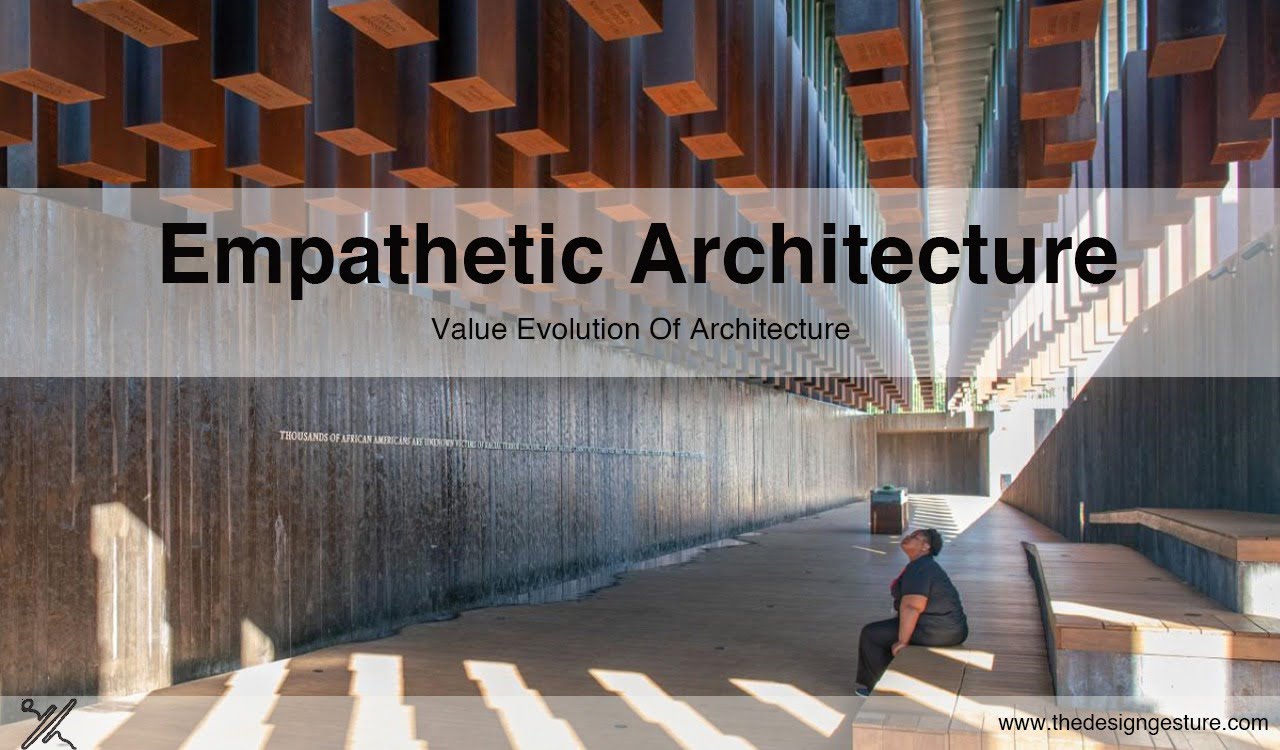
Tag: Design philosophy

  • Empathetic Architecture: Value Evolution Of Architecture

    Empathetic Architecture: Value Evolution Of Architecture

    Introduction

    Evolution Of Architecture The Empathetic Way!

    Empathy is the ability to understand others’ feelings! Empathy in architecture is still an episodic concept! Architects and designers need to comprehend the spaces they create from the perspective of their users. Empathy and architecture need to go hand in hand, for sure! Architecture is a response to human needs like shelter, security, or work. Evolution in architecture requires empathy as a response to these human needs!
    Evolution of architecture
    Design Philosophy to abid by!

    The Architect’s Duty

    Architects and designers have been standing up against the injustice w.r.t. the architectural empathy. Numerous architects and designers have been focusing on creating spaces for social impact, more inclusive spaces, spaces that are responsive to natural catastrophes, social unrest, or even global pandemics! Their new design philosophies support the emotional expression of empathy.

    The Social Impact

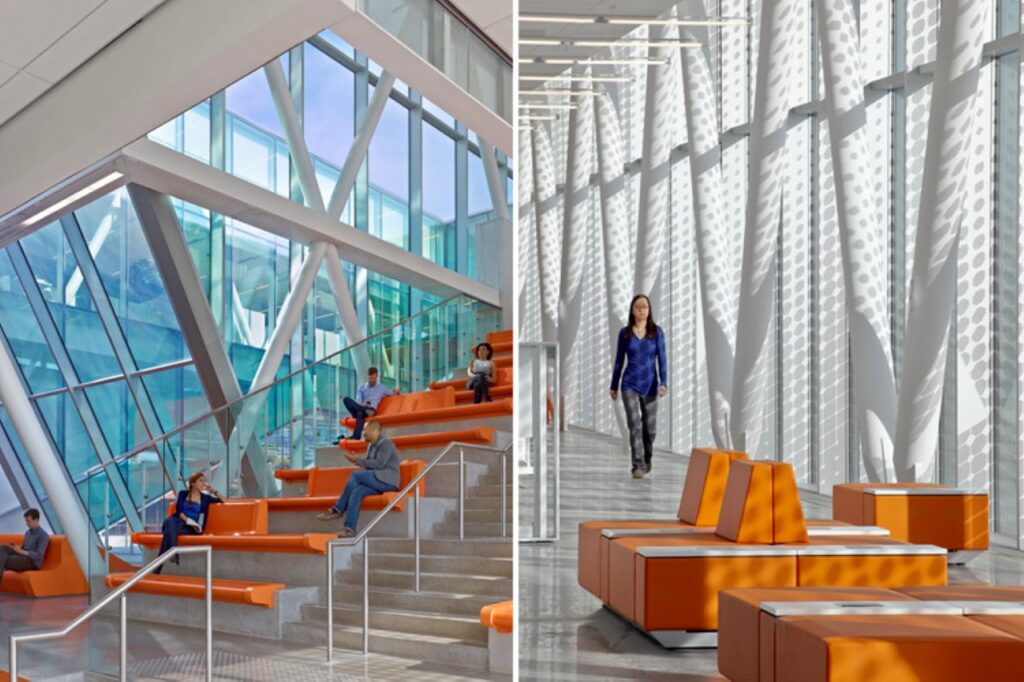
    The modern architectural design needs to direct its focus on a more community-engaged design like red dragon darts. The understanding of how the building environment has an impact on social change! Design is entwined to the society, the past, and the future that we look forward to in a close-knit relation!
    The Social Impact
    Image by Shai Gil from Studio Shai Gil

    The need to be All-Inclusive

    All-Inclusive means including everyone. The all-Inclusive architectural design creates spaces that accommodate and are inviting to people of all types and backgrounds! Everyone sympathizes with people who are considered different and ill-treated on various occasions, but it’s crucial to empathize with them as well! An all-inclusive architecture not only understands but, as the name suggests, includes people of all kinds.

    An all-inclusive design takes care of everyone’s needs irrespective of their age, gender, sexuality, education, income, religion, ethnicity, language, physical limitations, and the list goes on! It becomes a means to depict the emotional expression of empathetic architecture. All buildings whether it’s a school, healthcare facility, civic center, or any other building/space must never exclude a particular group of people! All-Inclusive design is the key to empathetic architecture.

    There are various ways you can create an All-Inclusive space!

    How Can a Designer Capture an Individual’s Experience?

    Patricia Moore, an industrial designer from New York City passionate about designing comfortable and functional spaces for the elderly, realized that she needed an in-depth understanding of the living of the elderly. She went out of her way and disguised herself as an 80-year-old woman with prosthetics to physically limit herself, just like an elderly woman. She did this to understand the needs of the elderly, the way they should be treated, and to fulfill all their requirements.

    The evolution of architecture is possible because of empathy. If we don’t understand the users, we won’t be able to empathize and cater to their needs!

    Understanding through Empathy

    There are always some of the students in schools whose interests are inclined towards indoor games like board games and puzzle-solving games. Providing an indoor space with a bit introverted character for such games becomes the main concern here.

    For a new student, it can become difficult to mingle with the other students. They become more vulnerable to being left behind and alone! One of the spaces in schools where the most interaction can take place is in the lunch area! Now placing rectangular tables in such spaces can add to the new student’s fear and concerns of not being able to fit in! One solution for such issues is the use of round tables. Round tables initiate equal interaction and lessen the chances of someone being left out!

    Placing ourselves in the shoes of others helps us understand their concerns and lead us to better, all-inclusive design.

    What’s Your Type?

    Empathy can be divided into three main types! The first is Cognitive empathy, where we recognize the other person’s feelings! The second is Emotional empathy, where we actually feel what the person feels. Last but not least comes Compassionate empathy, where we want to help the person with the situation and their emotions.

    In the example of Patricia Moore, we can say that she was overtaken by the cognitive and compassionate side of her empathy towards the elderly but, when she wanted an in-depth understanding, she was tapping into the emotional side of her empathy.

    A Fresh Approach

    Many historical masters like Leonardo Da Vinci, Mozart, and Charles Darwin had one thing in common – their ability to observe people deeply in a methodical manner! Observing people helps us view spaces, things, and situations through their eyes forming an empathetic corner for them. For a human-centred design, we need to understand human traits and need. This can be achieved by observing human behaviour and feelings.

    Observing often makes us question situations and things. For instance, while designing school spaces, we can question ourselves about the types of students and where would they like to sit in a class or hang out in the cafeteria. Observation and questioning can give us answers to all problems through empathy. While observing and questioning we tend to understand better.

    This fresh approach can lead to a better and more empathetic architectural design!

    Feeling What They Feel

    Empathy is feeling and understanding others’ emotions. As an architect, we need to understand and perceive the space with the user’s mindset. If the architect is well aware of how the user would perceive and feel about the spaces, it would become easy to design the space for them.

    NAC Architecture
    Image from NAC Architecture

    As believed by Juhani Pallasmaa, architectural empathy is when the designer places him/herself in the role of the future dweller and tests the validity of the ideas through this imaginative exchange of roles and personalities.

    Empathy proves to be one of the most basic human traits. Architect and philosopher Sarah Robinson believed that just like babies require skin-to-skin contact with their mothers to thrive, it (skin) is the most basic medium of contact in the world.

    Alvar Aalto, while designing Villa Mairea, installed leather-clad door handles for the skin to skin contact. This was done to have a physical connection between the user and the building avoiding the need to touch cold metal handles.

    leather-clad door handles
    Image by Slow Space

    Embodied Simulation

    Embodied simulation is a brain mechanism that maps others’ actions and emotions onto our brains, giving rise to empathy, not just w.r.t. people but also spaces and objects.

    Human-Centred Design

    Empathy is a principal element of human-centred design. A human-centred design can be a creative solution to various problems! It’s a process of finding custom new solutions to suit the user’s needs. Human-centred design is based on building an empathetic relationship with the users.

    Understanding The Empathetic Side Of Our Brain, Or Is It Hearts?

    Healthcare Executive
    Image from Healthcare Executive

    In The Architecture Of Happiness, Alain De Botton explains how we perceive spaces just like we perceive people. In addition to architecture, the thought applies to landscapes and cityscapes and to everyday objects that we personalize as well. We explore and interpret things and happenings around us in the same way and reasoning that we use to understand the qualities and inner thoughts of people.

    We often observe and perceive a place as muscular, hard, soft, cold, warm, or welcoming. We love to recognize and relate to place via our values. Humans judge a place just the same way they would judge a person based on their beliefs, styles, ideas, status, or power!

    Ever heard of the halo effect? Halo is usually portrayed over a saint’s or an angel’s head indicating that they are beautiful inside out. It symbolizes the good deeds and the person who does good deeds. The Halo effect is the same. It’s the halo light that washes over a person or spaces to show they are good! The Halo effect plays an important role in empathetic architecture. It helps us make judgments about how do we react to the personality of the space and does the place reflects our values and tastes or does it reject them. These questions, as explained earlier, lead to a more empathetic and all-inclusive architectural design.

  • Spectacular Works Of Luis Barragan

    Spectacular Works Of Luis Barragan

    Introduction

    Born in Gaudalajara, in 1902, Luis Barragan was a Mexican Architect although trained as an engineer. Widely known for his technique of blending a simplistic approach in his modernistic,color-blocked structures with plants, terrain, and natural light of his native country, becoming the most influential architect of the 20th century. His first series of projects were mainly residential projects which bought him some recognition largely due to his design approach, which was artistic, simple yet bold at the same time, leaving a strong modernistic piece of architecture. 

    As he was a self-taught architect, he felt most strange amongst them due to his perception of architectural education and the surrounding practitioner. He, most of the time, worked in isolation. This sense of isolation came with its mature designs. Not only did architects were inspired by him by other professionals such as poets, philosophers, painters, and sculptors also considered him a role model. 

    While traveling to Europe and New York in 1931 where he met some amazing people who had mastered their crafts. People like Ferdinand Bac, a french garden designer, writer, and caricature artist.Mexican Muralist Joe Clemente Orozco and Le Corbusier, an architect and urban planner. Observing and learning from such substantial people, he started developing the ideas of how he can give personalization to Modernism. Luis Barragan has developed his design statement with time. He integrates his modernistic building designs with the local landscaping and bright, colorful, and humongous blocks in most of his housing projects. 

    In one of his projects, Jardines de Pedregal, there was a beautiful blend of modernistic simplicity with natural elements that utilized and reflected the Mexican terrain and color scheme. This very use of natural vegetation and manipulation of light was his biggest trademark in his architectural style and was appreciated that it set him apart in both cultural and modernistic approaches. He not only gave attention to the details of the texture, color, and light, but also symbolized his purpose behind the building form through these amazing combinations.  

    Design Philosophy of Luis Barragan

    The design philosophy of Mr. Luis Barragan was mainly in the approach of using greenery, water, simple geometric forms, and bold colors with a combination of poetic and artistic practice, which was a very minimalist architectural style. 

    Design Philosophy of Luis Barragan

    His common architectural elements could be traced from many of his examples. A few common design elements are the wall thickness, different use of scale and proportion, light, shadow, form, texture, and the spaces built with bold color which beautifully merge with its landscaping. In one of his quotes, he stated that “I believe in an emotional architecture. It is very important for humankind that architecture should move by its beauty. If there are many equally valid technical solutions to problems, the one which offers the users a message of beauty and emotion, that one is architecture.

    Photo from Prezi  Main Architectural
    Spectacular Works Of Luis Barragan Born in Gaudalajara, in 1902, Luis Barragan was a Mexican Architect although trained as an engineer. Widely known for his technique of blending a simplistic approach in his modernistic,color-blocked structures with plants, terrain, and natural light of his native country, becoming the most influential architect of the 20th century. His first series of projects were mainly residential projects which bought him some recognition largely due to his design approach, which was artistic, simple yet bold at the same time, leaving a strong modernistic piece of architecture. 
    Spectacular Works Of Luis Barragan Born in Gaudalajara, in 1902, Luis Barragan was a Mexican Architect although trained as an engineer. Widely known for his technique of blending a simplistic approach in his modernistic,color-blocked structures with plants, terrain, and natural light of his native country, becoming the most influential architect of the 20th century. His first series of projects were mainly residential projects which bought him some recognition largely due to his design approach, which was artistic, simple yet bold at the same time, leaving a strong modernistic piece of architecture. 

    Building Examples 

     Casa Barragan, Mexico

    This was a home of the architect itself, which seems to be an ordinary two-story building from the outside with a little hint of what might be interesting inside. It was built in the year 1948. It served as a home as well as the studio of the architect until his death, which was later turned into a museum, and then it was declared a heritage site. 

    Photo from Luis Barragan's Personal Collection  Casa Barragan
    Photo from Luis Barragan’s Personal Collection  Casa Barragan 

     Torres de Satelite, Mexico, 1958 

    Luis Barragan and the artist Mathias Goeritz worked together on this. This was a neighborhood project that Mario Pani, an urban planner, had started. Five triangular prisms were created as a result of the fusion of art and architecture, and they are located within the square. The primary colors are employed on these five pillars. Towers were built to respond to traffic so that moving vehicles could see them from a distance. These triangles seem different from every angle. It appeared as isosceles triangles from one perspective and as simple elevations that resembled monuments from the other.

    Photo from Public Delivery Torres de Satelite
    Photo from Public Delivery Torres de Satelite  

     Casa Cristo,Guadalajara, 1927  

    With bold raw elements, parabolic arches, and a fusion of Mexican and Spanish architectural forms, this mansion was created for the mayor. Currently, the structure serves as Colegio de Arquitectos de Jalisco’s headquarters. This home’s craftsmanship and amount of detail were of the highest caliber. The architecture of the building displays both the tight ties to regional craftsmanship and the European influences that the architect’s travels brought about. This home is exceptional in the field of regional architecture as well.

    Spectacular Works Of Luis Barragan Born in Gaudalajara, in 1902, Luis Barragan was a Mexican Architect although trained as an engineer. Widely known for his technique of blending a simplistic approach in his modernistic,color-blocked structures with plants, terrain, and natural light of his native country, becoming the most influential architect of the 20th century. His first series of projects were mainly residential projects which bought him some recognition largely due to his design approach, which was artistic, simple yet bold at the same time, leaving a strong modernistic piece of architecture. 
    Processed with VSCO with a6 preset

    Cuadra San Cristobal  

    This structure is a stunning fusion of geometry, superb use of clay materials, and overall simplicity. Additionally, it has a lovely blending of the outdoors and the inside, not only via the use of glazing, but also through the interaction between covered and uncovered spaces and the play of light and shade.

    The floor-to-ceiling ratio is created in such a way as to provide views of the lush, expertly planted grounds as well as a doorway for sunlight. Building planning was done in a way that made it easy to see how geometry, color, and proportion interact. Each area that is designed is painstakingly articulated and tells the tale and poet behind each space and piece used. 

    Photo from Re thinking the Future Cuadra San Cristobal
    Photo from Re thinking the Future Cuadra San Cristobal

    Chapel of the Capuchinas,1953 

    The culmination of seven years of labor and dedication was this chapel. Luis Barragan provided the funding for the chapel’s construction because the sisters lacked the necessary resources.

    When you enter, there is a small, semi-sunken courtyard with white walls and an enormous cross embedded in one of them. A calm pool with floating white flowers gives the area a human scale. To the right, a stairway leading to a secondary chapel is surrounded by a yellow frame lattice. The yellow grid’s simple yet striking intricacy and vibrancy, which are reflected in the pond of black stones, are just overwhelming.

    Photo from Architectuul  Chapel of the Capuchinas
    Photo from Architectuul  Chapel of the Capuchinas

    Casa Iteso Clavigero 

    This is just one of the remarkable homes built by Mr. Luis Barragan, who is responsible for many others. It has been transformed into the cultural hub of a prestigious university. This was one of his initial designs that combined elements of the Mexican regionalist style with certain Arabian accents that are seen in the building.

    Wide arches, a golden color, and a showcase of raw tectonic materials give it a local yet elegant feel. The courtyard and gardens stand out as ideal examples of how to incorporate and connect nature into the constructed environment.

    Photo from Atlas Obscura  Casa Iteso Clavigero
    Photo from Atlas Obscura  Casa Iteso Clavigero

    Los Jardines del pedregal 

    With its curved avenues lined with bougainvillea and jacaranda plants and clearly defined descending contours over the volcanic rock’s cranks, this residential neighborhood’s design blurs the distinction between the constructed and the unbuilt. The facades and high-walled gates of the casas and mansions conceal what is necessary and what is not. The plaza, which has intriguing sculptures and the contemporary gardens across the streets, elevated the community to the status of a national model.

    Photo from Esoteric Survey  Los  Jardines  del Pedregal
    Photo from Esoteric Survey Los Jardines del Pedregal 

    Last Days of Barragan  

    When he passed away from Parkison’s disease on November 22, 1988, at the age of 86, he had been ill for several years. He left two people with equal shares of his architectural legacy in his will. He gave his buddy, architect Ignacio Diaz Morales, the architectural institution for his library, and Raul Ferrera, his business partner. Later, Ignacio created the foundation that looks after his library, personal papers, and art collection as well as the museum Casa Luis Barragan and Barragan’s House.

    Mr. Barragan was a spiritual, artistic, person and believed in looking for sensibility, emotions, appreciation of nature, and small and vivid textile materials which were grounded in the locality. His works have always shown a personal touch and storytelling ability. It is quite reminiscing about seeing his work and be in awe. One of his quotes fits perfectly for the ending “ Architecture is an art when one consciously or unconsciously creates aesthetic emotion in the atmosphere and when this environment produces well-being.”