
Tag: disaster management

  • Incredible Approaches to Earthquake-Proof Structures

    Incredible Approaches to Earthquake-Proof Structures

    Beautiful cities and constructions have been built by mankind throughout history, only for them to be destroyed by natural forces. The mere mention of earthquakes, which are classified as natural disasters, does not give off a very positive impression. Earthquakes are one of the planet’s most destructive forces; seismic waves that travel through the ground have the power to damage structures, claim lives, cause enormous financial losses, and more.

    The National Earthquake Information Center estimates that there are typically 20,000 earthquakes each year, 16 of which are major disasters. Similar to earthquakes, most damage is brought on by buildings collapsing while occupants are still inside, necessitating the construction of earthquake-proof structures.

    However, in older eras, when the type of structures was usually closer to the ground and did not reach a very significant height, there would be opportunity to run to an open area for minimal harm. But given the current situation, where high-rise structures are crammed closely together, there is little choice but to design the structures so that they can survive seismic activity. Engineers have improved building earthquake resistance over the past few decades by introducing new building designs and materials. These kinds of buildings are referred to be earthquake-resistant structures.

    Earthquake-resistant structures are those built to resist total collapse, protect life, and reduce damage in the event of an earthquake or tremor. Through a variety of techniques, earthquake-resistant structures absorb and dissipate seismically produced motion: damping reduces the amplitude of oscillations of a vibrating structure, and ductile materials (such as steel) can endure significant inelastic deformation.

    The article will describe the various approaches to earthquake-proof building design.

    Understanding Earthquake – Resistant Structures

    Buildings are intended to be protected from earthquakes to some extent or completely by earthquake-resistant or aseismic construction. The aim of earthquake engineering is to build structures that perform better during seismic activity than their conventional counterparts, even though no construction can be completely resistant to earthquake damage. Building regulations state that earthquake-resistant constructions must be able to withstand the biggest earthquake with a specific probability that is expected to strike the area where they are located. This means that in the event of a rare earthquake, the death toll should be kept to a minimum by preventing building collapse, while in the event of a more regular earthquake, the functional loss should be kept to a minimum.

    From the outside, buildings designed to resist earthquakes may not stand out. They are more resilient during these disasters, nevertheless, due to a number of factors.

    How to Make a Building Earthquake-Proof

    When experts plan and develop structures, they consider ways to lower dangers. Engineers labour to strengthen the structure and mitigate the effects of a prospective earthquake when creating an earthquake-proof building. Buildings are pushed in one direction by an earthquake’s discharge of energy; the approach entails having the building push in the opposite direction. These safeguards make sure that buildings can survive the effects of earthquakes. Here are a few techniques for making structures more earthquake-resistant.

    Base Isolators

    Base isolation is a technique used to “raise” the building’s foundation above the ground in order to withstand ground stresses. Base isolation entails erecting a structure on top of flexible steel, rubber, and lead pads. The isolators vibrate when the base shakes during an earthquake, but the building itself doesn’t move. As a result, seismic vibrations are successfully absorbed and kept from passing through the building.

    Seismic Dampers

    earthquake-proof
    Photographer Unknown

    Buildings that can withstand earthquakes must also include characteristics that can absorb shock. They are more frequently referred to as earthquake dampers by engineers. The shock absorbers used in automobiles are comparable to seismic dampers. Shock absorbers work similarly to how they do in automobiles i.e. they lessen the force of the shockwaves and lessen the strain on the structure. Pendulum power and vibrational control devices are used to achieve this.

    The dampers are positioned between columns and beams on each level of a building. Each damper comprises of a cylinder containing silicone oil and piston heads. When there is an earthquake, the structure’s vibrational energy is transferred to the pistons, which press on the oil. The force of the vibrations is then dissipated as a result of the energy’s transformation into heat. By absorbing damaging energy, seismic dampers prevent the building from being damaged. Generally speaking, the damper can withstand higher stress the larger its diameter.

    quaketek
    Photographer Unknown | Source: https://www.quaketek.com

    Earthquake-Proof Structural Reinforcement

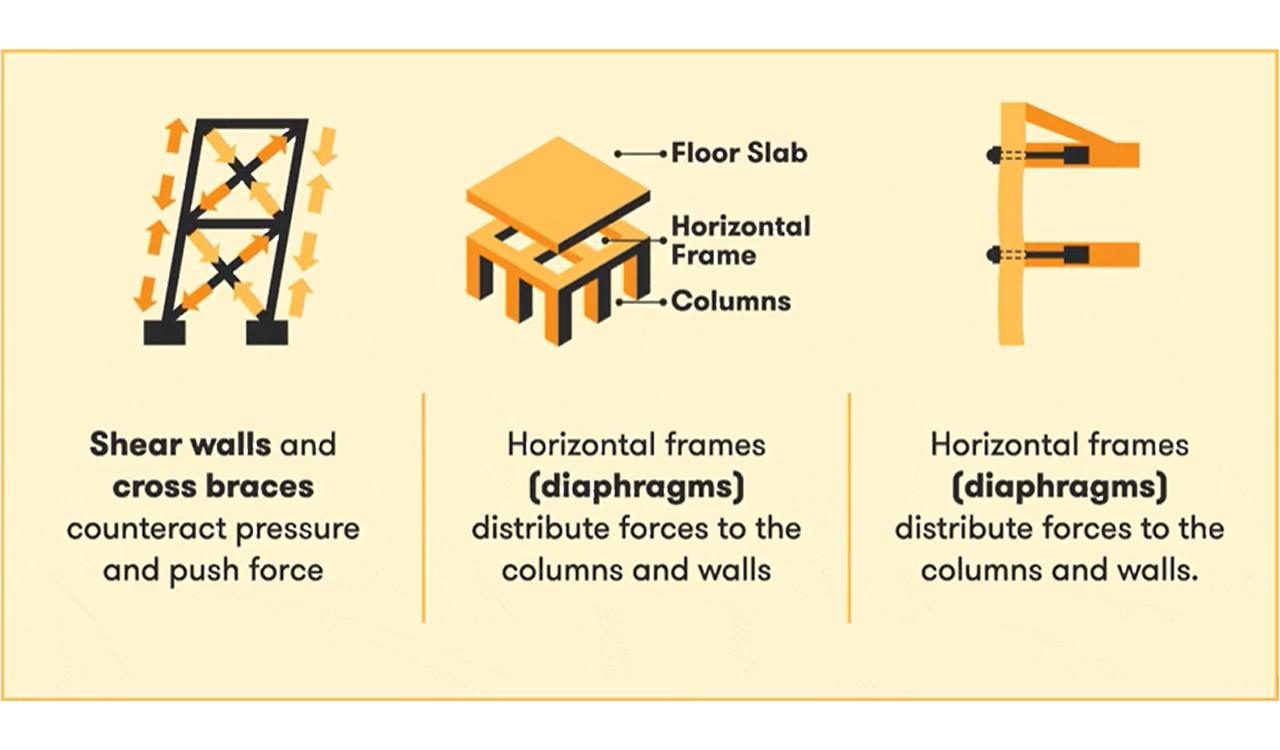
    Different techniques are used by engineers and architects to fortify a building’s framework against potential earthquakes. Buildings must redistribute the seismic forces that pass through them in order to withstand collapse. For instance, the main components of a building’s reinforcement include shear walls, cross braces, diaphragms, and moment-resisting frames.
    Photographer Unknown | Source: https://www.bigrentz.com
    Photographer Unknown

    Shear Walls

    These wide beams, which are given for high strength and stiffness, are vertically orientated. While core walls are made up of channel sections that are best used without any gaps, these are either plane or flanged in section. In high rise buildings, their thickness typically ranges from 150 mm to 400 mm. These walls ought to have symmetrical plans on both axes.

    Diaphragm

    Another essential component of a building’s structure is its diaphragm, which transfers lateral stresses to the structure’s vertically resistant walls or framework. Diaphragms, which are made up of the building’s floors, roof, and decks atop them, assist in pushing forces to the building’s vertical supports and relieving floor strain. There are also frames that can withstand movement.

    Bracing

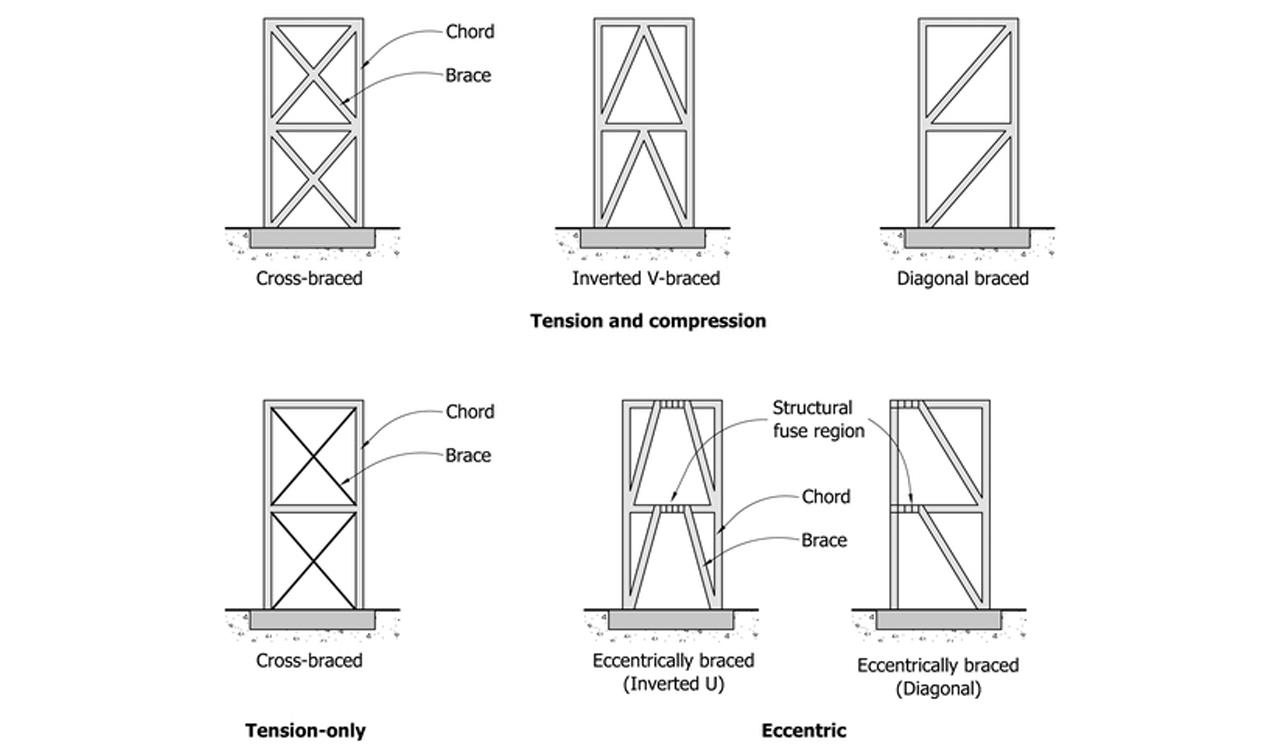
    Buildings are shaken from left to right by s-waves during an earthquake, therefore bracing keeps the shape and prevents the structure from becoming weaker. Different types of bracing, such as diagonal bracing, x-bracing, v-bracing, inverted v-bracing, and k-bracing, can be utilised. When diagonal supports in a building structure intersect, cross bracing is used to strengthen the structure.
    Photographer Unknown | Source: https://www.openquake.org
    Photographer Unknown

    Materials

    Shock absorbers, pendulums, and “invisibility cloaks” could, to some extent, assist in dispelling the energy, but the materials choose for a building are also in charge of its stability. High ductility materials can therefore take in a lot of energy without breaking. Brick and concrete are low-ductility materials, although structural steel is one of them. Structural steel, which comes in a variety of shapes and allows buildings to bend without breaking, is frequently used in the construction of modern buildings. Due to its considerable strength in comparison to its lightweight structure, wood is also an unexpectedly ductile material.

    Conclusion

    Each year, there are thousands of earthquakes worldwide. While some only cause slight or no harm, others result in building collapses, fatalities, and severe economic disruptions in the area. Because careful choices can save millions of lives every year, it is important to allow for some structural damage, resist lateral loads with stiffeners (diagonal sway bracing), and for different parts of the building to move independently.

  • Housing in Natural Calamities

    Housing in Natural Calamities

    Housing in Volcanic Zones

    The first thing that people think about volcanic damage is fire damage because of lava. Mudslide damage, floods, and ashes are the most damaging in buildings. Volcanic eruptions of one of the most potent and damaging natural calamities. It also triggers a Domino effect of other disasters. Dust and ashes in the sky can collapse on the roofs. One of the most important things to do is to protect the roof from ash compilation. Flat roofs are usually avoided because it leads to a buildup of ashes. Similarly, heavily stooped roofs are also avoided because ash is corrosive. 

    Natural Calamities:
    Photo by MauliNow

    Building Design in Volcano Zones

    The roof is meant to be smooth with a slick surface so the Ash slides from it. Reinforcing the structure with titanium makes it durable, robust, and is used for lateral support. The house is supported on stilts. These design solutions do not offer entire volcanic resistance. Volcanoes instigate earthquakes and tsunamis. These solutions do not complete protection, but protect the home on some level. Experts suggest the use of extra roof support and avoiding flat roofs or roofs with complicated designs. Concrete reinforced buildings are protected from storms and other disasters. Use of timber is supposed to be avoided. 

    Effect of Volcanoes on Buildings

    Volcanoes result in slow-moving Lava whose temperature goes up to 1292 °F to 2192 °F (700 °C to 1200 °C). Volcanic eruption leads to poisonous gases and strong storms. The distance of a building from a volcano doesn’t determine the degree of damage that it does. A building’s proximity to lava and the pyroclastic flow zones determines the level of damage a volcano might inflict on the building. 

    According to national geographic, pyroclastic is the rapid flow of lava, volcanic ash, and gasses running down in fickle ways. They’re hazardous because they can’t be stopped, even by water, and consume everything that comes in their way. Lava moves at a slow speed which buys people the time to escape, but, pyroclastic flows are rapid and go up to 200 miles per second. 

    Usually, buildings with stilts can withstand lava. Since ash is heavier than snow, it can damage the paint, flooring, drainage systems, and other structural support systems of the building, like HVAC. If the interiors aren’t maintained, it increases health risks. Volcanic eruptions also give rise to extreme storms and fierce winds that may fling boulders through the air and crush buildings that aren’t constructed properly. Fire, earthquakes, tsunamis, mudslides are some of the after-effects of the eruption. 

    disasters
    Photo by KitingField

    Use of Lava Rocks

    Using lava rocks for building construction makes it durable towards the lava. The downside to this is the complicated technicality and cost of construction. Buildings in Hawaii historically used lava locks for construction. Although this can be a great technique, the difference in composition of these rocks can be a hurdle in accomplishing quality construction. Some rocks are heavy and robust, while some are flimsy and quite crushable. This technique is not cost-efficient. Reinforced cement would be the best option for buildings in volcanic regions. 

    Techniques and Materials for Earthquake Resistant Homes

    Earthquakes are one of the most dangerous, impactful, and damaging disasters of all time. The aftershocks are sustained by the neighboring places. Structures built with stacked bricks and mortar and weak. In such houses, the weight is carried from the roof to the walls, all the way to the foundation. When such houses are subjected to seismic forces, it is very easy for them to crumble down. Concrete blocks or unreinforced bricks put the structure in a great degree of danger. Concrete and wood are earthquake resistant.

    Base isolation techniques permit the foundation to move without moving the entire structure. In this technique, isolation pads made from lead, steel, and rubber reduce the damage. Another technique is called damping, which involves the installation of shock absorbers that reduce the magnitude of earthquake vibrations. The most popular technique is called Base Isolation Technique. In this, the structure floats on a lead rubber bearing. A structural engineer ensures the seismic improvements in the buildings. The impact of the earthquake is beyond control. The necessary measures can be taken to ensure minimal damage. The walls, partitions, and slabs are thin and light. 

    earthquake
    Photo by MSB

    Housing in Flood Prone Areas

    Floods have been the reason for loss of human lives, loss of cattle lives, degradation of public utilities, damage of crops, and migration of the inhabitants. According to the National Commission of Floods, around 400 lakh hectares of land in India are under the flood-prone zone. Around 320 lakh hectares can be provided protection, which constitutes 80% of the total flood-prone zone. Structural measures can be taken to prohibit water from entering the habitations. 

    flood prone areas
    Photo from Earth bound

    Categories Of Damage

    According to an export group appointed by the Ministry of Urban Development, the government of India, there are five categories of flood damage. G1 stands for very low damage, where there are fine cracks in the plaster and about 10% of the total surface of walls is subjected to falling. G2 stands for Low damage, where the cracks are around 6m wide and about 50% of the total surface area of the walls is subjected to fall.  

    G3 stands for moderate damage where there are large and deep cracks in the walls. This leads to damage to the walls, electrical fittings, and loss of belongings. G4 stands for high damage where there is significant damage and loss of property. The property may experience collapse, sinking, and the lighter parts of the buildings may even float away. G5 stands for very high damage. 

    damage
    Photo by Down to Earth

    Curbing Effects of Flood

    Embankments near river channels, river damming, raising the level of villages above flood level can n all help in the prevention of floods. Proper planning of stormwater drainage system and including it in the master plans reduces the chances of urban flooding. Soil testing matters in determining the soil’s capacity to absorb water. 

    Houses built by filling small water bodies with sand have more chances of sinking. Houses built on slopes by removing the soil have higher chances of landslides during months. Houses are built away from any source of water, or away from areas where the course of water bodies has changed during previous floods.

    Before constructing buildings in the flood-prone zones, maps are produced which show the flood-prone zones and contours at an interval of 0.3m or 0.5m. The frequencies of flooding in each area are also mentioned in these maps. The degree of submersion or accumulation of water is also marked on these maps. 

    flood resistant
    Photo from Flood List

    Precautions through Construction such Natural Calamities

    Houses are raised and built on elevated platforms to avoid floods. Houses are built on stilts. Kutcha houses made of mud, clay, or brick or stone walls with mud mortar are very easily damaged by rain. Water seeps into them through roofs or directly through walls. The upper surface of the roofs can be plastered with water-proof mud plaster and also can be made fire-resistant if applied on the internal side. 

    150-200 mm thick black polythene of heavy gauge sheets can be laid at mid-thickness or upper quarter thickness of the clay layer as an alternative. The drainage of the roof should be ensured, and the lower portion of the wall next to the fall of water should be made a pucca. Water-proof mud, lime, or cement plaster is used for plastering the top of parapets. 500 mm of roof projection protects the wall from saturation. 

    Another method to protect walls is using burnt bricks externally and sundried bricks internally. This wall will be one and a half brick thick. The minimum plinth should be 450 mm above ground level, and a DPC (Damp Proof Course) should be laid at the plinth level on all the walls.