
Tag: House design

  • Climatology in Architecture: An Important Aspect of Every House Design

    Climatology in Architecture: An Important Aspect of Every House Design

    Climatology is the scientific study of climate. Climatology in architecture is a study related to the climate and the built environment. Buildings do not exist in isolation; they exist in a specific geographic environment. As a scientific discipline, architecture strives to ensure the harmony and unity of architecture and the surrounding geographic environment. If this is not possible, the building will not produce maximum comfort for the user, thus it will not achieve its purpose.
    Climatology in Architecture
    Climate Responsive Architecture

    Climatic zones in India

    climatic zones in india
    Climatic Zone map of India– Climatology in Architecture

    India has a wide variety of climates. It can be roughly divided into five climate zones. The climate in India classified for different types of buildings is helpful to the functional design of buildings. Our country is divided into different regions, so the climatic difference from one region can be reflected in the Indian style house design, which justifies some special regulations for each region. The significant differences in climate data between these regions define unique thermal comfort requirements for buildings located in different areas.

    Hot and Dry
    house design
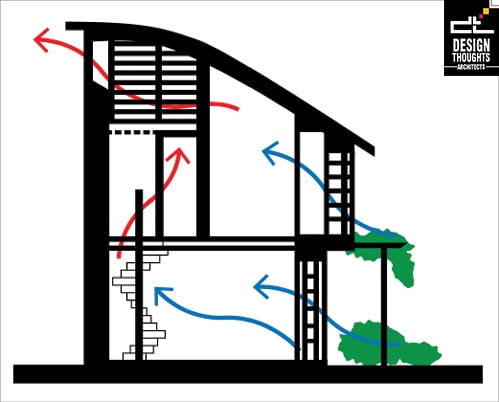
    House Design Strategies for Hot and dry Climate– Climatology in Architecture

    The hot and dry climate is characterized by the average monthly maximum temperature exceeding 30 ºC. The areas in this climatic zone in India are usually flat and the soil conditions are sandy or rocky. In this climate, it is imperative to control the movement of solar radiation and hot wind. Therefore, building design standards should provide adequate shade, reduce exposed area and increase heat capacity.

    Warm and Humid
    house design
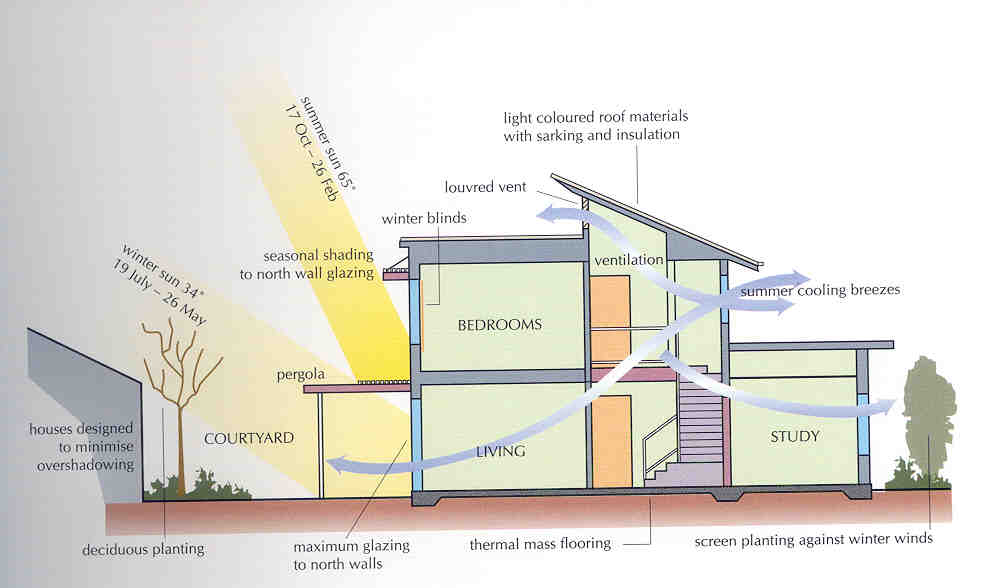
    Passive design strategies for Warm and humid climate– Climatology in Architecture

    The warm and humid climate is characterized by high relative humidity, around 70-90%, and high rainfall, around 1200 mm per year. The temperature in summer usually oscillates between 25 and 35 ºC, in winter the temperature varies between 20 and 30 °C. The design of houses in India in this climate should aim to reduce heat gain by providing shade and promote heat loss by maximizing cross ventilation. It is also necessary to dissipate moisture to reduce discomfort.

    Temperate

    Temperate climates are characterized by temperatures that are neither too hot nor too cold. Total annual precipitation usually exceeds 1000 mm. Winter in this area is very dry. The design of houses in India in this climate requires reducing heat gain by providing shade and promote heat loss through ventilation.

    Cold
    house design
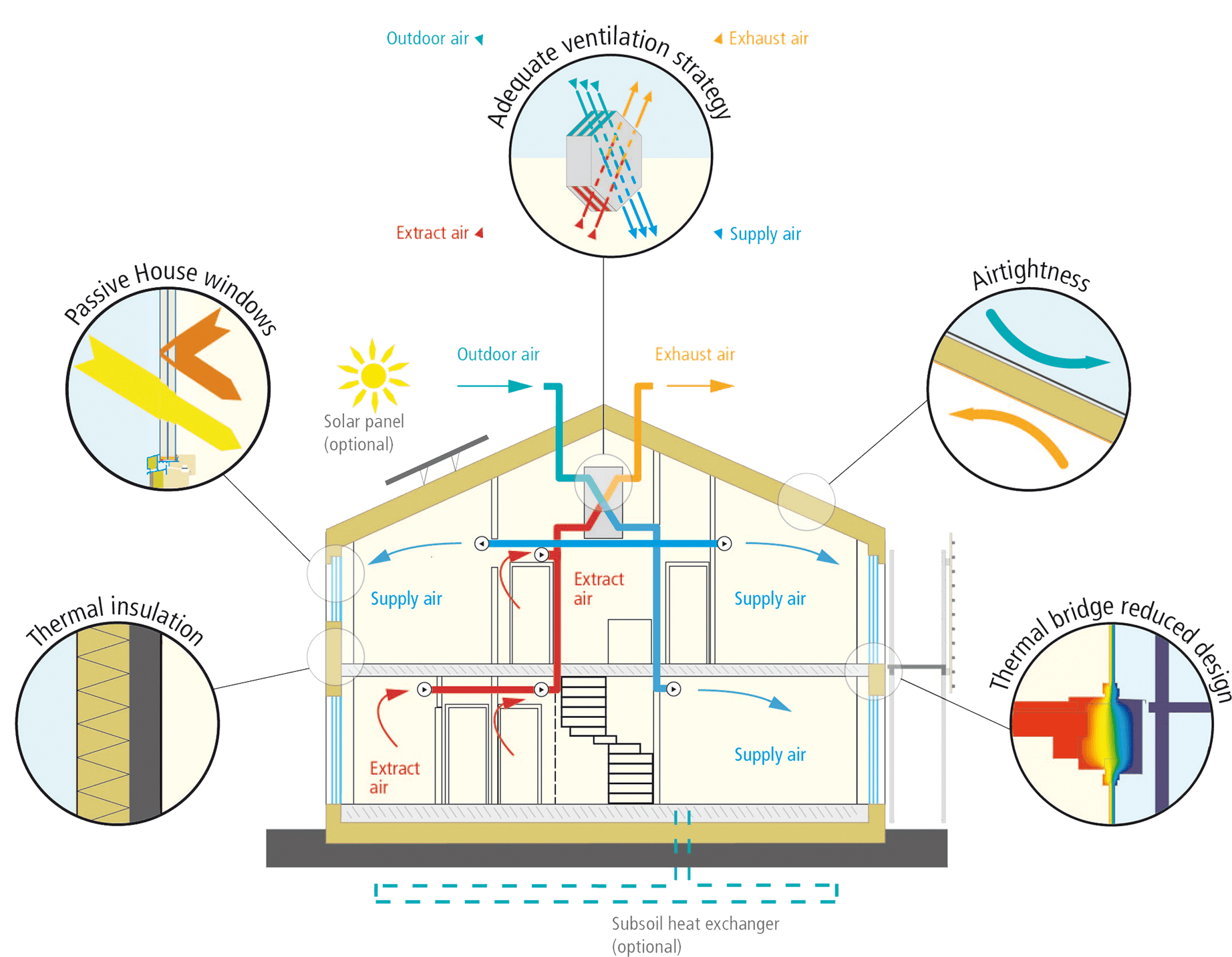
    Considerations when building a house in a cold climate– Climatology in Architecture

    Areas located in cold climates are at high altitudes. The temperature in summer oscillates between 20 -30 ºC, in winter it can oscillate between 3 ºC and 8 ºC, which makes it very cold. Cold weather requires the design of houses in India to have adequate insulation and penetration to resist heat loss and promote heat absorption by directly absorbing and capturing solar radiation in the living space.

    Composite

    Except for the fact that the composite area experiences higher humidity levels during the monsoon, most of the characteristics of the composite area are similar to those of the hot-dry climatic zone in India. Standards of design of houses in India standards are roughly the same as those for hot, dry weather (adequate shade, reduced exposure area, and increased heat capacity), except for the need to maximize cross ventilation during the monsoon.

    Impact of climatic factors on Building Design

    The climate in India affects the design of houses through various climatic factors. The five climatic zones in India as discussed earlier are influenced by the below-discussed factors. Even small variations in these factors cause major alterations in the design of houses in India. Therefore climatology in architecture plays an important role. Architecture and climate have always been linked in a way of mutual influence. As a provider of the shelter, the building deliberately changed the climate of the neighbouring area; traditionally, its design was shaped by the pressures and opportunities inherent in the regional climate.

    Topography

    The strength, direction, and moisture content of the airflow are greatly affected by terrain. Air can be diverted or channeled through mountains. Airflow is diverted upward, and when it cools, the releases its moisture. The descending air mass rarely produces precipitation, so precipitation characteristics vary greatly between locations on the windward and lee slopes of mountains. Air humidity will vary with the rate at which the moisture evaporates from the surface below, that is, it depends on the availability of water to evaporate.

    Solar Radiation

    climatology
    Solar control techniques– Climatology in Architecture

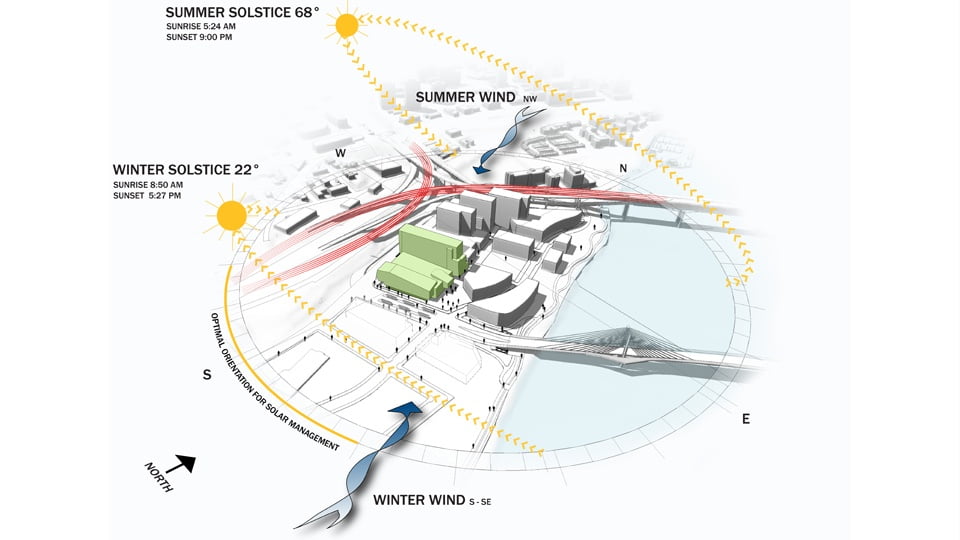
    The amount of light reaching any particular point on the ground depends on the time of day, the day of the year, the number of clouds, and the latitude of that point. The intensity of the sun changes with the time of day, peaking at noon and reaching a minimum at dusk. The solar energy naturally falling on the building can be used to heat the building without special equipment to capture or collect sunlight. Passive solar heating uses building materials such as large windows facing the sun and bricks that slowly absorb and release solar heat.

    The design of houses in India should be such that the longest wall extends from east to west and provides long exposure to the south, allowing solar energy to enter the home in winter. Well-insulated buildings with this structural feature can absorb energy from the sun and reduce heating costs by as much as 50%. Passive solar systems involve designing the structure itself in a way that uses solar energy for heating and cooling. The passive solar design also includes natural ventilation for cooling.

     Curtains and overhangs can also reduce the heat in summer while allowing plenty of sunlight in winter. Active solar heating systems involve the installation of special equipment that uses energy from the sun to heat or cool existing structures.

    Wind

    climatology in architecture
    House of light and wind– Climatology in Architecture

    The wind is air in motion. It is because of horizontal variations in air pressure. The greater the difference in air pressure amongst any places at equal altitudes, the stronger the wind will be. The triumphing wind is the wind direction most often determined for the duration of a given period. Wind tempo is the charge at which the air moves past a table sure object. The wind is the important factor of air float in houses. The pressure of many of the building envelopes and the outdoor environment differ, and that is why air float is possible.
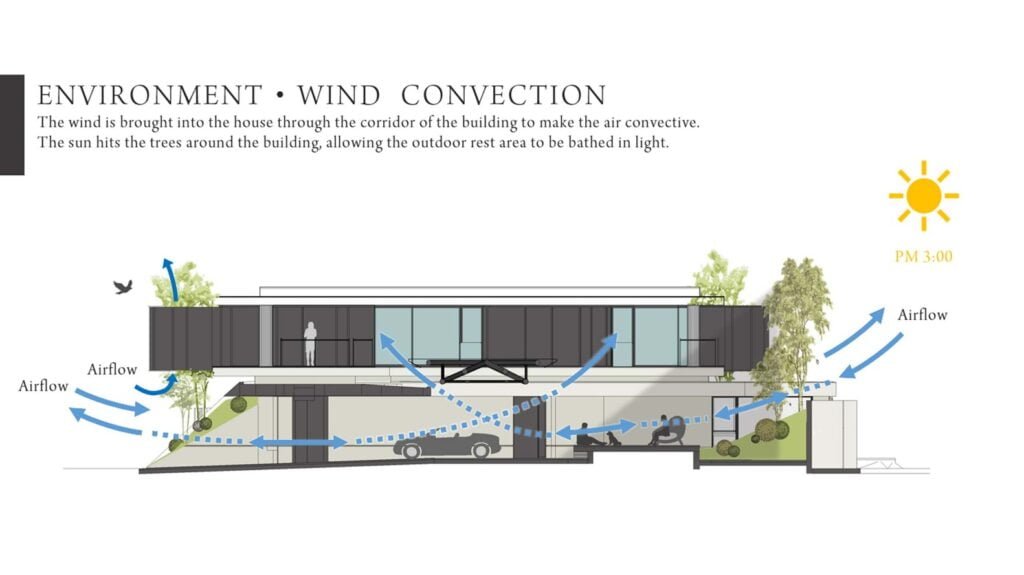
    climate in india
    Airflow in House Design– Climatology in Architecture

    Adequate fenestration is wanted to harness this. Prime of the destructive effects is that of wind-load on high-upward thrust houses. In the format and introduction of high-upward thrust houses, the impact of wind-load should be taken into cognizance. Adequate provisions have to be made withinside the idea format and the load-bearing framework of the houses to make certain true sufficient energy and help in competition to wind-load.

    Humidity

    Humidity is the quantity of water vapour within the atmosphere. Relative Humidity ratio is taken among the real quantity of water vapour within the air and the most quantity of water vapour that the air can preserve at that given air temperature.

    Relative humidity refers to the relationship between the humidity in the air and the maximum acceptable humidity, expressed in percentage. The higher the relative humidity ratio, the more likely it is that water droplets will form on physical objects including buildings and other buildings, such as bridges, streets, etc. on the surface of the earth.

    In coastal areas and islands, climate and humidity are high, and the design of houses in India is based on the high adverse effects of water. They must be designed and constructed by method to minimize adverse physical and chemical effects of water to the minimum or even zero. This can be done by choosing waterproof and anti-corrosion materials and equipment.

    Precipitation

    climatology in architecture
    Moisture Management Strategies– Climatology in Architecture

    Rainfall is one of the most decisive factors that need to be considered in the design of houses in India, especially in the ceiling design. In rainy areas, the roof of the building should be designed as a gable roof to reduce the erosion of water and minimize the accumulation of water on the roof due to damage. Otherwise, the adverse effects of rainwater and its infiltration into buildings will increase. Information of precipitation rate, especially in the design of dams and other structures is required to determine the size of the spillway, etc.

    Sound
    climatology
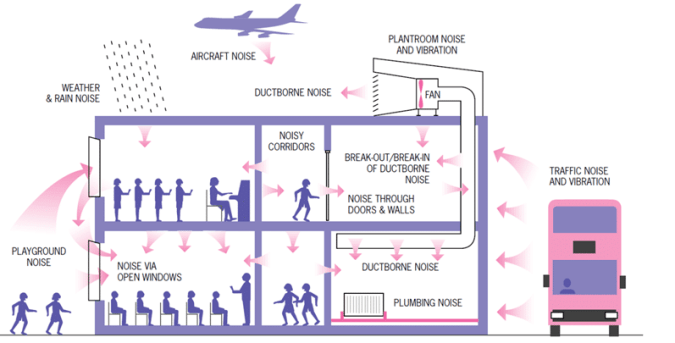
    Noise control in Buildings

    If a site is provided, the designer selects the location of the building and there is a source of noise on one side of the site (such as a busy road), it is recommended to place the building as far away as possible from the noise source. For every doubling of the distance, the noise level will decrease by 6 dB. Architectural acoustics help reduce the impact of acoustic disturbances, which can negatively affect health, well-being, and overall quality of life.

    The noise in the space where the sound source is located can be divided into two parts: direct noise and reverb noise. If the screen is placed between the source and the listener, direct noise can be reduced. It is better to place the screen closer to the source. The use of sound-absorbing materials on room surfaces can reduce reverb noise.

    Application in various Climatic Zones

    Climatology in architecture is crucial in the design of houses in India since the climate in India is diverse. Special care and attention are required while designing houses in India to ensure that they respond to various climates. Comparison of climate data and thermal comfort requirements provides a basis for selecting building forms and building components suitable for the climate to create the necessary internal comfort.

    house design
    Passive House Design– Climatology in Architecture

    Building Design in Hot and Dry climate

    Planning

    In this climatic zone in India, outdoor conditions are very harsh and thus buildings and outdoor living spaces should be protected as much as possible from strong solar radiation and hot, dusty wind. A closed building compactly planned and introvert is best suited. When site conditions permit, the larger size of the building is better for facing north and south, because these elevations receive the lowest heat load from solar radiation.

    Roofs and Walls

    The use of overhanging roofs, balconies, shading equipment, surrounding trees and walls, and buildings are familiar techniques in the design of houses in India. By aligning the buildings close to each other, especially if the east and west walls are placed close to the other, mutual shading will reduce heat gain from external walls. For this reason, in the hot and dry climate, there is a tendency to have a cluster of the building complex, narrow roads and streets, porches, colonnades, and enclosed small courtyards to obtain maximum shade and freshness.

    Ventilation
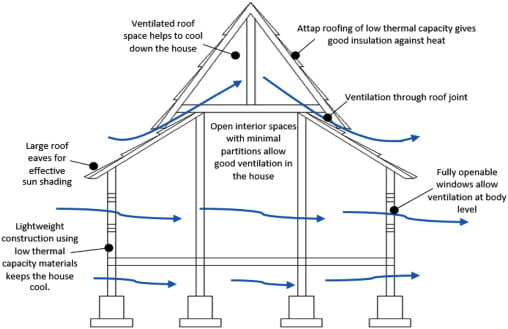
    climatic zones in india
    Air movement in traditional house design- Climatology in Architecture

    During the day, the opening should be closed and covered. For hygienic reasons, the ventilation should be kept to an absolute minimum to minimize the entry of hot air outside the house.

    Traditional shelter

    Traditional shelters found in most desert areas have heavy earth walls, bricks or stones, and roofs of the same material, usually supported by beams that do not use vaults. Thick walls provide good heat capacity and safety and noise protection. During the long warm season, these structures tend to be too hot at night. During these times, the roof and patio were often used for sleeping outdoors.

    Building Design in Warm and Humid climate- Climatology in Architecture
    climatology
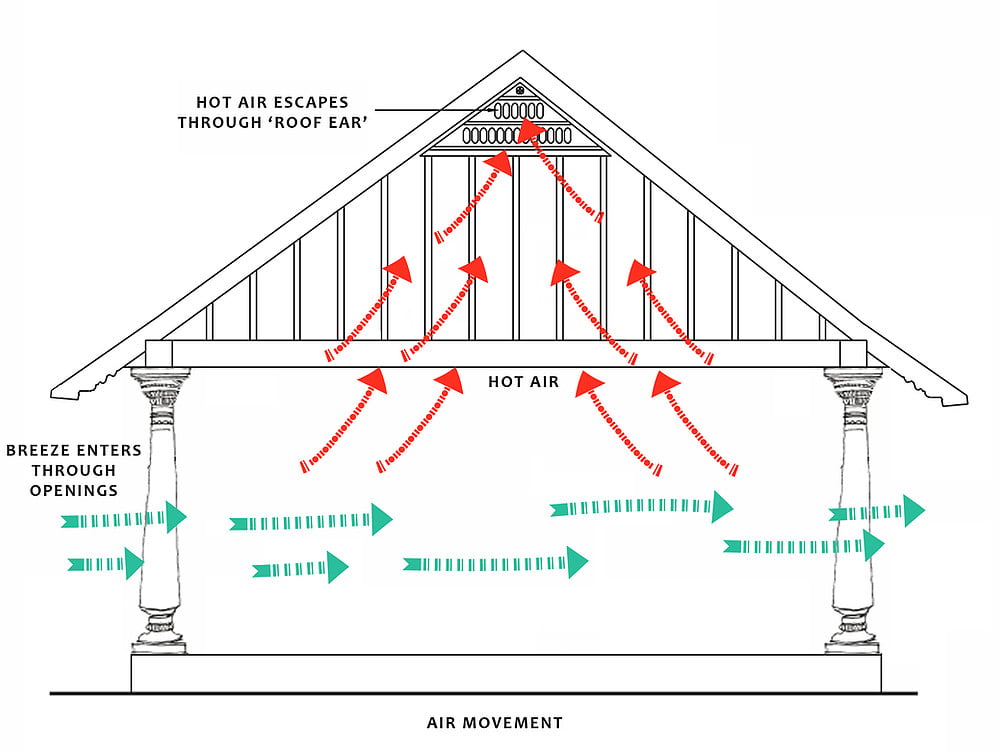
    Importance of Cross-ventilation in a warm and humid climate

    Under such climatic conditions, the design of houses in India often uses elongated open floor plans with rooms in a single row to achieve cross-ventilation. These rooms can be accessed from balconies or open balconies and also provide shade. Window and door openings are or should be as large as possible to allow air to pass freely. Sunshade and unobstructed air circulation are two basic requirements. The development density of hot and humid areas is always much lower than that of warm climate for three reasons:

    1. Allows air to circulate freely in the space between buildings
    2. Provides remote privacy because walls and screens cannot be used for this purpose
    3. Many activities are carried out outdoors

    Due to the considerable rainfall in these areas, pitched roofs are most often covered with corrugated iron, fiber cement, or shiny aluminum.

    Traditional Shelter

    In places where wood is scarce, single-story houses with earthen walls, the roof of wood, bamboo, or palm leaves, covered with straw, are typical. Wide protruding eaves obscured the walls. In areas where wood or flooring is more suitable for construction, traditional shelters are generally erected on stilts, constructed from local lumber or bamboo frames with woven mats and wood, or bamboo walls, floors, doors and shutters.

    Building Design in Composite climate

    Courtyard houses must be constructed in such a climatic zone in India. Buildings should be grouped in a way that takes advantage of the prevailing breeze in a short period when air movement is required. The medium density low rise development is suitable for these climates. This will ensure the protection of the outer space, mutual shading of external walls, shelter from the wind in cold seasons, shield against dust, and reduce the surface area exposed to sunlight. Radiation In hot and humid seasons, large and wide eaves are required.

    Balconies are used as outdoor residential areas to reduce sky glare, rain and shade, and can also become active in the dry season. It is only necessary to maintain a low wall temperature at night in the hot, dry season, but the same thermal performance will be useful in the cold season to keep the daytime heat during an uncomfortable cold night. Roof and external walls should be constructed of solid masonry or concrete to ensure a 9-12 hour heat transfer. Whether it is a cold or dry season, the heat capacity will have an advantage.

    Building Design in Cold climate

    Household wraps, moisture impermeable barriers, and effective caulking details are essential. Ventilation of the home is also essential to remove moisture from exterior walls and roof sheathing. Choose a construction site and home layout, and place your living room windows in the sun – that is, although bedroom windows may face north, they are within 30 degrees of true south. Choose a simple home plan with a steep roof, such as a standard gable.
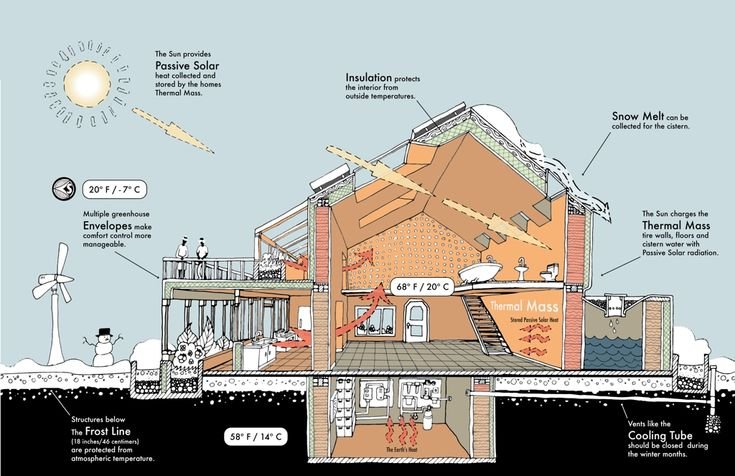
    design of houses in india
    Building design in cold climate

    Slate and tile roofs are less prone to snow. Design of houses in India should have a roof with fewer skylights or skylight openings, vents, and chimneys near roof ridges or peaks must be used. The passive solar design also uses darker colored roofs to absorb heat and “thermal mass” products such as concrete, bricks, stones, and tiles that retain heat from sunlight during the day and release heat at night. Other items may include electronic sensing devices such as differential thermostats, operable dampers and vents, operable Low-E blinds, shutters, and insulated awnings. Plans with a sunroom are very suitable for capturing solar heat.

  • Interesting Peep into Tiny Homes: Portable and Functional House Design

    Interesting Peep into Tiny Homes: Portable and Functional House Design

    Concept of Tiny Homes

    Tiny House Movement

    Tiny homes
    Photo by Maria Orlova from Pexels

    This is an architectural and social movement aimed at providing a simpler life in a smaller space. The people of all areas of life have determined that a large house, and more specifically, the great cost of the resulting life, is not necessary and harmful to their happiness. These people prefer tiny homes to reduce the financial and emotional weight of things.

    Types of Tiny homes

    Recreational Vehicles

    It is a motor vehicle or a trailer that includes houses designed for accommodation. RV types include coaches, campers, and caravans.

    Recreational Vehicles
    Photo by Kampus Production from Pexels

    The typical amenities of a camper include a kitchen, a bathroom, and one or more available to sleep. The RVs may vary from the basic bedrooms and kitchen, in luxurious, with features such as air conditioning (AC), water heaters, satellite televisions, and quartz receptors, and false ceilings, for example. Most campers are single.  

    Accessory Dwelling Unit

    Accessory Dwelling Units
    Accessory Dwelling Units

    Accessory dwelling units are also known as accessory apartments, second units, or granny flats— are additional lodging on single-family lots that are independent of the first dwelling unit. The separate living spaces are equipped with kitchen and loo facilities and might be either attached or detached from the residence

    Shipping Containers

    Built from multiple shipping containers, a shipping container house is designed often architecturally with all the amenities found in traditional home construction. This includes fully functional wet areas like kitchens, bathrooms, and laundry, plus a lounge or two, a business office, bedrooms, and verandas.

    South coast Shipping container House
    South coast Shipping container House

    Each home is uniquely designed to support the positioning, architectural plan requirements, and budget of the homeowner or builder. Shipping containers do an amazing job of keeping goods protected against wind and water. They will also heat up very quickly if there’s nothing to permit the nice and cozy air inside to flee. 

    Yurts

    Magical Yurt with spiral staircase
    Magical Yurt with spiral staircase

    Originally, a yurt may be a portable round, insulated tent used by nomadic groups of central Asia. They’re designed to be easily moved and are capable of keeping people comfortable in extreme weather. Due to its economic construction and high functionality, Yurt has gained a lot of fame recently. With the power to form all types of shapes and sizes, yurts provide you with flexibility over the look process and permit you to make it to best fit your needs. We’ve seen yurts in backyards of homes within the city and deep within the wilderness. They’re a good choice to consider when going tiny.

    Bus Conversion

    School bus Tiny Home
    School bus Tiny Home

    A school bus allows lots of natural light into your space because the walls are lined with windows. For times after you want more privacy, you’ll be able to add curtains. Many bus conversions cover their windows to feature insulation and privacy. This bus conversion takes advantage of the big amount of windows by keeping the coverings translucent. They add coverage, but also allow the taste of some light.

    Dimensions of Tiny Houses

    In recent years, tiny house plans have become more and more popular due to their versatility and environmental protection. They can be configured in any size, shape, and design to meet the needs of the owner. You can even build tiny homes on a trailer so you can take it home wherever you go. Although houses less than 1,000 square feet are considered tiny homes less than 400 square feet are considered small. They cannot exceed 8.5 inches wide, 40 inches long, and 13.5 inches high to be towed away.

    Layouts and Guidelines

    Apartments under 400 square feet are considered tiny homes, they vary in shape and size. The design and execution of tiny house plans are based on the needs of the owner. For example, a person might choose to live in tiny homes with wheels measuring 50 square meters. However, families with children can choose a larger model. A 350-square-foot house may have a roof that doubles as a deck to provide additional leisure space.

    Tiny House Plans
    Architecture design for home: Tiny House Plans

    A popular size is about 200 square feet, about the size of a dormitory. Tiny Homes prioritize the needs and wishes of owners who can build to their specifications. Living in a public micro-family environment also affects the size of the house. In many communities, facilities such as shared bathrooms and kitchens can change needs and thereby change the size of the home. However, despite the flexibility and customization options, not everyone is suitable for living in tiny house plans.

    Wall size

    If your house is less than 100 square feet or on a trailer, you can bypass certain building codes. In many cities, tiny house plans are not subject to the “Land Use Law” because they are too small to live in. In either case, for your safety, they must be structurally sound.

    Tiny House interior
    Tiny House interior

    The width of a standardized wall is:

    • A 2 × 4 is actually 3.5 inches wide.
    • A piece of oriented strand board or plywood packaging is approximately “thick”.
    • The outer cover (for aesthetic reasons) may vary, but 3/4 inch is average.
    • The thickness of the plasterboard on the inner wall is ½ inch.

    The inner wall is thinner than the outer wall. They are made of 2 x 4 plus 1/2 inch gypsum board on each side, for a total of 4.5 inches.

    Budget of Tiny Homes

    The budget of building a tiny house is based on various factors like materials, interior building materials, and tiny house appliances. Let’s compare the prices of standard houses, RVs, and tiny homes (or trailers). Tiny houses fall between these categories.

    Materials for building tiny homes
    Materials for building tiny homes

    If you plan to build your small house on wheels or on a piece of land, you will find that you will end up saving money and using less energy compared to most other living situations. It cannot be bypassed, but you should give priority to one of them. After you have decided which household features are most important to you and made a small house design plan, you can take the next step.

    Each type of tiny home caters to different preferences and needs, and the 6×12 enclosed trailer adds a unique dimension to the tiny house movement by emphasizing portability and compact living.

    Whether you are looking for the cheapest, lightest, or most environmentally friendly small house materials, making a list of materials before you start construction will save you a lot of trouble. The bill of materials can not only help you develop a meaningful budget, but also give you an idea of ​​the overall timeline of the project.

    Pros and cons of Tiny Houses

    Positive Facts


    Mortgage-Free

    If you are a millennial-focused on minimizing debt, it is not surprising that you are attracted to small RVs. The catch is that you simply must have enough savings to finance and build your own residence since most lenders typically won’t give loans for such small structures.

    Flexibility and Mobility

    Tiny homes could easily become a small manufactured home so it is moved easily, thus providing you with, the homeowner, the liberty to choose up and go – wherever and whenever.
    Customized Options

    Tiny houses made from recycled materials
    Tiny houses made from recycled materials

    Tiny homes can be customized with decor materials like granite, recycled glass, quartz, or mosaic tile for a fraction of what it’d cost to create during a traditional home. Luxury tiny homes are far more realistic than luxury homes.
    Low Utility Costs

    Electric, water, and gas bills are minimal since you’re living in such a little space. You’ll reduce or eliminate your bills completely if you select to put in solar panels.

    Challenges
    Limited Living Space

    Although builders have gotten creative with making the foremost of the space, living tiny means having barely enough room for you and your family to stay comfortably.
    Limited Storage

    Tiny House storage
    Tiny House storage

     If you have got 50 pairs of shoes or are someone who hoards books or video games, a little home might not be right for you. Living within your means and streamlining your possessions to only have what you utilize is vital to “living tiny.”

    Difficult to Entertain

    Hosting large parties or perhaps having some friends over for dinner may prove challenging in a very tiny home. The most suitable choice is to make an outside elbow room for entertaining guests.

    Tiny House Design in India

    Cuckoo’s Nest, Karnataka

    Architecture Firm: Between Spaces

    Area: 313.5 sq. mt.

    Location: Bangalore, Karnataka, India

    Cuckoo’s Nest/ Between Spaces
    Tiny house design in India: Cuckoo’s Nest/ Between Spaces

    It is built on a corner lot with roads on the west and north edges, a closed system, surrounded by silver areas and some palm trees. The task is to design a simple, practical, and modern tiny house plan for the elderly parents of the owner, the owner himself, and their two sons. The entire narrative of this house is structured around the idea of ​​playfulness and pragmatism.

    Tube Well House, Maharashtra

    Architecture Firm: Atelier Shantanu Autade

    Area: 400 sq. ft.

    Location: Ambajogai, Maharashtra, India

    Tube well House/ Atelier Shantanu Autade
    Tiny house in India: Tube well House/ Atelier Shantanu Aubade

    The structure of the west-facing front facade creates a posture similar to that of Indian Havelis. Mesh windows, protruding lattice boxes, and large overhangs can reduce surface temperature and regulate wind flow. In terms of structure, the vertical volume formed by slender pillars and long overhanging walls indicates the grandeur of the entrance.

    White Skube House, Kerala

    Architecture Firm: Srijit Srinivas-ARCHITECTS

    Area: 232 sq. mt.

    Location: Thiruvananthapuram, Kerala, India

    White Skube House/ Srijit Srinivas Architects
    White Skube House/ Srijit Srinivas Architects

    The curved shape of the finite floor plan makes it possible to organically create a curved cuboid. The architecture design of the home is painted white to increase the tranquility of the transformed Platonic form-highlighted by the chaos of the busy environment. The functional requirements of the narrow area are particularly demanding, including a car balcony that can accommodate two cars, a living and dining area, a kitchen and an adjacent work area, four bedrooms with en suite bathrooms, and a family suitcase on the upper floor.

  • Interesting Peep into a Victorian House Design: An Off-Grid Experience

    Interesting Peep into a Victorian House Design: An Off-Grid Experience

    Definition and History 

    Victorian-style architecture in Great Britain and former British colonies was a type of house generally built during the reign of Queen Victoria. At the time of the Industrial Revolution, successive housing resulted in the building of tons of Victorian house designs that are now a defining feature of most British towns and cities.

    Interestingly, many of the details that we now associate with this style are actually interpretations of older architectural movements featuring Medieval Gothic and Romanesque. Thanks to the size of the British Empire during that time, Victorian house design has an incredibly wide reach. It is widely populated across the UK, North America, New Zealand, and Australia.

    Victorian house designs have managed to capture the hearts and minds of people for over two centuries now. There is so much to the design than those dollhouse-like exteriors. This architecture style includes multiple and distinct variations that all deserve a critical look. Also, as the name suggests, Victorians became popular among the upper-class White people during Queen Victoria’s reign.

    What makes a house Victorian Style?

    As per the words of Thomas Jepsen from the design firm Passion Plans, “A Victorian Style house is something between a colourful dollhouse and a great English Remnant. While the style refers to a period of time in history, it is generally associated with certain characteristics.

    Here are a few common characteristics of Victorian house architecture:

    Exterior

    1. Two to three stories
    2. Steep, gabled roofs
    3. Intricate woodwork
    4. Towers and turrets
    5. Rich colours

    Interior

    1. High ceilings and windows
    2. Closed off rooms
    3. Detailed trim
    4. Ornamental architecture
    Victorian house design layout
    Victorian house layout

    Types of Victorian style houses

    Italianate houses

    Italianate homes were popularized first in the 1840s and lasted until the Civil war, drawing inspiration from 16th-century Italian villas. The main structures were often simple, rectangular-shaped houses with low sloping or sometimes flat roofs that protrude far out from exterior walls. The windows are usually tall and skinny often rounded at the top with trim. Some Italianate houses have square towers or cupolas that rise out of the centre of the house giving a Tucson villa vibe.

    Italianate houses are mostly seen in the greatest number in North American cities that experienced exponential growth during the mid-19th century Cincinnati, Ohio, New Orleans, Garden District, and parts of San Francisco, Brooklyn, and New York.

    Other characteristics are:

    1. Wide eaves
    2. Quoins chimneys
    3. Single storey porch
    4. Tall and narrow windows
    5. Double doors with glass panels
    Italianate houses
    Source

    Queen Anne houses

    Queen Anne homes were popular in the US from the 1880s until sometime around the 1920s. This was theoretically a revival of the style du jour during the actual reign of Queen Anne which lasted from 1720 to 1714 but there is a very quiet resemblance in practice. The Queen Anne homes are quintessential Victorian homes having asymmetrical, two or three-storied tall, steeply high-pitched roofs.

    They are often adorned with various wall textures and ornate trim which gives them a ‘gingerbread’ effect commonly associated with Victorian houses- typically painted in a variety of accent colours. Few of the Queen Anne homes have octagonal towers (topped with a round pointed roof) and ornate bay windows which makes them subtle in look and design.

    Other characteristics are:

    1. Gable ends
    2. Towers with balconies
    3. Bold exterior colours
    4. Bay windows
    5. Built from wood, stone and brick siding
    6. Stained glass window
    7. Decorative spindle work
    8. Wide and spacious verandas
    Queen Anne houses
    Source

    Gothic Revival houses

    The Gothic Revival-style homes were first introduced in the 1880s. These homes are the classic representations of romantic and picturesque architectural elements that manifested in the US. The main properties of these structures were inspired by the medieval design of churches. Therefore, making the Victorian Gothic Revival style homes different from that of medieval architecture such as high pointed arches, biblical and heraldic emblems.

    Other Characteristics include:

    1. Steep, pitched roof with overhanging eaves.
    2. Castle like turrets.
    3. Slender columns and decorative posts
    4. Unique modern trims
    5. Pointed arches above windows with high dormers
    Gothic Revival houses
    Source

    Folk Victorian houses

    The Folk Victorian house is the most common type of home found in the US. This gained popularity in the 19th century and was considered as a more affordable alternative to Queen Anne’s style of design. The architects of Folk Victorian-style houses created a pimped-up version of a Victorian house by using cheaper materials in a relatively plain design and decorative trims for low-budget families, but with almost similar and prominent front-facing gable and steep under eaves.

    Other characteristics include:

    1. Decorative detailing on the porch
    2. Ornamented gables
    3. Symmetrical structure
    4. Trimmed windows
    Folk Victorian houses
    Source

    Shingle style houses

    The Shingle-style homes are basically known for their simplicity and make a popular choice for summer or weekend houses of the rich and famous. Shingle-styled houses are made up of clapboard or brick, despite their misleading name.  These types of houses are characterised by their rustic appearance which was favoured by the working class. Used as a holiday cottage by the wealthy, these homes became popular in New England from 1831.

    Other characteristics are:

    1. Symmetrical exterior
    2. Pitched roofs
    3. Shingled roof and walls
    4. Wide porches
    5. Sash windows
    6. Round towers
    Shingle style houses
    Source

    Octagon style houses

    The octagon-styled houses were hugely popular from between 1850 to 1870 after its mention in Orson Squire Fowler’s book called “The Octagon House: A House for All”. This style of the Victorian house took its inspiration from the Gothic and Greek Revival times to create a unique approach to residential architecture by specializing in bright and airy spaces in affordable dwellings.

    The Octagonal style house is the world’s only 8-sided Victorian house design with the benefits of being a practical and energy-efficient property. This unique style has evolved over the past decade or so thanks to the new constructive innovations.

    Other characteristics include:

    1. Domed shape
    2. Wide eaves
    3. Low pitched roofs
    4. Partially encircling or full porches
    Octagon style houses
    Source

    Second Empire style houses

    The second Empire-style houses gained popularity between 1865 and 1880 in the late Victorian era. This originated first in France, with some of the most famous hotels featuring the same architectural elements as the Second Empire houses. The attic or the upper storey is usually light and airy with a high ceiling. The most stood-out, striking feature of a Second Empire house is its mansard roof, which is named after the 17th-century French architect, Francois Mansart. This type of roof is a 4-sided gambrel roof with two slopes on either side.

    Other characteristics include:

    1. Imposing tower
    2. Side veranda
    3. Balustrades
    4. Diamond shaped dormers
    5. Wrought iron railings in balcony
    6. Bay window
    7. Quoins chimneys
    Second Empire style houses
    Source

    Stick style houses

    The Stick-styled houses date back to 1860 and are widely characterized by their vertical, diagonal, or horizontal planks resembling Tudor-style buildings. This Victorian-style home has a more decorative aspect to it but with a simple design. Unlike other elaborate architectural designs of the Second Empire and Queen Anne styles, the Stick style home lacks the bay windows and decorative elements that are so characteristic of the Victorian era.

    Other characteristics are:

    1. Pitched gable roof
    2. Wooden exterior walls
    3. Towers
    4. Cross gables
    5. Decorative trusses
    6. Diagonal or curved braces
    7. Wooden decorative trims
    Stick style houses
    Source

    Richardsonian Romanesque style houses

    The Richard Romanesque style is the most dramatic of all architectural styles in the Victorian era (1838). This Victorian-style architecture was named after the architect, Henry Richardson. It didn’t take long before becoming popular all thanks to Medieval Spanish and Italian Romanesque elements that blended with modern materials and features.

    A typical feature of this type of house included circular arches above the porch supports and windows. These round arches were often set on huge pillars that were built directly into the wall.

    Other characteristics are:

    1. Round masonry arches
    2. Recessed entrances
    3. Heavy stone materials
    4. Square and cylindrical shaped towers
    Richardsonian Romanesque style houses
    Source

    Eastlake style houses

    By the end of the 19th century, a new movement in the US transformed the interior and exterior designs of properties. This movement was inspired by the British architect, Charles Eastlake, who convinced homeowners to replace their heavy furnishings with attractive pieces that were made by hand. This was termed as a start of reform which subsequently was followed by a simple layout.

    The Eastlake style is mainly recognized by its Gothic design with decorative shingles and trusses on the gable end. These types of Victorian houses often feature overhanging, second storey porches as their design feature. It also boasts paneled brick chimneys inspired by the Queen Anne period.

    Other characteristics are:

    1. Carved panels
    2. Perforated pediments
    3. Lattice work on porch eaves
    4. Interlaced wood strips
    5. Mansard porches with iron cresting
    Eastlake style houses
    Source

    The two architecture styles Grant noted to be most famous of the Victorian period- Italianate and Queen Anne are technically revivals of earlier architecture styles. Although both took on lives of their own and were often exuberantly decorative without much concern for historical accuracy according to Grant. Each has distinct features but what they have in common is an emphasis on vertical elements i.e. homes often stood at two or three stories with tall windows and porches and detailed ornamentations on the top.

    Building Materials

    The most common building material during the Victorian era were the ones that were local to the area. The buildings of the local material are sometimes called of Vernacular style. The known Cotswold villages were made of white Jurassic limestone, central England had buildings of red sandstone, Cornwall towns in the south and Aberdeen in the north were built of local granites, and places like Norwich, which had no local hard stone, was faced with flints.

    Victorian architecture was constructed with brick, local stone, and mortar, as these were the primary building materials and were an integral part of the construction. The roofing was typically composed of multiple layers of coal and tar over tongue and groove planking. The Victorian houses were usually made of wood or stone as they were quite large and imposing.

    Stone

    The number of full-blown Gothic stone mansions was never too large. Most early homes, especially in England, were built of stones and enhanced decorative stone tracery. Only the wealthy were able to afford such homes which required labours of highly skilled stone carvers. The over-priced Gothic style was eventually made into wood and lots of ‘Carpenter Gothic’ houses still stand even today.

    With the innovation of new manufacturing processes and emerging of railways, the previously locally produced building materials were instantly available all over the city. Henceforth, all houses started being made from bricks from Bedfordshire and slate from North Wales instead of being made off the local stone, time, and straw.

    Limestone

    The Portland Limestone was the most common white stone used across England for public buildings, for example, the Whitehall. Equally popular was also the Bath Stone, orangish sandstone of great value and beauty. Permian sandstone, reddish coloured sandstone, often weathered to give a deep pitted and honeycombed appearance such as the walls of embankments on seaside towns.

    Victorian Bricks

    A renaissance of brick was seen in the Victorian era. The local brick-making material for London was the London Clay, which were yellow and greenish-yellow in shade. Older, more hand-pressed bricks were often irregular in shape and had lines, squeeze-marks known as Stock Bricks. The Oxford Clay Bricks, plain red of most modern brick, dominated and ruled.

    The railways used fired Black brick. Minton’s perfected the encaustic tile (the colour in the material of the tile rather than just on the surface of it) and thereafter tile-covered buildings such as public houses became common with a flourishing of nouveau decors after the century.

    Victorian houses in different countries

    Victorian houses in different countries
    Image by CarAnd from Pixabay  

    United Kingdom

    In the UK, Victorian houses follow a wide range of architectural styles. The houses in the 1840s were influenced by classicism of Regency styles, the Italianate style, and the Gothic Revival style in the 1880s. The simplicity of Regency classicism fell out of flavor as the Italianate style influenced the domestic architecture which is now incorporated by varying’s of Stucco. The additional general features/influences brought out a progressive change in style that resulted from several other factors.

    The abolition of tax on bricks in the 1850s made these items cheaper yet a suitable material. The emerging railways allowed them to be manufactured elsewhere at a lower price and to standard sizes and methods. There was also a progressive introduction from the 1850s to building regulations.

    In deprived areas, Victorian houses were often very small. Victorian houses for the middle classes and upwards tended to accommodation for servants. And for the middle and upper classes, it aspired to follow the purest forms of contemporary architecture.

    North America

    Victorian houses in east American cities were three stories and those in western American cities were two stories. One feature that became hugely popular in the Victorian era was the use of wooden gingerbread trims to create ornate embellishments to decorate their homes. The Victorian-era residential architecture in America and Canada was a procession of styles borrowed from different countries and historical sites.

    Few examples of this style are:

    1. Carson Mansion, California
    2. John B Kane Residence, Los Angeles
    3. Alamo Square, San Francisco
    4. Farnam Mansion, New York

    Australia

    The Victorian period in Australia lasted roughly from 1840 to 1890. There were 15 styles that predominated of which, 8 were used for homes.

    1. Victorian Georgian
    2. Victorian Regency
    3. Free Gothic
    4. Rustic Gothic
    5. Free Classical
    6. Filigree
    7. Italianate
    8. Tudor

    Victorian house roofing materials

    During the Victorian period, many different types of roofing materials were used. Some were more durable than others and some were less. Like wood shingles, modern enhancements made restoring a Victorian roof design possible without compromising longevity and protection.

    There isn’t a single, one-size-fits-all ruffing material foot these types of houses but using the current roof as a guide, can be the best indicator of what materials to use. Slate tiles, Asphalt, wood, and clay tiles are mostly used as roofing materials

    Slate tiles

    Slate tiles began to rise in popularity during the end of the Victorian period. These are extremely durable, resistant to fire, and environmentally beneficial. They also last much longer than some other roofing materials, but these added benefits also come at a cost.  

    Asphalt

    While asphalt roofs weren’t used during the Victorian period, they can be made to resemble Victorian-style roofing, such as wood shakes or slate. Asphalt shingles can also come in varying shapes and sizes for added Victorian appeal and durability.

    Wood

    Wood roofing was used primarily for early Victorian houses. Wood is cost-effective and visually appealing, but it is not a long-lasting material. This is because wood is susceptible to rot, insect problems, and damage.  

    Clay Tiles

    Clay tiles were also used as roofing materials in the early Victorian houses. Clay roofing is durable and long-lasting, but it’s important to match clay tiles with the Victorian period.

    Evolution of Victorian houses

    During the Victorian era, architecture saw rapid changes. A variety of Victorian styles emerged, each with its own distinctive features and personalities. The most popular Victorian style spread quickly through vast published pattern books. Builders often borrowed its characteristics from several styles, creating unique and sometimes quirky mixes.

    In the 20th century, despite having the availability of these new products, several working populations in the countryside lived in tiny cottages, hovels, and shacks. In towns, people lived in back-to-back houses called terrace houses. Innovation in building techniques and mass-produced building materials that could be transported by rail saved builders time and helped them lead a housing boom during the 1850s and 1870s that witnessed millions of Victorian constructions.

    While the Victorian era officially ended in the 1920s, its accompanying architecture styles stuck around for another decade or so until the colonial movement surpassed them in popularity. Victorian homes became disliked in the following decades. As Grant said, “There was a time when the Victorian house was considered an unwelcomed presence in many neighborhoods. Indeed, it became a stereotype for the ‘haunted house’”.

  • 10 Best Examples of Prairie House

    10 Best Examples of Prairie House

    Introduction

    Founded in 1893 by Frank Lloyd Wright, the Prairie School or Prairie style of architecture began in Oak Park, Chicago. This innovative approach to domestic architecture was inspired by the broad and flat landscape in America’s Midwest. The arts and crafts movement greatly affected the design style, forcing Wright to offer alternative architectural components from the excessive usage of the Victorian era to the idea of Prairie home.

    Fun fact! The name Prairie style was not coined by Frank Lloyd Wright by rather coined by architectural critics and historians who agreed that his design was influenced by the landscape and plant life of the midwest Prairie of the United States and reflected in his structures.

    Prairie house style landscape
    Prairie style landscape

    The cornerstone for modern architecture was played by the emergence of Prairie house design. Prairie home designs are known for their sweeping horizontal lines and open floor plans.

    This style of house architecture is usually defined by horizontal lines, low or hipped roofs that bring large overhanging eaves with a centrally located chimney. It was heavily influenced by the arts and crafts movement and included fenestrations arranged in horizontal bands that incorporated the landscape, solid development, workmanship, and regulation in the application of decoration. The picture attached below explains clearly, all the elements that constitute the design discipline.

    Wright characterized the design as follows: “The prairie has its own beauty, and we should recognize and emphasize its natural beauty, as well as its calm level. As a result, gently sloping roofs, modest proportions, silent skylines, repressed heavy-set chimneys, and sheltering overhangs, low terraces, and out-reaching walls enclosing private gardens are the norm.”

    The work of Mahony and Griffin in Australia and India, particularly the collection of houses at Castlecrag, New South Wales, exemplifies how the Prairie School extended well beyond its Chicago beginnings.

    Marion Mahony Griffin’s drawing depicting Prairie Architecture
    Marion Mahony Griffin’s drawing depicting Prairie Architecture

    10 Best Examples Of Prairie House Design

    Prairie School design is probably the most innovative design strategy that has ever been discovered.  Although we love all the structures that were constructed using this style, we particularly favor these top 10 Best Examples Of Prairie House Design.

    Frederick Carter House

    Frederick B Carter, Jr. House, 1024 Judson Street, Evanston Cook County, Illinois
    Frederick B Carter, Jr. House, 1024 Judson Street, Evanston Cook County, Illinois

    Year of Construction: 1910

    Architect: Walter Burley Griffin

    Location: 1024 Judson Avenue in Evanston, Illinois.

    Ideology behind this Prairie House

    The historic house for Frederick B. Carter Junior is a classic example of Prairie House Design. Expert redesigned by Walter Burley Griffin, the Frederick Carter House was one of his early works wherein he tries to follow the footsteps of his mentor, Frank Lloyd Wright. Made out of brick and stucco the exterior also sports wooden half-timbering and trim. A classic Prairie house design, the house features horizontal lines with receding massing, a large gable roof visible in the facade, and quintessential overhanging eaves. With some elements like the usage of a cross-shaped design and wide gables, the architect tried to set a standard of design that was a step different from that of his mentor.

    Considering its history and architectural significance, the residence was included in the national register of historic places on July 30th, 1974.

    Library of Congress Prints and Photographs Division Washington, D.C. 20540 USA
    Source: Library of Congress Prints and Photographs Division Washington, D.C. 20540 USA

    The Darwin Martin House

    Martin House - Westside elevation and porte-cochere
    Martin House – Westside elevation and porte-cochere

    Year of Construction: 1903–1905

    Architect: Frank Lloyd Wright

    Location: Buffalo, New York

    Ideology behind this Prairie House

    Designed by the father of Prairie house design himself, Frank Lloyd Wright, this residence located at 125 Jewett Parkway in Buffalo, New York, is considered to be one of the most important projects from his designing era, which includes The Guggenheim in New York City and Fallingwater in Pennsylvania, so it’s pretty up there. Being Wright’s personal favorite, he referred to The Darwin Martin House as his “opus”, and called the construction “A well-nigh perfect composition”. The house features distinct 394 art glass windows that were designed by the man himself.

    The original total square footage of the Martin House Complex was 29080 ft2 (2700m2). The residential complex consists of the Martin house, the Barton house, the carriage house, the gardener’s cottage, the conservatory, and the pergola. The house sports a gable roof and horizontal lines and also extensive use of thin Roman bricks to add to the linearity.

    Ward Willits House

    Ward Winfield Willits House
    Ward Winfield Willits House

    Year of Construction: 1901

    Architect: Frank Lloyd Wright

    Location: Highland Park, Illinois

    Ideology behind this Prairie House

    One of the first houses designed by Frank Lloyd Wright, the Ward Willits House is considered one of the many iconic Prairie School houses. The facade of the house from the street seems symmetrical and blends in with nature and surroundings. The planning of the house features a central fireplace from which four wings extend out. Like all of his structures, this house also has custom-designed stained glass windows and wooden screens by Wright, that provide privacy and separation of space.

    Wright also designed furniture for most of his constructions to preserve the style of the structure, and this house is no exception. From this house forward, Wright started using wooden frames and stucco finishes in his structures. The house also sports a low roof, horizontal lines, an overhanging frame, and a cruciform plan structure. The house was visualized as an entertainment-style home and the planning follows.

    Dana–Thomas House

    Susan Lawrence Dana House
    Susan Lawrence Dana House

    Year of Construction: 1902-1904

    Architect: Frank Lloyd Wright

    Location: East Lawrence Avenue in Springfield, Illinois.

    Ideology behind this Prairie House

    Another classic from the legend is Frank Lloyd Wright, Dana–Thomas House where organic architecture is celebrated in this house with a relatively flat landscape. Wright’s love for Japanese architecture is reflected in this house via his representation of Japanese aesthetics.

    Strategically placed windows are an extension of the concept of expanding space, inviting people to view the landscape outside. He designed 450 art glass windows, skylights, door panels, sconces, 100 pieces of free-standing white oak furniture, and light fixtures for the house. The home is today a historic site under the Illinois Historic Preservation Agency (I.H.P.A.) after a restoration attempt in 1987-1990. Many critics believe that the flamboyant nature and personality of the Patron and the architect beautifully combine in this historic house.

    The Meyer May House

    Meyer May House
    Meyer May House

    Year of Construction: 1908 -1909

    Architect: Frank Lloyd Wright

    Location: 450 Madison Avenue SE, Grand Rapids, Michigan

    Ideology behind this Prairie House

    This Frank Lloyd Wright-designed mansion, built between 1908 and 1909, is known as “Michigan’s Prairie masterpiece.”  This house was commissioned to Wright by the president of May’s clothing store in Grand Rapids and his spouse Sophie. The house is two-storeys tall with a T-plan planning. The facade features pale thin Roman bricks with a hipped roof, long and broad eaves, and skylights. All the features that constitute a Prairie house design are implemented in this home. As usual, art glass windows were also placed in the structure carefully designed by the architect.

    He also wanted a lot of south sun entering the home from living room windows and skylights. The fenestrations were lead-cased and colored. The doors were glass accented and opened out to terraces and gardens that were included in the design. Later on, in 1922 additional two bedrooms upstairs and servant quarters were included in the structure. The Meyer May House was included in the Michigan State Register of Historic Sites in 1986, and it is also a component of the Heritage Hill Historic District.

    Harold C. Bradley House

    Harold C. Bradley House
    Harold C. Bradley House

    Year of Construction: 1909

    Architect: Louis Sullivan and George Grant Elmslie

    Location: Madison, Wisconsin

    Ideology behind this Prairie House

    Also known as the Mrs.Josephine Crane Bradley Residence, this house is designed by architects Louis H. Sullivan and his partner George Grant Elmslie. Though Sullivan did not design many residences, this house is one of the two he designed in Wisconsin. A rather modern take on the Prairie house design, the Harold C. Bradley House features gabled roofs,  lines depicting horizontality, and the quintessential, thin Roman bricks.

    Initially, the house had a cruciform design with a living room, library, and kitchen on each wing with a porte-cochère on the main entrance. The client then changed the plan with the edition of cantilevered sleeping porches on the second floor with the help of Louis Sullivan. In 1973, the Harold C. Bradley House was added to the National Register of Historic Places, and in 1976, it was designated a National Historic Landmark.

    Pleasant Home

    Farson Pleasant Home
    Farson Pleasant Home

    Year of Construction: 1897

    Architect: George W. Maher

    Location: Oak Park, Illinois, United States

    Ideology behind this Prairie House

    Also known as the John Farson House, the Pleasant Home is a classic example of Prairie house design. The house was originally located inside a complex. Inside the complex, we are also a Greenhouse, a coach house for horse carriages, and a horse stable which was then converted into a garage. The coach house and greenhouse were later demolished due to inadequate maintenance.

    Originally situated on a larger plot, the pleasant home has part of the lot converted to a park called The Mills Park. On June 19, 1972, the home was listed on the National Register of Historic Places in the United States. The United States Department of the Interior designated it a National Historic Landmark in 1996. The exterior of the home sports wooden clapboards, fascia, and soffit. The house sports tall windows for maximum natural light intake and gabbled roofs that are typical of a Prairie house design.

    Frank Thomas House

    Frank Thomas House 1901
    Frank Thomas House 1901

    Year of Construction: 1901

    Architect: Frank Lloyd Wright

    Location: Oak Park, Illinois, United States

    Ideology behind this Prairie House

    One of the most important structures in architecture, the Frank Thomas house was the first of the Prairie houses as described by Frank Lloyd Wright. The house has rooms that are elevated and there is no basement. Many of the features that are associated with Prairie house design such as flat roofs, broad projections, casement windows, built-in shelves, cabinets, ornate leaded glass windows, central chimneys, and custom-designed furniture, all originated from this one structure.

    The plan is L-shaped with a central axis that leads to the entrance of the house. The living room opens up to a covered porch. The breakfast room features a bay window-style seating area with wide windows for plenty of natural sunlight intake.  The house also has four bedrooms which are all located on the upper story.  The easily identifiable arc way in the facade of the structure sets it apart from other structures designed by Frank Lloyd Wright.

    Emil Bach House

    Emil Bach House
    Emil Bach House

    Year of Construction: 1915

    Architect: Frank Lloyd Wright

    Location: Rogers Park neighborhood of Chicago, Illinois, United States

    Ideology behind this Prairie House

    Another classic from Frank Lloyd Wright, the Emil Bach House picturizes Wright’s longing for Japanese architecture that is subtly hinted at in this house. It features a series of geometric cubic masses with overhanging horizontal slab roofs, typical of twentieth-century Wright structures. The house is designed as a two-story nuclear family home which includes a basement. It also has stunning views of Lake Michigan in its East facade.

    Correspondingly, the house also featured a large rear porch and a sun deck which is now taken down. Like many of Wright’s structures, the furniture was custom made and installed inside the structure which still survive. This was one of the latest houses designed by Wright before his deviation into a more expressionist and Japanese-inspired aesthetic. On September 28, 1977, the Bach House was designated a Chicago Landmark, and on January 23, 1979, it was listed to the United States National Register of Historic Places.

    The Robie House

    Frederick C. Robie House
    Frederick C. Robie House

    Year of Construction: 1909

    Architect: Frank Lloyd Wright

    Location: On the campus of the University of Chicago, in the South Side neighborhood of Hyde Park in Chicago, Illinois.

    Ideology behind this Prairie House

    Last but not least, the Robie house also known as Frederick C. Robie House is an iconic and example-setting structure designed by Frank Lloyd Wright in 1910. Initially constructed as a single-family home, it is today renowned as the most prominent example of Prairie school design and the primary architectural style thought to be uniquely American. Like all of his structures, Frank Lloyd Wright-designed every square inch of the house including the interiors, fenestrations, lighting, carpets, and textiles.

    Elements of Prairie design such as projecting overhanging roofs, connected lines of art glass windowpanes, and the usage of thin Roman bricks on the outside to represent linearity and horizontality have all been incorporated here. In July 2019, it was placed on the World Heritage List under the title “The 20th-Century Architecture of Frank Lloyd Wright.” On November 27, 1963, it was named a National Historic Landmark, and on October 15, 1966, it was added to the National Register of Historic Places.

  • 10 Best Examples of Victorian Houses

    10 Best Examples of Victorian Houses

    Victorian houses have managed to capture our hearts for over 200 years now. There is so much more than meets the eye behind those dollhouse-like exteriors. This architectural style includes multiple, distinct variations that all deserve a critical look.  Thanks to the magnitude of the British Empire during that time, Victorian architecture has an immensely wide reach. Evidence of this style is found across the UK and North America, as well as Australia and New Zealand.

    Winters House, California, USA- Eastlake style

    The Eastlake style is mostly known for its Gothic design with decorative shingles and trusses on the gable end. Overhanging, second-story porches are often featured in these types of Victorian houses as their design. It also boasts paneled brick chimneys inspired by the Queen Anne period.

    Eastlake movement was named after the English architect Charles Locke Eastlake after the release of his influential book ‘Hints on Household Taste in Furniture, Upholstery and Other Details. Eastlake was originally a painter who trained in Rome and was considered to have great knowledge in art however he had a specific preference.

    General characteristics of this Victorian House

    1. Carved panels
    2. Perforated pediments
    3. Lattice work on porch eaves
    4. Interlaced wood strips
    5. Mansard porches with iron cresting

    Winters House is an Eastlake movement-building in Sacramento, California, and was built in 1890. It has 3 stories and is approximately 4500 square feet.

    The House’s features are – steel pitched hip and gable roof, asymmetrical front façade, two-story angled bay under forwarding gable, mansard front porch, and second-story bay windows on both sides of the house. The roof of the house is made of asphalt shingles and the walls are made from pattern siding covered heart redwood. The foundation of the building is a cement parged brick stem wall and the decorative brick chimneys are part of a coal-burning fuel system.

    The interior of the house reflects the Eastlake style in the mantel spindles, the ornate tile work surrounding the two fireplaces. Below the cornice, the house has a frieze board that includes scrollwork sunbursts and stars. In the front porch, above the front doors are cut window panels in jewel tones. The porch has a framing of fans, flowers, dentils, and spindle work. The spindle work and stickwork are repeated from the upper porch to the lower porch balustrade.

    George W. Frank House, Nebraska, USA- Richardsonian Romanesque style

    The Richard Romanesque style is considered the most dramatic of all architectural styles in the Victorian era. This type of architecture style was named after the architect, Henry Richardson. It didn’t take long before becoming popular all thanks to Medieval Spanish and Italian Romanesque elements that blended with modern materials and features. Typical features of this type of house would include circular arches above the porch supports and windows.

    General characteristics of this Victorian House

    1. Round masonry arches
    2. Recessed entrances
    3. Heavy stone materials
    4. Square and cylindrical shaped towers

    This free revival style incorporates 11th and 12th century southern French, Spanish and Italian Romanesque characteristics. It mostly emphasizes clear, strong picturesque massing, round-headed Romanesque arches, which are often sprung from clusters of short squat columns, recessed entrances, richly varied rustication, blank stretches of walling contrasting with bands of windows, and cylindrical towers with conical caps embedded in the walling.

    The Frank House is a Richardsonian Romanesque design, with Colorado red sandstone from Wyoming. The exterior stone walls here are 18 inches thick, while the interior supporting walls are 14 inches thick and made of brick. The house has 14,000 square feet of living space, with three floors and a basement. This house originally had 10 fireplaces, 7 of which still remain. The extensive interior woodwork is English Golden Oak, done by a local carpenter named John Peter Lindbeck, a certified master carver.  

    The grand staircase has six posts, each of which has its own design. On the second-floor landing is the home’s Stained-Glass Window (5×9 feet). On the second floor, there were 4 bedrooms and 1 bathroom for guests. To fend off cold Nebraska winters, the house was heated by steam heaters located in several rooms throughout the house. In the dining room, the windows are curved to complement the veranda on the east side of the house.

    Herman C. Timm House, Wisconsin, USA- Stick style

    Herman C. Timm House, Wisconsin, USA- Stick style
    Source

    The Stick-styled houses are widely characterized by their vertical, diagonal, or horizontal planks resembling Tudor-style buildings. This Victorian house has a more decorative aspect to it but with a simple design. Unlike other elaborate architectural designs of the Second Empire and Queen Anne styles, the Stick style home lacks the bay windows and decorative elements that are so characteristic of the Victorian era.

    The style sought to bring a translation of the balloon framing that had risen in popularity during the middle of the century, and also by adding plain trim boards, soffits, aprons, and other decorative features. The style was commonly used in houses, train stations, life-saving stations, and other buildings from the era.

    General characteristics of this Victorian House

    1. Pitched gable roof
    2. Wooden exterior walls
    3. Towers
    4. Cross gables
    5. Decorative trusses
    6. Diagonal or curved braces
    7. Wooden decorative trims

    The Herman C. Timm house was built in 1873 in a Greek revival style by Kiel contractor August F. Neumann. It consisted of a current upstairs bedroom and first-floor kitchen and dining room. The original home became the rear of the home during addition in 1891. The addition was done in what was later called stick-style architecture. This was 1860-1890 trends were carpentry and woodworking technology allowed for much trim detail.

    The house features a tower for relaxation purposes. Several windows in the living room and vestibule were made from stained glass. The original Quetzal Art Glass brass chandelier remains in the parlor. A lot of the other original furnishings were sold by the family or future tenants so other period pieces were used. Tiny fragments of original wallpaper were found in most rooms during reconstruction. The three upstairs bedrooms contain donated historical items like the community’s first sewing machine, a bed warmer, and a trunk.

    Vaile Mansion, Missouri, USA- Second Empire style

    The Second Empire-style houses gained popularity in the late Victorian era. This originated first in France, with some of the most famous hotels featuring the same architectural elements as the Second Empire houses. The most stood-out, striking feature of a Second Empire house is its mansard roof, named after the 17th-century French architect, Francois Mansard is a type of roof is a 4-sided gambrel roof with two slopes on either side.

    General characteristics of this Victorian House

    1. Imposing tower
    2. Side veranda
    3. Balustrades
    4. Diamond shaped dormers
    5. Wrought iron railings in balcony
    6. Bay window
    7. Quoins chimneys

    The Harvey M. Vaile Mansion is located at 1500 North Liberty Street in   Missouri. Built-in 1881 for businessman Harvey M. Vaile, it is a locally significant example of Second Empire architecture.  The Harvey M. Vaile Mansion was designed by Kansas City architect Asa Beebe Cross. The symmetrical structure consists of a two-and-a-half-story block surmounted by a three-story central tower.

    It features an elaborate one-story porch, limestone moldings, heavily bracketed cornices, dormered mansard roofs, and multicolor slate shingles.  The tall, narrow windows, together with the central tower’s double mansard roof, emphasize the strong sense of verticality of the façade. It features 31 rooms with 14 feet high ceilings decorated by French, German, and Italian artists. The Vaile Mansion was the first house in Jackson County with indoor plumbing.

    Robert Waugh House, Illinois, USA- Octagon style

    The octagon-styled houses were hugely popular between 1850 to 1870. This style of the Victorian house took its inspiration from the Gothic and Greek Revival times to create a unique approach to house architecture by specializing in bright and airy spaces in affordable dwellings.

    This type of house is the world’s only 8-sided Victorian house design with the benefits of being a practical and energy-efficient property. This unique style has evolved over the past decade or so thanks to the new constructive innovations.

    General characteristics of this Victorian House

    1. Domed shape
    2. Wide eaves
    3. Low pitched roof designs
    4. Partially encircling or full porches

     The benefits of an octagon: the shape encloses space efficiently, minimizing external surface area and consequently heat loss and gain, building costs etc. An octagon is a sensible option instead of a circle because in a circular plan it is difficult to accommodate the furnishings. Victorian builders were used to building 135° corners, as in the typical bay window, and could easily adapt to an octagonal plan.

    Robert Waugh was born in Scotland but immigrated to the United States in 1850. He settled in Illinois in 1853.  Waugh initially lived in the apartment above his store. In 1886, he purchased a property and commissioned an octagon house.  The house remained in the Aitchison family until 1973. As of 1978, it was one of only ten remaining octagon houses in Illinois; the Waugh House is the only remaining one made of brick.

    The Robert Waugh House is a two-and-a-half-story octagonal house, made off red brick and limestone foundation. All eight facades are 16 feet long. The roof design is low pitched and has three gabled dormers. The main facade faces east and has a single-story hexagonal porch. The porch has six doric order columns and a simple balustrade. The adjacent facades feature a 3-windowed bay and above these bays are a grouped pair of double-hung windows. The other five facades have two-over-two double-hung windows. All windows have stone stills and have a shallow brick arch. The house is relatively simple and lacks ornamentation.

    Charles Lang Freer House, Michigan, USA- Shingle Style

    The Shingle-style homes are known for their simplicity and make a popular choice for summer or weekend houses. These are made of clapboard or brick, despite their misleading name. They are characterized by their rustic appearance which was favored by the working class. Used as a holiday cottage by the wealthy, these Victorian houses became popular in New England from 1831.

    Aside from being a style of design, it also conveyed a sense of the house as continuous volume. This effect—of the building as an envelope of space, rather than a great mass, was enhanced by the visual tautness of the flat shingled surfaces, the horizontal shape of many shingles, and the emphasis on horizontal continuity, both in exterior details and in the flow of spaces within the houses.

    General characteristics of this Victorian House

    1. Symmetrical exterior
    2. Pitched roof design
    3. Shingles as wall and roofing material
    4. Wide porches
    5. Sash windows
    6. Round towers

    The Charles Lang Freer House is located in Detroit, Michigan, USA. The house was originally built for the industrialist and art collector Charles Lang, Freer. He traveled widely, with one of his favorite spots being Newport, Rhode Island. There, he was favorably impressed by the shingle-style summer cottages built by the wealthy.  

    For the exterior, Eyre used coursed hard blue limestone from New York for the first floor. Dark, closely spaced shingles of Michigan oak cover most of the rest of the façade. A triangular gable and various dormers interrupt the roofline on the third storey. Chimneys dominate the east and west ends of the home, where the porches are underneath. These porches were originally open-air, but are currently closed stucco.

    On the interior, Eyre designed the home with Freer’s art collection in mind. There are 22 rooms and 12 fireplaces in the house, as well as an elevator, and numerous balconies, bay windows, enclosed porches, and skylights. In 1906, Eyre designed an art gallery, added above the stable.

    Orin Jordan House, California, USA- Folk Victorian style

    The Folk Victorian house is the most common type of home found in the US. This gained popularity in the 19th century and was considered as a more affordable alternative to Queen Anne’s style of design. The architects created a pimped-up version of a Victorian house by using cheaper materials and decorative trims for low-budget families, but with almost similar and prominent front-facing gable roof design and steep under eaves.

    General characteristics of this Victorian House

    1. Decorative detailing on the porch
    2. Ornamented gables
    3. Symmetrical structure
    4. Trimmed windows

    The Orin Jordan House is a Victorian house in California that was built in 1888 by Orin Jordan. Also known as the “Old Jordan House” and the “Whitaker Home”. It was built as a 29.75 by 38 feet two-story, ell-shaped, wood-frame house, with 9 rooms. The house was moved in 1926 by about 300 feet to the southwest, to its present location on Comstock.

    The ground-floor front porch is quintessential to the design, and it’s often the most heavily decorated part of the house. This was the era when the classic American front porch really took root. The most common porch posts are turned spindles (balusters) or posts with simple chamfered edges as well as embellished with carvings and other details. These supports are enhanced with friezes above, balustrades between the posts, and intricately cut spandrels in the upper corners.

    Lyndhrust Mansion, New York, USA- Gothic Revival style

    The Gothic Revival-style homes were first introduced in the 1880s. These homes are the classic representations of romantic and picturesque architectural elements that manifested in the US. The main properties were inspired by the medieval design of churches, making the Victorian Gothic Revival style homes different from that of medieval house architecture such as high pointed arches, biblical and heraldic emblems.

    General characteristics of this Victorian House

    1. Steep, pitched roof with overhanging eaves.
    2. Castle like turrets.
    3. Slender columns and decorative posts
    4. Unique modern trims
    5. Pointed arches above windows with high dormers

    Designed in 1838 by Alexander Jackson Davis, the house was owned in succession by New York City mayor William Paulding Jr., merchant George Merritt, and railroad tycoon Jay Gould. Merritt, the house’s second owner, engaged Davis as his architect, and in 1864–1865 doubled the size of the house, renaming it “Lyndenhurst” after the estate’s linden trees. Davis’ new north wing included an imposing four-story tower, a new glass-walled vestibule, a new dining room, two bedrooms, and servants’ quarters.

    Lyndhurst’s rooms are few and of a more modest scale, and strongly Gothic in character. Features include- narrow hallways, small windows, and sharp arches, and are fantastically peaked ceilings, vaulted, and ornamented. The effect is at once gloomy, somber, and highly romantic; the large, double-height art gallery provides a contrast of light and space. The house is covered by a landscaped park, designed by Ferdinand Mangold. The 390-foot-long onion-domed, iron-framed, glass conservatory, when built, was one of the largest privately-owned greenhouses in the USA.

    Carson Mansion, California, USA- Queen Anne style

    Queen Anne homes were popular in the US from the 1880s until sometime around the 1920s. These homes are quintessential Victorian houses having asymmetrical, two or three-storied tall, steeply high-pitched roofs. They are often adorned with various wall textures and ornate trim which gives them a ‘gingerbread’ effect commonly associated with Victorian houses- typically painted in a variety of accent colours.

    General characteristics of this Victorian House

    1. Gable ends
    2. Towers with balconies
    3. Bold exterior colours
    4. Bay windows
    5. Built from wood, stone and brick siding
    6. Stained glass window
    7. Decorative spindle work
    8. Wide and spacious verandas

    The Carson Mansion is regarded as one of the highest executions of American Queen Anne-style architecture. It is one of the most written about and photographed Victorian houses in California and possibly also in the United States. Samuel Newsom and Joseph Cather Newsom of the firm Newsom and Newsom of San Francisco (later Los Angeles and Oakland) were 19th-century builder-architects.

    The house is a mix of every major style of Victorian architecture. One nationally known architectural historian described the house as “a baronial castle in Redwood”. The style of the house has been described as eclectic and peculiarly American. Unlike most other houses dating from the period, this building always has been maintained and is in nearly the same condition as when it was built.

    Farnam Mansion, New York, USA- Italianate style

    The Italianate style was a 19th-century phase in the history of Classical architecture. In the Italianate style, the architectural vocabulary of 16th century Italian Renaissance architecture, which had served as inspiration for both Palladianism and Neoclassicism. The style of architecture that was thus created, though also characterized as “Neo-Renaissance”, was essential of its own time.

    Italianate house architecture is mostly seen in the greatest number of North American cities that experienced exponential growth during the mid-19th century Cincinnati, Ohio, New Orleans, Garden District, and parts of San Francisco, Brooklyn, and New York.

    General characteristics of this Victorian House

    1. Wide eaves
    2. Quoins chimneys
    3. Single storey porch
    4. Tall and narrow windows
    5. Double doors with glass panels

    The Farnam mansion’s exterior features a low-pitched roof, projecting eaves supported by large decorative cornice brackets, tall windows with ornate pediments, bay windows, and a wrap-around porch. A square belvedere is situated above the east side of the mansion. It has a mansard roof and a trio of arched windows on all four sides. The front entry features a pair of arched mahogany doors with windows, hand-carved panels, and rare ornamental bronze doorknobs.

    The interior of the mansion features 11-foot-high ceilings, ornate plaster ceiling medallions, and crown moldings, and tall paneled tiger-oak doors. Three of the first-floor rooms each contain a marble fireplace. A staircase leads to the second floor where there are four bedrooms, five bathrooms, a small library, nursery, and servant’s quarters.

  • 10 Best Examples of European Houses Around the World

    10 Best Examples of European Houses Around the World

    Unlike any other region, Europe has had a significant impact on architecture. Europe has a vast architectural legacy that reaches back to ancient times and has aided in giving unique answers to difficulties faced by diverse European nations. Art deco, art nouveau, De Stijl, modernism, futurism, brutalism, deconstructivism, and postmodernism were all influential in early twentieth-century European architecture. Facades, columns, and pilasters, arches, vaults, domes, windows, and walls built of brick or stone are common features of European house architecture.

    Examples of different types of European Houses

    More than anything else, architectural style determines how a home appears and feels. There are a variety of house architecture types in Europe, each reflecting the trends, affluence, and sometimes just the general mood of the age in which they were created and built.

    Some common characteristics of European house design are rooflines with sharply pitched hip or gable roof design and irregular massing, decorative aspects such as half-timbering, intricate windows, and brick or stonework are utilized in combination with brick, stone, and stucco.

    European house architecture has evolved tremendously but some features unique to its style remain the same and listed below are some European houses to learn more about this style of house architecture.

    Buckingham Palace

    Buckingham Palace
    Photo by Pinterest

    Home to the monarch, Buckingham Palace is a remarkable example of Neoclassical French Architecture by john Nash. The Buckingham Palace was designed in the 19th century, in an era that undoubtedly produced masterpieces, with modifications and renovations continuing until the 20th century.

    History

    The location at Westminster in London had a mulberry plantation and the Duke of Buckingham’s mansion, which was eventually demolished to make way for King George III and Queen Charlotte’s new house architecture. However, their son George IV had a vision of making that basic house into a masterpiece, and he enlisted the help of John Nash and his team of architects. The crew began work on the remodeling in the 1820s and was heavily influenced by the post-Rococo architectural trend known as “Neoclassicism.” Following Queen Victoria’s ascension, the palace was designated as the official London residence of the British monarch in 1837.

    European House Architecture

    The King was enamored with French Neoclassical design, and the palace’s front façade displays those elaborate elements. The symmetry in elevation, which is supported by lofty powerful columns, is a wonderful example of neoclassical qualities. The façade, which is made of Portland stone, is undeniably spectacular, with a refined and uncomplicated appearance that is agreeable to the eye.

    Buckingham Palace

    The palace is significantly bigger, with a floor area of 77,000 square metres and a height of 24 metres making it even more impressive. It has a total of 775 rooms, including 53 bedrooms,188 rooms for staff, and more than 90 offices. The Music Room, Drawing Room, and Throne Room are among the many rooms, each with its own function. The interior areas are decorated in a Belle Époque cream and gold colour scheme, with scagliola and blue and pink, dominating. 

    Buckingham Palace
    Photo by Vogue

    With various extensions occurring over the years, the palace evolved into a square layout with a quadrangle in the centre and two stories.

    The Present

    The palace is currently the residence of Queen Elizabeth II and Prince Philip, as well as the Duke of York and the Earl and Countess of Wessex. Apart from being a dwelling, the palace also serves as an art gallery, housing the Royal Collection, which includes precious artworks and furnishings. The Queen’s palace and art collection are not her personal property; they belong to the country.

    Buckingham Palace
    Photo by RTF

    The structure is an architectural marvel that symbolizes the beauty and grandeur of bygone centuries, in addition to being a historical and political marvel. Buckingham Palace has had its own path; there is plenty to see, learn, and be inspired by. The palace is indicative of a wide range of emotions, from citizens hoping to catch a sight of the Queen from the balcony to an architecture student awestruck by this regal grandeur.

    House in Ostrava

    House in Ostrava
    Photo by Archdaily

    The House in Ostrava was created by ti2 architekti and is based on the log style of European house Architecture. A log house, often known as a log cabin, is a conventional dwelling made of unmilled logs that are structurally similar to a log house. The phrase “log cabin” isn’t used by modern builders because it usually refers to a smaller, more rustic log structure, such as a summer cottage or a hunting cabin.

    House in Ostrava
    Photo by Archdaily

    House in Ostrava is a modern twist on the log-type European house design that was erected in 2019 in the Czech Republic’s city of Ostrava and spans over 277 square metres. The house is fashioned like a thin, long figure that follows the undulating terrain. The bottom floor has three different height levels, and the house’s technical amenities are located in the basement.

     The design is based on a rigorous zoning system for the day and night sections. The sloping roof design is about 30 metres long, with inner spaces ranging in height from intimate 2.3 metres to expansive 3.5 metres. The Facade is made up of metal trapeze plates that are vented. There are apertures on the longest facade sides, and the elementary block shape is connected by another volume consisting of a subterranean staircase.

    Rustic Red and Yellow Country House

     It is a classic European house design with open floor plans, arches, hip roof design with European roofing materials like clay tiles and stone-clad walls showcasing a country house architecture located in Windsor. It’s a seamless amalgamation of old-world ideas and modern technology, offering its owner a 4-bedroom plus loft (6-bedroom septic), 6.5-bath farmhouse that blends into the typical Vermont backdrop.

    Rustic Red and Yellow Country House

    The property has it all: a stunning 21+ acre setting with views of rolling meadows, Rush Meadow Valley, and Mount Ascutney, as well as endless stone walls, apple trees, a cascading river, and two ponds. 

    On the surface, it’s classic, yet on the inside, it’s hip with the first floor of the European house being open, with huge windows and high ceilings, plenty of light, and views from every window. A two-bay garage, carriage house party barn, wood room, and yoga studio are among the facilities that are connected. The three-season carriage barn’s enormous glass door opens to the stone terrace, and a massive stone fireplace and soaring ceilings make this a spectacular gathering spot for family and friends, with a nice guest suite on the second level.

    Rustic Red and Yellow Country House

    Kozina House

    This European house was built in a historical section of a small South Bohemian town that, despite its neglect, has a strong aura and potential. This European house is concealed from the hustle and bustle of the surrounding traffic in the little tranquil lanes next to the green patch of Kozina Square, although only a few feet separate the owners from the town centre with stores, services and offices, schools, cinema, theatre, and train station.

     The restored house is seen as a viable alternative to suburban houses that obtrude on the landscape in an excessive manner. It has all the characteristics of a European house design on the outside and a minimalist and modern approach to the interior. It includes white stone encased walls and wide windows on the outside, as well as a gable roof style with orange clay tile as the roofing material.

    Archways play an important role in interior design. This house has a fairly large living room with an attached outdoor terrace, an attic with children’s rooms and a playroom, a bedroom with its own bathroom, a garden with fruit trees, two parking spaces, and a spacious workshop with a car lift on a slightly smaller plot of land. Two adjoining houses are connected to form a residential building.

    Banja House

    The view from this European house, which is located in the hills of southwest Serbia, opens up to the valley over the Lim River and the neighboring countries of Montenegro and Bosnia, and Herzegovina. The house is ideal, nestled close to nature on a hill surrounded by pines, Swiss stone pines, and larches. It hasn’t been occupied since 1992, due to the fact that it was left unfinished. The proprietors have indicated a desire to create a bright, inviting hideaway here 30 years later.

    After three decades, GOLE GmbH – Architecture Office was able to bring this silent witness to a turbulent time into the present. The wish for an expansion for a new future was realised by dramatic, yet precisely dosed initiatives. The canopy was cut back to the facade, individual windows were relocated, and the facade was insulated for the first time. The role of the ground floor is reflected in its name: here is where things are fired and canned, cooked, and produced.

    On the first level of this House Architecture, a piano nobile with a small kitchen and bedrooms was constructed. Here, the window frames have been transformed into nature-inspired picture frames. The heat is stored in the new stone slab floor throughout the day and released at night.

    The top-level was transformed into a light-filled loft with a 360-degree view of the woods and valley: naked walls and soothing views. During huge family get-togethers, relatives are hosted here twice a year.

    Two Story 5-Bedroom Georgian Home

    Two Story 5-Bedroom Georgian Home

    As the name suggests it is a Georgian-style European house and some of the common qualities found in the Georgian-style house architecture are termed infinite in their variations, including symmetrical, centre-entry façade two-story houses and an infusion of the two-room-deep center-passage floor plan.

    Some unique features in this particular house – Front external image with hipped roof design, elaborate columns, and wrought iron railings around the main door. Right outside is the view with balconies and a stairway leading to a kitchen with a french door. A double garage and arched windows can be seen on the left side of the house. Hipped and gable roof design, as well as an airy patio with a trellis roof, may be seen from the back. The living room and family room are separated by a carpeted stairway. The family room features many arched windows and is entirely open to the kitchen and dining area.

    Ranch Style California Home

    European house architecture has influenced designs all over the world and this California ranch-style house is one such example. The ranch house architecture is noted for its long, dense ground profile and minimalistic nature, which employs a limited number of interior and outdoor decors. This home combines modernist ideals with working ranches to create a relaxed and easygoing atmosphere. 

    Ranch style was popular among the postwar middle class from the 1940s through the 1970s, and it was first built in the 1920s. Although this design was able to be exported to other countries, its popularity diminished in the late twentieth century as the neo-eclectic house style grew prominent.

    This California Ranch is a single-story house that has a neutral and minimal aesthetic in order to provide a cozy atmosphere for its owners. Ranch staff houses are known to be earthy and blend with the tones of nature and this house serves that just right. This house shows a sloping roof design and basic square windows which is common in this style.

    Milton Slater Brown House

    Milton Slater Brown House
    Milton Slater Brown House

    The Milton Slater Brown House is a splendid example of a Queen Anne-style European house that was vastly popular between 1700 to 1714 and then there was a revival in the 19th century.

    This Queen Anne-style house has abandoned all pretenses of symmetry in its house architecture. The sharply pitched roof design is a complicated fusion of hipped and gable roofs, chimneys, dormers, and turrets, and is often irregular in shape. Bay windows protrude from the side walls in an apparently random pattern. Although porches contribute to the asymmetrical look, the main facade of a typical Queen Anne House usually has a gable that dominates the elevation, giving it a singular focal point.

    The house’s details are an intricate blend of shapes, textures, and colours. There are a variety of walling textures, similar to the Stick Style House, with clapboard treatments, shingle patterns, and moldings. Spindles, brackets, finials, and columns are frequently used in combination. Queen Anne’s aesthetic impact was enhanced by the use of bold, rich, and bright hues. Along with a myriad of designs this house has three different roof designs including a dome-style roof over a room.

    This house has a complex blend of shapes, textures, and colours in its detailing. There are a variety of walling textures, such as clapboard treatments, shingle patterns, and mouldings, much as there are in the Stick Style House. Spindles, brackets, finials, and columns in various combinations are also popular. Bold, rich, vivid colours gave the Queen Anne visual punch, thus paint schemes add to the cluttered look.

    Pennycroft House

    Pennycroft House
    Photo by Archdaily

    Pennycroft is a stunning five-bedroom family home built on a semi-rural property on the outskirts of Great Missenden, Buckinghamshire, to replace an outmoded 1930s house architecture. To adhere to the strict regulations in a designated ‘Area of Special Character,’ the design is a contemporary interpretation of local Arts and Crafts architecture that references successful architectural elements of the era while providing a solution that better suits the needs of modern-day family living.

    A substantial brick base perforated with a series of holes supports a ‘clear storey’ with timber details above. The new construction consists of two structural elements: a massive two-story structure that houses the majority of the house and a vaulted single-story living area. A sleek glass bridge connects the two volumes, allowing them to be read independently while physically connecting to form an L-shaped footprint that frames the back garden.

    Bovingdon handcrafted red brick with lime mortar, sourced locally, wraps around the entire lower floor, resulting in a classic, high-quality finish. A rhythmical arcade of deep timber reveals with glass and timber infill spans the entire upper floor. All of the wood is FSC certified Douglas Fir that has been treated to keep its original, deep amber colour. This arcade can also be interpreted as a clerestory, which illuminates the facade from within at night.

    An off-center glass gable disturbs the rhythm on both sides of the volume, rising to a steep apex placed within a high-pitched roof design that echoes the form of historic Arts and Crafts structures. These exquisite gables are essential to focus points both inside and externally, emphasizing the location of two huge timber doors on the front facade, which serves as a welcome primary entry to the dwelling below.

    Blackwater House

    Blackwater House

    Photo by Archdaily

    Platform 5 Architects designed Backwater in the Czech Republic replaces an outmoded bungalow on a headland in an isolated lagoon in the Norfolk broads, giving practice director Patrick Michell a family home. 

    The home is divided into three low-rise sections with a slanted roof design that echoes the functioning boat shelters that are common on the Broads. To portray the form as an abstract folded plane, the roof design and side walls were coated in blackened timber shingles on the outside.

    The timber shingles on the front and back elevations of the house architecture are kept untreated to weather and give a warm textured appearance. Timber boarding has been employed on the bottom as a roofing material on the waterside elevation to produce a refined look that matches the internal woodwork.

    The greatest architectural drama is held for the waterside elevation, which is a straightforward manifestation of the three pitched bays that have been slightly faceted around the terraced ramp. The materiality of the neighbouring houses is contrasted by the timber shingle veneer, which is starting to weather back to offer a sympathetic presence against the trees and river.

    For interiors, a basic plan allows for flexible living and fits family life by allowing diverse activities to take place at the same time via timber sliding doors. A huge kitchen and dining area is located in the centre bay, which flows into a double-height living space separated by a steel-clad fireplace. The third bay houses the house’s three bedrooms, which are separated across two stories and joined by an extraordinary spiral staircase that rises from the entrance hall.

  • Interesting Peep into a Prairie House Design: An Off-Grid Experience

    Interesting Peep into a Prairie House Design: An Off-Grid Experience

    Definition

    Founded in 1893 by Frank Lloyd Wright, the Prairie School or Prairie style of architecture began in Oak Park, Chicago. This bold and new approach to domestic architecture was inspired by the broad and flat landscape in America’s Midwest. Prairie house design lay the cornerstone for modern architecture.

    This style of house architecture is usually demarcated with horizontal lines, flat or hipped roofs that are accompanied by broad overhanging eaves with commonly a central chimney. Heavily inspired by the arts and craft movement, the style also sported fenestrations that were grouped in horizontal bands which integrated the landscape, solid development, craftsmanship, and discipline in the use of embellishment. Prairie house design typically includes sweeping horizontal lines and open floor plans.

    Reckoning of the design style was heavily influenced by the arts and craft movement which forced Wright to suggest alternative architectural elements from the excessive use of the Victorian era to the proposal of Prairie house.

    Wright described the design as: “The prairie has its own beauty, and we should recognize and emphasize its natural beauty, as well as its calm level. As a result, gently sloping roofs, modest proportions, silent skylines, repressed heavy-set chimneys, and sheltering overhangs, low terraces, and out-reaching walls enclosing private gardens are the norm.”

    Planning and Layout

    Prairie structures frequently feature

    1. Strong geometry and massing,
    2. Particularly massive central chimneys,
    3. Exteriors in brick or stucco,
    4. Asymmetrical,
    5. Open floor layouts,
    6. Indoor and outdoor areas that are linked,
    7. Wood banding on the inside,
    8. Restriction on the use of applied decoration,
    9. Exploration of themes with a single shape or plant form using furniture,
    10. Wood carving,
    11. Plaster,
    12. Art glass,

    and other components inside a structure.

    Thin Roman bricks can occasionally add to the appearance, and cantilevers can frequently prolong the horizontal line without vertical support in a Prairie house design.

    Modern Prairie house design incorporates features of the 19th-century Arts and Crafts movement as well as characteristics of the early American Prairie lifestyle. The Prairie architectural style is distinguished by long, clean lines and low roofs that resemble the wide plains of the Midwest region. These buildings represent prairie life because they appear to sprout directly out of the earth on which they are built.

    Modern Prairie-style home design plans are often smaller in size, with three to four bedrooms and two to three-and-a-half baths. The internal area is efficient and provides plenty of space for outdoor living. The Prairie house design may be modified with an attached or detached garage as well as other amenities to fit the client’s needs.

    The Modern Prairie house design evolved during the late 1800s Arts & Crafts movement and was subsequently modernized by world-renowned architect Frank Lloyd Wright. Low-pitched hipped roofs with large overhangs, low horizontal lines, and bands of windows and natural materials characterize this style of house architecture.

    Characteristics of Prairie House Design and Region and Climatic Factors

    A Prairie-style house, according to Wright, is a building that is wedded to the earth on which it lays. In other words, he hoped to build structures that resembled the flat, stark terrain of the American Midwest. In doing so, he and his colleagues integrated a number of important features into their work.

    Manufactured by hand

    The Prairie house, like the Arts and Crafts movement, included a lot of hand-wrought woodwork and art glass. Wright was opposed to the Victorian idea of adorning with unrelated art. The majority of the modifications were discreetly integrated into the structure and were not too extravagant or elaborate. Windows were used as art features, and a lot of furniture was built on the spot. This notion of built-in art and furnishings kept new owners from bringing in non-essentials, hence helping maintain the style.

    The first level is an open plan

    The main room included an open living and eating area. The kitchen was the only location that was hidden. Prairie houses were generally concentrated on the living and dining rooms since Wright regarded a home as a public venue for entertainment.

    Lines that run horizontally

    In contrast to the Art Deco trend, which featured surfaces pointing upwards, the Prairie house design had many surfaces that were positioned horizontally. Prairie houses have concealed gutter downspouts and other vertical features. Long, horizontal, and flat cantilevered roofs were common. Because Wright was heavily influenced by linear Japanese prints, everything about a Prairie house is horizontally oriented, including the trim, bricks, and cedar siding.

    Robie House by Frank Llyod Wright
    Robie House by Frank Llyod Wright

    Woodwork that is simple and natural

    Woodwork was the primary choice of material. Natural components were to be showcased in their purest form in this design. The woodwork was kept basic and used smooth wood bands to showcase the wood grain in the house’ Architecture.

    Natural materials and themes are used

    Exteriors were often built of brick or stucco and featured a big, central chimney. The themes were basic and nature-inspired, such as a modest depiction of a leaf or branch in a Prairie house.

    Massive window walls

    The windows were enormous and took up full walls in certain cases. They contained art glass and other elements to make them appear more like works of art. Several windows in a row, arranged together to give the illusion of a glass wall, are common in the Prairie House design.

    Flow from the interior to the exterior

    Prairie houses were created from the inside out, rather than developing a floor plan based on an external arrangement. There was a deliberate movement from inside to outdoors.

    Materials

    Prairie Style of Architecture uses majorly 4 number of materials in its structures:

    Wood

    Frank Lloyd Wright had an increasingly affectionate relationship with Japanese architecture. He also wanted natural materials to be employed in his house Architecture which formed a gateway between nature and man-made. Wood was one of the most popular choices of materials when it came to interiors as well as a few elements on the exterior. Wright wanted to emphasize the naturality of materials so much so that he refused to employ any other colors or textures to let the natural grain of the wood shine through.

    He also includes horizontal wood clapboards on the exterior of his structures.

    Glass

    Frank Lloyd Wright wanted a material that would make his structures feel less heavy with an abundance of brick and wood. He employed entire glass walls into the Prairie house which bridge the gap between the outside and the inside. He even customized glass windows and had them professionally stained in his structures.

    Brick

    Probably the stamp of a Prairie design, brick is heavily used in all of the structures and forms the primary element. Thin Roman bricks were heavily used by the architect to give his structures a unique and natural feel.

    Brick in Prairie House Design
    Brick in Prairie House Design

    Stone

    Stone was used in the Prairie house but in a limited fashion. The entryways and the patios the constructed out of stone keeping in mind the brief of the particular space and frequency of usage.

    Roof

    Flat roof designs were cantilevered. Prairie homes featured a long, horizontal roof design with a broad, straight overhang, sometimes up to four feet. The roofing materials of choice were dark-colored shingles. Typically the roofs were low pitched hipped or flat with wide overhanging eaves that contribute to the building’s horizontal massing. When it comes to the eaves, they were usually boxed.

    Different Types

    After the invention of Prairie house design by Frank Lloyd Wright, the unique style of construction revolutionized residential architecture ever since its conception. While many architects followed this style of architecture they added in bits and pieces of their own style over time thus, forming hybrids. Here are the widely accepted hybrids of the Prairie house design.

    Foursquare Prairie House Design

    Many of the era’s American Foursquares in the Midwest and abroad combined the “modern” themes and materials of Prairie houses. The so-called American Foursquare, or “Prairie Box,” is a vernacular variation that is far more prevalent. These are simpler Prairie houses (albeit with ornate facades and porches on occasion), dubbed “Foursquare” because of their distinctive boxy shape and four rooms per level. They are usually two and a half stories tall, with a big central dormer. A full-width front porch and a four-room above four-room floor layout are common features of a Prairie house. Craftsman characteristics seen in many foursquare homes include strong piers and square columns, 4-over-1 or comparable craftsman windows, wooden shingles, and exposed rafter tails.

    Prairie School

    The Frank Thomas House, built in 1901, was one of Wright’s earliest mature Prairie School designs in Oak Park, Illinois.

    Prairie Bungalow

    This California home is one-story with a porch, but it also has near-flat roofs, stucco, and horizontal planes.

    The Prairie Revival

    A new home in “Modern Prairie Style”, the house’ Architecture resurrects traditional forms such as a low-hipped roof, an enclosed forecourt, Chicago-originated windows, and a prow.

    Evolution Over a Period of Time

    In the 1890s, Wright realized had a vision for a new American home and thus began designing structures that were later termed as Prairie house design. He drew his inspiration from the British arts and crafts movement to Japanese art and architecture and formed a beautiful amalgamation in a house termed the Prairie house design.

    Prairie houses, like other older homes, frequently require bathroom and kitchen upgrades. Wright liked a central living-room house, and today’s families consider the kitchen to be the center of their home. This entails connecting it to the rest of the home and adding modern appliances.

    “A real prairie home emphasizes the flow of space throughout the house and from inside to outside.”

    Examples

    House of Frank W. Thomas (1901).

    This home in Oak Park, Illinois, is regarded as Frank Lloyd Wright’s first prairie house. To emphasize geometric shapes, he utilized stucco rather than wood.

    Wright used the organic unity of a blooming flower to convey the complexity with which the structural components were merged into a coherent whole in this Prairie house. Nature was a constant source of inspiration for Wright, who remarked that the Thomas home “flares forth, opening like a flower to the sky.”

    House of Frederick C. Robie (1908)

    This Chicago residence is Wright’s most well-known Prairie house. It’s notable for its low profile and cantilevered roof design. Currently, a UNESCO World Heritage site, the Robie House was designed to head to toe by Wright which included interiors, windows, lighting, rugs, furniture, and textile. A number of materials including Roman bricks, red-orange iron spotted Roman brick veneer, Bedford limestone, etc. were used in many places throughout the structure.

    Similar motifs may be seen in tapestries around the home, as well as gates that encircle the outside spaces and enclose the garage courtyard, which shows the Architects’ attention to detail.

    Conclusion

    Ever since its conception in the 1900s, the Prairie house design has caught the attention of millions and inspired many homeowners to construct their houses in a similar fashion. Many of these iconic structures now serve as public museums that are open to photos, tours, and special interactive events. Some have even been transformed into a UNESCO World Heritage site. Some houses are also being funded for renovation to preserve the history and legacy of Frank Lloyd Wright.  Prairie school design is one of the most eclectic design variables that I have ever come across and definitely inspires young Architects to explore natural materials and use them in a way that accentuates their original form.