

What is a Metaverse?
The term “Metaverse” was coined by Neal Stephenson as a successor to the Internet and represents Stephenson’s vision of how a digital world might evolve in the near future. It was derived from a 1992 sci-fi novel called “Snowcrash.” Movies like “Blackmirror” and “Matrix” may give you an idea of what life in the metaverse would be like, where anything we can conceive can exist and we can constantly connect to the metaverse to expand our real lives with amazing experiences.
Science fiction is where most people get their ideas about the Metaverse. The Metaverse is often depicted as a virtual “jacked-in” internet — a manifestation of true reality but one grounded in a simulated (often theme park-like) environment, similar to that depicted in Ready Player One and The Matrix. While these types of experiences are likely to be part of the Metaverse, they are constrained in the very same way that films like Tron depicted the Internet as a literal digital “information superhighway” of bytes.
It was difficult to imagine the Internet of 2020 in 1982, and much more difficult to describe it to individuals who had never “logged” onto it. The Metaverse is a difficult concept to convey. Core characteristics, however, can be identified.

Metaverse is believed to be
- It never “resets,” “pauses,” or “ends,” it just keeps on endlessly.
- Be synchronised and dynamic – while pre-scheduled and self-contained events occur, just as they do in “real life,” the Metaverse will be a living experience that lives in real-time for everyone.
- Allow for an unlimited number of concurrent users while still giving each user their own sense of “presence” — everyone can be a part of the Metaverse and engage in a certain occasion at the same time and with their own sense of agency.
- Corporations and individuals will be able to create, own, invest, sell, and get compensated for a vast array of “labour” that generates “value” that is recognised by others.
- Be a hybrid of the virtual and real worlds, private and public networks/experiences, and open and closed channels.
Provide unparalleled data, digital items/assets, content, and other interoperability across each of these experiences — for example, your Counter-Strike gun skin might be used to paint a pistol in Fortnite or presented to a buddy on/through Facebook.
An automobile created for Rocket League (or even Porsche’s website) might be carried across to operate in Roblox in the same way. Today’s digital world operates as if it were a shopping mall, with each store having its own money, unique ID cards, proprietary units of measurement for items like shoes or calories, and various dress rules, among other things.
Be inhabited by “data” and “insights” developed and managed by a vast array of contributors, some of whom are self-employed people, while others may be spontaneously organized organizations or commercialized businesses.
What does it mean for Architects?
The Digital Economy’s Rise in the Big Picture
The global economy is shifting dramatically from the real to the digital, and the integration of the two has increased dramatically since the worldwide pandemic.
Several physical retail establishments have shuttered their doors, while fashion houses such as Balenciaga have chosen to present their latest collection in a video game. Commercial real estate owners are straining as tenants leave or downsize their workplaces, while video conferencing providers such as Zoom have soared in popularity as the virus spreads.

COVID-19 has altered our workplace culture, fastened the rise of e-commerce, and changed the way organisations run, whether we like it or not. Gaming, fashion, Hollywood, and cryptocurrency are among of the first industries to develop metaverses. There will be no other choice but to participate in the new release. You won’t be able to survive as a business if you don’t do this.
In the Digital Economy, An Architect’s Identity Crisis
In the physical world, architects are already dealing with an identity crisis. We used to be the master builder, possessing all of the necessary construction knowledge and skills. However, in today’s industrial society, many majors such as structure, mechanical, electricity, budget, and construction management have been separated from architecture, leaving the remaining portion to be mostly form-making, visualisation, close cooperation, and so on, with a scarcity of key technologies.
“Architecture is a time-consuming profession.” The simplest architectural endeavour takes at least four, five, or six years, which is far too slow for the current upheavals.” According to Rem Koolhas, a Pritzker Prize-winning Dutch architect, one of the profession’s shortcomings is its failure to adapt to today’s shifting technological and social climates. Technology is progressing, and “outsiders” in the IT world are attempting to restructure or reinvent the AEC business. We need to adjust to adapt, from industry to academics.
The metaverse is a new playground in which architects and other interested parties can participate. What more value can we add to the game if we are competing against game designers or developers?
Architect as a Link Between the Real and the Virtual
Architects have been in charge of building physical environments for ages. We have a firm knowledge of the projects because we are acting as the project manager to engage with all disciplines to deliver projects to end-users, whereas other consultants are more likely to be familiar with only a portion integrity of the entire picture.
Architects can operate as a bridge between the actual and virtual worlds, thanks to the growing trend of developing Digital Twins in the AEC business. “In construction, engineering, and architecture, a digital twin is a dynamic, up-to-date replica of a physical asset or collection of assets — whether it’s a building, a campus, a city, or a railway — that brings together design, construction, and real-time operational data,” according to Autodesk. Decisions are simulated, predicted, and informed by digital twins.”
Architects could use simulations to construct virtual versions of real-world scenarios in order to “test drive” unassembled structures. A digital twin is a model of a structure that uses data from connected sensors to tell its storey throughout its life cycle.
In the metaverse, there will be several applications that house digital clones or scan data such as point clouds and photogrammetry of real-world locations. Simply be imaginative in how you use the materials and how you create interactions and experiences across both domains.
Need for Social Responsibility in the Virtual World
Architects are strong communicators and listeners. To understand what clients and communities desire, we start by listening a lot. Apart from servicing clients, architects are more likely to prioritise social effect and responsibility in order to better serve a community as a whole.
Culture manifests and expresses itself through architecture. Prior to conceptual design, we attempt to comprehend a specific cultural background, which includes languages, place memory, and lifestyles. While the metaverse is not geographically bound, its users come from a variety of cultural backgrounds, and we may create “vernacular” metaverses that are rich in diversity and cultural inclusion.
Importance of Architecture
“Architecture stands with one leg in a 3,000-year-old world and perhaps another leg in the twenty-first century,” says Rem Koolhas. Our occupation is shockingly deep because of this almost ballet-like flexibility. You could argue we’re the very last profession with a memory, or the last profession with antecedents dating back 3,000 years that still exhibits the value of those long journeys today. I believed we were in the wrong location to deal with the present at first, but what we offer the present is memory.”
History is a mirror in which we see fresh facets every time we look at it. Architecture’s values have changed over time. From the Romans’ “Stability, Utility, and Beauty” to Ruskin’s “The Seven Lamps of Architecture (Sacrifice, Truth, Power, Beauty, Life, Obedience, and Memory)” in the nineteenth century.
From Le Corbusier’s “Toward an Architecture,” which ushered in modern architecture in the twentieth century by eschewing ornament and embracing pure form as the new spirit of the industrial age, to Christopher Alexander’s “Pattern Language,” which had a significant impact on software engineering.
In this digital age, do we need to identify new architectural values? My dear readers, I’d like to pose a question to you. We can construct a brilliant unmaterial metaverse if we can better define and implement the value of architecture.
The metaverse is in the process of forming and changing. Are you eager, dear fellow architects?
Meta Modernism Architecture
Meta Modernism Architecture is an architectural ideology and trend based on fresh and novel virtual architecture design technology in multiple Metaverses.
It is basically an architectural movement, to describe Meta Modernism Architecture. A movement dedicated to spreading their distinct expressions across different metaverses, including particularly fascinating connections with Decentraland, such as staging a PolkaWorld event.
Charlie Sun and Yen are the architects at the forefront of the Meta Modernism Architecture movement. Charlie Sun, the creator of Meta Live Studio, is a ten-year architect and designer. Yen is a metaverse architect that started working in this industry in 2019 and has created virtual galleries for well-known artists and collectors like ArtGee, Hackatao, and The Shanghai Gallery.
Introducing the Meta Modernism Architecture team’s pieces that will be on display at The Gallery
Meta City: The team is optimistic about Decentraland’s future, with an ever-growing number of users, events, and structures. We’ve constructed a simulation for the metaverse metropolis of the coming years as professional architects and urban planners!
Metarchitect Studio: The metaverse architectural studio employs the Genesis voxel concept, which is a hovering digital unit that continually generates new architecture. It is a Metarchitects’ manifesto, a depiction of Metaverse spirits, and a gallery of Metaverse architecture language, where you can explore the Metaverse’s various architectural forms.
Vault Hill Office: A Metaverse within a Metaverse is Vault Hill Office. Consider the Vault Hill Office to be the Decentraland metaverse’s experience centre. By introducing traditional architectural design into the metaverse, this invention focuses on merging real-life design with utility. It includes three unique floors, the first of which is a public atrium, the second of which is a private space, and the third of which is a rooftop that provides a fantastic view of the surrounding area.
Shanghai Gallery: One of their esteemed investors and partners, Yin Cao, the creator of Digital Renaissance Foundation, has a gallery in Shanghai. The Shanghai Gallery promotes the belief in the inherent goodness of combining art and technology in the present day.
Floating Monument: From afar, a stone voxel, a floating realism monument. The sturdy facade and recessed windows evoke mediaeval city walls, although the floating stance can be misleading.
Cyberpunk Factory: A factory with a punk facade and pixel core aimed at revealing the confluence of blockchain and metaverse spirits, which came in 10th place in the Aatheria Builder Contest.
The NFT Craze and Future of Design Profession
Would you buy a virtual building if someone tried to sell one to you? A virtual building, to be precise. Not anything that can be built in the real world or that you can enter, but an image or a movie that you can watch. This is essentially what’s being recommended as architecture enters the world of non-fungible tokens (NFTs), which have swept the globe.
NFTs have major implications for the future of digitalisation and commoditisation of the unbuilt environment in the design profession, which is constantly seeking to redefine what it means to be an architect.
Despite the fact that NFTs have been present since 2013, their popularity has recently exploded, or at least gained the attention of the mainstream media. Bidders are interested in owning a piece of virtual originality due to the excitement, novelty, and disruption around digital purchases.
NFTs are intended to provide you with something that can’t be duplicated: ownership of work valued at the price you pay for it via blockchain. It’s seen as the next stage in fine art collection, as well as a new frontier in terms of what we deem to be art, how we value it, and how we exhibit it.
You can make as many copies of a digital file as you want, but there is always only one original. It’s akin to how the Mona Lisa is shown in the Louvre, except the image has been replicated all around the globe.
The popularity of NFTs is due to technology, which has created a virtual world where items may be collected.
A 3D artist named Alexis Christodoulou recently sold his renderings as part of an NFT auction. The collection sold for roughly $340,000 as a package of nine animated videos that blur the line between the built and natural worlds.
Nifty Gateway, one of many online portals that offer digital goods, listed a set of “virtual furniture” for nearly half a million dollars. The furniture was designed by Andres Reisinger, a 29-year-old Barcelona-based artist, and consisted of couches, drawers, and an office chair that were auctioned off to bidders who could then use the furniture to build surroundings.

Mars House designed by artist Krista Kim, was the first ever digital house to be sold on the NFT marketplace.

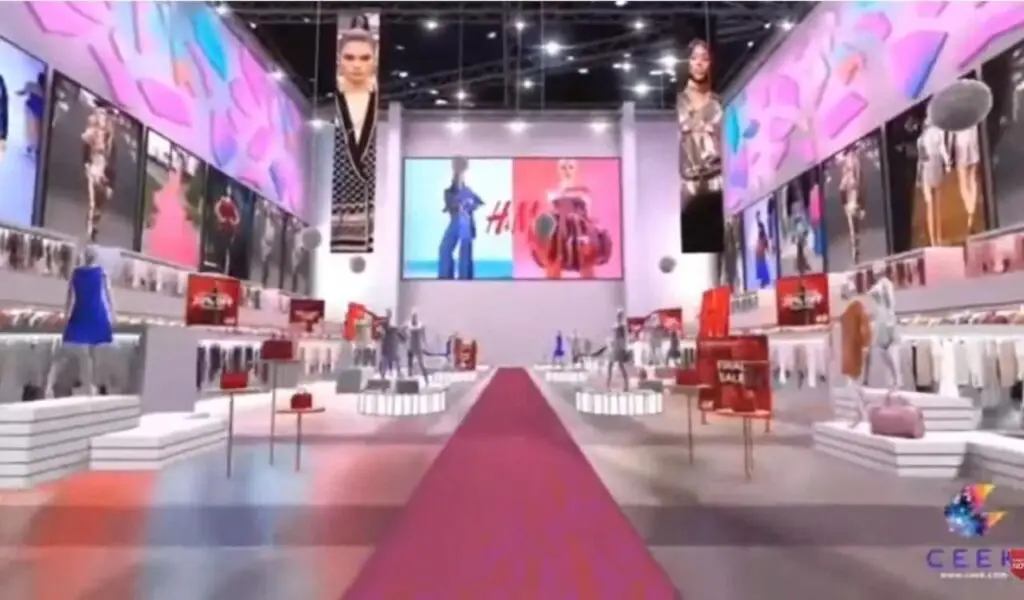
And very recently CEEK shared on twitter about the H&M virtual store being proposed that would provide a shopping experience in the Metaverse without using a gaming platform and solely being an online store. As H&M already has some stunning digital fashion out we can sure hope a virtual store in the making.
Some NFT designers on Instagram to take inspiration from:
- Adrian Moram
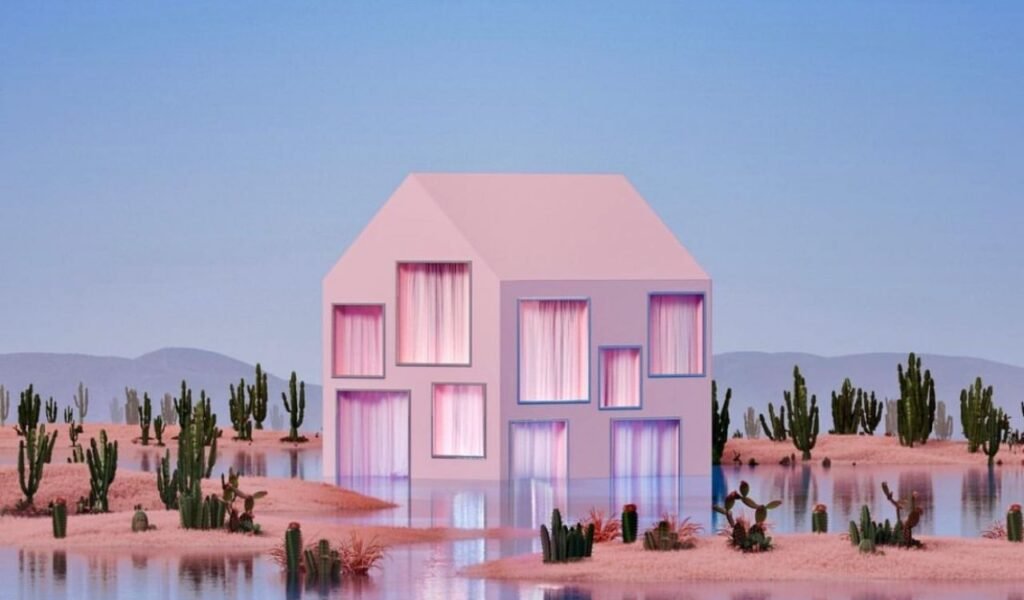
- Ezequiel Pini

- Alexis Christodoulou

- Andrés Reisinger

While some say that NFTs are only a “bubble” that will ultimately “burst,” rendering these digital images obsolete, there will undoubtedly be long-term effects on the art world and the wider design industry as more and more artists and designers enter the unknown future of this online market.
First and foremost, NFTs pose a question about ownership. In the architectural industry, ownership of a rendering, or image, is often assigned to a design firm rather than a single member of the design team. While the initial challenge may be determining who makes money on an NFT, it may provide opportunity for smaller offices that focus on more theoretical work to generate additional revenue.
This has the potential to change how we value architectural works in general. Architects are frequently treated as commodities, and their work is reduced to a simple transaction of services. Instead of experiencing the pressures of clients and dealing with the financial limits of a project, creativity will be recognised more and the ideas that currently limit architecture will shift, altering the entire profession and making architecture even more democratised.