
Tag: modernism

  • Memphis Design: Return of 80s Remarkable Décor Trend

    Memphis Design: Return of 80s Remarkable Décor Trend

    Memphis Design is making a comeback in a big way. The loud 80s look is back and it’s aesthetic is in vogue again, thanks in part to Gen Z and Millennial nostalgia and the 40th anniversary of its debut. It’s ubiquitous now, from fashion and graphic design to commercial packaging and branding.

    One of the most identifiable design trends is the Memphis Style! Bright neon, primary and pastel colours, geometric designs, and bold, repetitious patterns are all hallmarks of the style. You can’t dispute the Memphis Group’s influence on contemporary interior design, whether you love it or despise it. 

    Memphis design is one of those trends that would have sounded ludicrous in the early 2000s, but is now back in vogue among tastemakers and influencers.

    One of the most unlikely success stories in design history is the Memphis Design Movement. It began as a strategy for its authors to rail against and confuse elite perceptions, as so many artistic replies do. The outcome was an innovative aesthetic that continues to inspire today.

    What is Memphis Design?

    In the early 1980s, the famed Memphis Design collective of Milan-based designers created an important postmodern style known as Memphis Design. It was founded by the great Italian designer Ettore Sottsass (1917-2007), and it had a huge influence on 80s design, pushing for change with its bold mix of styles.

    With its vibrant colours, clashing patterns, and radical attitude to design, Memphis Design was a contentious style that was not for the faint of heart. Today, Memphis Design is the subject of museum exhibitions and continues to inspire interior designers, fashion houses, graphics and typography designers, set and costume designers, and others.

    Memphis Design is known today as the defining aesthetic of the 1980s, and understanding it completely requires a knowledge of the era in which it was born. Let’s take a look at Memphis Design’s history, as well as the people and influences who shaped it.

    History  

    Ettore Sottsass, an Austrian-born Italian architect and designer, founded the Memphis Design Group in his Milan living room in 1980, bringing together a group of adventurous individuals from all over the world who shared a desire to disrupt the design world. With 55 pieces that premiered at Milan’s Salone del Mobile (now called the Milan Furniture Fair) in 1981, they unveiled their eye-catching, provocative, rule-breaking style, generating a buzzy love-it-or-hate-it kind of style that became instantly famous around the world.
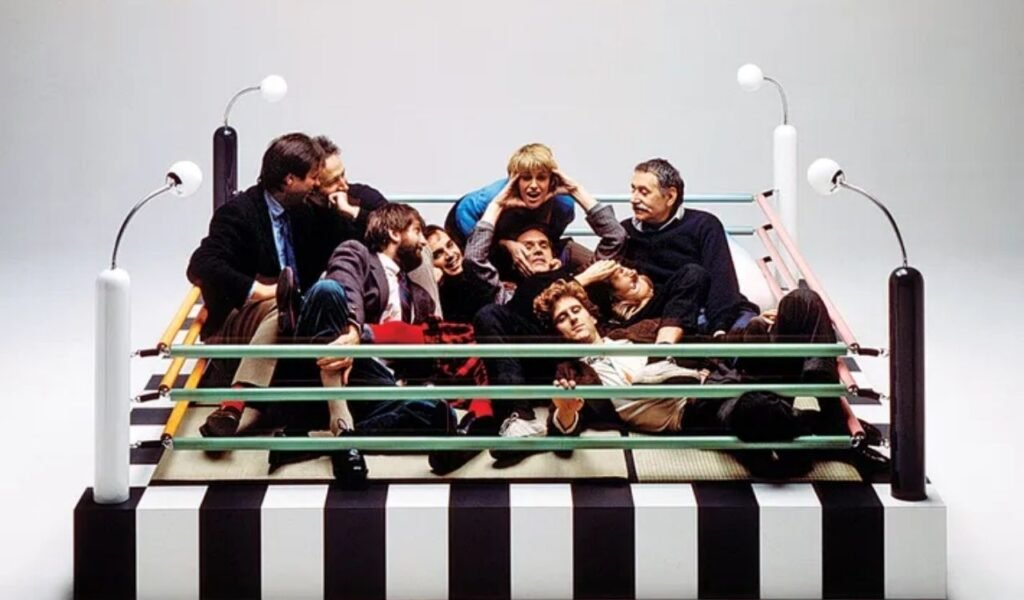
    memphis design
    Photo by Curbed.com

    Memphis Design was a reaction against the clean, linear midcentury modern design of the 1950s and 1960s, as well as the minimalism of the 1970s, with its decorative style filled with pop culture and historical references. Starting with the 1960s, Sottsass was involved in the Radical Design and Anti-Design movements in Italy.

    His early work includes sculptural furniture he dubbed “totems,” which are now on display at prestigious worldwide museums such as the Metropolitan Museum of Art in New York City. Memphis Design was influenced by a resurgence of interest in the Art Deco movement of the 1920s, as well as mid-century Pop Art, both of which were popular trends in the 1980s, with a dash of 1950s kitsch tossed in for good measure.

    Memphis Design was a hit with some people. Others thought it was obnoxious. “A shotgun wedding between Bauhaus and Fisher-Price,” as one critic phrased it.

    Sottsass and his collaborators created unusual, whimsical, rule-breaking designs for decorative glass and metal objects, home accessories, ceramics, lighting, textiles, upholstery, structures, interiors, and brand identities. Sottsass famously quipped, “All we ever heard about when I was young was functionalism, functionalism, functionalism, it isn’t sufficient, sensual and engaging design is also important.”

    memphis design
    Rendered Image of Karl Lagerfeld Bedroom

    Legendary fashion designer Karl Lagerfeld and David Bowie were both huge supporters of the design style in the 1980s. But Memphis Design wasn’t for everyone, and by the end of the decade, the collective had disbanded, with Sottsass quitting in 1985 and several of the group’s other major designers pursuing solo careers after the band disbanded for good in 1988. Alberto Bianchi Albrici bought the Memphis-Milano brand in the 1990s and continues to produce the collective’s original 1980s designs.

    Memphis Design has become a fountain of influence for multi-disciplinary designers, encompassing fashion giants such as Christian Dior and Missoni, as well as new generations of interior designers, type designers, filmmakers, and more, since the early 21st century, as nostalgia for 1980s style has returned.

    So, what was the significance of the name Memphis Design for this Italian-born design movement? Its name is a pun on the Bob Dylan song “Stuck Inside of Mobile with the Memphis Blues Again” from his 1966 Blonde on Blonde album, which was playing on repeat in Sottsass’ living room the night the Memphis Design group had its first official meeting.

    Memphis Design’s Defining Characteristics

    • Shattered preconceived notions of what constitutes excellent taste. 
    • Defamed the Bauhaus design idea of form following function.
    • Unafraid to be loud, outspoken, passionate, playful, and unconstrained. 
    • Created to elicit a strong emotional reaction 
    • Uninhibited, loud, bold, passionate, playful 
    • Colors in unusual combinations are used. 
    • Bold, contrasting designs are used on purpose. 
    • Simple geometric shapes are employed. 
    • Black-and-white graphics are used in this project. 
    • Edges and curves that have been rounded 
    • Squiggles are something I’m fond of. 
    • Terrazzo and plastic laminate are examples of materials used in varied finishes. 
    • Unconventional shapes, like as round table legs, are used to defy expectations.

    In What Way Is Memphis Style Returning?

    In Los Angeles, Memphis design resurfaced in 2005. A year before his death, the LACMA displayed a survey of Sottsass’ creations. 

    Following Sottsass’ death, there was a surge in interest in the Memphis sound. It impacted high-fashion brands Missoni, Karl Lagerfeld, and Christian Dior, with the latter’s 2011 collection serving as a catalyst for the style.
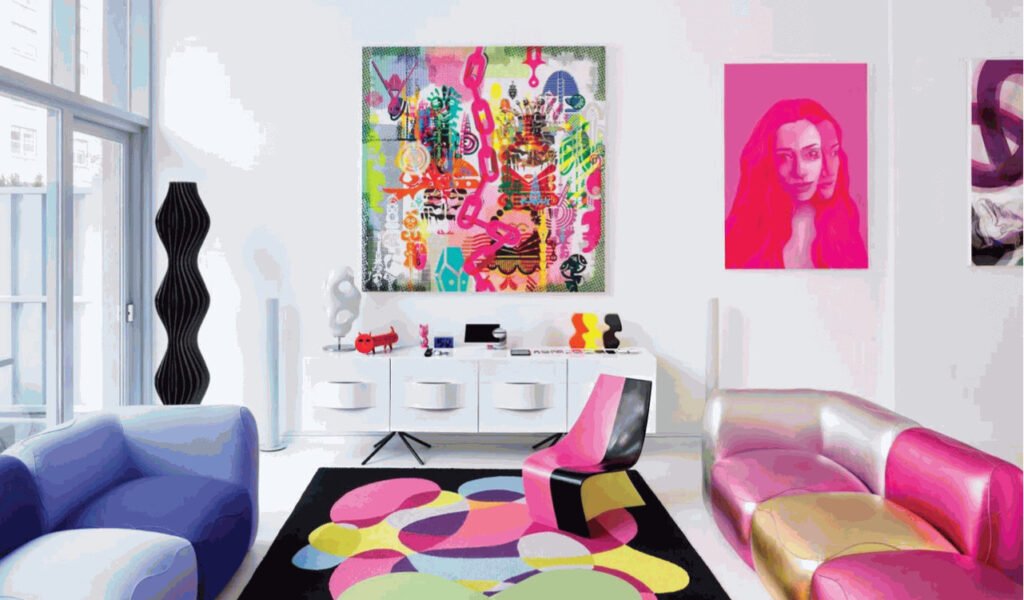
    los angeles
    Karim Rashid’s Home by Curbed.com

    Nathalie Du Pasquier, a founding member of the group, designed a range of patterns for American Apparel several years later in 2014. 

    Alessandro Mendini, who debuted in the first Memphis exhibition, designed a range of skate decks and clothes for Supreme in 2016. 

    West Elm debuted a line from contemporary Du Pasquier-inspired business Dusen Dusen in 2017, bringing the trend to a big box shop. 

    As minimalism took root in the 1990s, Memphis design fell out of favour. Despite this, some 40 years after its revolutionary debut, the “Less is Bore” design philosophy is back in style.

    How To Apply Memphis Design In Today’s World

    For better or worse, Memphis Design is deliberately dramatic, which can make it difficult to work with. It’s also one of those fashions that’s inextricably linked to its epoch, making the distinction between fashionably retro and antiquated a fine one to walk. Despite these challenges, designers all across the world are demonstrating that the style is more adaptable than you may think. Let’s take a look at some of the more recent Memphis Design variations.

    Memphis Design As A Background

    One of the most common methods to incorporate a Memphis Design pattern into the background is to use it as a background. Memphis was designed to call attention to itself, but the bright colours and chaotic patterns can also help foreground things stand out via sheer contrast. 

    A typical strategy is to create a kind of framing for the composition’s subject within the Memphis Design images. Alternatively, a background explosion of abstract colour can be created by scattering shapes directly behind the subject.

    Memphis Miniature Artwork

    Making a solid first impression has always been a priority for Memphis Design. It’s so potent that, like spicy sauce, a small amount is sometimes all you need to give your project a boost. 

    This is why, rather than relying only on showy visuals, many designers these days prefer to use small, scattered forms and lines to evoke Memphis Design. As a result, they are able to replicate some of Memphis’ joyous energy without all of the obnoxious show.

    Memphis Design With Texture

    Although traditional Memphis Design features flat colours and simple black-and-white graphic patterns, several modern designers have added additional variegated textures to the aesthetic. 

    Watercolour and acrylic paints, layered sketch illustrations, rough paper cut-out edges, and gradient are some examples. The technique not only lends a sense of 3D reality to a design that was already springing off the page, but it also creates shading that reduces the severity of Memphis Design.

    Typography Using Memphis Design

    Letterforms are good, predictable shapes for containing Memphis Design’s craziness. Consistent lettering, like a star, can serve as a focal point for the surrounding graphic elements, drawing them in and centring them. 

    Memphis design is frequently layered over the letters themselves. This is especially beneficial when working with 3D writing, as it provides the artist far more surface areas to work with when applying Memphis patterns. This style is best suited to artistic word-marks or hand-lettering projects that can afford to be colourful and inventive at the sacrifice of intelligibility.

    Memphis Design With Organic Touch

    Although Memphis Design was originally known for its harsh geometry, a common reassessment has attempted to incorporate flowing, oblong organic patterns back into contention. These are a logical extension of the wavy lines and spherical shapes that were popularised with the classic Memphis, instead of a significant departure. 

    While some may consider this to be a departure from typical Memphis design, that was never the objective. Memphis was known for violating the rules, so it’s only natural that it would break a few of its own.

    Some Real-Life Examples of Memphis Design

    Paradiso Ibiza Art Hotel

    modernism
    Photo by TheSpace

    Inside the Paradiso Ibiza Art Hotel, Miami modernism and the Memphis Group collide, creating a new hangout that puts art front and centre. The 60-room hideaway, located in San Antonio Bay on the island, is part of the Concept Hotel Group and features brilliantly coloured decor by Ilmio Design. 

    The curving Art Deco-style façade of the hotel has a pair of vertical pink fantails that appear as they belong in South Beach. Inside the flamingo pink foyer, guests will encounter an undulating, sunken seating area with curved forms and sweet colours. Above the aqua-blue-tiled reception counter, neon tube lighting hangs from the ceiling, with a wavy Memphis-style design that recurs throughout the hotel’s interiors. Pop art is displayed throughout the Paradiso Ibiza Art Hotel.

    The Paradiso Ibiza Art Hotel has an art gallery that is open to both guests and the general public, as well as a residency programme called “Zero Suite.” In exchange for putting their expertise on display and taking over the hotel’s social media channels, creatives are housed in a transparent micro workstation cube in the lobby where they may work and live for free. 

    A library with modern art publications, an outdoor theatre, and a tattoo studio are available to guests who want to depart with a permanent souvenir of their stay at the Ibiza hotel.
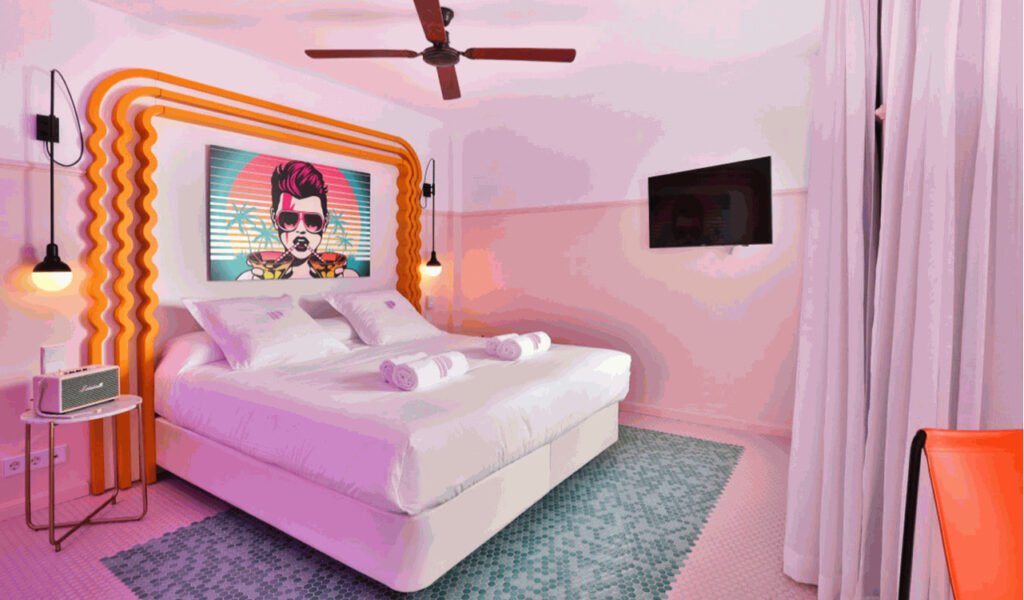
    private guest room

    The private guest rooms of the Paradiso Ibiza Art Hotel are just as vibrant as the lobby, with bursts of yellow, pink, and green that reflect the 1970s theme. They were designed as an extension of the gallery space and are decorated with a changing display of artworks, while the furniture pays homage to Ettore Sottsass’ Memphis designs with bold curves and whimsical nature. 

    The hotel’s rosy-hued swimming pool and lavender tropical vegetation, on the other hand, are on point for the Instagram age.

    Game Over Pizza

    los angeles
    Photo by M-Rad

    At this Los Angeles eatery, diners are transported to a Memphis fever dream, where they may order pizza slices with a heavy dose of nostalgia. 

    Everything from the huge arcade games to the squiggly patterned walls bears homage to a bygone era, with neon-lit Hollywood strip malls serving as inspiration.

    The interiors were designed by M-RAD, who used pink and blue neon lights, a tubular couch, and terrazzo-patterned tables straight from the Saved By the Bell canteen. The aesthetic is completed by a glass brick counter lined with stainless steel and leather stools. 

    interiors

    Diners can devote themselves to Game Over’s collection of ancient arcade machines or whatever 80s cult blockbuster is playing on its big-screen TVs that night after indulging in a 20″ pie.

    Saved By The Bell

    bell themed decor

    With its Saved By The Bell-themed décor and old VHS collection, this time capsule apartment in Texas transports you back to the 1990s. 

    Guests are watched over by New Kids On The Block posters while they sleep under Memphis-patterned bed covers before tucking into a bowl of Lucky Charms for breakfast.

    The owner of the two-bedroom US vacation rental – which starts at £197 per night – has filled the flat with vintage mementos such as an N64 system and a Talk-boy cassette player, as well as 90s music magazines. 

    An accurate reproduction of The Max cafe from the cult TV show Saved By The Bell serves as the main point. The postmodern features, such as the zig-zag door handle and the colourful vinyl-covered benches, will appeal to fans of the show. 

    Don’t worry if all of this makes you nostalgic for the past. A collection of Saved By The Bell videos is also available in the flat.

    The Ultrafragola Mirror
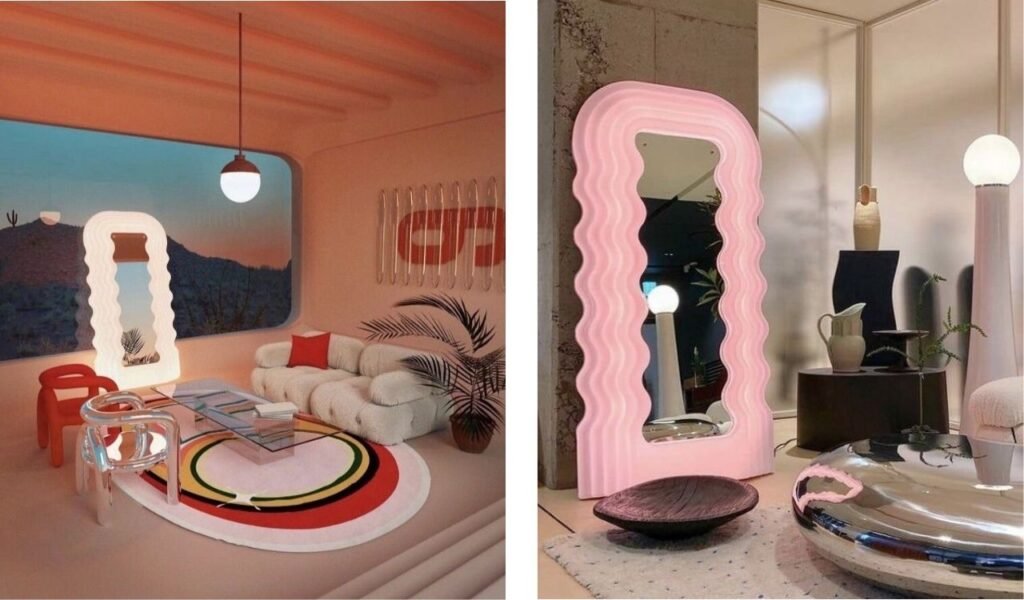
    selfie mirror

    The ultimate selfie mirror that was showcased at Raquel Cayre’s Dream House exhibit in 2018 and has since been owned by celebrities like Katherine Bernahardt, Bella Hadid, Lena Dunham, Kim Jisoo of Blackpink and many more and is also the mirror that inspired this article. 

    Mobili Grigi, a far-out bedroom series designed by architect Ettore Sottsass, was unveiled by Florentine manufacturer Poltronova at the Eurodomus 3 trade show in Milan in 1970. It was part of the brand’s ambition to bring revolutionary industrial materials, which had previously changed nautical and automobile design, into the house, and it was made of smooth, vacuum molded plastic and cast fibreglass. With one exception: the neon-lit pink mirror known as Ultrafragola, or “the ultimate strawberry,” the radical collection was made in a very limited quantity.

    The thermoformed plastic reflector (which appeared a decade before Sottsass founded the Memphis Group) was designed to highlight femininity—the contours of a woman’s figure, the waves of her hair, and a few other key features of her anatomy. That’s what we’d call objectification nowadays. However, women all over the world have flocked to the mirror ($10,500; now available in LED), which is still handcrafted using the original 1970 mould.

    The Memphis Uprising Continues To Gain Momentum

    Memphis Design was more than just a wild guess or a prank by bored designers. It was a defining moment for a decade and an inspiration for a generation. Its energy, freedom, and bright colours are still relevant today, which is why so many people find it so appealing. However, because of its boldness, it can be divisive. Make sure you’re dealing with a professional designer who understands your audience’s “bad taste” if you want to use Memphis Design to excite them in the correct way.

  • Shukan Lifestyle: Modern Interior Design

    Shukan Lifestyle: Modern Interior Design

    Project Name: Shukan Lifestyle 
    Design team: Ar. Bhumi, Ar.Jaimin and Id.Avisha
    Drafting team: Id. Vishal
    Execution team: Id. Vishal
    Photographer: @samarpanpictures

    The overarching theme of this 3BHK home interior revolves around modernism. Clean lines, minimalist aesthetics, and a careful selection of furnishings create an ambiance that is both timeless and on-trend. The choice of a colour palette comprising grey, brown, and white serves as the foundation, providing a neutral canvas that allows for versatile decor and a sense of spaciousness.

    modern

    Upon entering the home, the living room immediately captivates with its understated elegance. Shades of grey dominate the walls, while brown and white accents introduce warmth and balance. A sleek, contemporary sofa in a muted tone becomes the focal point.

    In the dining area, a modern dining set takes center stage, adorned with subtle accessories that enhance the overall aesthetic. Pendant lighting in warm tones casts a soft glow, creating an intimate and inviting space for shared meals.

    Modern interior

    Shukan Lifestyle: Modern Interior Design The overarching theme of this 3BHK home interior revolves around modernism. Clean lines, minimalist aesthetics, and a careful selection of furnishings create an ambiance that is both timeless and on-trend. The choice of a colour palette comprising grey, brown, and white serves as the foundation, providing a neutral canvas that allows for versatile decor and a sense of spaciousness.

    Our kitchen exudes sophistication with custom cabinets in a chic palette of beige and brown, ensuring ample storage in a clutter-free space. Modern appliances seamlessly integrate, while an overhead unit with profile lighting adds a touch of elegance, creating a warm and inviting culinary haven.

    Each bedroom in this 3BHK home is a retreat, incorporating the colour scheme to evoke a sense of calm and relaxation. The master bedroom, adorned in shades of grey and white, features a plush bed with tasteful bedding and artwork that ties the room together. The secondary bedrooms follow suit, with individualized touches to reflect the unique personalities of their occupants.

  • Raj Rewal: The Architectural Visionary of India

    Raj Rewal: The Architectural Visionary of India

    Introduction

    Indian architecture has seen many luminaries who have contributed to its rich tapestry.

    Of these, Raj Rewal is most notable as a trailblazer whose inventiveness in architecture has changed India’s scenery. Raj Rewal’s professional journey has been one of unwavering devotion to fusing modernism with Indian traditional architecture.

    His adept use of regional materials, commitment to sustainability, and sharp sense of structural and geometric innovation are widely acknowledged.

    The life and career of Raj Rewal are examined in depth in this article, including with his early years, distinctive architectural style, design philosophies, and enduring contributions to Indian architecture.

    Raj rewal
    Raj Rewal

    Early Life and Education of Raj Rewal

    Born on November 24, 1934, in Hoshiarpur, Punjab, Raj Rewal’s architectural journey began with a childhood rooted in two culturally rich cities: Delhi and Shimla. It was in these early years that his interest in architecture began to develop.

    Rewal’s educational path led him to the Harcourt Butler Higher Secondary School in Delhi. However, it was at the Delhi School of Architecture that his passion for the built environment truly flourished. His time at the institution between 1951 and 1954 set the stage for his future achievements.

    After completing his architectural degree in New Delhi, Rewal’s thirst for knowledge and exposure to global architectural practices led him to London in 1955. Here, he embarked on a transformative journey that would shape his architectural vision.

    Over his year there, he was surrounded by an atmosphere that fostered creativity and invention at the Architectural Association School of Architecture. He further expanded his horizons by studying at the Brixton School of Building in London from 1956 to 1960. These experiences broadened his perspective and planted the seeds of his unique architectural approach.

    Nehru Memorial Pavilion
    Nehru Memorial Pavilion_©www.re-thinkingthefuture.com

    Architectural Career Takes Root

    Upon returning to India, Raj Rewal’s architectural journey began in earnest. In 1962, he established his architectural practice in New Delhi. This was the pivotal moment when his vision and creativity started to manifest in the form of groundbreaking architectural designs.

    Not content with practicing alone, Rewal sought to share his knowledge and passion for architecture with others. He committed his time between 1963 and 1972 to instruct at Delhi’s School of Planning and Architecture, sharing his knowledge and encouraging the upcoming generation of architects.

    He didn’t limit his impact to India alone. In 1974, he ventured further afield, establishing a second architectural office in Tehran, Iran. This global exposure helped him refine his architectural language, making it both innovative and globally relevant.

    Jung-e-Azadi Memorial Freedom Struggle Complex
    Jung-e-Azadi Memorial Freedom Struggle Complex, Karatpur, India_©rajrewal.in

    Raj Rewal’s Architectural Vision

    Raj Rewal’s architectural vision can be summed up as a harmonious blend of modernism with traditional Indian architecture.

    Rewal’s skillful use of local materials is one of the main tenets of his architectural philosophy. These materials serve as the foundation for his creations and are crucial to his sustainability efforts. The buildings built by Rewal demonstrate a deep regard for both the local communities and the environment.

    The following are some of the key vernacular materials that he has employed in his architectural marvels:

    • Sandstone: Rewal’s ingenious use of sandstone lends his buildings a sense of timelessness. Sandstone has frequently appeared in his works due to its versatility, toughness, and vivid colors. This locally sourced material is not only sustainable but also deeply rooted in the region’s architectural heritage.
    • Stone Aggregate: By incorporating stone aggregate, Rewal adds texture and character to his designs. This material, often sourced locally, reinforces the connection between his structures and their surroundings.
    • Grit (Rich Cement with Crushed Sandstone): Grit is a prime example of how Rewal creatively uses traditional materials with a modern twist. This blend of rich cement and crushed sandstone results in an environmentally friendly material with a unique aesthetic.
    • Stone Cladding: Stone cladding adds both functionality and visual appeal to his buildings. It demonstrates Rewal’s dedication to incorporating conventional features into contemporary designs. Flooring made of kota stone: Kota stone is a material that is highly adaptable and durable. It has been a crucial component of his architectural toolkit. Teak Wood Doors: Using teak wood doors is a tribute to old-world artistry and a statement of his desire to produce ideas that will endure.
    Parliament library
    Parliament library_©en.wikipedia.org

    A Sustainable Approach

    Sustainability lies at the heart of Raj Rewal’s architectural philosophy. He is adamant that architects need to be environmental stewards, particularly in a world that is changing quickly. He is dedicated to sustainability in all of his endeavors.  

    This commitment to sustainability extends to all of his projects.

    His designs embrace past ideologies and incorporate forward-looking design elements that promote sustainable living. Rewal’s focus on sustainability includes the following aspects:

    • Passive Design Principles: His designs maximize the use of natural light, harness wind energy, and incorporate recycled and locally available materials. These guidelines guarantee that his structures not only operate effectively but also have a negligible effect on the environment.
    • Green Terraces: Rewal adds green terraces to his designs to improve the environment and provide aesthetic value. In addition to offering a natural haven in urban settings, these green areas support biodiversity and aid in the control of runoff from precipitation.
    • Photovoltaic Paneling: The integration of photovoltaic panels is a hallmark of his sustainable designs. These panels harness solar energy, reducing a building’s reliance on conventional energy sources and decreasing its carbon footprint.
    • Rooftop PV Panels: The use of rooftop photovoltaic panels is another example of Rewal’s commitment to sustainability. These panels serve a dual purpose by generating renewable energy and offering protection from the elements.
    Raj Gallery
    Raj Gallery_©www.architectural-review.com

    Architectural Philosophy

    Raj Rewal’s architectural philosophy is a multi-faceted approach to design that emphasizes several critical elements:

    • Rasa in Architecture: Rewal believes that every building has its spirit or “Rasa.” This spirit is formed through the integration of space, hierarchy, structure, and sustainability. One of the best examples of this concept can be seen in the State University of Performing and Visual Arts in Rohtak. Here, the dharma chakra, photovoltaic panels, the play of light and shadow in the internal spaces, and more all come together to create a unique ambiance that embodies the building’s Rasa.
    • Hierarchy: In his architectural designs, Rewal emphasizes the importance of hierarchy. He promotes human interaction and sociability by setting aside a central meeting area on a property. This method makes areas seem friendly and focused on the community. A striking example of this concept is evident in the Jang-E-Azadi Memorial Museum in Punjab, where the Minar stands as the hierarchy of the museum, with other site elements thoughtfully arranged around it.
    • Urbanism and Space: Rewal’s architectural vision heavily relies on space. Large courtyards and interconnecting circulation pathways are common features in his designs, which draw just as much attention as the actual architecture of the building. One excellent illustration of this emphasis on space and urbanization is the Asian Games Village in New Delhi. The interconnected courtyards and passageways create a sense of community and openness in the design.
    • Structure and Technology: Rewal’s designs often exhibit rhythm and geometric patterns, resulting in highly stable structural designs. The structure of a built form is not just a supporting element; it becomes the primary theme. Furthermore, his focus on the play of light and shadow brings buildings to life. The Hall of Nations in New Delhi is an exemplary instance of his mastery of structure and technology. Inspired by the perforated Jali, it features an outer facade made of steel frames, creating a unique identity.
    Raj Rewal: The Architectural Visionary of India Of these, Raj Rewal is most notable as a trailblazer whose inventiveness in architecture has changed India's scenery. Raj Rewal's professional journey has been one of unwavering devotion to fusing modernism with Indian traditional architecture.
    State Trading Corporation building_©www.reddit.com

    Legacy in Sketches

    Raj Rewal can translate concepts into concrete, jaw-dropping constructions; his design sketches bear witness to this. These drawings capture his ideas for his projects in a straightforward but impactful way. They provide light on his ability to conceive creatively and bring architectural ideas to reality. His earliest sketches of possible buildings are simple line drawings that spark his creativity and motivate onlookers.

    Hall Of Nations at Pragati Maidan
    Hall Of Nations at Pragati Maidan_©Photos by Ariel Huber

    Conclusion

    ​The innovative architect Raj Rewal has revolutionised Indian architecture. Rewal’s legacy is more than just a group of structures; it is evidence of the timeless beauty of architecture that blends in perfectly with its surroundings. India and the architectural community are blessed with his abilities to conceptualise and produce long-lasting structures. Raj Rewal’s impact on Indian architecture will never fade since he will always inspire future generations of architects and designers.

  • Introduction to Art Deco Movement: Capturing the Graceful Architecture

    Introduction to Art Deco Movement: Capturing the Graceful Architecture

    The 1920s saw the beginning of the Art Deco trend in architecture and decorative arts, often known as style moderne. Modernism as it transformed into fashion was reflected in Art Deco style. The goal was to create an anti-traditional, modern elegance that exuded richness and sophistication. Both expensive handcrafted things and mass-produced goods were among its offerings. We’ll discuss significant facets of the Art Deco era in this article, including its origins or influences, defining key characteristics, and art deco architecture around the globe.

    Introduction

    The French Arts Décoratifs movement was first introduced in the visual arts, architecture, and product design during the 1910s. It first acquired popularity in the United States and Europe from the 1920s through the early 1930s. Exposition internationale des arts décoratifs et industriels modernes (International Exhibition of Modern Decorative and Industrial Arts), held in Paris in 1925, is where the phrase “modern decorative and industrial arts” first originated.

    Art Deco
    Photographer Unknown | Source

    Art Deco had an impact on the exterior and interior styling and design of both large and little objects, as well as how individuals appear (via their clothing, jewels, and fashion). It also had an effect on household items like radios and vacuum cleaners, as well as on furniture, buildings (including skyscrapers and movie theatres), bridges, ships, and ocean liners, as well as on trains, cars, trucks, and buses.

    Origin of the Art Deco Moment

    Art Nouveau, the Bauhaus, Cubism, and Serge Diaghilev’s Ballets Russes were significant precursors of Art Deco. American Indian, Egyptian, and early classical literature as well as natural phenomena were taken into consideration while designing interior spaces. Pre-modern art, archaeology, Futurism, Orphism, Functionalism, and Modernism, among others, were all borrowed and used as decorative styles. Common images included bare-chested women, animals, realistic-looking flora, and sunrays.

    Cubism’s decorative potential was reached when it was used to produce fabrics or wallpaper with an Art Deco influence. The sharp contrast between horizontal and vertical volumes, which is exclusive to Russian Constructivism and the Frank Lloyd Wright-Willem Marinus Dudok line, is a common method for articulating Art Deco facades.

    Art Deco textile, wallpaper, and painted ceramic designs were influenced by the clashing hues and patterns of Fauvism, particularly in the works of Henri Matisse and André Derain. In addition to using high fashion terminology, it also made use of geometric patterns, chevrons, zigzags, and stylized flower arrangements. Art Deco was frequently influenced by a love of modern technology in the early 1930s, which gave rise to the Streamline Moderne movement.

    Introduction to Art Deco Movement: Capturing the Graceful Architecture The 1920s saw the beginning of the Art Deco trend in architecture and decorative arts, often known as style moderne. Modernism as it transformed into fashion was reflected in Art Deco style. The goal was to create an anti-traditional, modern elegance that exuded richness and sophistication. Both expensive handcrafted things and mass-produced goods were among its offerings. We'll discuss significant facets of the Art Deco era in this article, including its origins or influences, defining key characteristics, and art deco architecture around the globe.
    Photographer Unknown

    Characteristics

    The Art Deco style fused luxury and modernity through the use of expensive materials and expert craftsmanship in cutting-edge designs. It was used as decoration in first-class salons on cruise ships, first-class trains, skyscrapers, and movie theatres. A more melancholy change in fashion was brought on by the Great Depression. 

    The style is characterised by straightforward, usually “streamlined” forms, geometric or stylized decoration derived from representational shapes, and particularly pricey materials. Some examples of materials that regularly include both organic and inorganic elements are rock crystal, jade, silver, ivory, obsidian, and polymers like Bakelite, Vita-glass, and ferroconcrete. The distinctive characteristics of the Art Deco style, such as its relatively straightforward design, planarity, symmetry, and frequent recurrence of parts, imply a fondness for the intrinsic design virtues of technology despite the dearth of mass-produced Art Deco goods.

    Introduction to Art Deco Movement: Capturing the Graceful Architecture The 1920s saw the beginning of the Art Deco trend in architecture and decorative arts, often known as style moderne. Modernism as it transformed into fashion was reflected in Art Deco style. The goal was to create an anti-traditional, modern elegance that exuded richness and sophistication. Both expensive handcrafted things and mass-produced goods were among its offerings. We'll discuss significant facets of the Art Deco era in this article, including its origins or influences, defining key characteristics, and art deco architecture around the globe.
    Photographer Unknown

    For instance, between 1922 and 1925, Armand-Albert Rateau designed Jeanne Lanvin’s boudoir. By 1928, deep leather club chairs had been added, boosting the design’s comfort.

    Introduction to Art Deco Movement: Capturing the Graceful Architecture The 1920s saw the beginning of the Art Deco trend in architecture and decorative arts, often known as style moderne. Modernism as it transformed into fashion was reflected in Art Deco style. The goal was to create an anti-traditional, modern elegance that exuded richness and sophistication. Both expensive handcrafted things and mass-produced goods were among its offerings. We'll discuss significant facets of the Art Deco era in this article, including its origins or influences, defining key characteristics, and art deco architecture around the globe.
    Photographer Unknown | Source

    The Alavoine study is now on display at the Brooklyn Museum. It was created in the years 1928 to 1930. In Paul Ruaud’s Glass Salon, the serpentine and tubular seats were installed in place on a mat silvered glass slab floor in 1932. By the 1930s, the opulent aesthetic had been toned down.

    Art Deco in Architecture around the World

    Two apartment complexes, one by Auguste Perret on rue Benjamin Franklin and the other by Henri Sauvage on rue Trétaigne, were constructed in Paris in 1903 and 1904. The first examples of the art deco architectural style can be seen in these buildings. When the two young architects employed reinforced concrete in residential buildings in Paris for the first time, they entirely departed from the art nouveau aesthetic. The new buildings’ exteriors were simple, with a rectangular shape and straight lines.

    The ocean liner SS Normandie had Art Deco interior decor on her maiden voyage in 1935, which included a dining space with a ceiling and Lalique glass ornaments. More than merely architectural aspects were emphasised through the usage of Art Deco.

    Introduction to Art Deco Movement: Capturing the Graceful Architecture The 1920s saw the beginning of the Art Deco trend in architecture and decorative arts, often known as style moderne. Modernism as it transformed into fashion was reflected in Art Deco style. The goal was to create an anti-traditional, modern elegance that exuded richness and sophistication. Both expensive handcrafted things and mass-produced goods were among its offerings. We'll discuss significant facets of the Art Deco era in this article, including its origins or influences, defining key characteristics, and art deco architecture around the globe.
    Photographer Unknown

    The height of the Art Deco movement was characterised by American skyscrapers, which rose to become the world’s tallest and most recognisable modern structures. The height, form, colour, and illumination of these structures revealed the status of their architects. The American Radiator Building, designed by Raymond Hood in 1924, incorporated Gothic and Art Deco features, with gold bricks covering the façade to represent the sun. Wirt C. Rowland employed stainless steel as a decorative feature and coloured graphics in place of conventional ornamentation when designing Detroit’s Guardian Building.

    The skyline of New York City was also altered by the Raymond Hood-designed RCA Building (1933) and the William F. Lamb-designed Empire State Building (1931), which both featured Art Deco crowns, stainless steel spires, and gargoyles that resembled radiator ornaments. Chicago and other major American cities saw the emergence of comparable structures.

    Introduction to Art Deco Movement: Capturing the Graceful Architecture The 1920s saw the beginning of the Art Deco trend in architecture and decorative arts, often known as style moderne. Modernism as it transformed into fashion was reflected in Art Deco style. The goal was to create an anti-traditional, modern elegance that exuded richness and sophistication. Both expensive handcrafted things and mass-produced goods were among its offerings. We'll discuss significant facets of the Art Deco era in this article, including its origins or influences, defining key characteristics, and art deco architecture around the globe.
    Photographer Unknown

    In cities like London, Moscow, and Berlin, as well as other European capitals, residential and public architecture were all influenced by the Art Deco style, which was first made popular in Paris. Despite the fact that the initial examples of Art Deco architecture could be located in Europe, by 1939 there were major cities on every continent and in almost every country.

    European architects commonly produced Asian Art Deco buildings. However, there were a number of well-known native architects in the Philippines, like Juan Nakpil, Juan Arellano, and others. Many prominent Art Deco buildings were demolished in the late 20th century as Asia experienced fast economic growth, although some significant examples of the style’s architecture still exist, particularly in Shanghai and Mumbai.

    Introduction to Art Deco Movement: Capturing the Graceful Architecture The 1920s saw the beginning of the Art Deco trend in architecture and decorative arts, often known as style moderne. Modernism as it transformed into fashion was reflected in Art Deco style. The goal was to create an anti-traditional, modern elegance that exuded richness and sophistication. Both expensive handcrafted things and mass-produced goods were among its offerings. We'll discuss significant facets of the Art Deco era in this article, including its origins or influences, defining key characteristics, and art deco architecture around the globe.

    Photographer Unknown | Source: https://www.designpataki.com

    During the time of European colonial rule, the bulk of Art Deco buildings in Africa were built, typically by architects from Portugal, France, and Italy.

    Introduction to Art Deco Movement: Capturing the Graceful Architecture The 1920s saw the beginning of the Art Deco trend in architecture and decorative arts, often known as style moderne. Modernism as it transformed into fashion was reflected in Art Deco style. The goal was to create an anti-traditional, modern elegance that exuded richness and sophistication. Both expensive handcrafted things and mass-produced goods were among its offerings. We'll discuss significant facets of the Art Deco era in this article, including its origins or influences, defining key characteristics, and art deco architecture around the globe.
    Photographer Unknown

    Three notable Art Deco buildings may be found in Melbourne and Sydney, Australia: the Manchester Unity Building, Castlemaine Art Museum, and Grace Building. In New Zealand, towns like Napier and Hastings that were rebuilt after the 1931 earthquake have been protected and repaired; Napier has even been nominated for UNESCO World Heritage Site status.

    Numerous Art Deco structures may be seen in major cities like Montreal, Toronto, Hamilton, Ontario, and Vancouver, with some of the best examples being found in Mexico and the United States. While New Mexico combines Pueblo Revival with Territorial Style, the best examples can still be seen in the Miami Beach Architectural District.

    Conclusion

    It was believed that architecture was primarily aesthetically pleasing, ornamental, and decorative. The style immediately became popular in post-war culture because it expressed all that was up-to-date, opulent, and gorgeous. The people loved this new appearance since the 1920s were a happy and upbeat decade. Most famous Art Deco designers produced handcrafted or inexpensively produced things. Of course, they also talked about how to make sculptures, paintings, and structures, as well as how to make jewellery, glass, and furniture. Since a thriving economy was represented by Art Deco, people felt upbeat about the future.