
Tag: prison design

  • Prison Architecture

    Prison Architecture

    Introduction 

    Prison Architecture is a field that deals with design, construction,and management of correctional facilities. The primary goal of prison architecture is to create a secure and humane environment for inmates,staff, and visitors. This has evolved over the years,and modern prisons have features that are different from old prisons. The history, design principles and challenges faced by prison architecture would be explored here. 

    History of Prison Architecture 

    The architecture dates back to ancient times,and the first known prison was built in Egypt around 4000 years ago. This prison was used to hold prisoners of war,debaters and criminals. The prison consisted of underground cells with no windows,and prisoners were confined in complete darkness. This type of prison was prevalent in Europe during the medieval period, and prisoners were often subjected to inhumane conditions such as overcrowding,starvation, and torture. 

    The modern concept of prison architecture emerged during the 18th century, and the first modern prison was built in Philadelphia in 1790. This prison was known as the Walnut Street Jail and was designed by Robert Smith, to provide prisoners with a humane environment. The prison had separate cells, and prisoners were provided with food,clothing and medical care. 

    It was Quakers of Philadelphia who came up with the concept for what they called penitentiary- a place where prisoners could reflect on their crime and become truly sorry for what they had done. They believed that through reflection and repentance,inmates would give up crime and leave prison rehabilitated. The Walnut Street Jail became the model for the modern prison system, and prisons were built across the United States and Europe.  
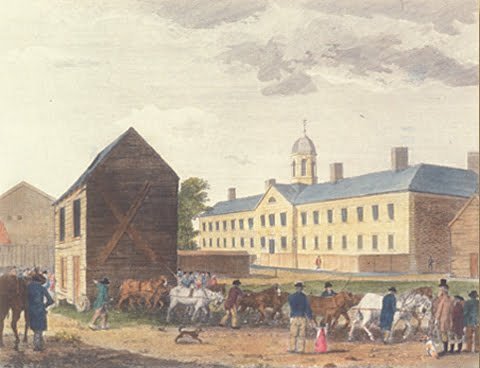
    Prison Architecture
    Walnut Street Prison and A.M.E Church  Discover Lewis & Clark  

    Design Principles of Modern Prisons  

    The purpose of today’s prisons is to create a safe and humane environment for inmates, staff, and visitors. Modern prison design principles are based on four main ideas: Security, functionality,sustainability and refinement.

    Prison architects’ primary concern is security, and contemporary prisons are constructed to minimize the likelihood of violence and prevent escapes. Secure perimeters like walls, fences, and electronic surveillance systems are built into prisons. Visitors to the prison are subjected to a thorough screening process before being allowed entry.

    Modern prisons are made to make the prison system run more smoothly, and functionality is another important aspect of prison design. Housing, recreation, education, and work are all separated in prisons. The prison’s layout needs to make it possible for staff to effectively supervise inmates and respond quickly to emergencies.

    The concept of sustainability in prison architecture is relatively new, and contemporary prisons are designed to conserve energy and protect the environment. Solar panels, energy-efficient lighting, and water-saving systems are all built into prisons. The environment is improved and operating costs for prisons are reduced through sustainable design.

    The final concept of contemporary prison design is humanization, which entails providing inmates with a welcoming environment. Individual cells in modern prisons provide inmates with privacy and personal space. Inmates are encouraged to participate in programs that assist them in developing skills that will prepare them for reintegration into society. Prisons are intended to provide opportunities for education, employment, and recreation.

    Challenges faced by Prison Architects 

    Prison architects face several challenges in the design and construction of correctional facilities. The main challenges include overcrowding, budget constraints, and meeting the needs of diverse populations. 

    Overcrowding is a significant challenge in many prisons, and it affects the design of the prison. It can lead to the construction of large dormitories instead of individual cells,which can increase the risk of violence and reduce privacy for inmates. 

    Budget constraints are another significant challenge faced by prison architects. Prisons are expensive to build and operate,and many governments are reluctant to allocate funds for the construction of new prisons. Budget constraints can affect the quality of life for inmates. 

    Meeting the needs of diverse populations is another challenge faced by prison architects. Prisons must accommodate inmates with different needs.

    Examples of Modern Prison Architecture 

    1. Storstrom Prison by C.F. Moller Architects 
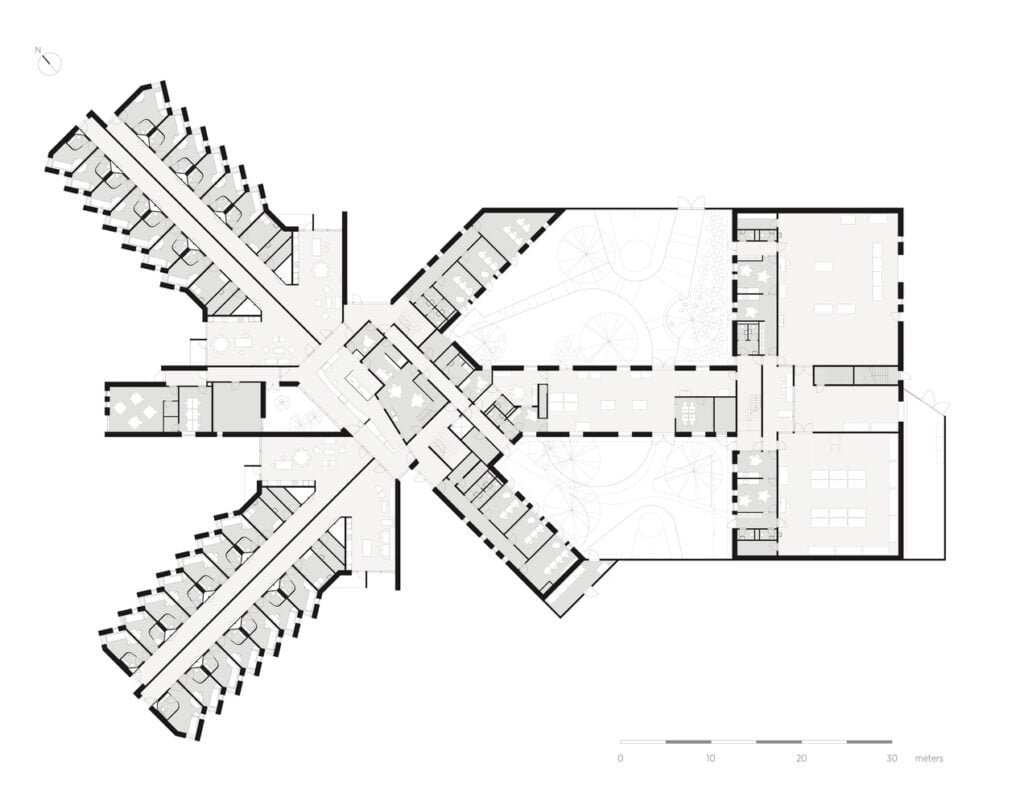
    ground floor
    Ground Floor  Archdaily  

    The objective was to construct the most humane high-security prison in the world, which contributes to the social rehabilitation of inmates through architecture that supports the mental and physical well-being of inmates and provides a safe and pleasant work environment for staff members.

    There are four standard prison wings and one maximum-security prison wing, each with 250 inmates. The staff building, the activity building, the workshop building, and the gate are all part of the same building. The prison offers the inmates the opportunity to practice their religion in either the church or one of the numerous devotional rooms.
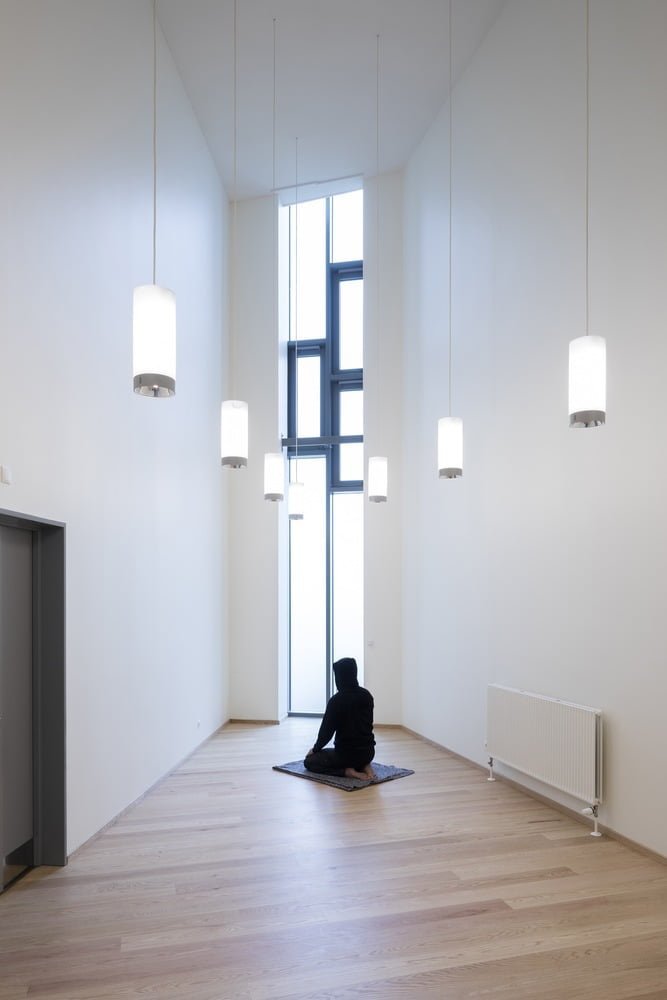
    Devotional Room 
    Devotional Room Archdaily  

    The engineering language of the structure is characterized by recessed veneers and rakish rooftop ridges,to limit the regulated appearance. An alternative to light-colored bricks and a mixture of concrete and galvanized steel makes up the facade’s material. These are materials that don’t need a lot of upkeep and age beautifully. The remaining five wings are constructed of brick, with the exception of the activity building, which has concrete paneling and glass facing and the workshop building, which has steel panel facing.

    The cell’s innovative design allows for daylight, and from the cell, inmates can access the living room and communal kitchen, where they can prepare their own meals.  

    In contrast to the overall angularity of the cell, the floor design of the 12.8 m2 cells includes toilet and shower units with curved walls so that prison staff can view most of the cell from the door. Bed, desk, chair, wardrobe, refrigerator, television, and lighting are provided in each cell. The furniture is made for the cells with fewer sharp edges to make the most of the space and reduce the risk of self-harm. There are also views of the countryside outside the cell.
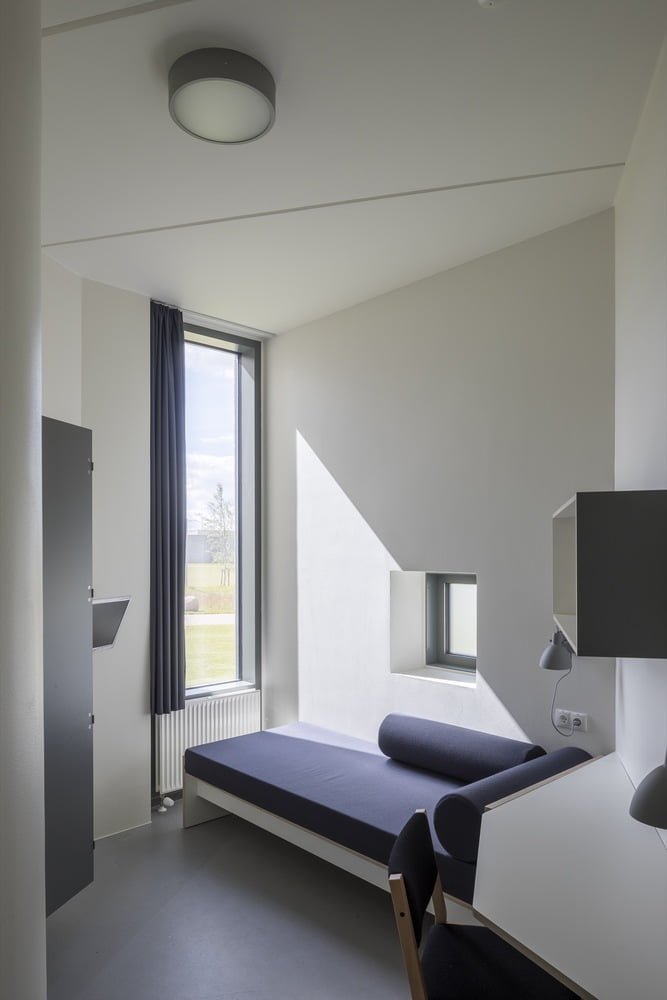
    Interior of cell 
    Interior of cell Archdaily  
    1. West Kimberley Regional Prison by TAG Architects and Iredale Pedersen Hook Architects 

    The plan of the jail is finished with awareness and cautious preparation and plan. They have the elements of visible security, high walls, bars, and heavy building materials that frequently dominate prison architecture, making the design elements quite significant. It was noticed that this prison was built to meet cultural and environmental requirements as well as keep people in the country.

    There are forty-two buildings in the prison, including twenty-two self-care housing units outlined in the campus master plan. It also has buildings for education and work, cultural meeting spaces, areas for elders’ programs, a building for the kitchen and laundry, a medical center, and a courtroom.

    Housing Units- 

    It was necessary to normalize the concept of housing as much as possible and allow prisoners to live together. As a result, the creation of a model that accommodates six to eight inmates required housing units. Each is designed around a common living area that includes living, kitchen, dining, bathroom, and individual rooms. The cells were able to develop the living, communication, and negotiation skills necessary for release thanks to this self-care accommodation, which also reduced costs.

    It has been demonstrated that these units reduce the prisoner’s stress by giving them greater control over their immediate environment—particularly in terms of airflow, temperature, illumination, and privacy.

    Existing vegetation
    Existing vegetation  Peter Bennetts  from ArchitectureAU 

    Addressing the health needs of Indigenous Prisoners- 

    Providing Indigenous prisoners with access to health care, which they typically do not have in the community, is one way to address their health needs. The planning and design of the West Kimberley Regional Prison took into account the health requirements of Aboriginal prisoners, and the facility includes services not typically found in other prisons. The availability of air conditioning is an additional distinguishing feature.

    The West Kimberley Regional Prison’s design provided a one-of-a-kind opportunity to address the frequently ignored requirements of Indigenous prisoners. The architects have boldly designed a custodial environment that allows the prisoner to remain connected to the country, maintain relationships with family and kin, and live within a specific social group in an environment that provides privacy and meets their health and safety needs. They have seized the opportunity to move beyond warehousing Aboriginal prisoners.

    An Array of service buildings
    An Array of service buildings   Peter Bennetts  from ArchitectureAU 

    Conclusion  

    Prison architecture addresses a lot of parameters and design challenges. But as the time passed the architects evolved the design of Prison to make it more human centric and make it more homely feeling. But there are still many prisons that require design development which focuses on the well-being of inmates. 

  • Prison Architecture: Towards a More Secure Yet Humane Prison Design

    Prison Architecture: Towards a More Secure Yet Humane Prison Design

    Prisons have been replaced by “correctional facilities” and “detention centres.” Whatever language we use, incarceration has grown into a huge industry that supports the banking, legal, food service, and telecommunications industries, as well as architects, designers, and contractors.

    However, while architects and psychologists have spent a lot of time thinking about how to make better prisons, the truth is that incarcerating people, safeguarding them from themselves and each other, and safely transferring them around presents a vast set of logistical issues.

    Typology: Prison - Architectural Review
    The Architectural Review

    Prison design is not a glamourous topic of study. It will never make you a household name, and inflexible security standards and budget constraints will permanently suffocate your creative thought. It might also be debatable.

    Design, of course, can remedy many of these problems, but regrettably, too frequently those who commission prisons—from counties to towns to states to the private prison industry—are more focused on money, security, and expediency than humanity, never mind excellent design.

    History of prisons

    Were Early American Prisons Similar to Today's? - JSTOR Daily
    Photo from JSTOR Daily

    Castles, fortifications, town gates, and bridge abutments were built with great strength and security throughout the Middle Ages, following the fall of Rome. The goal of this structure is to protect the town against raiding bands. These fortified cities lost a lot of their deterrent effect and enormous constructions when gunpowder was invented.

    Following that, many of these structures were converted into prisons, and many of them became well known for housing political prisoners. Prison rooms were not explicitly mentioned in castle layouts until the twelfth century.

    prisons
    Photo from History Hit

    The majority of detainees in early European prisons and jails were convicted in enormous chambers known as congregate rooms. Individual cells were far more expensive to construct than congregate housing facilities.

    Rwanda : 1995 -2005 my youthfulness in 1930 prison – Gahunde
    Photo from Gahunde

    In these communal prisons, segregation was irrelevant. The only separation provided was between the sexes; nevertheless, this application did not always exist and was only seldom employed in its entirety. The dismal and dark exteriors of typical early communal jails, which have played no permanent role in historical prison architecture, set the example.

    Prison design

    Monolithic Domes Make Perfect Jails and Prisons | Monolithic Dome Institute
    Photo from Monolithic Dome Institute

    Prison design is not a glamourous topic of study. It will never make you a household name, and inflexible security standards and budget constraints will permanently suffocate your creative thought. Typically, we conceive of architectural laws as being in place to ensure that public buildings are safe. But what if the damage to a structure is caused by the building working exactly as expected rather than by unforeseen structural failure? 

    Monolithic Domes Make Perfect Jails and Prisons | Monolithic Dome Institute
    Photo from Monolithic Dome Institute

    Is it possible for a structure built to promote human rights violations to be considered a violation in and of itself? And what exactly is the role of the architects involved? These are the questions at the heart of the ongoing discussion in the United States about the role of architects in prison design.

    Geometrical formation

    Appendix C: Prison Survey Form
    Photo from Reginfo.gov

    Radial Type

    The cell blocks in the radial configuration are placed as if they were individual spokes of a wheel. While not as comprehensive as the Panopticon, all cell blocks are connected to a central control area, which allows for complete control of all communication between persons in the various cell blocks. Many times, a square or rectangular exterior wall is used to enclose a completely radial construction of cell blocks. 

    Beyond Bars — Carcere di San Vittore, Milan, Italy. This is...
    Photo from Beyond Bars – Tumblr

    Telephone-pole Type 

    The telephone-pole formation is made up of a succession of lateral type cell houses connected by a long corridor that runs from an administration building nearby and cuts the distinct cell blocks at right angles. The corridor runs perpendicular to each of the individual cell blocks and connects each of the cell houses to the administration building in this plan type. 

    Overview (Section One) - The Environmental Psychology of Prisons and Jails
    Photo from Cambridge University Press

    This configuration provides for different levels of protection for each cell block. Individual lateral cell houses, for example, can be regulated by a separate security form, such as leniency or strictness. This security forms have specific impacts and do not affect the other individual call block governments.

    Cruciform’s Type

    cruciform
    Photo from Historic Ipswich

    Two perpendicularly intersecting wings make up this style. A corridor separates the lines on every four wings generated by perpendicularly crossed wings in this plan type. Later, additions might be used to enlarge the wings. 

    cells
    Photo from Corporate Watch

    Three wings are set aside for cells in some cruciform buildings, while one wing is set up for administration offices and prisoner communal rooms. Ipswich Prison (1784-1790) and Bullingdon Prison (1991) are two examples. Although both structures feature cruciform construction, their uses and interpretations of space are vastly different.

    Squares Type

    square type
    Photo from Ventura County Public Works Agency

    The basic shape of these prisons is square. This type can be used in a variety of ways. For example, the Ventura County Jail was constructed using a plan type of new generation architecture, yet the room is square.

    Hollow Square Type (Courtyards)

    hollow square
    Photo from Good Book of Prisons

    There is an inner courtyard in this plan style. Prisoners’ cells or dormitories are arranged around the courtyard. Newgate Prison, 1770–1785, Low Newton 1078, as an example. Both buildings have courtyards on the inside, but the spaces are used differently. Dormitories around the courtyard in Newgate, one of the first examples of inner courtyard prisons, have only visual contact in the horizontal axis with each other and no other connection.

    Panoptical Type

    Panopticon - Wikipedia
    Photo from Wikipedia

    The Panopticon was designed in a circular shape with individual cells on the outside. A small window in the back of the cell would allow in light to illuminate the contents, while solid walls between the cells would prevent any communication between inmates. Custodians who built an observation tower in the centre of the ring cells could look into all the cells that were arranged in a round pattern around it, like spokes on a wheel.

    The basic idea was that having the cells visible would make it easier for guards to control and keep an eye on the inmates at all times. This location, which could see everything, was created to ensure that every prisoner was under constant surveillance.

    panoptical
    Photo from Designing Buildings Wiki

    Rectangles Type

    Prison Architecture A Typological Analysis of Spatial Organizations
    Photo from DocPlayer.net

    The Prison Design Briefing System was a revolutionary method to prison design in England (PDBS). The Prison Building Board was established in 1987, and work on the Prison Design Briefing System began (PDBS). The rectangular shape was common in PDBS designs. However, in the United States, the ideas of small groups, small scale, and closer staff engagement were comparable to new generation design, which chose a triangle shape.

    Triangular Type

    triangular
    The Architectural Review

    Direct supervision and control were key to the new generation design idea. This new type of jail design placed prisoners and authorities closer together than ever before. Although inmates were given more freedom of movement, staff were able to keep a closer eye on them. This environment facilitated personal relationships in a more casual setting.

    Long hallways were avoided in favour of small groups of cells arranged in two levels around a huge room in the typical design that existed before the new generation design. As a result, inmates and prison guards mixed. To put it another way, this technology was employed to provide indirect supervision.

    Spatial Features

    The contemporary prison’s spatial concept and design should send a message to those who enter it, namely, that they are valuable individuals who are entitled to respectful and humane treatment, as well as a message to those who work there, namely, that the people they are guarding are fellow human beings. The jail format, with its basic characteristics of size, layout, and volume, plays a critical role in establishing a socially effective setting.

    Layout

    Why Utah's new prison design is cutting edge - Deseret News
    Photo from Deseret News

    The layout is a direct function of producing a functional spatial and social environment, while also allowing for the efficient application of safety, security, and surveillance systems, whereas the purpose of “punishing” through form has lost its significance in contemporary design.

    Volume and form

    History of United States prison systems - Wikipedia
    Photo from Wikipedia

    Volume distribution, form, and materialisation alter convicts’ perceptions, generate analogies with external created entities, and allow for better interaction among diverse prison components. As one of the two essential psychological stages, inmates’ well-being and perception are influenced by daylight, colours, flexibility, and openness.

    Outdoor space

    Yard Time for Inmates - Prison: The Hidden Sentence
    Photo from Prison

    Equipment, size, and materialisation of outdoor prison spaces form the image which inmates compare with the motifs existing in the external environment. Landscape design should be based on the measures to draw the surroundings into prison space and to draw the vegetation into the prison interior, with the common goal to raise the awareness and enhance the sense of belonging to the outside world.

    Examples 

    Auburn Prison 

    Former Auburn prison inmate faces 25 years to life for attack on correction  officer
    Photo from Auburn Citizen

    The New York State Prison at Auburn, which opened in 1819, was very different from the later built Eastern Penitentiary. (pp. 24 in Orlando, 1975) Auburn’s jail authorities devised a system that was nearly the polar opposite of Pennsylvania’s. The rectangular cell houses were a popular architectural style in Auburn. 

    Auburn system - Wikipedia
    Photo from Wikipedia

    This structure was built on a new inner cell design that was designed extremely small so that the inmates could not use vocational equipment. Because the interior cells were only built for sleeping and not for labor, they were modest compared to the outdoor cells at Eastern State Penitentiary. For multiple offenders in the same room, this working became a reality in the communal area. For congregate labor, though, the hush was maintained.

    The Auburn System - Photographs and text by Joe Librandi-Cowan | LensCulture
    Photo from LensCulture

    As a result, at Auburn, a new discipline was developed, known as the congregate system or Auburn system. Auburn had a well-developed discipline programme. During the day, inmates worked together in the shops, while at night, they worked alone in their little cells. 

    Prison Architecture: Towards a More Secure Yet Humane Prison Design Prisons have been replaced by "correctional facilities" and "detention centres." Whatever language we use, incarceration has grown into a huge industry that supports the banking, legal, food service, and telecommunications industries, as well as architects, designers, and contractors.
    Photo from Cayuga Museum of History and Art

    Apart from that, complete silence was maintained at all times. Lock-step marching line and a communal mess where the convicts sat face-to-face were the other disciplinary components. The Auburn architectural pattern of rectangular cell houses and inside cell blocks was used to design the majority of the jail for the next hundred years.

    Newgate Prison (1797) New York City

    Prison Architecture: Towards a More Secure Yet Humane Prison Design Prisons have been replaced by "correctional facilities" and "detention centres." Whatever language we use, incarceration has grown into a huge industry that supports the banking, legal, food service, and telecommunications industries, as well as architects, designers, and contractors.
    Photo from Daytonian in Manhattan

    In 1797, the Newgate Prison in GreenwichVillage, New York City, opened as a communal prison. The prisoners were sentenced in groups of ten or twenty at night since the Newgate prison was simply too small to accommodate and imprison all of the offenders. In addition, a high rate of pardoning had to be used in order to make way for individuals who had just been sentenced. 5067 offenders were convicted and 2819 were pardoned between 1797 and 1882. Convicts were compelled to work together from dawn to dusk in the community, which resembled an apartment.

    New generation prisons

    8.8. Types of Jails – SOU-CCJ230 Introduction to the American Criminal  Justice System
    Photo from Open Oregon

    The switch from radial layouts to direct supervision “new generation” design, which encourages more staff-inmate contact, has been the most important design change in the last thirty years. Direct supervision and control were key to the new generation design idea.

    Storstrøm Prison: a Modern, Human, High-security Prison that Uses  Architecture to Promote Prisoners' Social Rehabilitation | urbanNext
    Photo from urbanNext

    This new type of jail design placed prisoners and authorities closer together than ever before. Although inmates were given more freedom of movement, staff could keep a closer eye on them. This environment facilitated personal relationships in a more casual setting. Long hallways were avoided in favor of small groups of cells arranged on two levels around a huge room in the typical design that existed before the new generation design. 

    prison buildings
    Photo from DesignCurial

    Prison buildings, as spatial organizations, have not displayed a change principles taking into the historical development account. All the geometric and morphological findings point to the reality that prisons exist as structures that reflect power, particularly societal authority, and that make the inmates feel this power.