
Tag: restoration

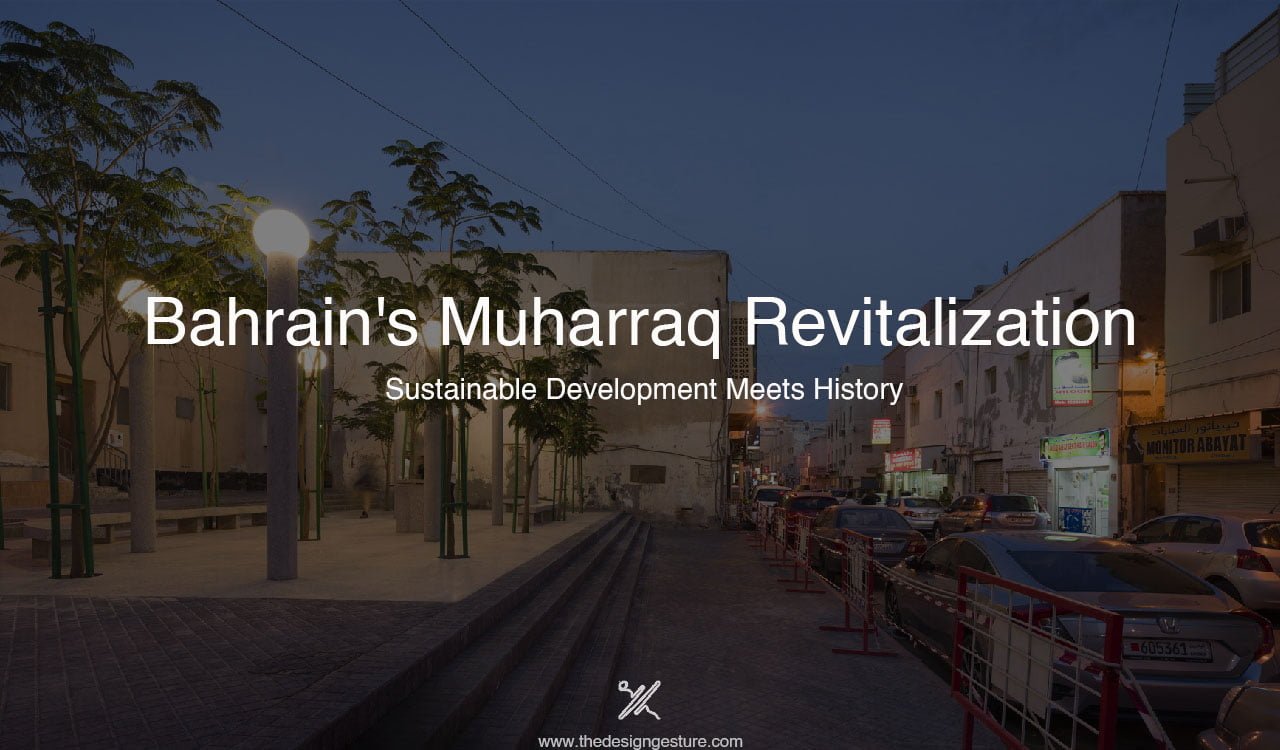
  • Bahrain’s Muharraq Revitalization: Sustainable Development Meets History

    Bahrain’s Muharraq Revitalization: Sustainable Development Meets History

    Introduction

    The Revitalization of Muharraq project involves the rehabilitation of the historic areas of Muharraq city, rooted in its former pearling trade located in the Kingdom of Bahrain. From an innocent initial intervention in the early 21st century by Sheikha Mai Al Khalifa to restore a cultural majlis in one of her family properties in Muharraq, the project took a complex shape with a holistic approach. The project evolved with a higher aim of not just preserving the historic structures related to pearling, but also instilling the lost communal spirit by constructing new cultural buildings and public squares encouraging a local influx in the city.

    bahrain
    Pearling Path Visitor Center and Museum © Archive Olgiati

    The Decline and the Rebirth of Muharraq, Bahrain

    Muharraq once flourished not only as the formal capital of the Kingdom of Bahrain but also as a global center for natural pearls, strengthening the economy of the country. However, the development of cultured pearls in the 1930s accompanied by a simultaneous discovery of oil in Bahrain, led to the decline of the pearling economy, and the capital was shifted to Manama from Muharraq. Gradually, the native families migrated from Muharraq, and the houses of Muharraq were rented to the expatriate workforce, mostly individuals.

    muharraq
    Sheikh Ebrahim Al Khalifa Centre for Culture and Research © Chiara Ciampricotti Iacoangeli

    The rebirth of Muharraq or precisely the rebirth of communal spirit in Muharraq was founded on the beliefs, tenacity, and ever-growing interventions of Sheikha Mai Al Khalifa which started in the early 2000s. Sheikha Mai intended to reinstate the cultural life in Muharraq which had declined significantly since the decline of the pearling industry, by restoring a majlis in her grandfather’s old house into Sheikh Ebrahim Al Khalifa Centre for Culture and Research.

    Since the inauguration of this Centre in 2002, Sheikha Mai has initiated several programs contributing to the revitalization project, seeking support from banks, local businesses, and public-private partnerships. The center was the initial step towards a noble direction founded on her firm belief that the reintroduction of cultural life into the abandoned areas of Muharraq, along with an integrated program of restoration and rehabilitation, could reverse its fate.

    Dissecting the project

    Bahrain's Muharraq Revitalization: Sustainable Development Meets History The Revitalization of Muharraq project involves the rehabilitation of the historic areas of Muharraq city, rooted in its former pearling trade located in the Kingdom of Bahrain. From an innocent initial intervention in the early 21st century by Sheikha Mai Al Khalifa to restore a cultural majlis in one of her family properties in Muharraq, the project took a complex shape with a holistic approach. The project evolved with a higher aim of not just preserving the historic structures related to pearling, but also instilling the lost communal spirit by constructing new cultural buildings and public squares encouraging a local influx in the city.
    Pearling Path © BACA

    The project involves the conservation and restoration of scattered natural and man-made structures related to the pearling trade, all knit together along the remarkable trail, “Pearling Path” telling the story of pearling, from the last remaining beach of Muharraq towards the inland. From the sea, the project includes three protected oyster beds, a preserved Bu Mahir fort, and a newly constructed visitor center on the seashore.

    Moving towards the inland, a newly constructed pedestrian bridge connects the reclaimed area to old Muharraq where a series of traditional buildings, precisely sixteen historic buildings related to pearling trade from divers’ homes, and merchants’ large courtyard houses to amarats underwent rehabilitation and restoration.

    Amarat is a local name for a warehouse usually located on the coast, but as of now, it is pushed inland due to reclamation. In addition to preservation, some of the old dilapidated structures were demolished and the plots of land were developed into new landscaped public spaces and a few other new cultural architectural buildings including the Archaeologies of Green Pavilion, the House of Architectural Heritage, the Pearling Path Visitor and Experience Centre, and the Dar Al Muharraq Centre for Traditional Music was built along the trail to revive the cultural spirit of Muharraq and awaken the memory of Muharraq among the natives.

    Restoration of Historic Buildings 

    Bahrain's Muharraq Revitalization: Sustainable Development Meets History The Revitalization of Muharraq project involves the rehabilitation of the historic areas of Muharraq city, rooted in its former pearling trade located in the Kingdom of Bahrain. From an innocent initial intervention in the early 21st century by Sheikha Mai Al Khalifa to restore a cultural majlis in one of her family properties in Muharraq, the project took a complex shape with a holistic approach. The project evolved with a higher aim of not just preserving the historic structures related to pearling, but also instilling the lost communal spirit by constructing new cultural buildings and public squares encouraging a local influx in the city.
    Bu Mahir Fort © pearlingpath.bh

    Bu Mahir fort and the seashore are of immense importance as they played a significant role in the communal and cultural lives of the residents of old Muharraq the seashore had witnessed farewells and reunions of pearl divers and also served as a playground for youngsters, a site of folkloric beliefs and rituals, a place for playing folk music, and an open-air majlis where traditional food was served. Unfortunately due to naval attacks on Bahrain, only a part of the fort remains intact. Restoration of the fort commenced in the 1970s, but only some of it was rebuilt. Again in 2010, the site was excavated to reveal its original foundations and dimensions.

    Bahrain's Muharraq Revitalization: Sustainable Development Meets History The Revitalization of Muharraq project involves the rehabilitation of the historic areas of Muharraq city, rooted in its former pearling trade located in the Kingdom of Bahrain. From an innocent initial intervention in the early 21st century by Sheikha Mai Al Khalifa to restore a cultural majlis in one of her family properties in Muharraq, the project took a complex shape with a holistic approach. The project evolved with a higher aim of not just preserving the historic structures related to pearling, but also instilling the lost communal spirit by constructing new cultural buildings and public squares encouraging a local influx in the city.
    Siyadi Mosque and Majilis © Timothy Power

    Some of the properties which were restored are still owned by the old pearl diving families. Since these buildings were dilapidated, Sheikha Mai sought a partnership with the owners and arranged for their restoration with the monetary support of other local institutions.

    A wide range of buildings including diver’s dwellings locally known as Al Ghus House, the majlis of the boat captain locally known as Nukhidhah House, Badr Ghulum House which served as both a home and a clinic then, Al Alawi House which is trader’s house, Al Jalahmah house, Murad house, Fakhro house and Siyadi complex which consists of Siyadi house, Siyadi majilis, and Siyadi mosque that belongs to the Siyadi family, were among those subjected to restoration and rehabilitation.

    The restoration of these buildings included tasks like reinstating lost wind towers for passive ventilation and measures were taken to carefully choose materials that resemble old materials. So, coral stone from demolished structures, and wood were reused in the restoration work in addition to the extensive use of terrazzo in the project, as it was a widely used material in Bahrain in the 1940s.

    New Intervention: Green landscaped areas along the trail 

    Bahrain's Muharraq Revitalization: Sustainable Development Meets History The Revitalization of Muharraq project involves the rehabilitation of the historic areas of Muharraq city, rooted in its former pearling trade located in the Kingdom of Bahrain. From an innocent initial intervention in the early 21st century by Sheikha Mai Al Khalifa to restore a cultural majlis in one of her family properties in Muharraq, the project took a complex shape with a holistic approach. The project evolved with a higher aim of not just preserving the historic structures related to pearling, but also instilling the lost communal spirit by constructing new cultural buildings and public squares encouraging a local influx in the city.
    Public Square © akdn

    As discussed above, the vacant plots that appeared due to demolition were conceived as green landscaped public squares. There are 18 such squares along the trail and the main idea behind developing them into squares instead of rebuilding, them is to address the needs of residents living in a contemporary city like Muharraq which lacks green open spaces and playgrounds for children.

    In an attempt to respect the pearling history of Bahrain, these squares were further adorned with spherical white street lamp posts, symbolic of pearls. The spherical lamp posts subtly intend to facilitate wayfinding while illuminating the streets of Muharraq. To a certain extent, these squares tend to resemble the old Bu Mahir seashore which once served as a playground and open-air majilis.

    New Intervention: Contemporary Cultural Buildings 

    Bahrain's Muharraq Revitalization: Sustainable Development Meets History The Revitalization of Muharraq project involves the rehabilitation of the historic areas of Muharraq city, rooted in its former pearling trade located in the Kingdom of Bahrain. From an innocent initial intervention in the early 21st century by Sheikha Mai Al Khalifa to restore a cultural majlis in one of her family properties in Muharraq, the project took a complex shape with a holistic approach. The project evolved with a higher aim of not just preserving the historic structures related to pearling, but also instilling the lost communal spirit by constructing new cultural buildings and public squares encouraging a local influx in the city.
    Pearling Path Visitor Center and Museum©Archive Olgiati

    New buildings make bold contemporary architectural statements while still respecting the pearling history of the region. The primary purpose of these new interventions is to reinstate the lost communal spirit in Muharraq. In the case of the Pearling Path Visitor and Experience Centre, the architecture was brutalist, devoid of any decoration similar to old Muharraq houses. The shape of skylights in the center resembled the form of coral slabs in the old houses while the towers resembled the wind towers of courtyard houses of Bahrain. The visitor center acts like a “public park” where visitors and local citizens can gather and socialize, lifting the communal spirit.

    Bahrain's Muharraq Revitalization: Sustainable Development Meets History The Revitalization of Muharraq project involves the rehabilitation of the historic areas of Muharraq city, rooted in its former pearling trade located in the Kingdom of Bahrain. From an innocent initial intervention in the early 21st century by Sheikha Mai Al Khalifa to restore a cultural majlis in one of her family properties in Muharraq, the project took a complex shape with a holistic approach. The project evolved with a higher aim of not just preserving the historic structures related to pearling, but also instilling the lost communal spirit by constructing new cultural buildings and public squares encouraging a local influx in the city.
    Archaeologies of Green Pavillion © Iwan Baan

    For instance, in the case of the Archaeologies of Green Pavilion, the white sleek finish with an inflexible outer geometry which is quite modern is juxtaposed with the curved geometries of the gardens inside resembling the courtyard gardens of the pearl merchant houses. The Dar Al Muharraq Music Center is also an excellent project that proves that a contemporary architectural language does not necessarily hinder a cultural revival.

    While it is undeniable that the chain mail covering of the music center is out of place in the historic Muharraq, it is true that the screen shades from harsh glare and allows the traditional Muharraq music for instance, the songs sung by pearlers at sea, to resonate through the neighborhood reviving cultural life.

    Revitalization of Muharraq: Not Merely a Tribute 

    Bahrain's Muharraq Revitalization: Sustainable Development Meets History The Revitalization of Muharraq project involves the rehabilitation of the historic areas of Muharraq city, rooted in its former pearling trade located in the Kingdom of Bahrain. From an innocent initial intervention in the early 21st century by Sheikha Mai Al Khalifa to restore a cultural majlis in one of her family properties in Muharraq, the project took a complex shape with a holistic approach. The project evolved with a higher aim of not just preserving the historic structures related to pearling, but also instilling the lost communal spirit by constructing new cultural buildings and public squares encouraging a local influx in the city.
    Cultural Revival at Muharraq © Archive Olgiati

    According to the revitalization project, the rich pearling history of 19th century Muharraq was reawakened, restored, and translated into a series of restored structures along a 3.5-kilometer long trail meandering through the narrow streets and alleyways of Muharraq, in addition to the new cultural spaces and contemporary buildings that dot the path.

    The Bahrain Authority for Culture and Antiquities (BACA) take on the revitalization project is applaudable for its bold and unique approach, firstly in attempting to make a demographic change in the region aiming at a local influx and secondly in allowing contemporary architectural interventions in a revitalization project. 

    Bahrain's Muharraq Revitalization: Sustainable Development Meets History The Revitalization of Muharraq project involves the rehabilitation of the historic areas of Muharraq city, rooted in its former pearling trade located in the Kingdom of Bahrain. From an innocent initial intervention in the early 21st century by Sheikha Mai Al Khalifa to restore a cultural majlis in one of her family properties in Muharraq, the project took a complex shape with a holistic approach. The project evolved with a higher aim of not just preserving the historic structures related to pearling, but also instilling the lost communal spirit by constructing new cultural buildings and public squares encouraging a local influx in the city.
    Chainmail Screen of Dar Al Muharraq Music Center © Bas Princen

    From the initial stage itself, BACA intended to “bring families back” and brought about projects with cultural communal significance and management policies favoring daily residents over tourists. For instance, the multi-story parking was planned to be lent free for residents while visitors may have to pay for it. BACA also made arrangements for the future extension of the communal use of the restored buildings by signing long-term agreements with the pearling families. In the case of the restoration of Murad House, its Magaid, a room previously where women would gather and guests would be entertained, was repurposed into a cafe open to the public while the Murad Majlis was restored for use by the Murad family alone.

    Bahrain's Muharraq Revitalization: Sustainable Development Meets History The Revitalization of Muharraq project involves the rehabilitation of the historic areas of Muharraq city, rooted in its former pearling trade located in the Kingdom of Bahrain. From an innocent initial intervention in the early 21st century by Sheikha Mai Al Khalifa to restore a cultural majlis in one of her family properties in Muharraq, the project took a complex shape with a holistic approach. The project evolved with a higher aim of not just preserving the historic structures related to pearling, but also instilling the lost communal spirit by constructing new cultural buildings and public squares encouraging a local influx in the city.
    28th Bahrain International Music Festival at Dar Al Muharraq Music Center © bna.bh

    This project was not merely about the preservation of a few buildings, instead, it intended to construct new structures of communal value and cultural significance, which will be worthy of preservation in a few decades. BACA’s firm decision to delineate the newly built structures from the historic ones with the help of a contemporary architectural language was a bold decision with an underlying message that the creations of today’s society are also as valuable as those of the past society.

    The site was inscribed as a UNESCO World Heritage site in 2012 and also awarded prestigious the Aga Khan Award for Architecture in 2019, for its boldness. This is an exemplary project that understands the legacy of the past yet doesn’t refrain from detaching from the past and moving ahead toward the future gradually!

  • The Adaptive Reuse of Historic Structures in India

    The Adaptive Reuse of Historic Structures in India

    What is adaptive reuse?

    The technique of reusing or adapting an existing structure for use other than its intended intent is known as the adaptive reuse of historic structures. The building may be used for a longer period thanks to repurposing. Even while various types of construction can be recycled, the phrase is usually used to refer to the reusing of old buildings. This will spare innumerable structures from being destroyed and rebuilt.

    Our ancestors engaged in substantial adaptive reuse projects back when building supplies were scarce and shipping and construction were pricey. As industrialization progressed, it became much simpler and less expensive to purchase goods at lower prices and convey them via complex road networks. Widespread construction and unsustainable building techniques were the results. Adaptive reuse is frequently associated with historic structures, but it can also be used to breathe new life into vacant, neglected, or underused structures that are still in good condition. 

    According to Yang and Chan, “adaptive reuse is a new kind of maintainable rebirth of the city since it includes the lifetime of the building, saves demolition waste, encourages the recycling of embodied dynamism, and delivers significant social and economic benefits to the world. It has become an exciting and creative challenge for architects to work with historic buildings and repair and restore them for ongoing usage. Structure change is referred to as “adaptive reuse.”

    Adaptive reuse is now viewed as a key tactic for protecting cultural assets in conservation theory and practice. A thorough review of academic writing on the subject from the 1970s to the present reveals that adaptive reuse theory is mostly founded in case study research, not architectural theory or/and conservation history, as one might expect.

     This article will provide a critical study of adaptive reuse theories from the nineteenth and twentieth centuries. From the standpoint of reuse, these contrasting ideas addressed the formal architectural link between old and new for the first time, as well as the discussion around this relationship. 

    The importance of reusability

    There are three conservation techniques, which are as follows:

    1. The upkeep of structures (Preservation)

    2. Reinstauration (Restoration)

    3. Adaptive reuse

    Each of these measures for conserving the environment cannot be applied uniformly to all types of buildings. When the natural resources were conserved, Numerous variables, including, influenced the selection of the optimal approach.

    (I) The significance of historical significance of the construction

    (ii) Cultural significance

    (iii) Condition of one’s physical health

    A building can only be preserved and restored if it has the potential to draw visitors as a tourist destination or if it can still serve the function for which it was originally built. The only method to conserve a building that doesn’t fit into one of these categories is to keep it in use, a practice known as an adaptive reuse.

    One must adjust to the changing circumstances by making the necessary modifications for the building’s new use without reducing its inherent historic value to preserve an old building, even if the neighborhood is undergoing significant changes and the building’s original function is no longer applicable.

    Examples of adaptive reuse techniques in India

    adaptive reuse
    Adaptive reuse  Biltrax Media 

    The fight for Indian freedom has dominated the history of our nation. With independence came new laws, a new constitution, and a new form of government. Before we gained our independence, our country was split into 562 Princely States that had a say in how affairs were run and The British Province, which was fully administered by the British.

    After the British colonialists left India on August 15, 1947, India and Pakistan became independent states. The Princely States faced a decision between remaining independent and allying with one of the two superpowers.

    Any structure constructed by a former princely state ruler and acknowledged as such by the Central government is exempt from taxation under the Act. Prior monarchs, however, leased palaces and other buildings outside of their royal residences to the government for its use as a result of this statute. Currently, government organizations like courts and local authorities, as well as educational institutions, are housed in these buildings. Many buildings have served purposes different than that for which they were designed throughout history. Throughout the conflict, several buildings served as makeshift hospitals and camps.

    Many abandoned factories and warehouses were converted into schools, hospitals, and even places of worship several decades following the industrial revolution, fusing the new with the old. Thus, it may be argued that “reuse” is not a novel idea in India. Whether you realize it or not, it has become a regular part of your life. A Haveli is frequently transformed into a business district. To do this, palaces must be converted into government buildings, mills into hotels, and residential streets into commercial districts.

    restoration
    Restoration for Adaptive reuse as Heritage Hotel-Tijara Fort   Archello

    There are three primary adaptive reuse options, each with its antecedents and ways for integrating the new use inside the current building. One of these is the possibility of preserving a structure for its original function.

    This might result in a

    1 modification of the purpose of the structure or

    2  a modification to the building’s usage.

    3 The facade of the building is remodeled, but the interior stays unaltered.

    deconstruction
    Diagram explaining the relation between deconstruction and adaptive reuse   Principle of adaptive reuse 

    Considerations to be made in the adaptation 

    1. No Cultural or heritage loss –

    The adaptation shouldn’t considerably lessen the cultural significance of the original while maintaining the structural integrity and significance of the structures. It is best to make adjustments that are largely reversible or have little impact. No cultural heritage should be lost. We also need to have the ability to assess the intangible aspects of age, personality, and architectural excellence. It is crucial to take into account a structure’s original cultural importance while repurposing it.

    Because its architectural legacy is unique due to this personality. Therefore, whether substantial or minor, any additions or alterations to a historic structure should not overpower its original character. Even if there appears to be a mismatch in the styles or materials, the building’s original design must be honored.

    1. Visual Significance –

     With the area, Important connections between the structure and its site must be respected, preserved, and not violated. The environment must be compatible with any additions or adjustments. Even after renovations, a visitor should be able to tell that a building is from the area. The building should not look out of place with its surroundings.

    The location is essential when deciding how many alterations or additions should be made to a building, especially a historical one.

    1. Compatibility with historic personality-

    The character of the ancient town or urban area must be maintained while adding new functions and activities. If a building is to be used for something entirely different, the new use ought to complement both the building and its surroundings.

    The degree of modification the structure can withstand and whether the community wants such a change would determine the building’s new function. For instance, a defunct mill in a district with a high concentration of businesses could be transformed into a shopping center or an office building. However, if it’s close to a residential area, it can end up becoming a public area. If it’s situated in a historically noteworthy area, it might be used as a museum or tourist attraction.

    1. Contemporary functional aspects-

    The improvement of space should be furthered by the usage of contemporary components. Public services should be improved by new construction and upgrades. The integrity, personality, and shape of the structure should not be altered or added to.

    Architectural features like the outside or interior shouldn’t be sacrificed if a structure is reused and new utilities like water, electricity and other modern amenities must be added. Shafts and ducts shouldn’t alter the existing features or draw attention to them. If escalators and elevators are required, they should be incorporated gradually through a series of interior changes rather than as an afterthought. Any façade updates should either enhance or blend in with the existing components.

    museum
    Mortizburg Museum, Germany  Adaptive Re-use around the world 
    1. New dimensions, materials, and finishes-

    The charm of the original should be preserved and enhanced while new volumes, materials, and finishes should represent contemporary ideas. The building’s intriguing characteristics, its historic contexts, its compositional balance, or its connection to its surroundings shouldn’t be diminished by additions. Modern additions might contribute to the improvement of space.

    No matter how big the addition is, it shouldn’t overwhelm the old building that it’s built on. Three types of new finishes that are necessary for the building’s completion include the restoration of an old feature using the same or similar material, a finish that shows the influences of the old without copying it, and the use of new materials in a new style while also reflecting the old materials.

    Conclusion

    A very lengthy amount of time has passed in India’s history. Many of the original buildings there are now vacant and empty. The structures can be rearranged while maintaining their historical relevance and making the most of their practicality. The thoughtful and informed reuse of historic structures could help create a community that is conscious of its impact on the environment and works to maintain a healthy way of life. It is conceivable that it might have a beneficial impact on Indian architecture.