
Tag: singapore

  • Green Architecture In Singapore: Leading Design and Technologies

    Green Architecture In Singapore: Leading Design and Technologies

    Introduction 

    Singapore has always been mindful of environmentally friendly construction and lowering the economy’s energy intensity by 2030. The formation of the city’s image in nature is the result of the combined efforts of the government, architects, and urban planners. To promote changes like sun-shading exteriors, water-efficient fixtures, computer modeling of energy flows and carbon emissions, and highly efficient air conditioning and ventilation systems, there are significant incentive programs and building rating tools. The previous list has been updated with 1534 new buildings since this grading tool was introduced in 2005.

    Due to population growth and the Intergovernmental Panel on Climate Change’s projections that Asia will experience a rise in construction sector emissions from energy usage in the developing world over the next ten years, with China playing a large role,

    According to architects and sustainability specialists located in Asia, Singapore has emerged as a model of green architecture for planners and developers across much of the Asia-Pacific region, where bad design is the norm and developers traditionally find little motivation to engage in sustainability.

    The term “green building” conjures up important, universal traits like consideration for energy usage and an effort to make a structure more in touch with its surroundings.

    In Singapore, the economy is central to all decisions, and it also serves as the foundation for the future. On the southernmost point of the Malay Peninsula, it has evolved into a testing ground for ventilation and air-conditioning engineers that Western and Asian manufacturers hope to sell throughout the rest of Asia.

    The objective is to promote vernacular designs that emphasize passive technologies like optimized shading and ventilation and sensitivity to the building’s carbon life cycle, even though some experts claim that the rules and regulations developed through these organizations may result in the consumption of air conditioning as an essential design component.

    The initiative to green Singapore was originally focused on giving the city-state a distinct and intentionally desirable image, today this approach is praised for its ability to tackle issues surrounding urban heat, assist with sustainable water management, and improve biodiversity in the city. 

    Green Design and Technologies in Singapore 

    To reduce negative environmental effects and maximize overall building performance, the Singaporean government promotes the adoption of sustainable building designs and green technologies. The BCA Green Mark Certification scheme, a framework for evaluating a building’s overall environmental performance, including energy, water efficiency, indoor environmental quality, and environmental impacts over the course of the building’s lifecycle, promotes these.

    For example, passive design principles are frequently used for buildings and spaces in tropical climates to cut down on energy use and carbon emissions. Some structures have a vernacular architecture that is carefully oriented to optimize daylight or reduce direct solar heat gain.

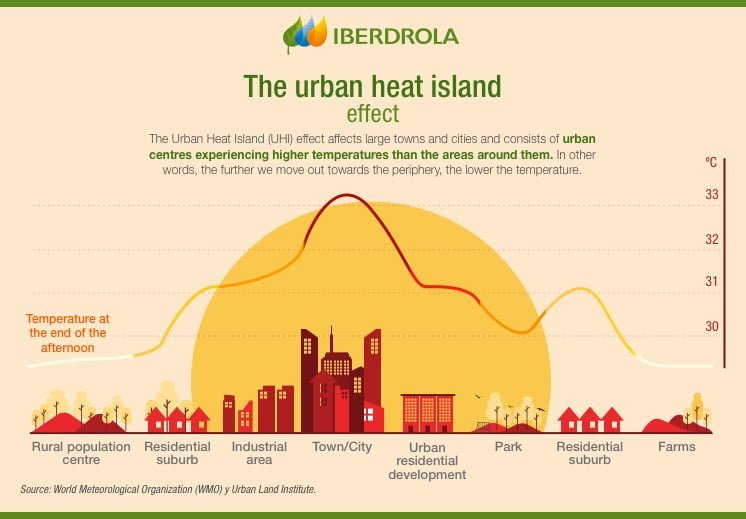
    To bring nature into dense urban environments, an increasing number of buildings are also incorporating ample greenery and trees, which provide shade and minimize urban heat effects. Many have sun-shading exteriors such as overhangs to block solar exposure. Green roofs, with layers of planted vegetation, further mitigate solar heat gains. They provide a nature-based alternative to and reduce the need for,” grey” solutions.
    Singapore
    Urban Heat Island  from Iberdrola 

    The Zero Energy Building (ZEB) on the BCA Braddell Campus and the recently completed National University of Singapore(NUS) School of Design and Environment building are notable examples.

    1. The Zero Energy Building (ZEB) –

    Architect- DP Architects,2009 

    This structure was identified as a test site for developing a green education program and investigating potential energy use practices in tropical regions. Through the use of active systems in addition to passive design, the structure was transformed into an energy-self-sufficient school that archives net-zero energy consumption.

    First, passive systems were put in place to lower the building’s energy usage. Then, intelligent active systems with little dependence on natural resources were added to these. It generates all of its energy requirements using solar energy.

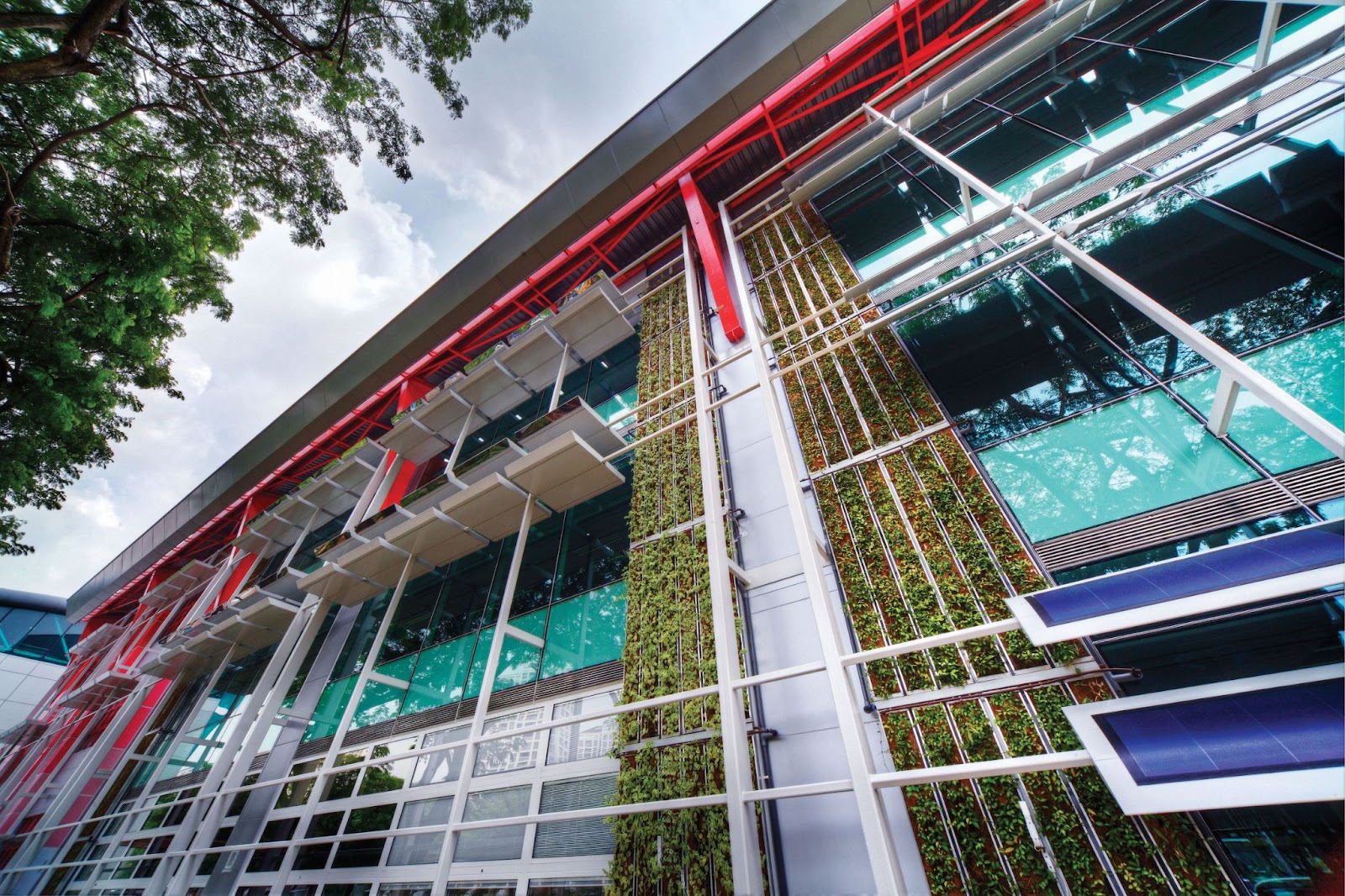
    By using low-emissivity glass, solar film coating, composite wall panels, green walls, green roofs, and shading devices, the passive design makes use of the building’s solar heat gain and natural ventilation.

    Other than this, there are many techniques used such as – 

    The school hall and classrooms are ventilated using hot air produced by solar-assisted stack ventilation. Due to the buoyancy effect, air will rise and exit the chimney as a result of heat buildup in the ducts.

    Light Pipes: A vertical pipe in the roof allows for the entry of natural light. Since light pipes have a smaller surface area than skylights, they are more effective since less energy escapes from the inside.

    The school hall and classrooms are ventilated using hot air produced by solar-assisted stack ventilation. Due to the buoyancy effect, air will rise and exit the chimney as a result of heat buildup in the ducts.

    Light Pipes: A vertical pipe in the roof allows for the entry of natural light. Since light pipes have a smaller surface area than skylights, they are more effective since less energy escapes from the inside.

    Green Architecture In Singapore: Leading Design and Technologies Singapore has always been mindful of environmentally friendly construction and lowering the economy's energy intensity by 2030. The formation of the city's image in nature is the result of the combined efforts of the government, architects, and urban planners. To promote changes like sun-shading exteriors, water-efficient fixtures, computer modeling of energy flows and carbon emissions, and highly efficient air conditioning and ventilation systems, there are significant incentive programs and building rating tools. The previous list has been updated with 1534 new buildings since this grading tool was introduced in 2005.
    Vertical Pipe  from Archello 

    Photovoltaic  Technology: Grid-tied Solar Panel Systems and Standalone solar panels are used. They work as sunshades, covered walkways, and railings. 

    Mirror Ducts: They are made of highly reflective material that channels daylight through horizontal reflective ducts in the false ceiling, which then exists through ceiling apertures above the users. 

    Green Roof and Green Walls: The green roof lowers the temperature from direct radiation heat gain. They reduce heat transfers from the building envelope into the interior. Temperature sensors monitor both surface and ambient temperature. 
    green wall
     Green Wall  from Archello 
    1.  Tuas Nexus-

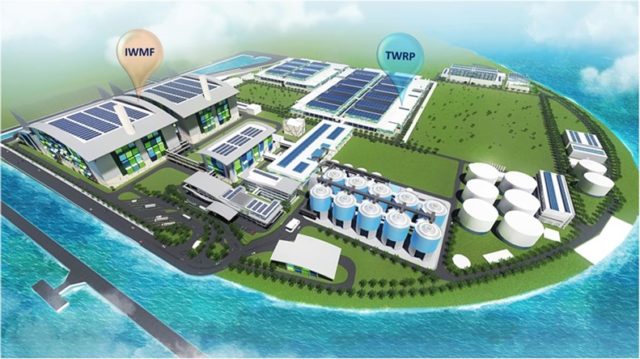
    Through the fusion of several sectors, it serves as another illustration of circularity. The structure will house the Taus Water Reclamation Plant run by Singapore’s Public Utilities Board and National Water agency as well as an integrated waste management facility run by the National Environment Agency, making it the first combined waste and water treatment facility in the world.

    By utilizing the water, energy, and waste nexus’s synergies, the construction will maximize resource and energy recovery while minimizing land take. For instance, the plant will run entirely on electricity produced by the waste-to-energy process, with any extra energy being exported to the grid.

    Tuas Nexus will be energy self-sufficient as a result of the integrated approach. This is expected to result in carbon savings of more than 200,000 tonnes of CO2 annually, equivalent to taking 42,500 cars off Singapore’s roads (Singapore, National Environment Agency 2020).
    tuas nexas
     Tuas Nexus  from World-energy 

    Bishan-Ang Mo Kio Park  

    The most well-liked heartland park in Singapore and one of the biggest urban parks were created by Ramboll Studio Dreiseitl. The old concrete canal was de-concretized and turned into a lovely 3 km meandering river with rich banks of wildflowers as part of the PUB’s Active, Beautiful and Clean Waters (ABC) initiative. The park is the largest draw for local inhabitants looking for recreational activities because it also has beautiful vegetation, Pond Gardens, and River Plains.

    This 62-hectare park is perfect for nature lovers because it is also home to a broad variety of fascinating wildlife and vegetation. Fitness aficionados can also use the facilities, where they can cycle or jog along the well-maintained paths.
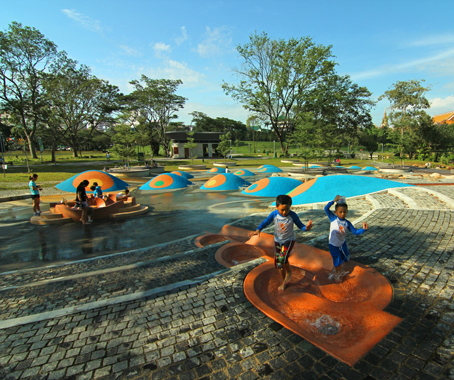
     Bishan-Ang Mo Kio Park
     Bishan-Ang Mo Kio Park  from IndesignLive Singapore 

    Jewel Changi Airport   

    Designed by Safdie Architects  

    In the year 2019 

    In order to create a new community-centric typology as the beating heart and soul of Changi airport, the airport was built as a link between the current terminals. It blends surroundings like a bustling marketplace and a paradise garden. The city in the garden is how many refer to the airport.

    The 135,700m2 area, which is open to the public, houses a landside airport, indoor gardens, leisure activities, shops, cafes, restaurants, and hotel accommodations all under one roof. Gateway gardens that orient the visitors and provide visual linkages between the internal programme elements are emphasised along all four cardinal axes.

    The terraced indoor garden, which includes strolling paths, cascading waterfalls, and peaceful seating spaces, is the airport’s main draw. It offers a variety of spatial and interactive experiences. More than 200 distinct tree and plant species can be found. The rain vortex that falls from an oculus in the destroyed roof to the woodland valley garden seven floors below is the tallest indoor waterfall in the world. A semi-inverted toroidal dome roof serves as the foundation for the jewel’s geometry.

    The main accomplishment of this airport is that it provides a level of comfort for the variety of activities. It also needed an integrated system of glazing, static and dynamic shading, and an advanced and effective displacement ventilation system in order to sustain the vast array of plant life within adequate sunlight. The airport now has Platinum GreenMark Status. 

    changi airport
     Jewel at Changi Airport  from Velvet Escape

    Conclusion 

    Now that global warming is increasing day by day. People are becoming more aware of the environment near them. From the food to the building that they live in. Architects are now becoming more and more towards sustainable designs the how the built environment inside the building affects the people living inside. 

    For sure it can be stated that Singapore is one of the leading countries in Asia that is taking massive steps toward green architecture. The advancement of the technologies and the integration of the structure and material is also noteworthy and something that could be learned from. 

  • Megacity Singapore- A Fascinating Dream of Planner or Gleaming Dystopia?

    Megacity Singapore- A Fascinating Dream of Planner or Gleaming Dystopia?

    About

    megacity
    Photo from Hyatt

    Singapore is a sunny, tropical islet in Southeast Asia, off the southern tip of the Malay Peninsula. Singapore is a megacity, a nation, and a state. It’s about 275 square country miles, lower than the State of Rhode Island, and inhabited by five million people from four major communities; Chinese (maturity), Malay, Indian and Eurasian. 

    Since its independence on 9 August 1965, the country has espoused an administrative republic system. Presently, the government and the press are led by Prime Minister Lee Hsien Loong while President Halimah Yacob is the Head of State. 

    Singapore is known as a City in a Garden and nearly 50 percent of the islet is green space. It’s a thriving megalopolis offering a world-class structure, a completely integrated islet-wide transport network, dynamic business terrain, vibrant living spaces, and a rich culture largely told by the four major communities in Singapore with each offering a different perspective of life in Singapore in terms of culture, religion, food, language, and history. 

    History

    The story of urban planning in Singapore starts from further than 50 years ago. On 12 September 1965, shortly after Singapore had been cast out of the lately formed Malayan confederation and had latterly declared its own independence, Prime Minister Lee Kuan Yew stood before a crowd of city hall sympathizers and said, ‘We made this country from nothing, from mudflats! Ten years from now, this will be a metropolis. Never fear!’

    By any mark, this was a bold prediction to make. Granted, 150 times of British social rule had created a thriving entrepôt around the port, a well- waxed civil service, and a rather graphic skyline of neoclassical and art deco piles clustered around the southern tip of the islet. But outside the central business quarter were mudflats and wetlands, and dirt-poor kampong townlets. Utmost of the population lived in squalid, crowded diggings. There was no dependable water force. In real terms, the average Singaporean in 1959 was as poor as the average American in 1860. 

    Against this sobering background – a megalopolis in a decade? Seemed impossible. But as history shows, Lee’s bold prediction came true.

    History of Urban Planning

    Urban planning in Singapore aims to optimize the use of the country’s scarce land coffers for the different requirements of both current and unborn generations of the population. It involves allocating land for contending uses similar to casing, commerce, assiduity, premises, transport, recreation, and defense, as well as determining the development viscosity for colorful locales. The way Singapore looks moment is, to a large extent, a result of the government’s effective perpetuation of its civic development plans, the most important of which is the Concept Plan and the Master Plan.

    Colonial Town Planning (1819 – 1958)

    urban planning
    Photo from Wikipedia

    The first urban planning frame in Singapore began in 1822 when Sir Stamford Raffles returned to Singapore and saw the haphazard way the city center had grown. A Town Committee was formed to revise the layout of the agreement. The first detailed megacity plan for Singapore was known as the Jackson Plan, named after Lieutenant Philip Jackson, the agreement’s mastermind and land surveyor in charge of overseeing the islet’s development.

    The Jackson Plan guided the growth of the megacity eight times, but the opening of the Suez Canal in 1869 brought more vessels and people to the islet, performing in overcrowded, dirty slums, poor hygiene, and sanitation in the megacity area. 

    In 1927, the Singapore Improvement Trust (SIT) was set up by the British social government to address the problem of urbanization and ameliorate the physical terrain of the megacity. The SIT worked to widen roads to manage the adding quantum of vehicles, created open spaces, and put in place ultramodern sanitation. Still, it could only make incremental development, as it had no authority to draw up comprehensive plans and control development. 

    By 1953, the social government realized the dire need for an overall plan to guide the physical growth of Singapore. This redounded in the 1958 statutory Master Plan that regulated land use through zoning, viscosity, and plot rate controls, and reserving lands for colorful amenities. The Planning Constitution, which is now known as the Planning Act, was enforced on 1 February 1960 to lay down the introductory legal frame controlling the use and development of land set out by the Master Plan. 

    Post-World War II Town Planning (1958 and 1965 Master Plan)

    Singapore officially separated from Malaysia on 9 August 1965 and attained independence. As a new nation, the government had a new set of pretensions and precedences of public survival, achievement, making Singapore a global megacity. Survival was important to Singapore because of the communist competitions endured by the new administration in the early 1960s.

    Also, the rapid-fire advance in information technology at the time made it essential for Singapore to come to a global megacity. These pretensions, combined with the drive to attain excellence collectively and organizationally as a new country, combine to produce the post-independence planning process. 

    Unlike the 1958 plan, post-independence planning was forcefully set within the boundaries of main and coastal plans. The need for profitable success was also urgently conveyed in the plans leading up to the 1980s. To this end, planning began to come to an institutionalized, professional act. Moxie was imported to prepare plans, specialist services were attained in the fields of planning, and the State and City Planning (SCP) Department was created.

    The original professional staff was transferred overseas to be trained. Post-independence planning was characterized by egalitarian pretensions and icing optimal land use. The land was considered a scarce resource, and allocation of land was a collaborative or public act as opposed to an individual bone. The SCP was concentrated on optimization of the democracy’s land coffers and resolving disagreeing development proffers in the overall interest of the state for the common good.

    The 1980s and 1990s 

    While Singapore’s development concentrated substantially on profitable success during the original post-independence times, as Singaporeans came richer in the 1980s, itineraries started taking into account quality of life factors. Fresh land within new municipalities was allocated for premises and open spaces, while auditoriums and common installations were incorporated into public casing estates to foster a sense of community between resides.

    Also, from 1980, artificial planning shifted towards structure and areas suited for advanced value diligence, and artificial areas started to be constructed as” business premises”. These” business premises” had cleaner surroundings than before artificial areas.

    The 2000s to present 

    civic planning
    Photo from Travel Triangle

    Public discussion and feedback started playing a lesser part in Singapore’s civic planning from the early 2000s, and for the medication of the 2001 Concept Plan, focus groups were formed to bandy civic planning issues. The 2001 plan substantially concentrated on the quality of life, proposing further different domestic and recreational developments, and balancing the pretensions of liveability and profitable growth.

    This included plans to make casing in mature estates, in the new town at Marina South, and at the western area of the islet. Green spaces would be expanded from 2000 to 4500 ha, with the opening of areas similar to Pulau Ubin and the Central Catchment Reserve, which will be accessible by Park Connectors. Sports installations will also be erected for recreational purposes, completing the opening of budgets, where residers can exercise and enjoy near access to nature.

    The strategies to sustain a high-quality living environment include:

    • Providing good affordable homes with a full range of amenities
    • Integrating greenery into the living environment
    • Providing greater mobility with enhanced transport connectivity
    • Sustaining a vibrant economy with good jobs
    • Ensuring room for growth and a good living environment in the future

    Urban Systems for Liveability

    Sustainable Mobility

    The “Lion City” has a character as one of the most strictly planned metropolises in the world. The LTMP 2040 aims for an accessible, presto, and well-connected transport network that can get residents around the megacity in 45 twinkles or less; an inclusive transport ecosystem; and a healthier, cleaner, greener transport terrain. One way they’ve been suitable to achieve and plan for such a cohesive structure is by using the Avoid- Shift- Improve (ASI) frame, a strategy that combines civic transport planning with land-use planning for the long run. 

    Avoid

    The ASI frame aims to achieve GHG emigration reductions, reduced energy consumption, lower traffic, and generally more habitable metropolises. The first step, “avoid,” refers to perfecting the effectiveness of the transport system and reducing the need to travel. In Singapore, homes and businesses are being erected in advanced consistency near to metro stations, so it ’ll take no further than 20 twinkles for residents to travel from home to neighborhood centers. 

    Shift

    The alternate step, “shift,” calls for a shift down from the most energy-consuming modes of transport, like buses, and towards further environmentally friendly modes, like walking, cycling, or public transport. For its part, Singapore has plans to develop a km islet-wide cycle track network by 2040, including a plenitude of places to situate your bike. Singapore’s public transport system is also excellent, and the megacity makes it easy to transfer between its 203 km of metro rail and its near motorcars via its effective chow card system. 

    Improve

    Eventually, the third step, “Improve,” refers to sweats to ameliorate vehicle and energy effectiveness, as well as to optimize public transport structure. Singapore formerly plans to extend its metro rail network with newer and safer technology, as well as add further green motorcars to its being line over the coming decade, making it that much easier to choose public transportation over a passenger vehicle. 

    But Singapore takes it a step further and actually discourages auto power. The megacity places harsh conditions on both power and the use of particular vehicles. Anyone who wants to buy an auto needs to get a Certificate of Entitlement through a transaction process, which frequently tacks on charges equal to the price of an auto. Likewise, motorists have to pay road druggies charges that vary depending on the time of day. 

    Singapore is a perfect illustration of a megacity that has effectively combined transport and land-use plans with excellent public transport and disincentives in order to make the ASI frame function. As a result, Singapore has important cleaner air quality than numerous other Asian metropolises, as well as stronger profitable development and increased quality of life.

    Sustainable Environment

    sustainability
    Photo from EIAS

    Singapore has come a long way on its trip towards sustainability. Over 50 times agone, Singapore was dirty and weakened, lacking proper sanitation and facing high severance. It was a small developing islet megacity- state with no natural coffers and faced an uncertain future after its unanticipated separation from Malaysia. Numerous were skeptical that Singapore could indeed survive on its own. 

    Singapore’s approach to sustainable development is guided by three crucial principles:

    • an intertwined approach and long- term strategic planning; 
    • Investments in R&D and innovative results; and 
    • forging partnerships. 

    Through an alliance known as the Singapore Sustainability Alliance, a marquee conforming of government groups, non-governmental associations, and tutoring institutions, Singapore has been suitable to come up with programs that produce a sustainable terrain. Other than this, the alliance has overseen the relinquishment of systems that include proper water use, renewable energy, energy effectiveness, waste operation, etc. which have significantly better business growth.

    Conclusion

    One of the reasons that Singapore proves to be such a magnet as a home is the ease of living, particularly in terms of hearthstone, transportation, and governance system. Over time, Singapore has made significant strides in numerous areas and has attracted an encouraging number of transnational accolades, which fete the megacity as vibrant and world-class. 

    So whether it’s the trades and artistic exchanges, the creation of slice- edge invention to enrich the lives of the communities at home or abroad, or the coming together of world-class minds to spark new business openings locally and internationally, Singapore is simply, the place where worlds meet.