
Author: Kshitija Chinurkar

  • Ultimate Office Lighting Guide You Need for Your Workplace

    Ultimate Office Lighting Guide You Need for Your Workplace

    Office lighting is more than just choosing light fixture types. Most of the office staff spend almost 8-10 hours of their day in the office. Office lighting can make or break an employee’s zest for working. So having a pleasant, habitual, and comfortable work environment for them is very important.

    Here is an office lighting design guide to help you in your office interior in the most efficient way.

    Ergonomics of lighting
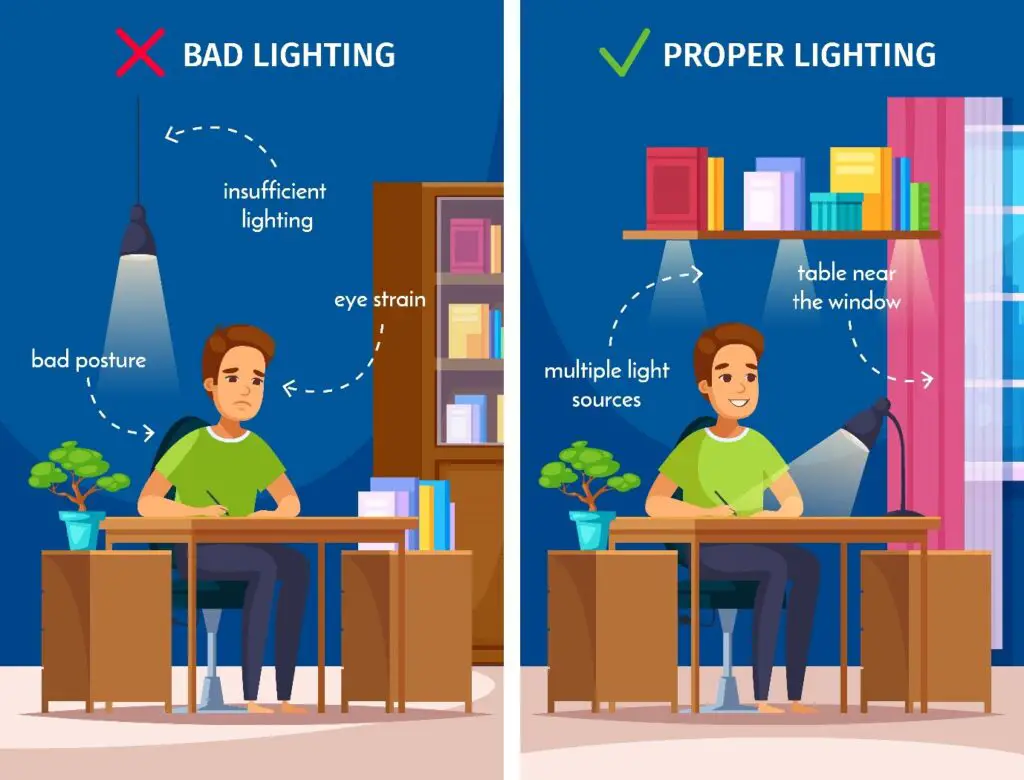
    Ergonomics of Office lighting
    Medical vector created by macrovector – www.freepik.com

    Ergonomics is concerned with designing and arranging lights in such a way that light and people interact with each other in the most efficient and safe way.

    Ergonomics is a very important part of every architectural lighting office design. Ensuring sufficient lighting around your workspace is the most important part of good ergonomic lighting. Inadequate lighting forces your eyes to work overtime to make sense of the task, creating eyestrain and headaches.

    Impact of Office Lighting Design on productivity and quality of work

    It’s proved that more exposure to natural light helps employees to be more productive, creative, and healthy. Workers deprived of natural light are more tired, have headaches due to eye-straining, and are less active.

    Adequate lighting meaning is well-designed office lighting that can help in keeping the workers healthy, productive, and motivated at the same time.

    Suitable Light for an office

    The lighting in any office should provide a wide spread of illuminance of light. The layout should be planned in such a way that there are a smaller number of shadows cast in any of the spaces.

    The most ideal choice for office lighting is LED.

    Benefits of LED Lighting

    1. LED can be dimmed as per the daylight and eyestrain.
    2. It is an energy efficient alternative because of its longer shelf life.
    3. LEDs don’t use energy in the form of infrared radiation.
    4. They can last for up to 50,000 hours.
    5. LED panels help to eliminate glare, which can improve comfort and workability.

    Use Maximum Natural Light

    Natural Light is the best source of lighting for any space. In an ideal situation, natural light should act as primary lighting and all the artificial lighting should be secondary. The work environment feels welcoming and brighter in the daylight.

    Positioning the workstations or cubicles such that they face north or south can also help. By this, you can avoid direct sunlight as it can create glares. 

    Using more natural lighting sources is also very cost-efficient as we save on a lot of energy. With new technologies like daylight harvesting systems, we can now have automated dimmable lights in accordance with the natural light present.

    Use Different Light Sources

    Office lighting is not just limited to overhead or desk lighting. Lighting is also used for visual appeal, particularly in corporate offices where companies would like people who visit to get a good first impression, much of which can be achieved by good lighting.

    Indirect lighting can help in subtly illuminating the workspace and relieve eyestrain.

    Non-reflective background surfaces, like a matte finish or muted colour furniture, can positively influence a work environment.

    Colour temperature for an office

    There is no set thumb rule for light colours of any office.

    Having said that, cooler bluish and white lights are ideal for spaces where more concentration on work is required.

    Warm, yellowish-toned lights work well in spaces where people come for relaxing.

    Save Energy

    The best way to save energy in an office is by using LEDs and setting up motion-censored lights.

    Dimmers are also an efficient way of energy saving.

    Install Lighting Control Systems

    1. This system helps in utilizing lighting sources more optimally, saving power and thus saving money.
    2. With this technology, lights fixed in the office will be included in that one system and will make the entire process of monitoring and using the lighting much simpler.
    3. This system makes the most out of natural daylight by regulating the lighting in different areas of your office.
    4. Areas that aren’t in constant use, such as corridors, toilets and meeting rooms, can benefit from this as the system will ensure these areas are only lit when they are in use.
    5. Dimmable switches can be installed to control light levels in meeting rooms where projectors are used.

    Office Lighting Design Guide for Each Room

    Ergonomics is involved in not just the lighting design of a workstation but the whole office that is, from the reception to the communal spaces. Here is a guide for you to help you have a clear idea of the requirements of each room in an office.

    Entrance and Reception

    Entrance and Reception
    Photo by Smartworks Coworking on Unsplash

    First impressions matter a lot so the entrance lighting has to be impactful. Lights in this area can give a dramatic and soothing effect. So, if you think that they are not in good working condition; consider stage light repair and services

    Use downlight for accent lighting and glare control.

    Light fixture types like pendant lights can be used in a group of 2-3 lights to enhance the ambiance.

    Corridor and Stairway

    These are challenging areas to light as most of the time they don’t have any natural light. These are also low-traffic areas so you have to find the balance between over lighting and making the space so dark that people feel unsafe when in that area.

    Ceiling or wall-mounted lights and recessed lights are the perfect fit for stairways and corridor spaces.

    Use of strip lighting on the floor or along the walls to serve as a guide for people passing through the office.

    Office Lighting in Open Plan Workspace
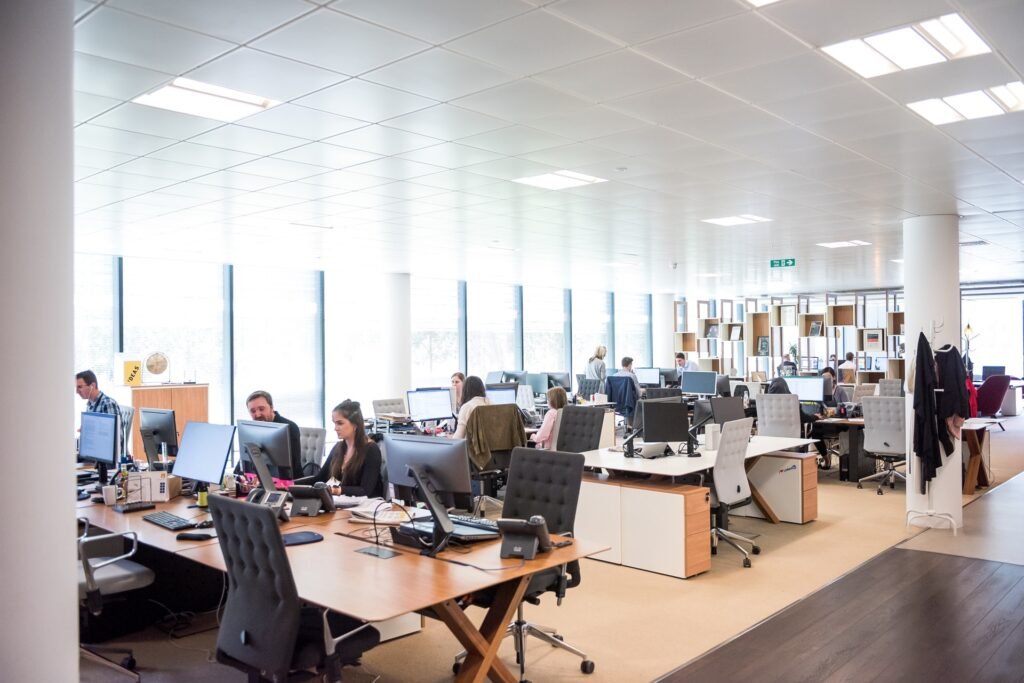
    Office Lighting in Open Plan Workspace
    Photo by Arlington Research on Unsplash

    It requires high illuminance of light to maintain a workable, positive atmosphere. Daylight harvesting is the most efficient solution for an open floor plan.

    Recessed ceiling-mounted lights help to light up the workspace homogeneously.

    Add spotlights or downlights to avoid any dark spots.

    Ergonomic is an integral parameter for any office lighting and it should not be neglected under any circumstances.

    Desk

    Desk
    Vector Vectors by Vecteezy

    Even if you have ceiling lights for the workplace, having a fully adjustable task light on the desk can never go wrong. Desk lamps at individual workstations provide both direct, task-oriented, and indirect background lighting which helps reduce glare.

    Ensure that the task lights are placed on the opposite side of the writing hand to avoid casting shadows.

    Office Desks and Task Lighting

    When considering office interior lighting design, don’t overlook the importance of lighting at individual workstations, especially office furniture Sydney. Task lighting is essential to provide focused illumination for tasks such as reading, writing, or using the computer. Desk lamps with adjustable arms and brightness settings can be placed strategically to minimize shadows and reduce eye strain. This localized lighting not only enhances productivity but also allows employees to personalize their lighting preferences, contributing to a comfortable and efficient workspace. Proper task lighting on office desks is a key component of a well-rounded lighting strategy, contributing to the overall success of your office lighting design.

    Executive Office

    Executive Office
    Photo by Campaign Creators on Unsplash

    The executive office has to be a very elegant space. It requires high illumination.

    Accent lights can focus on special areas and artistic elements.

    Install smart light control.

    Use suspended luminaire and track lights for accent lighting.

    Meeting Room

    Meeting Room
    Photo by Christina @ wocintechchat.com on Unsplash

    Meeting rooms are spaces where presentations, important work-related discussions, and workshops take place. The lighting here should ideally combine warm and cool light to balance the atmosphere of the space.

    Accent light and ambient light, when used in collaboration give an aesthetic effect to the meeting room.

    Kitchen Area

    The light above the cooking counter should be sharp and shadow-free. Whereas the serving island can have warm lighting.

    Communal Space

    adequate lighting meaning
    Photo by Yann maignan on Unsplash

    The atmosphere in this area has to be very relaxed.

    Dimmable lights and tabletop lights work best in such spaces.

    Along with this, make sure that the communal space is in an area with a good amount of natural light as it helps in reducing stress.

    These guys are some of the best in the custom design LED industry which you can check.

    In the realm of office lighting guide, the options are plentiful, but the right choice depends on various factors – from the layout of the space to the desired ambience. Throughout this guide, we’ve explored a range of lighting solutions, with a special focus on the versatility, mood-enhancing capabilities, and sustainability of high bay LED lights. Remember, the ideal office lighting design seamlessly combines functionality with aesthetics, creating an environment where productivity and well-being thrive side by side.

    FAQs

    Q. What is the importance of office lighting design?
    A. Office design lighting is crucial as it directly impacts employee’s productivity, health, and well-being. A well office light design scheme can create a pleasant and comfortable work environment, enhancing employee’s zest for working.

    Q. How does office interior lighting design affect ergonomics?
    A. Ergonomics in office interior lighting design ensures that light and people interact efficiently and safely. Sufficient lighting around workspaces is essential to prevent eyestrain and headaches caused by inadequate lighting.

    Q. How does office lighting design guide impact productivity and quality of work?
    A. Studies have shown that exposure to natural light can increase employees’ productivity, creativity, and overall health. Well-designed office lighting design guide can help keep workers healthy, productive, and motivated.

    Q. What is the ideal source of architectural office LED lighting?
    A. Architectural office LED lighting is considered the most ideal choice for office lighting. It is energy-efficient, can be dimmed according to daylight, and helps eliminate glare, improving comfort and workability.

    Q. How can natural light be maximized in an office setting?
    A. Natural light should be the primary source of lighting in an office, with artificial lighting serving as secondary. Positioning workstations to face north or south can help avoid direct sunlight and glares.

    Q. How can different light sources be used in office lighting design?
    A. Office lighting is not limited to overhead or desk lighting. Indirect lighting can help illuminate workspaces subtly and relieve eyestrain. Additionally, non-reflective background surfaces can positively influence the work environment.

    Q. What is the recommended color temperature for office lighting?
    A. Cooler bluish and white lights are ideal for spaces where concentration is required, while warm, yellowish-toned lights work well in spaces where people come to relax.

    Q. How can energy be saved in office lighting?
    A. Using LEDs, setting up motion-sensored lights, and installing dimmers are efficient ways to save energy in an office setting.

    Q. What are the benefits of installing lighting control systems in an office?
    A. Lighting control systems help utilize lighting sources more optimally, saving power and money. They can also make the most out of natural daylight by regulating lighting in different areas of the office.

    Q. What is the importance of office lighting design in different rooms?
    A. Office lighting layout should consider the requirements of each room, from the entrance and reception to communal spaces. Adequate lighting in the workplace contributes to a comfortable and efficient workspace.

  • 7 Interesting Ways Work From Home Lifestyle Affected Architects

    7 Interesting Ways Work From Home Lifestyle Affected Architects

    2 years ago, who would have thought that even architects could have the ‘privilege’ of a work from home lifestyle. It practically seemed impossible, for obvious reasons. I used to hear my friends boast about their fancy telecommuting life. But work from home as an Architect looked like a farfetched dream, too good to be true!

    After the Covid-19 pandemic hit, things changed. My firm told me to work remotely. I was super thrilled. I almost thought that the universe was in my favor. Little did I know that my imagination was going to be dashed by reality.

    With that being said, here is how my work from home lifestyle had an impact on me.

    No commuting

    Work from home

    Let’s face it. All of us who travel at those peak hours of the day have been anxious with the idea of that daily traffic. So, avoiding this battle was a win for me, with the bonus of not having to spend any money on travel. (I mean, who doesn’t enjoy saving those extra bucks?)

    Despite it all, to work and spend leisure time indoors is a challenging task. Change in the scenery kept the mind in focus with our jobs.

    Flexible work environment

    As an architect, more often than not, my work requires me to be creative. With an open schedule and no distractions that come with a work from home life, I channelized the creative side of my brain to its maximum potential.

    Although meeting deadlines was mandatory, I worked when I was most productive and wore what I was the most comfortable wearing. 

    To attend the google meets in pajamas had become my thing. Let me set the record straight. Whoever has resumed working from their office misses their pajamas.

    7 Interesting Ways Work From Home Lifestyle Affected Architects 2 years ago, who would have thought that even architects could have the ‘privilege’ of a work from home lifestyle. It practically seemed impossible, for obvious reasons. I used to hear my friends boast about their fancy telecommuting life. But work from home as an Architect looked like a farfetched dream, too good to be true! work from home lifestyle,no work-life balance,work from home as an architect,advantages of telecommuting,work from home life

    A curse of work from home life is that you are always available. It was funny how losing track of time in the workflow made me feel like I was always working. I have literally lost count of the extra hours I’ve put in working on a project.

    No Work-life balance

    An Architect’s job requires a significant amount of creative brainstorming and sitting in front of a computer throughout the day, can take a toll on anyone’s work performance. Work from home as an Architect gave me time to focus on improving my architecture and non-architectural skills. This helped me stay motivated in those tough times.

    Conversely, finding the perfect balance between your professional and personal life becomes a tedious task, as you are staying where you work. *In a scenario like this, where separating them becomes unattainable. * 

    7 Interesting Ways Work From Home Lifestyle Affected Architects 2 years ago, who would have thought that even architects could have the ‘privilege’ of a work from home lifestyle. It practically seemed impossible, for obvious reasons. I used to hear my friends boast about their fancy telecommuting life. But work from home as an Architect looked like a farfetched dream, too good to be true! work from home lifestyle,no work-life balance,work from home as an architect,advantages of telecommuting,work from home life

    More family time

    With no commute time and those flexible work timings, I was certainly spending more quality time with my family. This work situation has helped many families to reconnect, although we could not go anywhere out.

    With all things considered, while working, this acted as a distraction for most of us, for we had to put in extra efforts to concentrate on our work.

    Social life

    We have not experienced a healthy social life in almost 2 years now because of this work from home life and the lockdown.

    Those coffee breaks, in-person team discussions, and broadly the whole office-based camaraderie lightened the atmosphere while working. Checking up on a colleague just to take a break use to help in morale-boosting.

    With no work environment around, it was challenging to keep the office morale intact. It was hard to establish connections with newer colleagues when there was no face-to-face interaction.

    Pay cuts

    While some industries received incentives and grants for working from home, we, the Architects in India, were facing pay cuts. (This is a very underrated topic according to me, but a discussion for another day.)

    Designing process

    As an architect, designing is an integral part of our lives. And designing in itself is a very collaborative process. With that said, any communication gap, any technical glitch, meant redoing the tasks assigned.

    The lockdown came as a surprise for most of us, and as Architectural firms had no experience with how to function virtually, we lost the first few months just figuring the telecommuting world out.

    Although it got easier as time passed, the collaborative experience had its own perks.

    Work from home lifestyle and productivity

    In Covid-19 times, amidst the talks of depression and anxiety, most of us have been practicing meditation and mindfulness, increasing our efficiency.

    If we check the statistics, there are many advantages of telecommuting. But this has happened at the cost of losing our work-life balance.

    7 Interesting Ways Work From Home Lifestyle Affected Architects 2 years ago, who would have thought that even architects could have the ‘privilege’ of a work from home lifestyle. It practically seemed impossible, for obvious reasons. I used to hear my friends boast about their fancy telecommuting life. But work from home as an Architect looked like a farfetched dream, too good to be true! work from home lifestyle,no work-life balance,work from home as an architect,advantages of telecommuting,work from home life

    Conclusion

    Weighing the banes and boons of remote working, however, hunky-dory the idea of work from home lifestyle might seem, as an Architect, I would choose to be in my office, in my cubicle, with my colleagues anytime.

    And, maybe, at times, from the comfort of my home chair (now that I have a newfound bond with it.)

    What would you prefer? Work from home or work in the office. Let us know in the comments below.

  • A Career in Architecture: 9 Important Things to Know Before Starting

    A Career in Architecture: 9 Important Things to Know Before Starting

    As a kid, the structures and spaces around me always fascinated me. Everything in my surrounding intrigued me, be it a fancy restaurant or a friend’s garden. It was amusing to see how people interpreted spaces in their own unique manner.

    I was only 13 years old when I came across architecture as a profession. And that was it. I have wanted to become an architect ever since.

    But was it enough?

    Here are a few things I wish I was aware of before signing up for a career in architecture.

    Architecture is Not Just Designing

    Yes.

    Design is, most definitely, the most visible part of architecture. But Architecture is more than just designing.

    As much as it is about aesthetics, it is also about creating habitable spaces which are in rhythm with the surrounding. Environmental conditions, construction techniques, client requirements, functionalities of the structure, and human psychology play an integral part in developing spaces.

    With that said, not everyone wants to design after they have graduated. To find your calling, you have to be open to the ideas of working and exploring all the opportunities for having a career in architecture.

    Be Passionate

    If you are just choosing a career in architecture just because you are good at sketching and painting, you are in it for the wrong reasons, my friend.

    Architects can make their client’s dreams become a reality.

    Look at the Time Management Benefits

    There are a lot of time management benefits that we, as students, neglect. When a project begins, most of the students get involved so much in the designing, concepts, and ideas that it leaves them with a less amount of time to execute their thoughts into drawings and models.

    Because of this, pulling an all-nighter seems like the only option to complete the submission on time. This is not at all healthy for our system, however, cool it might sound.

    Don’t keep everything for the last minute

    a career in architecture and time management benefits
    Image by silviarita from Pixabay

    A simple way to prevent those last-minute mishaps is by not procrastinating. Having a perfectly timed schedule always helps to keep work, studies, and health intact.

    Strategic time distribution and planning is the key to keep all the tasks on track. This will also help in reducing this stress and meeting all the deadlines with no sleepless nights.

    Be Healthy to be Productive

    A Career in Architecture: 9 Important Things to Know Before Starting Here are a few things I wish I was aware of before signing up for a career in architecture. work from home lifestyle,no work-life balance,work from home as an architect,advantages of telecommuting,work from home life
    Photo by Total Shape

    Prioritizing your mental and physical health over the deadlines is necessary. You don’t have to get overly invested in any concept at the cost of your health. Overdoing anything is risky.

    Try to maintain the balance between your studies and your health. Keep a healthy diet. Having a schedule and planning is important so that you can take breaks from time to time to keep your mind focus on your ideas.

    Communication is the Key

    Keep on discussing your project

    Creative blocks are very common for every architecture student. It’s okay. Just ask for some guidance from your faculty. Discussing designing principles and ideas with your colleagues and getting their feedback is a very helpful process.

     By asking someone for their opinion, they simply introduced you to alternative approaches for the same situation.

    Architecture is a very collaborative process. (I cannot emphasize this enough). The more you discuss, the more are your chances of improving your design.

    Apart from my friends, my trick was to discuss my project ideas with my mom. She has been my best critique throughout. There were two reasons for this. One, I would get an idea of how a non-architectural background person would see my design. And two, no filter whatsoever.

    Thanks, Mom!

    Be Open to Criticism

    A little heads-up! There are going to be countless presentations with a lot of criticizing.

    While we welcome constructive criticism, understand that it differs from just criticism.

    Architecture is very subjective. Everyone might have very conflicting opinions. So, accept the criticism and take it into consideration while keeping your designing principles the same.

    A Career in Architecture: 9 Important Things to Know Before Starting Here are a few things I wish I was aware of before signing up for a career in architecture. work from home lifestyle,no work-life balance,work from home as an architect,advantages of telecommuting,work from home life
    Photo by Antenna on Unsplash

    Defend Your Work

    Everyone will criticize your work from time to time, stand up and defend what you firmly believe in. If you want to grow and become a better designer, you’ll have to learn where to draw a line.

    For the longest time, I would listen to the criticism and just accept what the jurors had to say (even if I didn’t agree with them). And when I realized and started defending my work, they found something else to criticize.

    You just have to make peace with the fact that not everyone is going to be happy with your designing principles and your design approach.

    Self-learning

    To have a career in architecture, one must realize that classroom knowledge should be a supplemental learning experience. The more you learn about architecture on your own, the more knowledgeable you will be.

    Make it a point to learn all the important software beforehand. Even if you join a tutor for these softwares, YouTube and Google will be your best teachers.

    Reading books will give up inspiration for great design ideas and for having your own designing principles which you can workaround.

    Research more

    Research is one of the most vital parts of a project. Before initializing the work, keep in mind to have clarity of the program, site, and client specifications mentioned.

    Keep on Learning

    As an architect, you get to learn something new every day. To keep up with the latest trends and techniques, you must be updated with your knowledge.

    A Career in Architecture: 9 Important Things to Know Before Starting Here are a few things I wish I was aware of before signing up for a career in architecture. work from home lifestyle,no work-life balance,work from home as an architect,advantages of telecommuting,work from home life
    Even after your education is over.
    KEEP ON LEARNING!

    Observation is your Guide

    As an architect, you have to be a good listener and observer.

    A Career in Architecture: 9 Important Things to Know Before Starting Here are a few things I wish I was aware of before signing up for a career in architecture. work from home lifestyle,no work-life balance,work from home as an architect,advantages of telecommuting,work from home life

    Spend Wisely on Stationery

    planning is
    Photo by Camille San Vicente on Unsplash

    Architecture in India is an expensive course. And, on top of that, you get to use all those fancy architecture supplies.

    Most of the items listed on a page, given to me at my orientation, weren’t essential at all. I had to be very mindful while spending on stationery. Spending on these supplies is what we are all guilty of. With that said, they might come across as very useful while purchasing, but mind you, they are costly and most of the time, unnecessary.

    Document and Backup Everything

    Keep a photographic record of EVERYTHING. The process models, the process sheets, every trial sketch, and every other drawing that seems useless at that point in time. This helps in knowing how far you have come in your project. And in the long run, the documentation will help in your portfolio building.

    The software we use for 3D modeling crashes if the files become very heavy. And as fate might have it, more often than not, the file is most like to crash the night before your jury.

    These last-minute experiences are traumatic and make you miserable. The best solution is to keep on backing up all the data from time to time.

    Goodbye Social Life

    I don’t remember attending a single event in the 5 years of my course.

    With the amount of workload, having a social life or meeting friends was not possible. This might get overwhelming sometimes.

    But if I look back, I didn’t mind the struggle.

    Music is your soulmate

    The connection between music and architecture is very ancient. Music will always help through those designing phases when you don’t want any distractions. It also used to make me focus more on my details while I was drafting.

    Internships are The Best Guides

    Even if your curriculum suggests only 6–12 months of internships, try to have more on-site experience. This is the best way to understand the reality of construction. Your fundamentals are very clear if you have worked and experienced the on-site working process.

    The internships will help you understand the functioning of different architecture firms. This will give you a rational idea of what you would like to pursue after your schooling.

    No Easy Rewards for a career in architecture

    If you are choosing a career in architecture for money, again a wrong reason.

    A Career in Architecture: 9 Important Things to Know Before Starting Here are a few things I wish I was aware of before signing up for a career in architecture. work from home lifestyle,no work-life balance,work from home as an architect,advantages of telecommuting,work from home life

    Architecture in India is a very undervalued profession.

    Many people just assume that Architects make loads of money. (How I wish that was true!) You have to be patient and trust the process with your hard work.

    As in any other profession, even in architecture, you have to struggle to become a brand name. There is no shortcut to success.

    That said I’ve learned a lot in these 5 years of my architecture journey. However, time-consuming and painstaking the process was, I wouldn’t have had it any other way.

    Being a successful Architect in India is a very tedious affair, but now, I am ready for the journey.

  • Ultimate Lighting Guide You Need for Your Home Interior

    Ultimate Lighting Guide You Need for Your Home Interior

    Lighting has a deeper impact on our moods and emotions. Lighting can create visual stimulation and put emphasis on a specific feature of your home, you want to highlight.

    Lighting for home decor is a very underrated feature of any interior design project. Whereas lighting, if done correctly, can amplify the interior of your home even more.

    Choosing the right light fixture types for your room décors can be confusing. So, we have here an ultimate lighting guide that will help you in deciding while finalizing your lighting décor.

    Types of Lighting

    There are 3 major categories of lighting.

    Ambient/General Lighting

    As the name suggests, general/ ambient light illuminates the space to make everything visible. Typically, this type of light provides suitable illumination with a broader overhead light cast in lighting for home decor.

    Ambient Light Fixture Types

    1. Ceiling lamp
    2. Wall-mounted lamp
    3. Recessed or downlight fixture
    4. Track light
    5. Floor lamp
    6. Table lamp
    7. Chandelier

    Task Lighting

    Task lighting helps in carrying out specific tasks like reading, sewing, cooking, studying, and working. This type of lighting gives you an option to adjust the lighting of your space as per your needs.

    Task lights should be bright enough to avoid eye-straining and they should be positioned in a way that it doesn’t cast distracting shadows.

    While selecting a perfect task light, keep in mind the activity you need it for and also the age of the person it is for. The glare and harshness affect our eyes as we grow older.

    Task Light Fixture Types

    1. Recessed or downlight fixture
    2. Pendant lighting
    3. Portable lamp
    4. Tape and track lights
    5. Slim line bar and under cabinet

    Accent Lighting

    Accent lights are used to highlight specific features or elements in a space. It adds a dramatic effect to the room. This lighting can change the mood of the space completely. The best example is the spotlights used over a painting.

    Accent lights should direct at least three times as much light on the focal point as compared to the rest of the space. If done right, this accentuates the focal point subtly.

    Types of Accent Light Fixture Types

    1. Track light
    2. Wall-mounted fixtures
    3. Slim line bar and under cabinet
    4. Recessed or downlight fixture

    Choose the Right Light Bulb

    There are three types of light bulbs you can choose from; LEDs, CFLs, and Halogen.

    LED (Light Emitting Diode) uses 90% less energy than incandescent lights. The last 25 times longer than halogen and three times longer than CFLs and are pocket-friendly. LEDs are 100% recyclable and cooler to the touch.

    CFL (Compact Fluorescent Light) is more energy-efficient and less hot than incandescent light. But it has a shorter lifespan than LEDs. They fade over time and reduce their illuminance. CFL contains mercury, so one has to be very careful while disposing of it.

    Halogen is more energy-efficient than incandescent light but less than both LED and CFL. Its cost of running and lifetime cost, both are very high.

    LED bulbs will be the ideal choice of light today. Along with being an energy-efficient and economical option, LED has a vast variety of lighting effects, perfect and different for every room. With the entry of smart led bulbs, the lighting solutions have changed drastically.

    Colour Temperature

    The Colour Temperature of light can extensively effect in setting the mood of the room.

    CCT (Correlated Colour Temperature) is the measure of the light’s colour appearance. Light is differentiated into three distinct categories (measured in Kelvin)

    Warm

    Neutral

    Cool

    Lighting Guide

    Warm Light

    It fills the space with a cozy, relaxed atmosphere, perfect for bedrooms and living areas.

    Neutral Light

    Neutral light is used in spaces where more concentration on the work is required, like the kitchen.

    Cool Light

    This light works best in spaces that need some additional focus like reading or working area or a bathroom.

    Lighting Guide

    Lighting should be planned and incorporated in the initial design stage. The type of light used will depend on the experience you want to create.

    These factors need to be considered while lighting for home decor:

    1. Size and utility of the room
    2. Ceiling height
    3. Colour of the furniture and the walls
    4. Age and preferences of the occupant

    More often than not, a good lighting design is a combination of all three types of lighting. (General, task, and accent)

    Entrance

    Entrance
    Photo by Allyson SALNESS from Pexels

    The entrance should give a warm, welcoming feeling and a good first impression.

    1. A pendant light or a chandelier at the doorway can create a dramatic impact.
    2. If you have a console table, add a table lamp.
    3. Adding a mirror above the console will create an illusion of a larger entrance hallway.
    4. Even if you have a smaller hallway, a mirror and a downlight always help in elevating the space.
    5. If you are placing are artworks, use suitable accent light fixture types for them.
    6. Make sure that it does not create high contrast shadows.

    Kitchen

    The kitchen is a very active space where all the food preparation takes place. It is also a gathering spot. As you handle several utensils, some of them sharp, shadow-free, sharp lighting is exactly what you need. The lighting decor for kitchen requires a perfect consideration of task and ambient lighting.

    1. Install LED strips on the wall units.
    2. Illuminate the countertop using undercabinet.
    3. Provide pendant light for the kitchen island or breakfast bar.

    Dining Area

    Dining Area
    Photo by Jonathan Borba from Pexels

    The dining area is more than just a place to eat. It is also a place for entertaining and socializing. It has the potential to be the most aesthetic part of your home, so invest in good fixtures.

    1. Most people make the mistake of placing a chandelier above the table and keeping it as the only source of light.
    2. Adding layers with wall scones, pendant light, etc can enhance the ambience of the space.
    3. Install dimmers to control the illuminance level.
    4. Mount undercabinet light to highlight your China cabinet.

    Living Room

    Living Room
    Photo by Curtis Adams from Pexels

    The living room is an all-purpose area where you will watch TV, read books and chat with friends and family. The lighting decor for living room needs to be more diverse, to reflect the tasks that are carried out in the room. As we spent most of our time in living rooms, the lighting in this room has to be suitable for your scheme of work.

    1. The lighting needs to a perfect combination of all lighting and light fixture types.
    2. Use multiple lighting layers with dimmable light.
    3. Use portable lighting for more flexibility and control.
    4. Use wall washing for bookshelves and artwork to make the space seem more spacious and luxurious.
    5. For the sofa/TV area, uniform indirect light is recommended, so as not to affect the vision or cause annoying reflections on the TV screen.

    Bathroom

    Bathroom
    Photo by Max Vakhtbovych from Pexels

    Bathroom lighting should emphasize more on safety and aesthetics. It requires careful consideration of lighting placement.

    1. Light both sides of the mirror. Vanity lighting is perfect to light up the mirror.
    2. Make sure neutral or cool light is directed towards your face.
    3. If you have a small bathroom, go for wall mounted light fixture types.
    4. Ambient lighting, wall scones and recessed lighting work well in a bathroom.
    5. If you have a tub, add dimmable lights over the head area.

    Bedroom

    Bedroom
    Photo by mark champs on Unsplash

    The light in the bedroom cannot be the same as in a kitchen or a home office. As a general rule, the lighting scheme should be definitely warmer and cozier. On both sides of the bed, there should be no more than a 1-Watt adjustable light source, allowing you to read or get up at night without disturbing your partner.

    1. Consider the scale and height of the room.
    2. Use direct lighting for desks, vanities, etc.
    3. Consider coloured bulbs to change the mood.
    4. Install dimmers and other lighting controls.
    5. Create ambient light with downlights and pendant fixtures.
    6. Control glare for tasks like reading.
    7. Consider lights that can be changed from up light to downlight.
    8. Try to use light bulbs of lower wattage.
    9. Don’t install lights directly over the bed.
    10. Use softer, shaded fixtures for sitting areas.
    11. Use flexible lamps for your reading light.

    Kid’s Room

    While choosing the light scheme for your kid’s room, keep in mind the age and gender of your child.

    If your child is a toddler, ensure that the light fixtures cannot be touched.

  • Government Jobs for Architects in India: a Perfect One-stop Guide

    Government Jobs for Architects in India: a Perfect One-stop Guide

    Architecture as a profession is surely a very difficult one as very few actually continue with it. While some students doing architecture leave it mid-way, some choose other fields after their graduation.

    There are generally no placements done in architectural colleges and it’s a lot of pressure on students to initially apply for internships and then for jobs.
    While few tend to go for the good Architecture firms to get some experience to start their own firms, many still try to find a stable job with security. And thankfully the government jobs for Architecture in India are one of the highest paying government jobs.

    Public Sector Vs Private Sector Jobs

    Private jobs or government jobs

    When you are looking at a career within the private or public sector, the key difference to notice is that public sector jobs are usually within government agencies, and on the other hand, the private sector can be an individual business or other kinds of independent companies.

    Benefits of Government Job

    Here are some benefits of having a government job in India:

    Job Security

    This is one of the main reasons people in India prefer a government job over any job in the private sector. There is no untimely termination of a job just because the company cannot afford to pay your salary.

    Irrespective of whether the country is facing recession or inflation or even if there is a global pandemic, your job is safe.

    Job Growth

    Even though job security is very crucial, one also needs to grow in their career.
    Growth in government jobs for architecture in India is very tricky. One has to be very patient and with the process. Higher designations come after a lot of waiting for people to retire so that you can be in charge.

    Perks

    We already know that having a job in the public sector means you don’t have to worry about finances even after retirement.

    With that said, such security schemes are now replaced by the New Pension Scheme in which pension funds are invested in the stock market and a portion of such funds are subjected to the changes that occur in our economy.

    The government also contributes an equal amount for the employees’ benefit, which goes to the National Securities Depository Limited.

    Pay

    Most of us believe that jobs in the private sector pay more than jobs in the public sector. This is not completely true. The truth of the matter is that government jobs also have quite competitive salaries as those provided in the private sector.

    Work-Life Balance

    As private-sector jobs are more performance-oriented than the public sector, long working hours and no holidays are very common there. This work environment also tends to promote some significant amount of competition, more often than not it is unhealthy as it, to keep up the pace.

    Government jobs are relatively relaxed as compared to the private sector, often lacking the shark culture, but at an equivalent time falling back on developmental opportunities. Interactions with bosses are more crucial than private jobs. However, transfers to other locations often tend to change the lifestyle for many people.

    Added Bonus

    Beyond salary and security, public sector work is additionally ideally suited to people that are driven to form a difference within the community. If you are motivated to help others and society, employment in the public sector could also be an excellent pathway for you to explore and find ultimate personal and professional fulfillment.

    Scope for Government Jobs for Architecture in India

    Architects are needed in most of the public sectors like the Army, Ports, Banks, educational institutes which need good and planned construction. With the growing infrastructure projects and the rapid development of smart cities, affordable housing projects, improvisation in urban development, and transformation, there is immense scope for Architects.
    One can add the sectors of construction, urban planning, urban development corporations, structure departments, interior designing, etc.

    Government Job Opportunities for Architects

    Government Jobs after B Arch

    Government Jobs for Diploma holders/Freshers

    Some qualities or criteria that the majority government organization looks for in an architecture graduate are their spatial planning and style, knowledge of materials, practical site knowledge, safety rules, management skills, ability to supply efficient designs within the budget. The candidates who have completed a Bachelor’s in Architecture from a recognized university with a minimum of 60% marks and registered with the Council of Architecture are eligible to use for employment within the public sector.

    It is a myth that there is no scope of work in the public sector for architecture freshers. The government of India offers many fellowship programs wherein one can register immediately after graduation.

    Here is an article on the fellowship programs in India.

    IIHS (Indian Institute of Human Settlement) also offers fellowships on an urban level. The eligibility criteria differ as per the gravity of the project.

    Having said that, these fellowships are on a project basis. But it is a good opportunity as you get to build contacts and gain knowledge of how the system functions.

    Government Jobs with Experience Requirement

    There are many government jobs for Architects in India after B.Arch which require some amount of work experience. Depending on the choice of your work profile, you can select a scope of work suitable for you. Some of the well-suited job profiles for Architects include the following.

    1. Architectural Engineer
    2. Architectural Historian/Journalist
    3. Building Researcher
    4. Interior Designer
    5. Section engineer
    6. Branch engineer
    7. Art Director
    8. Building Contractor
    9. Building Inspector
    10. Landscape Architect
    11. Set Designer
    12. Technical Illustrator

    Central Government Jobs after B Arch

    Job seekers within the field of architecture can get placed in various departments of the Central Government. Some of the areas within the Central Government that recruit B.Arch pass-outs include the subsequent.

    1. Department of Railways
    2. Architecture and Building Development Firms
    3. Department of Post and Telegraph
    4. National Building Organization
    5. Teaching Profession in Government Sector after B.Arch

    B.Arch pass-outs can opt for the teaching field as their career as well. India Institutes like NIT, IIT also hire bachelor’s degree holders as visiting faculty or core faculty of the institute.

    Government Jobs after M. Arch

    There are many job opportunities for people who have done a Master’s in Architecture. The majority scope of work available in the public sector is in the Urban Development department.

    A few government jobs for Architects after masters are enlisted below.

    1. Central And State Public Work Departments
    2. City Development Authorities
    3. Department Of Railways
    4. Housing Development Corporations
    5. Municipalities
    6. National Building Organization
    7. National Institutes of Urban Affairs and Housing
    8. Post And Telegraph
    9. Public Works Department (PWD)
    10. State Housing Boards
    11. Town And Country Planning Organization
    12. Urban Development Corporations

    Here is a government portal where you check out the new openings for Government Jobs in architecture.

    Most Popular Job Openings for Architects in Public Sector

    Urban Planner

    With the increasing infrastructure, Urban Planning is a highly decorated profession in the public and the private sector. The demand for urban planners is very high because of the new withstanding projects like smart city planning.

    An urban planner is a person in charge of developing plans and programs for the utility of the land. This planning is done to create communities, elevate the surroundings and uplift the social fabric in towns, cities, counties, and metropolitan areas.

    Interior Designer

    The main job of interior designers working in the public sector is to plan, research, and coordinate the interiors of an area or office. They are appointed to increase the effective usage of the space available.

    Building Inspector

    You can also choose to be a building inspector in the public sector. As the name suggests, a building inspector has to visit various construction sites and inspect if the regulations are being followed properly during the buildings’ construction.

    Architectural Engineer

    Government Jobs for Architects in India: a Perfect One-stop Guide There are generally no placements done in architectural colleges and it’s a lot of pressure on students to initially apply for internships and then for jobs.While few tend to go for the good Architecture firms to get some experience to start their own firms, many still try to find a stable job with security. And thankfully the government jobs for Architecture in India are one of the highest paying government jobs. work from home lifestyle,no work-life balance,work from home as an architect,advantages of telecommuting,work from home life
    People vector created by pch.vector

    Architectural Engineer is a person who works with architects and other engineers for the construction of buildings and for designing. The job of an architectural engineer is primarily designing, analyzing, and making alterations in the plan.

    Naval Architecture

    Naval Architects specialize in warship and submarine construction. A Naval Architect is involved in the design, quality control, repair, and construction of Naval vessels. In no other career, an Architecture Officer gets exposed to such wide developments. The Naval Architecture Cadre offers excellent opportunities to keep abreast of advancements in ship-building technology.

    To apply for this position, one needs to have a degree in Naval Architecture.

    Ministry of Defense

    Government Jobs for Architects in India: a Perfect One-stop Guide There are generally no placements done in architectural colleges and it’s a lot of pressure on students to initially apply for internships and then for jobs.While few tend to go for the good Architecture firms to get some experience to start their own firms, many still try to find a stable job with security. And thankfully the government jobs for Architecture in India are one of the highest paying government jobs. work from home lifestyle,no work-life balance,work from home as an architect,advantages of telecommuting,work from home life

    The Ministry of Defence requires Architects for producing the architectural drawings of various buildings and other structures. These officers are posted as Assistant Architect and can be promoted up to Additional Director General (Architect) with the Engineer in Chief Branch, Army HQ.

    One can directly apply for these job positions if you fit all the eligibility criteria mentions on their portals.

    Other Government Sectors that Recruit Architects

    Here is a list of sectors that provide significant employment opportunities for freshers and experienced Architects.

    1. Bharat Heavy Electronics Limited
    2. Delhi Development Authority
    3. Archaeological Departments of the Government
    4. Public Works Department of Government
    5. National Building Construction Corporation Limited
    6. Housing & Urban Development Corporations
    7. City Development authorities
    8. Town and country planning organizations
    9. Department of Railways
    10. Department of Post and Telegraph
    11. Civil Services
    12. Defence
    13. Public Sector Banks
    14. Municipalities
    15. National Building Organization
    16. Teaching Profession in Government Sector

    Entrance Exams you can take after architecture

    There are many government jobs in architecture in India for Architects. To apply for these government jobs, you have to take some Government entrance examinations.

    Here is a list of Government Entrance Exams available for Architects

    1. MES (Military Engineering Services)
    2. CPWD (Central Public Work Department)
    3. UPSC (Union Public Service Commission), conducts the recruitment examination for two architecture cadre posts.
    4. These are Architect (Gr B) and Deputy Architect (Gr A).

    These recruitments only happen based on vacancies.

    FAQ

    Q: What are the government job opportunities for architecture graduates in India?
    A: Architecture graduates in India have various job opportunities in the government sector. They can work in departments such as the Army, Ports, Banks, educational institutes, and urban development corporations, among others, which require skilled architects for planned construction and infrastructure projects.

    Q: What are the benefits of pursuing government jobs in architecture in India?
    A: Pursuing government jobs in architecture in India offers several benefits, including job security, competitive salaries, opportunities for job growth, work-life balance, and the chance to make a difference in the community through meaningful work.

    Q: What are the scope and opportunities for architects in government jobs in India?
    A: Architects in India have immense scope in government jobs, especially with the growing infrastructure projects, smart cities development, affordable housing projects, and urban development initiatives. They can work in various sectors such as construction, urban planning, interior designing, and more.

    Q: What are some popular job openings for architects in the public sector in India?
    A: Some popular job openings for architects in the public sector in India include Urban Planner, Interior Designer, Building Inspector, Architectural Engineer, Naval Architect, and positions in various government departments such as Railways, Post and Telegraph, and Housing Development Corporations.

    Q: Are there any government fellowship programs for architecture graduates in India?
    A: Yes, the government of India offers fellowship programs for architecture graduates, providing an opportunity to register immediately after graduation. These programs are usually on a project basis and offer valuable experience and contacts in the field.

    Q: What are the entrance exams for government jobs in architecture in India?
    A: Some of the entrance exams for government jobs in architecture in India include MES (Military Engineering Services), CPWD (Central Public Work Department), and UPSC (Union Public Service Commission) exams for Architect (Gr B) and Deputy Architect (Gr A) posts. These exams are conducted based on vacancies.

  • How To Generate Good Secondary Incomes Along with 9-5 Job?

    How To Generate Good Secondary Incomes Along with 9-5 Job?

    During this pandemic time, laying off had a severe impact on a lot of people. This made many of us realize the importance of having a secondary income so that we have something to rely on in these tough times.

    We have here various steps and ways in which you can start earning your secondary income even as a fresher.

    Need for Secondary Income

    I believe that architects are jacks of all trades, masters of most of them. (There! I said it.) It is true though, architecture involves designing, planning, changing, and executing a lot of structures. Sometimes we have to become interior designers and if the situation demands, even a product designer. 

    All of these are not easy tasks to do. With that being said, are Architects getting paid the way they should be? I am not saying that you cannot earn enough being an Architect, but it is a long road to travel if you are a fresher starting off with a 9-5 job.

    I am just starting as a Junior Architect and I know, I speak for a lot of freshers when I say that we do not get paid enough for the hours of work we put in for any firm out there.

    I also believe that we cannot change the system single-handedly. So here are my two cents on how architects can make some extra money while keeping their 9-5 jobs.

    If you are planning to earn from a secondary income source, you can follow a few steps!

    Step 1: Find your Niche

    Secondary income
    Photo by Per Lööv on Unsplash

    You can just start by analyzing what type of services are you going to provide and what your target audience is going to be. This can either help in limiting your ideas so that you can focus on one thing at a time. Or this can also lead you to explore interesting options you had never thought of.

    Once you have started growing your contacts, this niche can be expanded as you increase your scope of work.

    Step 2: Select your platform

    When you have an audience to address, you have to finalize the platform you will be providing your services on. This can be online, offline, or even both. Whichever suits the services you are providing.

    Step 3: Self Promotion

    This is a competitive world we live in. So, promoting is the key to making yourself visible in the market. 

    This promotion does not necessarily have to be paid. We will discuss further in this blog, how you can promote yourself and your product with minimum expenses. 

    We live in an era where earning money has become as easy as spending. There are way too many sources one can earn from.

    To simplify it there are two types of income sources.

    1. Active Income 
    2. Passive Income

    First, let’s talk about what is the difference between active and passive income.

    Active income is when you get paid for a certain task or a project that you do. And passive income is when you generate money by putting in minimal to no effort into the task.

    Active Income

    Now let’s look at ways by which you can earn money by active income.

    Freelancing

    These days freelancing can be done online as well as offline. 

    Online

    Upwork, Fiverr, Chegg, SimplyHired are some of the websites that help you get in contact with the people who are looking for the services you are providing.

    These websites help you reach out to a larger audience, thus increasing your chances of building good connections.

    Offline

    You can personally approach with a proposal to a firm or an institution where your services will be valued. To stand out, you can quote a reasonable rate for the work so that you can build a strong client base. This helps in building up a good reputation and a better portfolio if and when you decide to convert your freelancing into a full-time career.

    This process might take longer to establish your reach. But the outcome, in the long run, is very rewarding.

    Ideas for Freelancing

    Designing

    You can start small by designing logos, T-shirts, and book covers without having any prior knowledge of the field. Furniture design is also a good start for someone coming from a designing background.

    Let us know in the comments below if you’d like to know in detail about how you can create, share and earn from designing.

    Training

    As they rightly say, if you are good at something, never do it for free. So, start charging some money for the free pieces of advice you are giving everyone! You can provide software training individually or by affiliating with an agency on an hourly basis. 

    Service Providing

    As an Architect, I am trained to work on many software. I started my freelancing simply by creating 3D models for clients at a very reasonable rate.

    This didn’t cost me any money and at the same time, this improved my skills and made me proficient in the software.

    Similarly, you can choose you’re a field you are good in and put out those services.

    Passive Income

    Now let’s look at ways by which you can earn passive income.

    Blogging

    How To Generate Good Secondary Incomes Along with 9-5 Job? During this pandemic time, laying off had a severe impact on a lot of people. This made many of us realize the importance of having a secondary income so that we have something to rely on in these tough times. work from home lifestyle,no work-life balance,work from home as an architect,advantages of telecommuting,work from home life
    Photo by Miguel Á. Padriñán from Pexels

    Blogging has been a source of secondary income for many years now. Ads, affiliate marketing, sponsored reviews, and run campaigns are few means of income via blogging.

    You can also earn by promoting your services and linking your courses on the blogs. This way you are driving the traffic from your blog to the services that you are proving.

    Designing a Course

    If you decide on training people for your active income, you can simply video record the training and design an online course. This way every time someone enrols for that course, you get paid.

    Currently, Udemy is a great platform where you can start this course. 

    Starting a YouTube Channel

    YouTube is a growing platform right now. Everyone has easy access to the YouTube world. Being on this platform, you can build an audience by creating content for a global audience. Affiliate marketing is a source of income on YouTube as well.

    You can surely, use this platform for promoting the courses, blogs, and active services you provide.

    All of these extra income ideas can be turned into a full-time career option if this side income starts yielding more money than your job and also if you are willing to give up on your 9-5. 

    We hope this information was helpful for you. Let us know in the comments below if you would like to know about any of these secondary incomes in detail.

  • Psychology of Architecture: It’s Surprisingly Interesting Impact on Human Behavior

    Psychology of Architecture: It’s Surprisingly Interesting Impact on Human Behavior

    Psychology of Architecture is also known as Environmental Psychology. Environmental psychology is an interdisciplinary field that focuses on the interplay between individuals and their surroundings. The field defines the term environment broadly, encompassing natural environments, social settings, built environments, learning environments, and informational environments.

    architecture and human psychology
    Architecture and Human Psychology

    “Many people tend to underestimate the contribution of the physical environment to their overall level of life satisfaction. There is also a tendency to explain psychological processes exclusively in terms of personality and dispositional factors while ignoring environmental and situational factors. Nevertheless, the current scientific literature is confirming the profound impact that one’s physical environment can have on thoughts, emotions, and behaviour.

    The study of these interactions between humans and their physical environment is referred to in many different ways, but most frequently as Architectural Psychology. Strictly speaking, it is neither architecture nor psychology, but a unique field that combines relevant theoretical aspects of both in order to enhance the human experience. Architectural Psychology effectively bridges the gap between architecture and psychology.”

    Dr. Morgan Williams
    (Licensed Clinical Psychologist & Licensed Architect)

    psychology of architecture
architecture and human psychology
    Photo by Matheus Viana from Pexels

    Some Concepts in Architecture Psychology

    The psychology of architecture is filled with theories about how and why we act the way we do in our environment, here are some of them.

    Geographical Determinism

    Geographical determinism is the idea that all human activities are determined by the geographical location of the people.  The foundation and lifespan of entire civilizations are dependent on environmental factors, like topography, climate, vegetation, and the availability of water.

    architecture and human psychology
    Photo by Fast Company

    The theory suggests that too great of an environmental challenge leads to the destruction of civilizations while not enough challenge can result in a stagnation of culture. These environmental factors can also have a huge impact on what we value as a society and how we live and work together.

    Ecological Biology

    Ecological biology is grounded in theories of biological and sociological interdependence between organisms and their environment. According to this theory, organisms are an integral part of their environment rather than as separate entities. This opens the door for the study of interdependencies between the two and throughout the entire system.

    Behaviorism Approach

    What is behaviorism in psychology?

    Psychology of Architecture: It’s Surprisingly Interesting Impact on Human Behavior Psychology of Architecture is also known as Environmental Psychology. Environmental psychology is an interdisciplinary field that focuses on the interplay between individuals and their surroundings. The field defines the term environment broadly, encompassing natural environments, social settings, built environments, learning environments, and informational environments. work from home lifestyle,no work-life balance,work from home as an architect,advantages of telecommuting,work from home life
    Human and Architecture

    Behaviorism, also known as behavioral psychology, is a theory of learning based on the idea that all behaviors are acquired through conditioning. 

    Behaviorists brought focus on the conversation, insisting that both environmental context and personal context are very important determinants of the behavioral psychology approach. Although the behaviorism approach generally fell out of style as the leading perspective in psychology, its improved emphasis on contextual factors lived on.

    Gestalt Psychology

    Unlike the behaviorism approach, Gestalt psychology looks at the human mind and psychology about human behaviour as a whole. Gestalt psychology suggests that we do not simply focus on every small component. Instead, our minds need to perceive objects as part of a greater whole and as elements of more complex and interconnected systems.

    Continual Elements That Define Architecture Psychology

    Psychology of Architecture: It’s Surprisingly Interesting Impact on Human Behavior Psychology of Architecture is also known as Environmental Psychology. Environmental psychology is an interdisciplinary field that focuses on the interplay between individuals and their surroundings. The field defines the term environment broadly, encompassing natural environments, social settings, built environments, learning environments, and informational environments. work from home lifestyle,no work-life balance,work from home as an architect,advantages of telecommuting,work from home life
    By MDPI

    Attention

    Attention determines how we observe, notice, and interpret our surroundings. There are two stimuli for this: those that we willingly direct our attention towards and those that demand our attention (this can be an intensively distracting stimulus) 

    Perception and Cognitive Maps for Psychology of Architecture

    Psychology of Architecture: It’s Surprisingly Interesting Impact on Human Behavior Psychology of Architecture is also known as Environmental Psychology. Environmental psychology is an interdisciplinary field that focuses on the interplay between individuals and their surroundings. The field defines the term environment broadly, encompassing natural environments, social settings, built environments, learning environments, and informational environments. work from home lifestyle,no work-life balance,work from home as an architect,advantages of telecommuting,work from home life
    Leaf vector created by vectorjuice – www.freepik.com

    When we are looking around, a lot of things get registered in our minds. These registered interpretations are further organized and stored in our mind in the form of ‘Cognitive Maps’.

    Cognitive maps are spatial networks that connect our experiences with our current perceptions, helping us to recognize and understand the world around us and allowing us to navigate it effectively.

    Ideal Environments

    Architecture can evoke a sense of awe, well-being or instill the desire to leave a space if it makes us feel unwelcome or uncomfortable. Places, where people feel safe and self-assured, are Ideal Environments. These are the spaces where they are comfortable and familiar and are engaging.

    Psychology of Architecture: It’s Surprisingly Interesting Impact on Human Behavior Psychology of Architecture is also known as Environmental Psychology. Environmental psychology is an interdisciplinary field that focuses on the interplay between individuals and their surroundings. The field defines the term environment broadly, encompassing natural environments, social settings, built environments, learning environments, and informational environments. work from home lifestyle,no work-life balance,work from home as an architect,advantages of telecommuting,work from home life
    Photo by Britannica

    There are four factors that determine whether an environment is ideal:

    1. Unity: the sense that people and environment function in collaboration with each other.
    2. Legibility: the assumption that people can navigate the environment without getting lost.
    3. Mystery: the expectation of being able to acquire more information regarding the environment people are in.
    4. Complexity: the amount of information and variety in the surrounding that makes people eager and inquisitive.

    A well-designed space will make a person feel safe and connected to others, have the ability to freely move around offer an appropriate amount of sensory stimulation. Spaces should be designed in a way that they provide the people with a welcoming experience that inspires them and allows them to just be in the moment. 

    Environmental Stress and Managing

    The environment can influence our thinking, action patterns and, thus, for example, promote motivation, our readiness to act, and strengthen our performance or concentration. If we feel uncomfortable in any surroundings, it can result in inculcating stress, restlessness or discomfort, anxiety, reduce selflessness, cognitive weakness, and insufficient attention to the environment.

    As we have private spaces to live in, we can tackle these stresses by coming up with our own techniques to understand the situation. We can further help others by sharing our experiences and making them aware of such situations.

    Involvement

    Psychology of Architecture: It’s Surprisingly Interesting Impact on Human Behavior Psychology of Architecture is also known as Environmental Psychology. Environmental psychology is an interdisciplinary field that focuses on the interplay between individuals and their surroundings. The field defines the term environment broadly, encompassing natural environments, social settings, built environments, learning environments, and informational environments. work from home lifestyle,no work-life balance,work from home as an architect,advantages of telecommuting,work from home life
    Background vector created by macrovector – www.freepik.com

    Involvement is the amount of interaction and engagement that takes place between the people and their environment. The psychology of architecture is also dedicated to improving an individual’s participation in environmental design.

    It is focused both on promoting an individual’s understanding of environmental issues and on ensuring their early and actual participation in the design, adjustment, and organization of environments.

    Protective Behaviour

    Protective behavior is necessary for creating an ecologically sustainable society. The natural and built environment, both require protection of some sort to maintain them effectively. The protective behaviorism approach is the action people take to protect, safeguard and manage their surroundings harmoniously.

    Psychology of Architecture: It’s Surprisingly Interesting Impact on Human Behavior Psychology of Architecture is also known as Environmental Psychology. Environmental psychology is an interdisciplinary field that focuses on the interplay between individuals and their surroundings. The field defines the term environment broadly, encompassing natural environments, social settings, built environments, learning environments, and informational environments. work from home lifestyle,no work-life balance,work from home as an architect,advantages of telecommuting,work from home life
    Photo by Life and Psychology

    Conclusion

    By designing spaces that engage more than one sense, people evoke wider ranges of emotion. Most people associate experiences with how they made them feel.

    The type of materials, the amount of light, whether space is opened or closed, whether there are places to sit also impact human behavior in many different ways.

    Subconsciously we evaluate our experiences based on what we see, smell, hear, taste, or touch. We then formulate a response based on these criteria to determine whether or not we enjoyed the experience. 

    To understand psychology about human behavior in architecture, we first need to understand the relationship between humans and the environment we live in. Our state of mind is influenced by our surroundings. The design and feel of a neighborhood both influence and are influenced by the people in that area.

    FAQs

    Q. What is the psychology of architecture?
    A. The psychology of architecture, also known as environmental psychology, is an interdisciplinary field that explores the relationship between individuals and their surroundings. It examines how the design and environment of a space influence human thoughts, emotions, and behavior.

    Q. How does architecture and human psychology go hand in hand?
    A. Architecture and human psychology are interconnected, with design influencing emotions and behavior. Spaces can evoke feelings of comfort or stress based on layout and aesthetics. Understanding these connections is key in creating environments that promote well-being.

    Q. How can architecture be used to evoke emotions and enhance experiences?
    A. Architecture can evoke emotions and enhance experiences by incorporating elements that engage multiple senses. Factors such as materials, lighting, spatial layout, and seating can all influence human behavior and perception in significant ways.

    Q. How does protective behaviorism contribute to sustainable design?
    A. Protective behaviorism refers to actions taken to protect and manage the environment sustainably. By promoting protective behavior, designers can create spaces that are environmentally friendly and support ecological sustainability.

    Q. What is the importance of involvement in architectural design?
    A. Involvement refers to the level of engagement and interaction between individuals and their environment. In architectural design, involvement is crucial for creating spaces that meet the needs and preferences of the people who use them.

    Q. How does environmental stress impact human behavior?
    A. Environmental stress can lead to feelings of discomfort, anxiety, and reduced cognitive function. It is important for designers to create spaces that minimize environmental stressors and promote well-being.

    Q. What are ideal environments in architecture?
    A. Ideal environments are spaces that evoke positive feelings and behaviors in individuals. These environments are characterized by unity, legibility, mystery, and complexity, which contribute to a sense of safety, comfort, and engagement.

    Q. What are cognitive maps, and how do they relate to architecture?
    A. Cognitive maps are mental representations of our environment that help us navigate and understand the world around us. In architecture, cognitive maps can influence how we perceive and interact with built spaces.

    Q. How does attention play a role in the psychology of architecture?
    A. Attention plays a crucial role in how we perceive and interact with our environment. We can willingly direct our attention to certain stimuli or be influenced by stimuli that demand our attention, such as distracting elements in our surroundings.

    Q. What are some key concepts in architectural psychology?
    A. Some key concepts in architectural psychology include geographical determinism, ecological biology, behaviorism approach, and Gestalt psychology. These concepts help us understand how environmental factors shape human behavior and perception.

  • 7 Absolutely Impactful Natural Lighting Sources for Your Homes

    7 Absolutely Impactful Natural Lighting Sources for Your Homes

    We always prefer natural lighting over artificial lighting. Any home which is flooded with natural lighting sources seems pleasant, positive, and warm. The interior spaces look larger and more aesthetic with natural lighting.

    Benefits of Natural Lighting

    Good Eyesight

    Artificial lighting can cause eye-straining, as you have to keep on adjusting to the illumination at all times. Dopamine is produced when we expose our eyes to the sunlight. This helps in reducing vision problems like eye-straining and also makes reading easy.

    Regulates Sleep Cycle

    Artificial lighting confuses the body with the amount of illumination at any time of the day. Less exposure to any natural lighting sources can make the body lethargic. By regulating the sleep cycle, sunlight can make you more productive, active, happy, and motivated.

    Keeps Body Healthy

    Vitamin D is primarily obtained from all the natural lighting sources. Vitamin D helps maintain body weight, asthma symptom control, and build a good immune system.

    Increases Concentration

    Sunbathing can increase your attention span and make you more alert. This focus helps while completing tedious assignments.

    Improves Mental Health

    Exposure to daylight increases endorphin (happy hormones) production. This also helps in increasing the memory functioning of the brain. Natural light plays a crucial part in coping with stress and anxiety.

    Good For the Environment

    The bonus of using natural lighting for home decor is that it helps in saving energy and money at the same time. But apart from this, using more natural lighting sources means producing less carbon which is good for the environment.

    This is the reason why many times people are more comfortable in natural light rather than artificial light.

    Tips on Natural Lighting for Home Decor

    Now that we know the benefits of natural lighting, here are some tips and tricks that can help you amplify illumination in your homes with the help of natural lighting.

    Add Mirrors

    Rooms look bigger by adding mirrors on the walls. Adding a full-length mirror on walls opposite to the opening will make the room look bigger and it will reflect and double the amount of light entering the room.

    If you do not have a wall side for a full-length mirror, try putting a mirror on the surface of the wardrobe door. Choosing the correct angle for these mirrors is very crucial if you want the light to travel even to the darkest corner of your room.

    Spaces like the hallway function well with mirror placement. It is unnecessary that there has to be a direct sunlight reflection on the mirror. The light is partially distributed throughout even if only a medium amount of natural lighting sources are available.

    Reflective Surfaces

    Apart from mirrors, there are many new reflective surface ideas for lighting up space. Installing glossy tiles in the kitchen and bathroom can help in increasing the illumination of light in these spaces. Metallic decors or finishes on the furniture or ceiling also help in elevating the light entering the room.

    Glass blocks are another effective solution as a reflective surface to enhance natural lighting for room decor. These blocks can work efficiently even as partition walls as they are opaque.

    Natural Lighting for Room Decor

    No room is complete without placing furniture in it. The Interior of space can increase or decrease the propagation of light.

    When it comes to choosing home décor, always go for compact minimalist furniture. The more furniture you place, the more clustered the room looks. If the décor is compact, there is more room for light to enter.

    Try having low-height furniture as much as possible. If you have to have some tall furniture, make sure it is not blocking the direct light entering from any of the openings. If the number of shadows created is less, then the circulation of light will be more.

    Partition walls are another reason for the obstruction of light via openings. Avoid having solid wall partitions, instead of that, having glass partitions will help the light to flow.

    Having a higher ceiling can help in bringing in more natural light as there is more space for sunlight to circulate.

    Colour Palette

    natural lighting sources
    Photo by Sidekix Media on Unsplash

    Dark colours absorb light whereas lighter colours reflect it. Choosing light pastel or neutral colours for your wall can help to make the room look brighter. It also helps to have light coloured furniture and flooring to disperse the lighting.

    Having the same colour on all the surfaces might look monotonous. So, while choosing the right colour for the furniture you can have lighter colours for the heavy decors like cabinets and a shade or two darker for small accent pieces or artworks. This will add some contrast to the interiors. Metallic accessories and translucent furniture can also help in reflecting light.

    Make sure the ceiling is either matte white or two shades lighter than the wall colour. Matte finish suites well for the ceiling because it reduces glare.

    Large Openings

    Large openings
    Photo by Alberto Castillo Q. on Unsplash

    This is a very effective but expensive solution for natural lighting. This is only for the people who are planning an overall (internal and external) renovation. A larger opening or even increase in the number of openings can bring in more natural light into the home.

    Installing glass openings can also increase the light flow in a space. But if you do not want any transparent material for the openings, you can also opt for frosted glass.

    You can try having high window openings in spaces where regular window openings are not possible like a bathroom.

    A skylight can also bring in natural light in a room without openings. They are very useful in walk-in closets and hallways. If you are planning to install a skylight, make sure that it is properly sealed to avoid any leakage.

    Select the right Blinds

    Right Blinds/curtains
    Photo by Max Vakhtbovych from Pexels

    It is not always possible to keep our window or balcony door open. Natural lighting is important but so is maintaining our privacy. Blinds help in keeping our privacy, but dark curtains will again absorb the light and make the room darker.

    Sheer curtains can resolve this problem. They are light and allow daylight to penetrate through them while maintaining sufficient privacy.

    Home Office

    With the Covid-19 pandemic, home offices have made their way into house planning. We have already established that having a good amount of natural lighting helps in productivity and concentration. With that said, here are some tips to improve natural lighting in your home office.

    1. Place your desk near an opening with less interior obstructions for more daylight.
    2. To avoid creating glare on the screen, try placing the desk perpendicular to an opening. This will create a perfect balance between the natural lighting sources and the shadows.

    Bonus Tips

    Cleanliness

    Keep your home openings clean to ensure that maximum natural light is entering your home at all times.

    Natural Lighting Sources and Greenery

    Check if the landscape in your surrounding is obstructing the light entering your space. Trimming these trees, plants, and shrubs from time to time can help in having unobstructed natural light.

    Surface maintenance

    Be careful that the daylight doesn’t fade or damage any surfaces of the home décor.