
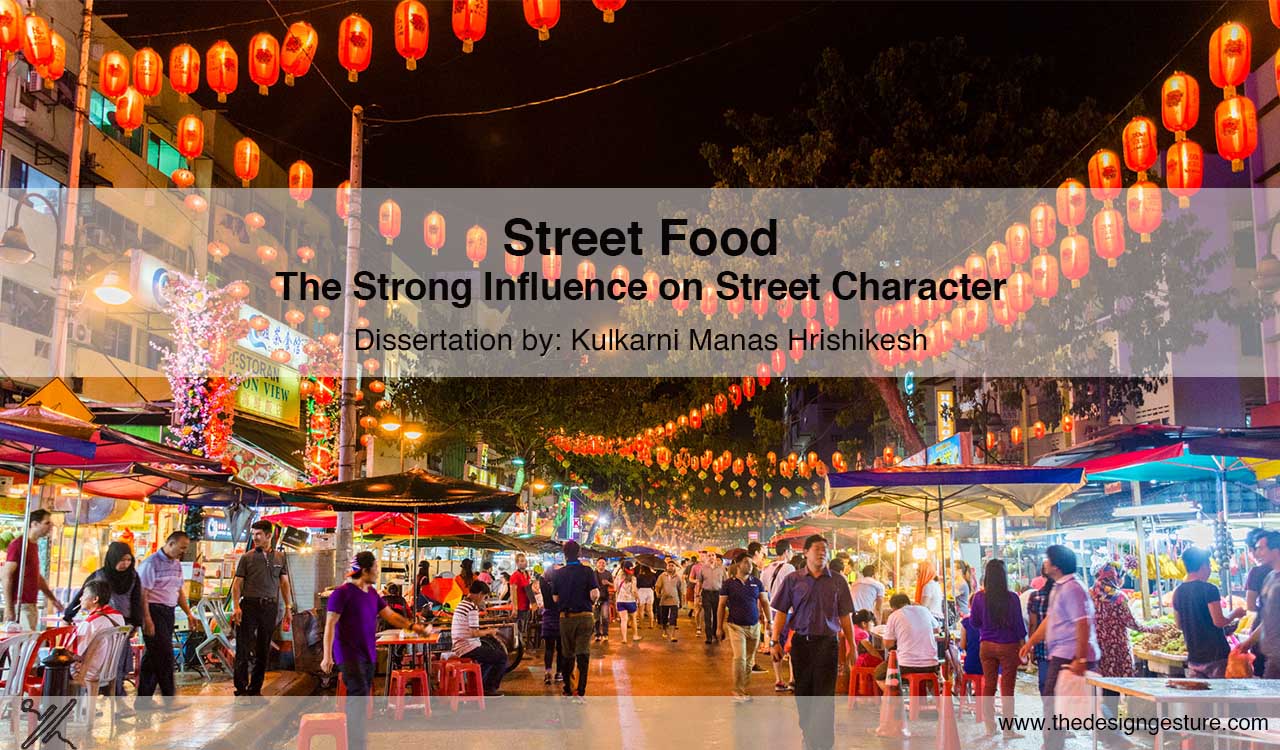
The street has been an integral part of urban activities for many decades. One of the major activities that define a bustling street in an urban context is the street food vending. This activity has evolved in the city of Pune as Khau–Galli or Food Streets. The character of these streets differs from others as they employ various systems for their functioning and their users vary in numbers and types are. However, because of the urbanization of the city, the streets are losing favour because of issues of congestion and hygiene amongst the few. Though Khau–Galli caters to large strata of society, they may get demolished in the new urban wave of development. This study aims to analyse the working and perception of these streets and their character on various user groups and finding how can these streets can be maintained, absorbed and retained in an urban city by proposing basic guidelines for an ultimate urban Khau Galli.
Keywords:
Street food, street character, street function, evolution, urban design
Aim
Analyzing the effects of street foodscape and its role in the evolution of surrounding areas.
To find the relationship between originator activity and the street food vending activity.
To find the various uses that this space addresses.
Methodology
Word Count 300-350 words
Scope
To study the usage and systems employed in a khau galli.
Documentation and analysis of various aspects as user experience, space usage, etc.
Limitations
The study will mainly deal with the street character and secondary study will deal with the effects on built character of the street due to the activities on the street.
The comparative analysis study will be limited to traditionally evolved and old khau gallis situated in the pune city.
Conclusion
After drawing out the above mentioned inferences and study of the earlier data. Following conclusions can be drawn which may be seen as basic guidelines for a Khau Galli to be an effective urban insert.
Now, this urban space should not only attract people and generate business for the traders but should also-
Be a place of celebration.
Provide social, cultural and recreational activities.
Build new associations between people and space.
Be a safe haven for dwellers nearby.
Provide a living to the economically weaker sections of the society.
Be affordable and versatile.
Be a breathing space in neighbourhood.
Develop an effective system of waste disposal so that minimum food is wasted.
Keep traditions of age old Khau Galiis alive.
Blend in the surrounding atmosphere or environment of the neighbourhood.
Heat Regulating Strategies in Nature That Architecture Can Take Inspiration From To Achieve Thermal Comfort Within Buildings
Abstract
In today’s world, there is a search for an architecture that is meaningful within its context and at the same time participates in the more universal aspects of a contemporary mobile society. It is an approach to architecture that strives to counter city level issues and lack of identity in Modern Architecture by using the building as one of the element. Today, iconic building which can be considered as the existential foothold dominated most of the cities in the world. The buildings which are identified in their places and conceived as iconic buildings are usually appreciated not only by professionals but also societies.
However, it needs to be investigated what exactly contributes to the cognitive image of such buildings to society and what are the different aspects that help make a building iconic. This study examines the Role of Architecture (buildings) in giving identity and economic boost to a city or region, with an objective to investigate outstanding examples from past and present which have given economic boost or helped city revive from its downfall through architecture and also to explore the aspects or ways which help structure become an icon. Under this scope certain iconic buildings which contribute to city identity and architecture will be selected and analyzed regarding their form, location, relationship with context, design principles and its contribution towards society with respect to economic development.
The case studies selected were the Sydney Opera house, Bilbao Guggenheim museum, the Gherkin tower (London) , Burj-al-Arab (Dubai), the Louvre pyramid (France) and other cases that failed in creating iconic effect. The findings from the research show that factors of spatial organization, time organization, general design principles, building shape and form, building materials, location, program brief, marketing strategies and relationship with context are effective factors in creating architecture identity and giving Image to the city. It was also observed that these buildings help to trigger economic development directly and indirectly towards its society through tourism, employment, surrounding development due to construction, thus attracting other area of business.
The dissertation concludes with observations related to the factors that contribute in giving identity to a city. It proves that Architecture through construction of emblematic buildings, plays an important role in giving identity and economic boost to a city or region.
To explore the role of architecture in giving identity and economic boost to a city or region.
Objectives
To find out and investigate outstanding examples from past and present which have given an economic boost or helped the city revive from its downfall through architecture.
To find out aspects which help in creating identity , making the structure an icon and thereby helping in economic development.
To identify aspects or ways in which the economy improves not only through tourism but by other ways too
To explore the aspects or ways which help structure become an icon.
Methodology
The method adopted is that of Case Study Research using secondary data sources. The study includes an analysis of ten such examples .
Scope
The study would lead to the identification of unique and modern architectural styles and the factors that are to be considered making iconic architecture
Limitation
The limitation of the study is its excessive reliance on published literature
Conclusion
Earlier the most important buildings were the Cathedrals and Town hall, however today the culture has shifted towards more cultural and commercial language. The innovative architectural buildings which known as an iconic building is the key role to identify and create a new perception for place. In fact, the design of iconic building and place has a significant relationship with each other.
The ‘Bilbao Effect’ not only inspired others but also reminded us of architecture being one of the catalyst for creating global identity, new image and positive economic impact for that region. However, not every building trying to achieve ‘Bilbao Effect’ was successful. It’s not just the design that helps in acquiring an iconic image but there are other factors that also need to be planned and implemented before construction of such large-scale projects like external accessibility, internal mobility, investment in human resource and technological innovations.
The study investigated the spectacular characteristics of iconic building such as innovative, uniqueness, being first, new image and extraordinary representation. The study has helped one to understand the concepts of identity and the factors that contribute to the image of buildings. The research deliberates the culture and history of place, architectural characteristics of an iconic building that let the development of architecture of cities, the power of place in the formation of an iconic building, as the particular aspects of design which designer should be considering about it via the image and representation of the building.
Factors like form, material, location, time, context, marketing strategies are found to be more influential factors in the process of image formation of a building. Most of these iconic buildings are so fascinating because the shape, size, or the ideas are materialized for the first time in an extraordinary manner, thus making them a novelty. Construction of Emblematic buildings and structures also helps to trigger economic development through tourism, employment, surrounding development because of construction and thus improving the general image of the region and thus attracting other area of business. Architecture thus plays an important role in giving identity and economic boost to a city or region.
Role of Architecture in Giving Identity and Economic Boost to a City or Region
Abstract
In today’s world, there is a search for an architecture that is meaningful within its context and at the same time participates in the more universal aspects of a contemporary mobile society. It is an approach to architecture that strives to counter city level issues and lack of identity in Modern Architecture by using the building as one of the element. Today, iconic building which can be considered as the existential foothold dominated most of the cities in the world. The buildings which are identified in their places and conceived as iconic buildings are usually appreciated not only by professionals but also societies. However, it needs to be investigated what exactly contributes to the cognitive image of such buildings to society and what are the different aspects that help make a building iconic.
This study examines the Role of Architecture (buildings) in giving identity and economic boost to a city or region, with an objective to investigate outstanding examples from past and present which have given economic boost or helped city revive from its downfall through architecture and also to explore the aspects or ways which help structure become an icon.
Under this scope, certain iconic buildings which contribute to city identity and architecture will be selected and analyzed with respect to their form, location, relationship with context, design principles and its contribution towards society with respect to economic development. The case studies selected were Sydney Opera house, Bilbao Guggenheim museum, Gherkin tower (London), Burj-al-Arab (Dubai), Louvre pyramid (France) and other cases that failed in creating iconic effect.
The findings from the research show that factors of spatial organization, time organization, general design principles, building shape and form, building materials, location, program brief, marketing strategies and relationship with context are effective factors in creating architecture identity and giving Image to the city. It was also observed that these buildings help to trigger economic development directly and indirectly towards its society through tourism, employment, surrounding development because of construction, thus attracting other area of business.
The dissertation concludes with observations related to the factors that contribute in giving identity to a city. It proves that Architecture through construction of emblematic buildings, plays an important role in giving identity and economic boost to a city or region.
Keywords:
Architecture, identity, Iconic characteristics, economic development
Aim
To explore the role of architecture in giving identity and economic boost to a city or region
Objective
1. To find out and investigate outstanding examples from past and present which have given an economic boost or helped city revive from its downfall through architecture.
2. To find out aspects which help in creating identity, making the structure an icon and helping in economic development.
3. To identify aspects or ways in which the economy improves not only through tourism but by other ways too
4. To explore the aspects or ways which help structure become an icon
Methodology
The method adopted is that of Case Study Research using secondary data sources. The study includes an analysis of ten such examples.
Scope
The study would lead to the identification of unique and modern architectural styles and the factors that are to be considered making iconic architecture
Limitations
The limitation of the study is its excessive reliance on published literature
Conclusion
Earlier the most important buildings were the Cathedrals and Town hall, however today the culture has shifted towards more cultural and commercial language. The innovative architectural buildings which known as an iconic building is the key role to identify and create a new perception for place. In fact, design of iconic building and place has a significant relationship with each other.
The ‘Bilbao Effect’ not only inspired others but also reminded us of architecture being one of the catalyst for creating global identity, new image and positive economic impact for that region. However, not every building trying to achieve ‘Bilbao Effect’ was successful. It’s not just the design that helps in acquiring iconic image but there are other factors that also need to be planned and implemented before construction of such large-scale projects like external accessibility, internal mobility, investment in human resource and technological innovations.
The study investigated the spectacular characteristics of iconic building such as innovative, uniqueness, being first, new image and extraordinary representation. The study has helped one to understand the concepts of identity and the factors that contribute to the image of buildings. The research deliberates the culture and history of place, architectural characteristics of an iconic building that let the development of architecture of cities, the power of place in the formation of an iconic building, as the particular aspects of design which designer should be considering about it via the image and representation of the building.
Factors like form, material, location, time, context, marketing strategies are found to be more influential factors in the process of image formation of a building. Most of these iconic buildings are so fascinating because the shape, size, or the ideas are materialized for the first time in an extraordinary manner, thus making them a novelty.
Construction of Emblematic buildings and structures also helps to trigger economic development through tourism, employment, surrounding development due to construction and thus improving the general image of the region and thus attracting other area of business. 66 Architecture thus plays an important role in giving identity and economic boost to a city or region.