

Tag: architecture design

  • Small Bathroom, Big Impact: Clever Remodeling Ideas for Compact Spaces

    Small Bathroom, Big Impact: Clever Remodeling Ideas for Compact Spaces

    Transforming a small bathroom into a functional and stylish space is a common challenge faced by many homeowners. Limited space doesn’t have to limit your creativity or the bathroom’s potential. With thoughtful design and clever remodeling ideas, even the most compact bathrooms can be turned into serene and practical spaces. This article will explore a variety of remodeling tips and tricks to help you maximize your small bathroom’s space and style.

    Utilizing Space Wisely for Small Bathroom
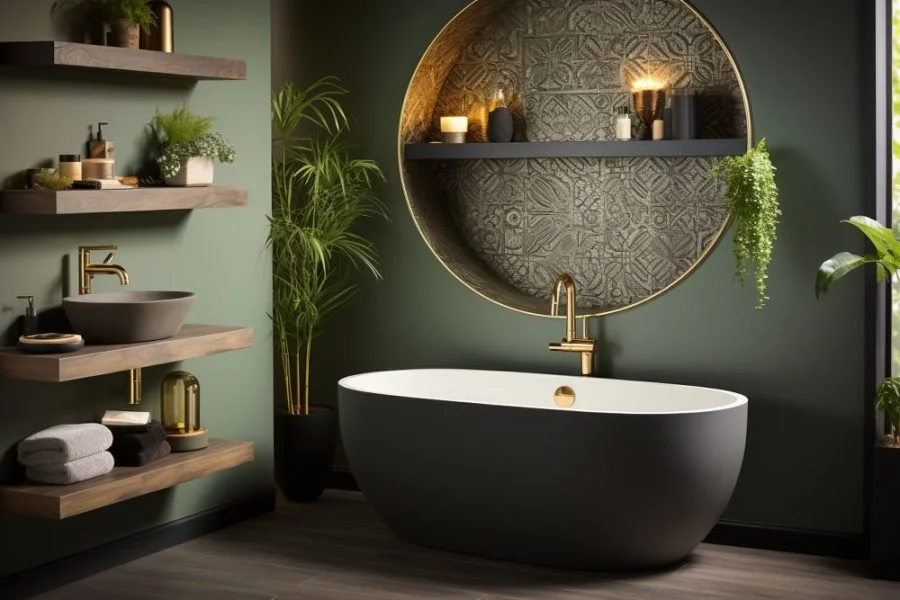
    small bathroom

    In small bathrooms, every inch counts. Opt for a corner sink or a floating vanity to open up floor space. Recessed shelving and medicine cabinets provide storage without crowding the room. A corner shower can be more space-efficient than a tub. Over-the-toilet storage racks or cabinets are excellent for utilizing otherwise wasted space. Sliding or pocket doors save more space than traditional doors. Also, consider wall-mounted fixtures like toilets and sinks, as they allow for more visible floor area, giving the illusion of a bigger room. These strategic choices in layout and fixtures can make a significant difference in optimizing the limited space of a small bathroom.

    Choosing the Right Color and Lighting

    Color and lighting play pivotal roles in enhancing the perception of space in a small bathroom. Light, neutral colors like whites or pastels make the area feel more open and airy. Glossy or semi-gloss finishes can reflect light, contributing to a brighter space. Large mirrors, strategically placed, can double the impact of light and give an illusion of depth. Opt for multi-layered lighting: a combination of overhead lights for general illumination and task lights near the mirror. Consider a skylight or frosted glass windows for natural light, which can make the bathroom feel more spacious and inviting.

    Innovative Storage Solutions
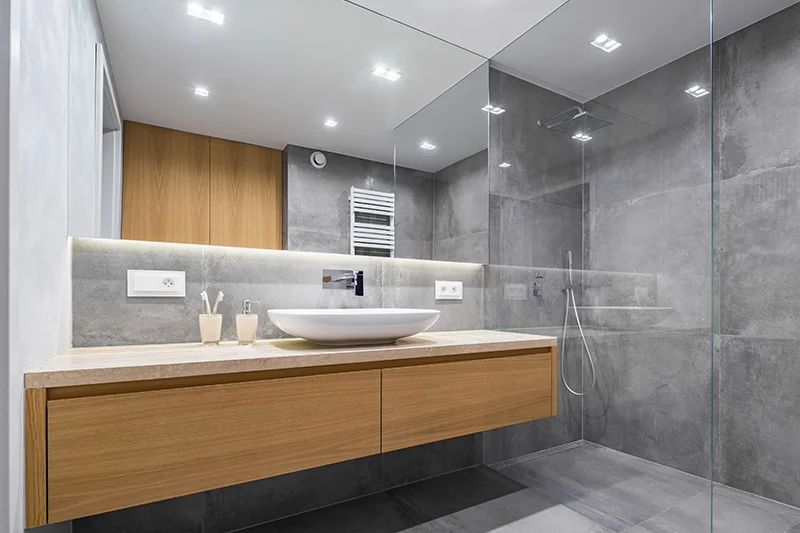
    Small Bathroom, Big Impact: Clever Remodeling Ideas for Compact Spaces Transforming a small bathroom into a functional and stylish space is a common challenge faced by many homeowners. Limited space doesn't have to limit your creativity or the bathroom's potential. With thoughtful design and clever remodeling ideas, even the most compact bathrooms can be turned into serene and practical spaces. This article will explore a variety of remodeling tips and tricks to help you maximize your small bathroom's space and style.

    Effective storage solutions are crucial in small bathrooms to avoid clutter. Utilize vertical space with tall, narrow cabinets or open shelving. Wall-mounted baskets and hooks can hold towels and toiletries without taking up floor space. Consider a vanity with built-in storage or under-sink organizers to keep essentials tidy. Recessed niches in shower walls offer space for bath products, maintaining a sleek look. Magnetic strips on walls can hold small metal items like tweezers and scissors. Opt for multifunctional pieces, like a mirror cabinet, to maximize utility. Creative, space-saving storage solutions can significantly enhance functionality and aesthetics in a compact bathroom.

    Making a Statement with Fixtures and Tiles

    In a small bathroom, fixtures and tiles offer an opportunity to add character and style. Choose bold, patterned tiles for the floor or a feature wall to create a focal point. Geometric patterns or bright colors can inject personality into the space. Select sleek, contemporary fixtures in finishes like matte black or brushed nickel for a modern touch. A statement sink or an unusual faucet can become a centerpiece. Consider scale when selecting tiles; larger tiles can make the space feel more expansive. Thoughtfully chosen fixtures and tiles can turn a small bathroom into a stylish and memorable space.

    Walk-In Showers: A Space-Saving Luxury

    For many, a grand rapids walk-in shower can be a game-changer in a small bathroom. Walk-in showers are not only a luxurious addition but also a practical choice for compact spaces. They eliminate the need for bulky tubs and can be custom-designed to fit any space. Opt for clear glass doors or even a doorless design to make the bathroom appear larger. Stylish, space-efficient, and accessible, a walk-in shower can add immense value and functionality to a small bathroom.

    The Illusion of Space with Glass and Reflections

    Glass and reflective surfaces are excellent for creating an illusion of space in a small bathroom. A glass shower enclosure opens up the area, as opposed to shower curtains, which can segment the space. Mirrored surfaces, whether on cabinets or as large wall mirrors, reflect both artificial and natural light, visually expanding the room. High-gloss tiles or shiny fixtures can also contribute to this effect, making the bathroom appear larger and more open. Using these elements strategically can transform a cramped bathroom into a seemingly more spacious and inviting area.

    Smart Technology for Enhanced Functionality

    Incorporating smart technology can significantly enhance the functionality of a small bathroom. Digital showers offer precise temperature and flow control, adding a touch of luxury and convenience. Motion-sensor faucets and lights provide hands-free operation, saving space and increasing hygiene. Heated floors or towel racks add comfort without occupying additional space. Even smart toilets with integrated bidets can save room while offering advanced features. These tech-forward additions not only optimize the use of space but also bring a modern, efficient edge to your bathroom, making it more comfortable and user-friendly.

    Maximizing Natural Light

    Natural light can transform a small bathroom, making it feel more open and airy. If your space allows, consider a skylight or a frosted window to let in sunlight while maintaining privacy. Even small windows can be maximized with light-colored window treatments that allow light to filter through. Reflecting natural light off mirrors and shiny surfaces can further brighten the space, creating a more expansive feel. Embracing natural light not only enhances the aesthetics of your bathroom but also promotes a more energizing and welcoming atmosphere.

    Eco-Friendly Features

    Incorporating eco-friendly features into your small bathroom remodel is not only good for the environment but can also be aesthetically pleasing. Low-flow toilets, faucets, and showerheads conserve water and reduce utility bills. Opt for LED lighting, which is energy-efficient and provides bright, clear light. Sustainable materials like bamboo for cabinets or recycled glass for countertops can add unique style elements while being environmentally responsible. These eco-friendly choices can elevate the overall design of your bathroom while contributing to a greener lifestyle.

    Conclusion

    Remodeling a small bathroom offers a unique opportunity to blend functionality with style. By utilizing space-saving designs, light colors, innovative storage solutions, and modern fixtures, even the most compact bathrooms can be transformed into elegant and efficient spaces. Incorporating smart technology and eco-friendly features can further enhance their utility and appeal. With creativity and careful planning, your small bathroom can make a big impact, proving that even the smallest spaces can be both beautiful and practical.

  • Le Corbusier’s Chandigarh City: India in the Search of Unique Identity

    Le Corbusier’s Chandigarh City: India in the Search of Unique Identity

    India, a culturally and traditionally rich nation today, has been prominent since ancient times. The Britishers invaded India with the greed of robbing the rich. They ruled for about 300 years, yet they couldn’t break the nation, though India (Hindustan) lost its identity. 

    “The identity lost, the hopes lost,

    Nonetheless, Chandigarh Vision provided an answer.”

    chandigarh city
    Chandigarh city

    Chandigarh: The Beginning

    After the independence, the country’s Muslim population was protected from the Hindu majority by leaving colonial masters, who reserved the eastern and northwest regions for their use. It took much longer than 73 days for many of the 100 million or so Muslims who were dispersed throughout India to relocate to these areas, which are now the countries of Pakistan and Bangladesh.

    Sir Cyril Radcliffe divided the state of Punjab between India and Pakistan when he drew the borders for the two nations; Pakistan kept control of Lahore, the state capital. Following this defeat, Punjab established a new state capital that would meet the state’s logistical needs and unmistakably declare to the world that a new, modern, wealthy, and independent India had come.

    chandigarh city
    Image 1: The Newspaper Archive about Chandigarh’s rise on Saturday, April 10, 1948. 

    The Punjabi government went to establish the new capital at Chandigarh, in the north of Delhi. The First Prime Minister of independent India, Jawaharlal Nehru explained, “From existing encumbrances of old towns and old traditions, let this be a new town, symbolic of the past…. an expression of the nation’s faith in the future.”. The Prime Minister, Jawaharlal Nehru of independent India wished to imagine the new capital as progress, and modernity.

    With the development of a new capital in Punjab, the American architects Albert Mayer and Matthew Nowicki were approached. Sadly, due to the sudden death of Nowicki, Matthew also dropped off the project. Once hope was in the air. The Project Directors searched Europe, and Le Corbusier was approached for the project, with Pierre Jeanneret as a site architect.

    Le Corbusier’s Chandigarh City: India in the Search of Unique Identity Eventually, as per the article published in the BBC, Chandigarh city is one the most successful planned cities with a combination of architecture, culture, and modernization.
    Image 2: The photograph at Le Corbusier’s Office in Chandigarh city during the planning alongside to the left to right is Pierre Jeanneret 

    Le Corbusier’s approach to planning was similar to that of the previous plan by Matthew and Mayer. The change was the city’s shape, insisting on curved roads, it was all rectilinear with clean and crisp grids. The modernist approach to city planning is about functionality. As a result, the roads were reworked, and the hierarchy. The city planning observed arterials to pedestrian and bicycle lanes, as 7Vs. This became the sector with a green open space following the north-south direction, while the commercial in the east-west direction. These plans reflect the Garden City Movement and the architect’s concept from the Ville Radieuse. The Ville Radieuse is the solution to free ground pedestrian movement without traffic congestion. 

    Le Corbusier’s Chandigarh City: India in the Search of Unique Identity Eventually, as per the article published in the BBC, Chandigarh city is one the most successful planned cities with a combination of architecture, culture, and modernization.
    Image 3: Le Corbusier’s Chandigarh Map in the year 1951

    The roads define the boundaries of the sectors. The sectors in conjunction with the roads indulged in various public functions. The sectors were further divided into four quadrants. The quadrants included housing. This resulted in a safe household with their schools, shopping centers, businesses, and public spaces. 

    The planned city incorporated residential housing into thirteen categories based on rank and income. yet, every category had a letter identifying the designer and a number indicating its position in the financial structure, but they were all the same in their contemporary, geometric simplicity. Along with perforated screens and, in a few cases, verandahs, the deep overhangs and recesses used for shading provided the main visual appeal in the otherwise monolithically rectangular buildings.

    Le Corbusier’s Chandigarh City: India in the Search of Unique Identity Eventually, as per the article published in the BBC, Chandigarh city is one the most successful planned cities with a combination of architecture, culture, and modernization.
    Image 4: Various Photographs of Chandigarh between 1951 and 1965
    Le Corbusier’s Chandigarh City: India in the Search of Unique Identity Eventually, as per the article published in the BBC, Chandigarh city is one the most successful planned cities with a combination of architecture, culture, and modernization.
    Image 5: Various Photographs of Chandigarh between 1951 and 1965

    The original approach had the capitol complex as the center of the city from the drawings in 1951. Then the change came when Le Corbusier planned the artificial hills between the Capitol Complex and the city, breaking the whole visuality. The urban isolation was there, the Capitol Complex has its own aesthetical and spatial appeal. Le Corbusier combined the traditional classical and Indian elements into the physicality to have a concrete identity for the city. 

    Eventually, as per the article published in the BBC, Chandigarh city is one the most successful planned cities with a combination of architecture, culture, and modernization.

    Chandigarh: A City of Identity  

    As the city had to accommodate about 150, 000 during the initial phase, the population is still on the rise. The approach should be able to meet the water and drainage needs based on the climatic conditions which was also a point of consideration. As the city was divided with an axial approach, the development was divided into phases. The initial phase focused on the development of the sectors with some major avenues towards the Capitol complex with a connecting railway, industrial area, and university. 

    Le Corbusier focused on the Capitol as the head, commercial center, industrial sector, and intellectual center of the city, bringing a biological element to the layout design. He oversaw the city’s architectural direction and created the structures of the Capitol. The senior architectural group’s other three members were responsible for social infrastructure, government housing, municipal buildings, commercial centers, and schools.

    To conceal the homogeneity of the sectors, a protected green belt and tree planting were employed. Chandigarh city was viewed as a low-rise, low-density city with a regular traffic pattern to cut expenses. Every significant architect created their style while adhering to a standard design of regular brick and stone box constructions featuring prisons and brise-soleil.

    Presently, one of the busiest hubs in the nation, Chandigarh city observes heavy traffic congestion that only gets worse as the city gets more and more urbanized. Over time, the initial stages of constructed bulls and spaces have become outmoded contemporary demands and scenarios. 

    Chandigarh City: The Contemporary 

    With the passing of time and the advent of technology, Chandigarh city got its new plan in the year 2015, to meet the need for expansion and growth. However, during these years unplanned development has seen resistance. As planning is indeed, to carry forward the past, Le Corbusier’s Planning will add up to the future planning approach. 

    The recent urbanization in Chandigarh city has changed the core. The outskirts development of recent times has been adversely affected by various factors such as high rates of land prices, housing shortage, the socio-economic aspect of the city, and growth as a city. 

    Hence, the smart city approach alters the original plan to suffice the upcoming challenges and needs of the rapidly increasing population. The city has taken steps towards this transformation with transit and people, improving the pedestrian walking experience and public spaces. 

    Given the complexity and high technological requirements of modern design, it could have been challenging to take on such a large project alone today. Le Corbusier, however, managed construction-related matters alone to keep others from influencing his theories through conversation. He was hardly a climate expert when it came to burning winds, the monsoon, and uninsulated concrete. Like this, at the municipal level, zoning regulations and the solitude of streets and avenues deter intensive urban activity. The city is a succession of images, its rigid, inurbane nature. 

    Le Corbusier’s Chandigarh City: India in the Search of Unique Identity Eventually, as per the article published in the BBC, Chandigarh city is one the most successful planned cities with a combination of architecture, culture, and modernization.
    Image 6: Chandigarh Map- City Master Plan 2031

    However, Chandigarh city is significantly more for what it might have been than for what it is now, much like most of his innovative ideas that have inspired countless architects throughout the years.