
Tag: built environment

  • Unraveling the Importance of Spatial Heterogeneity

    Unraveling the Importance of Spatial Heterogeneity

    CONCEPT OF SPATIAL HETEROGENEITY-

    Understanding Spatial inequality or spatial heterogeneity is a major need of the hour, stating the different verses of differences. In terms of socioeconomics, this condition impacts the major sectors of healthcare, infrastructure, public services, welfare, and so on. Such distribution occurs in, Urban- Urban, Urban-Rural divide, majorly where the differential factor is more, even being the part of the same geographical unit. This heterogeneity has also affected the population health, and understanding the wide inequality of provisions can act as a support for the development of policies, strategies, and interventions acting for the morbidity and mortality of different diseases. 

    SPATIAL HETEROGENEITY THROUGH SOCIAL LENS

    While talking in terms of socio-spatial inequalities, they spread all over the world, which were created due to the differences in social and economic patterns. Even though it cannot be easily seen through naked eyes being on the ground, but when we take up a look from a different perspective we can understand that the reality is far away from what we see every day. The difficulties people face problems to live due to the extremities in wealth and privileges provided.  

    PERSPECTIVE OF BUILT ENVIRONMENT

    In terms of Town and Urban planning, architecture, and civil engineering, we refer to the built environment as the man-made surrounding which helps the societies to settle down providing a variety of provisions such as shelter, buildings (commercial, residential, institutional, etc.), streets, walkways and so on. But when we link spatial inequality with the built environment, a different world can be imagined.

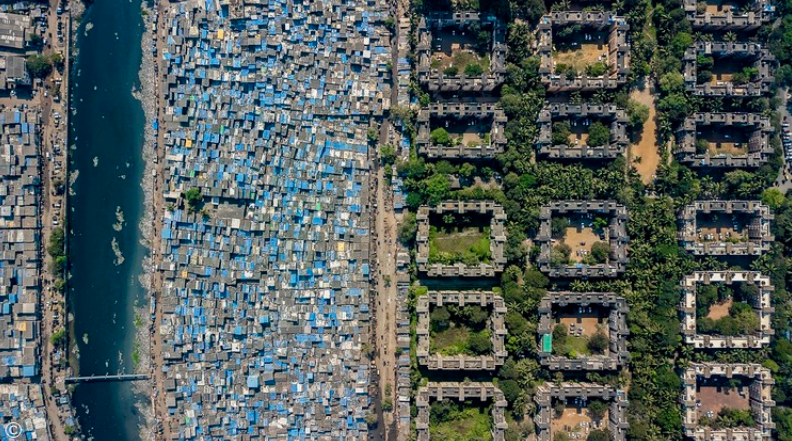
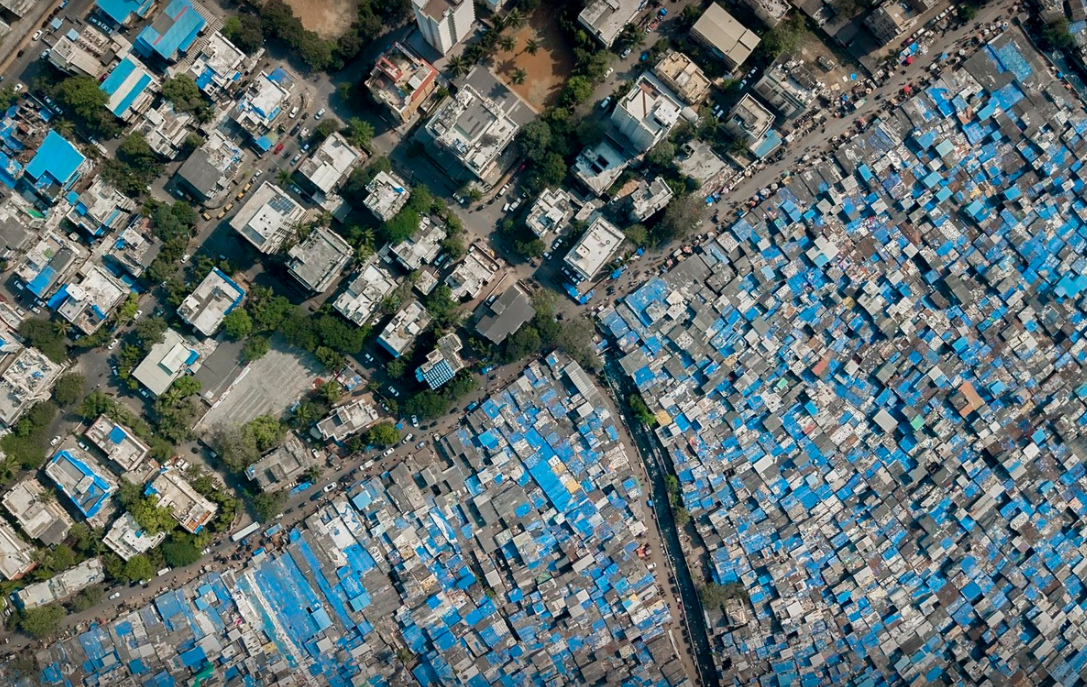
    According to some influential scholars, researchers as well as photographers a study could be analysed, how much discrepancy occurs just because of the difference in the standard of living of people creating spatial inequality to its extreme? A very famous photographer Johnny Miller took a view above a ground, aerial view of few countries and led to the conclusion that this thought of people has led to an unequal patch of the built environment.
    Spatial Heterogeneity
    Figure Mumbai, Índia. Image © Johnny Miller Photography

    ECOLOGICAL IMBALANCE – A CAUSE TO TALK ABOUT-

    This inequality has led to the ecological imbalance too, by creating a difference in the use of resources and availability of resources in some places becomes a burdened situation on the environment as well. Most of the factories built nearby water bodies have created a really bad impact on them whereas the “so-called, economically backward” areas experience a shortage of water.

    This is really an alarming situation all over the world where people should understand how much homogeneity and uniformity is required in any sector, instead of which we people are trying to create bars of differences and creating non uniform patterns leading to an ill effect on the environment and indirectly or directly impacting us, worsening with the progressing days. Hard to accept but yes, the mentality and thought process of people is getting corrupted with time formulating some such disturbing situations for the whole world.

    Africa
    Campo de Golfe Papwa Sewgolum, Durban, África do Sul. Image © Johnny Miller Photography
    Mumbai
    Mumbai, Índia. Image © Johnny Miller Photography
    LIVE EXAMPLES OF THE SCENARIO

    It’s really heart breaking to see people die just due to the lack of healthcare facilities which is again a result of spatial inequality being consistently maintained. Few of the live examples are proof of how all this has impacted our cities, let’s see some of them.

    HUBLI- DHARWAD

    “The twin cities” the reason behind taking up this is due to its historical emergence as a twin city and then with time getting transformed into a neoliberal urban area with a set of various policies such as democratic decentralization, introducing e-governance system and majorly privatization of water. It’s the area is located on the Mumbai- Bangalore corridor, which is an Urban- Urban divisional space. This area is known to be the 3rd largest urban centre after Bangalore and Mysore. The two cities, Hubli and Dharwad are distant by 18kms from each other but are governed under a single administrative unit which was united under Hubli- Dharwad Municipal Corporation (HDMC) in the year 1962.

    There is another city located on the way from Hubli to Dharwad namely, Navnagar, known for being agriculturally rich and getting upgraded into an Urban activity center. According to the administration, Navnagar comes under the Dharwad municipal division, famous for being the first city of Karnataka to get privatization of water done for 24X7 and setting up ward committees all over the 67 different wards providing e governance system for the public grievances, But what about the inequality occurring as constraints in the growth of the cities, taking place in the undulating terrain and creating a Spatial gap impacting the location of different facilities.

    Now, this contrast the “SLUMS” came into existence. Now they are the ones lagging and facing the taxing situations in the sectors of healthcare, connectivity, sanitary issues, and much more, Isn’t it what we gained from Spatial inequality. Now, this is how they have affected the facilities and provisions, let’s move on to a new reformation of cities over history.

    Hubli-Dharwad
    Hubli-Dharwad growth map@ Google earth image

    SURAT

    “the city of diamonds and textiles”. The city is internationally famous for these two industries and has caused some surprisingly high growth in few years. This spatial development occurred over years but has caused an alarming situation for the environment, being situated in the eco-sensitive areas it is a very crucial point to be kept in mind, not to be harmful to the areas of Arabian sea on one side and lower mangrove area on the other side. It was a difficult situation to tackle as towards west(Arabian sea) it was not possible to expand the city, so people started targeting the southwest area(towards lower lying waterbody and mangroves) due to lower land prices, creating rupture of rules and regulations.

    The expansion took place connecting the city to the Navsari area, but the environment was still in a state of concern. Many of the developers came into the picture and moved into this area to take over the development process, taking advantage of the rupture which had occurred. This caused the spatial juxtaposition as both Navsari and Surat have their peripheral region to be expanded. This still creates alarming conditions all over the south-western region which is highly eco-sensitive but is trapped under the rent-seeking contractors and developers enforcing real estate projects taking advantage of the low-cost lands, but causing very ill effects on the environment.

    Now, this was the situation where we could see how bad the condition is occurring due to the spatial inequality in both the cities, Surat and Navsari, even leading to political conflicts as well. Let’s have a look at another city with almost a similar situation but degrading at a faster rate.

    Urban expansion of Surat City | Download Scientific Diagram
    Topomaps by US Army maps services 1955, Landsat 2000 and Google earth 2012

    INDORE

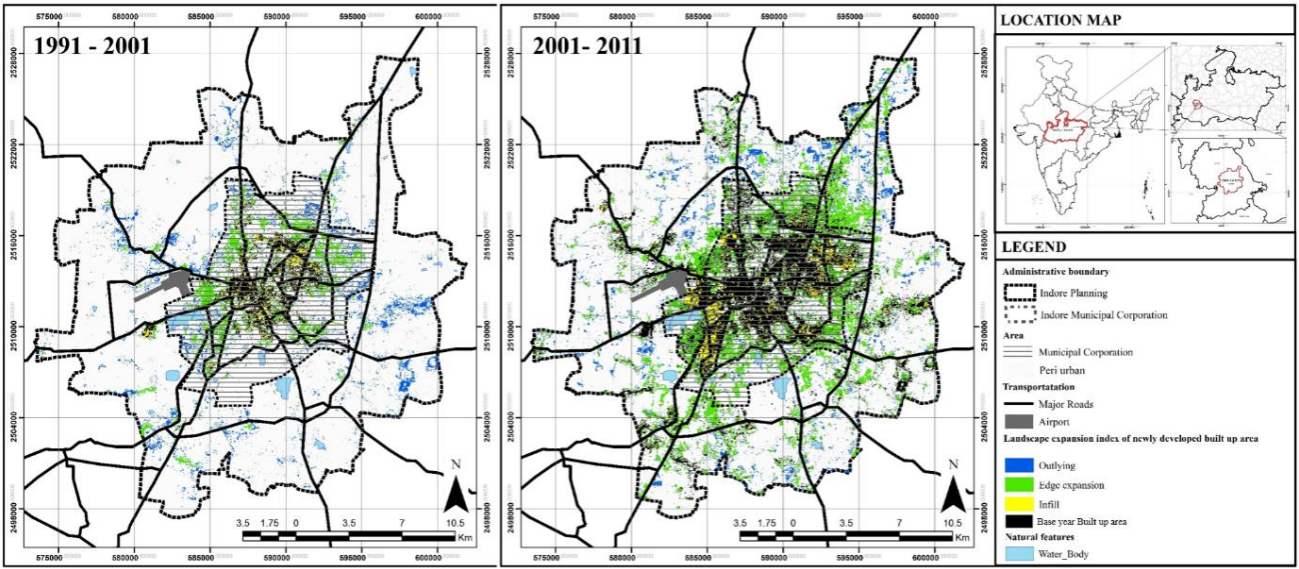
    “the mini Mumbai”. The city located in Madhya Pradesh has been the fastest-growing metropolitan city with a very dense concentration of economic activities going on there. The application of spatial inequality or in other words, Neoliberal Urbanism is heavily exhibited in the area creating a variety of situations. In accordance with the JNNURM, allowance for private participation and providing flexibility for managing land was approved. With the ongoing process, a major part of declination occurred in the agricultural field of action by 14 percent reduction of land.

    This made the village panchayats provide a no-objection certificate through the ruptured method with non-regular or illegal processes to the rent-seeking developers to have an approach easier to dealing with the areas. Unwantedly and unplanned development have occurred leading to expansion of areas which are majorly the contribution of these private developers and the rest done by the MP housing board and the governmental bodies of Indore. Now the question arises, how come it is harmful to proceed with Spatial Inequality in it? The very much relevant answer is the declination of agricultural lands, converting them into real estate projects. This has induced an imbalance in the ratio of built and unbuilt environments causing discrepancies.  

    All these cities being the metropolitan areas are on a major hold of this situation but then they are encouraging rent-seeking developers through the ruptured legal bodies misusing the neoliberal urbanism. Had it been done in a planned and proper manner, it would have occurred at a correct pace and would not have created the differences which occurred due to the heterogeneity in spaces, infrastructure, and public provisions as well.

    In accordance to researchers and scholars observing the historical development of cities, practically visible through aerial perspective, analysed by world-famous photographers and through the historical up-gradation of maps. These things have led to the conclusion, in some cities where agglomerations took place in an unsystematic manner have led to drowning the quality of our ecosystem creating spatial imbalance and unnecessary expansions in the eco-sensitive zones making our environment much more vulnerable and at a greater pace than expected.

    This as stated earlier has resulted in so much inequity also in terms of provisions that are majorly designed for the betterment of humans especially healthcare and infrastructure. Is it really what we want our life and living to be like? Is it what we want for our future generations? No, none of us prays for our life to be like this, all we want is to have a good and desired life and betterment for our future generations, but can we be a bit less self-centred this time? Can we just think of the coming future, the present condition of nature, just for the sake of our development we have forgotten the essence of life and nature and just going on and on with the unnecessary experiments on our nature?

    Let’s raise a voice against the Misuse of spatial inequality and use the concept to lead a good life and a better environment, joining hands against all the ill practices, fractured regulations, and non-regular methods.
    Analysing Spatial Growth
    Analysing Spatial Growth in peri urban areas using spatial metrics: A case study of Indore, AMAN SINGH RAJPUT

  • Hacking Your Habitat: Neuroarchitecture Tips for a Better Design

    Hacking Your Habitat: Neuroarchitecture Tips for a Better Design

    These days, humans spend most of their time indoors rather than working or relaxing exposure to the outdoors is becoming quite less popular, so the architecture has a big influence on people’s bodies and minds. Every year, more and more new research on neuroarchitecture is published, which suggests that people are becoming more interested in learning how the environment impacts people’s quality of life. Furthermore, to investigate and maximize these effects, architecture firms are progressively utilizing the knowledge of researchers and human experience design consultants.

    Neuroarchitecture
    Neuroarchitecture: Image Source

    These innovations and breakthroughs are platforms for people to dwell in and study the relationship between humans and the built environment. However, neuroarchitecture can be defined as any built environment that has been designed whilst following principles derived from neurosciences, thus helping to create spaces that benefit memory, improved cognitive capacity, and mental stimulation, while simultaneously avoiding stress. 

    Origin of Neuroscience

    Researcher Jonas Salk was experiencing a mental block, so he went on a holiday to Assisi, where he found the key to the discovery of the polio vaccine.  Convinced that the design of the Italian city had provided the right surroundings to allow his ideas to flow, he contacted the architect Louis Khan to create a research center that would reproduce these conditions and which would encourage creativity among the researchers. The Salk Institute was inaugurated in 1965, setting a benchmark for spaces in neuroarchitecture.

    However, the seminal finding for architecture came from neuroscientist Fred Gage, who became interested in how our environment affects the structure and function of the brain after learning in 1998 that the brain continues to produce neurons into adulthood.  To “investigate what the design of a space in the 21st century needs to be like to improve our wellbeing, increase performance, and reduce stress and fatigue in the cities,” the next step was to cofound The Academy of Neuroscience for Architecture with John Eberhard.

    Guide to Neuroarchitecture

    Chronobiology 

    Sunlight affects how well circadian rhythms (physical, mental, and behavioral changes that follow 24-hour cycles) work throughout the day and the seasons, and the immune and endocrine systems need to be regulated. Lack of light can lead to a variety of problems, including changes in the sleep-wake cycle, exhaustion, difficulty concentrating, depression, stress, and more.

    People’s moods and activities are also influenced by variations in the amount and color temperature of natural light: warm light promotes relaxation, while cold light stimulates. Simultaneously, intense lighting stimulates excitement, which leads to an increase in activity and a lift in mood. Low intensity encourages rest.

    Ceiling Height

    Research revealed that ceiling height influences behaviour and problem-solving skills by evoking various mental processes.

    Low ceilings increase concentration and activate a more concrete, focused, and detail-oriented type of thinking, while high ceilings encourage conceptual thinking and activate a sense of freedom and imagination that stimulates creative thinking.

    Connection to Outer Spaces

    The possibility of having a view of the outside enhances individuals’ well-being and mental state, particularly if that outside area is a natural one. Greenery appears to have the greatest impact, and urban vistas don’t seem to compare well to bodies of water. The more access to green spaces positively influences individuals’ productivity. 

    Proxemics

    Proxemics is the study of people keeping physical distance from one another to stay in a comfort zone that is determined by their mutual relationship and the type of interaction they have. Intimate, personal, social, and public are the four fundamental categories of spatial distance. Distinct levels of discomfort arise from any infringement upon these boundaries of personal space. It appears that people’s social environments, where private spaces have significantly decreased in recent years and replaced with public areas, align with the workplace.

    Eye Contact

    The foundation of human connections, both biologically and culturally, is eye contact. “Mirror neurons,” are an essential part of socialization, light up when they see other people and respond more strongly when they come into direct contact with each other. By looking at one another, we can get feedback from those we are speaking with, as well as communicate synchronicity and gauge each other’s moods.

    The likelihood of making eye contact can be affected by various factors, like the arrangement of equipment spatially, which can either maximize or minimize the opportunities for socialization and interaction.

    Noise

    Office noise is a big source of stress, distraction, decreased productivity, and unhappiness among coworkers. Noise-induced stress can cause the body to release cortisol, a hormone that aids in the body’s return to balance after an unpleasant event. Overconsumption of cortisol alters our ability to think clearly and remember information by interfering with emotional processing, learning, reasoning, and impulse control.

    Morphology

    A workplace’s materialization in various forms can produce tactile cues. According to a Harvard Medical School study, people prefer curves and soft outlines over sharp ones because they are naturally afraid of sharp objects. The study also found that when people looked at sharp objects, their amygdala became more active. It follows that while soft and rounded shapes may satiate our emotional need for safety and security, angular shapes are beneficial for alertness and concentration.

    Principles of Neuroarchitecture

    When talking about neuroarchitecture, light, and smell are inseparable aspects to consider. Both light and smell are connected to the human mind and body which reflects on the actions and responses of human beings. Some various studies and research give an overview of how humans and light are connected reflecting human behavior and mood. 

    Natural Light
    Natural Light is Essential to the Organism’s Physiological Temporal Organisation_©www.validus.construction

    The other principle of neuroarchitecture is learning focusing on the physicality of the environment and surroundings. The third principle of neuroarchitecture is decision-making. It’s important to decide what items make us happy and what should be thrown away. The next action is to provide those unsightly goods that are piled on the counter with some covert storage.

    neuroarchitecture
    Integrating Evidence-Based Design for Better Outcomes_©www.hksinc.com

    The fourth principle of neuroarchitecture is about new experiences in neuro-architecture. These days, research on neuro-architecture and the advancement of technology can reveal how human bodies and minds respond to the built environment.

  • Built Environment and Mental Health: Interesting Impact of Building Design on Human Psychology

    Built Environment and Mental Health: Interesting Impact of Building Design on Human Psychology

    The built environment around people, directly and indirectly, affects them. Poor housing quality leads to psychological distress. Living in an area that is too congested may have unfavorable effects on a person’s wellbeing. Design elements have a direct connection with a person’s psychological health and they also help a person navigate space. 

    Living in loud spaces or tiny apartments may create psychological disorders but won’t produce mental illness. Toxins emitted because of air pollution cause behavioral disturbances. Lack of adequate sunshine is also a cause of depressive symptoms. The physical environment alters psychosocial processes and, hence, influences mental health. The constructed environment has a significant effect on personal control, socially supportive connections, and recovery from stress and exhaustion. To investigate the influence of the physical environment on mental health, more prospective, longitudinal research and realistic, randomized trials are required.

    The issue of building basic theories on how the built environment affects mental health is much more difficult. It is also possible that certain people are more sensitive to the mental health effects of the built environment. We also need to pay greater attention to the health implications of various environmental risk exposure, since exposure to poor environmental conditions is not distributed randomly and concentrates among the poor and ethnic minorities.

    built environment
    Photo by Dezeen

    Designing For Built Environment Services

    A holistic conceptual model for designing the built environment for mental health services will improve treatment outcomes and experiences, benefit families and the community, and promote community resilience. The built environment can stimulate or avoid mental strength. Attachment towards a locality refers to the psychological and social connections humans feel with positive locations—their homes, the settings in which they grew up, and others. The conditions of modern-day lifestyles place extraordinary demands on us and regularly exhaust our ability to pay interest. 

    Having greener settings can relieve mental fatigue and contribute to repairing a person’s ability to pay interest. Crowded, noisy, and dangerous locations have an increase in adverse effects on humans and their mental states, fostering, for instance, pressure, anxiety, melancholy, and violent behavior. Some locations draw humans collectively and, for this reason, support the improvement of social ties and decorate the development of social capital. Places that inspire physical interest can both prevent and treat mental illness. High walls promote gloominess. Windows that are narrow and inaccessible show limited views. The surroundings of the built environment should be pleasant. 

    Nature Therapy

    Before modern pharmacological treatments, it was said that a variation of the surrounding environment might be good for our health, both mental and physical. After developments in modern medicine, people’s interest in environmental factors was minimized. A pill or talk therapy was considered as a solution, rather than changing the surroundings of a person. Recently, the benefit of nature has seen an increasing interest yet again, with studies focusing on the advantages of green spaces in urban and metropolitan regions. 

    As much as we appreciate nature, we don’t really live like our forefathers. There have been some overwhelming changes in the last three-quarters of the century. For the first time after the Neolithic age, most people are not a part of the agriculture sector. Most of the population lives in towns and cities. The environment we dwell in, its advantages and disadvantages, is mostly artificial. Considering the lifestyle people indulge in today, we spend most of our time in built environments instead of nature. Most of us, sick or well, spend time in a built environment.

    Architect’s Role in Built Environment

    For a long time, developers’ offers have paid limited regard for people’s happiness. Researchers found that only 4% of the architectural practices do post-occupancy assessments, and only 22% frequently did. This reveals that a huge share of architects don’t appear to be concerned about what people think or feel about their buildings. It is heartwarming that the number of architects designing for health is seen to be increasing day by day and trying to gather research on the effect of buildings on mental health.

     Many architects have acknowledged mental health issues in their structural projects. Andrew Maynard renovated his Melbourne home to be so open that the amount of sunlight coming into his home forces him to “wear sunglasses inside”. This was a bid to improve his mental health via his vitamin D levels. 

    The issue with all the newly constructed buildings is that most people are only concerned about the aesthetic value of a particular building. The one thing that sells is the ‘WOW’ factor of these buildings. As said by Sir Francis Bacon, “Houses are built to live in, and not to look on; therefore, let ‘use’ be preferred. Leave the goodly fabrics of houses for beauty only to the enchanted palaces of the poets, who build them with small cost.” 

    Whether it is the changing mindset of people, a fluctuating economy, or evolving trends, the architecture, engineering, and construction industry always counters and adapts without postponement. Buildings and built-in interiors can be designed aesthetically, allowing privacy while allowing for social interaction, providing access to the natural world and natural light, and encouraging everyone’s health. One of the most significant silver linings post-covid is the significant rise in mental health becoming people’s priority. Although, even pre-covid, a subtle change in terms of awareness regarding mental health had already begun. 

    Strategies for Better Environment

    Natural lighting, less glare, increased natural ventilation and exhaust facilities, large windows provide wider views, open stairwells encourage walking, provision of open-air patios or rooftops, adjacent exercise areas, including walking trails and pet parks, access to healthy food, integrating mass transportation, carpooling, or bicycle sharing for employees, waterfall structures, are other forms of bringing nature indoors that help uplift mental health.  

    Biophilia can play a major role in making the built environment more favorable for the user. According to certain clinicians, change is a pretty scary phenomenon for people with mental health illnesses. This results in a barrier when the patients realize their habits will have to be changed in order to feel better. So far, there is no obvious diagnosis and no ‘works for all’ solid solution to mental illnesses like anxiety and depression. Egg-shaped mobile therapy spaces were designed by Karl Lenton to provide prisoners with better and more comfortable access to healthcare.

    Versatile furniture might help. According to British studies, having workstations like individual standing desks promotes good posture, prevents cardiovascular diseases and certain types of cancer. Versatility in furniture also helps to make work less monotonous, which leads to a rise in the user’s level of motivation. Instead of a traditional desk, armchairs, bleachers, sofas, and high tables with diversity in colors and textures, offer a wide range of places to sit and experience and a variety of perceptions from people. 

    furniture
    Photo by Dezeen
    furniture
    Photo by Dezeen

    Space Planning

    Spaces should to designed in order to allow social interaction. Having multipurpose rooms with different colors and patterns and terraces or other forms of landscaping overlooking views is a great way to help people unwind. Other examples include yoga and meditation rooms with relaxation areas. Adding a certain level of playfulness in the space is a helpful tool. Inculcating outdoor spaces has always been an important factor. 

    neuroarchitecture
    Photo by Archdaily

    Neuroarchitecture has increasingly focused on outside spaces as instruments that may directly affect the brain, similar to charging a cell phone battery. Outdoor spaces, regardless of their amount of greenery, are critical for taking a break and recharging our batteries. Whatever the scale, the idea is to recognize the importance of physical space in the mental health of individuals who use it, as well as how certain measures may improve people’s quality of life.