
Tag: le corbusier

  • Chandigarh: Where Urban Planning Meets Imagination

    Chandigarh: Where Urban Planning Meets Imagination

    Chandigarh, a union territory and planned city located in northern India, serves as the joint capital of the states namely Punjab and Haryana. The city of Chandigarh was the dream city of India’s first Prime Minister, Jawahar Lal Nehru and it serves to blend the monumental architecture, cultural growth, and modernisation alongside.  

    Le Corbusier, a renowned Swiss-French architect and urban planner, was the main brain behind Chandigarh’s design, making it the first planned city after the country gained independence from the British Empire in 1947. Because Chandigarh skilfully combines history and modernity, it ranks among the most significant urban planning initiatives of the 20th century. The article will go through every significant detail including the historical background, design philosophies and principles, key features, legacy, and impacts of Chandigarh’s master planning.

    Historical Background

    With the creation of Pakistan as an independent state the same year, India became a republic. Punjab was separated into different parts as a result of the partition. With Lahore as its capital, one portion of Punjab entered Pakistani territory, and the other portion entered Indian Territory. As a result, it was determined that Punjab’s state capital needed to be relocated.

    Despite Chandigarh being selected as the new location for the country’s capital in 1948, no construction there began until 1950. It was given the name Goddess Chandi Temple in memory of the well-known temple of the Hindu goddess Chandi in the neighbouring Panchkula District. After three years of construction, the country’s President at the time, Late Sri Babu Rejendra Prasad, declared India’s capital open on October 7, 1953. The Union Territory is currently under the control of the Union Government.

    Architectural Vision and Design Principles
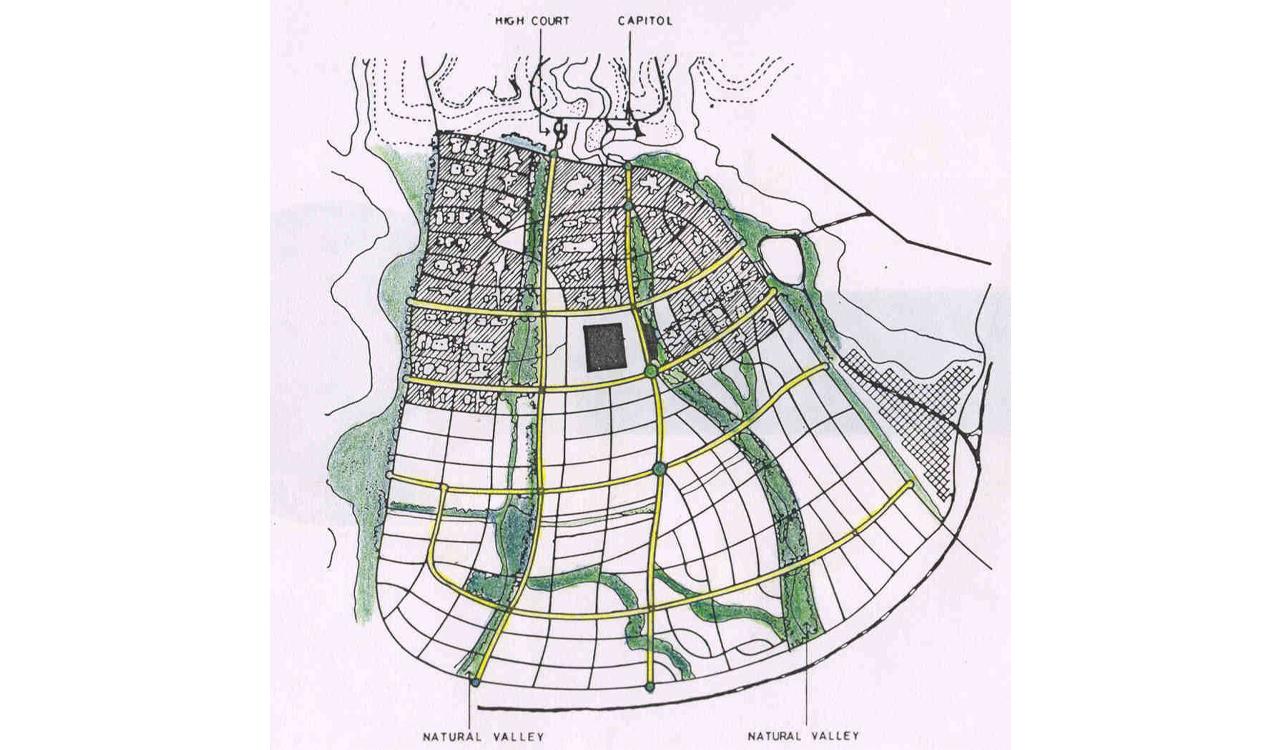
    Urban Planning: City of Chandigarh
    Photographer Unknown | Source

    The City Beautiful movement, which was a well-liked idea in North American urban planning throughout the 1890s and 1900s, is where the motif of “The City of Beauty” originated. Jane Drew, Maxwell Fry of England, P.N. Thaper, and P.L. Verma, the chief engineer of Punjab, all provided assistance to the renowned urban designer and architect Le Corbusier. We want to construct a lovely city, said American architect and original planner of Chandigarh Albert Mayer, who left the project for various reasons. In 1970s government publications utilised the word as a logo; today, it serves as the city’s self-description.

    Albert Mayer and Mathew Nowicki’s and Le Corbusier’s master plans were largely similar, with the exception of the fact that Le Corbusier changed the shape of the city plan from one with a curved road network to one with a rectangular shape with a grid iron pattern for the fast traffic roads and reduced its area for economic reasons.

    Albert Mayer
    Photographer Unknown

    The master plan for Chandigarh was compared by Le Corbusier to the human body, with each component serving a specific purpose. These are namely Head (The capitol complex), Heart (The city centre), Lungs (The leisure valley, innumerable open spaces and sector greens), Intellect (The cultural and educational institutions), Circulatory system (The network of roads, the 7Vs), Viscera (The industrial area).

    Salient Features

    The city of Chandigarh is designed very efficiently to cater the need of its residents, the salient features of the city are as follows:

    Sector-based Planning

    Superblock or sector planning theory was used to create the town. This is a completely new method of urban planning that aims to maximise the ease and comfort of the populace. There are 47 sectors in the town, each one housing between 10,000 and 15,000 people and measuring 1.25 kilometres in length and 0.81 km in breadth. Sector 13 doesn’t exist in this town. There are three to four neighbourhood units each sector.

    By supplying all of the necessities for daily life, such as retail malls, hospitals, gathering spaces, nurseries, and schools, each sector becomes essentially self-sufficient. It just takes about 30 minutes to walk around the entire area and you can get to all the schools on foot in under 15 minutes. Walking along the shaded footpaths is completely safe and comfortable thanks to a central continuous green strip of open space that runs through each zone.

    Open Spaces and Landscaping in Chandigarh

    With the Himalayas serving as a permanent backdrop, the town is enclosed on either side by two river beds that are about 5 km apart, and is bounded on the north by two rows of low, picturesque Siwalik Hills. It makes great use of its wealth of natural beauty. The landscape architect has chosen where and what kind of trees should be planted. Chandigarh currently has a distinct personality from an architectural standpoint. All open spaces along the road are grassed. In key sites, fountains and water basins are built.

    A large ring of open space extends from one sector to the next, passing between residential neighbourhoods and business districts. A big central park is provided, along with adequate open space in each district, to accommodate community and health centres, playgrounds, and swimming pools.

    Communication

    Le Corbusier may have been the first of his kind to use the seven varieties of roads (7 Vs) concept in Indian urban design. He developed it for various forms of traffic. Each suburb has a large number of stores within a 10- to 15-minute walking radius, and the margins of each area have fast-moving traffic lanes. The area contains roads that are good for slow-moving vehicles. There are bike lanes and shady pedestrian pathways. Effective segmentation nearly eliminates traffic issues while keeping homes completely protected from automobiles.

    Residential Units

    The housing is well-designed and located in a wonderful area. Gardens and parks located in convenient areas are used by every home. Even class IV government personnel are provided with tastefully equipped quarters that have all necessary amenities like power, sanitization, water supply, etc.

    These residential units have the peculiarity of having’sun-breakers’, which are fin-like projections of concrete and brick positioned at specific angles to the walls, on the simple external surfaces of the homes. These sun-breakers not only provide a beautiful, effective play of light and shade, but they also absorb the sun’s rays, keeping the homes warm in the winter and cool in the summer. In a democracy, this is the practical planning for the populace. As a result, Chandigarh has made history in town planning.

    Industries

    Even though Chandigarh is supposed to be the capital, it can nevertheless support industry. 600 acres of land have been set aside for manufacturers and industrial centres close to the railway station. The southern sector, which is also served by a railway siding, divides the residential sections from the industrial buildings with a vast green belt spanning 100 m by 150 m. Due to the industrial area’s location to the city’s leeward, the residential sections are shielded from wind. As a result, they are completely free of obnoxious sounds, smells, and dust, among other things.

    Capitol Complex
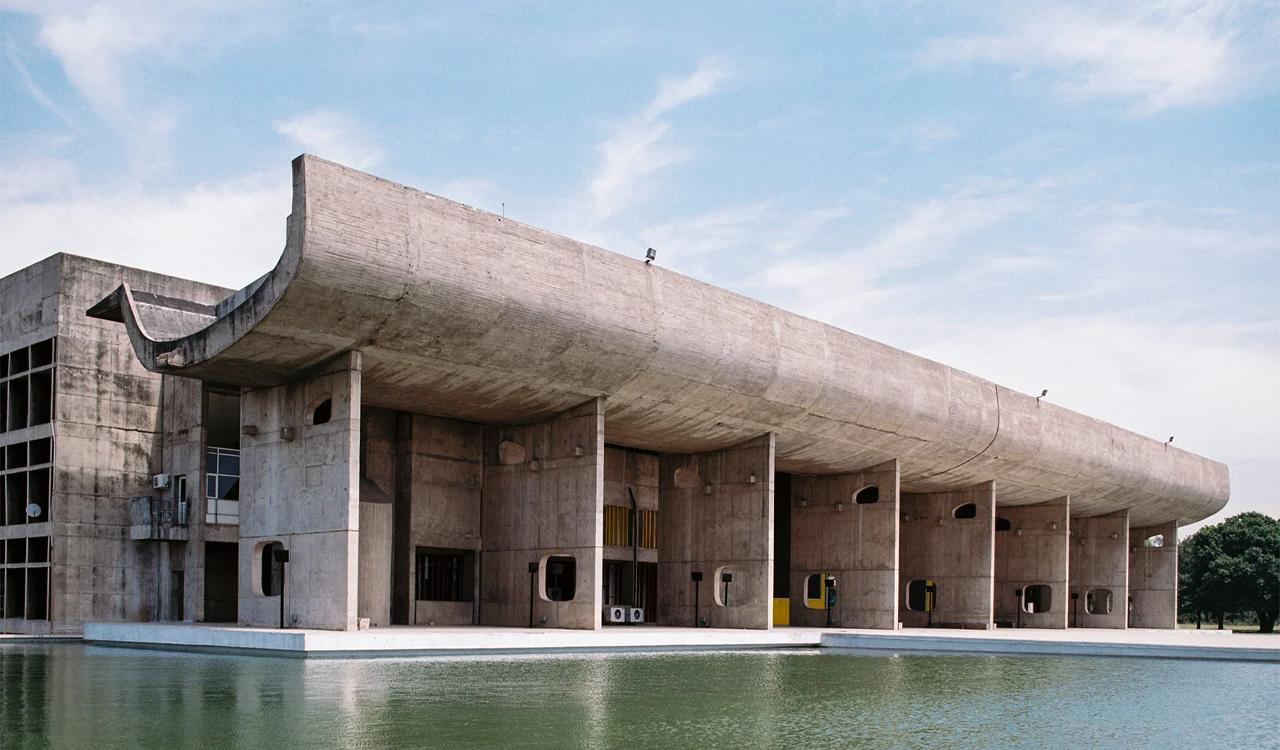
    Capitol Complex
    Photographer Unknown

    The four governmental buildings that Le Corbusier dubbed “Capitol” were his creations. The Assembly Hall, Secretariat, High Court, and Raj Bhavan are all located in the capital. The High Court is nine floors tall and has an intriguing parasol roof. These structures are monumental in nature, and in order to draw attention to the group’s excellent architectural design, he added a symbolic sculpture—the “Open Hand” monument, which stands in the Trench of Consideration and symbolises the principle of “open to give, open to receive”—to the ensemble.
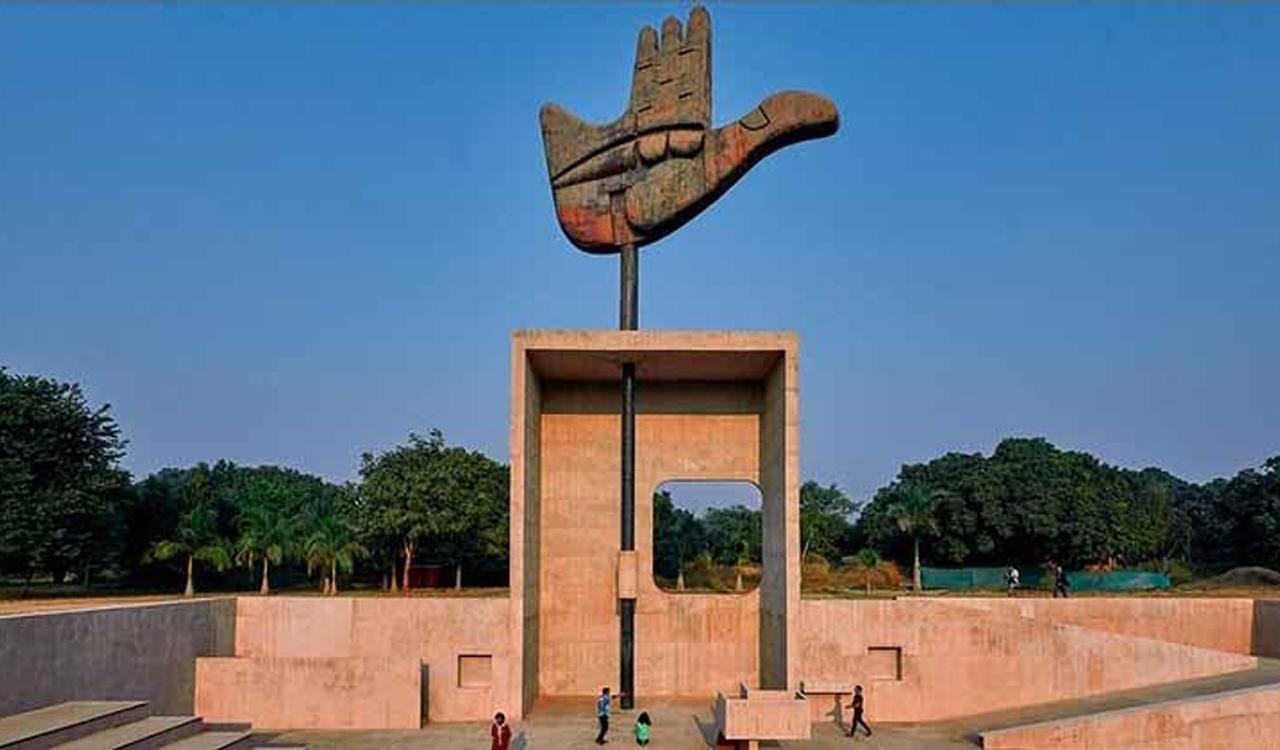
    Open Hand
    Photographer Unknown

    The “background” structures, which consist of commercial buildings, hospitals, and office complexes, are in contrast to these “foreground” structures. The capital is accessible via a gorgeous parkway and a 90 m wide road.

    Legacy and Impact

    Master planning of city of Chandigarh has left a long lasting impacts on urban planning of the modern day cities and maintain their architectural characters. The design mainly focuses the landscaping, green open spaces, and efficient infrastructure supporting its population. The city has been inspiration for many cities to prioritize the well-being of its residents while embracing modernity.

    Conclusion

    One of the pioneers who popularised the idea of living in a city that has been painstakingly planned, imagined, and then constructed is Le Corbusier. He forced them to think about what it would be like to live in a predetermined environment. Finally, by genuinely establishing that kind of environment, he was able to depict Chandigarh. Without a doubt, Chandigarh stands for the heroic endeavour to mend the shattered social and cultural life of the Punjab. It genuinely represents the apex of urban design.

  • Le Corbusier’s Chandigarh City: India in the Search of Unique Identity

    Le Corbusier’s Chandigarh City: India in the Search of Unique Identity

    India, a culturally and traditionally rich nation today, has been prominent since ancient times. The Britishers invaded India with the greed of robbing the rich. They ruled for about 300 years, yet they couldn’t break the nation, though India (Hindustan) lost its identity. 

    “The identity lost, the hopes lost,

    Nonetheless, Chandigarh Vision provided an answer.”

    chandigarh city
    Chandigarh city

    Chandigarh: The Beginning

    After the independence, the country’s Muslim population was protected from the Hindu majority by leaving colonial masters, who reserved the eastern and northwest regions for their use. It took much longer than 73 days for many of the 100 million or so Muslims who were dispersed throughout India to relocate to these areas, which are now the countries of Pakistan and Bangladesh.

    Sir Cyril Radcliffe divided the state of Punjab between India and Pakistan when he drew the borders for the two nations; Pakistan kept control of Lahore, the state capital. Following this defeat, Punjab established a new state capital that would meet the state’s logistical needs and unmistakably declare to the world that a new, modern, wealthy, and independent India had come.

    chandigarh city
    Image 1: The Newspaper Archive about Chandigarh’s rise on Saturday, April 10, 1948. 

    The Punjabi government went to establish the new capital at Chandigarh, in the north of Delhi. The First Prime Minister of independent India, Jawaharlal Nehru explained, “From existing encumbrances of old towns and old traditions, let this be a new town, symbolic of the past…. an expression of the nation’s faith in the future.”. The Prime Minister, Jawaharlal Nehru of independent India wished to imagine the new capital as progress, and modernity.

    With the development of a new capital in Punjab, the American architects Albert Mayer and Matthew Nowicki were approached. Sadly, due to the sudden death of Nowicki, Matthew also dropped off the project. Once hope was in the air. The Project Directors searched Europe, and Le Corbusier was approached for the project, with Pierre Jeanneret as a site architect.

    Le Corbusier’s Chandigarh City: India in the Search of Unique Identity Eventually, as per the article published in the BBC, Chandigarh city is one the most successful planned cities with a combination of architecture, culture, and modernization.
    Image 2: The photograph at Le Corbusier’s Office in Chandigarh city during the planning alongside to the left to right is Pierre Jeanneret 

    Le Corbusier’s approach to planning was similar to that of the previous plan by Matthew and Mayer. The change was the city’s shape, insisting on curved roads, it was all rectilinear with clean and crisp grids. The modernist approach to city planning is about functionality. As a result, the roads were reworked, and the hierarchy. The city planning observed arterials to pedestrian and bicycle lanes, as 7Vs. This became the sector with a green open space following the north-south direction, while the commercial in the east-west direction. These plans reflect the Garden City Movement and the architect’s concept from the Ville Radieuse. The Ville Radieuse is the solution to free ground pedestrian movement without traffic congestion. 

    Le Corbusier’s Chandigarh City: India in the Search of Unique Identity Eventually, as per the article published in the BBC, Chandigarh city is one the most successful planned cities with a combination of architecture, culture, and modernization.
    Image 3: Le Corbusier’s Chandigarh Map in the year 1951

    The roads define the boundaries of the sectors. The sectors in conjunction with the roads indulged in various public functions. The sectors were further divided into four quadrants. The quadrants included housing. This resulted in a safe household with their schools, shopping centers, businesses, and public spaces. 

    The planned city incorporated residential housing into thirteen categories based on rank and income. yet, every category had a letter identifying the designer and a number indicating its position in the financial structure, but they were all the same in their contemporary, geometric simplicity. Along with perforated screens and, in a few cases, verandahs, the deep overhangs and recesses used for shading provided the main visual appeal in the otherwise monolithically rectangular buildings.

    Le Corbusier’s Chandigarh City: India in the Search of Unique Identity Eventually, as per the article published in the BBC, Chandigarh city is one the most successful planned cities with a combination of architecture, culture, and modernization.
    Image 4: Various Photographs of Chandigarh between 1951 and 1965
    Le Corbusier’s Chandigarh City: India in the Search of Unique Identity Eventually, as per the article published in the BBC, Chandigarh city is one the most successful planned cities with a combination of architecture, culture, and modernization.
    Image 5: Various Photographs of Chandigarh between 1951 and 1965

    The original approach had the capitol complex as the center of the city from the drawings in 1951. Then the change came when Le Corbusier planned the artificial hills between the Capitol Complex and the city, breaking the whole visuality. The urban isolation was there, the Capitol Complex has its own aesthetical and spatial appeal. Le Corbusier combined the traditional classical and Indian elements into the physicality to have a concrete identity for the city. 

    Eventually, as per the article published in the BBC, Chandigarh city is one the most successful planned cities with a combination of architecture, culture, and modernization.

    Chandigarh: A City of Identity  

    As the city had to accommodate about 150, 000 during the initial phase, the population is still on the rise. The approach should be able to meet the water and drainage needs based on the climatic conditions which was also a point of consideration. As the city was divided with an axial approach, the development was divided into phases. The initial phase focused on the development of the sectors with some major avenues towards the Capitol complex with a connecting railway, industrial area, and university. 

    Le Corbusier focused on the Capitol as the head, commercial center, industrial sector, and intellectual center of the city, bringing a biological element to the layout design. He oversaw the city’s architectural direction and created the structures of the Capitol. The senior architectural group’s other three members were responsible for social infrastructure, government housing, municipal buildings, commercial centers, and schools.

    To conceal the homogeneity of the sectors, a protected green belt and tree planting were employed. Chandigarh city was viewed as a low-rise, low-density city with a regular traffic pattern to cut expenses. Every significant architect created their style while adhering to a standard design of regular brick and stone box constructions featuring prisons and brise-soleil.

    Presently, one of the busiest hubs in the nation, Chandigarh city observes heavy traffic congestion that only gets worse as the city gets more and more urbanized. Over time, the initial stages of constructed bulls and spaces have become outmoded contemporary demands and scenarios. 

    Chandigarh City: The Contemporary 

    With the passing of time and the advent of technology, Chandigarh city got its new plan in the year 2015, to meet the need for expansion and growth. However, during these years unplanned development has seen resistance. As planning is indeed, to carry forward the past, Le Corbusier’s Planning will add up to the future planning approach. 

    The recent urbanization in Chandigarh city has changed the core. The outskirts development of recent times has been adversely affected by various factors such as high rates of land prices, housing shortage, the socio-economic aspect of the city, and growth as a city. 

    Hence, the smart city approach alters the original plan to suffice the upcoming challenges and needs of the rapidly increasing population. The city has taken steps towards this transformation with transit and people, improving the pedestrian walking experience and public spaces. 

    Given the complexity and high technological requirements of modern design, it could have been challenging to take on such a large project alone today. Le Corbusier, however, managed construction-related matters alone to keep others from influencing his theories through conversation. He was hardly a climate expert when it came to burning winds, the monsoon, and uninsulated concrete. Like this, at the municipal level, zoning regulations and the solitude of streets and avenues deter intensive urban activity. The city is a succession of images, its rigid, inurbane nature. 

    Le Corbusier’s Chandigarh City: India in the Search of Unique Identity Eventually, as per the article published in the BBC, Chandigarh city is one the most successful planned cities with a combination of architecture, culture, and modernization.
    Image 6: Chandigarh Map- City Master Plan 2031

    However, Chandigarh city is significantly more for what it might have been than for what it is now, much like most of his innovative ideas that have inspired countless architects throughout the years.