

Definition And Emergence
A complex method for a complex form or set of final design requirements is parametric architecture. It is founded on algorithms that enable parameters and rules that, in the end, define and arrange the current relationship between the design needs and the finished design output. But in order to fully comprehend it, it is essential to first grasp when and who came up with the phrase “parametricism.”
Though the precise date the designers began using this word is still unknown, it was first employed in the field of mathematics. In his Ph.D. dissertation Parametic Practice, David Gerber claims that Maurice Ruiter was the first to use the term in his article Parametric Design in 1988. Additionally, the mathematician Samuel Geiberg formed Parametric Technology Corporation in 1985, the same year that Pro/ENGINEER, the first program for parametric modeling, was introduced (Weisberg 2008).
Nevertheless, there are significant disagreements over the origin of the phrase. According to legend, architect Luigi Moretti’s writings from the 1940s include the true origins of parametric. He defines parametric design in architecture as “establishing the relationships between the dimensions dependant upon the numerous factors” through the study of architectural systems. By creating the parametric stadium, which was displayed as part of his exhibition of parametric architecture at the twelfth Milan Triennial in 1960, he further demonstrated his interpretation of the concept. He then designed the Watergate Complex, which was the first substantial usage of computers between 1960 and 1965.
The parametric description of three-dimensional models is among the earliest examples of parametric. Another example is the publication by James Dana in 1837 on how to draw crystal figures. He describes the parametric relationship between three plane parameters and the division of lines in this passage. Later, architects used this as their starting point to create parametric models like Crystalline Splendour. The mathematicians claim that parametric gives two important criteria:
- A parametric equation express ”A set of quantities” with a number of parameters.
- The outcome(set of quantities) is related to the parameters through “explicit functions”.

Other well-known architects and artists, like Luigi Moretti, utilized a variety of technical skills to create intricate constructions. Among the famous individuals were Kiesler, Erich Mendelsohn, Ferei Otto, and Antonio Gaudi. The parametric design didn’t start to be useful for architects until the 1980s, and in 2008, Zaha Hadid and Patrick Schumacher announced the creation of a new architectural style called parametric architecture.
Advantages of Parametric Design in Architecture
- Parametric Design is a tool for structural complexities and its sturdiness along with function and aesthetics.
- Unique Innovations
- Allows structural complexities into subtle forms
- Saves a lot of material and reduces the cost of construction
- Increases the flexibility in design
- Variety of options until we reach the final design conclusion
- The 3rd Industrial Revolution
- Parametric Design is a philosophy and methodology that is replacing the Classical modernist Architectural Education
- Manufacturing and Material Science
- Building Information Modelling
- AI
Below are the few points discussed briefly.
The 3rd Industrial Revolution-
The theory is established while real-world experience and changing paradigm. Similarly, the theory of Modernism was generated due to the second industrialization with mass production and standardization becoming the characteristics of architecture. The current is based on robotics, computation, and mass customization.
Parametric Design is a philosophy and methodology that is replacing the Classical modernist Architectural Education –
We were living in modernism where it was about universalism, standardization, mass production, and homogeneity. Whereas Computational or parametric design is contextual, adaptable, mass customized, and heterogeneous. The main aim is not to teach the software but to look at and analyze things critically and with help of such tools the students explore and learn new ways of designing, sustainability, and manufacturing.
Manufacturing and Material Science-
The research into material science and manufacturing methodologies is a growing discipline within architectural academia.ComputerNumerically Controlled (CNC) is being used widely and opens up the possibilities for more adaptive and contextual design solutions.
Notable Examples
Architects have started experimenting with adapting Parametric Design as a style and many designs have evolved and the structures have been transformed into beautiful forms. Few major Architects we see today are Zaha Hadid, Frank O Gehry, and Herzog De Meuron.
Hamburg Elbphilharmonie’s Auditorium, Germany-
Architect- Herzog and De Meuron in the year 2016
The building complex accommodates a philharmonic hall, a chamber music hall, restaurants bars, a panorama terrace, Apartments, a hotel and parking facilities. And the heart of the complex is Elbphilharmonie. This building typology has undergone architectural reformation that is exceptionally radical in its unprecedented emphasis on proximity between artist and audience.

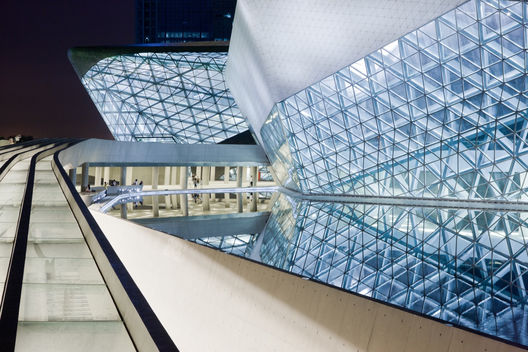
Guangzhou Opera House, China –
Architect- Zaha Hadid Architects in the year 2010
Guangzhou Opera house is located in the riverside location and is the heart of Guangzhou’s cultural development. The two structure is placed in such a manner that it harbingers the view of the pearl river and in the backdrop, there is an international Finance tower. The capacity is 1800 seats and the smaller capacity is 400 seats where art performances, concerts, and opera could be done.
The design concept evolved around the inspiration of Natural Landscape and the beautiful interplay between architecture and Nature with principles of erosion, geology, and topography,particualry influenced by river valleys. This concept creates beautiful and complex and dramatic interiors and exteriors canyons for circulation, lobbies, and cafes, allowing natural light to penetrate deep into the building. Different play of materials is also done where custom molded glass-fiber reinforced gypsum was used in the interiors of the auditorium.
The design exhibits the Unique exploration of Contextual Urban relationships by combing them with cultural traditions.
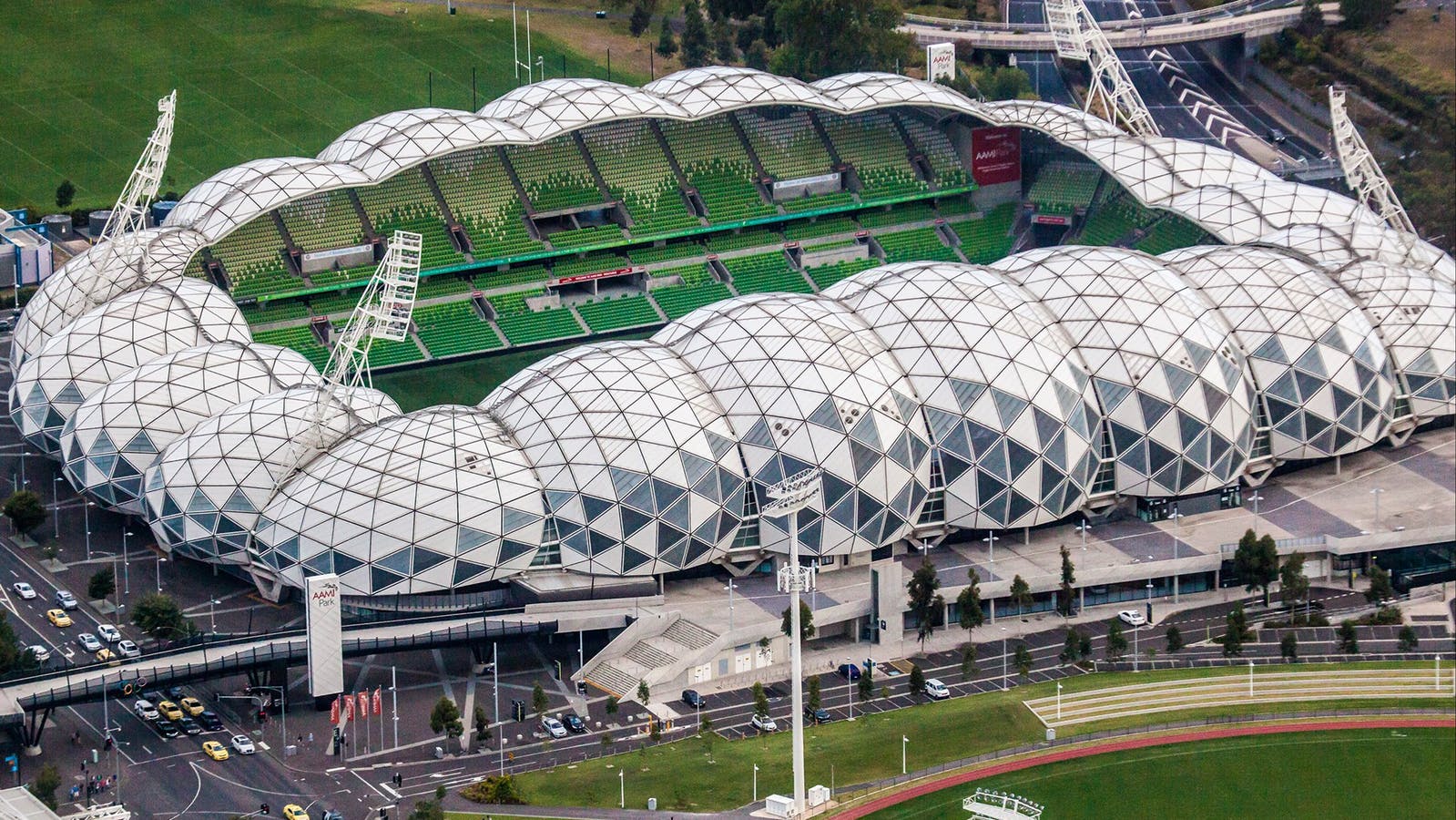
AAMI Park Stadium, Melbourne –
Architect-Cox Architects in the year 2010
This stadium features a bioframe design with a geodesic dome. For this design to create the roof structure, parametric modeling was used where there were many geometric configurations were derived in order to test the structural stability. Further, this parametric model was shared for the shop detailing and fabrication to ensure the final stadium stays true to what it was modeled.
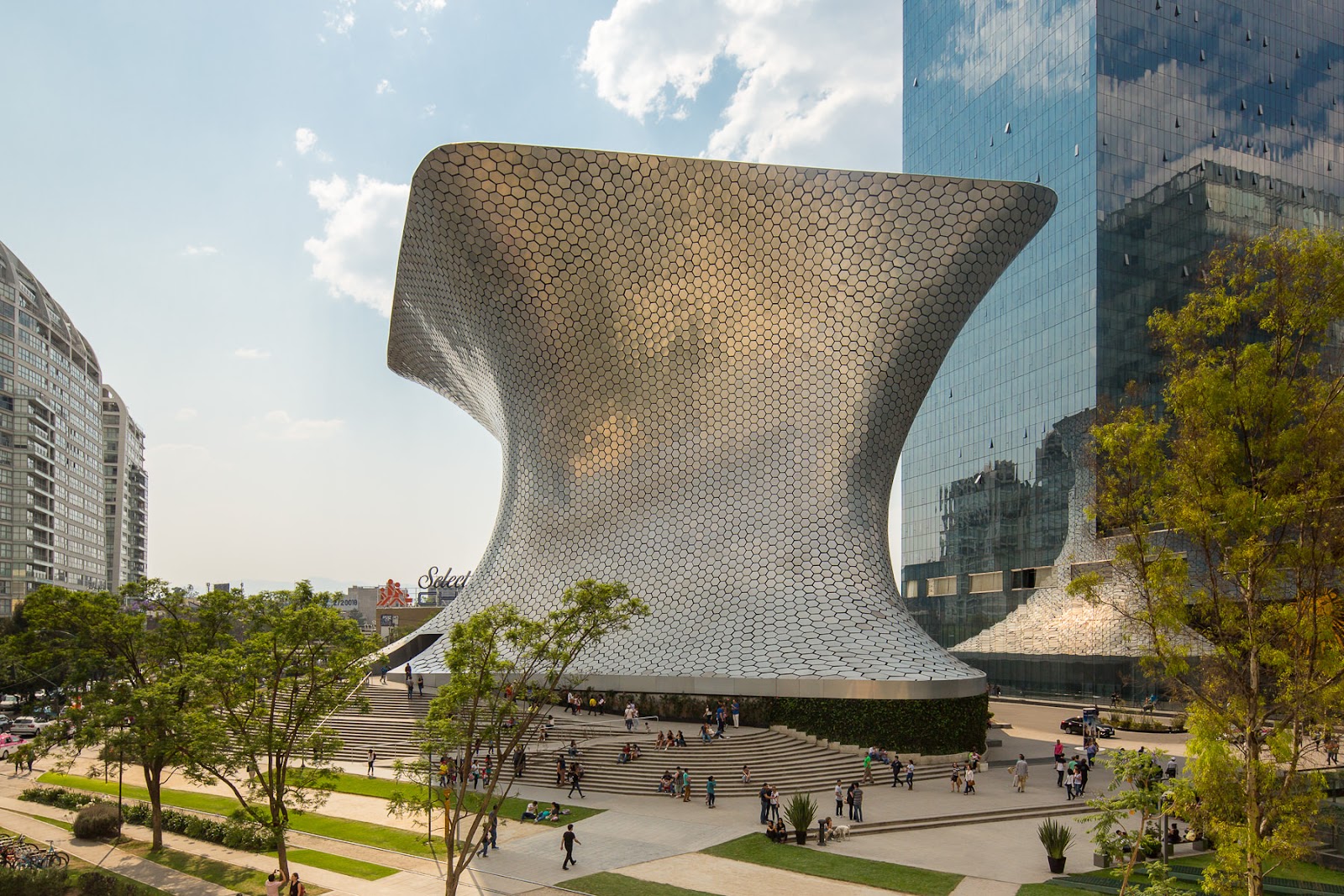
Museo Soumaya, Mexico
Architect-Fernando Romero
This museum was done in developed over 4 years and integrated complex systems and natural laws to have the building look like it is today. This avant-garde morphology has created a new paradigm and also represents the power of parametric modeling in the derivation of the built form.
At first glance, it looks a bit odd where there is a lack of windows, but due to the flat roof provided, it transmits the natural daylight that helps the interior of the museum during the day. The building houses the auditorium, library, offices, a multi-purpose gathering lounge, and a restaurant. The building has 28 curved steel columns of varying diameters used to hold up the shell of the building.
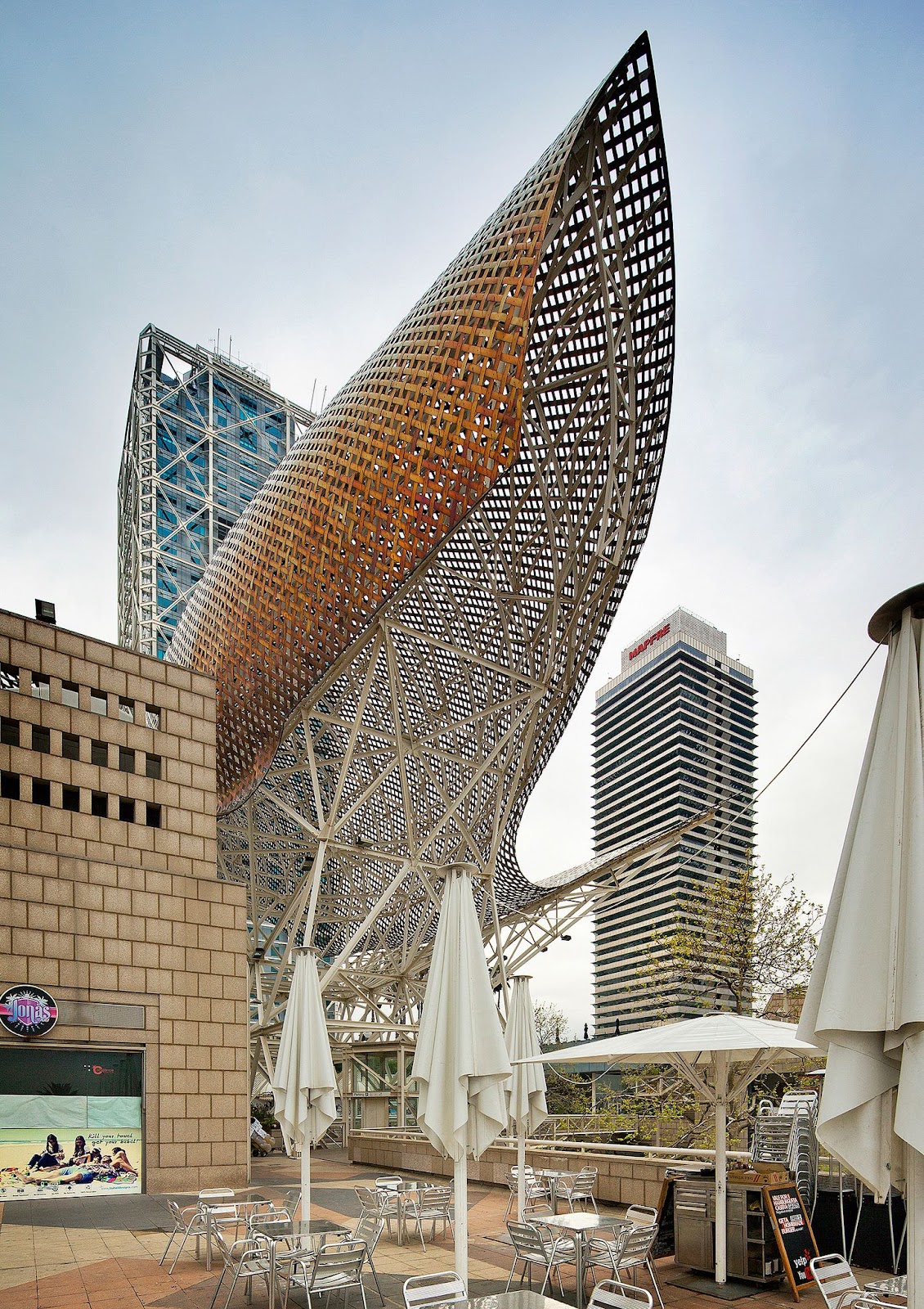
Peix Olimpic, Barcelona, Spain
Architect-Frank Gehry
The concept of this is of the shape which is similar to fish whose scales acquired a gold when they affect the sun’s rays and is a metal sculpture which has thin metal lines intersecting to form a lattice.
The concept of fish is described by the architect as a fish that can be beautiful, tailored to fit its environment, and its skin is used to keep the body dynamically consistent. Gehry uses computer-aided design not to create their models, which are made by hand but to provide precise specifications for their construction asymmetrical forms. The material is mainly used as metal plates.
Criticism for Parametricism
There are many questions and criticisms about parametricism as whether it is social relevance for those complex and intricate geometries compared to the past when it had strict geometrical formation and rules of propositions.
And there were other questions such as “Is this not an expensive, indulgent, and self-serving narcissism on the part of designers that distracts from the social task of Architecture? For more depth of clarity, we need to look further at the social needs of today, and the increasing diversity and density with the interconnectedness of contemporary life process that requires the complex spatial complex configuration that allows the diversity of event scenarios to unfold in close proximity.
Few of them are listed below –
- Avoid Rigid forms
- Avoid simple repetition
- Avoid a collage of isolated, irrelevant elements
- Avoid rigid functional stereotypes
- Avoid segregative functional zoning
All these negative connotations have affected the way we perceive the buildings and their functionality.
Conclusion
With the changing paradigm and the rapid change in the Architectural practice, it is mandatory it learns and adapts the new software tools in order to explore and experiment. These tools and architectural styles are both advantageous and disadvantageous. It is mandatory to remain on the right track and improve and develop more creative and sustainable designs for the future.