

Tag: Professional practice in Architecture

  • Gender Pay Gap: The controversial discourse in Architecture Industry

    Gender Pay Gap: The controversial discourse in Architecture Industry

    Introduction

    The gender pay gap in design industries has been reported for a long. Concerned organizations have also tried to find the loophole and address it. The American Institute of Architects (AIA) published a guide for equitable practice in 2018, and the Royal Institute of British Architects (RIBA) published a similar document in 2019.

     According to RIBA documents, practices that seek to close the wage gap between men and women can hire more females in junior positions, hoping they will be promoted to leadership positions in the future. However, he warns that if this is being adopted by other practices, it will not improve the overall situation of women in vocational managerial positions. This hints that there are not enough older female architects to go around.  

    As the RIBA document points out, there have been few female graduates in the past. As of 2021, only 17% of females have been registered as architects. RIBA accepts the idea that architectural firms do not appear to be sexist if there are several iconic female executives, as the female shortage is because of factors beyond their control.  

    However, the AIA document denies the RIBA document’s allegations and states that the wage gap does not close naturally. Looking at the gender pay gap between women and men, it was close to 60% in the United States in the 1960s. It is 80%, between 1980 and 1998. Most progress has been made in bridging the gap, but it has slowed significantly since then. 

    Bridging the gap between education and experience played a major role in this convergence, but it is no longer the wages of men and women. It does not contribute significantly to the gap. Currently, the gap is small at the beginning of the career in architecture and maximum at high salary levels later in the career. These institutions do not seem to agree that the shortage of women in architecture is due to the shortage of past graduates.
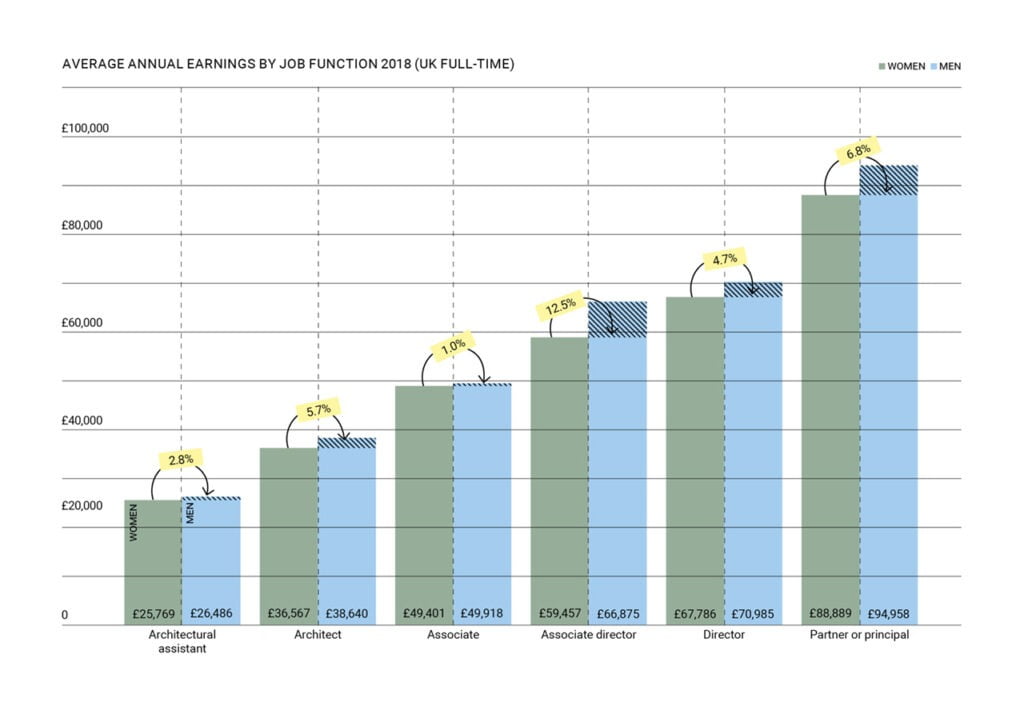
    According to RIBA’s Gender Pay scale Data 2020:

    The median gender pay gap went to 9.49% from 12.58% in the previous year.

    The mean gender pay gap went to 18.33% from 19.60% in the previous year.

    1.65% men and 0.5% women received a bonus payment.

    The mean bonus gender pay gap was 94.93%.

    The median bonus gender pay gap was 90.11%.

    Why Women Are Paid Less?

    What is the reason for women’s low income? There are various answers. The RIBA report recommends practical actionable measures that can be taken to enable hired women to continue working, reach higher levels and close the gender pay gap.

    The RIBA report highlights two main reasons for the gender pay gap in architecture. In these practices, wages play a prominent role. The women in the organization are in the lower half of the wage distribution because: 

    • Females are relatively low in the architecture firm. Paid management and support features dominate. 
    • The distribution of female professionals is younger than the distribution of male professionals. 
    Gender Pay Gap: The controversial discourse in Architecture Industry The gender pay gap in design industries has been reported for a long. Concerned organizations have also tried to find the loophole and address it. The American Institute of Architects (AIA) published a guide for equitable practice in 2018, and the Royal Institute of British Architects (RIBA) published a similar document in 2019.
    Gender Gap is Widening

    However, the AIA report makes a clearer claim than RIBA about overt sexism. The average salary of men is higher than the average salary of women in each profession, and the difference in average starting salary is thousands of dollars, further diverging to about 15 percent in subsequent work life. Income is most commonly cited as a major factor in professional success for both men and women, with a lack of compensation (as wages, promotions, opportunities, professional development, and meaningful work).

    RIBA’s report avoids this problem, while AIA’s report states that women are quitting their jobs because of persistent demoralization and low wages.

    Childcare

    Most women with children believe that starting a family has a negative impact on their professional development. Architecture is still a profession where female architects feel they have to sacrifice their career in architecture to start a family.

    According to respondents, 40% share the responsibility of caring for their children and relatives equally, but only 8% say they have less than the same share. Statistics confirm that the combination of work and family responsibilities continues to carry a great deal of weight among women. It’s a shame that the recently introduced childcare leave hasn’t changed the situation significantly.

    Career Milestones

    Architectural education is a long series of milestones. First, the education process takes around 5 years to complete, after which professionals need additional years to set up their practice. This is a very complex and strategic process, and it is not surprising that female architects are planning to have children around these milestones. The profession is still oriented towards a linear and rising career path.

    Men follow this traditional path, while women pursue typical or flexible career paths with some interruptions, different intensities, and changing roles throughout their careers. This has a negative impact on many women, regardless of talent, dedication, knowledge, or experience. It also means that women are unlikely to change these structures. The building industry really needs to rethink about its course structure and professional practice in architecture.

    Working Hours
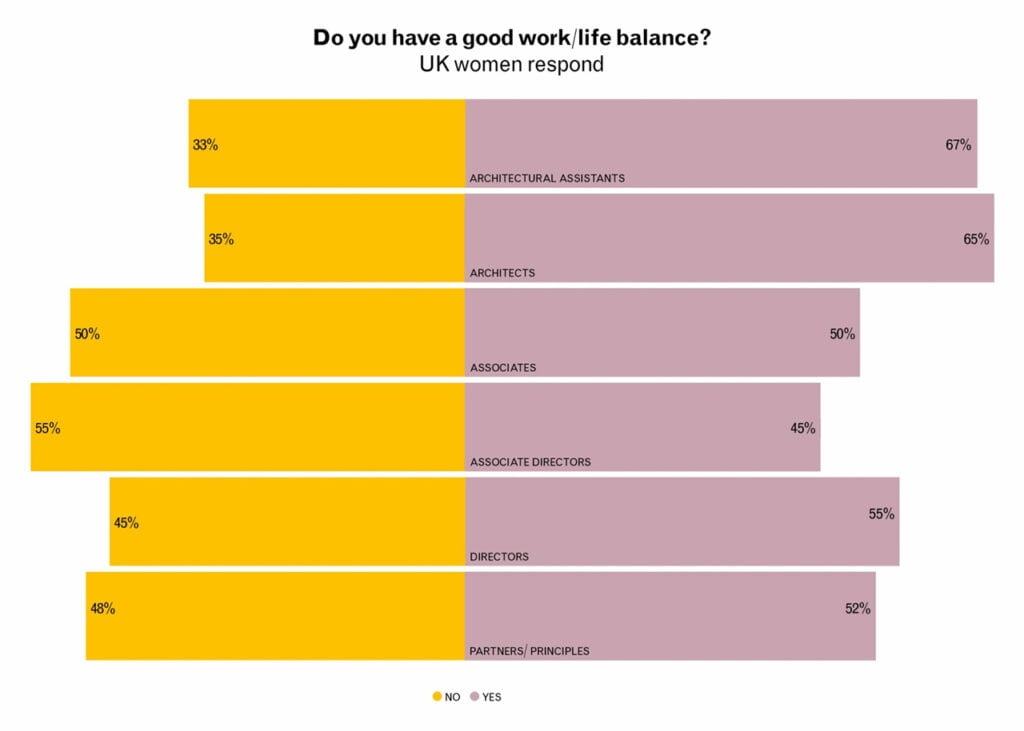
    Long working hours have been a problem in architecture since college, and challenges continue at all levels. Surprisingly, when architects climb the corporate ladder, their work-life balance seems to deteriorate.

    Overall, two-thirds of female architects and building assistants estimate a good work-life balance. This goes back to 50% of associates and 45% of associate directors, but over half of directors and partners/principals find a good work-life balance.

    Women with individual practices become more flexible in their time. However, the results of the survey show that among the self-employed architects surveyed, those with children are less likely to report good work-life balance compared to 63% of those without children. Architectural practices are tough and require a disproportionate amount of time and commitment. We certainly need to know that excessive working hours are unsustainable and that a balanced working lifestyle benefits everyone.

    Revelations of Gender Pay gap by leading Architecture firms

    Zaha Hadid Architects

    Gender Pay Gap: The controversial discourse in Architecture Industry The gender pay gap in design industries has been reported for a long. Concerned organizations have also tried to find the loophole and address it. The American Institute of Architects (AIA) published a guide for equitable practice in 2018, and the Royal Institute of British Architects (RIBA) published a similar document in 2019.

    Zaha Hadid Architects announced that women’s salaries are 19.6% less than men’s based on the median employee salary. The London studio, currently operated by Patrik Schumacher, is one of several British construction companies that had to publish figures for the gender pay gap after the change in the law. The figure shows that the median gender pay gap is 19.6%. It was calculated by comparing actual middle-income male and female salaries, a common indicator for measuring wage inequality. 

    The average pay gap for Zaha Hadid Architects is slightly higher, at 20.9%. The studio argues that the wage gap is due to numerous men in senior positions in the company. This wage gap exists because most of the longest-serving team members who have built up practice with Zaha Hadid in the last 30 years are men and have run the company since her death in 2016. This is why the percentage of women is lower than men in high-pay scale managers today.

     Mouzhan Majidi, managing director of Zaha Hadid Architects, said that employees in the same position at Zaha Hadid Architects receive the same compensation. Men and women in the same position at Zaha Hadid Architects are paid the same. He said, “We are gender-conscious and have an equal opportunity to recognize the significant contributions of all members of the team. 

    The practice also said that it set up a mentoring program across the practice and increased maternity allowances to close the gender wage gap. The statement said that they will implement a working system tailored to everyone and enable more women in architecture to realize all ambitions.

    Studio Gang closes the Gender Pay Gap

    Architect Jeanne Gang closed the gender pay gap between the company’s studio gangs and called on others to “correct wage inequality.” After investigating the issue, the gang announced it found that male employees in her company were paid slightly more than female employees. Therefore, the architect solved the difference by raising the salary this year. 

    In an article written for the Fast Company, according to Jeanne Gang, “The Great Injustice of Architecture is part of a key promotion to improve gender equality and women’s awareness among Studio Gang employees.

    Dezeen has also launched an initiative called Move the Needle to help drive the diversity of the building and design industry in response to this change. Gangs encourage Construction and Design Companies to deal with age inequality. Gangs are now encouraging other construction and design companies to do the same, the most “concrete” to create equality in the workplace.

     “We can start by looking at the fundamental issue of respect in the workplace: wages,” the gang said in an article. “In contrast to other measures of value, salary is a number. It’s concrete and objective. “By taking the first step towards equality through wages, we can move forward together and tackle the more complex challenges we face. 

    Now the gang movement is part of an important impetus for improving gender equality in the workplace by increasing support for women in the community. She joined many female architects campaigning for equal rights in the profession and attended a flash mob for gender equality at the Venice Architectural Biennale earlier this year. 

    Elizabeth Diller pointed out the issue of women’s college-to-work ratio and publicly talked about the need to increase the number of working women compared to men. Architect and filmmaker Beverly Willis also recently released a new film aimed at raising awareness of the women who built the project in New York City. 

    Boogertman + Partners join to support equal wages

    Boogertman + Partners, Africa’s largest construction company, has promised to close the gender pay gap in response to Dezeen’s Move the Needle initiative. South African studio has accepted after Dezeen’s simple calculator. This shows that the pay scale of females is 19% less per hour than male employees. Boogertman + Partners saw Move the Needle not only as an opportunity to be an industry leader in publicly advocating change but also as an opportunity to introduce regional challenges into ongoing discussions on a global scale. 

    Employing 96 registered architects and 260 employees, this office creates a gender imbalance not only within the enterprise but also among conference speakers, judges, and major industry award winners. Following Dezeen’s initiative to emphasize, it is the latest promise of change.

    Foster + Partners 
    Foster + Partners has announced that women are paid 10.5% less per hour than men, based on the median salary of their employees. The 10.5% gender wage gap for the UK’s largest construction company was calculated by determining middle-income earners. This is a commonly used statistic to show the typical gender gap in a company. When calculating the average salary, we see an even larger gender pay gap. It’s 23.8 percent. 

    Norman Foster needed to disclose figures because every UK company with over 250 employees needs to publish the gender pay gap each year. The number also shows that the median premium for women is 33% lower than that for men, while the median premium is 72% lower. 

    According to Foster + Partners, the difference in wages is mainly because more men are working in managerial positions. “Our wage gap is not a matter of equal pay”. Foster & Partners said in a statement released with numbers that men and women are equal to jobs of equal value throughout the practice.

     “Our analysis of the gender pay gap shows that there are more men than women and more men in higher positions.” Foster + Partners says of gender diversity. Working to promote Last year, Dezeen announced women make up only 10% of the best managers in the world’s largest construction company. Foster + Partners has a strong senior management team of 29 women, including Executive Chairman, Senior Executive Partners, and Senior Partners. 

    “It’s clear that there is a wage gap. To fill this gap, we are promoting gender diversity at the management level,” said Matthew Streets, managing partner of Foster + Partners. “Practice understands that this is a complex subject, and it takes time to strike the right balance. We understand we will close gender disparities and ensure diversity and inclusion at all levels. I promise. “He continued. 

    Foster + Partners is one of the first major British construction companies to announce its number. All architects who employ over 250 people are required to publish figures for the gender pay gap by April every year. Global construction and engineering company AECOM released its figures lately. 

    Conclusion

    An initiative to promote equal wages

    In recent times, architecture firms are aware of this situation and working towards the betterment. We, as architectural students, professionals and consultants, need to make people aware of this subject and contribute to make it better. This is a gradual process which will improve over time. Female architects need to mark their presence in the architecture field even more than before. Architecture must be introduced at school levels and girls must be encouraged to pursue their career in architecture and hence increase the college female student’s ratio. The big change is yet to be made!

  • Is Architecture an Absolute Dying Profession in India?

    Is Architecture an Absolute Dying Profession in India?

    Is architecture a dying profession in India? Definitely not. With half of the population living in urban areas, there is an increasing demand for architects, urban planners, and landscape architects in India. Though, architects in India have slipped into the mode of producing luxury products and vanity commodities. They are always proud of themselves, and their egos make them ignorant about the fast-changing world and its demands. Hence, there should be a change in the architects’ attitude to survive and pave the way for ‘better’ architecture in India. The article discusses the problems with the architects and the architecture profession in India.

    Staying away from politics

    Architecture is not a bunch of buildings, and the design is not objects or attractive patterns. Architecture is more public- It defines our sense of living, as well as our place in the community and civilization. And the design is based on thinking, it is political. But architects have withdrawn themselves largely from the social and political space and started procrastinating over details and techniques. When India is experiencing pressing issues of infrastructure and poor planning, architects and designers are focused on managing the everyday affairs of choosing the materials and textures, discussing form, and drafting joineries. 

    profession in India
    Malls in india_Photo by Wikimedia commons

    Architects should look beyond their buildings and recognize the impact they create on the cities. They should realize that working only in their buildings does not work anymore. For example, take a look at the design of shopping centers. Architects design shopping centers that make visitors buy more by removing windows and disconnecting them from time, regardless of the will of the visitor. Here the architect is the agent of the client and not the people. He is looking at the building and its client, not the city and its people.

    Future architecture cannot resistance to digital transformation_Photo by world Architectsater only to the luxury of specialized audiences. They have to look at the larger picture of the need for architecture to engage with the cities and all their people. The future buildings should not reflect the architect’s style but should be the reflection of the people and community in which it is built. 

    Resistance to digital transformation in Architectural Profession in India

    Changing lifestyles have transformed the meaning of architecture in every part of the world. But many architects in India remain hesitant about the transformation of architecture to current trends. They are reluctant to learn modern techniques and technologies. They follow the old systems and believe that their loyal clients will continue giving them a regular supply of projects. Students having trained in these firms who are running their business with the traditional clients also fall into the same loop when they practice. And so, there is no opportunity for an R&D to transform architecture into the current trends. 

    digital transformation
    Resistance to digital transformation_Photo by world Architects

    Architecture, as a profession, is often compared with doctors. But doctors have evolved over the past decades and are using modern technologies and architecture (especially in India) remains the same as several decades ago, i.e. drafting plans and sections using AutoCAD. Not that we should not learn or follow Charles Correa or Doshi; it is that we have to adapt their philosophies and ideologies to innovative techniques and methodologies through research and development.

    Lack of interdisciplinary collaboration

    architecture
    Collaboration in architecture_Photo by MIT news

    The emergence of architecture came from the rise of specialization in society. And it still lies in the history of privilege. Architects always consider themselves Master builders. Their collaborations are bound to Engineers, urbanists, landscape architects, and planners; but the future of architecture demands much more. Apart from the internal considerations, architecture also deals with other disciplines of study, which need interdisciplinary collaborations.

    Research in social and cognitive sciences on humans has investigated how buildings or environmental factors can alter social behavior. This shows the need for interdisciplinary collaboration in architecture. By bringing together as many disciplines and professions as possible, i.e. biology, human science, social science to architecture, we will be able to pose interdisciplinary questions and bridge the gap between architecture and other fields. Only when architects collaborate with professionals from other disciplines will they know the potential of architecture? And then they might act as ‘Architects’.

    The shift in design sensibilities

    apartments
    Apartments in India_Photo by Squareyards

    In India, architects have more or less given up the responsibility of projecting an “idea of India” through the built and physical environment. The sensibilities of the architects shifted towards fulfilling their ambitions and desires by building the tallest buildings, or the luxurious apartments and largest public spaces. They build to get a LEED or GRIHA, but not with places or people in mind. The concepts of sustainability and ‘going green’ have become fashion and some architects and real estate builders use them as marketing gimmicks rather than as a mandate for responsible design.

    Architects are pandering to money in unprecedented ways–creating what Rahul Mehrotra calls the Architecture of Impatient Capital. It leads to the architecture that is often whimsical, most often vendor-driven, for ease of speed of construction. However, there is a considerable transformation from fashionable materials such as aluminum or glass (in an inappropriate context), but still, there is a lot to be transformed.

    Limited role of Architectural media in India

    Architectural Journalism
    Architectural Journalism_Photo by Eduwik

    The decline of good architecture in India is most significant because of the lack of knowledge transferred from the past through Architectural media and education, which made today’s architects driven by beliefs rather than experimental truths. Though there is a lot of information available, none was converted into knowledge that can be easily accessible to architects. 

    To theorize a subject is to appreciate its value and existence more than its mere need to be. But the discussions on architecture have happily slipped into the rhetoric of regionalism or climate, hate-glass or love-brick and stone, introducing architects as lifestyle producers of fancy living. Though architecture media is expanding with more people coming in, it should not limit itself to the appreciation of architects and their projects. It should instead become an analytical weapon and a storehouse of knowledge (instead of data), making the people and architects realize the impact of architecture in our lives.

    What do Architects need to do?

    Architects are projecting themselves as creative beings, and are as subjective as an artist painting the wall. Architectural design is not always as subjective as art. It is the result of several decisions made by various disciplines relative to their users. “Good design is always objective because it just works”. It is research that prevents architects from building for themselves and encourages building for the people.

    Architects today are great problem solvers, giving impeccable reasons and solutions for their designs. But this tendency of solving problems will lead to the growth of technicians, not architects. Architecture should shift from problem-solving to posing questions, opening out to interdisciplinary collaborations. The future of architecture cannot be just energy-efficient and sustainable, but also about human sciences, culture, and social well-being.

    Hence, architecture in India, with all its possibilities, opportunities, and evolved sensibilities, would not be a dying profession with the architects that adapt to the changing technologies and lifestyles and shape our society by staying true to the values and culture of the people.

  • Top 10 Up and Emerging International Architects

    Top 10 Up and Emerging International Architects

    Introduction

    Unquestionably, architecture is a rising business with dazzling future opportunities throughout the world. The standards are increasing and so are the expectations with new and intriguing designs being created every day. Although the design is entirely subjective, some projects get nods of approval from many. I would think that the profession won in such rare situations.

    In the list below we have compiled the top 10 up and emerging International Architects that are revolutionizing the profession daily. Irrespective of a mention, we completely respect the professional practice in Architecture done by the Architects that are not enlisted and do not, in any way, disregard their valuable work and contribution to the field.

    This list is tentative and subjective.

    Top 10 Up and Emerging International Architects

    Mass Design Group

    Mass Design Group is an Architecture office of over 140 architects, landscape architects, engineers, builders, furniture designers, writers, filmmakers, and researchers from 20 different countries. They believe in the architectural design process of increasing access to purposeful, healing, and hopeful design. The firm’s acronym stands for Model of Architecture Serving Society.

    The Wall Street Journal named the firm MASS, the Architecture Innovator of the Year in 2020 for their origins in healthcare and designing architecture as a medium for healing. They believe that every project has a mission and work with our partners throughout the design process — from early visioning to project completion — to create and implement a shared vision for how design can help achieve that mission.

    Origin/ Birth: 2008

    Location(s): Rwanda

    Chief Architects: Michael Murphy and Alan Ricks

    Style of Architecture: Contemporary

    What Services Provided: Architecture, landscape design, engineering, planning, research, film, and community engagement.

    Notable Projects

    The Gun Violence Memorial Project

    Rwanda Institute for Conservation Agriculture

    National Memorial for Peace and Justice

    noa*- Network of Architecture

    The young team of architects and designers, led by founders Lukas Rungger and Stefan Rier and based in Bolzano (Italy) and Berlin (Germany), explores and examines interdisciplinary methods of application of architecture design, which are constantly evolving depending on the nature and requirements of each project. A holistic approach and strategy are central to noa*s way of conceiving design by adhering to the concept of “emergence,” where the whole is perceived to be far greater than the sum of its parts. Their professional practice in Architecture extends to residential, hospitality, commercial, mixed-use, exhibition, product, and experimental projects.

    Origin/ Birth: 2010

    Location(s): Bolzano (Italy) and Berlino (Germany)

    Chief Architects: Lukas Rungger and Stefan Rier

    Style of Architecture: Modernist and Contemporary Architecture with native elements

    What Services Provided: Hospitality Architecture, Interior Design

    Notable Projects:

    MohrLife

    Sudtirol Home

    Erfurt

    SETUP Architecture

    Architecture is a configuration, believes the architecture office. They believe the architecture design process is a system, a situation, a trick, a structure, and an organization. SETUP architecture studio’s architectural works, design research, and construction projects incorporate digital and virtual means of organizing space and redefine the roles of local and global intelligent methods of making, creating, producing, and setting up architecture. The studio was founded in 2014 in the Netherlands and Iran, and it now operates on a global scale in a variety of design and production scales.

    Origin/ Birth: 2014

    Location(s): Netherlands and Iran

    Chief Architects: Sina Mostafavi

    Style of Architecture:

    What Services Provided: Architectural works, design research, and construction projects

    Notable Projects

    Benetton Headquarters

    Softstone

    Farmanieh Residential

    Sher Maker

    Patcharada Inplang, Thongchai Chansamak, and their builder team are the creators of the architecture office, Sher Maker. They have a strong intention, as well as an interest in the process and meaning of the architecture design process. They are interested in the origins of architectural formations that are influenced by local technology and material availability. They are pursuing the design of the atmosphere that has an impact on the building in both physical and ambiance terms.

    Origin/ Birth: 2018

    Location(s): Chiangmai, Thailand

    Chief Architects: Ar.Thongchai Chansamak and Ar. Patcharada Inplang

    Style of Architecture: Modernist Architecture

    What Services Provided: Architecture solutions

    Notable Projects

    Sher Maker Studio

    Light Trap

    Boonma Cafe

    MUDA Architects

    The Architecture office, MUDA was founded in 2015 in Beijing, China, and Boston, Massachusetts, with the Chengdu office opening in 2017. MUDA is a place where people of different cultural backgrounds, mindsets, and creative design abilities are welcomed and valued. The architect team is made up of a diverse group of talented architects with forward-thinking ideas, extensive experience, professionalism, and distinct personalities. Among the design, practices are public architecture, cultural architecture, commercial architecture, urban planning, landscape design, and interior design. As a global leader in architecture, they have extensive experience in a wide range of markets and different applications of architecture design.

    Origin/ Birth: 2015

    Location(s): Beijing, China, and Boston, Massachusetts, and Chengdu

    Chief Architects: Yun Lu

    Style of Architecture: Contemporary, Modernist Architecture

    What Services Provided: Architecture, Interior Design

    Notable Projects

    Garden Hotpot Restaurant

    SCOOOPE

    Minjiang Service Center

    Atelier tao+c

    The Professional Practice in Architecture by Atelier tao+c was founded in 2016, and its design works range from a pendant lamp to a compound development, from the interior of small urban apartments to the renovation of old rural houses, from street shops to a youth community, you name it and they’ve done it all. In addition to practical work, the office has been involved in research and teaching, with a focus on topics such as the revival of old buildings and objects in domestic landscapes, covering all applications of Architecture Design.

    Origin/ Birth: 2016

    Location(s): Shanghai, China

    Chief Architects: Tao Liu, Chunyan Cai

    Style of Architecture: Contemporary

    What Services Provided: Architectural design / Interior design / Furniture design

    Notable Projects

    Capsule Hotel

    JHW

    The house with a slim light well

    Mole Architects

    The scale and nature of the projects vary in the Architecture office. They’ve designed artist studios and masterplans for developers with a desire to make better cities. They’ve designed many houses and buildings in between these scales, all of which contribute to the richness of the places where one lives and works. Buildings that are well-designed make life easier, more comfortable, and more pleasurable with its applications of Architecture Design.

    Origin/ Birth: 1997

    Location(s): Cambridge

    Chief Architects: Meredith Bowles

    Style of Architecture: Contemporary

    What Services Provided: Residential Architecture

    Notable Projects

    Hillside Development, Hsinchu, Taiwan

    Cavendish, Cambridge

    Balancing Barn, Suffolk

    Wilkinson Eyre Architects

    WilkinsonEyre is a leading architecture office in the world, with a portfolio of national and international award-winning projects. They have built a portfolio of bold, beautiful, intelligent architecture in applications of architecture design as diverse as culture, sport and leisure, education, infrastructure, residential, office, and large-scale master planning since our inception in 1983. A professional practice in architecture to look out for.

    Origin/ Birth: 1983

    Location(s): London, England, United Kingdom

    Chief Architects: Jim Eyre Chris Wilkinson

    Style of Architecture: Modernist Architecture

    What Services Provided: Architectural services

    Notable Projects

    Compton & Edrich Stands, Lord’s Cricket Ground, London

    University of Bristol: Fry Building

    Cooled Conservatories, Gardens by the Bay

    Space Matrix

    Since its inception in 2001, the design firm has evolved into a dynamic, agile, 21st-century digital enterprise; an architecture office specializing in workplace design. They have developed a distinct client focus that generates and delivers profitable, long-term, and future-­ready workplace solutions with their innovative applications of architecture design. Their ongoing mission is to continue revolutionizing the delivery of design and construction services in Asia and around the world. In Australia, China, India, Thailand, Singapore (HQ), and the United States, they have relevant project experience in over 80 cities and 15 office locations.

    Origin/ Birth: 2001

    Location(s): Bangalore, Bangkok, Beijing, Hong Kong, Hyderabad, Manila, Melbourne, Mumbai, New Delhi, New York, Pune, Singapore, Shanghai, Shenzhen, Sydney,Chennai.

    Chief Architects: Arsh Chaudhry, Shagufta Anurag, Jaiprakash Aildasani

    Style of Architecture: Contemporary

    What Services Provided: Branding, MEP, AV, IT, sustainability, security, and employee wellness

    Notable Projects

    Lazard, Sydney

    Crowdstrike, Pune

    Vanke, Shenzhen

    Studio Saxe

    Nature-inspired ideas are given structural form by Studio Saxe. The Costa Rica architects blend local knowledge with international design, combining a modern, global aesthetic with local expertise that includes craftsmanship, personal connections, and the sustainable sourcing of local materials. A clever design does not necessitate a lot of additional technology. They believe, true sustainability responds to natural conditions to reduce resource consumption while maximizing beautiful sensory experiences.

    Origin/ Birth: 2004

    Location(s): San José, Costa Rica

    Chief Architects: Benjamin Garcia Saxe

    Style of Architecture: Contemporary

    What Services Provided: Architectural Services

    Notable Projects

    The Sirena House

    Casa Bell Lloc

    Casa Flotanta