

Introduction
The gender pay gap in design industries has been reported for a long. Concerned organizations have also tried to find the loophole and address it. The American Institute of Architects (AIA) published a guide for equitable practice in 2018, and the Royal Institute of British Architects (RIBA) published a similar document in 2019.
According to RIBA documents, practices that seek to close the wage gap between men and women can hire more females in junior positions, hoping they will be promoted to leadership positions in the future. However, he warns that if this is being adopted by other practices, it will not improve the overall situation of women in vocational managerial positions. This hints that there are not enough older female architects to go around.
As the RIBA document points out, there have been few female graduates in the past. As of 2021, only 17% of females have been registered as architects. RIBA accepts the idea that architectural firms do not appear to be sexist if there are several iconic female executives, as the female shortage is because of factors beyond their control.
However, the AIA document denies the RIBA document’s allegations and states that the wage gap does not close naturally. Looking at the gender pay gap between women and men, it was close to 60% in the United States in the 1960s. It is 80%, between 1980 and 1998. Most progress has been made in bridging the gap, but it has slowed significantly since then.
Bridging the gap between education and experience played a major role in this convergence, but it is no longer the wages of men and women. It does not contribute significantly to the gap. Currently, the gap is small at the beginning of the career in architecture and maximum at high salary levels later in the career. These institutions do not seem to agree that the shortage of women in architecture is due to the shortage of past graduates.
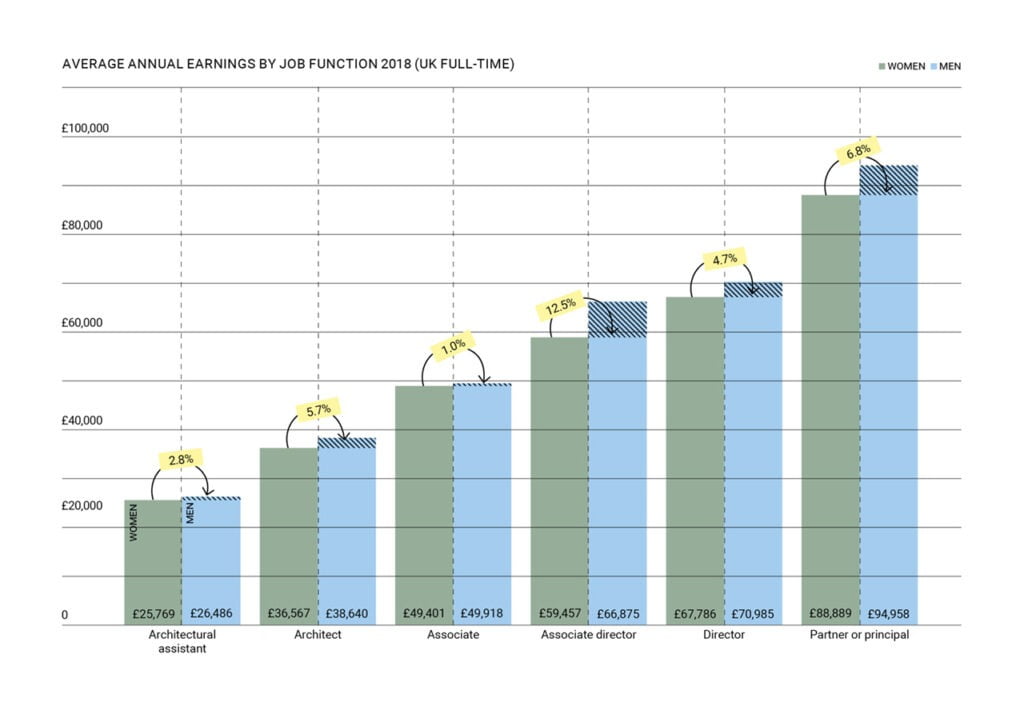
According to RIBA’s Gender Pay scale Data 2020:
The median gender pay gap went to 9.49% from 12.58% in the previous year.
The mean gender pay gap went to 18.33% from 19.60% in the previous year.
1.65% men and 0.5% women received a bonus payment.
The mean bonus gender pay gap was 94.93%.
The median bonus gender pay gap was 90.11%.
Why Women Are Paid Less?

What is the reason for women’s low income? There are various answers. The RIBA report recommends practical actionable measures that can be taken to enable hired women to continue working, reach higher levels and close the gender pay gap.
The RIBA report highlights two main reasons for the gender pay gap in architecture. In these practices, wages play a prominent role. The women in the organization are in the lower half of the wage distribution because:
- Females are relatively low in the architecture firm. Paid management and support features dominate.
- The distribution of female professionals is younger than the distribution of male professionals.

However, the AIA report makes a clearer claim than RIBA about overt sexism. The average salary of men is higher than the average salary of women in each profession, and the difference in average starting salary is thousands of dollars, further diverging to about 15 percent in subsequent work life. Income is most commonly cited as a major factor in professional success for both men and women, with a lack of compensation (as wages, promotions, opportunities, professional development, and meaningful work).
RIBA’s report avoids this problem, while AIA’s report states that women are quitting their jobs because of persistent demoralization and low wages.
Childcare

Most women with children believe that starting a family has a negative impact on their professional development. Architecture is still a profession where female architects feel they have to sacrifice their career in architecture to start a family.
According to respondents, 40% share the responsibility of caring for their children and relatives equally, but only 8% say they have less than the same share. Statistics confirm that the combination of work and family responsibilities continues to carry a great deal of weight among women. It’s a shame that the recently introduced childcare leave hasn’t changed the situation significantly.
Career Milestones
Architectural education is a long series of milestones. First, the education process takes around 5 years to complete, after which professionals need additional years to set up their practice. This is a very complex and strategic process, and it is not surprising that female architects are planning to have children around these milestones. The profession is still oriented towards a linear and rising career path.
Men follow this traditional path, while women pursue typical or flexible career paths with some interruptions, different intensities, and changing roles throughout their careers. This has a negative impact on many women, regardless of talent, dedication, knowledge, or experience. It also means that women are unlikely to change these structures. The building industry really needs to rethink about its course structure and professional practice in architecture.
Working Hours
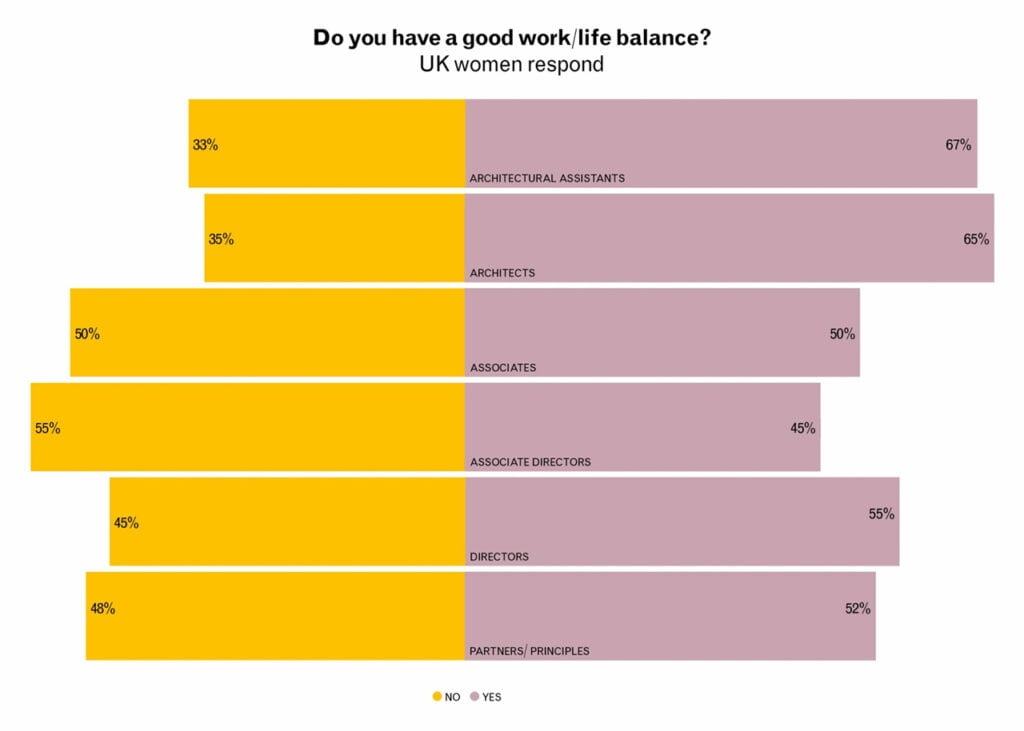
Long working hours have been a problem in architecture since college, and challenges continue at all levels. Surprisingly, when architects climb the corporate ladder, their work-life balance seems to deteriorate.
Overall, two-thirds of female architects and building assistants estimate a good work-life balance. This goes back to 50% of associates and 45% of associate directors, but over half of directors and partners/principals find a good work-life balance.
Women with individual practices become more flexible in their time. However, the results of the survey show that among the self-employed architects surveyed, those with children are less likely to report good work-life balance compared to 63% of those without children. Architectural practices are tough and require a disproportionate amount of time and commitment. We certainly need to know that excessive working hours are unsustainable and that a balanced working lifestyle benefits everyone.
Revelations of Gender Pay gap by leading Architecture firms
Zaha Hadid Architects

Zaha Hadid Architects announced that women’s salaries are 19.6% less than men’s based on the median employee salary. The London studio, currently operated by Patrik Schumacher, is one of several British construction companies that had to publish figures for the gender pay gap after the change in the law. The figure shows that the median gender pay gap is 19.6%. It was calculated by comparing actual middle-income male and female salaries, a common indicator for measuring wage inequality.
The average pay gap for Zaha Hadid Architects is slightly higher, at 20.9%. The studio argues that the wage gap is due to numerous men in senior positions in the company. This wage gap exists because most of the longest-serving team members who have built up practice with Zaha Hadid in the last 30 years are men and have run the company since her death in 2016. This is why the percentage of women is lower than men in high-pay scale managers today.
Mouzhan Majidi, managing director of Zaha Hadid Architects, said that employees in the same position at Zaha Hadid Architects receive the same compensation. Men and women in the same position at Zaha Hadid Architects are paid the same. He said, “We are gender-conscious and have an equal opportunity to recognize the significant contributions of all members of the team.
The practice also said that it set up a mentoring program across the practice and increased maternity allowances to close the gender wage gap. The statement said that they will implement a working system tailored to everyone and enable more women in architecture to realize all ambitions.
Studio Gang closes the Gender Pay Gap

Architect Jeanne Gang closed the gender pay gap between the company’s studio gangs and called on others to “correct wage inequality.” After investigating the issue, the gang announced it found that male employees in her company were paid slightly more than female employees. Therefore, the architect solved the difference by raising the salary this year.
In an article written for the Fast Company, according to Jeanne Gang, “The Great Injustice of Architecture is part of a key promotion to improve gender equality and women’s awareness among Studio Gang employees.
Dezeen has also launched an initiative called Move the Needle to help drive the diversity of the building and design industry in response to this change. Gangs encourage Construction and Design Companies to deal with age inequality. Gangs are now encouraging other construction and design companies to do the same, the most “concrete” to create equality in the workplace.
“We can start by looking at the fundamental issue of respect in the workplace: wages,” the gang said in an article. “In contrast to other measures of value, salary is a number. It’s concrete and objective. “By taking the first step towards equality through wages, we can move forward together and tackle the more complex challenges we face.
Now the gang movement is part of an important impetus for improving gender equality in the workplace by increasing support for women in the community. She joined many female architects campaigning for equal rights in the profession and attended a flash mob for gender equality at the Venice Architectural Biennale earlier this year.
Elizabeth Diller pointed out the issue of women’s college-to-work ratio and publicly talked about the need to increase the number of working women compared to men. Architect and filmmaker Beverly Willis also recently released a new film aimed at raising awareness of the women who built the project in New York City.
Boogertman + Partners join to support equal wages
Boogertman + Partners, Africa’s largest construction company, has promised to close the gender pay gap in response to Dezeen’s Move the Needle initiative. South African studio has accepted after Dezeen’s simple calculator. This shows that the pay scale of females is 19% less per hour than male employees. Boogertman + Partners saw Move the Needle not only as an opportunity to be an industry leader in publicly advocating change but also as an opportunity to introduce regional challenges into ongoing discussions on a global scale.
Employing 96 registered architects and 260 employees, this office creates a gender imbalance not only within the enterprise but also among conference speakers, judges, and major industry award winners. Following Dezeen’s initiative to emphasize, it is the latest promise of change.
Foster + Partners

Foster + Partners has announced that women are paid 10.5% less per hour than men, based on the median salary of their employees. The 10.5% gender wage gap for the UK’s largest construction company was calculated by determining middle-income earners. This is a commonly used statistic to show the typical gender gap in a company. When calculating the average salary, we see an even larger gender pay gap. It’s 23.8 percent.
Norman Foster needed to disclose figures because every UK company with over 250 employees needs to publish the gender pay gap each year. The number also shows that the median premium for women is 33% lower than that for men, while the median premium is 72% lower.
According to Foster + Partners, the difference in wages is mainly because more men are working in managerial positions. “Our wage gap is not a matter of equal pay”. Foster & Partners said in a statement released with numbers that men and women are equal to jobs of equal value throughout the practice.
“Our analysis of the gender pay gap shows that there are more men than women and more men in higher positions.” Foster + Partners says of gender diversity. Working to promote Last year, Dezeen announced women make up only 10% of the best managers in the world’s largest construction company. Foster + Partners has a strong senior management team of 29 women, including Executive Chairman, Senior Executive Partners, and Senior Partners.
“It’s clear that there is a wage gap. To fill this gap, we are promoting gender diversity at the management level,” said Matthew Streets, managing partner of Foster + Partners. “Practice understands that this is a complex subject, and it takes time to strike the right balance. We understand we will close gender disparities and ensure diversity and inclusion at all levels. I promise. “He continued.
Foster + Partners is one of the first major British construction companies to announce its number. All architects who employ over 250 people are required to publish figures for the gender pay gap by April every year. Global construction and engineering company AECOM released its figures lately.
Conclusion
An initiative to promote equal wages
In recent times, architecture firms are aware of this situation and working towards the betterment. We, as architectural students, professionals and consultants, need to make people aware of this subject and contribute to make it better. This is a gradual process which will improve over time. Female architects need to mark their presence in the architecture field even more than before. Architecture must be introduced at school levels and girls must be encouraged to pursue their career in architecture and hence increase the college female student’s ratio. The big change is yet to be made!