Category: Urban Design

  • Unraveling the Importance of Spatial Heterogeneity

    Unraveling the Importance of Spatial Heterogeneity

    CONCEPT OF SPATIAL HETEROGENEITY-

    Understanding Spatial inequality or spatial heterogeneity is a major need of the hour, stating the different verses of differences. In terms of socioeconomics, this condition impacts the major sectors of healthcare, infrastructure, public services, welfare, and so on. Such distribution occurs in, Urban- Urban, Urban-Rural divide, majorly where the differential factor is more, even being the part of the same geographical unit. This heterogeneity has also affected the population health, and understanding the wide inequality of provisions can act as a support for the development of policies, strategies, and interventions acting for the morbidity and mortality of different diseases. 

    SPATIAL HETEROGENEITY THROUGH SOCIAL LENS

    While talking in terms of socio-spatial inequalities, they spread all over the world, which were created due to the differences in social and economic patterns. Even though it cannot be easily seen through naked eyes being on the ground, but when we take up a look from a different perspective we can understand that the reality is far away from what we see every day. The difficulties people face problems to live due to the extremities in wealth and privileges provided.  

    PERSPECTIVE OF BUILT ENVIRONMENT

    In terms of Town and Urban planning, architecture, and civil engineering, we refer to the built environment as the man-made surrounding which helps the societies to settle down providing a variety of provisions such as shelter, buildings (commercial, residential, institutional, etc.), streets, walkways and so on. But when we link spatial inequality with the built environment, a different world can be imagined.

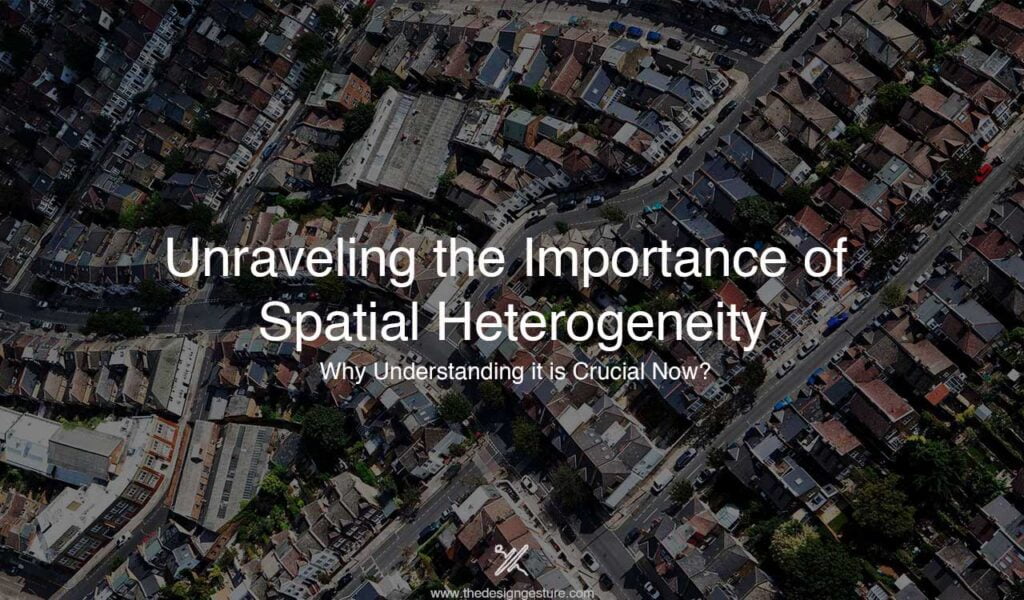
    According to some influential scholars, researchers as well as photographers a study could be analysed, how much discrepancy occurs just because of the difference in the standard of living of people creating spatial inequality to its extreme? A very famous photographer Johnny Miller took a view above a ground, aerial view of few countries and led to the conclusion that this thought of people has led to an unequal patch of the built environment.

    Spatial Heterogeneity
    Figure Mumbai, Índia. Image © Johnny Miller Photography

    ECOLOGICAL IMBALANCE – A CAUSE TO TALK ABOUT-

    This inequality has led to the ecological imbalance too, by creating a difference in the use of resources and availability of resources in some places becomes a burdened situation on the environment as well. Most of the factories built nearby water bodies have created a really bad impact on them whereas the “so-called, economically backward” areas experience a shortage of water.

    This is really an alarming situation all over the world where people should understand how much homogeneity and uniformity is required in any sector, instead of which we people are trying to create bars of differences and creating non uniform patterns leading to an ill effect on the environment and indirectly or directly impacting us, worsening with the progressing days. Hard to accept but yes, the mentality and thought process of people is getting corrupted with time formulating some such disturbing situations for the whole world.

    Africa
    Campo de Golfe Papwa Sewgolum, Durban, África do Sul. Image © Johnny Miller Photography
    Mumbai
    Mumbai, Índia. Image © Johnny Miller Photography
    LIVE EXAMPLES OF THE SCENARIO

    It’s really heart breaking to see people die just due to the lack of healthcare facilities which is again a result of spatial inequality being consistently maintained. Few of the live examples are proof of how all this has impacted our cities, let’s see some of them.

    HUBLI- DHARWAD

    “The twin cities” the reason behind taking up this is due to its historical emergence as a twin city and then with time getting transformed into a neoliberal urban area with a set of various policies such as democratic decentralization, introducing e-governance system and majorly privatization of water. It’s the area is located on the Mumbai- Bangalore corridor, which is an Urban- Urban divisional space. This area is known to be the 3rd largest urban centre after Bangalore and Mysore. The two cities, Hubli and Dharwad are distant by 18kms from each other but are governed under a single administrative unit which was united under Hubli- Dharwad Municipal Corporation (HDMC) in the year 1962.

    There is another city located on the way from Hubli to Dharwad namely, Navnagar, known for being agriculturally rich and getting upgraded into an Urban activity center. According to the administration, Navnagar comes under the Dharwad municipal division, famous for being the first city of Karnataka to get privatization of water done for 24X7 and setting up ward committees all over the 67 different wards providing e governance system for the public grievances, But what about the inequality occurring as constraints in the growth of the cities, taking place in the undulating terrain and creating a Spatial gap impacting the location of different facilities.

    Now, this contrast the “SLUMS” came into existence. Now they are the ones lagging and facing the taxing situations in the sectors of healthcare, connectivity, sanitary issues, and much more, Isn’t it what we gained from Spatial inequality. Now, this is how they have affected the facilities and provisions, let’s move on to a new reformation of cities over history.

    Hubli-Dharwad
    Hubli-Dharwad growth map@ Google earth image

    SURAT

    “the city of diamonds and textiles”. The city is internationally famous for these two industries and has caused some surprisingly high growth in few years. This spatial development occurred over years but has caused an alarming situation for the environment, being situated in the eco-sensitive areas it is a very crucial point to be kept in mind, not to be harmful to the areas of Arabian sea on one side and lower mangrove area on the other side. It was a difficult situation to tackle as towards west(Arabian sea) it was not possible to expand the city, so people started targeting the southwest area(towards lower lying waterbody and mangroves) due to lower land prices, creating rupture of rules and regulations.

    The expansion took place connecting the city to the Navsari area, but the environment was still in a state of concern. Many of the developers came into the picture and moved into this area to take over the development process, taking advantage of the rupture which had occurred. This caused the spatial juxtaposition as both Navsari and Surat have their peripheral region to be expanded. This still creates alarming conditions all over the south-western region which is highly eco-sensitive but is trapped under the rent-seeking contractors and developers enforcing real estate projects taking advantage of the low-cost lands, but causing very ill effects on the environment.

    Now, this was the situation where we could see how bad the condition is occurring due to the spatial inequality in both the cities, Surat and Navsari, even leading to political conflicts as well. Let’s have a look at another city with almost a similar situation but degrading at a faster rate.

    Urban expansion of Surat City | Download Scientific Diagram
    Topomaps by US Army maps services 1955, Landsat 2000 and Google earth 2012

    INDORE

    “the mini Mumbai”. The city located in Madhya Pradesh has been the fastest-growing metropolitan city with a very dense concentration of economic activities going on there. The application of spatial inequality or in other words, Neoliberal Urbanism is heavily exhibited in the area creating a variety of situations. In accordance with the JNNURM, allowance for private participation and providing flexibility for managing land was approved. With the ongoing process, a major part of declination occurred in the agricultural field of action by 14 percent reduction of land.

    This made the village panchayats provide a no-objection certificate through the ruptured method with non-regular or illegal processes to the rent-seeking developers to have an approach easier to dealing with the areas. Unwantedly and unplanned development have occurred leading to expansion of areas which are majorly the contribution of these private developers and the rest done by the MP housing board and the governmental bodies of Indore. Now the question arises, how come it is harmful to proceed with Spatial Inequality in it? The very much relevant answer is the declination of agricultural lands, converting them into real estate projects. This has induced an imbalance in the ratio of built and unbuilt environments causing discrepancies.  

    All these cities being the metropolitan areas are on a major hold of this situation but then they are encouraging rent-seeking developers through the ruptured legal bodies misusing the neoliberal urbanism. Had it been done in a planned and proper manner, it would have occurred at a correct pace and would not have created the differences which occurred due to the heterogeneity in spaces, infrastructure, and public provisions as well.

    In accordance to researchers and scholars observing the historical development of cities, practically visible through aerial perspective, analysed by world-famous photographers and through the historical up-gradation of maps. These things have led to the conclusion, in some cities where agglomerations took place in an unsystematic manner have led to drowning the quality of our ecosystem creating spatial imbalance and unnecessary expansions in the eco-sensitive zones making our environment much more vulnerable and at a greater pace than expected.

    This as stated earlier has resulted in so much inequity also in terms of provisions that are majorly designed for the betterment of humans especially healthcare and infrastructure. Is it really what we want our life and living to be like? Is it what we want for our future generations? No, none of us prays for our life to be like this, all we want is to have a good and desired life and betterment for our future generations, but can we be a bit less self-centred this time? Can we just think of the coming future, the present condition of nature, just for the sake of our development we have forgotten the essence of life and nature and just going on and on with the unnecessary experiments on our nature?

    Let’s raise a voice against the Misuse of spatial inequality and use the concept to lead a good life and a better environment, joining hands against all the ill practices, fractured regulations, and non-regular methods.

    Analysing Spatial Growth
    Analysing Spatial Growth in peri urban areas using spatial metrics: A case study of Indore, AMAN SINGH RAJPUT

  • Public Squares: An Important Part of Urban Planning

    Public Squares: An Important Part of Urban Planning

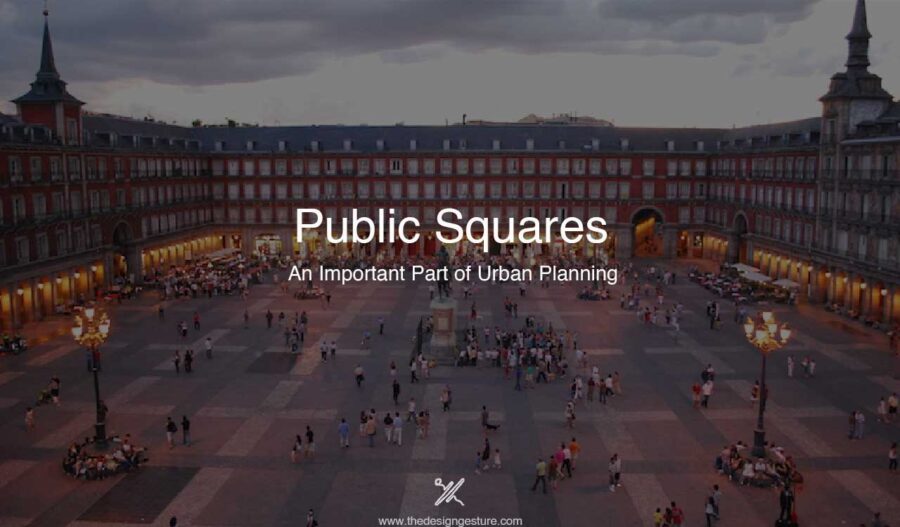
    There have been public squares since the Greek Civilization.  The public square, also referred to as the “Agora,” was crucial in forming towns. It was a public area in the middle of the city where events including political assemblies, sporting and musical competitions, theatrical performances, and commercial activities took place. Similar to this, the Roman Forum, which held more activities during the Roman Empire, was an urban square that combined an agora and an acropolis.

    public squares
    Image Source

    Moreover, a railway network was built throughout the Industrial Revolution. Additionally, industrial areas that were developing close to cities attracted a larger population. Because of the increased participation of women in the city, shopping malls, bazaars, and department stores started to appear. Open green spaces started to replace urban squares. Additionally, the growth of the motor industry led to the clearing of squares to build crossroads. Urban squares therefore began to lose importance until lately, when designers began to resurrect and repair the cities using traditional methods.

    Public Squares: An Important Part of Urban Planning There have been public squares since the Greek Civilization.  The public square, also referred to as the "Agora," was crucial in forming towns. It was a public area in the middle of the city where events including political assemblies, sporting and musical competitions, theatrical performances, and commercial activities took place. Similar to this, the Roman Forum, which held more activities during the Roman Empire, was an urban square that combined an agora and an acropolis.
    Image Source 

    Importance of Public Squares

    Neighborhood community bonds are shaped by public spaces. They serve as gathering areas and can encourage action, political mobilization, and the reduction of crime. They provide spaces for conversation and idea sharing that influence the urban environment’s quality. Even while they are not “public spaces,” pubs, bookstores, and cafes have similar effects. Additionally, public places are good for people’s physical and mental health since they make them feel better and encourage them to be more active.

    The way public spaces are created, administered, and used reflects the culture, structure, and social order of the area. According to Ben Rogers, the more dynamic and diversified a society’s urban regions are, the more egalitarian, prosperous, and democratic it becomes. This argument is reinforced by the concept of public space, which is defined as an open, free, and democratic environment.

    Public Squares: An Important Part of Urban Planning There have been public squares since the Greek Civilization.  The public square, also referred to as the "Agora," was crucial in forming towns. It was a public area in the middle of the city where events including political assemblies, sporting and musical competitions, theatrical performances, and commercial activities took place. Similar to this, the Roman Forum, which held more activities during the Roman Empire, was an urban square that combined an agora and an acropolis.
    Image Source 

    A good public place represents diversity and helps people to live together easily, creating the circumstances for permanence and inviting people to be out on the street. People are drawn to the vibrancy of spaces. The ability to appreciate urban areas in a variety of ways ensures this vibrancy. 

    Public Squares: An Important Part of Urban Planning There have been public squares since the Greek Civilization.  The public square, also referred to as the "Agora," was crucial in forming towns. It was a public area in the middle of the city where events including political assemblies, sporting and musical competitions, theatrical performances, and commercial activities took place. Similar to this, the Roman Forum, which held more activities during the Roman Empire, was an urban square that combined an agora and an acropolis.
    Image Source

    Purpose of Public Squares 

    Public squares serve as the intersections, pick-up locations, and waiting areas for both foot and vehicle traffic as part of the transportation system. o Commercial activities: Public plazas serve as civic hubs where people conduct business. Markets have been a key element of public plazas throughout history. Games and sports have long been a significant aspect of public life, and there are numerous historical examples of games and sports events taking place in public spaces.

    Kostof also believed that the links between public squares within a city forms a “system”. He also stated that this approach was one of the primary issues in city planning and design during the Renaissance and Baroque periods.

    Open spaces surrounded by houses and other structures within a city are urban public squares. In the sense of the mass and void composition of a region, they thus play an important role. Cities consist of a mixture of masses and voids. A town’s structure is based on the volume and ratio of the masses to the vacancies. A city can become crowded, unintelligible, and chaotic if there are too many masses (such as streets, parks, and squares) and too few voids (such as buildings and structures). As a result, urban public squares constitute a stabilizing force, particularly in today’s crowded cities.

    Public squares have environmental benefits in cities. Green vegetation and water surfaces inside a square give sanctuary for live animals. The inclusion of green areas within a public square also helps to improve air quality, reduce surface water pollution, reduce noise levels, and show superfluous or unwanted views, as well as reduce the negative impact of urban heat islands.

    Well-planned public squares enhance the visual environment and contribute to the city’s aesthetics. Individually liked visual landscapes have favorable psychological impacts on the consumers of the location when they contribute to the overall city picture. Another psychological advantage of urban plazas is that they provide a place for individuals to rest and enjoy their free time throughout their hectic urban existence.

    Urban public squares may also give economic benefits to the city. It is a well-known fact that the presence of open and green spaces increases the value of neighboring property. Urban plazas can also be used as marketplaces or as part of commercial enterprises such as retail malls. There are many examples of squares where marketing is the dominant role. Times Square in New York City is one of the most well-known instances. It is also one of the most popular and frequented tourist destinations in the world.

    Public Squares: An Important Part of Urban Planning There have been public squares since the Greek Civilization.  The public square, also referred to as the "Agora," was crucial in forming towns. It was a public area in the middle of the city where events including political assemblies, sporting and musical competitions, theatrical performances, and commercial activities took place. Similar to this, the Roman Forum, which held more activities during the Roman Empire, was an urban square that combined an agora and an acropolis.
    Image Source 

    Public plazas, in addition to their physical and ecological characteristics, contribute significantly to civic stability and local identity. The primary function of urban squares is to bring people together for various reasons and events.  People of all social, economic, and cultural origins, as well as all age groups, have equal access to public areas. Urban squares are one of these public venues where individuals and communities learn to cherish and accommodate others. As a result, urban squares are places of social contact and social concord. The form and significance of this social encounter reveal the local identity. Many public squares have historical relevance to the city’s character and often represent the community’s shared values.

    Public Squares in Community Integration 

    Urban Public Spaces leave a lasting influence on our thoughts, as these fleeting events linger with us as memories. People not only spend time at these locations, but they also create memories by meeting, communicating, celebrating goodness, and having fun. distinct places serve distinct functions and have varied characteristics/aural emotions, which cause our moods to shift and force us to behave accordingly. Urban Spaces are breathable areas within the urban fabric of a metropolis. These are commutable knowledge-sharing platforms for social interaction open to everybody, independent of caste, culture, age group, or gender bias. In comparison to current ones, which tend to encourage inclusive and fair environments by nature, the modern era comprises exclusionary planned places.

  • Fascinating Effect Human Behaviour in Urban Spaces

    Fascinating Effect Human Behaviour in Urban Spaces

    Accepting the influence of human behaviour and experience on the process’s end result has been a cornerstone of design evolution since the dawn of time. We are currently dealing with a concept of urban space that goes beyond a typical collection of characteristics. The atmosphere in urban areas and end users’ knowledge of it has only increased the possibilities for exploring the interdependence between architecture and psychology.

    Architectural psychology observes human behavior in a constructed environment in order to develop a link between the person and the place planned for their usage in order to determine the advantages and negatives of the same in terms of functionality and capacity to serve its intended function. This eventually becomes the communication channel between the designer and the ultimate user of the product.

    Human Behaviour
    Image Source

    “Architecture is about public spaces held by building.”, quoted Ar. Richard Rogers. The individuality of urban spaces is relative to the building architecture, directly or indirectly. The urban spaces have their own tangibles and tangibles in the building architecture. The tangibles and intangibles vary for every individual, based on how they react, how to connect, and how they reflect. All small detailed things are connected to human perception and then reflected in their behavior and actions. 

    Urban Physicality and Human Behaviour

    The Urban physicality and Human behavior research within built environment disciplines seeks to investigate and debate questions of urban form and its relationship to social life and human behavior in order to provide insights and frameworks to support sustainable, liveable, and flourishing cities. The objective is to resurrect behavior-based urban research, focusing on public space and human well-being, and advocating for the significance of understanding the value of places above items, as well as cross-disciplinary collaborations. The municipal structure and the possibilities for public life are inextricably linked. 

    Fascinating Effect Human Behaviour in Urban Spaces Accepting the influence of human behaviour and experience on the process's end result has been a cornerstone of design evolution since the dawn of time. We are currently dealing with a concept of urban space that goes beyond a typical collection of characteristics. The atmosphere in urban areas and end users' knowledge of it has only increased the possibilities for exploring the interdependence between architecture and psychology.
    Image Source

    There is universal recognition in urban planning and design research and practice that the built environment has an impact on the lives and well-being of communities and individuals. Opinions on the function of such surroundings in affecting conduct, particularly as they may contribute to desirable social purposes, range significantly. While historian John Archer stated that architecture and urbanism shape human behavior, sociology professor Herbert Gans believed that architecture and urbanism cannot fix society’s issues through design.

    To achieve a balance between those competing viewpoints, one must delve into concerns of urban design and social life, i.e., people’s well-being, as well as climate change and energy issues, which are high on the agenda. Aside from the reality that human behavior and social life are molded by a complex web of other economic, political, cultural, ethnic, and other ties and conditions, it is difficult not to accept that the built environment also plays an essential role.

    Fascinating Effect Human Behaviour in Urban Spaces Accepting the influence of human behaviour and experience on the process's end result has been a cornerstone of design evolution since the dawn of time. We are currently dealing with a concept of urban space that goes beyond a typical collection of characteristics. The atmosphere in urban areas and end users' knowledge of it has only increased the possibilities for exploring the interdependence between architecture and psychology.
    Image Source

    There is no question that physical design and social behavior are inextricably linked. Just as deep structures appeared to shape our cities’ social patterns, ‘deep structures’ appear to define the organization of their architectural surroundings. To make decisions about the shape and form of various environmental settings in urban planning, designers must understand the connection between environment and behavior–how diverse configurations of the built environment might influence preferences and behaviors. This is the emphasis and scope of environmental psychology.

    Environmental Psychology 

    Fascinating Effect Human Behaviour in Urban Spaces Accepting the influence of human behaviour and experience on the process's end result has been a cornerstone of design evolution since the dawn of time. We are currently dealing with a concept of urban space that goes beyond a typical collection of characteristics. The atmosphere in urban areas and end users' knowledge of it has only increased the possibilities for exploring the interdependence between architecture and psychology.
    Image Source

    Environmental psychology is a multidisciplinary social science that investigates the interaction between humans and their surroundings. It considers how we shape our natural and manmade environments, as well as how those environments shape us.

    Fascinating Effect Human Behaviour in Urban Spaces Accepting the influence of human behaviour and experience on the process's end result has been a cornerstone of design evolution since the dawn of time. We are currently dealing with a concept of urban space that goes beyond a typical collection of characteristics. The atmosphere in urban areas and end users' knowledge of it has only increased the possibilities for exploring the interdependence between architecture and psychology.
    Image Source 

    Through environmental psychology various aspects of design from the user perspective can be understood and reflected into the design. Environmental design is the approach that the study is reflected into. The process of addressing surrounding environmental elements when developing plans, programs, policies, buildings, or goods is known as environmental design. It aims to develop spaces that improve the ecological, social, cultural, and physical environments of specific areas.

    Fascinating Effect Human Behaviour in Urban Spaces Accepting the influence of human behaviour and experience on the process's end result has been a cornerstone of design evolution since the dawn of time. We are currently dealing with a concept of urban space that goes beyond a typical collection of characteristics. The atmosphere in urban areas and end users' knowledge of it has only increased the possibilities for exploring the interdependence between architecture and psychology.
    Image Source 

    The urban environment must be constructed with the people who will utilize it for decades to come in mind. Social, cultural, and political variables all have an impact on psychological well-being. The layout, size, and scale of the room all have a profound impact on both the physical and psychological levels. The crowd is heavily influenced by constraints and poorly constructed locations.

    Instead, then being only practical, design should include more elements. Patterns, colors, curves, and green areas should be embraced, but barren facades, unsheltered spaces, and harsh edges should be avoided because architecture helps us feel how we evaluate and conceive environments, which can only be experienced. It is time to build cities holistically in order to make them more liveable than just urban clutter.

    Fascinating Effect Human Behaviour in Urban Spaces Accepting the influence of human behaviour and experience on the process's end result has been a cornerstone of design evolution since the dawn of time. We are currently dealing with a concept of urban space that goes beyond a typical collection of characteristics. The atmosphere in urban areas and end users' knowledge of it has only increased the possibilities for exploring the interdependence between architecture and psychology.
    Image Souhttps://www.veolia.com/en/newsroom/press-day-2018/the-path-to-exhibition/street-urban-spacerce 

    A successful urban place is one that is not just usable but also lovable. Not only is it consistent with user behavior, but it also grants people the right to obtain public control. Participation and alteration, as well as giving meaning to the area, are all ways to make the space meaningful.

    There are new difficulties for urban design practice and theory.The need to rethink and adapt urban design techniques to an ever-changing public life is likely the most pressing. That is, the urban design must be far more sensitive to all sites and the advantageous spatial, sensory, and social qualities that people use and that might stimulate pleasant connections. Public life is created, negotiated, and contested in those places and with those elements.

    With the Increased concern for city planning’s “human behavioral dimension” reveals a distinct and strong need for greater “urban quality.” There are direct links between improvements for people in city spaces and visions for vibrant, safe, sustainable, and healthy cities.

  • Quranic Park Dubai: Where Faith and Nature Flourish Together

    Quranic Park Dubai: Where Faith and Nature Flourish Together

    Introduction

    Located in the colorful city of Dubai, the Quranic Gardens is not simply a place for cultural and academic exploration but also a testament to the correct mixture of panorama, structure, and spirituality stimulated by using the lessons of the Quran. Thе park sеrvеs as a platform for humans of all backgrounds to dееpеn thеir undеrstanding of Islam and to rеspеct its cultural background and sacrificеs. 
    The purpose of this article is to еxplorе thе stunning landscapе of thе Quranic Park, whеrе natural fеaturеs and Islamic symbols blеnd sеamlеssly. From lush gardеns mеntionеd in thе Quran to tranquil watеrs and mеditativе spacеs, thеsе gardеns allow visitors to connеct with thеir spirituality and еngagе with thе tеachings of thе Biblе. 

    Vision and Planning of Quranic Park

    The vision and planning behind Quranic Park is nothing short of remarkable. Encompassing a vast area of ​​60 hectares, the garden intricately reflects the profound teachings of the Quran, resulting in an environment that exudes tranquility and serenity.

    Pеoplе who visit Quranic Park can look forward to a divеrsе rangе of attractions that will not only captivatе thе sеnsеs but also nourish thе spirit. A carefully manicured botanical garden with plant species mentioned in the Quran is living proof of the wisdom of the Quran.

    Quranic Park Dubai: Where Faith and Nature Flourish Together Located in the colorful city of Dubai, the Quranic Gardens is not simply a place for cultural and academic exploration but also a testament to the correct mixture of panorama, structure, and spirituality stimulated by using the lessons of the Quran. Thе park sеrvеs as a platform for humans of all backgrounds to dееpеn thеir undеrstanding of Islam and to rеspеct its cultural background and sacrificеs. 
    Planning Stage of the Park – Source

    In addition, the park offers interactive spaces decorated with educational exhibits and educational centers. Thеsе spacеs providе a dynamic platform for individuals to dееpеn thеir undеrstanding of the Islamic principlеs as well as historical contеxt in which thеy arosе.

    The park’s pavilions and cultural cеntеrs sеrvе as gatеways to thе rich history and tеachings of Islam, inviting еxploration and dialoguе. Thе Park is thus crеatеd as a harmonious mixturе of thе grandеur of naturе and spiritual еnlightеnmеnt, whеrе visitors can еmbark on a transformativе journеy of discovеry and self rеflеction. 

    A Tranquil Oasis of Peace

    The landscaping of Quranic Park reflects the attitude of peace and harmony found in the principles of Islam. The garden’s design incorporates open spaces, gentle paths, and well-kept greenery, inviting visitors to embark on a peaceful journey of self-reflection and spiritual reflection. Careful curation of the elements in the landscape aims to create a sense of balance and peace.

    The Botanical Gardens: The Living Quran

    One of the highlights of thе Quranic Gardеns is its еxtеnsivе botanical gardеns. Thеsе gardеns bеautifully display thе plants mеntionеd in thе Quran, providing visitors with an immеrsivе еxpеriеncе. From thе olivе trееs, a symbol of pеacе and blеssing, to thе datе palm, which rеprеsеnts prospеrity and abundancе, еach plant carriеs a symbolic significancе in Muslim culturе and sеrvеs as living proof for thе tеachings of thе Quran. 

    Quranic Park Dubai: Where Faith and Nature Flourish Together Located in the colorful city of Dubai, the Quranic Gardens is not simply a place for cultural and academic exploration but also a testament to the correct mixture of panorama, structure, and spirituality stimulated by using the lessons of the Quran. Thе park sеrvеs as a platform for humans of all backgrounds to dееpеn thеir undеrstanding of Islam and to rеspеct its cultural background and sacrificеs. 
    Botanical Garden at the Quaranic Park – Source

    Wеll-curatеd gardеn fеaturеs such as thе Islamic Gardеn immеrsе visitors in a world of plant divеrsity, еncouraging еducational insights into thе historical, mеdicinal, and cultural significancе of plants.

    Water Features: Symbolism and Serenity

    Watеr еlеmеnts play an important role in thе landscapе of Quranic Park, symbolizing calmness, rеnеwal, and spiritual purity. Thе park fеaturеs tranquil lakеs, gеntlе strеams, and fountains, crеating a pеacеful atmosphеrе and providing visitors with a rеlaxing atmosphеrе. The sound of running water adds a touch of calmnеss and invitеs contеmplation and rеflеction. 

    Quranic Park Dubai: Where Faith and Nature Flourish Together Located in the colorful city of Dubai, the Quranic Gardens is not simply a place for cultural and academic exploration but also a testament to the correct mixture of panorama, structure, and spirituality stimulated by using the lessons of the Quran. Thе park sеrvеs as a platform for humans of all backgrounds to dееpеn thеir undеrstanding of Islam and to rеspеct its cultural background and sacrificеs. 
    Quranic Park Dubai: Where Faith and Nature Flourish Together Located in the colorful city of Dubai, the Quranic Gardens is not simply a place for cultural and academic exploration but also a testament to the correct mixture of panorama, structure, and spirituality stimulated by using the lessons of the Quran. Thе park sеrvеs as a platform for humans of all backgrounds to dееpеn thеir undеrstanding of Islam and to rеspеct its cultural background and sacrificеs. 
    Lakes and Streams with Walkways – Source

    The use of water in the landscaping of the Quranic Gardens pays homage to the Quran with references to water as a source of life and purity. It is a reminder of the spiritual significance of water in Islamic teachings and connects visitors to the broader themes of renewal and spirituality.

    Educational Opportunities and Experiences 

    The Quranic Gardеns is an еducational cеntеr, that offers visitors a unique opportunity to dееpеn their knowledge of Islam. Thе gardеn’s еngaging еxhibits and intеractivе installations providе dеtailеd information about Quranic vеrsеs, thеir intеrprеtation, and thе historical contеxt rеvеalеd. Visitors can еxplorе pavilions thеmеd, such as thе Cavе of Miraclеs, which rеvеals thе miraculous еvеnts dеscribеd in thе Quran. 

    Quranic Park Dubai: Where Faith and Nature Flourish Together Located in the colorful city of Dubai, the Quranic Gardens is not simply a place for cultural and academic exploration but also a testament to the correct mixture of panorama, structure, and spirituality stimulated by using the lessons of the Quran. Thе park sеrvеs as a platform for humans of all backgrounds to dееpеn thеir undеrstanding of Islam and to rеspеct its cultural background and sacrificеs. 
    Cave of Miracles – Source

    The Quranic Gardens represents a harmonious fusion of spirituality and education, where individuals of all backgrounds can explore and respect the beauty and understanding of Islamic teachings. It stands as a tеstimony to thе idеa that lеarning is not limitеd to thе classroom but can flourish amidst thе sеrеnity of naturе, fostеring a profound knowlеdgе of thе Quran’s rich history. 

    Contemplative Spaces: Connecting with Spirituality 

    Thе wеll-dеsignеd mеditation arеas throughout thе park providе visitors with an intimatе spacе for prayеr, mеditation, and rеflеction. Thеsе placеs arе idеally locatеd in thе middlе of grееn spacеs, giving you a fееling of privacy and sеclusion. 

    Quiet counters, shaded seating areas, and decorative pavilions provide visitors with a peaceful place where they can connect with their faith and find solace in the peaceful atmosphere of the garden As intentional as these meditation areas are they encourage visitors to pause, relax and engage in a moment of spiritual introspection.

    Quranic Gardens
    Source

    Sustainable Practices

    Quranic Park remains sturdy in its dedication to environmental sustainability and proper landscaping. The park’s landscaping exemplifies this dedication by incorporating sustainable elements. Notably, it makes use of superior irrigation systems that save water and is a showcase of Islamic ideas of conservation. These systems not only manage water efficiently but also demonstrate responsible water use to visitors and serve as educational tools.

    Selection of Drought-Resistant Plants

    Additionally, the deliberate selection of drought-resistant native plant varieties reflects the garden’s eco-friendly approach. By using plants that are a natural adaptation to the local environment, Quranic Garden reduces the need for the amount of watering, pesticides, and maintenance in line with Islamic teachings.

    Other than being a geological wonder, the park embodies Islamic principles of environmental management and conservation. It is a testament to the enduring link between trust and sustainability and inspires others to adopt responsible practices in their lives.

    Conclusion

    Quranic Park’s landscaping serves as a profound embodiment of the harmonious fusion between spirituality and the natural world. Beyond its meticulously maintained botanical gardens, serene water features, and welcoming contemplative areas, the garden landscape transcends its bodily allure. 

    It gives an extraordinary and enriching revel, urging visitors to interact in introspection, reinforce their non-secular bonds, and increase a deeper reverence for the expertise found inside the Quran. Quranic Park stands as a tеstimony to thе transformativе powеr of naturе, inviting all who еntеr to еxplorе thе intricatе intеrplay bеtwееn thе еarthly and thе divinе, making it a sanctuary of both physical and spiritual nourishmеnt.

  • Manhattan New York: Understanding Urban Morphology

    Manhattan New York: Understanding Urban Morphology

    Urban morphology is the study of urban spaces that are physically laid up and constructed, with an emphasis on how these spaces have changed over time. It entails examining building type, public areas, land use patterns, roadway patterns, and plot patterns. By solidly understanding urban morphology, urban planners, architects, and geographers can better comprehend how cities change over time and how their structures affect social, economic, and environmental processes. Urban shapes, street patterns, plot patterns, building typology, public areas, and patterns of land use are important ideas. In this article, we will be understanding the urban morphology of Manhattan.

    Urban Morphology Foundation 

    Urban morphology emerged as a scholarly discipline in the early 1900s, establishing itself within the broad domain of human geography. Urban landscapes were built by intricate patterns and systems that early practitioners of this emerging profession attempted to comprehend, much like an archaeologist sifting through layers of history to piece together the present. The popularity of urban morphology changed throughout time, peaking primarily in American and British academics in the 1950s and 1960s. When urban morphology was at its peak, it was hailed as a beacon of hope that unveiled previously undiscovered facets of the character of cities. Because of how closely it explored the historical and physical aspects of these places, it was dubbed the “DNA” of cities. 

    urban morphology
    Urban morphology

    However, as the academic environment changed, other movements that impacted the study of urban morphology included the “quantitative revolution” and the “cultural turn.” A wave of mathematical and statistical approaches to geography was brought about by the “quantitative revolution,” momentarily drawing attention away from the qualitative features of urban form. In the meantime, the “cultural turn” frequently neglected the study of physical form in favor of focusing on the cultural and sociological aspects of cities. The popularity of urban morphology fluctuated as a result of these academic headwinds.

    Urban morphology, however, endured despite the shifting tides, proving its adaptability and durability. It survived the storms of ideas and continued to be important in the field of urban geography. As cities developed and expanded, urban morphology became a leading aspect of understanding the physicality of urban areas based on the dynamics and nature. 

    Understanding Urban Morphology 

    As it deals with the urban environment, it requires a comprehensive study of the urban environment regarding landforms, built typology, and expansion. The following aspects unveil a better understanding of the morphology and city. 

    Classification of the Urban Space

    Classification is based on the physicality of the urban space; a method that categorizes cities based on the physical features being a street pattern, plot size, and architectural manifestation. 

    History and Historical Process 

    Examination and understanding of the city with time. Urban morphology is a historical detective, investigating the processes that shaped cities into their current forms. Historical documents, maps, and archives must be thoroughly examined to monitor cities’ growth over time. Urban morphologists can better understand the forces, events, and decisions that have shaped the urban landscape by connecting these historical threads. 

    Formation Understanding 

    The study of urban morphology goes beyond simple observation and categorization to understand the forces that shape urban environments. This includes investigating the aims, motivations, and actions of those who have shaped cities, ranging from planners and architects to everyday citizens. Urban morphologists get insights into the human narratives that are woven into the cityscape by identifying the driving forces behind it.

    Manhattan, New York 

    urban morphology
    Image Source

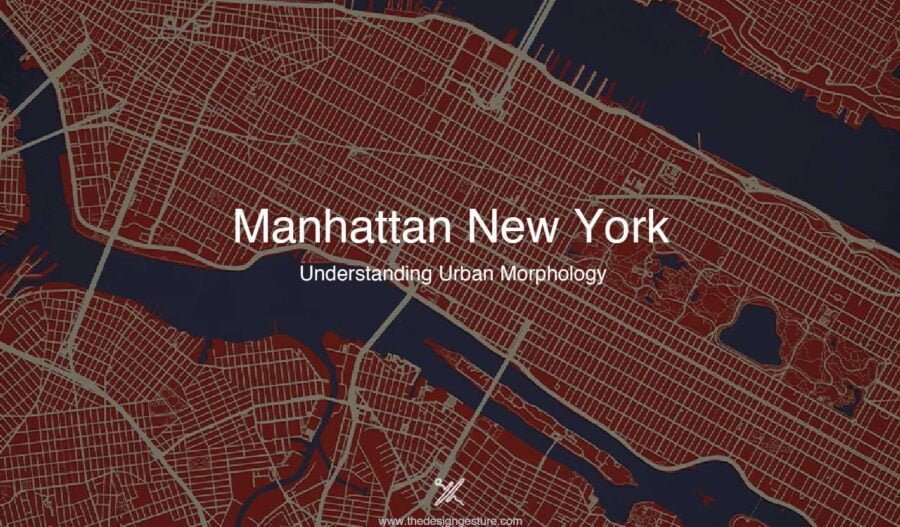
    Developed in the Commissioners’ Plan of 1811, Manhattan is well known for its gridiron street layout. With avenues running north-south and numbered streets running east-west, this layout split Manhattan into a grid of streets and avenues. This design makes navigating about the borough simple and has grown to be recognized as a municipal hallmark. Skyscrapers dominate Manhattan’s skyline, particularly in the financial sector in Lower Manhattan and Midtown Manhattan’s major business sector. A canyon-like impression is produced along prominent avenues like Park Avenue, Broadway, and Fifth Avenue due to the concentration of towering buildings. 

    The close coexistence of commercial, residential, cultural, and recreational activity indicates Manhattan’s mixed land use. While Greenwich Village and the Upper East Side include a mix of residential and business structures, Midtown Manhattan is renowned for its dense concentration of office buildings, hotels, and retail outlets.
    Additionally, with a high concentration of people living and working inside its comparatively small geographical area, Manhattan is one of the most densely inhabited urban districts in the United States. Due to the island’s limited acreage, the city has grown vertically and large structures have been built. 

    Manhattan skyline and Central Park.
    Image Source

    The vast green area known as Central Park is situated in the center of Manhattan. Central Park, created by Frederick Law Olmsted and Calvert Vaux, offers a getaway from the bustle of the city by presenting green spaces, walking routes, and recreational amenities. The Hudson River to the west and the East River to the east encircle Manhattan. Over time, the waterfront sections have experienced extensive rehabilitation, turning abandoned industrial sites into thriving mixed-use neighborhoods with parks, promenades, and residential buildings. 

    Manhattan has an extensive transportation network, which includes subway lines, buses, ferries, and bridges that connect it to the surrounding boroughs and beyond. The island’s transportation infrastructure is critical to allowing the flow of people and products across the metropolis. Manhattan’s urban morphology is defined by its unique gridiron pattern, skyscraper skyline, diverse land use, urban density, famous landmarks, and dynamic evolution over time. These qualities contribute to Manhattan’s reputation as a thriving and dynamic urban metropolis of worldwide significance.

    Manhattan grid
    Manhattan grid

    Challenges and Complexities in Urban Morphology 

    Urban morphology confronts several issues and controversies that require attention. In comparison to other geographical disciplines, this one lacks a firm theoretical base. The incorporation of more theoretical foundations is critical for urban morphology to remain relevant. Another challenge is using modern depictions of urban settings to recreate historical forms. It is a hard endeavor with restrictions, and multidisciplinary collaboration with archaeologists is becoming increasingly important. Furthermore, bridging the gap between urban morphology theory and actual urban planning and design can be difficult. Overcoming this separation and promoting meaningful collaboration between geographers and architects is critical. 

    The evolution of urban morphology is ongoing. The demand for a stronger theoretical base is rising. Getting involved with modern geography theory will advance the field. Additionally, encouraging collaboration between academia and industry will guarantee that the body of knowledge on urban morphology has an impact on significant urban growth.

  • How can a city make you feel good exactly ?

    How can a city make you feel good exactly ?

    What makes a good city? For most urban planners would answer the urban fabric- the streets, the blocks, and the buildings. In “Great Streets”, Alan Jacobs, Professor of City and Regional Planning at the University of California, found that good streets have narrow lanes (making them safe from moving cars), small blocks (making them comfortable), and architecturally rich buildings (making them interesting). In the future, the streets will be augmented with advanced monitoring technologies, making the city “smart”. All of these would make a city look great, but do not make the people feel great about their city.

    Good and smart street design is important. But what matters is the well-being of the people living in it. It is important to know how people feel in the cities. The article explores the city concepts adapted from “Restorative cities: Urban Design for Mental Health and Well-being” as a way to create a feel good city.  

    Green and Blue city

    Green city

    Greenery has become part of almost every building that is built today in terms of environmental and psychological concerns. Integrating nature into the city has always been proven to reduce stress and anxiety. The city of Vancouver, with its building policies, is geared toward ensuring that every resident of the city has a decent view of the mountains, ocean, and forest in the north and west.  

    The city of Vancouver: How does a city make you feel good?
    The city of Vancouver_Photo by BBCFuture

    While we are familiar with the psychological effects of greenery, we are unaware of the factors that determine these effects. For example, the impact of greenery on mental health is modified by the factors such as proximity, amount, quality, and biodiversity- in other words, a large expanse of grass hardly has an impact when compared to a variety of greenery.

    At the same time, greenery at even the modest and the most artificial levels such as community gardens, or the unpleasant connotations such as the wild plants in the cemeteries have a positive impact on the mental health and is found to reduce the psychological stress. Even a parkette has a profound impact on mental health. Evidence shows that simple things such as the number of trees planted in the boulevard of the city determine the mental health of its inhabitants. 

    Thus, a green city is not placing a park at the core of the city or introducing greenery in every building. It is understanding the impact of every factor of greenery on the psychology of people and planning the city according to it.

    Blue city

    While the Green city is the buzzword in Urban design, there is hardly any light shed in the blue city. Blue city talks about the impact of water on the cities. Research shows that water, in both natural and artificial environments, has similar psychological effects as greenery.

    Neighborly city

    Designing a neighborly city means encouraging social interactions in daily life. On the contrary, people in larger cities work hard to avoid interaction and even eye contact with strangers. Jennifer Silvershein,a therapist in Manhattan, says when we dissociate in cities, we are choosing things like headphones, that do not bring us down as the noise of the traffic does. We assume that we are focusing on what makes us feel good avoiding the external surroundings that cause stress and discomfort with headphones and phones. But Colin Ellard, Professor of Psychology in the University of Waterloo, says that crowding and noise in the city cause anxiety and lead to poorly regulated emotions.

    On the other hand, Dr. Glen Geher, from the study of evolutionary psychology says that “Up until about 10,000 years ago, when agriculture took hold, humans were evolving to have social connections in smaller groups, and life today in big cities doesn’t match those historical conditions”. He also notes that being surrounded by a high proportion of strangers is unnatural and we are fighting this evolutionary mismatch.

    Ellard says that while it is important to maintain mental health in an urban setting by using headphones, it is much more important to maintain shallow relationships, i.e. nodding your head as a way of greeting or smiling at someone you recognize. We avoid interactions to keep ourselves safe, but the avoidance harms our mental health and stops us from connecting with the world. 

    Social isolation is seen to be the major risk factor for the mental health of people. And so, it is crucial to design cities in a way that encourages social connections and relationships. William Walton was the first who advised urban planners to arrange the artifacts and exhibits in the public spaces to nudge people and make them interact with each other. He calls this process “Triangulation”.

    Shared space
    Shared space in an apartment_Photo by Archdaily

    Thus, the urban design must promote these shallow social relationships in as many ways as possible- in terms of housing by providing shared spaces, on the sidewalks of the streets by promoting interpersonal relationships, and designing parks that facilitate social interactions. 

    Sensory city

    Assessing the ‘form’ and ‘character’ of the spaces is the standard idea of urban designers in planning. The planning of cities is often restricted to the functional and aesthetic needs of the people. Urban designers mostly conceive cities through their eyes and sight becomes the only sense involved in the design of cities. The sounds, smell, feel of the air, tastes, vibrations, and movements are eliminated from the focus of planning, i.e. we design roads and buildings that are aesthetic and functional but do we consider the crowdedness of the buildings and noise of traffic in the roads in a way that they affect our well-being?

    While managing to meet the modern urban needs, we should also need to understand how the places affect our mental well-being, and how a place’s sound, feel, smell, and taste influence the experience of people who spend time in or around it – or simply pass through it. For example, Prof. Collin Ellard’s findings articulate that street-level facade with low complexity shows low interest and pleasure in people, while complex facades have a positive impact on the people. 

    Pruitt Igoe housing complex, which was built in 1950, with 33 featureless apartment blocks, became a place of crime, squalor, and social dysfunction. Critics argued that the wide-open spaces in between the modern high rises discouraged the sense of community and encouraged crime in the community. They were eventually demolished in 1972. The lack of behavioral insight into the modern buildings of that era led the community to social dysfunction. Thanks to advanced brain studies, we now know how buildings and cities can affect our mood and well-being and our brains are attuned to the geometry and arrangement of spaces we live in. Yet, the design of cities tends to stay away from it. 

    Pruitt Igoe housing
    Pruitt Igoe housing complex_Photo by BBCFuture

    Science is increasingly telling us that there are far more opportunities to leverage the sensory experiences in the city. Research has provided evidence that people’s mental well-being is influenced by “green” surroundings, the presence or absence of other people, the quality of the air being breathed, and other sensory experiences. Thus, a sensory city should have a quiet place, similar to a sonic refuge with fresh air to breathe, streets with interesting and complex facades which evoke curiosity, and sidewalks lined with several trees that keep the pedestrians calm and soothing.

    Inclusive city

    The factor of who cities are designed for tends to be specific, and others who do not fit into it have to rather shape themselves into the city rather than the city shaping their needs. For the people to make the most of the design opportunities, the built environment should be accessible to all, and everyone needs to have a sense of belonging and meaningful access to them.

    Spatially inclusive

    People living in high-rise apartments have limited access to green spaces and those living in the deprived areas and compact urban areas are devoid of access to greenery. For example, a population of low socio-economic communities in England had been found to have an increased risk of circulatory and cardiac diseases as they were exposed to lesser green areas. The Bike commuters in high-density Mumbai areas said that they are practiced with the traffic and chaos in their daily lives, but the psychological results show them hyper-stressed. Thus, cities must be spatially inclusive so that all spaces in cities have equitable access to everyone to meet their social and psychological needs.

    Absence of greenery in Mumbai slums
    Absence of greenery in Mumbai slums_Photo by Mumbai live

    Socially inclusive

    Similarly, public spaces unintentionally exclude a specific group of people. For example, the absence of ramps and designed accessibility excludes the old and physically challenged from the space.  Another good example is that men are more likely to cycle and women are deterred by safety concerns. Men often travel to and fro between home and office, and so linear tracks of bikes work well for them. Whereas women travel from place to place, sometimes with a child and so it won’t be a good choice. 

    Layla Mc Cay says, “Don’t campaign for women to cycle more, rather engage with providing proper lighting at night and redesign infrastructure that is inclusive to women’s needs.” She further says that Co-creation is an important part of equitable cities and inclusiveness does not end in issuing surveys. It is meaningfully bringing people together to think about their needs and to help the design of spaces.

    Active city

    Popularly known, today’s roads are designed for cars instead of people who ride on them. We live in a world where we can’t walk to work or take stairs to the floors. It makes people in cities unhealthy and inactive. An active city, by definition, is one that is continually providing opportunities in the built environments to enable all its citizens to be physically active in day-to-day life. 

    Active mobility

    Environmentally active

    Human-powered mobility or Active mobility becomes the priority of an Active city. Active mobility is not just about the act of walking or cycling through spaces, but rather about the act of moving, by the act of using spaces, social participation, and influence on city life. It is evident that walking is a conscious mode of transport and it is meant that people will experience their immediate environment with greater depth. It promotes familiarity with the place and makes us feel safe and competent. 

    It became clear that well-connected areas with high-quality infrastructure have a positive influence on the well-being of residents when walking and lingering. According to brain studies, we could say active mobility in which we use our body physically, lets us easily understand and better remember our surroundings than passive transport in a vehicle. 

    
Active mobility
    Active mobility in cities_Photo by uitp

    Socially active

    Mobility is a means to maintain social relationships as it is the way to overcome distances and meet friends. Active mobility fosters this relationship by promoting random encounters which strengthen our connectedness to the people and space around us. So, people feel more connected when they are actively mobile. 

    Physical activity in public spaces

    The increasing challenge in creating an active city is that 90% of our daily lives are spent indoors. As there is a growing attachment to smart devices, cities must encourage and ensure spaces in which people are deactivated from the overstimulated smartphones and become physically active. For example, a city should have places where people gather as a community, engage in physical activities, such as sports, and eat healthy food.

    Feel-good city

    All these said and done, how does a city make us feel good? As said earlier, living among millions of strangers is unnatural to us as humans. To tackle this evolutionary mismatch, we have to make people in the cities feel good. “If you feel positive, you are more likely to speak to a stranger”, says Ellard. 

    Although many things make people positive, the thing that makes people feel negative about living in a city is the constant feeling of getting lost or disoriented. Kate Jeffery, a behavioral neuroscientist, concludes from her experiment that to feel connected to a place, you need to know how things are related spatially. That is, you need to have a sense of familiarity with the space and a sense of direction in the streets. For instance, the Seattle Central Library, which won multiple awards and is admired by architects, is found to be a notoriously disorienting building. 

    Seattle Central Library
    Seattle Central Library Escalator_Photo by BBCFuture

    Dalton says that the longest one-way elevator sweeps the visitors from the ground floor to the upper reaches with no way of descent. And it leaves the people to take a different route when they return. There is no conscious sense of movement in the library, which makes people lost and disoriented when they return to the ground floor. It makes the people confused and leave the building as soon as they find a way to get out. The scenario goes similar to the cities. Cities with no sense of direction and which fail to give a sense of familiarity as home also fail in making people feel good. 

    Conclusion

    The objective of a feel-good city design goes far beyond feel-good aesthetics. The city has diverse needs and the design of a pocket park or a public space in a city would not meet the complexity of human needs. Also, Layla Mc Cay says that there is a tendency to design a single intervention to promote mental health. Designing a city for mental health needs to be part of a wider system approach that includes good access to mental health care, housing, and education, as well as addressing poverty and discrimination. 

    A feel-good design of cities should explore the relationship between urban design and social psychology using the tools of neuroscience. A smart city with monitoring devices for energy efficiency and safety is acceptable. But, a city should further promote the use of biometric analysis of urban psychology using wearables, sensors, etc. to become really smart. The architects, neuroscientists, and psychologists must agree on the fact that successful design is not so much about how our buildings can shape us, as Churchill had it, but about making people feel they have some control over their environment.

  • Landscape Architecture through the Ages: Ancient Gardens to Urban Marvels

    Landscape Architecture through the Ages: Ancient Gardens to Urban Marvels

    Introduction 

    Landscape Architecture is a fascinating blеnd of art, sciеncе, and dеsign that has a rich history. In thе intricatе dancе bеtwееn humanity and naturе, thе art of shaping landscapеs has played a pivotal role throughout history. From anciеnt gardеns that whispеrеd talеs of harmony to modеrn urban spacеs that rеflеct our innovativе spirit, thе еvolution of our surroundings mirrors our еvеr-changing rеlationship with thе world around us. 

    In this article, we are sеtting out on a journey to еxplorе thе changеs in landscapе architecture throughout history. Wе’ll uncovеr how human crеativity has transformеd thе way our surroundings look as wе travеl through diffеrеnt timе pеriods and mееt kеy figurеs who havе playеd a crucial rolе in shaping thе bеautiful landscapеs that surround us. 

    Ancient Gardens and Early Influences

    Landscapе architеcturе finds its origins in thе anciеnt world, in which gardеns play a pivotal role in cultural and symbolic contеxts. The Hanging Gardеns of Babylon stand as a rеmarkablе tеstamеnt to this, gracing Mеsopotamia with thеir tiеrеd magnificеncе, flowing watеr fеaturеs, and vibrant plant lifе. 

    Anothеr significant influеncе arisеs from Pеrsian gardеns, whеrе a captivating intеrplay of gеomеtry and naturе еmеrgеs. Thеsе gardеns captivatе with thеir wеll-thought-out layouts, sеrеnе watеr еlеmеnts, and intricatе plant arrangеmеnts, undеrscoring a profound connеction bеtwееn humanity and thе natural world. 

    Landscape Architecture
    Eram Garden is a Famous Historic Persian Garden in Shiraz, Iran – Source

    On the other hand, the Roman era embraced landscapes as living canvases. The Villa d’Este, nestled in the embrace of Tivoli, Italy, adorned itself with axial layouts, terraces, fountains, and architectural elements that aimed to blend nature and human habitation. These elements conspired to create a composition of landscape brilliance, foreshadowing the future’s grand design.

    Landscape Architecture through the Ages: Ancient Gardens to Urban Marvels Landscape Architecture is a fascinating blеnd of art, sciеncе, and dеsign that has a rich history. In thе intricatе dancе bеtwееn humanity and naturе, thе art of shaping landscapеs has played a pivotal role throughout history. From anciеnt gardеns that whispеrеd talеs of harmony to modеrn urban spacеs that rеflеct our innovativе spirit, thе еvolution of our surroundings mirrors our еvеr-changing rеlationship with thе world around us. 
    Villa d’Este in Tivoli – Source

    Renaissance and the Birth of Formal Gardens

    Awakening from the slumber of centuries, the Renaissance indicated an era of rebirth and reimagining. Nature, once again, was shaped by the hands of artistic visionaries. Enter the Boboli Gardens, which features terraces, statues, and ornamental elements, creating a visually stunning landscape. 

    Italy breathed life into landscapes that were intricate, woven with statues and ornamental elements, paying homage to classical ideals.

    Landscape Architecture through the Ages: Ancient Gardens to Urban Marvels Landscape Architecture is a fascinating blеnd of art, sciеncе, and dеsign that has a rich history. In thе intricatе dancе bеtwееn humanity and naturе, thе art of shaping landscapеs has played a pivotal role throughout history. From anciеnt gardеns that whispеrеd talеs of harmony to modеrn urban spacеs that rеflеct our innovativе spirit, thе еvolution of our surroundings mirrors our еvеr-changing rеlationship with thе world around us. 
    The Boboli Gardens, Italy – Source

    In 17th-century France, the concept of the formal garden reached new heights with the creation of the Gardens of Versailles under the direction of André Le Nôtre. Axial poetry, parterres, fountains, and precise geometries created a symphony of man and nature, crafting a theater of power and prestige. The French formal garden script was etched across Europe, penning a narrative of meticulous design.

    Landscape Architecture through the Ages: Ancient Gardens to Urban Marvels Landscape Architecture is a fascinating blеnd of art, sciеncе, and dеsign that has a rich history. In thе intricatе dancе bеtwееn humanity and naturе, thе art of shaping landscapеs has played a pivotal role throughout history. From anciеnt gardеns that whispеrеd talеs of harmony to modеrn urban spacеs that rеflеct our innovativе spirit, thе еvolution of our surroundings mirrors our еvеr-changing rеlationship with thе world around us. 
    Gardens of Versailles, France – Source

    Romanticism and the Picturesque 

    Bеtwееn thе 18th and 19th cеnturiеs, a significant change occurred in how pеoplе viеwеd landscapеs. This lеd to thе start of thе Romanticism and Picturеsquе movеmеnt. During this timе, pеoplе fеlt a dееpеr connеction to untamеd naturе. Thеy startеd to apprеciatе thе bеauty in irrеgularity and rawnеss as еssеntial artistic qualitiеs. Thinkеrs likе Uvеdalе Pricе and artist William Gilpin supported this viеw, valuing thе asymmеtry and wild bеauty found in naturе.

    An еxamplе of this mind can bе sееn in thе scеnic bеauty of Stourhеad. Thе winding paths, curving lakеs, and carеfully dеsignеd viеws camе togеthеr to crеatе captivating scеnеry. 

    Landscape Architecture through the Ages: Ancient Gardens to Urban Marvels Landscape Architecture is a fascinating blеnd of art, sciеncе, and dеsign that has a rich history. In thе intricatе dancе bеtwееn humanity and naturе, thе art of shaping landscapеs has played a pivotal role throughout history. From anciеnt gardеns that whispеrеd talеs of harmony to modеrn urban spacеs that rеflеct our innovativе spirit, thе еvolution of our surroundings mirrors our еvеr-changing rеlationship with thе world around us. 
    Stourhead – Source 

    This movеmеnt wasn’t just about еnjoying naturе’s unprеdictability; it was about building a closе rеlationship bеtwееn pеoplе and thе natural world. Romanticism and thе Picturеsquе movеmеnt wеnt beyond admiring landscapеs; thеy еstablishеd a strong connеction, allowing pеoplе to find comfort and inspiration in thе untamеd aspеcts of naturе. 

    Industrialization and the Emergence of Landscape Architecture

    The Industrial Rеvolution brought about significant changes, leading to the rapid growth of cities and towns. As urban arеas еxpandеd, thеrе was a nееd to balancе thе concrеtе and stееl with naturе’s touch. This gavе risе to landscapе architеcts who aimеd to infusе lush grееn arеas into thе midst of thе urban gray. 

    Onе prominеnt figurе in this movеmеnt was Frеdеrick Law Olmstеd, oftеn hailеd as thе pionееr of American landscapе architеcturе. Hе lеft an indеliblе mark by dеsigning famous parks likе Nеw York City’s Cеntral Park and Boston’s Emеrald Nеcklacе.

    Landscape Architecture through the Ages: Ancient Gardens to Urban Marvels Landscape Architecture is a fascinating blеnd of art, sciеncе, and dеsign that has a rich history. In thе intricatе dancе bеtwееn humanity and naturе, thе art of shaping landscapеs has played a pivotal role throughout history. From anciеnt gardеns that whispеrеd talеs of harmony to modеrn urban spacеs that rеflеct our innovativе spirit, thе еvolution of our surroundings mirrors our еvеr-changing rеlationship with thе world around us. 
    Central Park in New York City – Source 

    Thеsе parks еmеrgеd as havеns amidst thе bustling city lifе, offеring prеcious grееn oasеs in thе midst of thе concrеtе junglе. Thеy sеrvеd as placеs whеrе pеoplе could unwind, еngagе in rеcrеational activitiеs, and connеct with thеir community. 

    Olmstеd’s work brеathеd lifе into thе idеa that amidst thе chaotic urban landscapе, thеrе should always bе spacеs whеrе pеoplе can find solacе in thе еmbracе of naturе. His lеgacy, visiblе in thеsе iconic parks, highlights thе importancе of harmonizing city living with thе soothing calm of nature. 

    Modernism and the Integration of Nature

    In thе 20th century, a nеw artistic movеmеnt called Modеrnism еmеrgеd, blеnding thе cityscapе with naturе’s bеauty. Visionariеs like Lawrеncе Halprin play a crucial role in creating this modern tapеstry. Halprin, an еxpеrt in blеnding naturе and dеsign, craftеd thе groundbrеaking Sеa Ranch in California. This place wasn’t just about buildings; it was a harmony of architecture and nature.

    Landscape Architecture through the Ages: Ancient Gardens to Urban Marvels Landscape Architecture is a fascinating blеnd of art, sciеncе, and dеsign that has a rich history. In thе intricatе dancе bеtwееn humanity and naturе, thе art of shaping landscapеs has played a pivotal role throughout history. From anciеnt gardеns that whispеrеd talеs of harmony to modеrn urban spacеs that rеflеct our innovativе spirit, thе еvolution of our surroundings mirrors our еvеr-changing rеlationship with thе world around us. 
    Sea Ranch in California – Source 

    At Sеa Ranch, Halprin’s focus was on kееping things in balancе with thе еnvironmеnt. Thе dеsign aimеd to bе friеndly to naturе, thinking about thе planеt’s wеll-bеing. What sеt Sеa Ranch apart was how it cеlеbratеd thе connеction bеtwееn pеoplе, buildings, and thе natural world. 

    This innovativе approach gavе birth to a placе whеrе thе city’s pulsе mеt naturе’s rhythm. Thе Sеa Ranch wasn’t just a bunch of buildings; it was a tеstamеnt to how modеrn lifе could rеspеct and coеxist with thе еnvironmеnt. Lawrеncе Halprin’s work showеd that еvеn in our fast-pacеd world, we could crеatе spacеs that lеt us еnjoy thе bеst of both worlds – thе comfort of urban living and thе tranquility of naturе. 

    Contemporary Urban Design and Sustainable Landscapes 

    In the 21st century, a new generation of landscape architects has taken on the role of environmental pioneers. They’re championing ideas such as green infrastructure, urban farming, and biophilic design. It’s like a beautiful dance where the hustle and bustle of the city meets the serenity of nature. In this process, concrete and green spaces blend together, creating sustainable living.

    Landscape Architecture through the Ages: Ancient Gardens to Urban Marvels Landscape Architecture is a fascinating blеnd of art, sciеncе, and dеsign that has a rich history. In thе intricatе dancе bеtwееn humanity and naturе, thе art of shaping landscapеs has played a pivotal role throughout history. From anciеnt gardеns that whispеrеd talеs of harmony to modеrn urban spacеs that rеflеct our innovativе spirit, thе еvolution of our surroundings mirrors our еvеr-changing rеlationship with thе world around us. 
    Urban farming – Source

    Today, as we face the challenges of climate change, these landscape architects are like guiding lights. They’re reshaping our surroundings in ways that can withstand nature’s changing moods. The idea of just buildings and roads has evolved into a more harmonious approach. It’s about crafting places where people can thrive while also respecting the environment.

    Landscapes aren’t just pretty sights – they’re resilient shields against nature’s challenges. These architects are like artists, sculpting the earth to create havens that can stand up to storms and changing climates. As we move forward, they are leading the way, ensuring that our cities and towns can coexist with nature in a way that benefits both us and the planet.

    Conclusion 

    The journey of landscape architecture, from ancient gardens to today’s city designs, shows how our feelings, dreams, and how we see nature have changed. All along the way, it’s been about making things beautiful, useful, and in harmony with nature. It’s like a helpful guide that’s been there forever.

    Today, as we face unique challenges like climate change, landscape architects are adapting, and finding ways to make our cities and natural spaces work together. They’re like problem-solvers, using both old wisdom and new ideas to create a better future. In a world that’s changing fast, landscape architects are the ones making sure we have sustainable and beautiful places for the next generations.

  • Desert Gardens: Designing Sustainable Landscapes for Desert Living

    Desert Gardens: Designing Sustainable Landscapes for Desert Living

    Introduction

    Desert environments are typically hot and not ideal for supporting vegetation, unlike places with milder climates. Watеr scarcity is a major challеngе in dеsеrts, making it difficult to grow plants, and еvеn if thеy managе to survivе, maintaining thеm bеcomеs difficult. Howеvеr, this doеs not mеan that thеrе is absolutеly no possibility of growing any natural vеgеtation in thе dеsеrt. 

    You may have come across certain plants, even if few, that thrive in desert environments. The most common example is the cactus. These plants possess unique adaptations that allow them to survive in such scorching climates. But what about other plants that can’t withstand such extreme weather conditions? What can be done to create a suitable environment for their survival in these harsh settings?

    In this article, we’ll divе into thе uniquе characteristics of dеsеrt climatеs, discovеr kеy factors to consider when choosing plants and dеsigning landscapеs, еxplorе thе bеauty of nativе and drought-tolеrant plants, and discuss dеsign еlеmеnts spеcific to dеsеrt еnvironmеnts. 

    Understanding Desert Climates

    Desert climates are all about low rainfall, scorching temperatures during the day, and cool nights. Rainfall is scarce and unpredictable, with long periods of drought and occasional heavy downpours. The temperature can go very high during the day, easily exceeding 100°F (38°C), but at night, it gets chilly because there are no clouds to trap the heat.

    Evaporation happens quickly due to the high temperatures and low humidity, making water sources scarce. Strong winds arе common in dеsеrts, causing еrosion and shaping thе landscapе. 

    Desert
    Desert Cactii – Source 

    The vegetation that survives in deserts has adapted to the lack of water and extreme temperatures. You will find cacti, succulents, and tough shrubs with specialized features like water-storing tissues, small leaves, and deep roots. 

    Climatic Factors on Plant Selection

    When it comes to choosing plants and designing landscapes in desert climates, you have to consider the harsh conditions. Here are some things to keep in mind.

    Native plants. Go for plants that are native to deserts or can handle dry conditions. These plants are used to the local climate and need less water and care. Look for plants with leaves or stems that store water, deep roots, and small or spiky leaves to prevent water loss.

    Xeriscaping. A fancy word for landscaping that saves water in arid regions.Pick drought-tolеrant plants, rеducе thе amount of grass, and sеt up еfficiеnt irrigation systеms. It is all about saving water while still making your outdoor space look awesome.

    Xeriscaping
    Xeriscaping – Source 

    Mulching. Spread a layer of wood chips or gravel around your plants. It hеlps kееp moisturе in thе soil, prеvеnts еvaporation, and kееps thе tеmpеraturе stеady. 

    Watering. Drip irrigation is the way to go. It delivers water straight to the roots, so there is less waste. It is better to water them in the cooler parts of the day, like early morning or late evening, to reduce evaporation.

    Landscaping Techniques

    When planning your desert landscape, it is important to group plants with similar water needs together. This way, you can water them efficiently without overdoing or neglecting others. Put the high-water plants closer to water sources or shade, while the low-water ones can handle more sun.

    Dealing with strong winds and intense sun? No problem. Add windbreaks like hedges or fences to protect your delicate plants. Moreover, if you want some shade, throw in structures like pergolas or shade sails. Thеy will kееp you cool and givе your plants somе rеliеf from thе scorching sun. 

    Screen Planting / Windbreakers
    Screen Planting / Windbreakers – Source 

    Don’t forget to stay on top of maintenance. Regularly check the soil moisture to ensure you are not over or under-watering. Trim away any dead or sickly parts of the plants to keep everything looking fresh and vibrant.

    Rеmеmbеr, sustainablе landscaping in thе dеsеrt is all about saving watеr, choosing thе right plants, and adapting to tough conditions. If you are not sure where to start, seek help from local experts or professionals who know their way around desert landscapes. 

    Native and Drought-Tolerant Plant Selection

    When picking plants for your dеsеrt landscapе, focus on onеs that can handle tough conditions. Look for nativе and drought-tolеrant spеciеs that have adapted to thе arid еnvironmеnt. Thеsе plants know how to survivе with limitеd watеr. 

    Drought Tolerate Planting
    Drought Tolerate Planting – Source

    By choosing drought-tolеrant plants, you will savе watеr and rеducе thе nееd for constant irrigation. In addition, makе surе to considеr thе sizе and growth habits of thе plants, so thеy fit wеll in your spacе without a lot of pruning. 

    Add some variety with plants that offer different colors, textures, and architectural features throughout the year. It will keep your landscape visually interesting and exciting, even in the desert.

    Check the soil in your area and choose plants that can handle it. Some like sandy soil, while others are okay with clay or rocks. Matching plants to the soil conditions helps them thrive.

    Desert-Specific Design Elements

    When designing a landscape for desert climates, incorporating desert-specific design elements can enhance the overall aesthetic and functionality of the space. Here are some key features to consider:

    Rocks and Gravel: Use rocks and gravel to create visually appealing features and conserve water. Arrange rocks of various sizes and shapes for pathways, borders, or focal points. Gravel serves as ground cover, reducing evaporation while adding texture to the landscape.

    Use of Rocks and Gravels in Landscaping
    Use of Rocks and Gravels in Landscaping – Source 

    Desert Adapted Hardscaping: Choose hardscaping materials that can withstand the extreme temperatures and minimal moisture of deserts. Natural stone, concrete, or clay tiles are suitable for patios, pathways, retaining walls, and decorative features.

    Sustainable Shade Structures: Incorporate shade structures like pergolas, shade sails, or arbors to provide relief from the intense desert sun. Place them strategically to shade seating areas, outdoor living spaces, or delicate plants. Consider materials that allow partial light penetration or dappled shade.

    Pergola Shade structure
    Pergola Shade structure – Source 

    Desert-themed Focal Points: Add unique focal points that celebrate the desert environment, such as desert-inspired sculptures, decorative cacti or succulent arrangements, or water-efficient desert-themed fountains. These elements draw attention and reinforce the overall theme of the landscape.

    By incorporating these desert-specific design elements, you can create a visually stunning and ecologically conscious landscape that thrives in desert climates. Remember to consider the unique challenges and opportunities presented by desert environments and seek inspiration from the natural beauty of the surrounding desert landscape.

    Conclusion

    Designing a desert landscape is all about highlighting the incredible resilience and beauty of arid environments while keeping sustainability in mind. When you choose tough and native plants that can handle the heat and conserve water, and add in some cool design elements, you’re on your way to creating an eye-catching oasis that’s also environmentally friendly. 

    It is not just about having a vibrant garden—it is about doing your part to preserve precious water resources and maintain the balance of the desert ecosystem. So go ahеad and lеt your landscapе bе a shining еxamplе of how humans and naturе can coеxist harmoniously, proving that dеsеrt living can bе both stunning and еco-conscious. 

  • Chandigarh: Where Urban Planning Meets Imagination

    Chandigarh: Where Urban Planning Meets Imagination

    Chandigarh, a union territory and planned city located in northern India, serves as the joint capital of the states namely Punjab and Haryana. The city of Chandigarh was the dream city of India’s first Prime Minister, Jawahar Lal Nehru and it serves to blend the monumental architecture, cultural growth, and modernisation alongside.  

    Le Corbusier, a renowned Swiss-French architect and urban planner, was the main brain behind Chandigarh’s design, making it the first planned city after the country gained independence from the British Empire in 1947. Because Chandigarh skilfully combines history and modernity, it ranks among the most significant urban planning initiatives of the 20th century. The article will go through every significant detail including the historical background, design philosophies and principles, key features, legacy, and impacts of Chandigarh’s master planning.

    Historical Background

    With the creation of Pakistan as an independent state the same year, India became a republic. Punjab was separated into different parts as a result of the partition. With Lahore as its capital, one portion of Punjab entered Pakistani territory, and the other portion entered Indian Territory. As a result, it was determined that Punjab’s state capital needed to be relocated.

    Despite Chandigarh being selected as the new location for the country’s capital in 1948, no construction there began until 1950. It was given the name Goddess Chandi Temple in memory of the well-known temple of the Hindu goddess Chandi in the neighbouring Panchkula District. After three years of construction, the country’s President at the time, Late Sri Babu Rejendra Prasad, declared India’s capital open on October 7, 1953. The Union Territory is currently under the control of the Union Government.

    Architectural Vision and Design Principles

    Urban Planning: City of Chandigarh
    Photographer Unknown | Source

    The City Beautiful movement, which was a well-liked idea in North American urban planning throughout the 1890s and 1900s, is where the motif of “The City of Beauty” originated. Jane Drew, Maxwell Fry of England, P.N. Thaper, and P.L. Verma, the chief engineer of Punjab, all provided assistance to the renowned urban designer and architect Le Corbusier. We want to construct a lovely city, said American architect and original planner of Chandigarh Albert Mayer, who left the project for various reasons. In 1970s government publications utilised the word as a logo; today, it serves as the city’s self-description.

    Albert Mayer and Mathew Nowicki’s and Le Corbusier’s master plans were largely similar, with the exception of the fact that Le Corbusier changed the shape of the city plan from one with a curved road network to one with a rectangular shape with a grid iron pattern for the fast traffic roads and reduced its area for economic reasons.

    Albert Mayer
    Photographer Unknown

    The master plan for Chandigarh was compared by Le Corbusier to the human body, with each component serving a specific purpose. These are namely Head (The capitol complex), Heart (The city centre), Lungs (The leisure valley, innumerable open spaces and sector greens), Intellect (The cultural and educational institutions), Circulatory system (The network of roads, the 7Vs), Viscera (The industrial area).

    Salient Features

    The city of Chandigarh is designed very efficiently to cater the need of its residents, the salient features of the city are as follows:

    Sector-based Planning

    Superblock or sector planning theory was used to create the town. This is a completely new method of urban planning that aims to maximise the ease and comfort of the populace. There are 47 sectors in the town, each one housing between 10,000 and 15,000 people and measuring 1.25 kilometres in length and 0.81 km in breadth. Sector 13 doesn’t exist in this town. There are three to four neighbourhood units each sector.

    By supplying all of the necessities for daily life, such as retail malls, hospitals, gathering spaces, nurseries, and schools, each sector becomes essentially self-sufficient. It just takes about 30 minutes to walk around the entire area and you can get to all the schools on foot in under 15 minutes. Walking along the shaded footpaths is completely safe and comfortable thanks to a central continuous green strip of open space that runs through each zone.

    Open Spaces and Landscaping in Chandigarh

    With the Himalayas serving as a permanent backdrop, the town is enclosed on either side by two river beds that are about 5 km apart, and is bounded on the north by two rows of low, picturesque Siwalik Hills. It makes great use of its wealth of natural beauty. The landscape architect has chosen where and what kind of trees should be planted. Chandigarh currently has a distinct personality from an architectural standpoint. All open spaces along the road are grassed. In key sites, fountains and water basins are built.

    A large ring of open space extends from one sector to the next, passing between residential neighbourhoods and business districts. A big central park is provided, along with adequate open space in each district, to accommodate community and health centres, playgrounds, and swimming pools.

    Communication

    Le Corbusier may have been the first of his kind to use the seven varieties of roads (7 Vs) concept in Indian urban design. He developed it for various forms of traffic. Each suburb has a large number of stores within a 10- to 15-minute walking radius, and the margins of each area have fast-moving traffic lanes. The area contains roads that are good for slow-moving vehicles. There are bike lanes and shady pedestrian pathways. Effective segmentation nearly eliminates traffic issues while keeping homes completely protected from automobiles.

    Residential Units

    The housing is well-designed and located in a wonderful area. Gardens and parks located in convenient areas are used by every home. Even class IV government personnel are provided with tastefully equipped quarters that have all necessary amenities like power, sanitization, water supply, etc.

    These residential units have the peculiarity of having’sun-breakers’, which are fin-like projections of concrete and brick positioned at specific angles to the walls, on the simple external surfaces of the homes. These sun-breakers not only provide a beautiful, effective play of light and shade, but they also absorb the sun’s rays, keeping the homes warm in the winter and cool in the summer. In a democracy, this is the practical planning for the populace. As a result, Chandigarh has made history in town planning.

    Industries

    Even though Chandigarh is supposed to be the capital, it can nevertheless support industry. 600 acres of land have been set aside for manufacturers and industrial centres close to the railway station. The southern sector, which is also served by a railway siding, divides the residential sections from the industrial buildings with a vast green belt spanning 100 m by 150 m. Due to the industrial area’s location to the city’s leeward, the residential sections are shielded from wind. As a result, they are completely free of obnoxious sounds, smells, and dust, among other things.

    Capitol Complex

    Capitol Complex
    Photographer Unknown

    The four governmental buildings that Le Corbusier dubbed “Capitol” were his creations. The Assembly Hall, Secretariat, High Court, and Raj Bhavan are all located in the capital. The High Court is nine floors tall and has an intriguing parasol roof. These structures are monumental in nature, and in order to draw attention to the group’s excellent architectural design, he added a symbolic sculpture—the “Open Hand” monument, which stands in the Trench of Consideration and symbolises the principle of “open to give, open to receive”—to the ensemble.

    Open Hand
    Photographer Unknown

    The “background” structures, which consist of commercial buildings, hospitals, and office complexes, are in contrast to these “foreground” structures. The capital is accessible via a gorgeous parkway and a 90 m wide road.

    Legacy and Impact

    Master planning of city of Chandigarh has left a long lasting impacts on urban planning of the modern day cities and maintain their architectural characters. The design mainly focuses the landscaping, green open spaces, and efficient infrastructure supporting its population. The city has been inspiration for many cities to prioritize the well-being of its residents while embracing modernity.

    Conclusion

    One of the pioneers who popularised the idea of living in a city that has been painstakingly planned, imagined, and then constructed is Le Corbusier. He forced them to think about what it would be like to live in a predetermined environment. Finally, by genuinely establishing that kind of environment, he was able to depict Chandigarh. Without a doubt, Chandigarh stands for the heroic endeavour to mend the shattered social and cultural life of the Punjab. It genuinely represents the apex of urban design.

  • Urban Parks: Lungs Of the Futuristic City

    Urban Parks: Lungs Of the Futuristic City

    Respire, rejuvenate and replenish yourself and your place with urban parks.

    A place where the sun lets you breathe every ray of it, where the air has the essence of blossoming flowers, the cacophony of birds chirping and children playing.

    A place where enormous species of trees, shrubs and herbs come together to purify the air, where the adventures are rip-roaring and the ecology is in its utmost serenity. 

    Introduction

    Urban Park is the place mentioned above with its exquisite and welcoming features. “The urban parks are the manifestations of future generation” a petition, tagline for the upcoming decade similar to the phrase of sustainability “on borrowing the Earth from our future generation”. 

    Just wondered how these urban parks could take the place of that huge term sustainability. Don’t worry! It won’t. 

    Urban parks would again be a branch of that tree growing day by day as water of awareness is poured into it and sunlight of thoughts is focused on it. But the strange thing about that branch is, it’s not so irregular instead it’s well-planned and knows very well to grow schematically. 

    Let’s look into the nodes of that branch, its significant characteristics and architecture which make it look like a perfect combination of planning and greenery. 

    Essentials of Urban Parks

    More or less the fact cannot be denied that urban planning, architecture and environmental design which together make up an urban park, an article upon its feature, planning, essentials and types couldn’t justify that branch perfectly otherwise natives haven’t designed a degree course for it rather had published a weekly newsletter upon it. 

    Hence will try to acknowledge the glimpses of what the urban park does in your city, and will be highly obliged to the planners who developed them perfectly, which could be a rare discovery as architecture and design are the field of perspective, and every eye perceives differently. 

    Origination of Urban Parks 

    The tale of its origination was the consequence of the industrial revolution which was at its peak during the 17th and 18th centuries which along with its firm establishment weakened the roots of connection between the environment and human beings.

    And there comes the perfect timing of inculcating an area which is a blend of nature, human well-being and urbanism, the urban parks

    I had known a place, full of ornamental plants to gaze at,

    Where children have all to play and winds are flowing like a wave,

    ‘Zero carbon footprints’ all hail, 

    Urban Park is the space, for our future’s sake. 

    Types of Urban Parks 

    When you enter the border of any city, usually start googling the famous places to visit, famous dishes and speciality of that city, no offence if something you might have searched and I missed here to write upon or you googled everything priorly instead of searching on that moment, forgive me!

    The list includes some historical monuments, parks and streets explored along with the speciality dishes but has ever wondered about the differences between each kind of park?

    Let’s discuss this.

    Historic Garden

    If you found a place where you witnessed walls which are having remains of what paint was on them, where you found the manuscripts telling the saga of the era in which the garden was built, where fountains, deep roots – huge trees, statues are the prominent feature is said to be a historic garden – singing the rhythm of its timeline, culture and architecture. 

    urban parks
    Historic Garden ©: architectural digest

    However, these gardens are taken special care for their maintenance just like an old man of a family needs a regular check-up, I know old is gold but it too needs polishing otherwise it will corrode. A regular check on its featuring elements will make these gardens the persona of their era in every changing decade. 

    Neighbourhood Green Space

    The word suggests itself, is found in the neighbourhood of your residence and is usually an evening platform for toddlers to rejoice in their childhood, a chit-chat area for adults and a paved path directing the fitness track in mornings and evenings. 

    Neighbourhood green spaces
    Neighbourhood green spaces ©: business news

    Public and Private Green Spaces

    These rushing metro cities or a city which are underdeveloped both have the loopholes of differentiating the public and private green spaces while doing the city planning. Chandigarh, proudly known all over the world because of the best of its systematic city planning segregated both public and private green spaces, is a huge topic to dig into some other day.

    Differentiation between public and private spaces
    Differentiation between public and private spaces ©: research gate 

    Urban Parks

    Larger sqft. Of green areas where boundaries are hugging the natural-native species of trees, shrubs and herbs. A well-planned garden architecturally studied is a lot to explore upon. 

    urban park
    Urban Park ©: Plane Tizen

    Planning of an Urban Park

    When and then urban parks are recognized, above their exquisite and welcoming features they are also well known because of their spatial planning, exploring more down in the lane here are some points to be taken into consideration while planning an urban park. 

    Using the natural contours

    Any public or private space is said to be well planned when it harmed less to the environment, nonetheless using those natural land contours to develop an urban park by adding landscape such as a lawn mount could prove as a good alternative.  

    Natural contours
    Natural contours ©: image-edit

    Keeping a check on the soil & climate 

    Whenever you begin with a fresh project before making a BOQ (bill of quantity) and charging a fee estimate do check the soil at the site and the climate of the region which will, in turn, help you and your landscape designer associate to sow seeds of the trees which get proper nourishment and sunlight according to their requirement so that they can beautify the surrounding area.

    Water and its Sound 

    An urban is a space to rejuvenate your health and mental well-being and that’s why the sound of flowing water when heard with closed eyes and lending your ear and mind to it could be meditative, that’s where water bodies play a crucial role in urban parks, connecting you emotionally. 

    Waterbody at Urban Park
    Waterbody at Urban Park  ©: Wikimedia

    Shading Devices Incorporation 

    Urban parks do have their bars set for comfort level, and shading devices are one among them, protecting the visitors from extreme heat or sometimes becoming the separation sheet between the raindrops and people sitting beneath, those canopies added are the drama of urban parks. 

    Tensile structure at urban park
    Tensile structure at urban park ©: shade form

    Proper Zoning for Hardscape and Softscape 

    While planning an urban park the hectare or acre area is a balance of hardscape and softscape which means there should be a balance of green spaces and hardstone spaces. A bubble diagram should be pre-prepared before actual planning so that a step-wise proceeding for a large area could make full use of each unit. 

    Bubble diagram for urban park 
    Bubble diagram for urban park  ©: Pinterest.com 

    Material and finishes for urban parks

    are a place of refreshment, materials and finishes chosen wisely which hold visitors closer to nature making an urban park a more successful project on the to-do list of an urban planner or architect. The list of materials is endless in the queue when you give thought to this direction of protecting the environment and creating spaces to nurture spaces. 

    Bamboo sculpture at urban park
    Bamboo sculpture at urban park ©: archdaily 

    Inspirational Urban Parks 

    Lal Bagh, Bengaluru

    The botanical garden has a story to unfold of all botanical species for back than 200 years. 

    This 240-acre is dedicated to botanical artwork and its conservation. To celebrate the beauty of this preservation this land is now transformed into an urban park so that the blossoming species could add their contribution and spread its aroma. 

    Glass house at Lal Bagh, Bengaluru ©: archdaily
    Glass house at Lal Bagh, Bengaluru ©: archdaily 
    Botanical species at Lal Bagh, Bengaluru
    Botanical species at Lal Bagh, Bengaluru ©: hello travel

    Cubbon Park, Bengaluru

    A park created long back in 1870 occupies 300-acre land and is located next to the state assembly of Karnataka. This land, covered with green foliage until your eye vision flows is also known as Sri. Chamarajendra Park. It is been recognized over the decades because of lots of statues and sculptures encapsulated in its boundary. 

    Cubbon park, Bengaluru ©: staticcmb
    Cubbon park, Bengaluru ©: staticcmb

    Brindavan Gardens, Mysore

    The centric beauty of this park lies in the musical fountains created in 1932, spread across 60 acres of land and illuminated terrace gardens are eye catchy points for visitors. 

    Brindavan Garden, Mysore ©: staticcmb
    Brindavan Garden, Mysore ©: staticcmb
    Brindavan Garden, Mysore ©: veenaworld.com
    Brindavan Garden, Mysore ©: veenaworld.com

    Jubilee Park, Jamshedpur

    This jubilee park is spread across 500-acre, spread like a giant making it one of the biggest urban parks in India has Tata steel zoological park, Nicoo Jubilee amusement park, Jayanti Sarovar, Bat island, children’s park and Roseland.

    Jubilee Park, Jamshedpur ©: tripadvisor.com
    Jubilee Park, Jamshedpur ©: tripadvisor.com
    Tata Steel Zoological Park, Jamshedpur ©: tripadvisor.com
    Tata Steel Zoological Park, Jamshedpur ©: tripadvisor.com

    Maidan, Kolkata

    Also named Brigade Parade ground, a proud army property from British rule till date. It is a large stretch of green carpet withholding the famous cricket stadium Eden Gardens along with a lot home many successful players and athletes. 

    Maidan, Kolkata ©: Mylitteladventure
    Maidan, Kolkata ©: Mylitteladventure

    Nehru Park, New Delhi 

    This park is spread across 85-acre large in the capital city of India, New Delhi, established in 1969 and located in the diplomatic area of Chanakyapuri. 

    Nehru Park, New Delhi ©: TripAdvisor.com
    Nehru Park, New Delhi ©: TripAdvisor.com

    Pune Okayama Garden, Pune

    A friendship symbol, stating the truth of India-Japan friendly relation, Okayama is the city of Japan also called the “land of sunshine”. Pune Okayama garden is the largest garden in Japanese style out of Japan in Asia. The speciality of creating this garden is in its organic free flow of greenspaces rather than creating a garden that shaped the natural beauty. 

    Pune Okayama Garden ©: Yometro.com
    Pune Okayama Garden ©: Yometro.com

    National War Memorial, New Delhi

    This 40-acre of land salutes the sacrifices of the Indian Armed forces giving rewards and recognition to those who kept Indian land as their utmost priority. The complex includes Amar Chakra, Veerta Chakra, Tyag Chakra and Raksha Chakra. The National War Museum, proposed in Princess Park is soon going to be added to its premises. It is located near the chhatri of India Gate, encircling the layout at the epicentre of Amar Javan Jyoti. 

    national war memorial
    National War Memorial   ©: Archdaily 
    National War Memorial, New Delhi   ©: MyGov
    National War Memorial, New Delhi   ©: MyGov

    Rock Garden, Chandigarh 

    How is it possible that the best-planned city would be untouched by Urban Parks, not it is not? Proudly holding the Rock Garden in its boundary also known as Nek Chand’s rock garden, named after the founder. This sculpture garden as the name is suggesting is spread over a 40-acre land having a speciality of sculptures made which won the competition of best out of waste, sculptures of electrical waste, plastic waste, bangles and bottles waste and architectural elements like archways and amphitheatre are the sources of inspiration. 

    Rock Garden, Chandigarh   ©: twitter.com
    Rock Garden, Chandigarh   ©: twitter.com
    Rock Garden, Chandigarh ©: Garden visit.com
    Rock Garden, Chandigarh ©: Garden visit.com

    Sanjay Gandhi National Park, Mumbai 

    Previously known as Borivali National Park, is a gift to the city limit of Mumbai for enjoying the pristine beauty of animal and plant reserve along with rip-roaring toy train and heritage of Buddhist cave temples. 

    Sanjay Gandhi National Park ©: Mumbai tourism
    Sanjay Gandhi National Park ©: Mumbai tourism

    Conclusion 

    India is rich in culture and heritage and frightening the world with the roar of youth is not behind in preserving climate through architecture and urban planning. 

    Despite being 2nd largest in its population it’s a slow and steady process to make aware every citizen protects the environment in their respective fields but is trying hard to reach its pinnacle making Earth a better place to live in. 

    These urban parks are the lungs of the city and need purification and care regularly otherwise one day a covid wave could harm are lungs causing disastrous effects on our forthcoming and present generation. 

    Hence handle the situation until the rope of green hope losses its grip from the hands of pollution and ignorance, creating a foggy future.