
Tag: open space

  • Open Spaces: Important Role in Architecture and Design

    Open Spaces: Important Role in Architecture and Design

    Introduction

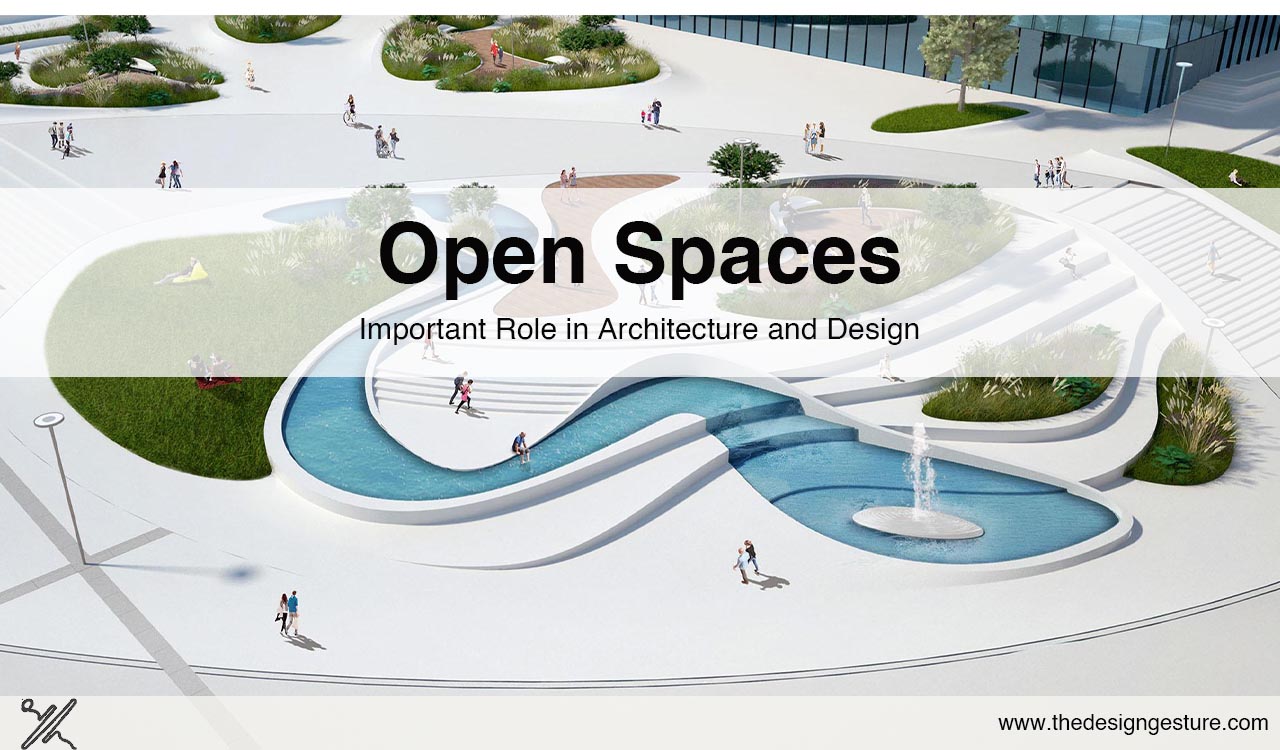
    Open spaces are areas that are consciously undertaken schematically to play out a function in Architecture and design to generate public zones or private utility zones like Parks and Gardens, Natural and Semi-natural Urban Green spaces, Outdoor Sports Facilities, Green Corridors, Amenity, Children and Teenagers, Allotments, Community Gardens and City Farms

    They serve in the category of developed or undeveloped areas under urban development. Most of the public spaces come under government authority, providing people with recreational areas. One such example is the development of the Sabarmati Riverfront in Gujarat state of India placed in the heart of Ahmedabad city.

    Its Function in Architecture and Design

    All the above-discussed open spaces act as a catalyst in architecture and design to experience the urban landscape in nature’s parameters like vegetation, land, fresh air, and water in the utmost opportunistic way with its other various functional and cultural aspects. The fulfilment of housing, agriculture, public buildings, industries, and other utility areas has led to the spike of urbanization because of circumstantial increasing population, leading to more concrete cover and fewer open spaces. 

    Through forces of these circumstances, removal of green lands has been directed for a fateful time, affecting an imbalance of urban biodiversity. However, it has added concerns for government authorities and people to balance our build-up and open spaces. Various steps are incorporated to establish open spaces within or around buildings and cities/towns under the Urban development schemes.

    Government And Netizens Action for Urban development

    Considering this risk to the open spaces, the Government of India has issued city and building bye-laws to plan policies considering the environment. According to the Indian housing ministry’s 2014 Urban and Regional Development Plan Formulation and Implementation (URDPFI) guidelines, open spaces fall under three categories: recreational space, organized green space, and other common open spaces. Urban development sustainably minimizes the inadequate methodology for buildout where nature is characterized less before humans.

    Cities like Mysore and Chandigarh top for the greenest cities of India despite the population factor, one of the Best-planned cities of India and has become an inspiration for other cities to develop their green envelope and improvise their urban landscape for a preferable and healthier environment to live, this has risen the inclusion of open spaces in architecture and design by considering them from the initial stages of designing a building or area

    Advantages of Open Spaces:

    Natural Ventilation

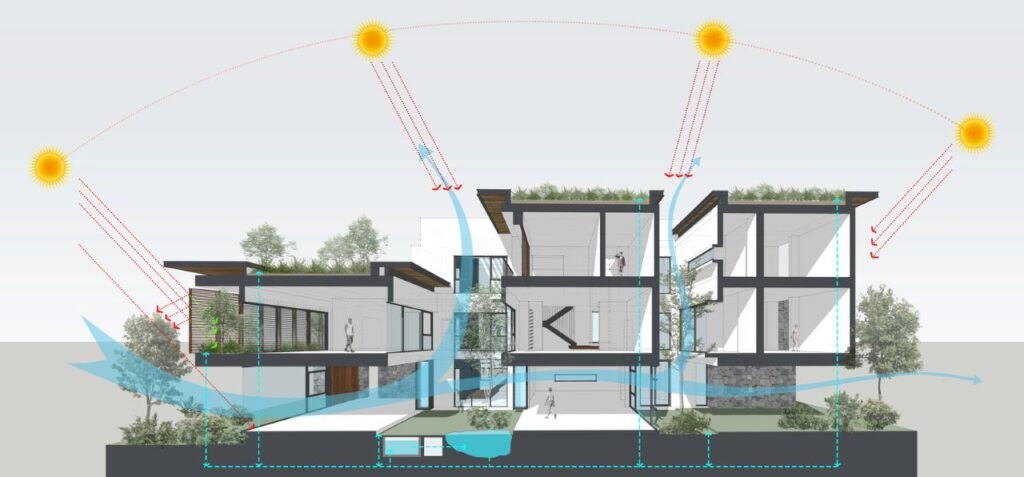
    Open spaces tend to bring the outdoor air indoors by the conventional placement of openings, depending upon the requirement of a building while considering wind direction and velocity of the surrounding environment. It supports energy efficiency in a building by reducing the application of mechanical ventilation. Elements like airflow direction and its distribution play an important role in affecting the overall performance of space efficiently and economically.

    The Architecture and design of Historical buildings in India are the epitome proof. With Art and culture, their versatile capability to establish thermal comfort indoors is commendable makes them exceptionally more fascinating. 

    Like in India, some historical buildings today also operated with no mechanical means because of their architecture and design. One such example is the architecture of Rajasthan State, of India. It holds cities and mahals like the famous “Hawa mahal” or the palace of winds with 953 carved jharokhas or windows, creating the Venturi effect (doctor breeze) air conditioning the entire structure during the hot summers to face the arid climate.

    Hawa mahal
    Photo by Jakub Hałun from Hawa Mahal

    Natural light

    Open spaces provide a medium to have Natural Lighting that plays a crucial role in any building’s architecture and design to engage more positivity in the space and mood upliftment. A high working rate is proven for people who work in spaces lit with natural light. Magnificently, it helps to reduce the use of artificial lighting. That is quite an appreciable factor in today’s times.
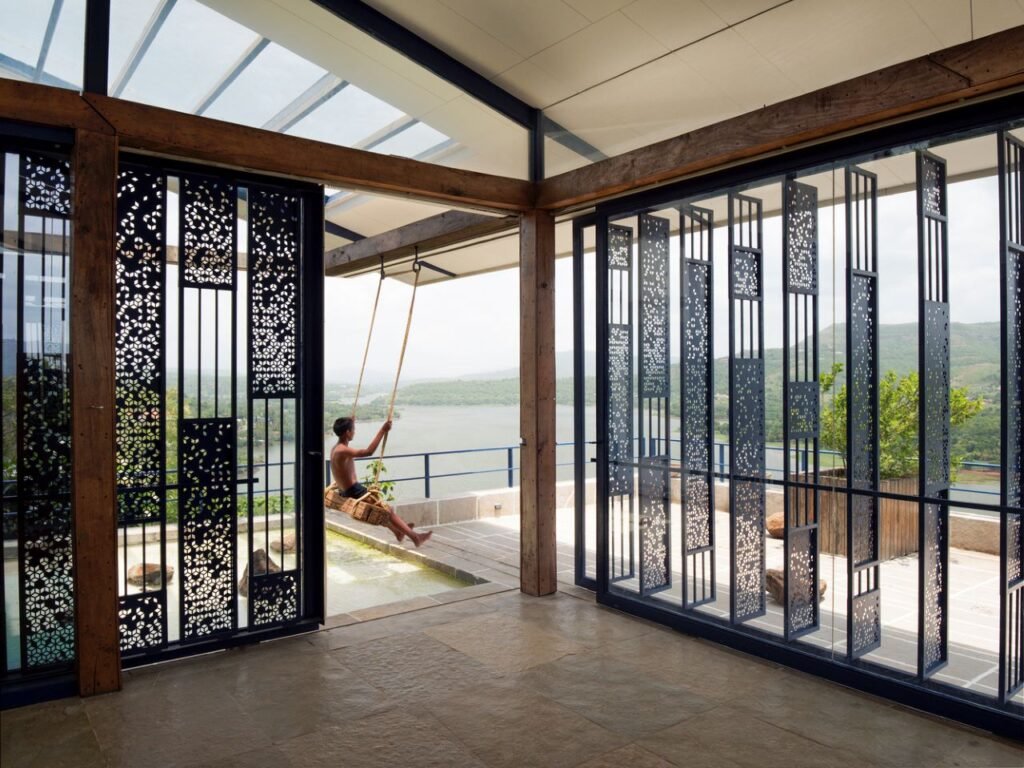
    A Space becomes supplementarily energy efficient with the help of daylight. Hence, saving energy in the best possible way. Natural light not only induces light in space but also adds depth. It can create some astounding effects if used artistically. “Church of the light” building designed by the architect “Tadao Ando “is one such example, like here light plays a symbol of spirituality, accounting a unique and showing the flexible nature of light.

    Sustainability/Energy Efficiency

    Energy efficiency in an urban landscape is achieved through open spaces as it allows Natural light and ventilation. These are dominant factors contributing to making a building sustainable if used in its natural form or contributing to lessen the requirement of mechanical energy that is approximately (35-60%) required for air-conditioning, heating, ventilation, and artificial lighting that affects consumption of energy. Conscious steps taken for it may achieve the target to attain sustainability in buildings, as each type has its distinctive requirement.
    Recreational Space

    Open spaces are developed through landscape architecture to create green outdoors where people relax or gather, away from the hustle of work, and feel comfortably relaxing under the blue sky. Also, these spaces habitats leisure activities. In institutions, offices, hospitals, around residences, and within towns/cities. A community park is a place that encourages people around to engage themselves in an activity like walking, jogging, exercising, playing, or having social meet-ups.

    It acts like a magnet in a city, as it attracts people from all age groups with distinctive cultures and backgrounds, as well tourists to feel harmony with the environment. This urban development makes these spaces active unit zones to relax and play. They offer quality to the lives of people around them as it inclines them closer to Mother Nature.

    recreational
    Photo of Riverfront park, Ahmedabad from oasis

    Human health benefits

    Open spaces are getaway places for people to be close to nature, feel active, and psychologically improve mood and focus. Not too far, we all were in the pandemic situation locked under our roofs and what helped people to feel positive and unconfined open spaces around residences like balconies and Private Terraces. And only allowable access for them to be outdoors and feel nature’s vibe. An individual optimism boosts when they are in such places.

    health benefit
    Photo by Tripleopixel for Deearth Architects from Archdaily

    Indoor-Outdoor connection

    Open spaces develop a connection between indoor and outdoor spaces, manifesting feelings of independence, less isolation, and more imagination. Indoors are filled with light and break the isolation of closed walls. A seamless transition is possible through large glass facades or windows. This concept of indoor-outdoor connection in an urban landscape is popular in demand today as people have believed in the balance of open and build-up spaces. Landscape architecture makes the vibe of surroundings more relaxed with added vegetation or water bodies to them, makes it more natural and energy-efficientCourtyard planning is one such example of it.

    indoor uotdoor
    Indian habitat centre – Photo by Madhu Kapparth from Forbes

    Indian habitat centre” in New Delhi, India, is being designed with a core courtyard holding vegetation, water bodies in such a way that it creates an image of a mini tropical forest and allows constant regulation of improved quality air. A-frame roof structure uniquely catches the eye because of its aesthetics. While functionally permitting, the required amount of sunlight and shade that purely justifies the concept of an urban landscape.

    Vegetation

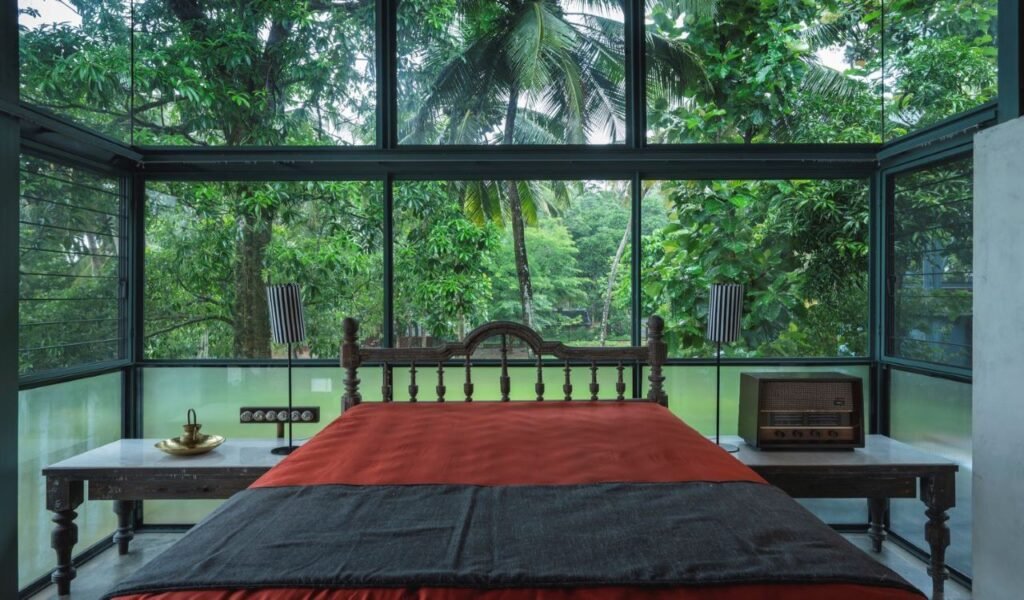
    Open spaces can also be transformed through landscape architecture into green spaces with habitation of vegetation, creating a soothing environment. It controls the microclimate and escalates the aesthetics. The Green colour makes you feel optimistic and refreshed. That encourages better physical and mental health. Hence, it is highly in demand today because of its property of being a mood lifter.
    Open space as a catalyst!

    There are unlimited benefits of open spaces for an urban landscape. It entails a building with better quality to function and gain sustainability from its design features. Hence, a balance with the natural environment is paramount for today’s building to breathe and provide a thermally comfortable, fresh indoors responsive to the climate outside.

    We all know global warming and how it is striking the lives of all living beings or how huge may be the future circumstance. This issue may decrease if all architecturally designed spaces or buildings are in coexistence with the natural environment. To bring about energy efficiency and sustainability for our mother planet Earth.

    Landscape architecture is the primary element for urban landscapes to achieve a human and nature balance. Open spaces all together make this world a better place to live in by promoting better physical and mental health for all living species.

  • Less is More: The Perfect Guide To Modern Minimalist Architecture

    Less is More: The Perfect Guide To Modern Minimalist Architecture

    Introduction

    Minimalist architecture has shaped structures for over a century. Embracing new accoutrements and rejecting ornamentation, the modern movement predicated minimalist architecture through rational use and function.

    Though minimalism is a bit polarizing — critics mock it for feeling too cold and empty — it’s an influential style that pervades not only ultramodern and contemporary armature but also innards, graphic design, and the visual trades.

    Minimalist armature surfaced from the Cubist-inspired movement of De Stijl and Bauhaus in the 1920s. It began as stripping off decoration from design and using the bare essential rudiments. Engineers like Ludwig Mies van der Rohe believed that minimalism reveals a space’s true substance, furnishing it with the maximum power.

    History

    1800-1850: Introduction of Simple Living

    A visionary gospel emerges in America and is vulgarized by the likes of Ralph Waldo Emerson and Henry David Thoreau.

    They held the romantic view that sapience and understanding can be gained through solitariness and simplicity, similar to illustrated in the book Walden.

    While not stated as minimalism, this fresh approach was believed to be a megahit in the coming times.

    1920-1930: The Elevated Design Period

    The ultramodern style that the word minimalism is most associated with was heavily told by the Bauhaus School’s ideal of balancing beauty with the use of product design.

    In the Bauhaus Era, preceptors and scholars of the academy offered a volition to uninspiring cultivated products and reimagined the part art could play in society.

    To this day, Bauhaus remains one of the most influential design movements of all time, having married functional design with aesthetic pleasure to produce an ultramodern art form that could bring beauty to everyday objects and beyond.

    1960-1970: Expansion Of Minimalism

    The roots of minimalism in architecture are frequently traced back to the late 1950s. The movement was a response to new styles of architecture and life that were being cultivated in the United States.

    In the U.S. in those post-WWII smash times, there was a movement towards large and inordinate styles of structure. During this period, prepped cities and cavernous supermarkets popped up each over the chart, and there was a trend towards the ornate. Minimalism developed as a response to the decreasingly marketable and consumerist cultures that were being reflected in the design.

    Although minimalist art (which is occasionally known as verisimilitude art) has its roots in America, the minimalist armature was born away. Northern Europe, particularly Scandinavia, and Japan, are important in the history of minimalist design, and in fact, these places continue to be among the biggest clasp of minimalism.

    1980-2000: Adaption of Simple Living

    The coming stage of the history of minimalism saw an ongoing increase in simple art and simple living movements.

    Sympathizers of “slowness” repel the ultramodern idea that the fast accession and accumulation of further effects or gests is even better. They believe quality is preferred over volume and conforming your life to a further deliberate pace will help you get the most out of it.

     2000–Present: Minimalism Becomes Mainstream

    Blogging came mainstream and lawyers of simple living, good design, and the colourful slow movements started using the medium to partake their ideas. Suddenly, minimalism came to the de facto term used across these communities.

    People started writing about minimalism in different areas of life. Hey, we easily jumped on the crusade too. Still, while well-meaning, occasionally these rules have adverse issues.

    If someone tells you they’re a minimalist, you can’t assume you know what they mean. And indeed, if their description is analogous to yours, their interpretation may still be country miles down from your thinking. A now-ubiquitous term has led to confusion and conflict that overshadows its positive connotation.

    Characteristics

    Minimalist architecture is based on the concept of clean, simple yet elegant spaces. Some characteristics of it are as follows.

    Minimalist architecture
    Photo by Phil Beard from Archeyes

    The Farnsworth House by architect Mies Van Der Rohe showcases minimal architecture. Using clean lines in the exterior using geometric shapes and a monochromatic palette with simple materials makes it an iconic example of minimalist architecture.

    Geometry and Clean Lines

    Minimalism is about the reduction of what is needed, and in architecture, the essential is the form of the structure. Reduced indeed further, the structure blocks of these structures are all figures and lines — and that is exactly what you will find in the minimalist architecture.

    Structures designed on the concept of minimalist architecture follow basic geometric shapes and sharp lines, yet they do not seem boring. In fact, minimalist engineers frequently produce drama by combining pruned-down geometric forms and playing with scale.

    Simple Materials

    Minimalist architecture focuses on reducing the ornamentation and this is not only limited to décor and detailing, it also focuses on materials. Simple materials which do not turn the focus away from the form of the structure are usually used.

    Materials like steel, glass, and concrete are the most commonly used materials in this type of architecture.

    Limited Ornamentation

    The concept behind minimal architecture is reducing ornamentation to bring out the true essence of its form, materials, and décor. Architectural detailing like carvings, corbels, friezes are not a part of this type of architecture.

    Monochromatic Palette

    Minimal architecture also means avoiding bright, bold colour palettes that might suppress other elements’ essence. Usually, monochromatic neutral palettes of white, beige, grey, brown are used. These neutral tones help ensure the idea of minimalism is still intact.

    Symmetry and Balance

    Visual balance is one of the most important features of minimal design. To achieve visual balance, symmetry, uniformity, repetition become crucial elements. They can be applied to the layout of furniture, overall décor, or lighting all around.

    Clean, Light-filled space

    Some of the important fundamentals of this type of architecture are clean, open, and light-filled spaces. Using a neutral colour palette, light colour tones for walls, clean modern detailing, and the right number of accessories and uncluttered spaces gives the design a calm, attractive, and interesting appeal.

    The spaces inspired by minimalism are airy, uncluttered, and have an artistic touch within the boundaries. Right play with natural light can make the space feel warm and breathable.

    Principles

    minimalism
    Photo from Malabar

    An apartment in New York that explores minimalist architecture through simple materials, a neutral colour palette and one emphasized feature.

    Quality Over Volume

    While creating a minimalist design, be sure to invest in quality rather than volume. It isn’t necessary to spend lower on minimalist design. Choose developer lights and fittings, high-quality storehouse spaces, and so on to embellish the house without cluttering.

    Multiple Materials

    The minimalist design style must intrigue the people. Traditionally, in minimalist design, always soft colour tones are used but choose a texture with different like glass, oil, cloth, timber, and crockery. This design style is about the combination of form and function, which can be achieved by rich textures in a functional home item.

    Standout Piece of Furniture

    Find and select a hero piece of furniture, let it emphasize. Now choose the accessories and decorations in combination with the standout piece. The furniture should keep the principle of form and function and a simple line that can connect with the interior design.

    Art as a Focus Point

    In a space, let a piece of art dominate. In a space with simple ultramodern cabinetwork, accessories, decorations, and neutral colour palettes used, add a dominating piece of art, whether with bright colours, textures or designs.

    less is more
    Photo by Saudi_apt from Behance

    An Emphasized Element

    In designing minimalism, add an element that’s emphasized in the room. For illustration, mix a neutral colour tone like grey, white or brown and so on with a discrepancy colour that’s a piece of furniture, a piece of art, accentuation or point wall, a large decoration piece, and so on. It should catch the eye of a person entering the room by drawing attention to a commodity that’s redundant, special, and unique.

    Simple Furniture

    There’s a large variety of furniture available. It’s better and sensible to choose pieces that are minimum and simple in design. So, the other effects can catch the centre of attention like a piece of art.

    Let The Views Speak

    If the home with minimalism features has a remarkable and exceptional view, minimize or reduce the size and volume of complications of the inner space. Let the view be the focal point. Keep the design simple, remove the gratuitous or unwanted details.

    Plenty of Open Space

     In minimalism, there’s a plenitude of open space in the home. Avoid the desire to fill up all the space in the room with décor and accessories because there’s plenty of redundant space to fill. The idea in minimalism is to have an open and wide space in the apartments to achieve a comforting and calm terrain.

    Light As Decor

    It’s also important in minimalism to use light as décor. Always use lights smartly and efficiently in minimalist homes. Avoid chunky chandeliers as they’re the worst agonies of a minimalist home design. Choose the ornamental, stunning lights that are a workshop of art in themselves and they can round the design of the minimalist innards.

    Design Tips

    furniture
    Photo from Pinterest

    Keep it simple

    Every element of design should be simple and essential. Everything should be functional and straightforward, be it furniture, lights, or materials.

    Choose Neutral Colour Palette

    The colour palette should comprise calming, neutral tones which do not hinder other elements’ beauty. A neutral and light colour palette also results in the space looking larger visually.

    neutral color palette
    Photo from Pinterest

    Use Clever storage solutions

    Minimalism is not only limited to materials and décor; it also involves storage spaces. This doesn’t mean reducing the number of belongings, but smartly using spaces to store them. This can include ottomans with storage, storage spaces on floors, flexible furniture pieces and so on.

    Minimise Accessories and Decorations

    The accessories and decor in minimalist design are simple and nominal. They can be of bright and bold colours, as they are small in size and number. The idea is to let the true beauty of every accessory piece come out.

    Pros of Minimalist Architecture

    Open Spaces

    Minimalism is synonymous with the decluttering of things and thus functions well to establish an important field of breathing in space. It allows the spaces to be airy, breathable, and, hence, calming. Minimalism works well for small apartments and homes as well.

    Saves Money

    The ideology behind this architecture branch is ‘Less is more’. This works for money too. As the agenda is to reduce ornamental elements and stick to the essentials, the budget also goes down. Thus, as quantity reduces, expenses also reduce. But this is not a straightforward task, except a challenge for the designer.

    Psychological Benefits

    With decluttered, airy spaces, our minds are also decluttered. Clean, crisp lines, geometric shapes, light colour palettes allow the mind to breathe and relax as well.

    Cons of Minimalist Architecture

    Expensive

    Many times, in a trial, to reduce the chaos and declutter the spaces, customised pieces are required. These lead to increased costs. But minimalism promotes one expensive thing rather than a variety of cheap ones.

    Maintaining the theme

    This type of architecture requires following a particular theme and a palette throughout. This can be a nightmare for people who collect different pieces and showcase them as many times as it might not go well with the theme.

    Boring to some

    Neutral colour palettes, simple materials and clean lines can be boring for some people. The monotony of a space, which is the concept of minimalist architecture, can be soulless to some. Less use of colour adds to the same.

    Iconic Examples of Minimalist Architecture

    Donald Judd’s House, New York, USA, 1968

    Donald judd
    Photo from Divisare

    Donald Judd was an American art critic. The house was envisioned as not just a place to live, or a place to work, but the spaces themselves were very much a part of his oeuvre. The house should stand as it was, encouraging the visitor to contemplate and behold the object, without alluding to anything more. It was a whole experiential and sensory experience.

    Okinawa House, Okinawa, Japan, 2013 -2016

    Okinawa house
    Photo from Dezeen

    Okinawa House is a residence in Japan, designed by architect John Pawson on the concept of minimalism. The house explores the sense of horizontal and vertical expansiveness by combining single and double-height spaces within a form that is closed and tapered to the rear, but to the front flares and opens like an eye over the headland, with the ground floor level raised to optimize sightlines to the ocean.

    Wabi House, Puerto Escondido, México, 2016

    Wabi house
    Photo from Archdaily

    In Mexico, this waterfront compound was designed by Japanese architect, Tadao Ando. This house is a perfect example of balance between melding of contemporary, simplistic forms and traditional, time-honoured techniques. Tadao Ando used distinct, native materials to create a space that cannot be created elsewhere, such as marmolina (granite/marble mix) as well as parota (a Mexican hardwood) for the flooring.

    The Therme Vals, Vals, Switzerland, 1996

    Therme Vals
    Photo from Archdaily

    Designed by Peter Zumthor, The Therme Vals is a hotel built over the only thermal springs in the Graubunden Canton in Switzerland. The Therme Vals is built from layer upon layer of locally quarried Valser Quarzite slabs, which became the inspiration for stone material and cave like form. It is a complete sensory experience designed in one.