Tag: Victorian House design

  • Interesting Peep into a Victorian House Design: An Off-Grid Experience

    Interesting Peep into a Victorian House Design: An Off-Grid Experience

    Definition and History 

    Victorian-style architecture in Great Britain and former British colonies was a type of house generally built during the reign of Queen Victoria. At the time of the Industrial Revolution, successive housing resulted in the building of tons of Victorian house designs that are now a defining feature of most British towns and cities.

    Interestingly, many of the details that we now associate with this style are actually interpretations of older architectural movements featuring Medieval Gothic and Romanesque. Thanks to the size of the British Empire during that time, Victorian house design has an incredibly wide reach. It is widely populated across the UK, North America, New Zealand, and Australia.

    Victorian house designs have managed to capture the hearts and minds of people for over two centuries now. There is so much to the design than those dollhouse-like exteriors. This architecture style includes multiple and distinct variations that all deserve a critical look. Also, as the name suggests, Victorians became popular among the upper-class White people during Queen Victoria’s reign.

    What makes a house Victorian Style?

    As per the words of Thomas Jepsen from the design firm Passion Plans, “A Victorian Style house is something between a colourful dollhouse and a great English Remnant. While the style refers to a period of time in history, it is generally associated with certain characteristics.

    Here are a few common characteristics of Victorian house architecture:

    Exterior

    1. Two to three stories
    2. Steep, gabled roofs
    3. Intricate woodwork
    4. Towers and turrets
    5. Rich colours

    Interior

    1. High ceilings and windows
    2. Closed off rooms
    3. Detailed trim
    4. Ornamental architecture
    Victorian house design layout
    Victorian house layout

    Types of Victorian style houses

    Italianate houses

    Italianate homes were popularized first in the 1840s and lasted until the Civil war, drawing inspiration from 16th-century Italian villas. The main structures were often simple, rectangular-shaped houses with low sloping or sometimes flat roofs that protrude far out from exterior walls. The windows are usually tall and skinny often rounded at the top with trim. Some Italianate houses have square towers or cupolas that rise out of the centre of the house giving a Tucson villa vibe.

    Italianate houses are mostly seen in the greatest number in North American cities that experienced exponential growth during the mid-19th century Cincinnati, Ohio, New Orleans, Garden District, and parts of San Francisco, Brooklyn, and New York.

    Other characteristics are:

    1. Wide eaves
    2. Quoins chimneys
    3. Single storey porch
    4. Tall and narrow windows
    5. Double doors with glass panels
    Italianate houses
    Source

    Queen Anne houses

    Queen Anne homes were popular in the US from the 1880s until sometime around the 1920s. This was theoretically a revival of the style du jour during the actual reign of Queen Anne which lasted from 1720 to 1714 but there is a very quiet resemblance in practice. The Queen Anne homes are quintessential Victorian homes having asymmetrical, two or three-storied tall, steeply high-pitched roofs.

    They are often adorned with various wall textures and ornate trim which gives them a ‘gingerbread’ effect commonly associated with Victorian houses- typically painted in a variety of accent colours. Few of the Queen Anne homes have octagonal towers (topped with a round pointed roof) and ornate bay windows which makes them subtle in look and design.

    Other characteristics are:

    1. Gable ends
    2. Towers with balconies
    3. Bold exterior colours
    4. Bay windows
    5. Built from wood, stone and brick siding
    6. Stained glass window
    7. Decorative spindle work
    8. Wide and spacious verandas
    Queen Anne houses
    Source

    Gothic Revival houses

    The Gothic Revival-style homes were first introduced in the 1880s. These homes are the classic representations of romantic and picturesque architectural elements that manifested in the US. The main properties of these structures were inspired by the medieval design of churches. Therefore, making the Victorian Gothic Revival style homes different from that of medieval architecture such as high pointed arches, biblical and heraldic emblems.

    Other Characteristics include:

    1. Steep, pitched roof with overhanging eaves.
    2. Castle like turrets.
    3. Slender columns and decorative posts
    4. Unique modern trims
    5. Pointed arches above windows with high dormers
    Gothic Revival houses
    Source

    Folk Victorian houses

    The Folk Victorian house is the most common type of home found in the US. This gained popularity in the 19th century and was considered as a more affordable alternative to Queen Anne’s style of design. The architects of Folk Victorian-style houses created a pimped-up version of a Victorian house by using cheaper materials in a relatively plain design and decorative trims for low-budget families, but with almost similar and prominent front-facing gable and steep under eaves.

    Other characteristics include:

    1. Decorative detailing on the porch
    2. Ornamented gables
    3. Symmetrical structure
    4. Trimmed windows
    Folk Victorian houses
    Source

    Shingle style houses

    The Shingle-style homes are basically known for their simplicity and make a popular choice for summer or weekend houses of the rich and famous. Shingle-styled houses are made up of clapboard or brick, despite their misleading name.  These types of houses are characterised by their rustic appearance which was favoured by the working class. Used as a holiday cottage by the wealthy, these homes became popular in New England from 1831.

    Other characteristics are:

    1. Symmetrical exterior
    2. Pitched roofs
    3. Shingled roof and walls
    4. Wide porches
    5. Sash windows
    6. Round towers
    Shingle style houses
    Source

    Octagon style houses

    The octagon-styled houses were hugely popular from between 1850 to 1870 after its mention in Orson Squire Fowler’s book called “The Octagon House: A House for All”. This style of the Victorian house took its inspiration from the Gothic and Greek Revival times to create a unique approach to residential architecture by specializing in bright and airy spaces in affordable dwellings.

    The Octagonal style house is the world’s only 8-sided Victorian house design with the benefits of being a practical and energy-efficient property. This unique style has evolved over the past decade or so thanks to the new constructive innovations.

    Other characteristics include:

    1. Domed shape
    2. Wide eaves
    3. Low pitched roofs
    4. Partially encircling or full porches
    Octagon style houses
    Source

    Second Empire style houses

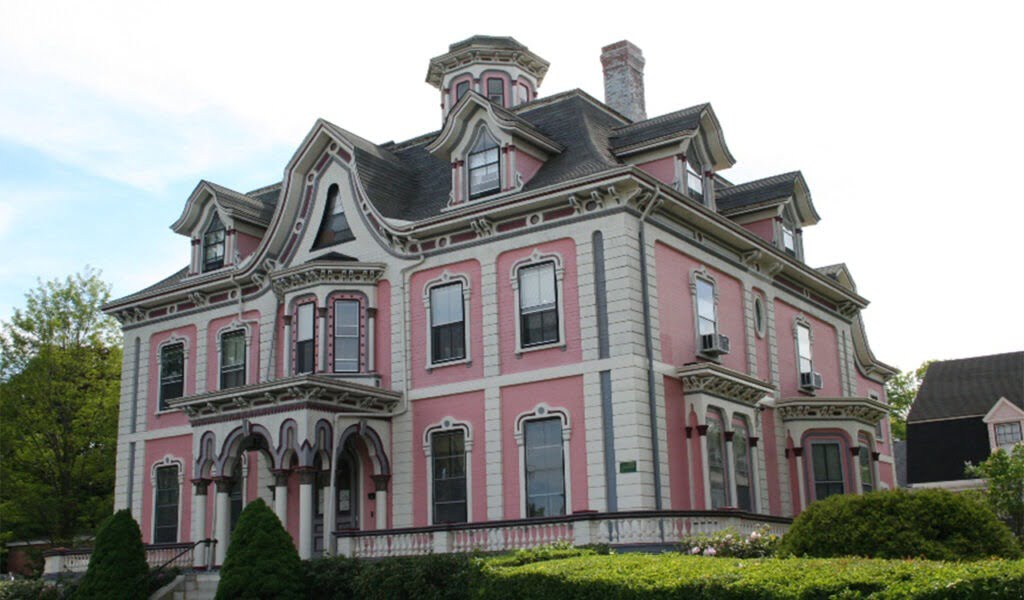
    The second Empire-style houses gained popularity between 1865 and 1880 in the late Victorian era. This originated first in France, with some of the most famous hotels featuring the same architectural elements as the Second Empire houses. The attic or the upper storey is usually light and airy with a high ceiling. The most stood-out, striking feature of a Second Empire house is its mansard roof, which is named after the 17th-century French architect, Francois Mansart. This type of roof is a 4-sided gambrel roof with two slopes on either side.

    Other characteristics include:

    1. Imposing tower
    2. Side veranda
    3. Balustrades
    4. Diamond shaped dormers
    5. Wrought iron railings in balcony
    6. Bay window
    7. Quoins chimneys
    Second Empire style houses
    Source

    Stick style houses

    The Stick-styled houses date back to 1860 and are widely characterized by their vertical, diagonal, or horizontal planks resembling Tudor-style buildings. This Victorian-style home has a more decorative aspect to it but with a simple design. Unlike other elaborate architectural designs of the Second Empire and Queen Anne styles, the Stick style home lacks the bay windows and decorative elements that are so characteristic of the Victorian era.

    Other characteristics are:

    1. Pitched gable roof
    2. Wooden exterior walls
    3. Towers
    4. Cross gables
    5. Decorative trusses
    6. Diagonal or curved braces
    7. Wooden decorative trims
    Stick style houses
    Source

    Richardsonian Romanesque style houses

    The Richard Romanesque style is the most dramatic of all architectural styles in the Victorian era (1838). This Victorian-style architecture was named after the architect, Henry Richardson. It didn’t take long before becoming popular all thanks to Medieval Spanish and Italian Romanesque elements that blended with modern materials and features.

    A typical feature of this type of house included circular arches above the porch supports and windows. These round arches were often set on huge pillars that were built directly into the wall.

    Other characteristics are:

    1. Round masonry arches
    2. Recessed entrances
    3. Heavy stone materials
    4. Square and cylindrical shaped towers
    Richardsonian Romanesque style houses
    Source

    Eastlake style houses

    By the end of the 19th century, a new movement in the US transformed the interior and exterior designs of properties. This movement was inspired by the British architect, Charles Eastlake, who convinced homeowners to replace their heavy furnishings with attractive pieces that were made by hand. This was termed as a start of reform which subsequently was followed by a simple layout.

    The Eastlake style is mainly recognized by its Gothic design with decorative shingles and trusses on the gable end. These types of Victorian houses often feature overhanging, second storey porches as their design feature. It also boasts paneled brick chimneys inspired by the Queen Anne period.

    Other characteristics are:

    1. Carved panels
    2. Perforated pediments
    3. Lattice work on porch eaves
    4. Interlaced wood strips
    5. Mansard porches with iron cresting
    Eastlake style houses
    Source

    The two architecture styles Grant noted to be most famous of the Victorian period- Italianate and Queen Anne are technically revivals of earlier architecture styles. Although both took on lives of their own and were often exuberantly decorative without much concern for historical accuracy according to Grant. Each has distinct features but what they have in common is an emphasis on vertical elements i.e. homes often stood at two or three stories with tall windows and porches and detailed ornamentations on the top.

    Building Materials

    The most common building material during the Victorian era were the ones that were local to the area. The buildings of the local material are sometimes called of Vernacular style. The known Cotswold villages were made of white Jurassic limestone, central England had buildings of red sandstone, Cornwall towns in the south and Aberdeen in the north were built of local granites, and places like Norwich, which had no local hard stone, was faced with flints.

    Victorian architecture was constructed with brick, local stone, and mortar, as these were the primary building materials and were an integral part of the construction. The roofing was typically composed of multiple layers of coal and tar over tongue and groove planking. The Victorian houses were usually made of wood or stone as they were quite large and imposing.

    Stone

    The number of full-blown Gothic stone mansions was never too large. Most early homes, especially in England, were built of stones and enhanced decorative stone tracery. Only the wealthy were able to afford such homes which required labours of highly skilled stone carvers. The over-priced Gothic style was eventually made into wood and lots of ‘Carpenter Gothic’ houses still stand even today.

    With the innovation of new manufacturing processes and emerging of railways, the previously locally produced building materials were instantly available all over the city. Henceforth, all houses started being made from bricks from Bedfordshire and slate from North Wales instead of being made off the local stone, time, and straw.

    Limestone

    The Portland Limestone was the most common white stone used across England for public buildings, for example, the Whitehall. Equally popular was also the Bath Stone, orangish sandstone of great value and beauty. Permian sandstone, reddish coloured sandstone, often weathered to give a deep pitted and honeycombed appearance such as the walls of embankments on seaside towns.

    Victorian Bricks

    A renaissance of brick was seen in the Victorian era. The local brick-making material for London was the London Clay, which were yellow and greenish-yellow in shade. Older, more hand-pressed bricks were often irregular in shape and had lines, squeeze-marks known as Stock Bricks. The Oxford Clay Bricks, plain red of most modern brick, dominated and ruled.

    The railways used fired Black brick. Minton’s perfected the encaustic tile (the colour in the material of the tile rather than just on the surface of it) and thereafter tile-covered buildings such as public houses became common with a flourishing of nouveau decors after the century.

    Victorian houses in different countries
    Victorian houses in different countries
    Image by CarAnd from Pixabay  

    United Kingdom

    In the UK, Victorian houses follow a wide range of architectural styles. The houses in the 1840s were influenced by classicism of Regency styles, the Italianate style, and the Gothic Revival style in the 1880s. The simplicity of Regency classicism fell out of flavor as the Italianate style influenced the domestic architecture which is now incorporated by varying’s of Stucco. The additional general features/influences brought out a progressive change in style that resulted from several other factors.

    The abolition of tax on bricks in the 1850s made these items cheaper yet a suitable material. The emerging railways allowed them to be manufactured elsewhere at a lower price and to standard sizes and methods. There was also a progressive introduction from the 1850s to building regulations.

    In deprived areas, Victorian houses were often very small. Victorian houses for the middle classes and upwards tended to accommodation for servants. And for the middle and upper classes, it aspired to follow the purest forms of contemporary architecture.

    North America

    Victorian houses in east American cities were three stories and those in western American cities were two stories. One feature that became hugely popular in the Victorian era was the use of wooden gingerbread trims to create ornate embellishments to decorate their homes. The Victorian-era residential architecture in America and Canada was a procession of styles borrowed from different countries and historical sites.

    Few examples of this style are:

    1. Carson Mansion, California
    2. John B Kane Residence, Los Angeles
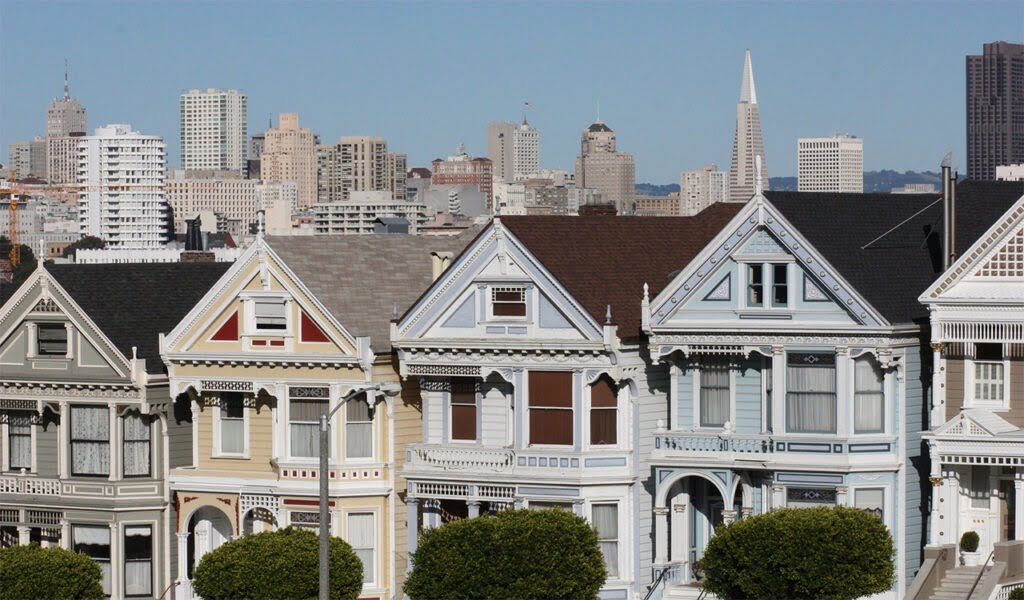
    3. Alamo Square, San Francisco
    4. Farnam Mansion, New York

    Australia

    The Victorian period in Australia lasted roughly from 1840 to 1890. There were 15 styles that predominated of which, 8 were used for homes.

    1. Victorian Georgian
    2. Victorian Regency
    3. Free Gothic
    4. Rustic Gothic
    5. Free Classical
    6. Filigree
    7. Italianate
    8. Tudor

    Victorian house roofing materials

    During the Victorian period, many different types of roofing materials were used. Some were more durable than others and some were less. Like wood shingles, modern enhancements made restoring a Victorian roof design possible without compromising longevity and protection.

    There isn’t a single, one-size-fits-all ruffing material foot these types of houses but using the current roof as a guide, can be the best indicator of what materials to use. Slate tiles, Asphalt, wood, and clay tiles are mostly used as roofing materials

    Slate tiles

    Slate tiles began to rise in popularity during the end of the Victorian period. These are extremely durable, resistant to fire, and environmentally beneficial. They also last much longer than some other roofing materials, but these added benefits also come at a cost.  

    Asphalt

    While asphalt roofs weren’t used during the Victorian period, they can be made to resemble Victorian-style roofing, such as wood shakes or slate. Asphalt shingles can also come in varying shapes and sizes for added Victorian appeal and durability.

    Wood

    Wood roofing was used primarily for early Victorian houses. Wood is cost-effective and visually appealing, but it is not a long-lasting material. This is because wood is susceptible to rot, insect problems, and damage.  

    Clay Tiles

    Clay tiles were also used as roofing materials in the early Victorian houses. Clay roofing is durable and long-lasting, but it’s important to match clay tiles with the Victorian period.

    Evolution of Victorian houses

    During the Victorian era, architecture saw rapid changes. A variety of Victorian styles emerged, each with its own distinctive features and personalities. The most popular Victorian style spread quickly through vast published pattern books. Builders often borrowed its characteristics from several styles, creating unique and sometimes quirky mixes.

    In the 20th century, despite having the availability of these new products, several working populations in the countryside lived in tiny cottages, hovels, and shacks. In towns, people lived in back-to-back houses called terrace houses. Innovation in building techniques and mass-produced building materials that could be transported by rail saved builders time and helped them lead a housing boom during the 1850s and 1870s that witnessed millions of Victorian constructions.

    While the Victorian era officially ended in the 1920s, its accompanying architecture styles stuck around for another decade or so until the colonial movement surpassed them in popularity. Victorian homes became disliked in the following decades. As Grant said, “There was a time when the Victorian house was considered an unwelcomed presence in many neighborhoods. Indeed, it became a stereotype for the ‘haunted house’”.

  • Victorian Architecture: One of the Fascinating Architectures of the 18th Century

    Victorian Architecture: One of the Fascinating Architectures of the 18th Century

    Introduction

    Victorian architecture emerged in England and has largely defined the architecture of its cities and towns. Victorian-era architecture and its influence have also spread internationally to places like North America, Australia, and New Zealand, where numerous countries and regions modified it to fit local tastes, lifestyles, and building materials available locally. Victorian Architecture also has an influence across a few regions of India when the British ruled the country, it was a way to prove dominance and spread their culture.

    Victorian Architecture
    Source

    History 

    Victorian architecture states to styles that emerged in the period between 1830 and 1910, throughout the reign of Queen Victoria. Victorian architecture isn’t just limited to one specific style, it is a broad term that embodies many styles that emerged during Victoria’s 63 years of reign as queen. Victorian architecture doesn’t categorize as a standard style, architects and builders of that time created buildings that suited the client’s wishes or just used their creativity. 

    Victorian architecture
    Source 

    Victorian houses were built to accommodate large families from all walks of society and varying income levels. Hence, everything from close rows of terraced houses constructed for the worker class on crammed narrow streets didn’t include gardens or sanitation along with semi-detached and detached houses. However, the Industrial Revolution encouraged societal alterations that were inspired by Victorian buildings’ designs. The Victorian era hatched various well-known styles, consisting of Gothic revival, Italianate, Second Empire, Queen Anne, stick style, Romanesque style, and shingle style.

    Characteristics of Victorian Architecture 

    Bright exteriors 

    victorian buildings
    Bright Exteriors- victorian buildings

    Victorian architecture, especially the residential typology, was commonly painted in a variety of pastels, jewel tones, and earthy colors. Few structures inspired by Victorian architecture feature a monochromatic color scheme, whilst others highlight numerous contrasting colors. The traditional Victorian color palette was dark and consisted of dark, rich, and deep shades of maroon, red, burgundy, chestnut, dark green, brown, and blues. The various bright colors used in the exteriors in Victorian architecture were to customize and personalize their structures.

    Mansard roofs

    victorian buildings
    Mansard roofs- Architecture in victorian era

    Mansard roof is a type of roof having two slopes on every side, the lower slope is considerably steeper than the upper. It was a most functional element of the building was to increase the usefulness of the attic story with better light and headroom space; it was very useful in the Victorian era when people had larger families and the income was scarce for the middle class, trying to maintain their stature. Mansard roofs, other than creating extra space, had another advantage is that they were steep and hence were very useful in seasons of rainfall and snow, helping remains slide off easily.

    Stained glass windows

    victorian buildings
    Stained window glasses- Architecture in victorian era

    One of the most distinctive characteristics of Victorian architecture was the stained glass of all sorts, as it was a way to individualize and personalize a residence. A wide range of designs and features made this a stunning element of Victorian exterior style and Victorian interior style as part of doors, windows, and sometimes even the part of the furniture.

    Bay Windows in Victorian Architecture

    architecture in victorian era
    Architecture in victorian era

    Bay Windows are a very distinctive feature of the Victorian architecture period and are great for creating a little extra interior space and allowing more natural light to enter the building. Victorian Bay windows typically are three-sided, with either full-length windows or provided with an extra seating space. The ground floor bay window often had a slate roof, or it might continue into a first-floor bay, again topped with an individual roof.

    Decorative and Ornate gables

    victorian style architecture
    Victorian style architecture

    The sloped design of a gable roof allows for exceptional water drainage, as the angle of the pitch allowed the rain and snow to slide off the roof easily. Gable Decorations are a great way to accent roof pitches and were exceptionally popular in Craftsman-style homes and Victorian-style architecture.

    Wraparound porches

    architecture in victorian era
    Victorian buildings

    Victorian houses generally had wraparound porches that encircled the entire house and could have more than one entrance to the porch. This extra accessibility made the travel throughout the house much easier. In the Victorian Era, wraparound porches were usually used to entertain guests and enjoy the views of the gardens. 

    Small gardens

    victorian style architecture
    Architecture in victorian era

    The victorian landscape had a more formal garden style with garden beds and parterres filled with colorful and exotic species of plants. During the Victorian Era hedging, and landscaping was away to give privacy and demarcate the house’s boundaries from its neighbors, exotic landscaping was also laid to display wealth and sophistication.

    Examples of Victorian Architecture in India 

    Chhatrapati Shivaji Terminus in Mumbai, India

    victorian era architecture styles
    Architecture in victorian era

    Chhatrapati Shivaji Terminus in Mumbai is a renowned landmark that has become a mark of the city, was built as the headquarters of the Great Indian Peninsular Railway. The terminus was designed by a British-born architect and engineer, Frederick William Stevens, taken from the initial design by Axel Haig. Chhatrapati Shivaji Terminus construction commenced in 1878, in the south of the old Bori Bunder railway station, and was finished in 1887. Chhatrapati Shivaji Terminus was constructed to mark the 50 years of Queen Victoria’s power. The scale and design of the terminus building were aimed to commemorate, communicate, and stand as a legacy to demonstrate the power of the ruling.

    Municipal Corporation Building, Mumbai

    victorian era architecture styles
    Source

    The Bombay Municipal Corporation Building is situated opposite of Chhatrapati Shivaji Terminus and residences, one of the largest civic organizations in the country. Municipal Corporation Building was designed by F.W. Stevens with the influence of the Victorian Gothic style. The foundation stone for the Bombay Municipal Corporation Building was laid on 9th December 1884, and the construction of the building was finished in 1893. 

    The Rajabai Clock Tower

    victorian buildings
    Source

    The Rajabai Tower is located in South Mumbai, India, within the Fort campus of the University of Mumbai. The Rajbai Tower was designed by British architect Sir George Gilbert Scott. The construction work started in 1869 and was completed by 1878. The Rajabai Tower has arches that are one of the key elements drawn from Islamic architecture along with the strong influence of Victorian-Gothic architecture style and were embedded in the list of World Heritage Sites in 2018.

    Bombay High Court

    victorian buildings
    Victorian buildings

    The Bombay High Court was one of the three High Courts in India founded in the Presidency Towns by exclusive rights conferred by Queen Victoria, bearing the date June 26, 1862. Bombay High Court operated as a court of special and appellate jurisdiction during the British Rule for over 80 years, seizing the uppermost chime of the judicial hierarchy amongst the all-important Bombay Presidency. Bombay High Court although had the right to provide justice, but for reason had Victorian influence in construction, to show British dominance.

    Crawford Market

    victorian style architecture
    victorian style architecture

    Crawford Market is the old name for Jotiba Phule Market is in the soul of South Mumbai. Jotiba Phule Market is the main market in Mumbai, where everything is available. The marketplace was designed by British architect William Emerson and signified an initial push to merge Victorian Gothic architecture with local and indigenous components of the region. 

    Examples of Victorian Architecture all over the World 

    Palace Of Westminster, United Kingdom

    victorian era architecture styles
    victorian era architecture styles

    Palace Of Westminster is one of the greatest highly distinguished Victorian-era. The Palace of Westminster was designed by Augustus Pugin and Charles Barry, construction lasted from 1840 up until 1870. It is the adobe of the United Kingdom’s House of Parliament and is established in Westminster in London. Sir Charles Barry’s joint design and collaborative ideas for the Palace of Westminster utilize the Perpendicular Victorian Gothic style, which was generally common during the 15th century and rebirthed during the Gothic resurgence of the 19th century.

    The Painted Ladies, San Francisco, California

    architecture in victorian era
    Source

    San Francisco’s Resplendent Victorians, Elizabeth Pomada, and Michael Larsen are the nicknames of the famous the Painted Ladies of San Francisco. In 1963, San Francisco artist Butch Kardum worked with intense blues and greens on his Italianate – Victorian-style designed homes, and later the influences took over when the also neighbors started to renovate the houses into beautiful colorful houses now known as the Painted Ladies. The Painted Ladies represents California’s, Gold Rush. California’s Gold Rush led to a lot of money coming into the city, hence the San Francisco builders wanted to flaunt their newfound wealth with these magnificent residences. Hence, most of the dwellings were ornamented with many striking windows, decorated rooflines, and turrets.

    Balmoral Castle in Aberdeenshire, Scotland

    victorian architecture interior
    Source

    Balmoral Castle was inspired by the Scottish baronial and Victorian Gothic revival styles. The architects of Balmoral Castle were William Smith and John Smith. The construction material used to build Balmoral Castle was granite, which was a specialty of the architect William Smith. Balmoral Castle has been the Scottish dwelling of the Royal Family ever since it was bought for Queen Victoria by Prince Albert in 1852. The architectural style was mainly Scottish with a blend of Victorian style, and this implementation brought the highland culture in monarchy into the spotlight and combined many of the British lengths throughout the kingdom.

    Sydney Town Hall, Australia

    Victorian Architecture: One of the Fascinating Architectures of the 18th Century Victorian architecture emerged in England and has largely defined the architecture of its cities and towns. Victorian-era architecture and its influence have also spread internationally to places like North America, Australia, and New Zealand, where numerous countries and regions modified it to fit local tastes, lifestyles, and building materials available locally. Victorian Architecture also has an influence across a few regions of India when the British ruled the country, it was a way to prove dominance and spread their culture.
    Source

    The Sydney Town Hall is a late 19th-century recorded in the heritage structures list. The Sydney Town Hall building is located in the city of Sydney, the capital city of New South Wales, Australia. The Town Hall was designed by architect JH Wilson in High Victorian style and built of Pyrmont sandstone. A unique element of Sydney Town Hall was the primary use of Australian ideas for ornate detail all over the structure like its colonial coatings of arms, an abundance of native flora, the metalwork railings, light fixtures, stained glass windows, mosaic floors, and carved cedar infused in the building.

    Victoria Law Courts 

    Victorian Architecture: One of the Fascinating Architectures of the 18th Century Victorian architecture emerged in England and has largely defined the architecture of its cities and towns. Victorian-era architecture and its influence have also spread internationally to places like North America, Australia, and New Zealand, where numerous countries and regions modified it to fit local tastes, lifestyles, and building materials available locally. Victorian Architecture also has an influence across a few regions of India when the British ruled the country, it was a way to prove dominance and spread their culture.
    Source

    The Victoria Law Courts on Corporation Street, Birmingham, England. The Victoria Law Court was designed by architects Aston Webb & Ingress Bell and constructed between 1887 – 1891 with additional work carried out in 1894 & 1914, the foundation stone was set by Queen Victoria on March 23, 1887. The Victoria Law Court is a red brick and terracotta building with a strong effect of Victorian architecture style.

    Conclusion 

    Numerous diverse styles arose during the Victorian period few of them were particularly prominent styles that came to the limelight namely Queen Anne, Classical, Gothic Revival, Arts and Crafts, Italianate, and Romanesque Revival. However, Victorian buildings share several key characteristics. Generally, Victorian architecture could be defined as dollhouse shaped, along with curlicue adornments, bright colors, and asymmetrical design patterns. Victorian buildings mostly were brick, with large interior staircases and windows, balconies, porches, and fireplaces in every room.

    Victorian style doesn’t just celebrate one unique point though, everything in it has implications, they are not a result of mass production. Victorian homes celebrate opulence, which means every structure has a story behind it that initiates conversations and buzz. The Victorian period was big on discovering new things and styles, including art, literature, socializing, equal rights, design trends, and fresh horizons of status. But now Victorian architecture has just become a style of architecture signifying a particular period that still can be utilized in our interests.

  • 10 Best Examples of Victorian Houses

    10 Best Examples of Victorian Houses

    Victorian houses have managed to capture our hearts for over 200 years now. There is so much more than meets the eye behind those dollhouse-like exteriors. This architectural style includes multiple, distinct variations that all deserve a critical look.  Thanks to the magnitude of the British Empire during that time, Victorian architecture has an immensely wide reach. Evidence of this style is found across the UK and North America, as well as Australia and New Zealand.

    Winters House, California, USA- Eastlake style

    The Eastlake style is mostly known for its Gothic design with decorative shingles and trusses on the gable end. Overhanging, second-story porches are often featured in these types of Victorian houses as their design. It also boasts paneled brick chimneys inspired by the Queen Anne period.

    Eastlake movement was named after the English architect Charles Locke Eastlake after the release of his influential book ‘Hints on Household Taste in Furniture, Upholstery and Other Details. Eastlake was originally a painter who trained in Rome and was considered to have great knowledge in art however he had a specific preference.

    General characteristics of this Victorian House

    1. Carved panels
    2. Perforated pediments
    3. Lattice work on porch eaves
    4. Interlaced wood strips
    5. Mansard porches with iron cresting

    Winters House is an Eastlake movement-building in Sacramento, California, and was built in 1890. It has 3 stories and is approximately 4500 square feet.

    The House’s features are – steel pitched hip and gable roof, asymmetrical front façade, two-story angled bay under forwarding gable, mansard front porch, and second-story bay windows on both sides of the house. The roof of the house is made of asphalt shingles and the walls are made from pattern siding covered heart redwood. The foundation of the building is a cement parged brick stem wall and the decorative brick chimneys are part of a coal-burning fuel system.

    The interior of the house reflects the Eastlake style in the mantel spindles, the ornate tile work surrounding the two fireplaces. Below the cornice, the house has a frieze board that includes scrollwork sunbursts and stars. In the front porch, above the front doors are cut window panels in jewel tones. The porch has a framing of fans, flowers, dentils, and spindle work. The spindle work and stickwork are repeated from the upper porch to the lower porch balustrade.

    George W. Frank House, Nebraska, USA- Richardsonian Romanesque style

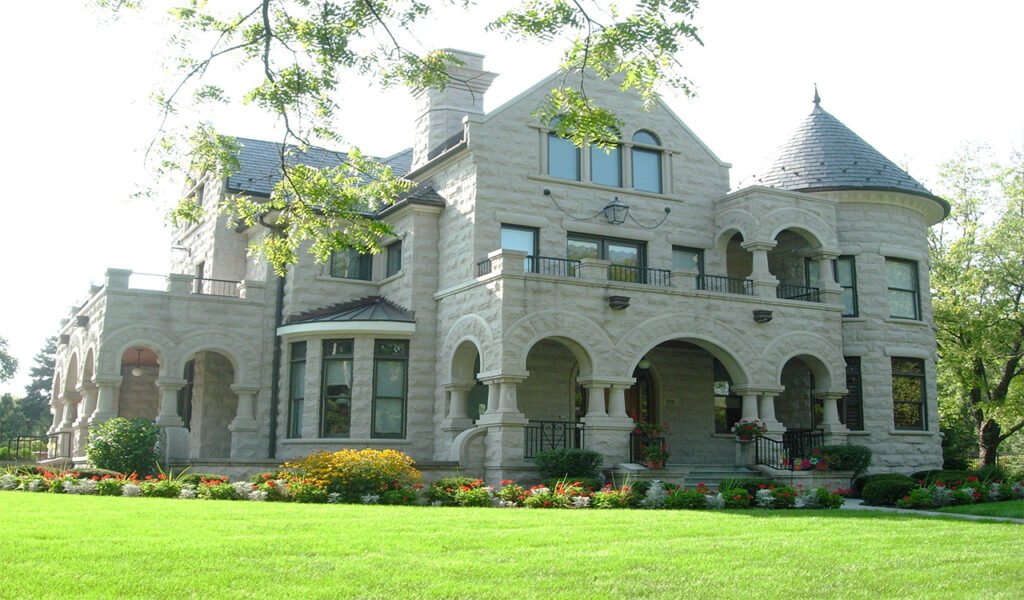
    The Richard Romanesque style is considered the most dramatic of all architectural styles in the Victorian era. This type of architecture style was named after the architect, Henry Richardson. It didn’t take long before becoming popular all thanks to Medieval Spanish and Italian Romanesque elements that blended with modern materials and features. Typical features of this type of house would include circular arches above the porch supports and windows.

    General characteristics of this Victorian House

    1. Round masonry arches
    2. Recessed entrances
    3. Heavy stone materials
    4. Square and cylindrical shaped towers

    This free revival style incorporates 11th and 12th century southern French, Spanish and Italian Romanesque characteristics. It mostly emphasizes clear, strong picturesque massing, round-headed Romanesque arches, which are often sprung from clusters of short squat columns, recessed entrances, richly varied rustication, blank stretches of walling contrasting with bands of windows, and cylindrical towers with conical caps embedded in the walling.

    The Frank House is a Richardsonian Romanesque design, with Colorado red sandstone from Wyoming. The exterior stone walls here are 18 inches thick, while the interior supporting walls are 14 inches thick and made of brick. The house has 14,000 square feet of living space, with three floors and a basement. This house originally had 10 fireplaces, 7 of which still remain. The extensive interior woodwork is English Golden Oak, done by a local carpenter named John Peter Lindbeck, a certified master carver.  

    The grand staircase has six posts, each of which has its own design. On the second-floor landing is the home’s Stained-Glass Window (5×9 feet). On the second floor, there were 4 bedrooms and 1 bathroom for guests. To fend off cold Nebraska winters, the house was heated by steam heaters located in several rooms throughout the house. In the dining room, the windows are curved to complement the veranda on the east side of the house.

    Herman C. Timm House, Wisconsin, USA- Stick style

    Herman C. Timm House, Wisconsin, USA- Stick style
    Source

    The Stick-styled houses are widely characterized by their vertical, diagonal, or horizontal planks resembling Tudor-style buildings. This Victorian house has a more decorative aspect to it but with a simple design. Unlike other elaborate architectural designs of the Second Empire and Queen Anne styles, the Stick style home lacks the bay windows and decorative elements that are so characteristic of the Victorian era.

    The style sought to bring a translation of the balloon framing that had risen in popularity during the middle of the century, and also by adding plain trim boards, soffits, aprons, and other decorative features. The style was commonly used in houses, train stations, life-saving stations, and other buildings from the era.

    General characteristics of this Victorian House

    1. Pitched gable roof
    2. Wooden exterior walls
    3. Towers
    4. Cross gables
    5. Decorative trusses
    6. Diagonal or curved braces
    7. Wooden decorative trims

    The Herman C. Timm house was built in 1873 in a Greek revival style by Kiel contractor August F. Neumann. It consisted of a current upstairs bedroom and first-floor kitchen and dining room. The original home became the rear of the home during addition in 1891. The addition was done in what was later called stick-style architecture. This was 1860-1890 trends were carpentry and woodworking technology allowed for much trim detail.

    The house features a tower for relaxation purposes. Several windows in the living room and vestibule were made from stained glass. The original Quetzal Art Glass brass chandelier remains in the parlor. A lot of the other original furnishings were sold by the family or future tenants so other period pieces were used. Tiny fragments of original wallpaper were found in most rooms during reconstruction. The three upstairs bedrooms contain donated historical items like the community’s first sewing machine, a bed warmer, and a trunk.

    Vaile Mansion, Missouri, USA- Second Empire style

    The Second Empire-style houses gained popularity in the late Victorian era. This originated first in France, with some of the most famous hotels featuring the same architectural elements as the Second Empire houses. The most stood-out, striking feature of a Second Empire house is its mansard roof, named after the 17th-century French architect, Francois Mansard is a type of roof is a 4-sided gambrel roof with two slopes on either side.

    General characteristics of this Victorian House

    1. Imposing tower
    2. Side veranda
    3. Balustrades
    4. Diamond shaped dormers
    5. Wrought iron railings in balcony
    6. Bay window
    7. Quoins chimneys

    The Harvey M. Vaile Mansion is located at 1500 North Liberty Street in   Missouri. Built-in 1881 for businessman Harvey M. Vaile, it is a locally significant example of Second Empire architecture.  The Harvey M. Vaile Mansion was designed by Kansas City architect Asa Beebe Cross. The symmetrical structure consists of a two-and-a-half-story block surmounted by a three-story central tower.

    It features an elaborate one-story porch, limestone moldings, heavily bracketed cornices, dormered mansard roofs, and multicolor slate shingles.  The tall, narrow windows, together with the central tower’s double mansard roof, emphasize the strong sense of verticality of the façade. It features 31 rooms with 14 feet high ceilings decorated by French, German, and Italian artists. The Vaile Mansion was the first house in Jackson County with indoor plumbing.

    Robert Waugh House, Illinois, USA- Octagon style

    The octagon-styled houses were hugely popular between 1850 to 1870. This style of the Victorian house took its inspiration from the Gothic and Greek Revival times to create a unique approach to house architecture by specializing in bright and airy spaces in affordable dwellings.

    This type of house is the world’s only 8-sided Victorian house design with the benefits of being a practical and energy-efficient property. This unique style has evolved over the past decade or so thanks to the new constructive innovations.

    General characteristics of this Victorian House

    1. Domed shape
    2. Wide eaves
    3. Low pitched roof designs
    4. Partially encircling or full porches

     The benefits of an octagon: the shape encloses space efficiently, minimizing external surface area and consequently heat loss and gain, building costs etc. An octagon is a sensible option instead of a circle because in a circular plan it is difficult to accommodate the furnishings. Victorian builders were used to building 135° corners, as in the typical bay window, and could easily adapt to an octagonal plan.

    Robert Waugh was born in Scotland but immigrated to the United States in 1850. He settled in Illinois in 1853.  Waugh initially lived in the apartment above his store. In 1886, he purchased a property and commissioned an octagon house.  The house remained in the Aitchison family until 1973. As of 1978, it was one of only ten remaining octagon houses in Illinois; the Waugh House is the only remaining one made of brick.

    The Robert Waugh House is a two-and-a-half-story octagonal house, made off red brick and limestone foundation. All eight facades are 16 feet long. The roof design is low pitched and has three gabled dormers. The main facade faces east and has a single-story hexagonal porch. The porch has six doric order columns and a simple balustrade. The adjacent facades feature a 3-windowed bay and above these bays are a grouped pair of double-hung windows. The other five facades have two-over-two double-hung windows. All windows have stone stills and have a shallow brick arch. The house is relatively simple and lacks ornamentation.

    Charles Lang Freer House, Michigan, USA- Shingle Style

    The Shingle-style homes are known for their simplicity and make a popular choice for summer or weekend houses. These are made of clapboard or brick, despite their misleading name. They are characterized by their rustic appearance which was favored by the working class. Used as a holiday cottage by the wealthy, these Victorian houses became popular in New England from 1831.

    Aside from being a style of design, it also conveyed a sense of the house as continuous volume. This effect—of the building as an envelope of space, rather than a great mass, was enhanced by the visual tautness of the flat shingled surfaces, the horizontal shape of many shingles, and the emphasis on horizontal continuity, both in exterior details and in the flow of spaces within the houses.

    General characteristics of this Victorian House

    1. Symmetrical exterior
    2. Pitched roof design
    3. Shingles as wall and roofing material
    4. Wide porches
    5. Sash windows
    6. Round towers

    The Charles Lang Freer House is located in Detroit, Michigan, USA. The house was originally built for the industrialist and art collector Charles Lang, Freer. He traveled widely, with one of his favorite spots being Newport, Rhode Island. There, he was favorably impressed by the shingle-style summer cottages built by the wealthy.  

    For the exterior, Eyre used coursed hard blue limestone from New York for the first floor. Dark, closely spaced shingles of Michigan oak cover most of the rest of the façade. A triangular gable and various dormers interrupt the roofline on the third storey. Chimneys dominate the east and west ends of the home, where the porches are underneath. These porches were originally open-air, but are currently closed stucco.

    On the interior, Eyre designed the home with Freer’s art collection in mind. There are 22 rooms and 12 fireplaces in the house, as well as an elevator, and numerous balconies, bay windows, enclosed porches, and skylights. In 1906, Eyre designed an art gallery, added above the stable.

    Orin Jordan House, California, USA- Folk Victorian style

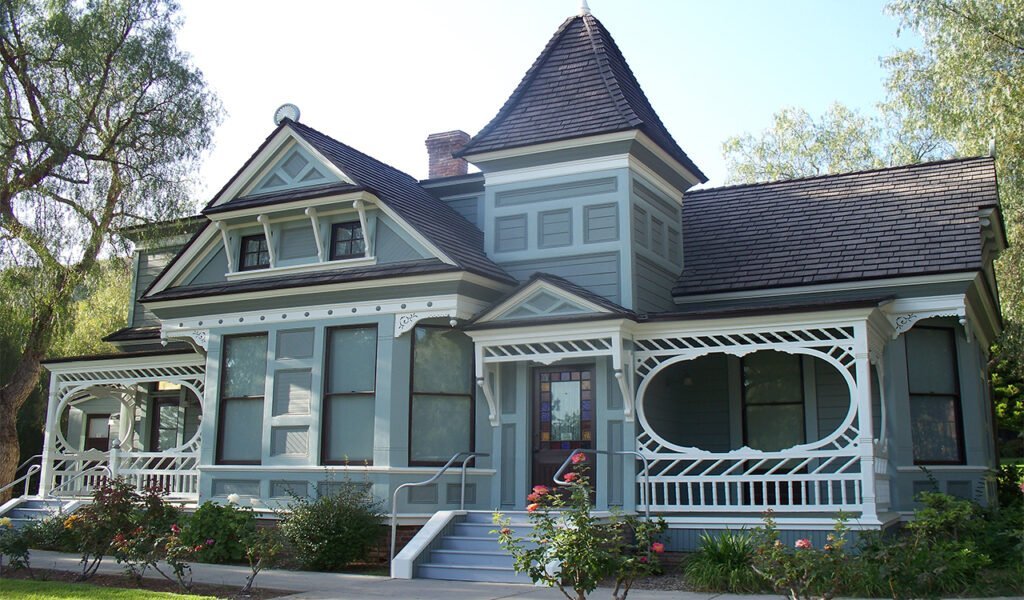
    The Folk Victorian house is the most common type of home found in the US. This gained popularity in the 19th century and was considered as a more affordable alternative to Queen Anne’s style of design. The architects created a pimped-up version of a Victorian house by using cheaper materials and decorative trims for low-budget families, but with almost similar and prominent front-facing gable roof design and steep under eaves.

    General characteristics of this Victorian House

    1. Decorative detailing on the porch
    2. Ornamented gables
    3. Symmetrical structure
    4. Trimmed windows

    The Orin Jordan House is a Victorian house in California that was built in 1888 by Orin Jordan. Also known as the “Old Jordan House” and the “Whitaker Home”. It was built as a 29.75 by 38 feet two-story, ell-shaped, wood-frame house, with 9 rooms. The house was moved in 1926 by about 300 feet to the southwest, to its present location on Comstock.

    The ground-floor front porch is quintessential to the design, and it’s often the most heavily decorated part of the house. This was the era when the classic American front porch really took root. The most common porch posts are turned spindles (balusters) or posts with simple chamfered edges as well as embellished with carvings and other details. These supports are enhanced with friezes above, balustrades between the posts, and intricately cut spandrels in the upper corners.

    Lyndhrust Mansion, New York, USA- Gothic Revival style

    The Gothic Revival-style homes were first introduced in the 1880s. These homes are the classic representations of romantic and picturesque architectural elements that manifested in the US. The main properties were inspired by the medieval design of churches, making the Victorian Gothic Revival style homes different from that of medieval house architecture such as high pointed arches, biblical and heraldic emblems.

    General characteristics of this Victorian House

    1. Steep, pitched roof with overhanging eaves.
    2. Castle like turrets.
    3. Slender columns and decorative posts
    4. Unique modern trims
    5. Pointed arches above windows with high dormers

    Designed in 1838 by Alexander Jackson Davis, the house was owned in succession by New York City mayor William Paulding Jr., merchant George Merritt, and railroad tycoon Jay Gould. Merritt, the house’s second owner, engaged Davis as his architect, and in 1864–1865 doubled the size of the house, renaming it “Lyndenhurst” after the estate’s linden trees. Davis’ new north wing included an imposing four-story tower, a new glass-walled vestibule, a new dining room, two bedrooms, and servants’ quarters.

    Lyndhurst’s rooms are few and of a more modest scale, and strongly Gothic in character. Features include- narrow hallways, small windows, and sharp arches, and are fantastically peaked ceilings, vaulted, and ornamented. The effect is at once gloomy, somber, and highly romantic; the large, double-height art gallery provides a contrast of light and space. The house is covered by a landscaped park, designed by Ferdinand Mangold. The 390-foot-long onion-domed, iron-framed, glass conservatory, when built, was one of the largest privately-owned greenhouses in the USA.

    Carson Mansion, California, USA- Queen Anne style

    Queen Anne homes were popular in the US from the 1880s until sometime around the 1920s. These homes are quintessential Victorian houses having asymmetrical, two or three-storied tall, steeply high-pitched roofs. They are often adorned with various wall textures and ornate trim which gives them a ‘gingerbread’ effect commonly associated with Victorian houses- typically painted in a variety of accent colours.

    General characteristics of this Victorian House

    1. Gable ends
    2. Towers with balconies
    3. Bold exterior colours
    4. Bay windows
    5. Built from wood, stone and brick siding
    6. Stained glass window
    7. Decorative spindle work
    8. Wide and spacious verandas

    The Carson Mansion is regarded as one of the highest executions of American Queen Anne-style architecture. It is one of the most written about and photographed Victorian houses in California and possibly also in the United States. Samuel Newsom and Joseph Cather Newsom of the firm Newsom and Newsom of San Francisco (later Los Angeles and Oakland) were 19th-century builder-architects.

    The house is a mix of every major style of Victorian architecture. One nationally known architectural historian described the house as “a baronial castle in Redwood”. The style of the house has been described as eclectic and peculiarly American. Unlike most other houses dating from the period, this building always has been maintained and is in nearly the same condition as when it was built.

    Farnam Mansion, New York, USA- Italianate style

    The Italianate style was a 19th-century phase in the history of Classical architecture. In the Italianate style, the architectural vocabulary of 16th century Italian Renaissance architecture, which had served as inspiration for both Palladianism and Neoclassicism. The style of architecture that was thus created, though also characterized as “Neo-Renaissance”, was essential of its own time.

    Italianate house architecture is mostly seen in the greatest number of North American cities that experienced exponential growth during the mid-19th century Cincinnati, Ohio, New Orleans, Garden District, and parts of San Francisco, Brooklyn, and New York.

    General characteristics of this Victorian House

    1. Wide eaves
    2. Quoins chimneys
    3. Single storey porch
    4. Tall and narrow windows
    5. Double doors with glass panels

    The Farnam mansion’s exterior features a low-pitched roof, projecting eaves supported by large decorative cornice brackets, tall windows with ornate pediments, bay windows, and a wrap-around porch. A square belvedere is situated above the east side of the mansion. It has a mansard roof and a trio of arched windows on all four sides. The front entry features a pair of arched mahogany doors with windows, hand-carved panels, and rare ornamental bronze doorknobs.

    The interior of the mansion features 11-foot-high ceilings, ornate plaster ceiling medallions, and crown moldings, and tall paneled tiger-oak doors. Three of the first-floor rooms each contain a marble fireplace. A staircase leads to the second floor where there are four bedrooms, five bathrooms, a small library, nursery, and servant’s quarters.