Author: Chahat Agrawal

  • The Amazing Staircase Design

    The Amazing Staircase Design

    Staircase designs are one of the important elements of architecture, which guides the path to go vertically. They allow users to travel vertically from a certain height distance to another, acting as a vertical bridge, an easy innovation of history, probably more than 6000 BCE. History has shown a constantly changing trend in the design and evolution of stairs (w.r.t. materials, design, the addition of elements, structure) with every architectural period 9 from ancient civilization to the 21st century. 

    In today’s world, we often see synonyms of the stairs in more advanced ways such as Lifts, elevators, stairlifts, ladders, escalators, walkways, and ramps, which function similarly to the stairs.

    Staircase Terminology
    stair hall design

    Various parts of the Staircase

    Step

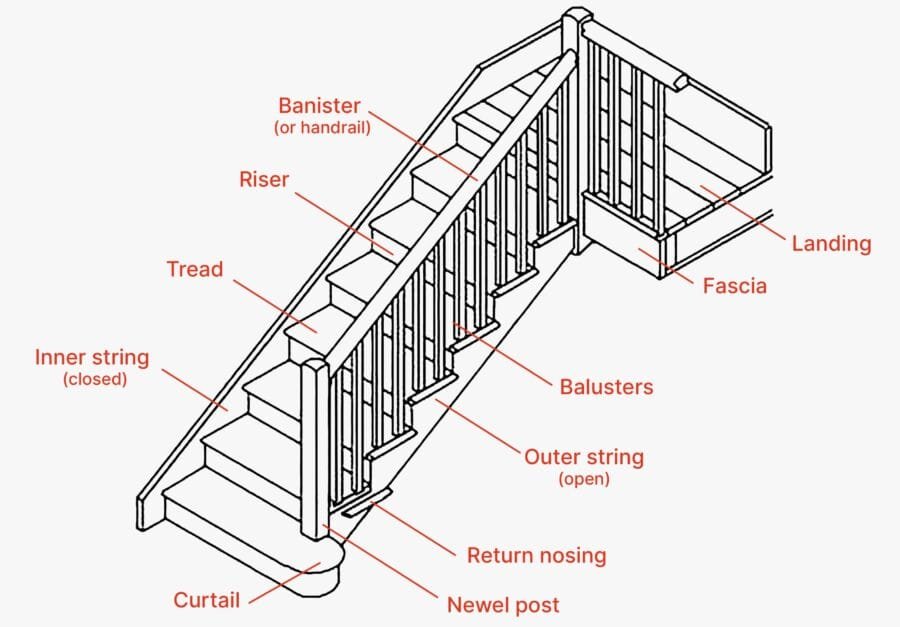
    A step comprises two parts of the staircase- Riser and Tread.

    Riser

    The Vertical element that adds height to the tread is known as a riser. Closed staircases have risers in various styles and materials, whereas Open stairs do not have risers, so they are known as open-tread staircases. The number of Risers is calculated by dividing the floor-to-floor height by the height of 1 Riser.

    According to the National Building Code of India, Chapter 3, under the staircase provision, the maximum riser height shall be 150 mm irrespective of the building type. There should be a maximum of 12 risers in a single flight.

    Tread

    The horizontal element, i.e. the base of the staircase on which the user steps in to move vertically is known as a tread. All staircases have treads irrespective of the width and thickness. The number of Treads is always one less than the number of Risers. According to the National Building Code of India, the minimum tread should not exceed 250 mm. 
    zigzag stair design

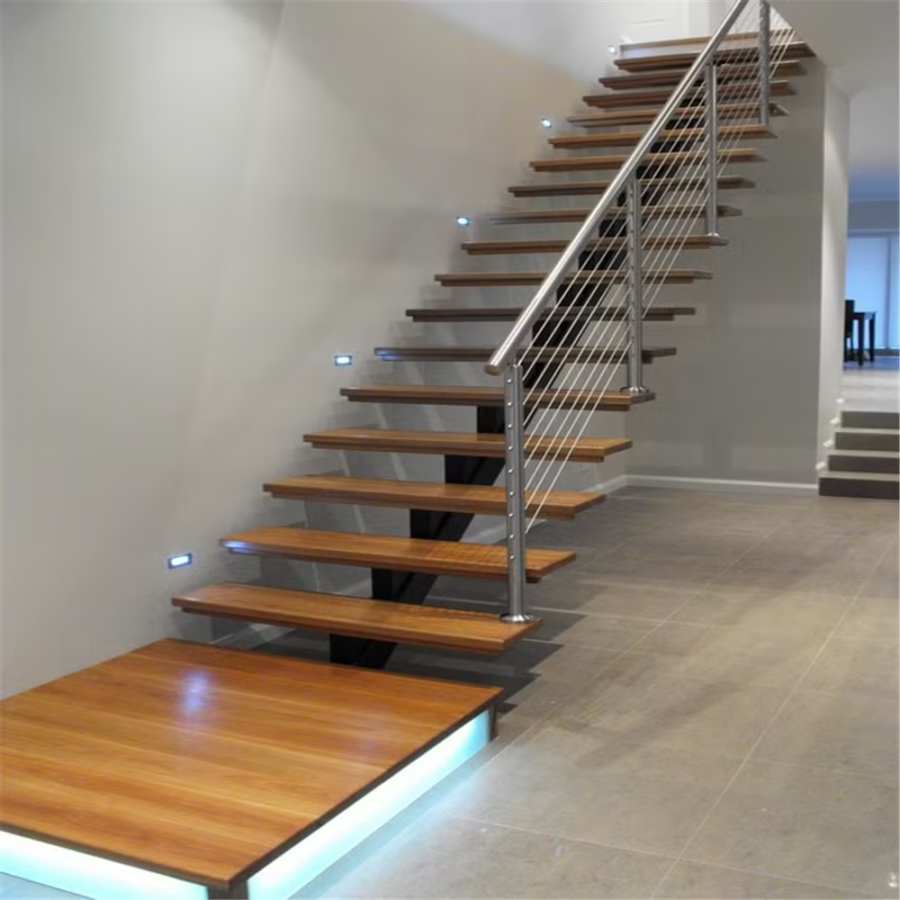
    Wood Modern Style Straight Staircase Design

    Landing

    The wide step or platform provides a resting space or indicates a change in the direction of the staircase. The landing should be placed after every 12 risers in a flight.

    Flight

    A vertical series of steps bridging between two levels of a structure.

    Nosing

    The extended edge part of the tread is known as nosing. It is used to protect from injury as most of the walking activity takes place on the tread. The most commonly used materials for nosing are marble, vinyl, aluminium, wood, etc.

    Handrail

    A handrail is a rail placed right above the pitch to hold and support the user. It is also termed a bannister. Every staircase set has a handrail as one of the components. It commonly ranges between 80 and 90 cm. For the elderly or physically abled- a different railing is provided on the left side of the stair directly attached to the wall. The handrail is fixed on balustrades which supports to stand erect. Add elegance with a stair handrail design glass option for a sleek and modern look.

    Newel Post

    The vertical support column placed at the beginning and the end of the handrail provides support to both the handrail and balustrades. It is generally 9×9 cm.

    Evolution of Staircase Design 
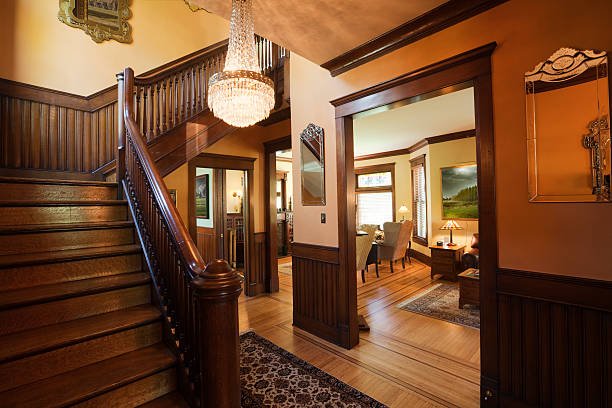
    granite stairs design

    Old Wooden Staircase Stock Photos

    The staircase design house is a wonderful and comfortable creation of the ancient period for going vertically. Earlier it was strictly restricted to mud staircases or stone staircases serving only the function of going upstairs. But, with growing time, there’s been a prominent growth in the design aspects of staircases. How important it is for a residence to have a pleasing yet durable staircase. 

    Choosing the right staircase design house plan is crucial for both aesthetics and functionality. Let’s discuss some of the staircase designs in different scenarios for a residence.

    Modern Staircase Designs

    Concrete Stair Design For Small House

    Stunning glass staircase designs

    Generally, staircases have been restricted to dog-legged, straight, u-turn staircases in residential and commercial buildings. Classical or lavish buildings, especially vast residences or palaces, enjoyed spiral and bifurcated staircases. Nowadays, staircase designs have been modernized and gone beyond the mundane, improving fluid connections to upper and lower floors.

    These changes have been consistent in the visual appeal of the staircase structure and steps, railing, materials, etc. A staircase design modern style can instantly give your home a contemporary upgrade.

    Floating Staircases

    These staircases tend to determine the idea that treads are in the air or floating in a particular direction, this appears without support obstructing the natural view. These minimalistic trending staircases in a house offer unobstructed views. The design not only avails in linear geometry but also has proofs in curves.

    Cantilever Staircases

    The staircases where tread appears to be in the air as if in the air and without any support. The support is hidden in minimalistic ways. The difference between the floating staircase and the cantilever staircase is there is hidden structural support in these staircases. The tension is visually strong. 

    Staircase Design Inside House

    Staircases inside homes are not only a way to go upwards but also add to the aesthetics of the interiors. A staircase designed well and placed in a nice spot surely changes the outlook. If designed there, it can add an element to the living room and provide a room for light in the interiors with a touch of nature. Let’s cover some aesthetic staircase designs in different materials and styles. The perfect stair design inside house plans can make your interiors more dynamic and spacious.

    Stair Design with Storage

    Maximizing space under the stairs can be utilized. It can be used as a storage space, a place for an interior garden, or any other useful or recreational purpose. Innovative stair design with storage is perfect for maximizing small spaces.
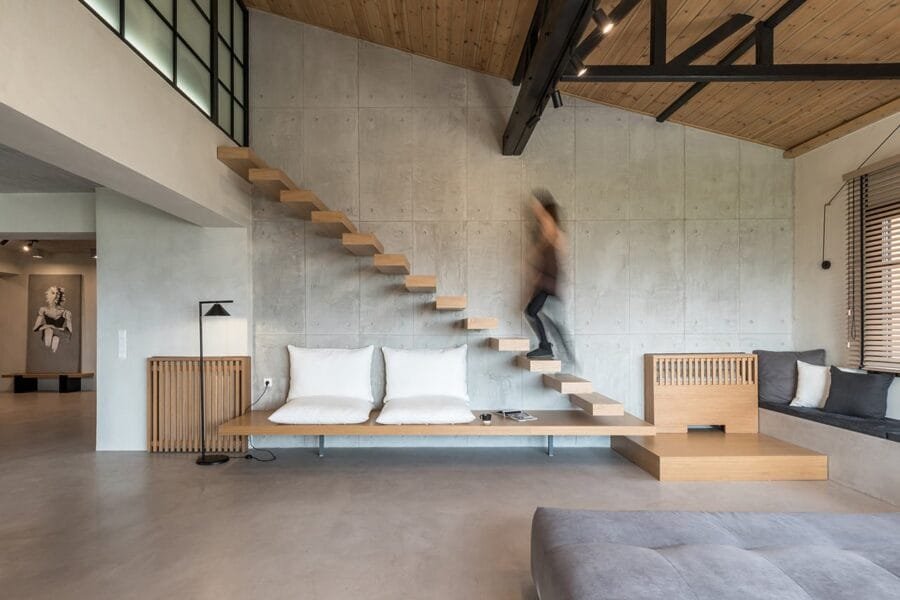
    staircase design

    Designing a Cozy spot under the staircase

    Staircase spaces can be designed as special nook spots with little storage where one can read, spend lazy time, or sit idly and keep small things as storage or for decoration. Architects design these spaces for the pantry for the kitchen or extend a kitchen space alongside a staircase, such as for firewood storage or setting up a minibar. Clever stair design small space solutions help maximize functionality without compromising on style.
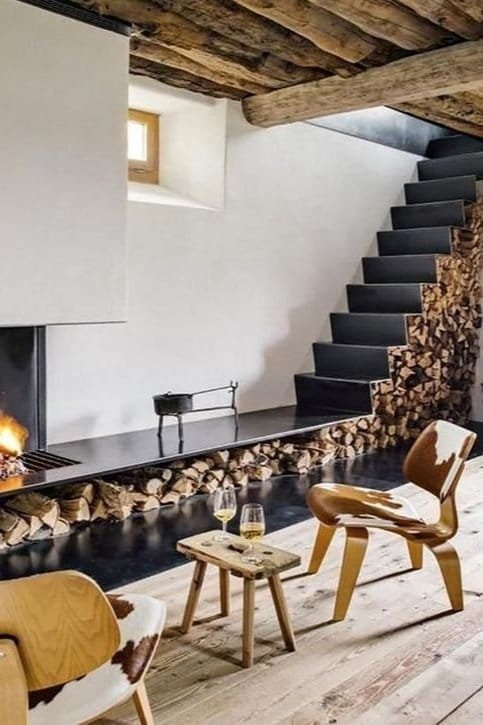
    Left Hand Double Winder Staircase

     Firewood storage under the stairs adds texture and utility space

    Stair Design as Book Library or Home office

    Dull and abandoned spaces under the staircase can be transformed into a useful study/office space with a large book wall below and along the stairways. The picture below sets a high bar for a classy library space built below the stairs. 

    U Shaped Stair Design

    Classy bookcase with study/office under the stairs

    Indoor Garden under the Stairs

    staircase design modern

    Green Life under the stairs

    Empty spaces can make a house look mundane. The staircase is not just a way of going upstairs but a short journey that can change the outlook of the house. The journey should be pleasing and at least be made useful. Adding low-maintenance greenery to the interiors allows proper ventilation and fresh air to enter the room, which makes users feel calm and pleasant.

    Every time architects and designers try their best to beat the monotony and transform an abandoned space under the staircase into beautiful imagery, the ideas never cease.

    Staircase Railing Designs 

    Railings are an important element in the staircase design as they are used as a holding element or support to move vertically. Railings have undergone a beautiful and useful transformation from heavy ornate traditional wooden railings to sleek modern glass railings. Depending upon the style of the interiors or exteriors wherever the staircases are best placed, different materials and designs have been prominently chosen for them.

    A stylish stair railing design can transform your staircase into a stunning focal point. Opting for a staircase design glass structure brings an open and airy feel to your interiors. Enhance elegance and visibility with a glass railing design for stairs.

    Based on material choice:

    Glass Railings

    For a sleek and contemporary interior style, glass railings are a perfect choice. A frameless glass in glass railings is a popular choice. Tempered clear glass, colourful glasses, black glass, textured glass, etc. are some of the glasses used in the glass grills. These glass railings are fixed through metal clips, an EPDM gasket is also provided for protection from vibration and insulation. 
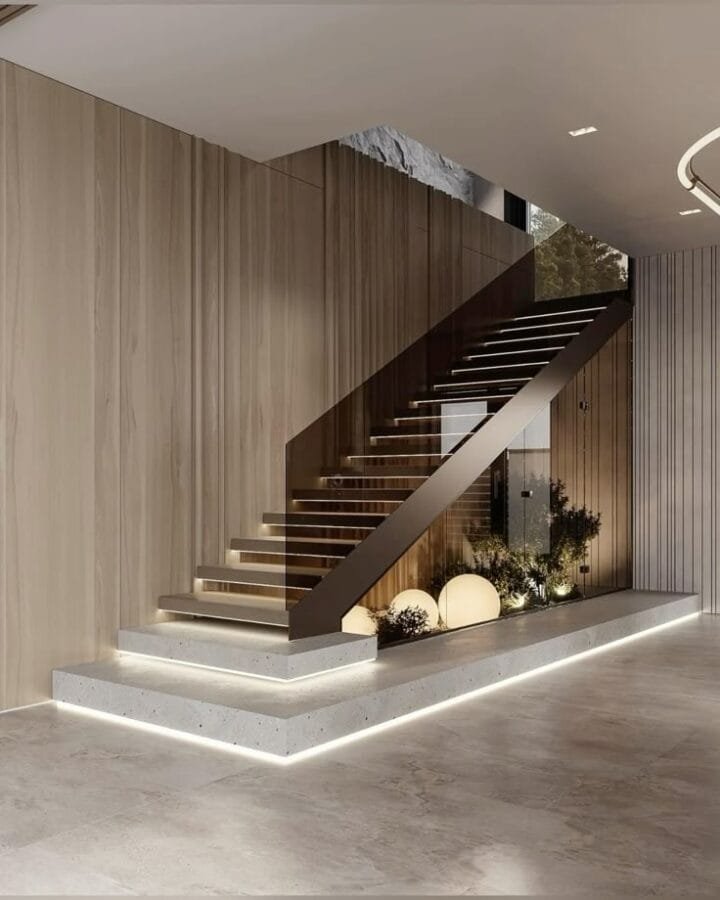
    stair design wood

    Black Glass used in the Interior staircase railings

    The railing provides an unobstructed view and is durable enough to withstand. It can be used with or without a frame. The glass railing is often used with aluminium or other metal posts, steel posts, etc. 

    Steel Railings

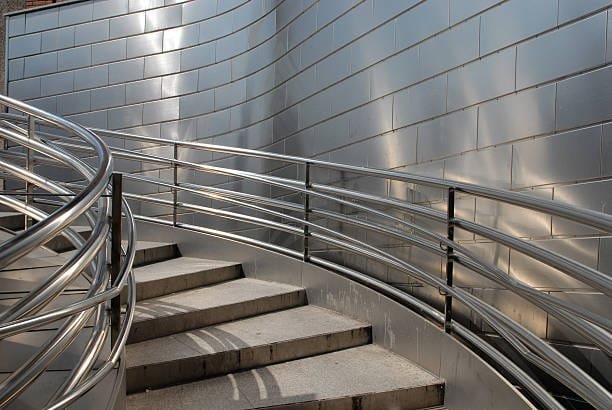
    Steel in railings look classy, aesthetically pleasing, and are durable. Different types of steel are used in railings preferably stainless steel. Steel can be used as an overall material in the railings, or it can be used in combination with glass railings, wooden railings, glacier panels, etc. It can also be used in different ways such as in geometric style, with LED Lights, there have been thousands of adaptations happening to make steel railings elegant. Choose modern stairs railing designs in steel for a sleek and minimalist look.
    stair handrail design glass

    Stainless Steel gives an elegant look to the railings

    Wood Railings

    Wood Railings are a classic example of a royal and seamless staircase to your home.

    staircase design kerala

    Wooden handrails in the staircases are durable

    Oak and Pine are the most preferred woods used for railings. Oak is durable and provides a natural look but it is a bit expensive, whereas Pine wood is less durable as compared to Oak, but offers various reasons to use it for the staircase railings. Warm and timeless, stair design wood choices bring natural beauty into your home.

    Cable Railings

    Cable railings are widely used in the exterior of commercial and pool areas. These railings are corrosion-resistant and weather resistant which makes them the best option to use near water-side areas such as pools, etc. Generally, stainless steel is used as cables in staircases or general railings. 

    These railings offer unobstructed views because cables are less known hurdles. Their strength and durability depend on the type of material, size, and how close the cables and posts are held together.

    stairs grill design

    Stainless steel is used as a cable railing

    Staircase Lobby Design Makeover

    The journey to the stairs before climbing should be pleasing and designed carefully. That allows the architect to have an insight into the user’s mind of what he/she must be going through, it depicts a trail of emotion. Therefore, a staircase hallway or lobby can be designed depending on the interior of that house or the approach to staircase design. 

    House stairs design should complement your home’s interior style while ensuring safety and comfort. The staircases have always been a discussion of evolution. When one thinks they can’t be more enhanced, an innovative element adds up.

    Adding a sculpture or a piece of art

    stair design for home outside

    The sculpture adds drama to the staircase lobby

    Adding a sculpture or an artistic element can add drama or fun to the lobby. It can define the user’s personality. The sculpture in the above picture cuts off the monotony of a similar colour scheme with nothing to catch sight of. The introduction of an artistic element makes the lobby look interesting.

    Introducing furniture to the lobby
    zigzag stair design

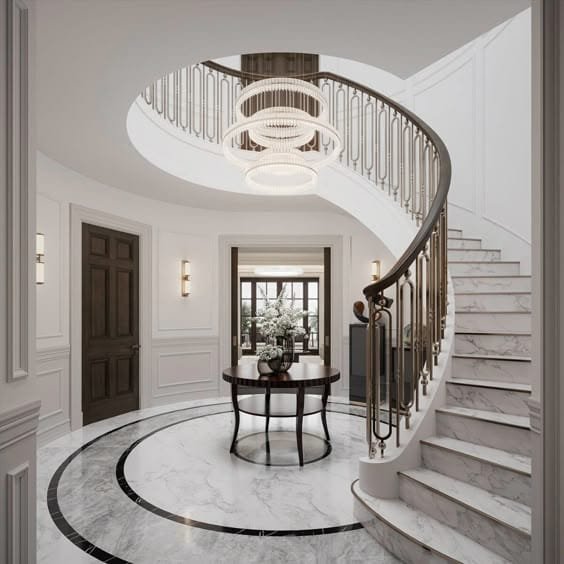
    Introducing a flower table to the Staircase lobby

    Introducing a flower vase or a coffee table in the lobby can bring out the sweet and dreamy side of the interiors. The furniture can give a classy, royal, and elegant look. The lobby space can also be treated with the living area furniture such as a couch or console, depending on the location of the staircase inside.

    staircase design drawing

    The staircase lobby functions as a living area.

    Adding a chandelier and crafty floor tiles

    Mosaic tiles, patterned tiles, or any other classic or chequered floor tiles or a pattern can also enhance the lobby. Adding creative and attractive tiles for your stairway with staircase design tiles for both safety and visual appeal. Sometimes, the users want to opt for minimalism and want less furniture to be placed. A staircase lobby can work well with a chandelier in the centre with an eye-catching floor pattern. Enhance the look of your steps with creative stair tiles design that suits both indoor and outdoor spaces.

    Introducing a green space to the lobby

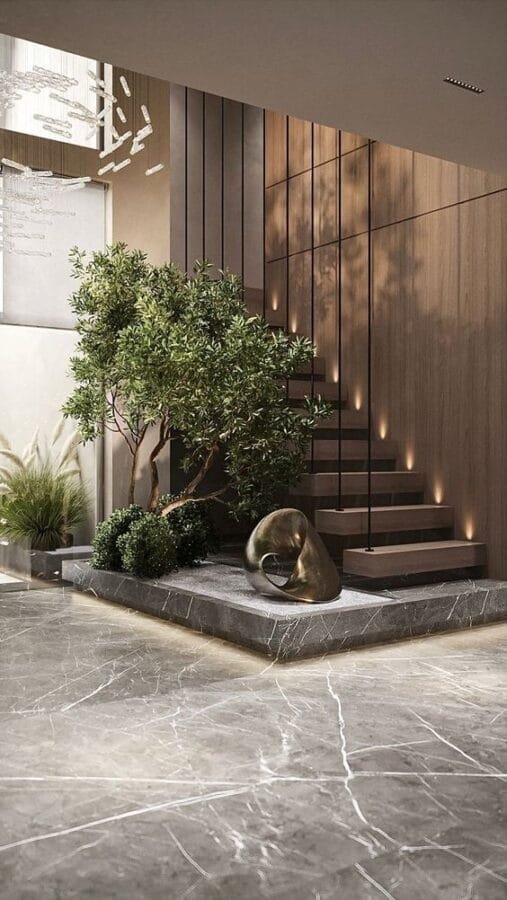
    Durable and stylish staircase design outdoor options are essential for garden or patio areas.
    stair design iron

     Adding indoor landscaping to the lobby

    Unique Staircase Tile Design

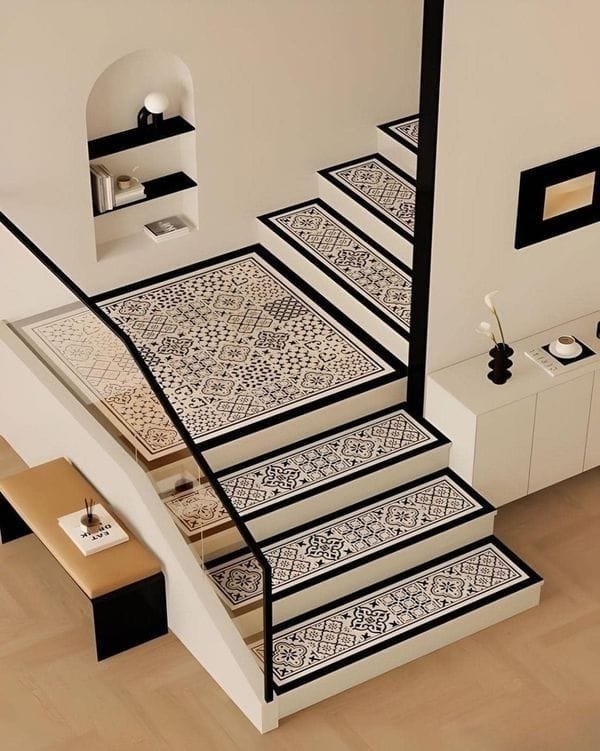
    Tiles are an important aspect of staircase design. The appropriate choice of tiles can elevate the aesthetic and safety of a staircase. The selection of tiles may vary depending on the interior mood board, the safety, and durability of the building, and the cost.
    stair handrail design steel

    Ceramic Tiles are used in the interior staircase.

    These tiles are best suited for interiors. Ceramic patterned tiles bring the aesthetic and cultural aspect of the staircase. These are durable, water-resistant, and easy to clean and maintain.
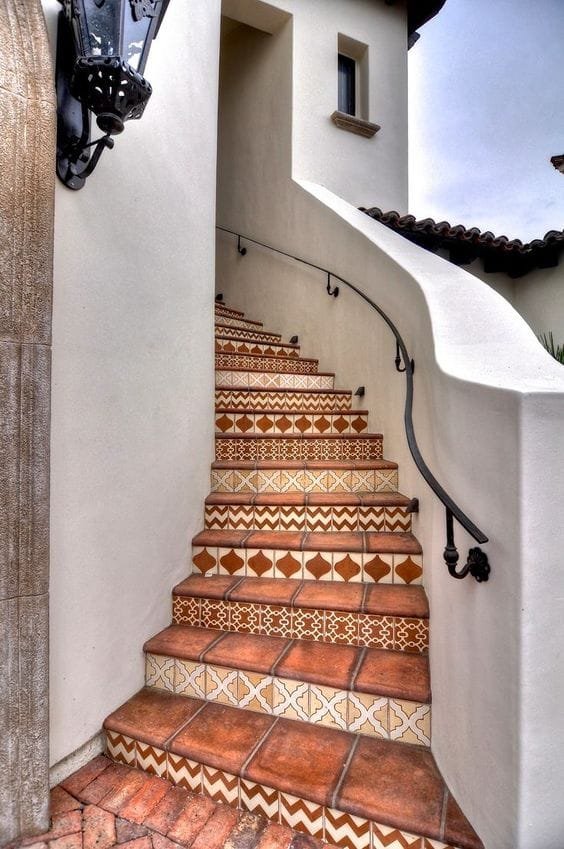
    stair design black and white

    Quarry Terra Tiles bring earthly tones to the interiors

    Quarry tiles are a prominent choice, as they look similar to terracotta tiles and provide a natural look. These tiles are extremely durable, quite affordable, and long-lasting.
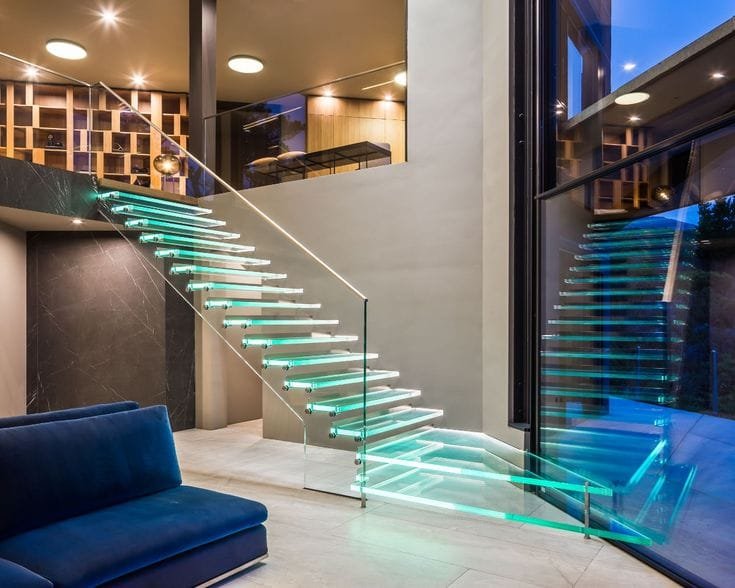
    stair down design

    Glass Staircases add elegance to the room

    Glass Tiles add visual interest and an unobstructed view to the user. These tiles add depth to the environment. Glass lets the user feel like he/she is floating upwards. These types of tiles are quite popular in modern staircases.

    Tiles Lighting

    LED lights are often used in tiles for ambient illumination. The tranquillity of the space can be felt through ambient lighting, which adds a guiding effect to the house.

    glass railing design for stairs

    LED lights add elegance to the tiles

    staircase design glass and wood

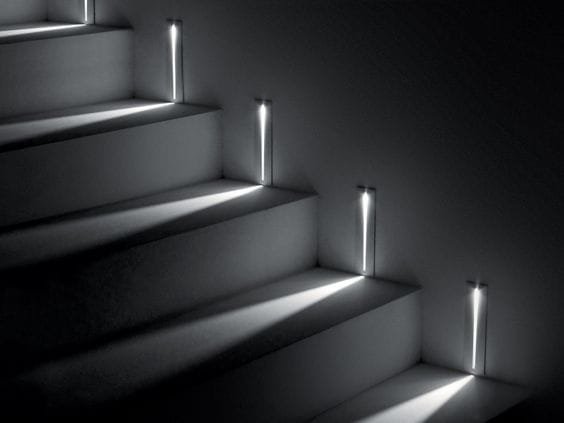
    Wall-mounted Steplight to illuminate the staircase

    Wall-mounted aluminium step light provides a minimalistic look to the staircases. These lights go well with the sleek and sharp design of the interiors.
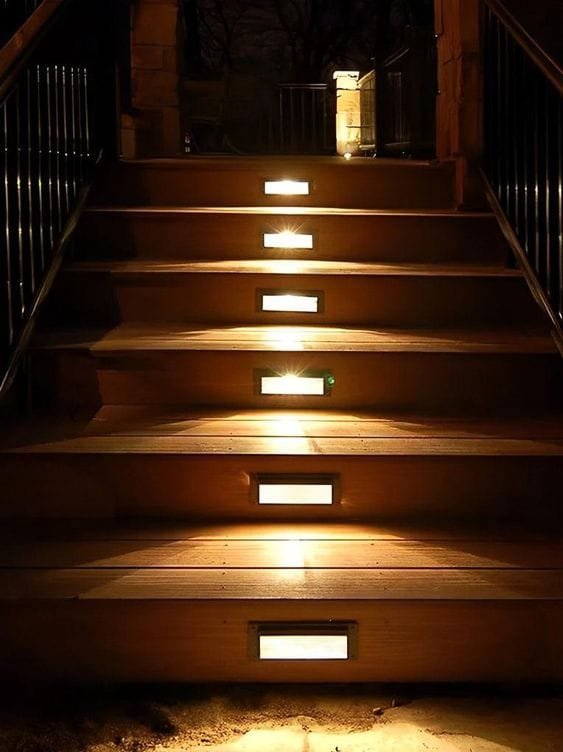
    staircase ventilation design

    Rectangular Grills LED Modern Lights

    Staircases have transformed lives and houses in many effective ways such as adding visual appeal to the lobby spaces. From mud/rope ladders to moving stairs called escalators, staircases have evolved with generations and will continue to do so. Diverse and innovative staircases also inspire level architecture designs.

  • Beautiful Lotus Temple- Bahá’í House of Worship

    Beautiful Lotus Temple- Bahá’í House of Worship

    Padma Shri Winning Architect

    Architectural of Indian Habitat Centre

    Beautiful Lotus Temple- Bahá'í House of Worship  Fig: The Lotus Temple, New Delhi by Fariborz Sahba lotus temple

     Fig: The Lotus Temple, New Delhi by Fariborz Sahba

    The Lotus Temple, located East of Nehru Place in New Delhi, India, is one of the seven Baha’i Houses of Worship worldwide. It symbolizes a united world. The Temple was designed and constructed by Ar. Fariborz Sahba and Flint & Neill COWI respectively. Its foundation was laid in 1953. The complete temple structure was completed in 1986.

    House of Worship

    The Lotus Temple was designed to provide a sacred place symbolizing peace, love, and harmony, irrespective of religion, gender, age, and background. Sahba explored India before reaching a final planning of the Lotus Temple, he observed Indian Temple architecture. He realized the importance of Lotus and decided to bring similar freshness and purity to his design. 

    Propagating the ideologies of the Baha’i who believe in no god and have the energy to work for themselves to achieve better in life. The Temple doesn’t require following any religion or tradition and is solely independent. The main aim of building the Lotus Temple was to add contemplative space, a prayer hall in particular for all religions, which is above every division, binding humans and emotions with divinity and oneself.

    Architecture of Lotus Temple

    Fariborz Sahba’s piece or ‘peace of art’ deserves to be reached to the world. Lotus Temple has derived its inspiration from the half-opened Lotus, which represents the national flower of India symbolizing peace and serenity. 

    The site has a slope difference of 10 m and there are natural contours on the site. A large part of the landscape along the way of the prayer hall is covered with manmade contours, placing the temple on the topmost part of the site. The Temple Complex houses an annual hall and an ancillary building that includes a library, an information centre, an administrative building, and some restrooms.

    The concept of choosing the Lotus had to be converted into a geometric form, translating into the form of a structure. The Lotus temple comprises nine arches of flat, cylindrical, and conical shape with an angular interval of 40 degrees, largely supporting the entire structural load. The structure was designed by architects and engineers using complex equations and mathematical proofs at tests. It was so complex that it took almost two years to design drawings on paper.

    Its main aesthetic, the floating Lotus, is surrounded by nine leaves in water. The outer structure is built into three parts associated with the number nine. Nine shells, nine entrances, and nine pools surrounding Lotus. The nine-based construction suggests that the number nine is the last digit which refers to completeness and the nine virtues of faith.

    Lotus temple

    Fig: Nine Pools surrounding Nine Petals which are entrances to the annual hall

    The first set of the Lotus petals which are open suggests the entrance to the annual hall. The second set of leaves open surrounding the innermost set, i.e. the third set of nine petals which are partly opened and form the ceiling of the annual hall. The centre of the lotus, opened from the top, is a steel structure covered with glass, protecting the hall against the weather.

    The Lotus petals, though delicate in design, are made of concrete providing strength and stability to the structure. These nine pools open to each entrance allow proper ventilation and a cool breeze to enter the building, which works against the scorching heat of Delhi.

    Lotus temple delhi

    Fig: Model of the Temple depicting outer leaves structure

    The above model is kept in the Information centre of the ancillary building. The width of the entrance leaves is 15.4m wide and grows to 22.5m at the upper extreme.

    Interior of the Structure

    Prayer Hall

    Beautiful Lotus Temple- Bahá'í House of Worship  Fig: The Lotus Temple, New Delhi by Fariborz Sahba lotus temple

    Fig: Interior Dome Structure

    The inner dome of the temple is round and parabolic-conical shaped. The height of the inner dome rises to 28 meters. The space between the ribs of the inner dome after a certain height, is covered by 60 mm thick shells. The construction is based on a nine radial-grid system.

    Beautiful Lotus Temple- Bahá'í House of Worship  Fig: The Lotus Temple, New Delhi by Fariborz Sahba lotus temple

    Fig: Ringstone symbol, at the top of the ancillary hall 

    The Ringstone symbol, marked at the top of the interior dome signifies the relationship between human and divine power which believes in manifest humanity and preaches it.  The inner dome surface is exposed concrete with architectural patterns all over the outer surface.

    The ancillary hall can nearly accommodate 2500 people to gather and worship. The hall receives ample natural light through nine entrances and glass surfaces. The natural light acts as a healing and soothing effect. Wooden seatings are placed in a circular arrangement with minimum slope.

    Exhibition Space 

    Beautiful Lotus Temple- Bahá'í House of Worship  Fig: The Lotus Temple, New Delhi by Fariborz Sahba lotus temple

    Fig: Exhibition room located in the basement, under the prayer hall

    The Exhibition area is located in the basement. The passage to the Exhibition passes through the poolside, which is located beneath the prayer hall. The location of nine pools allows a cool breeze to enter inside, making the place stay cooler and ventilated for longer hours.

    The Exhibition space involves teachings and principles educating visitors about the Baha’i faith and culture. It showcases scriptures and writings about the Baha’i faith.

    Library and Information centre

    Beautiful Lotus Temple- Bahá'í House of Worship  Fig: The Lotus Temple, New Delhi by Fariborz Sahba lotus temple

    Fig: The walkway to the Information centre is covered with Red Sandstone

    The Information centre was placed opposite the House of Worship along the way of the Prayer Hall to provide more information about the Baha’i culture and their sayings.

    Beautiful Lotus Temple- Bahá'í House of Worship  Fig: The Lotus Temple, New Delhi by Fariborz Sahba lotus temple

    Fig: 3d Model of Lotus Temple in Information Centre

    It also contains a beautiful Library, open to visitors interested in learning more about Baha’i culture. The library houses over 2000 books in more than 111 translations and provides a peaceful environment. 

    Gardens of The Lotus Temple

    Beautiful Lotus Temple- Bahá'í House of Worship  Fig: The Lotus Temple, New Delhi by Fariborz Sahba lotus temple

    Fig: Lush lawns of Lotus Temple, New Delhi

    The linear pattern is followed for the landscape design of the Lotus Temple. There are natural contours available on the site and it has a slope of 10 degrees down. Some man-made contours are added to contrast the natural landscape for aesthetic purposes. The contours don’t hide the architecture of the temple, they contrast the White complex.

    Recycled water and rainwater harvesting are the main sources of irrigating the lush lawns and they’re properly maintained with regular trimming and removing weeds. The temples preserve many flora species and also conserve resources.

    As the temple is open in the crucial hours of the day and operated for more than 10 hours each day, solar panels have been installed which acquires electricity usage up to 45 percent, cutting costs.

    The Landscape style of the Lotus Temple is minimalistic and has a very geometric approach in context to modern India symbolizing one religion of humanity. Contemplative gardening like meandering walkways encourages exploration and cuts monotony.

    Small pools near the built-up area add a soothing atmosphere and improve ventilation around the temple complex.

    Materials

    The Lotus temple reinforcement in the white concrete is galvanized and protected from being rusted. One visiting the temple can find petals’ outer and inner surfaces cladded with White Marble onto the concrete surface of shells using anchors and steel members. The Marble was quarried from Mount Penteli in Greece and cut in Italy and is of high quality adding life to the ethereal beauty of the temple.

    The structural formwork of the temple structure has a timber joist supporting the panel. 

    Beautiful Lotus Temple- Bahá'í House of Worship  Fig: The Lotus Temple, New Delhi by Fariborz Sahba lotus temple

    The White Cement used all over the temple was exported from Korea, as good quality was needed to build the structure during that time. The Temple is a complex craft executed by many skilled labourers. The stairs to the prayer hall were made of red sandstone.

    In the Interiors, wooden seating in the hall complements the white marble depicting class, serenity, and peace. 

    Awards

    Lotus Temple has received many awards for its tremendous structure. Some of the prestigious ones include:

    • Award of Excellence in 1987 by the US for emulating a building like a flower.
    • In 1987, Fariborz Sahba was awarded ‘Excellence in Religious Art and Architecture’
    • American Concrete Institute awarded Lotus Temple for ‘Excellence in concrete structure’ in 1989
    • GlobArt Academy 2000 to Fariborz Sahba in Vienna, Austria.

    Publications

    Articles

    Fariborz Sahba, the Architect of Lotus Temple received fame for building the outstanding complex structure inspired by the regional concept ‘Lotus’. By 2003, Fariborz had appeared for more than 500 interviews and numerous articles published. 

    A few of the major publications are mentioned below:

    • In February and December 1987, ‘Progressive Architecture Magazine’
    • ‘Encyclopaedia Iranica’ in 1989 
    • With the title ‘Illuminating Engineering Society in North America’ in Lighting Design + Application Magazine
    • In 2016, in BBC Travel under the title, ‘Most Beautiful Places of Worship’

    Books

    • Forever in Bloom by  Time Books International in 1992
    • The Dawning Place of the Remembrance of God by Thomas Press in 2002

    Frequently Asked Questions 

    Q. What is the Lotus Temple opening and closing timings ?
    A. The Lotus Temple is one of the most popular attractions in Delhi. It remains open 6 days a week. In summers – 9:00 am to 7:00 pm and in winters – 9:00 am to 5:30 pm. The temple remains closed on Monday.

    Q. What is the Lotus Temple Entry Fee?
    A. There is no entrance fee to visit the Lotus Temple. The temple cares about maintaining silence and decorum while in the prayer hall. Photography is prohibited unless special permissions are granted.

    Q. How to Reach Lotus Temple?
    A. The nearest metro station is the Violet line at Kalkaji Metro Station, a 5-minute walk to the temple from the metro station. The route to Kalkaji and Lotus temple entrance runs parallel. One can take private cabs/taxis to reach the temple. 

    Q. What are the Attractions near Lotus Temple?
    A. Kalkaji Devi Temple – a very popular temple in Delhi, is 600m away, Hauz Khas village, and ISKCON Temple, are some of the nearby places tourists love to visit.
    The Lotus Temple is surrounded by numerous tourist attractions nearby:

    • ISKCON Temple – 2.6 Km away
    • Humayun’s Tomb – 6.5 Km away
    • Hauz Khas Village – 8.5 Km away
    • Qutub Minar – 9.8 Km away
    • Connaught Place – 14.5 Km away
  • 5 Important Retreat Centres in India

    5 Important Retreat Centres in India

    “The life of inner peace, being harmonious and without stress, is the easiest type of existence.”

                                                                                                            —Norman Vincent Peale

    People often attempt to make their inner selves happy. It is unusual to think that their lives should be meaningful as they are afraid of meaninglessness. People fret about the ‘nihilism’ of this or that aspect of our culture. It is important to communicate and be satisfied with the idea of living. The saying, “If you can’t go outside, go inside” refers to the idea that everything will settle down if you awaken your inner self. 

    Humans can take care of minds and souls by practising meditation. But with all the hustle of the external environment, it is difficult to meditate. For this purpose, Retreat Centres were designed to cultivate an environment that disconnects humans from the external world.

    Niraamaya Retreat Centre, Kerala
     Top View of Niraamaya Retreats, Kerala

    Introduction

    The concept and understanding of retreat is not a linear one, as the meaning is subjective and has transformed & continues to shift, and reflects present societal issues and many needs as to how much and in which way one retreats. A basic and common understanding is that retreats provide “a sense of respite, refuge and rest, and this often forms the essence of this type of wellness tourism provision (Kelly, 2010:109)

    In today’s world, People have undergone wonderful experiences emotionally, spiritually and physically in these Retreat Centres. As the growing demand for work and labour increases, the human race is becoming hectic each day, they further feel a need to rejuvenate and regain good health.

    What are Retreat Centres?

    A retreat centre can serve various purposes, where it can be a place for quiet reflection and rejuvenation, an opportunity to regain good health, and it can mean a time for spiritual reassessment, either alone, in silence or in a group. They can be solitary, shared with family, and friends, or in groups with strangers. 

    Retreats Online classifies retreats as “yoga, spiritual-religious, health-wellness, personal creativity, destination-getaway, outdoor-adventure, business executive, and meeting space (Retreats Online, a Worldwide Directory).

    Retreat centres unwind souls and reconnect with their inner selves, amidst nature’s embrace, finding peace and tranquillity that heals and revives. 

    Different types of Retreats

    Every Retreat varies in nature as per location and the type, they offer varies. They are invented with prime purpose for individuals, allowing them to rediscover their purpose and harmony.

    Nowadays, there are many types of retreats with different purposes. These are:

    Wellness Retreats

    Wellness retreats are vacation centres that allow us to focus mentally, physically, and emotionally while participating in fitness and meditation routines, healthy eating, and spa therapies. They are well-oriented in the outdoor spaces with natural surroundings, inspirational and sight-seeing views, and a sense of seclusion to avoid disturbance, as you work on your inner and outer selves. 

    Meditation Retreats 

    This retreat cleanses the mind and restores inner peace. Other meditation retreats in India offer guided meditation technique training or mindfulness meditation classes. There are different types of meditation retreat centres:

    • Vipassana
    • Beginners 
    • Ones that mix meditation and yoga 
    • Buddhist
    • Mindfulness 

    Yoga Retreats

    This type of Retreat Centre exercises both your mind and body. Philosophically, Yoga helps to achieve liberation (moksha) and being one with the divine soul. People feeling at odds with the world, or stuck in life should explore Yoga Retreat Centres. They are the perfect choice for them. Many Yoga retreats include aerobics, nutritional classes, and courses on the philosophy of meditation and yoga.

    Spiritual Retreats

    Spiritual retreats have become popular for humans seeking personal spiritual or psychological growth. Spiritual programs have developed in many religious and secular cultures which typically incorporate various elements including prayer, meditation, and self-reliance. Thousands of people engage in these retreats every year, with yoga retreats among the most popular, for their spiritual and therapeutic value. (Hoyez, 2007)

    Adventure Retreats

    Adventure camps are all about fun. At this type of Retreat, you’ll be doing all sorts of outdoor activities. These retreats are generally in areas where there are mountains or large rivers. Canoeing, hiking, rock climbing, etc. are a few of the adventurous activities that allow individuals to connect with the environment and feel the excitement.

    India is a land of Yoga and meditation. It covers large options for getting cured physically, emotionally and spiritually. The country is full of exquisite Retreat Architecture in different regions. A harmonious blend of light, shadow and structure, Retreats has witnessed impeccable journeys.

    Viveda Wellness Retreat, Maharashtra

    Viveda Wellness Retreat, Nashik, Maharashtra
    Viveda Wellness Retreat, Nashik, Maharashtra

    In nearly 7 acres span of Beze Village, Nashik, Viveda Wellness Retreat is well designed by A for Architecture Design Firm. The centre is located between the gigantic Sahyadri mountain range, the mesmerizing waterfall of the Gautami Godavari dam, and a mosaic of multi-toned farmlands, medical trees, cattle, cows, buffaloes, sheep, and so on.

    The place has a hot and dry climate, especially during summers, but also enjoys pleasant monsoons & winter conditions. The spaces are designed to enhance the comfort of the visitors by creating a cool and moderately moist environment. Maximum open and green spaces have been built such as a courtyard, stepped pool, and open seating spaces connected to greenery. 82 per cent of the landscape is bedded with green plantations. Viveda is India’s only IGBC-certified resort, in the platinum category and this is not an easy feat. The project is in a remote location, hence, it outsources and employs local craftsmen who are impeccable in working with local traditional materials. 

    Its main spaces include resting spaces, healing spaces, and amenity blocks – involve squares with different functions and a corresponding spatial quality: Naturopathy cluster as Wada; yoga and meditation dome as Chaityas; Massage rooms as courtyard houses; Swimming pool as Kund; and the amphitheatre and restaurant as Ghats.

    OPEN GALLERY TO RESTING ROOMS
    Pathways amidst Resting Rooms
    MEDITATION HALL AT VIVEDA WELLNESS RESORT
    Meditation Space

    Shreyas Retreat Bangalore

    Location: Neelamangala, Bangalore 

    Site area: 22 acres / 90177sq.m 

    Architect: Pratap Malik and Associates, Delhi 

    Accredit: 4-star Ayurveda health resort

    The Various Packages Offered are:

    1. Silent Retreat 
    2. The Joy of Giving 
    3. Yoga Retreat Package
    4. Culinary Experience 
    5. Wellness for the Soul
    6. Ayurveda Rejuvenation 

    Shreyas is designed in raw and organic form, a 20,000 Sqft spa block which is an addition to a well-known Yoga Retreat that offers spectacular levels of spaces and experiences. It is in raw and organic form contemplating with natural light in a spectacular play of light and shadows. 

    Gallery of Shreyas Retreat
    Gallery of Shreyas Retreat, Bangalore

    The spaces inside are held together with a promising design language of Hand-crafted Jaali screens on walls, solid wooden doors and perforations and open spaces which merge the interior and exteriors, quite creatively. The main block fades into the earth and is half submerged to connect to the separate quality of the Earth, with the light and air movement planned from a series of sunken courts. The approach to the main block slowly and gradually opens up layers of spaces which are programmatically planned to suit the smooth spatial transitions of the guests. 

    SPA BLOCK OF SHREYAS RETREAT
    Spa Room

    Each spa room positioned, offers an exquisite view of the surroundings, whilst fading view of the guests from outside, with local exposed brick Jaali works as the shell, which provides organic form.

    With each block growing from the sunken gardens into the sky, often merging into a row of green, the organic approach seamlessly complements the colour tone of the retreat amplifying it in every serene way.

    Divine Retreat Centre Kerala

    Divine Retreat Centre Kerala, is a renowned spiritual destination that showcases a blend of modern and traditional architectural features. Some of the notable architectural features include Natives and locals referring to this area as Divine Nagar. Divine Retreat Centre – where the self-healing and family retreats are held in Malayalam, which is on one side of the road. People from different backgrounds come to attend these holistic retreats. 

    A majestic entrance gate with a large crucifix sets the tone for a spiritual path. As we move ahead, visitors get entwined to imposing prayer towers which offer panoramic views and quiet spaces for reflection. It has a large, well-ventilated auditorium with a seating capacity for more than thousands, which is ideal for retreats and convention meetings.

    Traditional & local architectural elements reflect the cultural heritage of Muringoor. The retreat centre is crafted with good accessibility and sustainability, ensuring a minimal ecological footprint.

    DIVINE RETREAT CENTRE KERALA
    Divine Retreat Centre Kerala

    Beautiful Landscape patterns and gardens are crafted such as the Rosary Garden, a scenic way of the cross out of lush greens, meditation and a relaxing garden. 

    The retreat centre also houses several homes for the mentally unwell and the marginalised section of society. 

    • The Divine Mercy Home for the Aged
    • St Mary’s Home for destitute women (also has a crèche for abandoned children)
    • Samaritan Home, for school-going children aged 3 to 17
    • Shanti-puram Care Centre, which is a home for the mentally challenged, was started in 2001.
    • De-addiction centre.
    • St Vincent Aids Home that looks out for HIV-positive and AIDS patients.

    Logos Retreat Centre Bangalore

    Logos Retreat Centre is a renowned Spiritual Retreat Centre, in Bangalore, India. This Retreat offers a serene and peaceful environment. The environment further helps individuals look for physical, emotional, mental and spiritual growth. It is also known for its various programs such as Satsang, dhyaan and yogic activities, and spiritual events crafted to help participants deepen their faith in divine power and experience spiritual and mental healing. 

    Marian Retreat Centre Anakkara Kerala

    Marian Retreat Centre Anakkara is a prominent Christian Retreat Centre which offers Spiritual Growth, Renewal and Healing. It is situated in a peaceful environment, it is a place where individuals, couples and groups can relax through various Retreat Programs and spiritual activities. Marian Retreat Centre Anakkara offers accommodation, prayer halls and Chapels and Dining facilities.

    Few activities such as Daily Mass – a regular celebration of Eucharist, Adoration, Devotion and other spiritual activities are practised.  

    Benefits of Retreat Centre

    • Retreat centre help rejuvenate life and provide guidance to the inner self to look out for a better path in life. Exploring one’s mind guides certain variations in life. The individual answers that one looks for in the world, these wellness and meditation retreats drive us to the path. 
    • Boosts happiness and reduces mental stress by healing human senses, mind, body and soul. The brain reacts to new activities and changes in the environment and stimulates leading to the overall well-being of human life. The brain produces hormones which boost happiness.
    • Retreat centre explain the need for positive communication and minimizing social gaps to widen sharing experiences. Taking vacations or having a day off relaxes the mind and connects to different sets of people varying in culture and opinions, which provides relief from stress and unnecessary tension in the mind. It can lead to overall improvement and mental well-being which leads to increased happiness.
    • Visiting new and relaxing environments and proximity to nature improves memory power and increases the concentration of the mind. Exposure to new circumstances during travel has been linked to better memory and enhanced creative thinking.
    • A retreat centre can be a great help for people recovering from losses, or going through difficult situations. In times of negative thoughts recurring, a retreat can provide a safe and moral space to work through feelings of grief. Therapeutic practices such as yoga- meditation, social sharing and counselling sessions can help in overcoming grief and allowing time to understand one’s emotions which leads to the path towards healing.
    Yoga and Meditation Space
    Individuals Practising meditation in a peaceful space.

    Retreat Centre of Ancient Times

    The retreat centre is a space for people of the world to go, find peace and heal themselves. It allows exploring their inner self and their connection to the divine soul. Meditation practice and learning Yoga, working with Shamans and Gurus, conducting ceremonies, preaching inner satisfaction and expanding their consciousness to find connection with selves.

    Architecture communicates effectively with the physical as well as the mental status of an individual through the human and natural senses. Focusing on Form and Beauty, retreat designers ages ago came up with an idea of spiritual and emotional growth. India has been forever rich in such unsaid Retreat Centre.

    Maharashtra is one such place in India surrounded by many caves. The grandeur of Ajanta Caves, meticulously artistry all over the cave with stone carving and hand paintings, air resting and passing evenly with gentle breezing and subtle stone striking sounds made Ajanta’s a mini monsoon retreat. 

    The concept of Varsavasa (a term in Buddhist) where caves were monsoon treats for monks in ancient ages. Rains were a difficult time to travel around, caves acted as the perfect shelters and for preaching meditation. This led to the rise from ‘Monsoon retreats in Caves’ to ‘Varsavasa Cave Architecture’. Caves’ locations were strategically chosen not only for their raw and scenic beauty but also for their proximity to main trade routes, which facilitated the import of resources and patrons.

    Kalari Kovilakom, Kerala is one of the oldest Indian wellness retreats, established in 1902 in the green lands of Kerala. This retreat was restored from a Vengunad Kingdom’s Palace to a beautiful healing retreat in the late 19th century. Ayurveda therapies, herbal treatments, and yoga sessions are some of the services provided in this centre.

    Kalari Kovilakom, Kerala
    Kalari Kovilakom Retreat in Kerala

    The place draws inspiration from the ancient science of Ayurveda, Kalari Kovilakom has many immersive wellness programs which aim at restoring balance and vitality.

    The Art of Living was established in 1986 and was founded by Shri Shri Ravi Shankar. From my school days, My Physics teacher used to organise art of living sessions for his students. From memory, I remember attending their sessions, and it had a great effect on my mind I was calm and positive to succeed in my studies. The Retreat centre is situated on the outskirts of Bangalore and teaches physical exercise, yoga, meditation, and ancient breathing techniques. Visitors can participate in several programs, including the renowned Art of Living Happiness Program, silent retreats, and holistic wellness workshops. 

    More than social media, Art of Living techniques are spread over the world in more than 100 countries. Their attendees had a great impact and are on the path of humanity.

    Chakras and their Involvement

    Spirituality in retreat centre can be attained within as there is no need to craft separable areas for such ‘Dhyaan’. Human minds often neglect the fact, therefore the need to create these spaces magnifies because of decreased mental and physical well-being nowadays. To achieve efficient design, Architects need to understand the spiritual aspects of the body. 

    The spiritual body involves seven Chakras which connect body, mind and soul. When we relate chakras to the human body, it symbolises the energy centres of the body. Balancing Chakras in the human body is important for their well-being.

    Chakra Meditation
       The Seven Chakras 

    Each of the Seven Chakras acquires a unique colour, and is responsible for a specific type of physiological function & emotional experience: 

    a) Muladhara (Root Chakra, Red) — involves Basic trust, protection, sense of safety, and being grounded 

    b) Svadisthana (Spleen or Sacral Chakra, Orange) — Enjoyment, pleasure, creativity and sexuality 

    c) Manipura (Navel or Solar Plexus Chakra, Yellow) — Personal power and Self-esteem 

    d) Anahata (Heart Chakra, Green) — Compassion, love, and forgiveness. It serves as a connection between mind, body and spirit 

    e) Visuddha (Throat Chakra, Blue) — Communication and Expression. It is the source of our capacity to express ourselves verbally and to communicate our ultimate truth. 

    f) Ajna (Third Eye Chakra, Indigo) — involves Intuition, awareness, inspiration and introspection

    g) Sahasrara (Crown Chakra, Violet) — Spirituality and enlightenment. It is also known as the “thousand petal lotus,” because it represents spiritual enlightenment and a link to our higher selves, other people, and ultimately the divine. 

    Connecting Chakras with Retreat Centre

    Enhances Spiritual Growth 

    Connecting with Chakras enhances the spiritual and architectural experience of the Retreats, enhancing the proper balance of environment and harmony. It represents different aspects of the human body, mind and soul. Each Chakra presents different growth and awareness, which enhances visitors’ experience and mind satisfaction.

    Connecting with Nature

    Designing Retreat Centre in a raw and natural environment amidst five aspects of Nature i.e. Fire, Water, Earth, Ether and Air allows visitors to experience the real organic beauty of the environment. Balancing nature in Architecture purifies the surrounding and nearby environment allowing it to heal quickly.

    Improving health and well-being

    The seven chakras are believed to be connected to various physical, emotional, and spiritual aspects of the human body. Retreats provide a space and environment which heals improves concentration and reduces mental stress.

    Creating a sense of tranquillity

    Architecture designed with seven chakras in mind can help to create a sense of tranquillity and calmness. By incorporating natural materials, colours, and forms to represent each chakra, Architects and Designers can create spaces that promote relaxation and peace of mind.

    Providing a serene and memorable experience

    Architecture which is designed with the seven chakras in mind can provide a unique and memorable experience for visitors. By incorporating design elements and materials that represent each chakra, architects and designers can create spaces that are visually appealing, emotionally engaging, and spiritually uplifting.

    Introspecting Spaces and Their Effect on the Built Environment

    Traditional architecture frequently had a specific function in mind when it was designed, and future user uses, or environmental changes were rarely considered. Architects design spaces in which people can introspect, retrospect, meditate, read or practice yoga. An open space, more like a third space which can be visited more often and is away from external world nuisances. 

    With the rapid increase in urbanization and the move towards sustainability with each passing day, the need for these spaces in the raw environment or more in their raw form grows more often. Amidst green spaces, or use of landscaping at vast, and using local traditional materials and techniques in Retreats will be eco-generative to nature. By and large, an individual’s psyche is more settled and calmer when they are associated with nature. Research has shown that being outside in daylight keeps an individual’s condition upbeat and cheerful. At present, however, it is asserted that the need for construction tractability is critical because of difficulties with affordability, resource depletion, fluctuating demographics, and climate alteration.

    Scale and Proportion, light and shadow, geometry and colour all are parts of different aspects of Retreat Architecture. These elements in architecture lead to points of convergence and divergence of visitors and further connecting and bonding them with the space to retrospect and heal sensory organs.

    Contemplative Space
     Contemplative Space                  
    Introspective place for Dhyan
        Open Space for ‘Dhyaan’

    It is understood that the architecture of the 21st century needs to be correspondingly flexible and adaptable for several reasons, the most crucial of which is the user’s mental and spiritual well-being. Therefore Retreats retreat needful people and help them explore inside to heal and satisfy their souls.

  • Top Library – As A Third Place

    Top Library – As A Third Place

    The book has always been a symbol of poise and prestige; a statement of cultural distinction and personal value.

    Top Library - As A Third Place Ningbo New Library lotus temple

    Ningbo New Library

    It is Wednesday, 14 August, 2024. I decided to write about refining my theories on the aura of Libraries for the nth time. Almost five thousand years ago, we know Ashurbanipal assembled the oldest known library and Asinius Pollio established the first public library, and the thought always kept fluttering over my head on how one could cage books within four walls. But, preserving libraries in a traditional yet evolved way is much more important than figuring out the freedom of books. 

    A caged human feels alive and free after becoming a part of reading culture. Reading became a transformative journey of self-awareness, illuminating life’s mysteries and intricacies. Visiting Libraries has always been a lot more than the act of reading itself. Library architecture design must consider both aesthetics and functionality to serve diverse user needs.

    Most of the world’s population has shifted to the internet and digital library mediums where everything is available without any hustle and movement. Only a few book enthusiasts avid readers, and researchers were left to visit and make the libraries alive. Therefore, designers and artists came up with the vision to protect libraries at any cost as this has sometimes been the only source of their cultural representation.

    Libraries began adapting as a third place. Apart from the traditional reading setup, the spaces emerged with a place for interaction, reading, discussing, and eating. Let me engage you with the diversity of libraries. The library architecture testing framework ensures the robustness of the systems implemented in digital libraries.

    The Diversity of Libraries

    Top Library - As A Third Place Ningbo New Library lotus temple

     Incredible Architecture Libraries

    National Libraries

    The country establishes these libraries and guides the country’s cultural heritage. It contains important national resources, biographies, and access to research which holds the impression of being preserved by the Country. National libraries can hold books, digital copies, and computers for researchers. The Imperial Library of Kolkata is India’s largest library by public record.

    Research Libraries

    Research Libraries are curated with a collection of knowledge that holds importance to academic pursuits, research, and data collection. They can be in books, journals, articles, research papers, and archives. These have the sole purpose of contributing to research and educational backgrounds. The National Library of Malta in Valletta and the Sistine Hall of Vatican City are two prominent Research Libraries in the world.

    School/University Libraries

    These kinds of libraries are attached to universities and schools or any educational institution that provides material access to all the students and faculties of that or other institutions depending on the norms of that library. It contains all the material needed by students, and faculties for academic pursuits.

    Public Libraries

    The name itself describes that public Libraries are established for the common good, they’re easily accessible to the community and encourage reading and lending activities at minimal or no cost. These libraries are run and set up by state and local governments. Every state has at least one public library in the country which is accessible to every age-group citizen.

    Top Library - As A Third Place Ningbo New Library lotus temple

    Public Libraries

    Digital Libraries

    This type of library deals with a collection of digital materials such as e-books, videos, DVDs, audiobooks, lectures, and other digital resources. Examples of Digital Libraries include Internet Archives, Open Library, and Project Gutenberg. A library architecture thesis can explore the influence of modern technology on traditional library design.

    Special Libraries

    These specialized libraries have evolved as sanctuaries for rare and specialized collections, catering to the interests of specific communities. Many have their roots in the esteemed scientific and engineering societies of the 19th century, which sought to provide their members with exclusive access to cutting-edge knowledge and resources.

    Top Library - As A Third Place Ningbo New Library lotus temple

    Special Library

    Let’s break the paradigm of our perspective towards Libraries and understand the need for Physical Libraries. 

    Public libraries have started adapting varyingly. The need for a library grew and is still growing as not every person has access to the digital world. Hence, books are reliable and cheap sources of qualitative data. To go and explore an entirely different world of book collection, digital sources cannot make you feel as good as one feels in the library in awe of books. Research has shown that people despite regional and social differences share a common interest in reading. Many private data, archives, and journals whose public and digital access is denied, we need a physical storehouse of those data. 

    Ill-maintenance, lack of funds, mundane infrastructure and buildings, and less access to the libraries resulted in a loss of public interest in the places. 

    Redefining Public Libraries in the World

    Top Library - As A Third Place Ningbo New Library lotus temple

    Design Ideas for Public Libraries

    Library can be a leisure place if they can be connected both internally as well as externally, even for non-readers. Open seating arrangements with lounge furniture – for merely interactive spaces with book stacks, to promote engagement and sociality. Libraries can have spaces for art forms, exhibitions, magazines, journals, interview spots, places for conferences, or organizing literary events. 

    The idea behind organizing literary events in the Library such that the place was flexible and adaptable to many ideas came from when I was in school. My school, Grand Columbus International School had a beautiful yet adaptable library space for reading, researching, and organizing events. Multi-purpose use of the space is which can make libraries attractive and satisfy modern solutions and needs. 

    Ray Oldenburg was a sociologist who coined the term ‘Third Place Theory’, in which he states that for a person, the third place should be a comforting and leisurely place where the person can relax away from home, but feels at home. The library architecture plan included several flexible study areas and multimedia zones.

    Exploring Indian Libraries, we get a hint of the old aesthetics of a traditional library, where the building is swamped with book stacks and systematic seating with utter silence. 

    Public Library in India with traditional setting

    Public Library in India with traditional setting

    Modern Libraries are slowly emerging a new definition of libraries where social engagement, discussions, involvement of cafes and exhibitions, and a leisure spot for people will evolve. For final projects, presenting a library architecture case study focusing on sustainable design is one of the best options.

    Route 9 Library

    Modern libraries evolving to multi-functional spaces

    Incorporating Spaces through User’s Lens

    In the 21st century, Libraries are effectively adapting according to the growing demands of readers following their needs and expectations. After the pandemic, COVID-19, the need for outdoor amenities has increased. Libraries should be designed as such designating more spaces for children, teens, and tweens.

    The library should offer flexible as well as adaptable reading and learning environments for readers. It is a place where people from diverse backgrounds, age groups, and interests come to widen their knowledge and enrich their learning experience. Another is a Tech-hub for the latest digital technology access and a smooth Wi-Fi connection. The library architecture floor plan of the new university library features innovative learning spaces and quiet zones.

    Along with Libraries, some basic and leisure requirements can be added to the list to make them more engageable, such as contemplative spaces, eating hotspots – and cafeterias. VMDO Architects in their research came up with awe-inspiring innovative spaces for the Modern transformation of Libraries. These are:

    • Digital Media Common Rooms
    • Adaptable to event space
    • Library Staff
    • Maker Spaces
    • Traditional Reading Rooms 
    • Gathering spaces 
    • Browsing Rooms
    • Outdoor Learning Spaces
    • Conference Rooms
    • Teen Service Rooms 

    Let’s explore a few interesting Libraries around the world known for their exquisite features and popularity among citizens. 

    Not Just Library

    Not Just Library, Taiwan, 2020

    Not Just Library, China, 2020

    The Library was built on a heritage place, once a bathhouse for women working in a Tobacco company. Its main attractions include interactive open spaces, workstations, a museum, and appropriate spaces for art and design events and exhibitions.

    Bath steps modified as seating and book stacks

    Bath steps are used as shelves with LED Strip running over the seating 

    The Focused user groups for the Library were designers, artists, readers, photographers, and tourists of noisy Taipei City. The built area was 436 Sq.m. acquiring a Ground Floor and Garden for interaction and small gatherings. They have transformed a simple bathhouse into a marvel of literature. The library has a separate room provided for computer users with data access and a garden area with a coffee table and chairs.

    The walls with mosaic are preserved to display the historic beauty. The library has its busy hours from 12 pm to 6 pm with Saturdays most, and Mondays as holidays.  

    Sweet Briar College Cochran Library

    College Library in Cochran, VA

    Sweet Briar College Library in Cochran, VA

    Ralph Adams Cram constructed the Cochran Library in 1927. The site location and orientation of the Library building make it a perfect blend of the architect’s vision and the reader’s requirements. The natural light felicitates the entire reading space and gives readers an outside view of the building. 

    It’s a beautiful work of modern approach mixed with traditional elements such as materials used in the facade and interior of the building including cast stone masonry, brickwork, and large glass windows. The Library building consists of an enlarged reading space, a room for books, open space for gathering and discussion connected inside by a vaulted gallery of arches.

    Reading Hall of Cochran Library

    Reading Hall of Cochran Library

    The Cochran Library addition and renovation, culminating from a decade of partnership, sought to harmoniously blend preservation and innovation, respecting the library’s esteemed heritage and loyal alumnae, while embracing the evolving needs of modern learning spaces.

    Along the front of the facade, a vaulted gallery is opened as a 24-hour study area for students coming to the library

    Along the front of the facade, a vaulted gallery is opened as a 24-hour study area for students coming to the library

    The Book Room

    The Book Room, Pune, India

    Cultural Library Cafe of Pune, built-in 2020

    In an area of 940 sq.ft, The Book Room is well established as a small double-height spacious library with a small courtyard and parking lot. It is a must-have place for readers and youths as well as adults who love being there among books and food. The place is built up in levels depicting a tremendous roller-coaster journey when a person enters a journey through the book. 

    Stepped amphitheater like informal Seating

    Stepped informal seating as a multi-utility learning space

    Libraries have been both comforting and knowledgeable places at the same time. To enrich visitor’s experience, the cafe used subtle earthly and light tones to make the space more humane. The material and texture palette comprises brick, concrete, and eco-friendly plywood. The interior is surrounded by greenery by maximum use of indoor plants which also keeps the building cool most of the time. 

    The Book Room has ample space for public interaction, seminars, and author events, and also a work area with informal seating. Bookshelves are provided on the walls to maximize the space. 

    Furniture such as chairs, bookshelves, and reading tables were also chosen such that it integrates with the texture of the reading area to provide a soothing effect to readers. A perfect third place for today’s world. A communal reading area, situated at the far end, is intentionally crafted to encourage dialogue, spark conversations, and facilitate the cross-pollination of ideas among people from varied backgrounds, promoting a sense of community and collective discovery.

    Top Library - As A Third Place Ningbo New Library lotus temple

    Use of Earthly tones and a subtle colour palette to make the space more humane

    Cotia Library Garden

    Cotia Library Garden, Brazil

    Cotia Library Garden, Brazil

    This private library’s design originated from a bibliophile’s desire to transform a hidden book collection, previously tucked away in boxes, into a beautifully organized and displayed space. The design process entailed a thoughtful conversation between the established habits of the existing home and the vast potential of the adjacent garden, aiming to create a seamless fusion. It was completed in 2016 within a small area of 104 Sq.m. 

    There were two entity volumes which were separated by a generous garden and a balcony. The project has several openings and each opening is determined by a different purpose.

    The transparency added invites the morning sun in winter and hides it in summer. The East facade is covered with horizontal blinds allowing minimal sun for light landscaping.

    North and South  facade of the library

        North and South facades of the library aim at a visual contact with the existing house

    The library’s inner spaces are crafted through a thoughtful balance of openings and defined by the central double-brick wall, which provides structural support. The toilet, the most secluded space, acts as a solid foundation for the hybrid structure of wooden pillars and masonry. In contrast, the reading balcony offers an expansive and airy atmosphere, perfect for quiet contemplation and reading beneath the tree’s protective shade.

    It is also known as the Garden Library. This is designed in the context of residence for people of that residency/house. It proposed a dialogue between daily habits cultivated in a pre-existing house and a large garden area available.

    Exploring various libraries with distinct features and attractions sets them apart from other libraries that are not maintained or don’t adapt according to modern needs.

    Third-place theory is a generalized idea that can be applied to any space, which can emphasize a space leading to innovation, new experiences, and social involvement. 

    Above through various examples, we saw the inclusion of cafes, and outdoor green spaces for gathering added strength to the library, for even non-book readers to at least try the experience of going to the library which can add a new dimension to their thoughts. 

    Incorporating some needful spaces- open, semi-open, and closed spaces, as per the users will add a new life to the libraries. 

    References 

  • 20 Best Architecture Firms in Mumbai

    20 Best Architecture Firms in Mumbai

    Mumbai, or ‘Bombay’, is India’s most populous and bustling city, which never sleeps. In her hustle, the city’s moments arise, strangers share memories, and exchange smiles, and however harsh it seems, Mumbaians embrace, welcome, and make this city home.

    The city is a perfect blend of food, culture, and architecture. It upholds many architectural styles – Portuguese, Victorian, Gothic, Indo-Saracenic, and contemporary Architectural styles. In different regions of Mumbai, you’ll come across various styles that connect people and buildings. 

    Emerging Architects and their artistic vision, shaping our country and globally, deserve a platform to converse about. Here, I’m including the Top 20 Architecture Firms in Mumbai. These firms have undergone a beautiful journey while transforming the meaning of Architecture according to their artistic vision.

    Abha Narain Lambah Associates– Architecture Firms in Mumbai

      Chhatrapati Shivaji Maharaj Vastu Sangrahalaya
      Chhatrapati Shivaji Maharaj Vastu Sangrahalaya

    Types of Projects: Monuments, Public Buildings, Hospitality, Educational Buildings,  Corporate, Palaces, Museums

    Abha Narain Lambah, Principal and Conservation Architect, founded ANL Associates. ANL is a multifaceted Architecture Firm, major specializing in Architectural Conservation, Restoration of old buildings, Museums, Palaces, Regional level Conservation Management, and more. The firm has been consistently in touch with Historic sites, 15th-century temples in Hampi & Ladakh, ancient Buddhist sites of Ajanta, restoration, and retrofitting of old buildings, museums, palaces, medieval mosques, forts, and more. 

    ANL has won various prestigious Awards. Some of them are:

    • 13 UNESCO Asia-Pacific Awards for Conservation Heritage
    • HUDCO Best Restoration Project 2020, 2019, 2018
    • Architectural Digest Architect of the Year Award 2019
    • PRIX Versailles Best Interior Retail Asia Pacific Award 2020

    Some of Abha Narain Lambah Associates’s most prominent projects include:

    • Chhatrapati Shivaji Maharaj Vastu Sangrahalaya, Mumbai, India
    • Le Corbusier Capitol Complex, Chandigarh, India
    • Ajanta Caves, UNESCO World Heritage Site, Aurangabad, India
    • Jai Vilas Palace, Gwalior, India

    Abraham John Architects– Architecture Firms in Mumbai

    Chhavi House / Abraham John Architects- Architecture firms in Mumbai
    Chhavi House, Jodhpur, India, 2018

    Types of Projects: Residential, Corporate offices, Cultural buildings, Hospitality, Urban Development 

    It is a multi-disciplinary Architecture firm founded by Abraham John in 1967. The firm focuses on reconnecting nature and architecture and is moving towards eco-friendly and sustainable projects, mainly residential projects. Local and environment-friendly materials, maximum use of light and ventilation in the building to conserve energy, open green contemplative spaces, and their co-relation with the building are prominent features of AJ Architects. The firm strives to regain a balance between function, aesthetics, form, climate, materials, and budget in every project.

    The firm has won a few prestigious Prizes such as the Architecture Master Prize 2018, International Property Awards 2018, and ULTRATECH India Next-Winner (Urban Category) 2017.

    Some of Abraham John Architects’ prominent projects include:

    • Villa in the Palms, Goa, India
    • Chhavi House, Jodhpur, India
    • The New Shivaji Park Project, Dadar, India
    • MMA Matrix Gym, Mumbai, India 

    Architecture BRIO– Architecture Firms in Mumbai

    The timber-clad pavilion in Holiday Home overlooking Mumbai Bay
    The timber-clad pavilion in Holiday Home overlooking Mumbai Bay

    Types of Projects: Residential, Group Housing, Hospitality, Contemporary

    Architecture BRIO was founded in 2006, primarily focusing on Urban Contemporary and a wide range of Experimental projects. BRIO follows an exquisite design approach connecting the built environment with the external world, acknowledging the ever-growing population and environmental safety. The firm is successfully led by Shefali Balwani and Robert Verrijt followed by an enthusiastic team of Architects enriching in Vernacular Structures.

    BRIO’s portfolio boasts a diverse array of spectacular projects, spanning Cultural and Institutional, Hospitality, Educational, and primarily Residential domains.

    These are:

    •  House in a Beach Garden, Alibag, India
    • The Riparian House, Karjat, India
    • Himalayan Mountain Retreat, Mukteshwar, India

    The firm has been part of many astonishing interior projects in residential domains.

    Designing the Interior while leaving a remarkable impact on the spaces that can multi-function simultaneously. A few on the list are:

    Casa Brio-Living Space in Bandra, Mumbai
    Casa Brio is an 80 sq.m. residence in Bandra, Mumbai 

    Casa Brio – The small spaces were enlarged. The illusion of many rooms and more walkable space is created. Each room is multi-purpose and is designed in a particular way.

    • Tala Treehouse Villa, Tala, India
    • Spiral Dollhouse, Mumbai, India

    Architecture BRIO has won many reputed Awards such as – INDE Awards, Australia for Billionbricks Homes(2021), ID Honours – Elle Decor(2021), Architectural Award Building Integrated Solar Technology(2019) 


    Atelier Design N Domain– Architecture Firms in Mumbai

    K HOUSE, ALIBAUG, MUMBAI, INDIA
    K House, Alibaug, on the outskirts of Bombay

    Types of Projects: Residential, Commercial, Hospitality, Sport

    The Studio, co-founded by Ar. Anand Menon and Ar. Shobhan Kothari, and spearheaded by Ar. Kiran Kapadia (Founder of KDND Studio LLP) has enabled the firm to reach certain heights. ADND creates serene yet visually striking spaces.

    The Firm centres around the interior of Residential buildings. It has been talked over town and published in several magazines such as:

    • Home & Design TRENDS
    • Interiors & Decor
    • Living etc
    • The Tiles of India and more.

    Some of the notable works by the firm are:

    • Marna, Goa (2024)
    • Zydus Cadila, Mumbai (2023)
    • Casa Felig, Alibaug (2020)
    • RB Elements, Mumbai (2019)

    DCOOP– Architecture Firms in Mumbai

    BRIDGING THE GAP, MAHARASHTRA, INDIA
    Bridging The Gap, Maharashtra, 2017

    Types of Projects: Residential, Retail Stores, institutional, offices, and Master Planning

    Shilpa Ranade and Quaid Doongerwala, graduates from CEPT University, decided to establish DCOOP in Mumbai, in 2003. DCOOP’s main ideologies include contemporary and sustainability towards any building. The firm mainly exercises, deep knowledge of history and experience which they practice in the building. Distilled proportions and a sense of balanced tranquilness characterize DCOOP’s projects. 

    Their projects include anthropometric study, artistic vision, engineering, and management at different stages.

    Some of the prominent works of DCOOP are:

    • Sublime Ordinaries, Vasind (2016)
    • Bridging The Gap, Northern Edge (2017)
    • School of Sciences, Cuddapah (2008)

    DP Architects– Architecture Firms in Mumbai

    Designing the heart of Punggol, a Community Hub and a mixed use building
    One Punggol- Integrated Community Hub

    Types of Projects: Interior Design, facade, landscaping, Urban Planning and sustainable design

    The firm was established by the name ‘Design Partnership’. It was set up by Ar Koh Seow, Ar William, and Ar Tay Kheng in 1967. DP Architects is located at Nariman Point, Mumbai. The firm has successfully spread across 16 offices from London to Shanghai with a family of over 900. The firm has few prominent books published. These are:

    1. The Master Architects Series- DP ARCHITECTS
    2. EVOLUTION OF A RETAIL STREETSCAPE
    3. EVOLUTION OF A CIVIC DOWNTOWN
    4. DP DESIGN- DESIGNING SPACES
    5. DP ARCHITECTS- 50 YEARS SINCE 1967
    6. THE DUBAI MALL- SAND TO SPECTACLE
    7. DP DESIGN- DESIGNING CHANGE

    Some notable works from the firm include:

    • Jurong Spring Community Club, Singapore
    • Lazada One, Singapore
    • Raffles Girls’ Secondary School, Braddell Road

    Hafeez Contractor Architects– One of the Best Architecture Firms in Mumbai

    OSHO INTERNATIONAL MEDITATION RESORT, PUN
    Osho International Meditation Retreat, Pune

    Types of Projects: Hospitals, Institutions, Large Residences  and Town Planning

    AHC is a leading architecture design firm in India well established in 1982. The firm has dealt with all kinds of projects such as Institutions, Public Sector Undertakings, Hospitality, Healthcare, and Large Corporations. From designing tall buildings, and metro skyline to engaging in social housing and redevelopment housing for slums, Hafeez has gone through a tremendous journey of Architecture.

    AHC has won over 75 national and International awards. His famous works include:

    • DLF Ericsson, Gurgaon, 2015
    • Mahindra World School, Tamil Nadu
    • Indian School of Business, Hyderabad
    • ICICI Headquarters

    HOK Architects– Architecture Firms in Mumbai

    St. Louis CITY SC’s CITYPARK | St. Louis, Missouri
    St. Louis CITY SC’s CITY PARK | St. Louis, Missouri

    Types of Projects: Workspaces, Cultural, Commercial, Hospitality, Healthcare, Recreation, Retail, Residential

    It is a leading multidisciplinary firm in Mumbai with Architecture offices in more than 23 countries. HOK is an acronym of Hellmuth, Obata + Kassabaum, and was kept on the last name of its founders. It is one of the oldest firms, which has a great portfolio in designing buildings driven by technicality and imagination. Their prime focus is on creating ‘Green Buildings’.

    HOK’s reputed works include:

    • Mercedes Benz Stadium
    • Bay Meadows and Open Text
    • Southport Theatre and Convention Centre
    • The Francis Crick Institute

    The firm won its first major university project in 1961. HOK has been carbon neutral since 2022. The firm is dedicated to achieving net-zero emissions in the projects we design by 2030. 

    HOK has won leading Awards such as the IDEAS Award for Excellence in Architecture, the AIA Illinois Capitol Award, the 2023 Urban Land Institute Healthy Place Award, and more. 


    IMK Architects– Architecture Firms in Mumbai

    Symbiosis University Hospital and Research Center
    Symbiosis University Hospital and Research Center

    Types of Projects: Healthcare, Hospitality, Residential, Commercial, Community development, Institutional, Urban Planning 

    Mr. I.M.Kadri founded IMK Architects in 1957, which is primarily based on Biophilic Architecture. The firm emerges with warm and vibrant interior spaces as well as building layouts and enhances site sensitivity with vital solutions and form. This Mumbai and Bengaluru-based Architecture Firm steps out of conventionality and brings sustainability and nature into its built art forms.

    Rambagh Palace Hotel, Jaipur
    Rambagh Palace Hotel, Jaipur, Rajasthan

    With more than 60 years in the Industry and over 150 projects, IMK boasts an array of notable works all over the Country. Some of them are:

    • SGC-Towncentre, Torangallu
    • HAJ House, Mumbai
    • TAJ Gateway, Mumbai
    • TAJ Mahal Hotel Delhi
    • Fort Aguada Beach Resort, Goa

    M Moser Associates– Architecture Firms in Mumbai

    Sony Music, Mumbai
    Sony Music, Mumbai

    Types of Projects: Residential, Commercial, Community development, Institutional, Healthcare, Hospitality, Urban Planning

    Moser has a notable reputation in Architecture since 1981, the firm widely focuses on sustainability and interior spaces. The firm is growing and reaching new heights with some big clients. The firm is constantly working on net-zero projects and finding ways to reduce carbon emissions through Sustainable Architecture, it is on a mission to achieve net zero by 2050. 

    Here are selected works by the firm:

    • Sightour Ophthalmic Hospital, Hangzhou
    • SHL Medical, Taoyuan
    • Yale University, Beijing
    • M Moser Workspace, Vancouver

    M Moser has won reputed awards such as: 

    • Interior Design – Silver Award for SHUI ON WORKX, Shanghai
    • Biophilic Design and Nature Integration for CITI EON, Pune
    • FX Design Award for HUDSON RIVER TRADING, London

    Morphogenesis– Architecture Firms in Mumbai

    Surat Diamond Bourse
    Surat Diamond Bourse, Surat

    Types of Projects: Residential, Commercial, Institutional, Healthcare, Hospitality, Interiors and Landscape Urbanism

    Morphogenesis was founded by Sonali Rastogi and Manit Rastogi in 1996 and is well set up in 8 countries. Women lead nine out of ten departments in Morphogenesis. Their design style arenas include Master and Urban Planning, Residential, Commercial, and Institutional in core subjects of Sustainability, Landscape, Technology, Interiors, and Design Management. 

    Morphogenesis is a team of more than 1500 architects and has won nearly 100 International and National awards, and more than 750 publications.

    Their prominent works from India are:

    • Surat Diamond Bourse, Surat
    • IILM, Greater Noida, India
    • Ansal University, Gurugram, India
    • Infosys Campus, Nagpur, India

    P.K. Das and Associates– One of the Best Architecture Firms in Mumbai

    Wankhede Stadium, Mumbai
    The Wankhede Stadium, Cricket Ground, Mumbai

    Types of Projects: Residential, Stadiums, Entertainment, Railway Stations, Industrial, Institutional

    Pranab Kishore Das, a visionary Indian architect and activist, is celebrated for revolutionizing the concept and redefining the boundaries of architecture and urban planning.

    Over 50 years of legacy in the industry, the firm has left an impeccable mark on the country by crafting astonishing buildings. Their commitment extends from residential and industrial projects to large-scale urban planning, encapsulating a belief that design should resonate with collective aspirations. 

    The firm has major contributions to public spaces, restoring buildings, redevelopment of slums, and urban planning. 

    The studio has received some reputed Awards such as:

    • Jane Jacob Award (2016)
    • HT Changemakers Award (2015)
    • A+D & Spectrum Foundation Architecture Awards (2004, 2010)
    • The Deutsche Bank Urban Age Award (2008)

    P.K. Das Architects has worked on some notable projects. These are:

    • Wankhede Stadium, Mumbai
    • Dadar Railway Station
    • Adani Commercial Tower, Ahmedabad
    • ICICI Prudential Corporate Office

    Prem Nath Associates– Architecture Firms in Mumbai

    HMEL Township, Bhatinda, Punjab
    HMEL Township, Bhatinda, Punjab

    Types of Projects: Residential, Housing, Sports, Commercial and IT Parks, Temple, Corporate, Institutional, and Interior Design

    Ar. Prem Nath established his firm in 1977 and began his architectural journey in Mumbai. With the breathtaking design of India’s first revolving restaurant in Mumbai, he left a mark on the city’s architectural landscape, also paving the way for innovative high-rise buildings that have become synonymous with Mumbai’s identity. 

    Prem Nath got his first break when the legendary Dharmendra, a noteworthy actor, allowed him to plan his home during the starting days of his career. He showcased his high performance and this work opened new opportunities to him. Several Bollywood actors and rich delegates approached him.

    PNA has spread its branches to Ahmedabad, Mumbai, and New Delhi. 

    The list of a few popular projects by the firm are:

    • Golden Palm Resort in Bangalore
    • Bhakti Park, a Residential Complex in Mumbai
    • Sky Villas in Mumbai

    ARK Reza Kabul Architects– Architecture Firms in Mumbai

    Shreepati Jewels, Mumbai, India
    Shreepati Jewels, Mumbai, India by Ar. Reza Kabul

    Types of Projects: Residential, Commercial, Industrial, Institutional, Educational

    In 1988, Reza Kabul established ARK in Mumbai, to build a universe of tall buildings and skyscrapers. It has other offices in Pune and California. 

    The firm has proven its expertise in delivering projects ranging from architecture to interior, and urban to master planning. It has created marvelous buildings that are awe-inspiring and stepping out of conventionality with different forms, technologies, and functionality. 

    ARK has managed to earn big-fat clients and always had gaga over the industry such as AXIS Bank, ECO-Homes, Ekta World, L&T Realty, Reliance Trends, Radisson, and more.

    Without a missing, every year since 2003 the firm has received Awards for its tremendous work such as Best Architect of the Year by Accommodation Times, Best Corporate Design Excellence by CNBC Awaaz, Bharat Gaurav Award’ by All India Achievers Foundation, Hotel Interior Designer of the Year. 

    Reza Kabul has a hand in certain amazing projects. These are:

    • Clark Road, Lakeside, USA
    • Ekta Parksville, India
    • Dheeraj Corporate Park, India
    • Tak Skyline, Ahmedabad, India

    RMA Architects- Architecture Firms in Mumbai

    CEPT University, Ahmedabad, India
      CEPT University, Ahmedabad, India 

    Types of Projects: Residential, Institutional, Office, Retail, Art galleries

    Rahul Mehrotra set up the firm in Mumbai in 1990 which was rebranded as RMA Architects in 2010, this visionary firm has expanded its reach to Boston, crafting a distinctive architectural legacy that harmoniously integrates contextual sensitivity, innovative design, and cultural depth, leaving an indelible mark on both cities. 

    The firm knows history and heritage centers and has collaborated with local people and traditional craftsmen to dive deeper into the study of building design.

    Rahul Mehrotra has been in the news for his architecture practice and the vision guiding him, he talks about Climate Change and has several projects published in magazines and news such as CEPT LIBRARY, THREE COURT HOUSE, HATHIGAON, HOUSE IN AN ORCHARD.

    A Few notable projects of the firm are:

    • Mata Ramabai Ambedkar Worli Smashan Bhumi, Mumbai
    • House in a Tea Garden, Tamil Nadu
    • Hathigaon, Jaipur
    • Green Cube House, Chennai

    Sanjay Puri Architects– One of the Best Architecture Firms in Mumbai

    Prestige University, Indore
    Prestige University, Indore– Sanjay Puri Architects

    Types of Projects: Residential, offices, retail & Entertainment, educational, cultural, hospitality, and Master Planning

    Sanjay Puri is a renowned &  leading Architect of India. He graduated from Rachana Sansad Academy of Architecture, Mumbai obtaining an Architecture degree in 1988, further, he started working for Ar. Hafeez Contractor. 

    His design motto is – not to repeat any design. Sanjay is creative and innovative in his design considerations. The firm mainly focuses on concept building and its connection with people and surroundings. 

    The world is full of canvas. Sketch. Sanjay has a firm belief in sketching before actually going deep into the project.

    Sketch by Sanjay Puri- Sanjay Puri Architects
            Sketch by Ar. Sanjay Puri– Sanjay Puri Architects

    The firm has won many prestigious International Awards. Some of them are:

    • BLT Built Design Awards for Residential house in Ras, Rajasthan
    • World Architecture Community Awards for Akluj, India
    • Green Good Design Awards, Chicago for The Courtyard House
    • DNA Paris Design Awards for Aria Hotel

    Here’s a list of a few popular projects done by Sanjay Puri Architects:

    • STUDIOS 90, KARNATAKA
    • BARODA HOUSE, BARODA
    • NARSIGHAR, NOKHA, RAJASTHAN
    • ARIA RESORT & SPA, NASIK


    Serie Architects– Architecture Firms in Mumbai

    5 Science Park Drive, Singapore
    5 Science Park Drive, Singapore

    Types of Projects: Residential, Educational, Workspaces, Cultural, Hospitality, Mixed-use, Exhibition design

    Serie Architects was established in Mumbai and now, it has branches in London as well as Singapore. With many awards in their portfolio, they’ve gained a reputed position in the industry. A significant portion of their portfolio consists of competition entries that have garnered widespread recognition, while several others stem from a conceptual approach, demonstrating the firm’s capacity to breathe life into bold, imaginative concepts. 

    It’s one of the popular featured projects include:

    School of Design & Environment
    School of Design & Environment, 2018

    It is the first net-zero energy building of its kind in the tropics. The building features a spacious design studio of over 1,500 square meters, accompanied by a generous 500-square-meter open plaza, and a rich array of public and social amenities, such as workshops, research centers, a new cafe, and a library, all carefully crafted to foster a sense of community and collaboration. 

    Some of the notable works are:

    • Patna Science Museum 
    • Jameel Arts Centre
    • Singapore State Courts
    • Oasis Terraces

    SPASM Design Architects– Architecture Firms in Mumbai

    House of The Soaring Rock, 2018
    House of The Soaring Rock, 2018

    Types of Projects: Residential and Hospitality

    SPASM was kept on the initials of Ar. Sanjeev Panjabi And Ar. Sangeeta Merchant, the firm was founded in 1995. Their work style includes Contemporary, experimental, and details. SPASM has received tremendous awards for its beautiful residential works. Houses are designed as mirrors and representations of the culture and personality of the people residing there. 

    For this, they have won many awards such as the ID Honours Awards(2023), and the TRENDS Excellence Award. Special mentions and publications mentioned their few notable houses such as Vohra House, Copper House, and more. 

    Here are a few amazing projects:

    • Parikrama, Murud
    • House cast in a Liquid Stone, Khopoli
    • Copper House, Ahmedabad
    • Aon, Tanzania

    Sameep Padora Associates– One of the Best Architecture Firms in Mumbai

    Craft Deli, Phoenix Market City, Mumbai
    Craft Deli, Phoenix Market City, MumbaiSameep Padora

    Types of Projects: Residential, Restaurants, Institutional, Religious, Entertainment

    Sameep Padora set up SPA in Mumbai. He has spoken promisingly about Housing, Homegrown Cities, and Decoding Mumbai. The firm has handled multi-functional projects such as Film City, Urban Amphitheater, Temples, Parks and Houses, Clubs, and Art Labs.

    SPA has organized various exhibitions, collaborated on many projects, and researched technical subjects. The firm also won awards for its upskilling projects. A few of them are on the list here:

    • Winner for Best Public Building i.e. Temple of Steps (2021)
    • Wienerberger Brick Award for Maya Somaiya Library (2020)
    • ASSAP Construction World Award (2013)

    His Portfolio of Projects includes some popular and Featured Projects:

    • Hampi Art Labs
    • JSW Odisha Township
    • Sienna Apartments
    Sienna Apartments, Hyderabad, 2018
    Sienna Apartments, Hyderabad, 2018– Sameep Padora

    Studio Emergence– Architecture Firms in Mumbai

    Hybrid Futuristic Planetarium, India
    Vishakhapatnam Planetarium, Andhra Pradesh

    Types of Projects: Public Buildings, Residential, High rise buildings

    Khushbu Davda and Seeja Sudhakaran founded Studio Emergence with a shared vision of parametric and geometric design. Emergence’s main ideologies deal with the geometric concepts linked with human adaptability and emotions. 

    It has designed the Emblem of Make In India and many other popular installations. The studio believes in socially acknowledging and gaining knowledge from artists, Architects, and several designers across the globe.

    It has won many awards for its most loved and featured project. These are:

    • Vishakhapatnam Planetarium
    • MMRDA Andheri Metro Design
    • Green Turf Landscapes

    It’s projects and ideologies and the exquisite design approach has been the talk of the town and news and magazines. The following publications published their works. These are:

    • MGS, Modern Green Structures and Architecture
    • TFOD
    • Architects & Interiors India
    • Times of India
    • TU 142 Museum, The Hindu

    The above list might have missed a few versatile and dapper Architects, but certainly, they are not missed by Great visionary people. From Vishvakarman (architect of Gods) to one of the few mentioned above, each architect has served a great purpose and added versatility to the world following Gestalt Theory i.e. Form, Function, and Beauty. 

  • Beautiful Umaid Bhawan Palace, Jodhpur

    Beautiful Umaid Bhawan Palace, Jodhpur

    Introduction

    India, especially Rajasthan, is known for its grandeur and the allure of its rich, regal architectural history of palaces. Let’s explore Umaid Bhawan Palace in this article. One of the lasting palaces built before Independence lies southeast of the blue city, Jodhpur. The best time to visit is between November and February, when the city enjoys a delightful climate, with temperatures varying from a cool 7°C to a warm 25°C, making it perfect for exploring the beauty of the magnificent palace.

    Although, boasting marvelous Indo-Sarcenic Architecture in golden yellow hues, the Palace is the former royal house of Jodhpur’s former king, Maharaja Umaid Singh. He built the palace in 1943 on Chittar Hill. The palace is now the residence of his grandson, Maharaja Gaj Singh II.

    Umaid Bhawan Palace, Jodhpur, Rajasthan

    The Regal Architecture of Umaid Bhawan Palace in Jodhpur

    Let’s dive deeper into the enriching heritage and spectacular features of the palace.

    History of Umaid Bhawan Palace Rajasthan

    Let’s talk about when was it built. The origins of Umaid Bhawan Palace date back to the 20th century, when the palace was built in late 1943. A saint’s curse uttered ages ago, he had told a devastating drought that would one day occur at the land of Jodhpur. And so, in the 1920s, the city faced a severe drought and famine for three consecutive years.

    In their odd hour, the residents of the village approached their beloved Maharaja, Umaid Singh, for salvation. Being a generous king, he vowed to build a Palace that would bring livelihood to his people. So, in 1929, the foundation of Umaid Bhawan Palace in Jodhpur in India was laid, as a symbol of hope in their darkest hour. 

    Around 2000-3000 workers worked tirelessly, their labor a testament to the maharaja’s unwavering commitment. The Palace was one of the world’s largest royal residences, but after four years of building the home, Maharaja Umaid Singh died.

    Following the brief residencies of Umaid Singh and his successors, Maharaja Gaj Singh II, as years passed, he turned the palace into a hotel and museum, breathing new life into his unparalleled home.

    Unfolding Architecture Marvels of Palace

    The final layout of Umaid Bhawan Palace was designed by Architects Henry Vaughan Lanchester and Budhmal Rai. It was mainly completed in the Indo-Saracenic style under the guidance of chief architects S.S. Jacob and Vidyadhar Bhattacharya. 

    A golden-yellow sandstone Palace complex is built on 26 acres of land with 15-acre lush green gardens. The sandstone monument features two wings: one a private residence for the Rathore Dynasty’s descendants, where they enjoy a life of luxury and seclusion, and the other, a beautifully converted hotel.

    Umaid Bhawan Palace, Jodhpur, Rajasthan

    The lush green garden spread over 15 acres of land

    Keeping the royal heritage of Rajasthan alive, Umaid Bhawan Palace features an impressive array of opulent spaces, including 347 rooms with several courtyards, a majestic throne chamber, a beautiful banquet hall that can nearly accommodate 300 people, a private meeting hall, a grand Durbar Hall for public audiences, multiple private dining halls, a comprehensive library, a lavish ballroom, a luxurious indoor swimming pool and spa, a billiards room, two exquisite marble squash courts, four tennis courts and long passage-ways.

    Maharaja Gaj Singh, affectionately known as ‘Bapji’, stays in a private wing of the Umaid Bhawan Palace, which showcases a stunning blend of architectural styles, combining the ornate grandeur of Indo-Saracenic, the timeless elegance of Classical Revival, and the sleek sophistication of Western Art Deco. 

    Passages connecting gardens to the Palace

    A long passage-way with a beautiful array of trees connecting the Palace

    The Umaid Bhawan Palace combines Renaissance-inspired domes with majestic Rajput-style towers. Throughout the palace, numerous elements pay homage to Hindu architectural traditions, reflecting India’s rich cultural heritage. Its entrance is adorned with the majestic Coat of Arms of the Rathore Royal family, adding a touch of nobility and heritage.

    Makrana marble and Burmese teakwood have been prominently used in interiors. Bhawan’s major architectural attraction is the inner sky-blue dome with caricatures, which soars to an impressive 103 feet (31 meters) within and is surmounted by an outer dome reaching 43 feet (13 meters) in height.

    Entrance hall of the Umaid Bhawan Palace, Jodhpur

    The entrance hall under the central cupola of Bhawan

    J.S. Norblin created astonishing fresco paintings in the east wing of the palace with great precision and fineness. The palace is completely designed in an art-deco style. 

    Magnificent Venues of the Bhawan

    Since reaching the Palace only requires flying to the nearest airport it becomes ideal and beautiful venue for holding events or to get a picturesque scene. These are:

    • Marwar Hall – a luxurious banquet with elegant furniture and lighting
    • Rathore Hall – Majestic hall with dazzling chandeliers for grand celebrations
    • Baradari Lawn- The lawn under the open sky offers a lush green view and the utmost solace. The Lawn is used for wedding or corporate retreat events in a setting of timeless charm.
    • Fountain Courtyard – An oasis where a grand fountain meets Jharokhas. The venue is used for ultimate cultural events.

    Nick Jonas and Priyanka Chopra’s Royal Wedding

    There’s no doubt about the royal ambiance of the old-charm era of India, the moment one steps into Umaid Bhawan Palace. The gorgeous fort has seen many grand events including the famous wedding. On 1 December 2018,  Bollywood actress- Desi girl, Priyanka Chopra, and popular sensation American singer, Nick Jonas read the vows under regal embroidery of Jodhpur. The place was slated to serve as the couple’s wedding venue, which is a beautiful blend of Indian and Western architecture.

    Priyanka chopra and Nick jonas

    Jose Villa shoot for Priyanka and Nick’s White Wedding

    The duo’s wedding ceremonies stretch across three days with both Hindu and Christian ceremonies taking place. A Mehendi ceremony, a Hindu ceremony, and a Christian ceremony are all held at different locations within the palace. Umaid Bhawan Palace location held a grand reception on the palace’s lawns, with decor of intricate floral arrangements, candles, and traditional Indian elements. The wedding foresaw families, close relatives, and friends of the couples including some known personalities such as celebrities like Parineeti Chopra, The Ambanis, Joe Jonas, Sophie Turner, and Dwayne “The Rock” Johnson. 

    Hotel

    A beautifully converted hotel, out of some part of Bhawan, is kept away from the lavish and imperial lifestyle of royal residents of the palace. There are exuberant tales from the tourists about the hospitality of the Taj Group. The hotel is used by tourists to experience royalty and the luxurious life of the palace, it offers a glimpse of the royal life.

    The hotel offers restful slumber in Lavish accommodations, grand dining halls, rejuvenating spas, and wellness sessions. The Hotel consists of 70 rooms and suites. There are many types of suites such as Royal Bedroom Suites, Grand Royal Bedroom Suites, and Maharaja and Maharani Suites.

    Each hotel suite is designed in a remarkable Jodhpuri style to embark rich culture and tradition of Jodhpur. Makrana marble is used in Bathroom interiors with blue and white tones. 

    Royal Bedroom Suite at Indian royal residence

    Royal Bedroom Suite at Indian royal residence turned part hotel

    Hotel Rooms and Suites’ of Umaid Bhawan Palace cost starts from ₹37,000-40,000, inclusive of food, accommodation, and wifi. It’s a perfect holiday spot for 1-2 days where people can experience a new world as Taj Holidays offers Romantic evening offers, Spa treatment, and wellness sessions. 

    Restaurants at Umaid Bhawan

    The hotel has two restaurants- Risala and Pillars and a bar- Trophy Bar.

    Risala

    Risala offers a fine dining experience with authentic Rajasthani Cuisines, Indian, and Continental Cuisines. Its opens from 7:30 AM to 10:30 AM in the morning. It again opens in the afternoon from 12:30 PM to 3:30 PM and in the evening from 7:30 PM to 10:30 pm.

    Risala- Restaurant at Umaid Bhawan in old-world charm style

    Risala- restaurant at Umaid Bhawan in old-world charm style 

    Pillars

    The restaurant offers different multinational and Indian Cuisine. It is an open-air café on a colonnaded terrace with a panoramic view of the Palace Gardens. Its opens from 7:30 AM to 10:30 AM and in the evening from 7:30 PM to 10:30 pm.

    Pillars, an open air café

    Pillars, an open air café at Umaid Bhawan, Jodhpur

    Trophy Bar

    An aesthetic sports-themed bar with hunting artifacts, Trophy Bar has a vintage wine collection. Its opens from 11:00 AM to 11:00 PM.

    Trophy bar- authentic sports themed bar at Umaid Bhawan

    Trophy bar- authentic sports-themed bar at Umaid Bhawan

    The palace has scenic surroundings and so much to explore and unwind with a stroll through the palace’s lush gardens, with an array of birds, and picturesque fountains, The beautifully manicured green oasis is open to visitors, inviting them to relax, recharge, and capture memorable moments amidst nature’s splendor. 

    Retreat of Well-Being

    J Wellness Circle at Umaid Bhawan practices Indian healing methods enrouting five sacred elements – Water, Air, Fire, Earth, and Ether for rejuvenation of body, mind, and spirit. Guests will discover a wide menu of unique regimens and holistic remedies such as Yoga, meditation, and signature massages. 

    Some Indian Therapies are practiced that are fit for royalty such as Pehlwan Malish, Pada Mardana, and Champi. Their Signature therapies include Shringaar (bridal experience), Nawab-e-Khaas (regal splendor), Vishraam, Vishuddhi, Chandana, etc. Using fresh and natural ingredients, the Centre provides enriching personal experiences for beauty therapies – Pedicure, Manicure, and facials. The Palace has a large outdoor and indoor pool decorated with Handmade tiles and painted frescos. 

    Subterranean Zodiac Indoor Pool for Maharaja

    Subterranean Zodiac Indoor Pool for Maharaja

    Umaid Bhawan Palace Museum Jodhpur

    The historic Blue City itself has many wonderful things to explore and preserve. The Museum holds a collection and perseverance of extraordinary items and historical references. The Museum has a symbolic flag given by Queen Victoria to Maharaja Jaswant Singh in 1877 and magnificent collections. These are:

    Umaid Bhawan Palace Museum, Jodhpur

    Umaid Bhawan Palace Museum, Jodhpur

    Classic Cars Collection

    It features a stunning collection of vintage cars, a pride to Maharaja Umaid Singh’s passion, with beautifully conserved vintage models from the early 20th century that reveal the royal family’s rich history and culture. Vintage Treasures of Cadillac Series 75(1939), Rolls-Royce Phantom II(1934), Austin Martin, V12 Lincoln Continental(1946), and more.

    Cutlery Collection

    The Umaid Bhawan Palace Museum displays personal items of the Maharajas and the royal family’s collection of:

    • Cutlery
    • Glassware (plates, wine glasses, etc.)
    • Porcelain items (crockeries)

    Weapon Collection

    The Museum is full of a variety of weapons such as swords, armory, and shields of the royal family. There are also some rare guns and pistols from the past carefully preserved in the museum.

    Trophies, Clocks, and Paintings Collection

    There is a unique collection of royal family trophies such as Tiger skin cushions, elephant feet stools, and many more astonishing pieces. Antique clocks in different shapes and sizes from all over the world preserved by them can be seen here. The museum’s major attraction is its paintings- fresco, royal family portraits, and miniature paintings. 

    Textile and Royal Wardrobe

    Umaid Bhawan Palace Museum in Jodhpur also features an impressive textile collection, showcasing:

    • Shawls (made of wool, silk, or cashmere, often embroidered or adorned with precious stones)
    • Turbans (made of silk, cotton or wool)
    • Royal garments such as Achkan, Sherwani, Dhoti, Sarees, Lehengas
    • Mojari 

    The lavish handwork embroidery on these wearable items, crafted by skilled artisans, is truly breathtaking and a testament to the region’s rich cultural heritage.

    Frequently Asked Questions

    How to reach Umaid Bhawan Palace, Jodhpur?
    The Palace is well-connected to the city center. It is 10 Km away from Jodhpur City Centre. Bhawan has good transport connectivity, and it can be reached by Auto-Rickshaws, Taxis/Cabs. Jodhpur Railway Station is 4 km away from the palace. Also, the nearest local airport is 5 Km away.

    Opening Hours and Ticket Prices

    The Museum is best to visit in the Winter season as Jodhpur has the best weather during the winter season. Umaid Bhawan timings for the museum are from 10:00 am to 4:30 pm every day except for government holidays. 

    The Museum entry fees (per person) for nationals:

    Kids (5-11 years old) – ₹ 10

    Adult – ₹ 30

    For Foreign Nationals:

    Per person – ₹ 100

    Hotels near Umaid Bhawan

    There are more than 300 hotels for staying and living in the beautiful heritage of Jodhpur. These hotels provide accommodation with food and ample services such as massage, Spa, free wi-fi, romantic dinner dates, and tour guides to Jodhpur and nearby places. The hotels on the list are:

    • Rigmor Haveli 
    • Hotel Rajwara Palace 
    • Ummed Jodhpur Palace Resort and Spa
    • Hotel Niky International
    • Ratan Vilas

    References