
Author: Riya Ahuja

  • Garden Styles: Historic and Modern Gardens around the World

    Garden Styles: Historic and Modern Gardens around the World

    English Garden Style

    The English landscape garden emerged in England around the 18th century. This style replaced the symmetrical and formal garden style all across Europe too. The key concept was taken from the paintings to form a picturesque view of the garden. Vertical gardens were not in trend.

    Characteristics

    • The garden style has a lake or a pond which is artificial but gives a natural looks and mirrors the neatness of the landscape.
    • The garden is sweeps of lawn spread across, with mounds and clumps of trees in nooks and corners.
    • Sculptures are large and detailed and can be spotted from a distance.
    • Ruins, natural stone, bridges and temples are an essential part which distinguishes them from other garden styles.
    • Grottos, a romantic cave, is built to resemble a cave.
    • Ha ha wall- to separate the garden from grazing land.

    Example

    Chiswick house and gardens

    French Garden Style
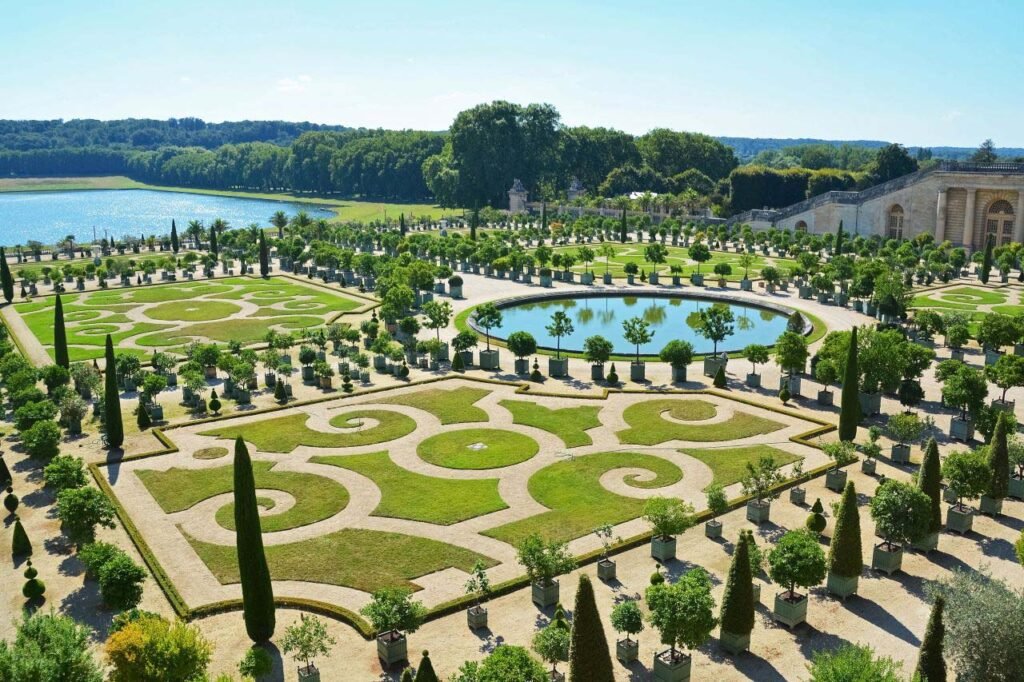
    The French Garden style is a formal type with the concept of order over nature. The garden follows a cool and calm, symmetrical style, with every element arranged in an orderly fashion.

    The epitome of this mathematical approach is the gardens at the Palace of Versailles. The gardens were planned but nowadays there are a variety of other types like terrace garden design or vertical garden.

    Characteristics

    • A neat garden space considering the perspective and optics principle.
    • A terrace overlooking the garden
    • Vegetation is organised and is directed in a pattern. The trees and flower beds are at a particular height and trimmed.
    • The flower beds are in a geometric shape like oval or rectangular to make it look neat from the interior or terraces
    • Stone garden elements like sculptures, columns or pathways or along the pathways to create a lavish look. Stone elements around the pool or water body to enclose the pool.

    Mughal Garden Style

    This landscape style is inspired by the Persian Garden style and follows a harmony between nature and other elements, forming a mesmerizing landscape. In India, this is the most famous and historic type of garden style inhabiting major important buildings like the Taj Mahal and Rashtrapati Bhavan. The distinguishing feature is of symmetrical rectilinear layout with the axis.

    Characteristics

    • The layout is rectilinear with a central axis following a systematic approach. The approach is rigidly formal with the concept of Char bagh.
    • The vegetation in the central is low will high planters at the periphery, so the focus is clear.
    • Water body is usually running and a dividing element. Another element which is stone chadar , a stone or marble chute.
    • Chabutara is for resting, and baradari is an element with 12 doors for effective air flow.
    • Types of Mughal garden are:

    Tomb garden design

    Terrace garden design

    Palace garden design

    Plain garden design

    Example

    Mughal Garden Style- Rashtrapati Bhavan
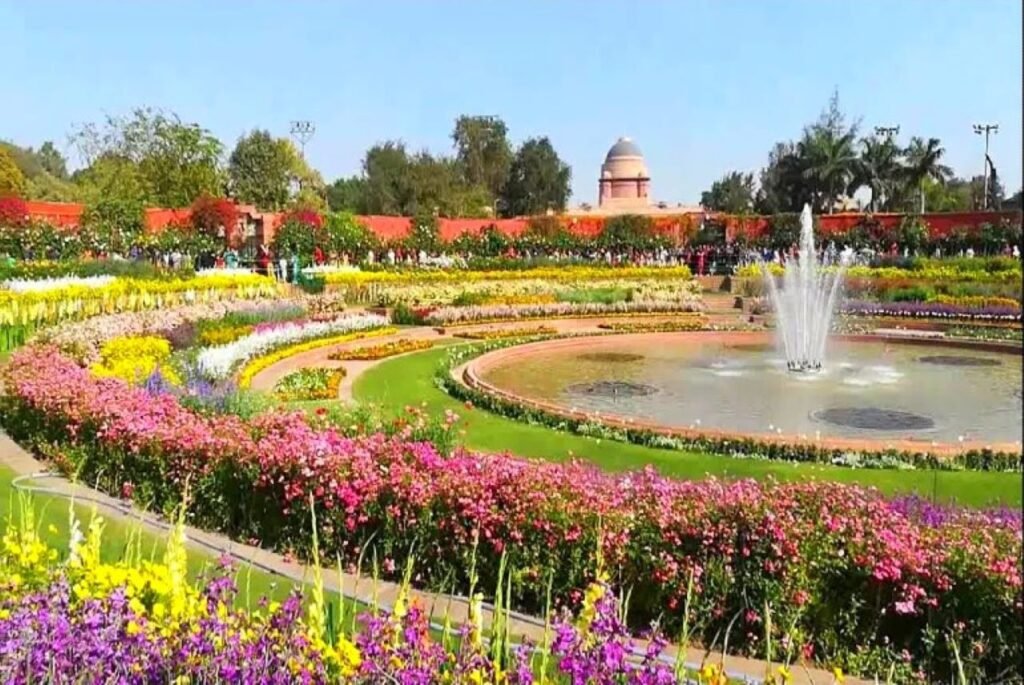
    Mughal Garden Style- Rashtrapati Bhavan

    Pinjore Garden, Panchkula
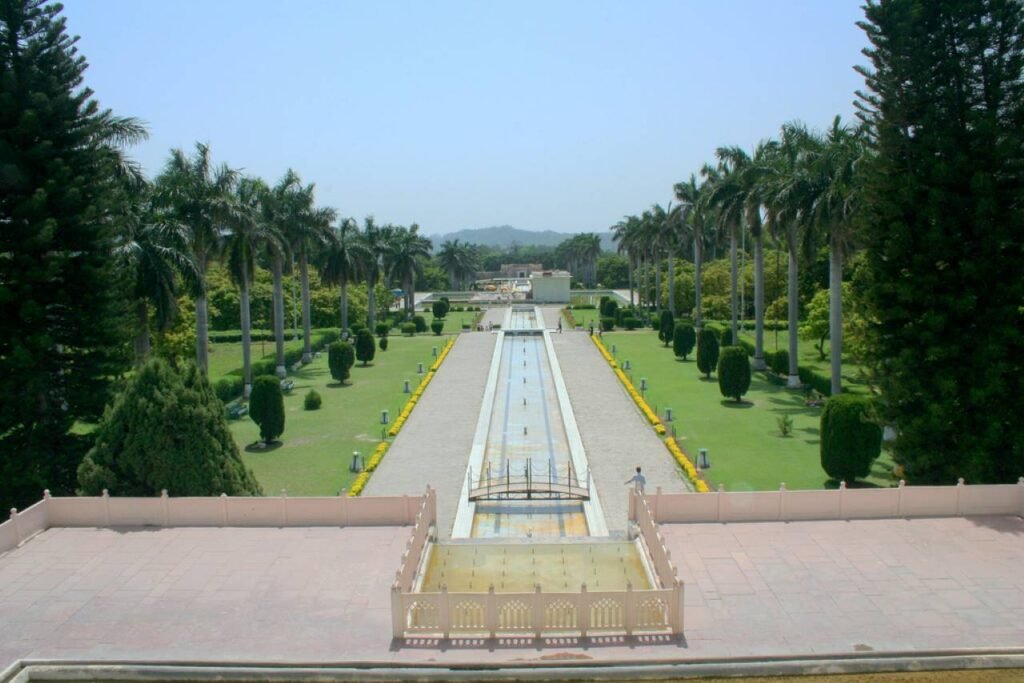
    Pinjore Garden, Panchkula

    Japanese Garden Style
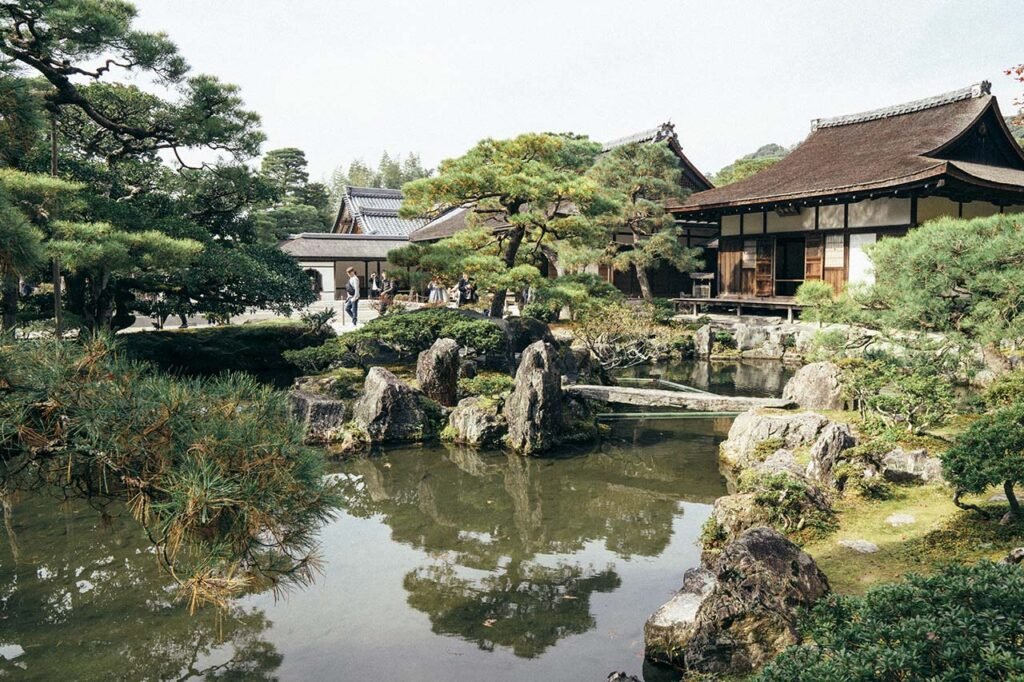
    Japanese Garden Style

    Japanese garden style is based on traditional practices which avoid ornamentation and believe in the natural process. Japanese gardens are highly influenced by the Chinese garden style and Buddhist culture. These can be classified in basic three types:

    • Dry garden-karesansui
    • Tea garden-chaniwa
    • Hill garden-tsukiyama

    Characteristics

    • This landscape style always has a water body, like a pond or fountain or a representation of water by white sand. In Buddhist symbolism, it represents ying and tang , water and stone which compliments and complete each other.
    • In its original form, a dai doro, a stone lantern, which represents the five elements of Buddhist cosmology, is another feature.
    • They are asymmetrical and don’t follow any axis, but are balanced properly and form harmonious complementing features.
    • Stones are integrated into Japanese gardens in a natural form.
    • Rock, sand and gravel are an essential feature, which represents Mount Horai or Mount Sumeru

    Chinese Garden Style

    The key concept is to form a harmony and relationship between nature and man. The Chinese garden style landscape is connected with zig zag pathways and creates a sense of curiosity with new scenes slowly unfolding like a series of paintings.

    Characteristics

    • Bridges made of timber, wood or stone slab are an essential feature which are zig zag and also called nine-turn bridges.
    • The central element is the pond with lotus flowers and a viewing pavilion .
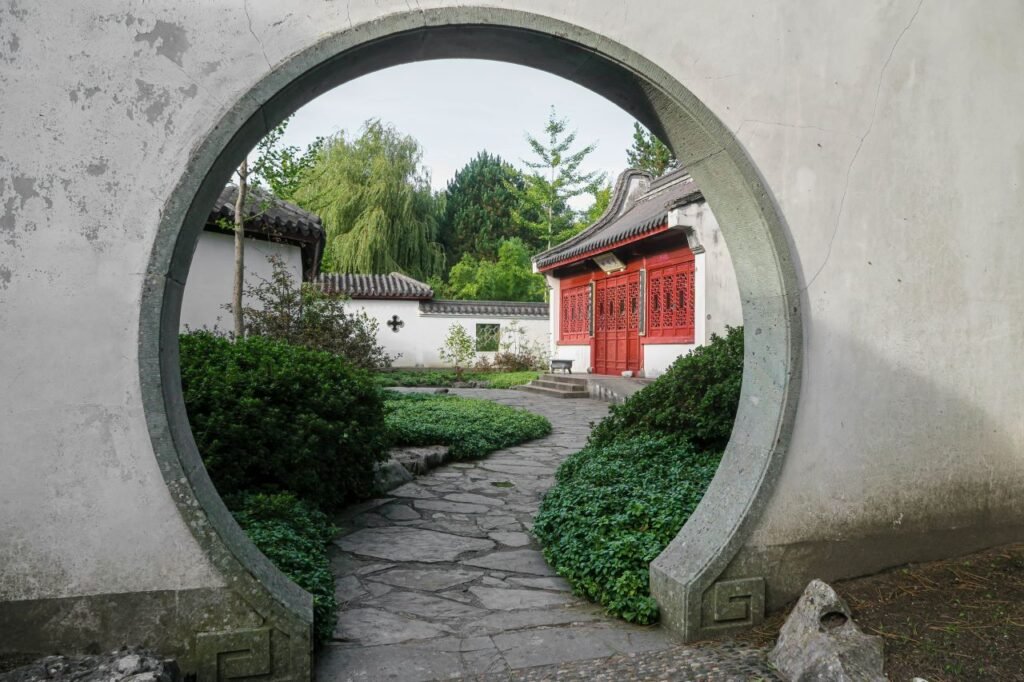
    • Moon gate, which is at the entrance or in between the pedestrian pathways, is a semicircular gate and has a different spiritual meaning for every tile on the gate.
    • Borrowed scenery that incorporates background landscape in the composition of a garden.
    House Garden Design

    There can be different garden which can be designed at homes. Depending on the needs and ideas, the house garden design styles can be chosen.

    Vegetable Gardens

    Vegetable garden style has a lot of benefits apart from being aesthetic. It can be grown in a small space and as per the needs of the kitchen. They can be grown with a lot of fun and enjoy the fruits of labor. This can also be an initiative to help save the environment. The vegetables can be grown in containers and one by one.

    Indoor Gardens

    There are different plants which are suited for indoor house garden design. Some may require direct light or indirect light and should be placed accordingly. Some indoor plants are spider plant, money plant or snake plant and many more. They can be placed near the window or used as decor pieces.

    Therapeutic Gardens

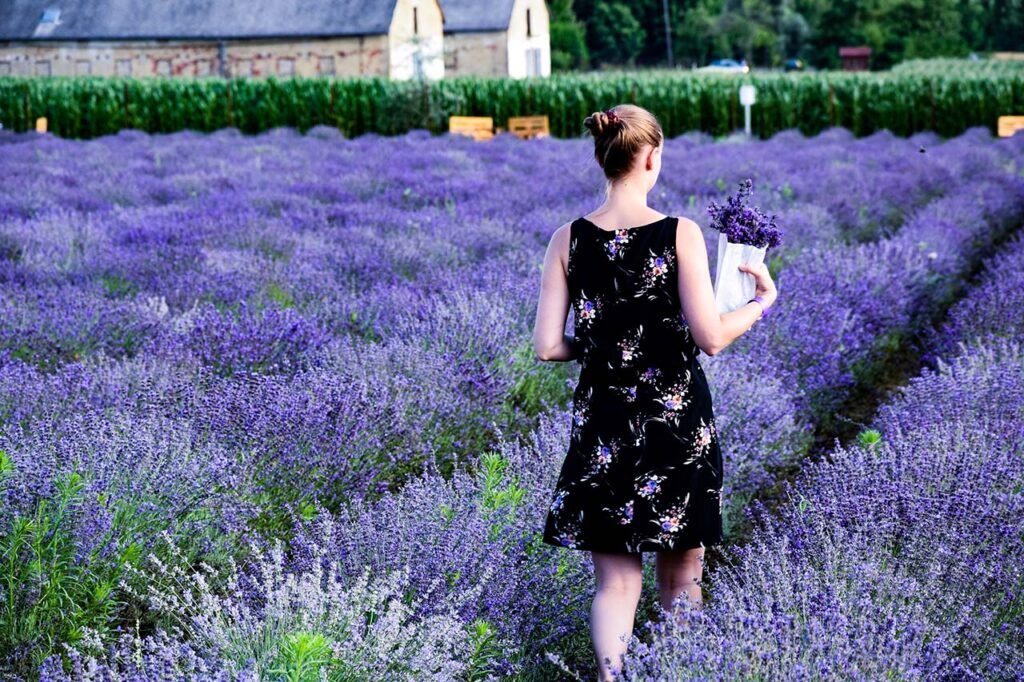
    Gardening, in general, is a very relaxing activity. Each plant has a magic of its own. Some plants like lavender or mint or lemon have the tendency to make the person in the garden relax and these plants are used as anti-depression or anxiety and can be used for house garden design. These fragrances of lavender are used for aroma oil can make a person refresh.

    Succulent Gardens

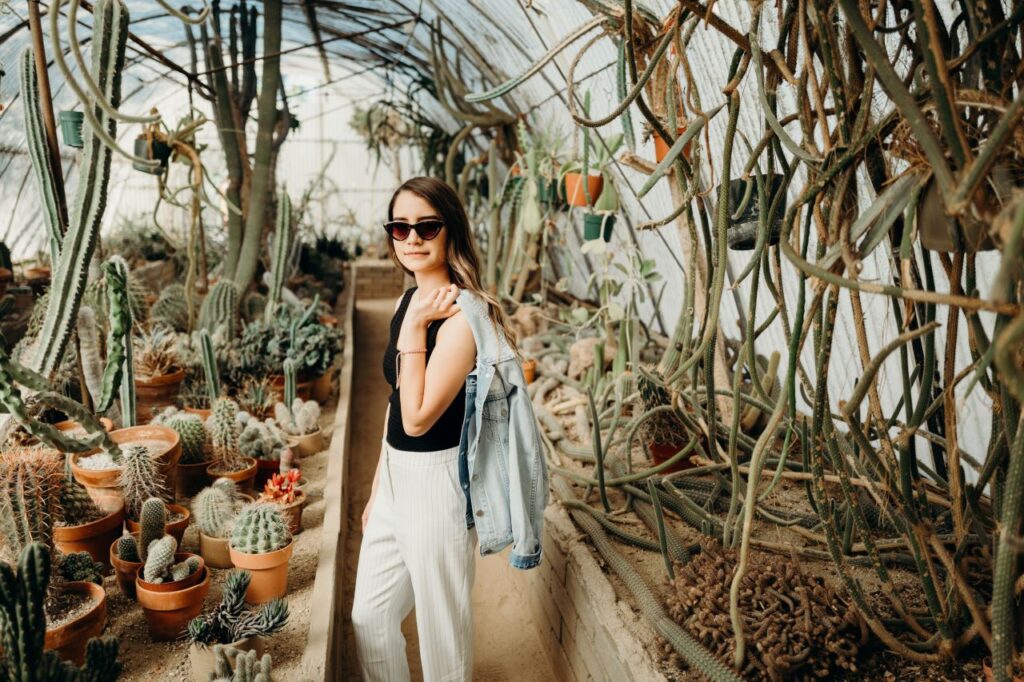
    Succulent gardens are of varied types- outdoor, indoor, potted or even terrariums or even in terrace garden design. These are ideal for warm and hot climates. The key aspect to consider is the type of soil and moisture level in the area. Plants like cacti, jade plant or aloe vera are succulent plants and need about 6-7 hours of sunlight. They are of different sizes, textures and colours.
    Vertical Garden

    Fairy Gardens

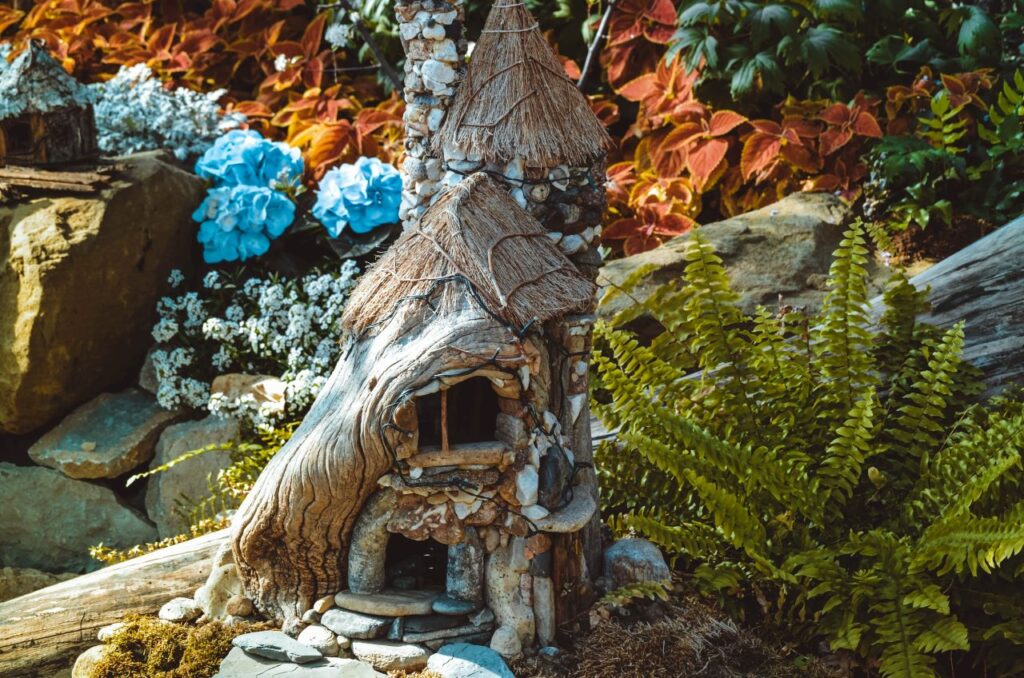
    Fairy gardens are designed in miniature form with diminutive plants and small accessories. These can be designed as indoor or outdoor or terrace garden design plants and can be used as a fun activity for kids.
    Roof Garden Design

    Roof garden or terrace garden can be started by planting in small containers – big or small, or planters or beds and using all kinds of different plants. Elements like patio and seating can be added to make the place better.

    Essence

    Gardening is not just limited to these styles, a home garden design can be a personal space with an individual’s desire and budget. There are multiple types of plants- flowering, seasonal, succulent or indoor, each with their own personality. So, try to mix and match and make your own customised garden and embrace it.
    Essence


  • 7 Incredible Indian Cities that Architects Must Definitely Visit

    7 Incredible Indian Cities that Architects Must Definitely Visit

    India has been a hub for culture and heritage forever. Every part tells a different story, which inevitably binds you in a circle of astonishment. As architects, we have an eye for details, perspective, harmony, and all the other design principles. 

    Indian cities have their own share of mesmerizing beauty to explore. So, as Architects, we are bound to know more about these cities and gain a new perspective.

    Indian Cities for Architects To Visit

    Indian Cities: Ahmedabad

    The heritage of Ahmedabad is a mix of many cultures, each leaving a mark in terms of architecture in the form of bridges, temples, mosques, and others, each belonging to a different period. The architecture of Ahmedabad has evolved over centuries from Mughal architecture to British and Modern structures by famous Architects.

    The pols of Ahmedabad are close-knit community houses with shared spaces like courtyards and narrow lanes. These pols are a must-watch for any architect, they are the essence of Ahmedabad. Sarkhej Roza, Jami Masjid, and Rani ki vav are places that are all built differently but give a sense of calmness intangible aspects. 

    Ahmedabad is not just rich in historic monuments but also is famous for modern architecture by Louis-I-Khan, Charles Correa, Balakrishna Doshi, and many more. IIM Ahmedabad, Amdavad ni Gufa, Sabarmati riverfront, Gandhi Ashram, NID, CEPT, and newly constructed Narendra Modi Stadium are other places that will give a lot to learn from.

    Mandu

    Mandu, a city in Madhya Pradesh, is most famous for its forts and temples which illustrate a story of their own. Jahaz mahal is the most popular fort there which is situated near a lake and has large terraces overlooking the lake. 

    Mandu is also famous for Rani Roopmati’s pavilion with the unparalleled vision of River Narmada. Other places to visit to gain a knowledge of stone as a material and building large corridors, terraces and heighted space to gain a perspective of scale and proportion are Dilawar Khan’s Mosque:,Baz Bahadur’s Palace,Hindola Mahal,Bagh Caves and Jami Masjid.

    Jaipur

    Jaipur ‘ Pink city of India ‘ got this name because of the hospitality and the terracotta stone used for construction. Jaipur at large represents how tangible and intangible aspects go hand in hand while designing.

    Also, the concept of Vastu shastra and a well-planned city is popularized from here. While in Jaipur one gets to picture the royalty and luxuries life of the Rajas, the large rooms and intricate carvings are what make the mahal and forts centerpiece of attention.

     Jaipur not only is detailed and extravagant, but also every element is well thought. For instance, the window, lintels or even the space between buildings is conceptualized according to climate. 

    The most famous place to visit is Hawa mahal, which gives a peek into the life of kings and queens. The Jawahar Kala Kendra by Charles Correa can be considered as the heritage inspired modern day architecture.

    Hampi

    Hampi has been described by UNESCO as an “austere, grandiose site” in Karnataka. It is rich in historic structures which include forts, riverside features, royal and sacred complexes, temples, shrines, pillared halls, mandapas, memorial structures, water structures and others. 

    Group of monuments in Hampi is Vijayanagar style and is made with granite primarily. Vijaya Vittala Temple is the most iconic and is in the form of chariot, and has gained the maximum popularity amongst the other monuments.

    Achyutaraya Temple, Hanuman Temple, Badava Linga Temple and many others are made from stone, but the space in the temple which attracts the most is the mandapas. The mandapas have many columns and give a pleasant background for photos. The carvings and textures are what will attract an architect at first glance.

    Udaipur

    Udaipur-City of Lakes , is a blend of nature and built form and is for those who love to work in harmony with nature. The presence of the lake not only provides an aesthetic picture but also keeps the climate in check, providing an automatic coolness to the neighboring areas.

    The town is filled with palaces near the lake which are now turned into resorts favorable for destination weddings or outings on weekends from nearby areas. The most famous palaces are near Lake Pichola. Udaipur also has some temples and Havelis with a courtyard, giving a poetic sense to Udaipur.

    Lavasa

    Lavasa is a hill station near Mumbai and not a very famous one. Architects interested in sustainability will find Lavasa a live case study for the same. The principle to design is new urbanism i.e  “Walk to Work”, “Walk to School” and “Walk to Park” become reality with non- polluting industries and ecological tourism.

    The concept of design is formed by working with biologists with biomimicry. The city’s rooftops are inspired by the morphology of the native banyan fig leaf.

    The Western Ghats region is prone to seasonal flooding from monsoons and a strategy based on ant nests has been adopted to channel water through the city. This efficient plan is inspired by the local harvester ants that divert water away from their nests through multi-path, low-grade channels. Further, water has been stored in networked building foundations, much like tree roots.

    Lavasa

    Auroville

    Auroville situated near Pondicherry is an experiential town where once a desert is now a habitable town. The town is filled with people looking to explore in their life and so it is reflected in the city’s architecture and culture.

    The Matrimandir Temple, designed by Roger Anger, is the soul of the city. From form till the planning and garden surrounding the golden sphere, every thing is considered from deep within. The name ‘Matrimandir’ means literally ‘Temple of the Mother’.

    The construction practice in Auroville is completely different from other cities. The work, whether small or big, is done in vernacular architecture and the aim is to follow ecological practices like rainwater harvesting and using solar panels. Every structure feels as if it is protruding from the earth. 

    Some other places which can be visited are Chandigarh, Leh Ladakh, and Delhi. It is rightly said by Arundhati Roy,” India lives in several centuries at the same time.”

  • Biomimicry Architecture: A Unique Art of Mimicking

    Biomimicry Architecture: A Unique Art of Mimicking

    Biomimicry Architecture is a technical approach to analyzing, observing, and taking inspiration from nature to create designs in various fields of art and architecture. The terms biomimicry and biomimetics come from the Greek words bios, meaning life, and mimesis, meaning to imitate.

    It is believed that for all challenges the world is facing today, nature is the solution. Janine Benyus in her ted talk ‘biomimicry in action’ said, “When we look at what is truly sustainable, the only real model that has worked over long periods of time is the natural world.”

    Biomimicry architecture

    History

    The term biomimetics first came into existence in the 1950s by American physicist and inventor Otto Schmitt. But even before this humans have been observing nature and creating wonders from it. For example, the flying of birds was the inspiration for the Wright brothers, which led to the creation of airplanes. Another example of biomimicry architecture is rock-cut architecture, caves have been used as shelter and sown the seed of Indian Buddhist temples and carving into caves and mountains.

    In 1997, the book Biomimicry: Innovation inspired by nature by Jenine Benyus not only explained the term biomimicry but also provoked the minds of designers. This concept has been in use for a very long time. In fact, the concept of the Golden Ratio is seen in nature’s way which led to the golden ratio in architecture as well. The most famous example is the Great Pyramid of Giza in 2560 BC. Also, many Architects modern today are returning to the ancient method of the golden ratio in architecture for better prom[ortions and aesthetics.

    Golden Ratio
    Golden Ratio

    How Biomimicry Has Shaped Our Buildings

    Biomimicry can take many paths. There are many challenges like climate change, construction, and demolition waste, depletion of resources, and others that have led the world to take solutions from nature.  Biomimicry architecture refers to researching and executing construction by the strategies found in the natural environment that can be converted to sustainable solutions for shaping our buildings.

    Architecture

    In Architectural history, biomimicry is not a recent concept but buildings were inspired by nature throughout the early years also. The east gate center, a mid-rise complex in Harare, Zimbabwe follows the strategy of passive cooling i.e uses only 10 percent of energy compared to other conventional buildings. This strategy was studied by the termites’ ability to maintain constant temperature and humidity in their mounds despite the varying temperature from 1.5 degrees C to 40 degrees C. It is not mandatory for the form to be the same i.e follow biomorphic architecture.

    Architecture

    Construction

    Due to the development along the coastline, marine life and the natural ecosystem suffer serious stress. The residents along the coastline face the major issue of rising sea level and inevitable changes in weather along the coastline which has led to retrofitting, creating barriers along the line, and turning to energy efficient buildings. But this has a negative impact on marine life from the materials like concrete which is used majorly in the development process.

    ECOncrete is inspired by the oysters and other marine organisms which build underwater cities which grow. ECOncrete supports natural processes like calcification which in turn helps the concrete to gain strength and withstand harsh conditions. They have also tried to inculcate biomorphic architecture for organisms. The growth of these organisms also acts as an active carbon sink, offsetting a large amount of carbon footprint.

    organic architecture
    EConcrete

    Energy Efficiency

    Scientists at Princeton University have created a biomimetic solar cell design inspired by the folds and wrinkles on leaves. They have used relatively cheap plastic which generates 47 percent more electricity than the same type of solar cells with a flat surface.

    The team used ultraviolet light to cure a layer of liquid photographic adhesive, alternating the speed of curing to create both shallower wrinkles and deeper folds in the material, just like a leaf. Biomimicry is not just limited to organic architecture but has paved its way to energy-efficient buildings too.

    Energy Efficiency
    Source

    Other Types of Bio-inspired Design

    The factor that differentiates is the design approach and functional challenges. Bio-inspired design is taking ideas from nature it can be done in three ways

    other Types of Bio-inspired Design

    Biomorphic Architecture

    Biomorphic architecture refers to designs in which the form is inspired by nature i.e they look like nature. It is appealing to watch as it is taken from nature. The most famous example is of Lotus Temple in Delhi which as the name suggests is in the form of the flower lotus.

    Biomorphic Architecture
    Photo by Jovyn Chamb on Unsplash

    Bio-utilization

    Bio-utilization is the process in which natural products are used in the construction of structures.

    This can be a useful method for sustainability and energy efficiency while biomorphic architecture may or may not be. Aiming to reduce carbon emissions in masonry manufacturing, bioMASON grows brick. The company’s process uses bacteria that alter the pH balance of the surrounding aggregate material, allowing calcium carbonate to grow and bind the material together with little to no carbon emissions similar to coral reefs.

    Bio-utilization
    Source

    Three Levels of Biomimicry Architecture

    Organism Level

    The form, shape, or pattern of the building is inspired by the organisms or natural elements to create organic architecture. Gherkin tower which was designed by Norman Foster has a hexagonal skin on the exterior which is derived from Venus Flower Basket Sponge. The lattice-like exoskeleton of this organism and round shape help fight the underwater stresses or current.

    Behaviour Level

    In this, the building mimics the process or how the element interacts with the environment in practice and creates masterpieces. Golden ratio in architecture can be used for aesthetic purposes, it has now become a process but forms are derived from it. The Qatar Cacti Building is inspired by how cactus interact with the environment and then designed according to how it survives in the hot and dry climate and executing with the same principles.

    Ecosystem Level

    This is not just executed on a building level but on a larger scale and mimics how each component works in an ecosystem to bring out a successful entity. Taking inspiration from banyan fig leaves the challenge of seasonal flooding in Lavasa city. The foundation is also made in a way to fight excess water and create energy-efficient buildings.

    Examples

    Morarjee Textiles, Nagpur

    A Nagpur-based factory, Morarjee Textiles which aims to address both human and environmental challenges to create an organic and energy efficient building designed by Exploration Architecture, a UK-based company.

    For the design of the building, the team took inspiration from nature. Exploration architecture who specializes in biomimicry architecture took ideas from biologies such as Euplectella glass sponge or the Venus flower basket, which is used for the structural members like steel columns and trusses.

    As the aim of the team was to design sustainable and energy-efficient buildings with natural light, the roofing material used is profiled aluminum which has many advantages like, lightweight and decreases the cost of the structure. The products of the textile firm are zero waste and so was their aim to construct the factory this inspiration was drawn from the ecosystem.

    Morarjee Textiles, Nagpur
    Morarjee Textiles, Nagpur
    Morarjee Textiles, Nagpur

    Sahara Forest Project, Tunisia

    Exploration Architecture is a firm working on biomimicry architecture and this project Sahara Forest is inspired by natural processes to tackle the issue of creating habitat areas in arid regions of the Sahara. It’s an ambitious project to create harmony with nature by learning from nature for a step towards organic architecture.

    The inspiration is from Namib beetles, which condenses the humidity and gathers tiny drops of air to form large droplets from the shape of its exoskeleton so as to gain water and survive. A similar kind of process is used in arid regions to gather vegetation and other forms of line.

    The complex is self-sufficient and can obtain water by extracting air through a system of grilles and condensers on the roof making it an energy-efficient building.

    Sahara Forest Project, Tunisia
    Sahara Forest Project

    Beijing National Stadium , Beijing

    This Beijing National Stadium or Birds nest is designed by Swiss architects Herzog and De Meuron. This is one of the famous examples of biomimicry architecture principles. The idea for this came from the structural strength and complexity of a bird’s nest.

    The random pattern made of steel structural members depicts the twigs and is made using advanced geometric patterns to establish compact nature. The outer facade is wrapped around a sitting bowl. 

    The challenge was to design a stadium to withstand all weather conditions in a sustainable manner, be compact in nature to accommodate the audience as close to the arena as possible, and lastly to be earthquake resistant. The bird’s nest has twigs and filler between spaces to withstand harsh conditions. Similarly, steel is stuffed with fillers called inflated ETFE cushions.

    These fillers are added to the roof, sides, and inside to make the stadium rain and windproof at the same time to provide natural ventilation aiming for an energy-efficient building.

    Beijing National Stadium, Beijing
    Beijing National Stadium, Beijing
    biomimicry
    Photo by Luke Brugger on Unsplash

    The Future of Biomimicry

    The relationship between man and nature has transformed drastically. In primitive times, this relationship was inseparable, and slowly with time this bond has deteriorated, but once again man is learning the essence and importance of nature for its own survival. From golden ratio in architecture to organic architecture, every step has emerged from nature.

    Biomimicry architecture is not just limited to architecture but also is dedicated to multidisciplinary fields and is making progress in all. Each new challenge cannot be just tackled with technology, looking up to nature as a mentor and collaborating with various teams of engineers, scientists architects and environmentalists will help gain a potentially positive and sustainable bond.

  • Dubai Expo: An Event of Innovation, Technology and Arts

    Dubai Expo: An Event of Innovation, Technology and Arts

    World expo, officially called International Registered Exhibitions, is where people from all over the world gather to find solutions or innovative technologies for challenges or problems. This happens with a gap of five years, with 192 nations as participants. In simple words, it is an international exhibition of food, culture, technology, sports, architecture, and literally everything. This year, the Dubai Expo has been organized in from 1st October 2021 to 31st March 2022.

    History of Expo

    The first World Expo was hosted in London in 1851 and the concept was appreciated there and since then it is happening in 5 years. The BIE-Bureau International des Expositions was created in 1928 to regulate the events. The expo is held for 6 months in host nations. Till 2021, in total 34 world expos have been organised, which gave the world immense new innovations in each theme.

    The world expo originated in the time of the industrial period in Britain and was held in London’s Crystal Palace.

    Dubai expo

    Some famous inventions at World Expo

    Telephone by Alexander Graham Bell in 1876 at Philadelphia’s Centennial Exposition of Arts

    Heinz tomato ketchup in 1876 at Philadelphia’s Centennial Exposition of Arts

    Coffee percolator in 1855 in Paris

    The Eiffel Tower in 1889 at Exposition Universelle in Paris

    Eiffel tower

    Ferris wheel World’s Columbian Exposition in Chicago 1893

    X-ray machine 1901 Pan-American Exposition, in Buffalo, New York

    Ice cream cones in 1904 St Louis World Fair

    Hot dogs in 1904 St Louis World Fair

    TV broadcasting 1939 World Fair in New York

    Air conditioning 1939 World Fair

    Hydrogen-powered car Hanover Expo in 2000

    Dubai Expo 2021

    Bureau International des Expositions (BIE) on 27 November 2013 selected Dubai as the host to conduct the expo, but unfortunately because of covid-19 it was postponed from 20 October 2020 to 10 April 2021 to 1 October 2021 to 31 March 2022. But the name has the year Dubai 2020 for branding.

    The theme for the year 2020 is ” Connecting Minds, Creating the Future”, and the sub themes are, Opportunity, mobility and sustainability, each with its pavilion designed by AGi Architects, Foster and Partners and Grimshaw Architects, respectively.

    The site for the Dubai Expo is 438 hectare and is between the cities of Dubai and Abu Dhabi. The site plan is designed by the American firm HOK, is organised around a central plaza, named Al Wasl, with three themes: Opportunity, Mobility and Sustainability.

    Dubai expo

    Pavilions at Dubai Expo 2020

    Trending Pavilions at Dubai Expo 2020

    Terra – The Sustainability Pavilion

    Designed by Grimshaw Architects, Terra aims to create awareness about real life solutions to real-world problems. This pavilion inspires to fight for climate change, reduce carbon footprint and make an environmental impact in architecture and design.

    There are 4912 solar panels, 18 energy trees, and a 130 metre wide canopy which generates 4GWh of alternative energy. Also, for water treatment, innovative irrigation techniques, including a grey water recycling system, aim to reduce water use in the landscape by 75 percent.

    Sustainability Pavilion

    Mission Possible- Opportunity Pavilion

    This pavilion architecture and design is done by AGi Architects aims to connect age, language and culture, and celebrate our shared human experiences.

    Opportunity Pavilion

    Alif- Mobility Pavilion

    Designed by Foster + Partners, features worlds largest passenger lift, which will transport 160 plus people at a single time. The pavilion also stars a partly underground, partly open-air 330-metre track for you to see innovative mobility devices in action.

    Mobility Pavilion

    Singapore

    Pavilion designed by WOHO architects, with the concept of Themed Nature. Nurture. Future. It is a plant filled pavilion depicting a city of nature through smart and sustainable urban solutions and infrastructure development.

    The areas are ground garden, featuring city cone, rainforest cone and flower cone surrounded by canopy walks. And the first floor comprises a sky market.

    The focus for the Singapore pavilion is sustainability. It aims to have minimal impact on the environment and architecture industry and thus aims for net- zero energy throughout the event. The energy demands are covered by 517 solar panels on the roof, the groundwater drawn on site is desalinated through reverse osmosis, thus having a closed loop water system.

    The food produced in restaurants is processed through eco digester and waste is recycled. This reduces off-site transportation for recycling and saves energy as, through these processes, rooms do not need air-conditioning showcasing infrastructure development.

    Singapore Pavilion

    Russia

    The theme for the Russian pavilion in Dubai expo is Creative Mind: Driving the Future and comes under mobility. The focus is on the human brain, the most complex phenomenon. The show revolves around the theme- “The mechanics of a miracle” presented by a multimedia show. The author of the idea and design of the main exposition of the Russian pavilion is Simpateka Entertainment Group.

    The dome-shaped structure in architecture and design comprises multi-coloured tubes- threads with a combination of bright colours, giving the feeling that there is no beginning or end. This depicts the endless process of brain and nerves, and the unstoppable movement and progress.

    Russia Pavilion


    UAE

    The pavilion in Dubai expo is in the opportunity district, designed by Santiago Calatrava. The building depicts a falcon bird, which is the national bird of UAE. It is a four- storey pavilion with falcon’s wings made of locally produced carbon fiber, and it can open or shut the wings to shelter roof solar panels.

    The entire roof can open in three minutes. The architecture and design concept is of the power, flow of falcon and channelised this for technological innovation to create a balance in architecture design and structural stability.

    UAE Pavilion

    India Pavilion at Dubai Expo

    The India pavilion designed by C P Kukreja, with the concept लोका: समस्ता: सुखिनो भवन्तु (Lokah Samastah Sukhino Bhavantu), which means, “May everyone, in the entire world, be happy.” The theme is Openness. Opportunity. Growth. It is a four- floor pavilion with Ayurveda, Yoga, space programme, culture, entertainment, infrastructure development and future opportunities.

    The facade showcases ‘ India on the move’ with its 360 degree rotating panels. There are 600 panels, a mosaic that will present 75 years of history to the expo by kinetic facade.

    The India Pavilion in World Expo also hosts an amphitheatre, conference rooms, state pavilions, restaurants, souvenir shops, and much more.

    India Pavilion

    Al Wasl Dome- The Central Pavilion

    The central pavilion connects the three thematic districts and acts as a focal point. The plaza is designed by US-based firm Adrian Smith and Gordan Gill Architecture industry. The lattice framework is the 3D of the symbol of Expo 2020 and is made from 13.6 kilometres of steel. The dome is 130m wide and 67.5 metre tall and weighs 2,544 tonnes.

    The Al Wasl Dome acts as an urban room and will remain in Dubai after the expo and will host multipurpose, large-scale events. The dome transforms to a 360 degree projection surface with projections depicting the infrastructure development.

    Central Pavilion

    After Dubai Expo 2020

    After the 6 astonishing months of the Dubai expo, District 2020 will redevelop 80% of the Expo’s infrastructure and surroundings. The Expo will be renamed “Human Centric City of the Future” and will become a city on its own which will accommodate 145,000 people.

    Some buildings will remain unchanged like the UAE pavilion or the sustainability district – terra will become a center for child and scientific education. Dubai will promote the soul of the World expo connecting minds, creating the future, and will be a step towards sustainability fulfilling its mission of mobility, opportunity, and sustainability. 

  • Pune Metro: Environment Friendly and Effective Metro in 2022?

    Pune Metro: Environment Friendly and Effective Metro in 2022?

    With an increase in population in various developing cities in India, the National Metro Rail policy of 2017 has advised to go for MRTS (mass rapid transit systems) in cities with a population of over 20 lakhs. With more and more people coming out from small towns in search of jobs, there is a need for more and better public transport. Using private vehicles for long distances leads to congestion and a rise in pollution. This has made India invest in MRTS and other public transport. In this article, the focus is on the Pune Metro Transit system.

    India and Its Metro Projects

    Interesting Facts about Metro Rail Project:-

    • Oldest Metro Rail System: Kolkata Metro
    • Newest Metro Rail System: Nagpur and Pune Metro
    • Largest and Busiest Metro System: Delhi Metro (347 km)
    • Smallest Metro System: Ahmedabad Metro (6 km)
    • Lucknow Metro is the most expensive metro rail project in Uttar Pradesh and started in 2017
    • Kochi Metro: It also got completed recently. 
    • Hyderabad Metro: It got operationalized in July 2017. 
    • Some proposed and upcoming metro projects are Patna, Bhopal, Indore, Meerut, Guwahati, Chandigarh, Vijayawada, etc.
    Pune Metro: Environment Friendly and Effective Metro in 2022? With an increase in population in various developing cities in India, the National Metro Rail policy of 2017 has advised to go for MRTS (mass rapid transit systems) in cities with a population of over 20 lakhs. With more and more people coming out from small towns in search of jobs, there is a need for more and better public transport. Using private vehicles for long distances leads to congestion and a rise in pollution. This has made India invest in MRTS and other public transport. In this article, the focus is on the Pune Metro Transit system. Pune Metro,public transport

    About Pune MRTS

    Over the past few years, Pune has evolved in terms of education, IT parks, research, and development, all this considering sustainability in mind. With expansion and migration there comes a need for a properly planned and executed metro rail system for ease of transportation.

    Pune Metro along with Nagpur metro is the greenest and most environmentally friendly metro in India.

    Pune metro is divided into 3 phases:

    Line One   

    The first phase(North-South Corridor) or first-line covers 17.4 km. This line is 6km underground and 11.4 km elevated, in which it covers 8 underground stations and 9 stations on elevated ground that’s 14 stations. This line is implemented by Maharashtra Metro Rail Corporation Limited (MahaMetro), the same as Nagpur Metro.

    Purple color is chosen to denote this line, which symbolizes the valor, power, and dedication of the Punekars along with the industrial areas of Pimpri- Chinchwad.

    Line Two

    Second Phase (West-East Corridor) or line two covers 15.7 km and 16 elevated stations in total. The colour blue, or Aqua, denotes this line, which stands for truth and confidence. Also, this route passes through 2 rivers-Mula and Mutha, therefore the name Aqua line. This line is also implemented by Maharashtra Metro Rail Corporation Limited (MahaMetro).

    Pune Metro: Environment Friendly and Effective Metro in 2022? With an increase in population in various developing cities in India, the National Metro Rail policy of 2017 has advised to go for MRTS (mass rapid transit systems) in cities with a population of over 20 lakhs. With more and more people coming out from small towns in search of jobs, there is a need for more and better public transport. Using private vehicles for long distances leads to congestion and a rise in pollution. This has made India invest in MRTS and other public transport. In this article, the focus is on the Pune Metro Transit system. Pune Metro,public transport

    Line Three

    Started in 2018 by the prime minister, it will cover 23 elevated stations and a distance of 23.3 km. This line is by the Pune Metropolitan Region Development Authority (PMRDA) and the joint venture between Tata Realty and Siemen.

    In total 54.58 km length is covered with 53 stations, from which Line 1 and Line started in 2022, but line 3 is expected to begin in 2023.

    Unique Points About Pune Metro

    • The Pune metro is 15th of India and 3rd in Maharashtra.
    • Pune Metro is India’s first metro with an aluminum body metro train.

    The advantage of using an aluminum body is that it is anti-corrosion which will increase the life of the coaches to nearly 40 years. 

    Also, the weight of the coach decreases, which helps to increase the speed of the metro by making it light. 

    Another advantage is lower haulage cost, better fuel efficiency, and low carbon emission compared to steel counterparts.

    These can be manufactured in less time, which escalates production.

    These aluminum coaches are made in Kolkata by Titagarh Wagons(Firema) Limited and are 2 tonnes lighter than average coaches.

    • Also, 2 Independent metro lines were started on the same day, which took 5 years to complete.

    Environmental Factors

    During the construction process, minimum harm is done to the eco-sensitive areas of Pune

    • Pune Metro has transplanted 2,267 trees falling in alignment by innovative root ball technology- this is a process used for repotting plants.

    Other than this, for afforestation, 6300 trees are to be planted which is equal to a reduction of 130 tonnes of CO2 per year. 

    • Grid-connected solar energy

    On the rooftops of elevated stations, boundary walls, and depot solar panels are installed, which will generate electrical energy. This energy will be utilized in stations and traction power for the running of trains. 65% of the electrical energy demands will be met by solar panels.

    Pune Metro: Environment Friendly and Effective Metro in 2022? With an increase in population in various developing cities in India, the National Metro Rail policy of 2017 has advised to go for MRTS (mass rapid transit systems) in cities with a population of over 20 lakhs. With more and more people coming out from small towns in search of jobs, there is a need for more and better public transport. Using private vehicles for long distances leads to congestion and a rise in pollution. This has made India invest in MRTS and other public transport. In this article, the focus is on the Pune Metro Transit system. Pune Metro,public transport
    • Innovative and sustainable construction practices
    • The C&D waste (construction and demolition waste) is recycled to the maximum.
    • Using fly ash. Fly ash is a supplementary cementitious material, which is a byproduct of coal-fired power stations. According to IGBC, the use of fly ash materials gains the project maximum points.
    • Using curing compound- a substance that is mixed in concrete to reduce the loss of water or heat for proper curing so that the concrete gains strength.
    • The proper drainage system, for effective recycling of water.
    • Pune Metro project, including the stations, is planned to keep in consideration the IGBC platinum rating system.
    • As for water efficiency, rainwater harvesting, reuse of treated water for horticulture, and flushing with proper monitoring are planned.
    • Various other factors like using eco-friendly refrigerants, energy-efficient pumps, proper orientation of stations for natural daylight and ventilation, and highest rating (BEE) energy-saving appliances are executed to make this project more suitable for sustainability.
    • Consideration of reducing air pollution is also done.
    • Using the metro will decrease vehicular traffic by approximately 60000, which will help to reduce the consumption of fuel.
    • New Austrian Tunneling Method (NATM) was incorporated as the cut and cover method was not possible because of congestion.

    The philosophy for this method is to use the strength of the surrounding soil to the greatest extent possible to strengthen the tunnel structure. You can read more about this here.

    Pune Metro: Environment Friendly and Effective Metro in 2022? With an increase in population in various developing cities in India, the National Metro Rail policy of 2017 has advised to go for MRTS (mass rapid transit systems) in cities with a population of over 20 lakhs. With more and more people coming out from small towns in search of jobs, there is a need for more and better public transport. Using private vehicles for long distances leads to congestion and a rise in pollution. This has made India invest in MRTS and other public transport. In this article, the focus is on the Pune Metro Transit system. Pune Metro,public transport

    Conclusion

    As of now, being a few months since the inauguration of Pune Metro, it feels like a boon to Punekars, but each mass level of construction comes with both pros and cons. During the land acquisition or in the process of construction, there might be some issues faced by the residents. Here, at present, the positives are more than the negatives impacts.

    “Clean public transport is top priority for Modi Govt.  The number of cities with metro rail increased to 18 from 5 in the last 5 years. The aim is to increase it to 25 cities by 2025, “said on Nov 2, 2021, at UN Climate Change Conference (COP26)”, says PM Narendra Modi.

    India is growing at a rapid pace, metro or other public transport are not a luxury anymore but need of the hour. But, with this rapid growth in construction and constant development, thinking and execution through sustainability, considering the harmful effects of climate change, is not an option anymore. 

  • Architecture in Extremely Hot and Dry Climate

    Architecture in Extremely Hot and Dry Climate

    Understanding the climatic conditions of a region is very beneficial to the designers and the occupants. Each region has its own list of elements and conditions which should be thought upon before effective designing. In this article, the measures to be taken for effective analysis and planning in hot and dry climates are covered.

    The knowledge of climatic conditions will enable the Architect to select the wall thickness, roofing, materials, size of the openings, and other features to effectively control the amount of solar radiation coming through. 

    Characteristics of Hot and Dry Region

    • The temperature in these regions ranges from  27 and 49°C and 22 deg C at night
    • Humidity is moderate to low, with clear-skied most of the time
    • The low humidity means less rainfall and therefore less vegetation in the region
    • The wind flow is minimal but when there it’s hot and dusty.

    Architectural Measures

    The factors that should be adopted to prevent solar radiation should be considered at all levels of planning, construction, and maintenance.

    Orientation and Form

    The planning should be compact, and under one roof to avoid a lot of movement, which can cause unnecessary thermal loading and discomfort to occupants. The orientation of the longer side facade should be North-South, as the solar radiations are less harsh than East or West. The sun moves from east to west, therefore the sun’s rays are at a maximum in this direction.

    The concept of planning in context with climate is seen in traditional times. Jaipur comes under a hot and dry climate, the Havelis were designed close to each other with narrow lanes, for an effective flow of wind as hot air when passed through narrow lanes cools the flow. 

    Shading

    The shading is an essential part of hot and dry climates, unlike warm and humid climatic zones.

    Shading of roofs, openings, and open spaces should be effectively enclosed with low thermal capacity materials

    Also, the shading of openings in Havelis of Jaipur, be it courtyards, doors, or windows, was done in a beautiful manner. Jharokha windows were effective to block the harsh sun rays but allow cool air to enter inside.

    Another method that is popularly used is the double roof, in which two roofs are constructed. The material for both should be reflective to prevent infrared rays. Due to this double roof, the inner roof is prevented from the rays and a large number of harsh rays are absorbed by the outer roof.

    Wall Surface

    Thick exterior walls are ideal choices for hot and dry regions as this decreases the transmittance of sun rays from outside to inside. Cavity walls or double walls can also help to reduce the transmittance time. 

    Dark color surfaces should be avoided as they store the absorbed heat for a time as compared to light coloured wall surfaces

    According to the traditional construction techniques, mud, stone, or brick walls provide good thermal capacity and will prolong the time of heat entering the structure.

    Openings and Ventilation

    Diurnal temperature variation plays a crucial role in planning in dry and hot climate conditions. Diurnal temperature variation is the variation between a high air temperature and a low temperature that occurs during the same day.

    This can be achieved by the difference between temperature and airflow during the night and day.

    During the day, the windows are shut or shutters closed, or even small windows should be used for ventilation. At night when the temperature is less and wind flow is cool, large windows are open to keep the interiors cool.

    Buildings oriented at 45 degrees towards the windward side with broader facades will receive more ventilation, the negative pressure will be increased and an increased indoor airflow will result. For dust-free and cool air ventilation sources should be ducted. 

    Other Techniques to Keep Interiors Cool

    Solar Chimneys

    Solar chimneys are wide, and tall structures attached to the building and work on the principle of buoyancy. The chimney absorbs all the solar radiation falling on the building, thus making it hot and full of warm air. Then this chimney in turn exits out all the hot air inside the building through the principle of the stack effect. It is important that the chimney is insulated from the building itself so that heat gains do not transmit into occupied spaces.

    Architecture in Extremely Hot and Dry Climate Understanding the climatic conditions of a region is very beneficial to the designers and the occupants. Each region has its own list of elements and conditions which should be thought upon before effective designing. In this article, the measures to be taken for effective analysis and planning in hot and dry climates are covered. Pune Metro,public transport

    Using High-Performance Doors and Windows

    Low E glass windows have an invisible coating that reflects infrared rays. These glasses reflect most of what thus keeping the interiors cool. Low E glass or Low emissivity means the ability of a surface to absorb and emit energy in the form of radiation. These glass windows reflect solar radiation but at the same time allow light to pass through.

    Architecture in Extremely Hot and Dry Climate Understanding the climatic conditions of a region is very beneficial to the designers and the occupants. Each region has its own list of elements and conditions which should be thought upon before effective designing. In this article, the measures to be taken for effective analysis and planning in hot and dry climates are covered. Pune Metro,public transport

    Evaporative Cooling

    As hot and dry regions have low humidity, evaporative cooling techniques can be majorly used to keep the structure cool. Inspired by the traditional Indian system, a water body such as a pond or lake is designed in accordance with the wind flow. 

    Evaporative cooling reduces the indoor temperature and also the load on the air conditioner is reduced. A water body in the courtyard or in the way of wind flow can be beneficial in cooling the interiors.

    AHU system or cooling tower is air is precooled and then entered. This process can be done with the help of water sprinklers or water bodies.

    Vegetation

    In today’s architectural world, where technology has advanced so much, vegetation is not just limited to the ground. Roof gardens, Vertical Gardens, or creating different flow patterns through trees to cool the environment are popular as well as effective.

    Architecture in Extremely Hot and Dry Climate Understanding the climatic conditions of a region is very beneficial to the designers and the occupants. Each region has its own list of elements and conditions which should be thought upon before effective designing. In this article, the measures to be taken for effective analysis and planning in hot and dry climates are covered. Pune Metro,public transport

    Vegetation reduces the direct impact of the sunrays and heats up the surfaces by acting as a buffer. It can also be used as a shading device. Roof gardens add to the thickness of the roof, thus increasing the thermal capacity and increasing the time lag.

    Conclusion

    In the time of climate change, it is of utmost importance to adapt to these measures despite being totally dependent on mechanical systems for cooling or heating. As a responsible architect or designer, it is important that the first step before planning should be to understand the site and climatic context and then proceed. 

    These measures may seem small or costly, but in the long run, they will be profitable both for the individual and the Earth.

  • Workplace design: Innovative Use of Office spaces

    Workplace design: Innovative Use of Office spaces

    Introduction

    An adult human being spends on average around 90000 hours at work over a lifetime. The changes in office design depend on the advancement in technology, new career prospects, and the category of people working there. The changes in workplace design have been tremendous in the last decade or so. The offices which we hear in our grandparents’ stories feel like a detention center.

    Traditional Office Spaces

    The traditional office design was on the concept of ‘one for all. During, early 20, s when the workload was at its peak, new technologies emerged, the internet came into play there were few job opportunities and more energetic youth. The work culture was of fixed hours in a cubicle. With the emergence of computers storage units decreased and the spaces became open from what they were in 1999s.

    Workplace design: Innovative Use of Office spaces An adult human being spends on average around 90000 hours at work over a lifetime. The changes in office design depend on the advancement in technology, new career prospects, and the category of people working there. The changes in workplace design have been tremendous in the last decade or so. The offices which we hear in our grandparents’ stories feel like a detention center. Pune Metro,public transport

    Open Plan Office

    Before the covid-19 outbreak offices were working with a new concept of open offices. An open-plan office works on the principle of collaboration or shared office. This type of layout became popular due to increased creativity, and communication. Also, as there were no walls employees became more approachable.

    Architecturally, the shared office concept provided scope for flexible spaces and effective space utilization. But this concept was on the verge of failure as over time studies have shown that this creates a sense of consciousness and causes disturbances which in turn decreases the effective work done.

    The different ways of working include

    TELE-WORKING

    In this type of working the concept of work from home comes into play in which maximum work is done through technology. The communication is conducted through video, calls, or texting.

    HOT- DESKING

    This concept means that Employees effectively share a desk. No individual has an assigned workstation. This way choosing of the desk according to needs is possible. This is possible in a shared office layout.

    WORK-LOUNG

    One of the emerging spaces in the office to increase collaboration and sharing of ideas. These spaces are break-out spaces that are used for multifunction.

    WORK-CAFÉ

    In a work-café working is done in a café without hampering food.

    WORK-CAFÉ
    Photo by Andrew Neel on Unsplash

    Workplace design nowadays is not just limited to confined glass spaces but is elevated to green outdoor spaces or just working at home comfort in PJs.

    Workplace design: Innovative Use of Office spaces An adult human being spends on average around 90000 hours at work over a lifetime. The changes in office design depend on the advancement in technology, new career prospects, and the category of people working there. The changes in workplace design have been tremendous in the last decade or so. The offices which we hear in our grandparents’ stories feel like a detention center. Pune Metro,public transport
    Photo by Andrew Neel on Unsplash

    Importance of Break- out Spaces

    Gen Z and millennials are more inclined towards having flexible working hours and casual work culture. In relevance to this breakout spaces are becoming more essential and prevalent in an office. Breakout spaces are available to employees to unwind from the chaos of work and take a break from the formal layout.

     As the culture of open-plan offices is at a decline these spaces are very helpful to provide collaborations and communications. This also ensures the well-being of the employees.  The offices nowadays revolve around the break-out spaces this is the idea for coworking offices.

    Workplace design: Innovative Use of Office spaces An adult human being spends on average around 90000 hours at work over a lifetime. The changes in office design depend on the advancement in technology, new career prospects, and the category of people working there. The changes in workplace design have been tremendous in the last decade or so. The offices which we hear in our grandparents’ stories feel like a detention center. Pune Metro,public transport
    Photo by Slidebean on Unsplash

    Coworking Office

    A coworking office is so popular and effective, so the question arises how are they thriving so much? The answer is rather simple unlike a traditional office coworking office that has people from different sectors, projects or firms so this decreases the competition, at the same time elevates the chances of connections and networking outside an individual’s work domain. The spaces in coworking offices are in a variety and one can choose the environment he/she wants to work in. It contains a variety of formal, informal rooms with indoor and outdoor facilities in a shared office. These types of workplace design are the need of the hour.

     Xennials were more into the permanent desk and fixed routine but the youth now want to invest their time, energy, and money on experiences rather than working all day. So, what matters the most is that people can be themselves in a coworking office and this is the reason these types of shared offices are so in demand.

    Workplace design: Innovative Use of Office spaces An adult human being spends on average around 90000 hours at work over a lifetime. The changes in office design depend on the advancement in technology, new career prospects, and the category of people working there. The changes in workplace design have been tremendous in the last decade or so. The offices which we hear in our grandparents’ stories feel like a detention center. Pune Metro,public transport
    Photo by Copernico on Unsplash

    All About Employees Wellbeing

    The workplace design now is

    • Casual shared office
    • Uses natural material to increase sustainability
    • Green walls
    • Breakout zones

    LinkedIn Office, Bangalore

    LinkedIn’s Bangalore office is designed to provide an immersive environment with many amenities that offer an employee a balanced work-life experience. The colorful & eclectic design moved employees from one unique spatial experience to another, at the same time it’s woven together by a common design thread that reinforced LinkedIn’s brand identity and culture.

    The breakout spaces are designed keeping in mind the 3 aspects. Firstly, to provide an alternate work environment, these spaces are an extension to a particular work zone usually separated by a partition. Secondly, for mental rejuvenation after working for a long period in front of screens, or long discussions one needs to clear the mind. These spaces are detached from the workstations. Lastly, Physical rejuvenation after long hours of constantly sitting, employee needs to rest and move around. For these various activities, rooms are designed like a gym, entertainment room.

    Workplace design: Innovative Use of Office spaces An adult human being spends on average around 90000 hours at work over a lifetime. The changes in office design depend on the advancement in technology, new career prospects, and the category of people working there. The changes in workplace design have been tremendous in the last decade or so. The offices which we hear in our grandparents’ stories feel like a detention center. Pune Metro,public transport
    Workplace design: Innovative Use of Office spaces An adult human being spends on average around 90000 hours at work over a lifetime. The changes in office design depend on the advancement in technology, new career prospects, and the category of people working there. The changes in workplace design have been tremendous in the last decade or so. The offices which we hear in our grandparents’ stories feel like a detention center. Pune Metro,public transport

    Flipkart Office, Bangalore

    Flipkart office provides a workplace design that is suitable for today. It offers a varied type of break-out space scattered all over the building. The shared office and cubicle workstation are also present in formal and informal meeting rooms. The office provides an alternate work environment which has wooden floors and informal ball seating and also Cafeteria and work lounge are provided.

    For the mental relaxing library is provided with comfortable sofas and ottoman as for physical rejuvenation mini-golf coarse and various other types of game rooms. there are some other spaces like an art gallery or bowling room to let workers completely detach from the workload. The workplace is surrounded by quirky elements and innovative rooms.

    Workplace design: Innovative Use of Office spaces An adult human being spends on average around 90000 hours at work over a lifetime. The changes in office design depend on the advancement in technology, new career prospects, and the category of people working there. The changes in workplace design have been tremendous in the last decade or so. The offices which we hear in our grandparents’ stories feel like a detention center. Pune Metro,public transport

    Chumbak Office Bangalore

    Chumbak office might not have a variety of breakout spaces, but the workplace design is organized creatively and colorfully which doesn’t give the sense of working in an office. The office follows an open plan office which has been not quite seen as effective for some offices but for chumbak it has turned out to be a great concept. The open-plan office helps in the effective collaboration and bouncing of ideas among employees.

    The interiors are in yellow and teal colours which make each element stand out from the crowd. The meeting room and shared office spaces are not just tables and chairs but have amazing lighting which inhabits the feeling of work- café, and the cherry on the cake is that the office is pet-friendly.

    Workplace design: Innovative Use of Office spaces An adult human being spends on average around 90000 hours at work over a lifetime. The changes in office design depend on the advancement in technology, new career prospects, and the category of people working there. The changes in workplace design have been tremendous in the last decade or so. The offices which we hear in our grandparents’ stories feel like a detention center. Pune Metro,public transport
    Workplace design: Innovative Use of Office spaces An adult human being spends on average around 90000 hours at work over a lifetime. The changes in office design depend on the advancement in technology, new career prospects, and the category of people working there. The changes in workplace design have been tremendous in the last decade or so. The offices which we hear in our grandparents’ stories feel like a detention center. Pune Metro,public transport
    Workplace design: Innovative Use of Office spaces An adult human being spends on average around 90000 hours at work over a lifetime. The changes in office design depend on the advancement in technology, new career prospects, and the category of people working there. The changes in workplace design have been tremendous in the last decade or so. The offices which we hear in our grandparents’ stories feel like a detention center. Pune Metro,public transport
    Chumbak Office

    Post- Pandemic Workspaces-Shared office or Cubicle Workstation

    During this pandemic, a new normal has emerged which is entirely based on technology. Today our homes have become our offices. This outbreak has compelled every designer to review our workplace design. Some major IT companies have accepted the work from home while some sectors are facing difficulties to do so. This return-to-work situation has raised many questions.

    Will We Return to Cubicle Workstation?

    Hopefully not, the cubicle workstation will solve the problem of social distancing but cubicles remind us of the past, the repetitive and monotonous work culture. So, the next step expected to be will be to assign the respective desk which will be expanded in size. Three steps that buildings can take include is increasing the amount of outdoor air to the space, maintaining/increasing airflow rates to the space, and adding higher efficiency filtration to the systems. Using disinfectant materials and sensory appliances will play a key role.

    Conclusion

    Post pandemic the office will have a completely new look. As the generation today is more inclined towards flexible living, collaborating and teamwork this will raise expectations for the workplace from cubicle workstations to shared office layout, and going back to traditional practices will be unacceptable, expecting a versatile workplace design is not a choice but a necessity.

  • 8 Breathtaking Modern Cabin Houses examples-Living Off the Grid

    8 Breathtaking Modern Cabin Houses examples-Living Off the Grid

    Modern House Designs

    Modern Cabin house designs have clean lines with high ceilings with tall windows having natural light and ventilation. This type is quite opposite to the traditional cabin houses which had small windows to keep the interiors warm, but with the advancement in technology this is not the problem anymore

    Also, cabin house architecture is moving step by step towards sustainability by implementing various eco-friendly measures and is not just limited to wood as a material but is also using recycled materials and becoming self-sufficient.

    Another change is in the roof design which was restrained to shade in traditional styles. But in modern style roofing is an aesthetic member of the design. The interiors are luxurious with all the necessities and the exterior is minimalist.

    Black Cabin House

    The cabin house is small, 54 square meters, with high ceilings and vast views from the window which gives the feeling of immense space.

    The cabin is not a typical wooden house but has a black exterior with plywood in the interiors. The planning is around the kitchen and living area with a panoramic view of the Macau river and green forest. The furniture is of vibrant colors to contrast with the surroundings.

    Black Cabin House

    SANU Second Home, Japan

    After covid-19 house architecture has changed, the residents of Japan have started to move to the countryside from urban apartments, therefore the architecture studio ADX has planned to make 40 cabin houses at five sites at the end of 2021 around national parks, forests and mountains.

    With the thought of minimalist architectural style, the space is full of atmospheric openness and integrates with the surroundings. It has a 13-feet high ceiling, at the same time minimizing the environmental impact by using 100% domestic wood and recycled concrete and on top of it is prefabricated.

    Lot 6 Winthrop, Washington

    With a backdrop of forest, the cabin is nestled on a stone butte and blurs the distinction between outdoor and indoors. It is surrounded by ponderosa pines.

    The eye-catching part is the outdoor room with a double fireplace for indoors and outdoors surrounded by kitchen, dining, and living rooms. The cabin house design is long and lean with large french windows for a pine forest view.

    Lot 6 Winthrop, Washington
    Lot 6 Winthrop, Washington
    Photo by Erik Johnson

    North Bay Residence, San Juan Island

    Architects: Prentiss + Balance + Wickline

    This cabin house architecture is an example of harmony with nature, this cabin grows with the surroundings. With floor-ceiling windows all around the cabin to overlook Griffin Bay. The roof is not just sloping like a typical cabin house but has a green moss-filled rooftop.

    The stone siding that runs along the patio creates a sense of privacy eyt merging with the surrounding. The cabin house has luxurious furniture and modern kitchen interiors with most of the natural elements. The concrete fireplace is impressive, and does not feel out of the place but stills the focus for a brief second.

    North Bay Residence, San Juan Island
    North Bay Residence, San Juan Island
    Photography: Jay Goodrich

    The Sisters,Montreal, Canada

    Architects: Anik Péloquin architecte

    This cabin house is an addition to an existing 30-year-old hunting lodge and is called,’ Sisters of charity’. This new edition has a guesthouse of the material Tamarac. The interiors are light coloured contrasting the exteriors.

    The entire wall has windows with a view of the lake, and the roof from one side is 25-foot due to which a second room is designed on the upper floor. The adjoining patio has seating arrangements for the outdoors. Overall the renovated part does not seem out of place but balances the existing structure.

    The Sisters,Montreal, Canada
    The Sisters,Montreal, Canada
    Photography: Louis Prud’homme

    Project Ö, Finnish Archipelago National Park

    Project Ö is a self-sustaining cabin house, with project Ö meaning ‘ an island in Swedish. The theme for this cabin is a traditional Finnish archipelago with a gabled roof. The aim was to create compact size rooms without compromising on functionality and comfort.

    The design is lean and narrow to accommodate many windows for mesmerizing views. As for the self-sufficient factors, the cabin has solar power for energy, filtered ocean water for drinking, effective heating and cooling systems, and a sauna stove to heat both water and simultaneously the floor. This was creating an eco-friendly cabin in the lap of nature.

    Project Ö, Finnish Archipelago National Park
    Project Ö, Finnish Archipelago National Park
    Photography: Archmospheres

    The Karg Cabins

    These are a range of cabin houses by an Estonia-based company to offer to live and work. It offers a range of cabins from 129 square feet to 215 square feet. The functionality of these is for all the climatic conditions and can experience all four seasons.

    Also, this has the facility of solar panels and insulation from organic materials. The unique factor which makes these cabins ahead of the time is that it uses shugnite plaster which eliminates electromagnetic waves, and also the windows are reflective and triple-glazed.

    The Karg Cabins
    The Karg Cabins

    False Bay Writer’s Cabin by Olson Kundig Architects

    The cabin was designed to make the client connect with its island setting. The structure had wooden slat decks so that it can be secured when not in use. These wooden slats or shutters were managed by a system of hydraulic winches, wire rope, pivoting sheaves, and lead blocks.

    The shutters opened to the living room with long windows and sliding doors. The fireplaces rotate 180 degrees and an inverted roof with overhangs to drain water at the rear of the cabin. The interior of the cabin is modern and designed for isolation purposes as per the client’s requirements of house architecture.

    False Bay Writer’s Cabin by Olson Kundig Architects

    Phillip K. Smith’s Transparent Log Cabin

    This cabin house design looks transparent due to the alternate mirrored panel with a wooden panel arranged in a horizontal manner.

    Phillip K. Smith’s Transparent Log Cabin
    Photo- Steven King

    The TreeHouse by Baumraum

    The vision of this project was to combine cabin houses with treehouse designs to create an environmental and social responsibility for the people and planet.

    The TreeHouse by Baumraum
    The TreeHouse by Baumraum

    The Bottom Line

    The one thing that is common in both traditional and modern is the connection with surroundings, using of natural elements and breathtaking locations, some roofing materials but this time in modern cabin houses a tall glass window is designed to enjoy the view.

  • Product Designing: A Great Career Option After Architecture

    Product Designing: A Great Career Option After Architecture

    After doing 5 years of architecture, you need a break from designing, sit back and relax. During the course of 5 long years, all-nighters, lots of redos, and coffee breaks you have developed a unique skill set of softwares, creativity, visual understanding, and psychology.

    Providing architectural services trains you for a user interface experience, analyzing the needs of clients, and creating their dream into reality is your forte. This is a similar kind of problem-solving and designing innovation required for the product designing process.

    What is Industrial Designing?

    Industrial designing is professionally designing the products, objects, appliances with the prime focus of appearance, functionality, and manufacturing. The products that one encounters daily are a part of this and have undergone an extended process of research, design making,  manufacturing, and finishing to finally reach the consumer to make their life easy with this well-designed product.

    Difference Between Product Designing and Industrial Designing

    Product Design and Development – it is considered as a subpart of Industrial designing. The production process is personalized and is done for a small quantity and does not require any CAD software. It is about creating artistic and aesthetic products. This is about creating solutions.

    Industrial Designing- it is a mass production process and requires a knowledge of softwares with experience in manufacturing business models. This takes into consideration from start till end manufacturing account. Some examples are Dyson cyclone vacuum, KitchenAid stand mixer

    Another sub-category under Industrial designing is Furniture designing

    Furniture Designing

    Architecture and Furniture designing have a lot in common, the main link is understanding the client’s behavior and requirements. In architecture, the scale of projects is large while in furniture designing the scale is small but at the end of the day what matters is that it is comfortable to the users. While designing a house or a table, research, anatomy, designing, specifications, and execution the process is the same, it’s just a matter of scale and proportion.

    The architecture or product designing process is both a constituent of designing according to functionality and trend. Both have to imagine interiors or exteriors keeping in mind the client requirement, materials, anatomy, and sustainability.  Designers have an eye for grids and patterns, an understanding of layout, plot drawings and plans, good communication and listening skills, and spatial design skills as they relate to dimension and structure.

    Skills Required for Product Design and Development

    There are some transferable skills from architecture to product designing.

    User Understanding

    Having empathy, i.e to understand and adapt to other person feelings and experiences, and bring that into designing the products. The habit of observing our surroundings as an Architect helps to perceive the thought process of the user.

    Architects have not only trained themselves to understand the psychology of other people but also to grasp the surroundings, vegetation, site analysis, and climate and accordingly derive concepts, so this knowledge makes an Architect the jack of all trades.

    Redo has taught a lot

    After getting a lot of redos, Architects develop a shield from which in turn helps them to give up on an idea or concept and move on to another fresh one real fast.

    This is really helpful in the product designing process, fast learning through repetitive trying is an essential requirement

    That'd be great!

    Research! Research! Research!

    A skill mastered by all architects is the art of research. The initial level is researching typology, then site, climate, sustainable techniques, or user anatomy. The various methods of researching are also explored through surveys, interviews, the internet, or books.

    This is a great advantage for product designing as it generates a sense of initiation and develops a proper, systematic procedure before beginning product design and development.

    Visual treat

    The habit of romanticizing a concept, or picturing a piece of barren land to a multistoried building is a commendable factor and this increases the visualization horizon and takes it to a higher level.

    Similarly, in product designing the key role is to visualize a problem and find a solution to it at the same time making it look aesthetically pleasing and treat to the eyes. The solution should also be presented or communicated to the client at the beginning stage. So, at the same time presentation and communication of visual ideas which are in the designers head should be explained to the end-user which brings us to the next – technical skills

    Technical skills

    Architects are comfortable with digital drawing and animation softwares for 3D views or walkthroughs, also are well versed with systematic thinking, and can simultaneously think about both smaller or bigger pictures i.e work on both intricate details and planning processes.

    This is effective for the product designing process. For designing the products the softwares which is used works on the same principle. Apart from this sketching also helps in the transformation.

    Some of the softwares are

    • Adobe illustrator
    • Adobe photoshop
    • Autocad
    • Blender
    • 3ds max
    • Grasshopper

    Architects that Work in Product Designing in India.

    Gomaads

    The firm started in 2013 that works on lifestyle product design and development made out of concrete and is started by Gopendra Singh and  Malavika Singh Gupta coming from architecture backgrounds.

    Their ideology is that concrete is a versatile material that can take many forms and can blend with the surroundings. Their firm is Noida-based.

    Studio Wood

    They are a collaborative design studio, who aims for product designing in India. The firm has three co-founders- architect (Sahej Bhatia), interior designer (Navya Aggarwal), and product designer (Vrinda Mathur) and together they create amazing furniture designs. The services are for residential as well as commercial.

    Saif Faisal Design Workshop (SFDW)

    This is a Bangalore-based interdisciplinary industrial design studio started in 2014. The studio not only works in furniture but also in Lighting, crafts, Urban Farming (Aquaponics), Architecture & Interiors, Brand Identity, Design Development, Creative Direction, Motorcycle design, Automotive racing & Jewelry Design. The founder Saif Faisal did architecture and works on the ideology of ‘essentialism.’

    UI/UX Design

    What is a UI/UX Designing?

    An UXer will work to ease the work of the user and improve the accessibility of the product.

    The product designers work on the requirements of the business compared to the UX designers who care about users’ needs.

    There are a few overlapping similarities between a UX designer and a product designer. To begin with, both designers will go through the design thinking process and maintain a human-centered approach when it comes to design. Both have a market-driven approach to their job. Also, both use the same type of software. Nowadays, both can be used interchangeably.

    Conclusion

    Architecture teaches us many design skills which can be transferred to many other design disciplines. It might seem difficult to give it all up but it is better to discover your true potential and take the leap. The core purpose of product designing is to solve problems and this is a quality mastered in 5 years of academic practice.

  • Rooftops: Fascinating Innovation of the 21st Century

    Rooftops: Fascinating Innovation of the 21st Century

    Introduction

    Architecture today is not just limited to planning but has joined hands with landscape and green spaces as well. Roofscapes or Rooftops and terrace architecture have an essential part to play in designing. The importance of a good roof is that it protects from climatic factors but also serves as an aesthetic member of the structure. In a world where urbanism is at its peak and there is a need for recreational spaces, roofs have evidently gained popularity. Innovative roofs with new materials and green technologies are coming into play with help of various software and some traditional techniques

    Creative Types of Rooftops

    Amager Bakke Power Station- Ski Rooftop Park

    This project is situated in Copenhagen, Denmark, and was completed in 2019 by SLA and the waste-to-energy power plant, Amager Resource Center. It is a waste to the energy power plant with a rooftop ski park. The power station generates electricity by treating the city’s waste. This provides a greener alternative to landfills by processing around 400,000 tonnes of waste per year and heats 140,000 households.

    A ski slope sits at the top with landscaping all around making the structure look like a green hill. It is a 170,000 square foot park with a 1,640-foot long ski slope that features running trails, shelters, climbing walls, playgrounds, and fitness equipment and also provides a panoramic view of the city. The aim was to create biodiversity and attract birds and butterflies. This power plant doesn’t give a sense of dullness, instead creates a recreational green space for the city.

    Bangkok’s Thammasat University

    Rapid development, industrialization, and urbanization have led to a drastic change in climate and also on the rice cultivation in Bangkok. To tackle this issue, Bangkok’s Thammasat University created the largest urban rooftop farm in Asia, the 22,000 sq. m. (236,806 sq. ft.). The university combines both architecture and landscape to fight the issue of climate change making the project green and not just development through structure and making modern roof design types. The project is an H-shaped floor plan with traditional agricultural ingenuity, a green roof, urban farming, solar roof, and rooftop garden space.

    Inspired by traditional agricultural practices the planning is done in a zig-zag pattern where cascading rainwater is stored and used to grow food. Also, the runoff water is stored in the retention pond on four sides which stores water much more effectively than concrete.

     Bangkok’s Thammasat University
    Bangkok’s Thammasat University

    California Academy of Sciences

    California Academy of Sciences in San Francisco combines exhibition, education, and research. It also has a natural history museum, aquarium, and planetarium under one roof.

    Renzo Piano was influenced by seven major hills of San Francisco and planted around 1.7 million California native plants. The building’s courtyard lies below a glass ceiling which allows cool air to flow at night keeping the interior cool without air conditioning.

    The roof plan has an organic form with domes of different sizes. There are two domes, one above the planetarium and the other above the rainforest exhibition which has many skylights for ventilation. The rooftop garden is used by visitors as an observatory deck and also for surface water runoff. The rooftop has photovoltaic cells which generate 5 percent of the electricity required by the museum. The project has platinum LEED certification.

    Maya Somaiya Library

    This library is designed for Shri Sharda English Medium School by Sameep Padora. The vaulted rooftop is in a fluid motion where the ground turns into the roof. The material used is brick for the sole reason of availability as well as its utility as insulation against the strong sun. The roof seems to have evolved from the ground to create a mound-type formation. The library gives the feeling of an unbounded structure that symbolizes the free flow of knowledge.

    Maya Somaiya Library: Concept
    Concept

    Funen Blok K – Verdana

    An apartment building in Amsterdam accommodates ten residences with personal roof terraces. The number of stories varies from one to four by the curved roof. The rooftop has pockets or cutouts to inhibit private balconies. Each apartment is accessed by a single corridor through the center which is based on the concept of back-to-back housing. The terrace is like a blanket of green flowers.

    Funen Blok K - Verdana
    Funen Blok K – Verdana

    Courtyard Kindergarten, Beijing

    This site of the project merges two age groups senior citizen housing and kindergarten. The site has an ancient Siheyuan courtyard and the kindergarten is designed to blend with this.

    The organic form curves around the existing structure making it a whole and none of it feels out of context.

    The roof plan connects all the independent blocks and makes it a whole. In this case, also the ground becomes the roof with landscaping and green spaces which is walkably giving the impression of endless opportunities for the kids. The roof is accessed through staircases and slides and has punctures for courtyards. The courtyards are designed for maximum inlet of natural light and ventilation.

    Hotel Hubertus, Valdaora

    The project is planned to keep in mind the natural topography of the area. The USP of this project is that the swimming pool which is 25m long acts as a connector rooftop between the old and new. It is a cantilever structure that seems to be floating and is supported by native larch tree trunks.

    The pool connects two accommodation wings, with the view of the valley. The material used for the cantilever roof is an anthracite-colored stone that unites with the landscape and green space around creating a view of an infinite pool. The position of the pool, which floats 12 m above the ground giving the experience of floating in a mountain.

    Hotel Hubertus, Valdaora
    Hotel Hubertus, Valdaora
    Hotel Hubertus, Valdaora
    Photos by Alex Filz