Category: Architecture

  • Amphibious Architecture: Is it an Advantage for Architecture Industry?

    Amphibious Architecture: Is it an Advantage for Architecture Industry?

    Building Resilience: The Advantage of Amphibious Architecture

    Why is Amphibious Architecture a thought/necessity?

    Floods are one of the most serious risks to humanity and their habitat as a result of climate change and unusual events. The cost caused by such a flood scenario is huge, both economically and in terms of human life lost owing to a lack of facilities for giving shelter to individuals in a short amount of time. Architects, Engineers, Designers, Researchers, and Professionals came together for the first time to discuss Amphibious Architecture at the first International Conference on Amphibious Architecture Design and Engineering.
    They established and discussed the new paradigm of life on the water using their skills and experience. This was the first conference to create awareness for innovation to adapt to rapid climate change, examining the various causes of flood occurrence and flood scenarios, with some claiming that it was due to melting snow and hence rising sea level.

    Definition of Amphibious Architecture

    As the name implies, pertaining to living on both land and water, and specifically describes architecture as the architectural form adapting to dry and wet circumstances without creating any type of damage during or after the flood. Hence, it is known as an alternative option for flood mitigation, as it allows the normal structure to float on water.

    The structure’s foundation is attached to the ground according to the site’s condition and terrain, but it still allows the home to move freely vertically during times of flooding. The buoyancy principle is utilized, which is installed beneath the home and displaces the water as needed to produce flotation, and the vertical guidance system permits the house to move freely vertically at times of flooding. The vertical guidance system enables the rising and falling house to return to the same location by using the principle of buoyancy, which is installed beneath the house and moves the water to give floatation as needed. 

    Different solutions for amphibious foundations are employed in various places of the world. From low-cost DIY solutions devised by the residents of Old River Landing, Louisiana, to more complicated designs by specialists that incorporate the floating foundation and vertical guidance system into the structure’s design.

    One of the many hybrid scenarios is this type of construction. As an illustration, the building is sustained in part by both land and water. Another illustration would be the temporary lifting of the structure using hydraulic or mechanical jacks. Another illustration is waterproofing.

    Designing such structures requires the concept of land use planning, site selection, and community resilience issues such as the place of amphibious buildings in multi-lines-of-defense systems and policy considerations. 

    Buoyant Foundation

    The construction is retrofitted through the existing structure’s foundation, allowing the superstructure to continue floating on water as high as necessary during floods while the ground conditions remained the same.

    The system consists of three fundamental components: vertical guideposts that prohibit the home from only moving vertically and nothing else, buoyancy blocks beneath the house that give flotation, and a sub-frame that holds everything together. Utility lines with self-sealing couplings are also available. The entire cost would be reduced and the dwellings with such a technology could be readily lifted from the amphibious ground.

    Advantages 

    The construction of such structures has a few benefits over traditional constructions. Here are a handful of those mentioned: –

    Performance: While an amphibious house may adapt to shifting flood levels by ascending as the water rises, a house with a fixed structure will be negatively impacted by the rising water level. If growth in the flood depth could be foreseen far in advance, the upward posts could be expanded with ease.

    Economic Benefits: Adding an additional framework would be expensive and necessary for conventional buildings, but amphibious development retrofitting gives large cost savings over the long-term static rise. The house with amphibious development has a lower risk of damage in cases of heavy flooding.

    Social Advantage: The option of changing the height puts such types of structures at an advantage. They will give residences to eliminate their inhabitants from road level. 

    A City Moving Toward Amphibious Architecture

    With two-thirds of its territory below sea level, the Netherlands is taking the necessary measures to achieve amphibious architecture. The government adopted this concept and permitted building industry experimentation, which led to the development of projects like Maasbommel.

    Zevenbergen, a co-organizer of ICAADE, participated in this project in which 34 amphibious homes were built outside of a dyke where the river level fluctuates frequently. Another project involved converting the existing buildings in the flood-prone area to amphibious architecture in New Orleans, where Elizabeth English was also a co-organizer of ICAADE.

    However, amphibious structures don’t just refer to those that can float; they also include dry-proof and wet-proof ones that can adapt to the environment. Buildings that are dry-proof are created or modified to keep water from entering them during a flood. Additionally, water can infiltrate wet-proof structures, which also make it possible to leave the building quickly and damage-free.

    James Davidson Architect Designs floating device for Queenslander

    Australian architect James Davidson uses an architecture approach of permeability and flood-resistant materials to design wet-proof structures. Queenslander house would float using Pontoon device.

    Amphibious Architecture

    The system was modeled by the vertical posts used to support Queenslander architecture. Vertical columns that cross the building’s wall framework are used to propel the pontoon. The top floor rises together with the floodwater because it is connected to a coupling system that uses the column as a guide. The height can rise depending on how tall the pylons are.

    The Australian Height Datum, however, continues to rise. It was about 8.5 meters in 2011 but rose to 9.5 meters in 2014. When Davidson was asked to host an international conference on amphibious architecture in Bangkok in 2015, he recognized that his work with wet-proofing and pontoon buildings could be combined to offer a solution for homes that are prone to flooding. They created pontoon constructions by collaborating with Westera Partners Engineer Josh Neale.

    queenslander
     The pontoon structure used to float Queenslander  

    Projects Done By Bouyant Foundation 

    Amphibious Retrofitting in Mekong River Delta, Vietnam 

    The atypical elevating homes on their sites is a common procedure in this area for retrofitting. These retrofits are practical, preventative responses to the risks posed by yearly flooding incidents. They also act as trials and data sources that may be used to strengthen this foundation system and spread this approach throughout Southeast Asia as proof of concept.

    Waterloo, Ontario: NRC Pavilion  

    The goal of this project was to create a flood-resistant dwelling prototype. The Canadian National Research Council provided the funding. The project was broken up and carried out in three distinct stages:

    At the University of Waterloo, 

    Phase 1: Entails designing, building, and installing a floating pavilion atop a stormwater retention pond.

    Phase 2: Create a prototype retrofit by designing and building it.

    Phase 3: Creating design standards for Canadian amphibious retrofit construction as a first step toward having it included in the national building code.

    pavilion
     NRC Research Pavilion  

    Conclusion 

    It is time to start planning and thinking about the metropolitan areas that will contain the facility where during a flooding crisis the people, as well as their homes, might be preserved, as the climate is obviously changing day by day and floods are the most increasing phenomenon.

    This idea of amphibious construction is neither novel nor particularly inventive; people have always learned how to defend themselves and their homes from floods. We are fortunate to live in a time when modern technology and quick computers allow us to quickly identify and fix our faults without having to spend a lot of money.

    Future sea level rise is a given, and while there are various solutions, I believe amphibious architecture focuses on the during and post scenario of individual units rather than the system as a whole. Therefore, when these two ideas are combined, both on an individual level and overall, ideas like sponge city can play a significant role.

    To conclude, I’d like to mention that one of an architect’s responsibilities is to improve people’s lives, and that experimentation comes naturally to us.

  • How Architects Can Fight Homelessness: The Global Housing Crisis 

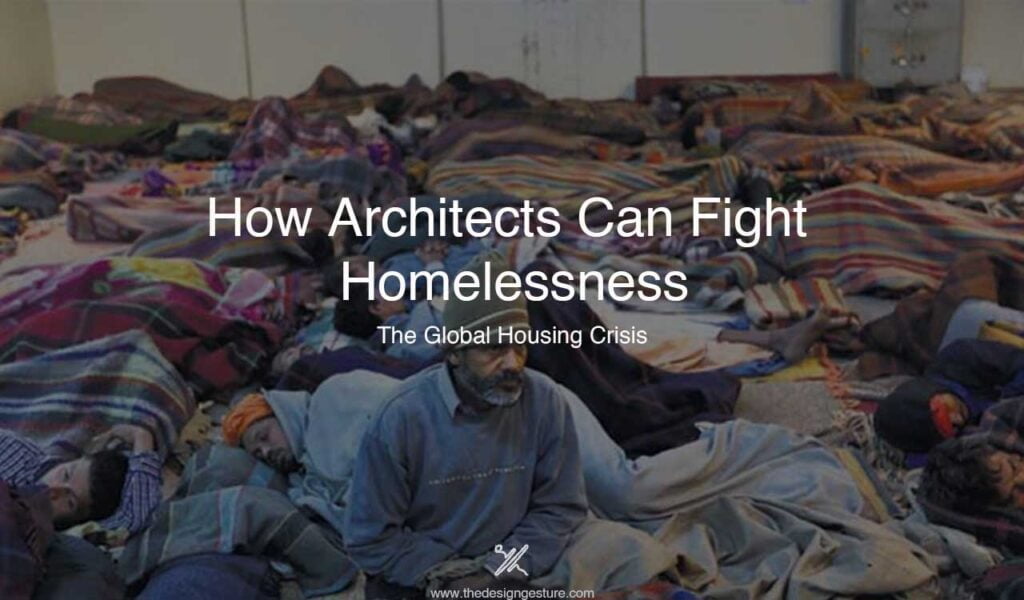
    How Architects Can Fight Homelessness: The Global Housing Crisis 

    “We travel because we need to. Because distance and difference are the secret tonics to creativity. When we get home, home is still the same, but something in our minds has changed, and that changes everything.”

    – Jonah Lehrer

    Introduction

    For most of us, a more agreeable statement couldn’t exist. As we travel for fulfillment and wander for distraction, scale new heights and make new memories, as we sail the seas of the known and journey the untrodden path, the beauty of the journey is unknown till one comes back home and rests his head on his own worn-out pillow. Ah, home sweet home. To me, home is the space where I can exist as I am- no inhibitions, no boundaries, no expectations. To me, home is akin to heaven. According to the popular English language encyclopedia, Britannica, homelessness is defined as the state of having no home or permanent place of residence.

    But what about those who have nowhere to go? Nowhere to belong and nowhere to go, innocent folk have been compelled to give up on the idea of heaven and embrace impiety. What of them? 

    Homelessness
    Photo by MART PRODUCTION from Pexels

    Homelessness: The Statistics 

    Homelessness is a social issue of growing concern, prevalent in almost all countries. Homelessness is a global challenge lying at the intersection of housing affordability, substance misuse, urbanization, racial and gender discrimination, infrastructure, and unemployment.

    The United Nations Human Settlements Program estimates that 1.6 billion people live in inadequate housing, and suggests that over 100 million people have no housing at all. In India alone, approximately 4 million people are homeless and 65 million people live in urban slums.

    The Global alone, Crisis

    Although the soaring gasoline prices are the current cause of concern, another facility has steadily been pushing numbers worldwide- housing rents. Driven by economic polarization, insufficient government policies, and the COVID-19 pandemic, the world has seen an increase in the number of unhoused, putting a larger group of the population at risk for the same. Moving in parallel with increased house prices, higher rents have priced a large population out of home buying and renting. 

    Additionally, growing urbanization has steered governments to demolish affordable social housing and has created a ruthless economy that favors profits and aesthetics over liveability. In India, government authorities demolished 53,700 homes, evicting 260,000 people for slum-free city beautification projects, despite the government’s ‘Housing for All-2022’ scheme. 

    slum free
    Photo by Sergio Souza from Pexels

    Urbanization in India 

    The rapid urbanization India has experienced in the last few decades has paved the way for an unbalanced economic development. As a growing number of people migrate from rural areas to urban centers in search of employment, cities are often unable to accommodate them. The clear obstruction between the supply and demand of housing tends to abandon citizens to fend for themselves. 

    In a desperate attempt to find a short-term solution for these issues, governments isolate the unhoused by building low-cost housing societies in areas lacking resources, and little to no access to water, transportation, or employment opportunities. This alienates the less fortunate and enables a classist system where the problem only continues to grow, further pushing them into poverty.

    Design- The Tool to Creating Dignity for All resources

    Design has the power to feel and make feel, to tell stories, and build the future. It’s quite fascinating to experience the way different people react to design in the world around them. I believe our interaction with design is like that all resources have a soundtrack playing at all times, something we’re not always aware of subconsciously sending cryptic messages on how to feel, how to behave, and what to expect. 

    design
    Photo by Tima Miroshnichenko from Pexels

    I believe architecture is the profession of creating better lives, building spaces for its inhabitants to have their values reflected. Design has the unique ability to make people feel dignified, seen, and respected. 

    Yet, present-day architecture is almost disconnected from the people who are most directly affected by its work. Rather than focusing on the societal impact and contribution of buildings and spaces, it is only concerned with the aesthetic quality and Instagram-ability of the space. 

    The homeless, one of society’s most vulnerable, have the least access to thoughtful design, perhaps the commodity they could benefit from the most. Dedicating projects to the public will not only dignify the people but also the novel profession of design, thus diversifying not only the client threshold but also the forms of design for the world to enjoy. 

    The way architecture is thought of and talked about can be entirely revolutionized if every design decision is thought of as an opportunity to invest in the dignity of the people you design for and the spaces you serve. Because once you experience dignity, nothing less will be acceptable. 

    Architecture has the agency to be the engine for change. 

    Existing Short-Term Solutions 

    For decades, architecture has been synonymous with social responsibility and the desire to improve society through a built environment. However, these short-term proposals aim to push the problem elsewhere and simply act as a band-aid in the grand scheme of this pressing issue. 

    Hostile Architecture 

    Hostile architecture, sometimes called “defensive architecture” is a trend in urban design that city planners and architecture purposefully set up infrastructure meant to deter homeless people from using public spaces. Anti-homeless architecture manifests as curved benches, benches with dividers between the seats, sprinklers hidden in foliage, spikes on window sills, walls, and under bridge spikes.

    This sort of design champions an ‘out of sight, out of mind’ narrative, further ostracizing and stigmatizing the homeless population, while failing to resolve the issue at hand. 

    If we fail to advocate for more inclusive spaces, the homeless epidemic will only get worse from here forth. 

    Parasitic Architecture 

    This idea, though a short-term solution, is a promising solution for the future and has been explored in many conceptual projects around New York City. The project is a series of hexagonal-shaped pods that have been designed to latch onto existing structures, filling in the gaps between buildings or on rooftops by capitalizing on the abundance of unused vertical spaces on the exteriors of buildings.

    In distinction to the combined spaces offered by many homeless shelters, each unit is devised to house one inhabitant to maintain their privacy and security.

    Revamping Existing Spaces 

    It is no secret that design has the power to dictate the future by learning from our past. Renovating abandoned, already existing spaces that are no longer in use to cater to housing requirements is not only the best sustainable solution but is incredibly cost-effective, requiring minimal funding. 

    spaces
    Photo by Laurie Shaw from Pexels 

    In LA, a collaboration between American firms, NAC Architecture and Bernards has made efficient use of shipping containers by transforming them into a housing complex for the homeless. The complex has a whopping 232 housing units, a commercial kitchen, landscaped area, and a parking lot. 

    In London, Holland Harvey Architects transformed a disused London Supermarket into an impressive homeless shelter. ‘Shelter from the Storm’ provides 42 beds, rehabilitative support, and fresh meals for the homeless. The space also doubles as a cafe to encourage interaction between the public and the vulnerable. 

    Both of these are two very simple, yet starkly innovative, cost-effective, and efficient solutions; but it can only get better than this! 

    Tiny Homes 

    The tiny-house or micro-home movement is an increasingly sought-after trend that doubles as a low-cost housing option. It is an architectural movement that essentially downsizes and simplifies living spaces. 

    In LA, Lehrer Architects built a community of colorful tiny houses or a tiny house village to house the city’s homeless residents. The lockable micro-homes are eight-by-eight-foot structures that can accommodate one or two people. The project took only 13 weeks to construct and complete. So far, the city has built 8 of these villages and intends to construct many more. 

    Additionally, tiny houses act as a preventative solution to homelessness, fostering the possibility of housing that people can build themselves. 

    tiny homes
    Photo by Mikael Blomkvist from Pexels 

    Winston Churchill once said, “We shape our buildings, and afterward, they shape us.” I can only hope this quote will dictate the future of and scope of architecture. Great architecture is a sign of hope. Thoughtful architecture has the power to heal. 

  • 7 Incredible Indian Cities that Architects Must Definitely Visit

    7 Incredible Indian Cities that Architects Must Definitely Visit

    India has been a hub for culture and heritage forever. Every part tells a different story, which inevitably binds you in a circle of astonishment. As architects, we have an eye for details, perspective, harmony, and all the other design principles. 
    Indian cities have their own share of mesmerizing beauty to explore. So, as Architects, we are bound to know more about these cities and gain a new perspective.

    Indian Cities for Architects To Visit

    Indian Cities: Ahmedabad

    The heritage of Ahmedabad is a mix of many cultures, each leaving a mark in terms of architecture in the form of bridges, temples, mosques, and others, each belonging to a different period. The architecture of Ahmedabad has evolved over centuries from Mughal architecture to British and Modern structures by famous Architects.

    The pols of Ahmedabad are close-knit community houses with shared spaces like courtyards and narrow lanes. These pols are a must-watch for any architect, they are the essence of Ahmedabad. Sarkhej Roza, Jami Masjid, and Rani ki vav are places that are all built differently but give a sense of calmness intangible aspects. 

    Ahmedabad is not just rich in historic monuments but also is famous for modern architecture by Louis-I-Khan, Charles Correa, Balakrishna Doshi, and many more. IIM Ahmedabad, Amdavad ni Gufa, Sabarmati riverfront, Gandhi Ashram, NID, CEPT, and newly constructed Narendra Modi Stadium are other places that will give a lot to learn from.

    Mandu

    Mandu, a city in Madhya Pradesh, is most famous for its forts and temples which illustrate a story of their own. Jahaz mahal is the most popular fort there which is situated near a lake and has large terraces overlooking the lake. 

    Mandu is also famous for Rani Roopmati’s pavilion with the unparalleled vision of River Narmada. Other places to visit to gain a knowledge of stone as a material and building large corridors, terraces and heighted space to gain a perspective of scale and proportion are Dilawar Khan’s Mosque:,Baz Bahadur’s Palace,Hindola Mahal,Bagh Caves and Jami Masjid.

    Jaipur

    Jaipur ‘ Pink city of India ‘ got this name because of the hospitality and the terracotta stone used for construction. Jaipur at large represents how tangible and intangible aspects go hand in hand while designing.

    Also, the concept of Vastu shastra and a well-planned city is popularized from here. While in Jaipur one gets to picture the royalty and luxuries life of the Rajas, the large rooms and intricate carvings are what make the mahal and forts centerpiece of attention.

     Jaipur not only is detailed and extravagant, but also every element is well thought. For instance, the window, lintels or even the space between buildings is conceptualized according to climate. 

    The most famous place to visit is Hawa mahal, which gives a peek into the life of kings and queens. The Jawahar Kala Kendra by Charles Correa can be considered as the heritage inspired modern day architecture.

    Hampi

    Hampi has been described by UNESCO as an “austere, grandiose site” in Karnataka. It is rich in historic structures which include forts, riverside features, royal and sacred complexes, temples, shrines, pillared halls, mandapas, memorial structures, water structures and others. 

    Group of monuments in Hampi is Vijayanagar style and is made with granite primarily. Vijaya Vittala Temple is the most iconic and is in the form of chariot, and has gained the maximum popularity amongst the other monuments.

    Achyutaraya Temple, Hanuman Temple, Badava Linga Temple and many others are made from stone, but the space in the temple which attracts the most is the mandapas. The mandapas have many columns and give a pleasant background for photos. The carvings and textures are what will attract an architect at first glance.

    Udaipur

    Udaipur-City of Lakes , is a blend of nature and built form and is for those who love to work in harmony with nature. The presence of the lake not only provides an aesthetic picture but also keeps the climate in check, providing an automatic coolness to the neighboring areas.

    The town is filled with palaces near the lake which are now turned into resorts favorable for destination weddings or outings on weekends from nearby areas. The most famous palaces are near Lake Pichola. Udaipur also has some temples and Havelis with a courtyard, giving a poetic sense to Udaipur.

    Lavasa

    Lavasa is a hill station near Mumbai and not a very famous one. Architects interested in sustainability will find Lavasa a live case study for the same. The principle to design is new urbanism i.e  “Walk to Work”, “Walk to School” and “Walk to Park” become reality with non- polluting industries and ecological tourism.

    The concept of design is formed by working with biologists with biomimicry. The city’s rooftops are inspired by the morphology of the native banyan fig leaf.

    The Western Ghats region is prone to seasonal flooding from monsoons and a strategy based on ant nests has been adopted to channel water through the city. This efficient plan is inspired by the local harvester ants that divert water away from their nests through multi-path, low-grade channels. Further, water has been stored in networked building foundations, much like tree roots.

    Lavasa

    Auroville

    Auroville situated near Pondicherry is an experiential town where once a desert is now a habitable town. The town is filled with people looking to explore in their life and so it is reflected in the city’s architecture and culture.

    The Matrimandir Temple, designed by Roger Anger, is the soul of the city. From form till the planning and garden surrounding the golden sphere, every thing is considered from deep within. The name ‘Matrimandir’ means literally ‘Temple of the Mother’.

    The construction practice in Auroville is completely different from other cities. The work, whether small or big, is done in vernacular architecture and the aim is to follow ecological practices like rainwater harvesting and using solar panels. Every structure feels as if it is protruding from the earth. 

    Some other places which can be visited are Chandigarh, Leh Ladakh, and Delhi. It is rightly said by Arundhati Roy,” India lives in several centuries at the same time.”

  • Shipping Container Architecture: Transform Metal Boxes to Modern Structures

    Shipping Container Architecture: Transform Metal Boxes to Modern Structures

    Introduction

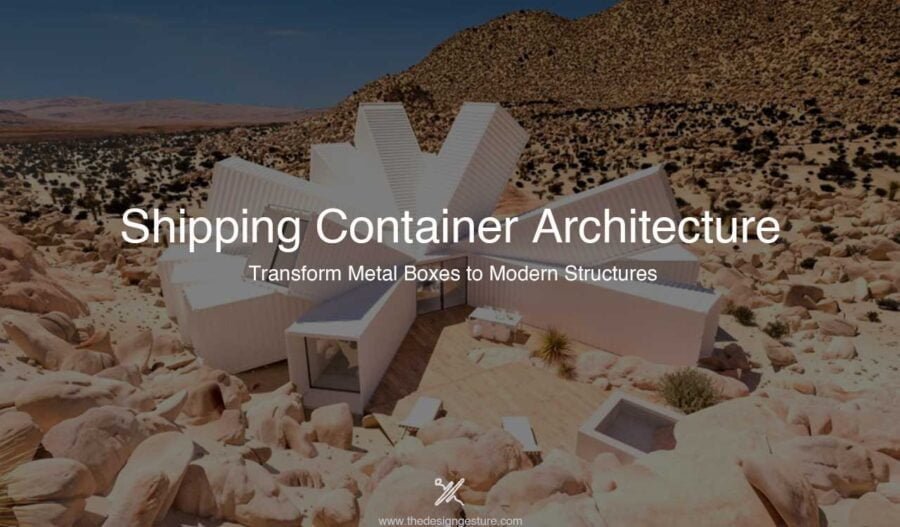
    Every year, thousands of shipping containers meet their end, destined for abandonment or landfills. Of late, an extraordinary metamorphosis has occurred within the realm of architecture. These discarded metal giants, originally designed for the relentless journey of goods across the globe, have been given a new purpose—a second chance as the building blocks of innovative architectural creations. Welcome to the world of shipping container architecture, where sustainability meets creativity to shape a greener and more design-forward future. Let us examine the transformation, potential, sustainability, and challenges of shipping container architecture.
    Progression of Container Design

    Malcom McLean_imcbrokers.com.jpg
    Malcom McLean©imcbrokers.com

    Shipping containers as architectural components may seem like a recent trend, but their history dates back to the mid-20th century. Malcolm McLean revolutionized the shipping industry in the 1950s by introducing standardized containers. This innovation greatly streamlined global trade, making it more efficient and cost-effective. Not until the late 20th century did architects and designers begin to understand the building potential of steel containers. The appeal of using shipping containers in architecture lies in their modularity, structural strength, and sustainability.

    Vissershok Container Classroom, Cape Town_archdaily.com.jpg
    Vissershok Container Classroom, Cape Town©archdaily.com 

    During the Vietnam War, containers were used for shipping supplies and served as emergency shelters, marking their early use in construction. In Europe and Asia, shipping containers are already integrated into commercial and residential structures, providing affordable housing solutions. Today, shipping containers are used for various purposes worldwide, from mobile schoolhouses in South Africa to quick-to-high-end shops in New York. Overall, shipping container architecture has evolved from necessity to modernization, addressing architectural and urban development challenges.

    Benefits of Shipping Container Architecture

    ContainHotel, Czech Republic_contemporist.com.jpg
Shipping Container design
    ContainHotel, Czech Republic©contemporist.com

    Shipping container architecture offers a compelling and cost-effective approach to modern construction. These containers, originally designed for global transport, provide an affordable building material that is both robust and weather-resistant. Their affordability is enhanced by the use of recycled containers, which reduce waste and conserve resources. Beyond cost savings, shipping container homes are environmentally sustainable. Environmental stewardship greatly benefits from repurposing decommissioned containers, which reduces waste disposal reliance on landfills while minimizing requirements for fresh resources. This approach aligns with contemporary sustainability goals, making shipping container architecture an attractive and eco-friendly choice for designers.

    These structures are highly customizable, allowing architects to design layouts, select sustainable materials, and integrate energy-efficient features, thereby reducing their ecological footprint. Moreover, the inherent durability of shipping containers ensures a long-lasting and resilient living environment, while the flexibility to adapt and expand container configurations caters to evolving spatial needs. Finally, the mobility of container homes adds extra versatility, making them an attractive choice for those seeking building solutions that can easily be relocated. In summary, shipping container architecture offers a multifaceted approach, combining cost-effectiveness, environmental consciousness, durability, customization, and mobility, making it a compelling option in the contemporary architectural landscape.

    Evaluating Sustainability Amid Shipping Container Challenges

    Prairie Logic, Kansas City_archdaily.com.jpg
    Prairie Logic, Kansas City©archdaily.com

    Shipping container architecture offers a unique construction approach but comes with its own set of challenges. Addressing these challenges is essential for evaluating its sustainability claims. Shipping containers, in their raw state, are ill-suited for human habitation due to issues like poor insulation, ventilation, and limited natural lighting. Converting them into habitable spaces requires extensive modifications, which may counteract their sustainability benefits. Achieving energy efficiency can be challenging, and the use of new materials during these modifications contributes to resource consumption and emissions. There is also the environmental issue of site preparation and the longevity of containers.

     Another challenge is the environmental impact of container choices. Some buyers opt for new containers, which may not be as eco-friendly as repurposed ones. Used containers might have transported potentially harmful substances or incurred damage during transportation, making them less appealing from an environmental perspective. Moreover, addressing structural concerns can be a complex task, often requiring skilled professionals and contractors. Navigating building permits, especially in regions where container housing is less common, can be intricate, involving adherence to specific building codes and requirements. To fully harness the potential of shipping container structures as a sustainable architectural choice, careful planning and examination of these factors are essential.

    Urban Rigger, Copenhagen

    Urban Rigger, Copenhagen_prefabcontainerhomes.org.jpg
    Urban Rigger, Copenhagen©prefabcontainerhomes.org 

    In Copenhagen, Denmark, the Urban Rigger project by Bjarke Ingels Group (BIG) presents a sustainable and innovative response to the increasing demand for student housing. Situated in the underdeveloped area of Copenhagen’s harbor, the project repurposes 974 recycled shipping containers to create 12 studio residences surrounding a central winter garden, fostering a sense of community among students. The buoyant design allows for potential replication in other harbor cities where affordable housing is needed. This creative use of standardized containers not only addresses housing needs but also makes use of a flexible and eco-friendly building typology optimized for harbor cities.

    The Puma City, Boston

    Puma City, Boston_archdaily.com.jpg
    Puma City, Boston©archdaily.com

    PUMA City is a mobile architectural marvel that creatively repurposes 24 shipping containers into a versatile and transportable retail and event building. PUMA City is a three-level stack of containers with a clever design that incorporates internal outdoor spaces, generous overhangs, and inviting terraces. The lower levels house expansive retail spaces with double-height ceilings, offering a refreshing contrast to the container’s modular interior. On the second level, you’ll find offices, a press area, and storage, while the top level features a stylish bar, lounge, event space, and a spacious open terrace.

    What truly sets PUMA City apart is its ability to be assembled and disassembled multiple times at various international ports. The structure utilizes 12-meter-long shipping containers and existing container connectors to create a secure and dynamic architectural composition, both horizontally and vertically. Each module is designed for efficient shipping as conventional cargo, with structural covering panels that seal the large openings. This approach makes PUMA City the first container building of its size to be genuinely mobile, demonstrating the incredible potential of shipping containers in architectural design and sustainability.

    Pallotta TeamWorks, Los Angeles

    Pallotta TeamWorks, Los Angeles_bigboxcontainers.co.za.jpg
    Pallotta TeamWorks, Los Angeles©bigboxcontainers.co.za

    Pallotta TeamWorks aimed to revolutionize charity fundraising by merging business strategies with humanitarian efforts. They needed an inspiring yet cost-effective headquarters in a warehouse space. Despite budget constraints, innovative solutions were sought, focusing on efficient MEP systems. Collaborating with a sustainability-focused client, the project explored a partially conditioned environment, taking advantage of Southern California’s climate. The concept of “Breathing Islands” emerged, acting as air diffusers and creating distinct workspaces while reducing the need for conditioned air. These white tents were hung from the existing roof structure, with shipping containers anchoring their corners. Efficient infrastructure descends from the ceiling.

    Pallotta TeamWorks, Tent Islands_officesnapshots.com.jpg
    Pallotta TeamWorks, Tent Islands©officesnapshots.com

    The building featured a unique island desk design and an executive tower constructed from stacked shipping containers. The project achieved its objectives while embracing resource efficiency. Color plays a vital role in defining spaces. Dark blue shipping containers framed transitions, and varying blues elevated visual depth. Public areas were boldly orange against a white and blue backdrop, while the tent neighborhoods featured a muted earthy palette, akin to the charity’s mobile tent cities.

    The Keetwonen Student Village, Amsterdam

    Keetwonen Student Village in Amsterdam_livinspaces.net.jpg
    Keetwonen Student Village, Amsterdam©livinspaces.net

    As we explore creative housing solutions, we turn our attention to Keetwonen, the largest container city in the world. It comprises 1,000 upcycled container studio flats, offering students private living spaces with bathrooms, kitchens, balconies, and separate study and sleeping areas. Each unit includes hot water and high-speed internet. The project creatively stacks containers in blocks up to five levels high, with courtyards for safe bicycle parking and social gatherings. Insulation and rainwater drainage are facilitated by integrated rooftops. Nine months after completion, it has become one of the most popular student dormitories in Amsterdam, showcasing the versatility of container-based design.

    Shoreditch Boxpark, London

    Shoreditch Boxpark, London_viator.com.jpg
    Shoreditch Boxpark, London©viator.com

    Boxpark, a distinctive shopping district in London’s Shoreditch, serves as a prime example of shipping containers’ unconventional architectural utilization. Conceptualized by Roger Wade and brought to life by the British firm Waugh Thistleton Architects, this temporary shopping center stands as a testament to adaptability and versatility. Comprising forty containers on the first floor and twenty on the second, totaling sixty distinct units, Boxpark showcases its unique architectural concept within a former railway goodsyard.

    Shoreditch Boxpark Store_absolutemagazine.co.uk.jpg
    Shoreditch Boxpark Store©absolutemagazine.co.uk

    What sets Boxpark apart is its inventive approach to interior retrofitting. The containers are transformed into cafes and stores offsite, a process that takes approximately three months. Once completed, these modules can be seamlessly integrated into the retail center in just one to three weeks. This flexibility is invaluable, empowering emerging retailers to establish themselves and relocate with ease, fostering a dynamic and diverse retail environment. Moreover, Boxpark functions as a transient hub for shopping and socializing, infusing fresh vitality into the urban fabric. This ingenious use of shipping containers not only revitalizes underutilized spaces but also presents a blueprint for adaptable urban development.

    The Sugoroku Office, Gifu

    The Sugoroku Office, Gifu_thecoolist.com.jpg
    The Sugoroku Office, Gifu©thecoolist.com

    The Sugoroku Office in Gifu, Japan, designed by Daiken-Met Architects, serves as a pioneering demonstration of flexible architecture. This three-story mobile framework incorporates stacked shipping containers, creating a unique workspace with the potential for future residential use on the penthouse floor. Its design resembles a construction zone, making it appear as if it’s both a functional workplace and an ongoing construction project, creating an intriguing blend of aesthetics. What makes this office particularly remarkable is its ability to be easily assembled and disassembled, making it a practical solution for temporary structures in urban areas.

    Sugoroku Office Ground Floor Studio_decoist.com.jpg
    Sugoroku Office Ground Floor Studio©decoist.com

    The architects tackled the challenge of making rental contracts for small-scale structures in a city with a decreasing population and increasing vacant land. They devised a steel structural grid that not only simplifies the assembly process but also reduces the load on the containers, accommodating the weight of the building’s shell, furnishings, and occupants. Importantly, this modular structure can be disassembled and relocated elsewhere. The office’s storage systems creatively incorporate used plywood and packing bands from construction sites, demonstrating an eco-conscious approach to design and resource utilization.

    GAD, Tjuvholmen

    GAD, Tjuvholmen_bigboxcontainers.co.za.jpg
    GAD, Tjuvholmen©bigboxcontainers.co.za

    GAD is an ingenious semi-temporary gallery designed by MMW Architects, located in Tjuvholmen, Norway. This flexible gallery is built around ten standard steel containers, creating a unique and adaptable space for art exhibitions. The ground floor consists of five containers, while three containers surround a central first-floor courtyard, and the final two complete the square-shaped building, offering access to the top-floor balcony. The containers are thoughtfully insulated and feature circular windows and roof lights to maximize natural light, creating an ideal environment for showcasing art.

     The revolutionary design of GAD enables simple disassembly, relocation, and reassembly, making it an adaptable and accessible place for art exhibitions in many locales. This project exemplifies how shipping containers can be creatively repurposed for artistic and cultural endeavors.

    The Container House, Udaipur

    The Container House, Udaipur_dezeen.com.jpg
    The Container House, Udaipur©dezeen.com

    In the serene Aravalli hills near Udaipur, India, you will find The Container House, an exceptional countryside escape by Rakhee Shobhit Design Associates (RSDA). Crafted in response to the client’s pandemic-era desire for a nature-centric retreat, this unconventional residence redefines home design. There are two units named Champa and Chameli. Created from repurposed shipping containers, the house offers seclusion and harmony with nature. Both units are elevated above the ground to minimize flood risks, structurally reinforced and insulated, and adorned with green exteriors to blend seamlessly with the natural landscape.

    Chameli Unit_dezeen.com.jpg
    Chameli Unit©dezeen.com

    Chameli boasts an open layout with a living area on one side and a bedroom, bathroom, and kitchen with a suspended fireplace on the other. In contrast, Champa adopts a more traditional configuration, featuring a bedroom, living room, kitchen, and small gym, with wooden partition walls defining these spaces. Both units include full-height windows and sliding doors that open onto hardwood terraces, perfectly linking indoor and outdoor rooms and providing panoramic views of the surrounding scenery.

     Market 707, Toronto

    Market 707, Toronto_stenoodie.com.jpg
    Market 707, Toronto©stenoodie.com

    Located in an urban neighborhood in Toronto, Market 707 is a dynamic market created from salvaged shipping containers, revitalizing an underused area near a sidewalk. LGA Architectural Partners collaborated with a Scadding Court staffer to bring this project to life in 2010, which was inspired by similar container-based stalls in Ghana.

    Initially conceived as a seasonal market, Market 707 has since evolved into a year-round hub featuring diverse vendors, from Japanese street food to local artisans. These modified containers boast roll-up doors and are sheltered by canopies, and vendors have transformed the adjacent paved area into a lively sidewalk café. With daily rent at $10, this district offers an inexpensive platform for up-and-coming business owners. Thanks to the innovative market concept, some vendors have transitioned from containers to permanent storefronts.

    Starbucks, Taiwan

    Starbucks, Taiwan_archdaily.com.jpg
    Starbucks, Taiwan©archdaily.com

    Renowned architect Kengo Kuma has ventured into shipping container-based architecture for the first time to design Starbucks’ inaugural store in Taiwan. Situated in a shopping mall, this two-story structure is constructed from 29 repurposed shipping containers and operates as a drive-thru. Kuma’s design draws inspiration from the asymmetrical foliage of coffee trees and traditional Chinese bucket arches, resulting in a tall space filled with natural sunlight through skylights. The 29 containers come together to shape a geometric space. Within this space, there are comfortable seating areas. Starbucks’ commitment to sustainable stores is highlighted, with 45 pre-fabricated modular stores already opened in the US, reducing the environmental footprint of new construction.

    Stadium 974, Doha

    Stadium 974, Doha_dezeen.com.jpg
    Stadium 974, Doha©dezeen.com

    Stadium 974 in Doha, designed by Fenwick Iribarren Architect for the Qatar 2022 World Cup, stands out as a piece of iconic architecture. Constructed using 974 recycled shipping containers, the stadium embraces natural ventilation, reducing the need for climate control systems. Therefore, it only hosted evening matches. The containers’ bright colors are associated with various stadium functions, adding a vibrant touch.

     A meticulous standardization process has been applied to each element, simplifying transportation, storage, and assembly. The stadium functions like a giant meccano, featuring prefabricated slabs and metal supports, promoting reversibility and sustainability with recycled steel. This “plug and play” strategy reduces construction time and costs. After the FIFA World Cup, the stadium was dismantled and reused for future events, which demonstrates its versatility and eco-friendliness.

    Conclusion

    The evolution of container architecture, transitioning from standardized cargo carriers to sustainable urban landscapes, has been remarkable. Shipping containers serve as versatile building materials, allowing architects to craft remarkable and environmentally conscious designs. Their modularity, cost-effectiveness, and eco-friendly attributes have made them a popular choice for a wide range of projects, from temporary structures to permanent residential complexes. While shipping container architecture offers numerous advantages in repurposing steel containers and reducing waste, it also presents challenges like insulation, ventilation, and navigating building permits.

    As architects continue to push the boundaries of creativity and sustainability, the role of shipping containers in architecture is likely to expand further, contributing to a more eco-friendly and diverse built environment. 

  • Vernacular Architecture of Kerala: Learning Sustainability from the Best

    Vernacular Architecture of Kerala: Learning Sustainability from the Best

    Introduction to Vernacular Architecture

    Vernacular architecture is a style of architecture that is designed and built for the needs of people, with locally available materials, reflecting upon the culture of the place. Vernacular architecture is specific to a region and climate. In theory, a vernacular building is built without the guidance of a professional, like an architect. Thus, vernacular architecture is cost-effective, climate-responsive, modest, sustainable, and a reflection of the culture of the place. 

    Introduction to Kerala and its Architecture

    Kerala is the twenty-fifth largest state in India, in the area surrounded by Karnataka on the northeast, Tamil Nadu on the east, and the Arabian Sea on the west. With a coastline of around 600km of the Arabian sea, Kerala is known for its spectacular flora and fauna, backwaters, and respect for its culture.

    Kerala prides itself for being the flag bearer for not just how a culture can respect its past, but also march forward with growth & progress as well. Kerala’s vernacular architecture, which is still heavily practiced throughout Kerala and some of south India, is one such inspiration for all. It is in striking contrast with the Dravidian Architecture followed in other parts of South India and is strongly influenced by Indian Vedic architectural science (Vastu Shastra).

    History and Origin 

    Kerala gets its indigenous style of architecture from all climatic, geographical, and historical factors.

    Favored by generous rains because of monsoon and bright sun, this land is lush green with foliage and rich in beast life. In the uneven terrain of this region, mortal habitation is distributed thickly in the rich low- lands and sparsely towards the hostile mounds. Heavy rains have brought in presence of large water bodies in form of lakes, gutters, backwoods, and lagoons. The climatic factors, therefore, made its significant benefactions in developing the architecture style, to fight the wettest climatic conditions coupled with heavy moisture and harsh tropical summers.

    Geographically, Kerala is a narrow strip of land lying in between the seacoast of peninsular India and confined between the towering Western Ghats on its east and the vast Arabian ocean on its west.

    History also played its benefactions on the Kerala architecture. The towering Western Ghats on its east have successfully averted influences of bordering Tamil countries into present-day Kerala in after times. While the Western Ghats insulated Kerala to a lesser extent from Indian conglomerates, the exposure of the Arabian ocean on its east brought in close connections between the ancient people of Kerala with major maritime societies like Egyptians, Romans, Arabs, and so on. Kerala’s rich spice polish brought it a center of global maritime trade until the ultramodern ages, helping several transnational powers to laboriously engage with Kerala as trading mates. This helped in bringing in influences of these civilizations into Kerala’s architecture.

    Different types of Kerala Architecture

    The architecture of Kerala is divided into two parts, Nalukettu and Ettukettu. 

    Nālukettu is the home of generations of joint family kinfolk or Tharavadu, where many generations of a matrilineal family lived. These types of structures are observed in the Indian state of Kerala. The traditional architecture of Kerala is a rectangular structure where four blocks are joined with a central, open to the sky courtyard. 

    The four halls on each side are named Vadakkini (northern block), Padinjattini (western block), Kizhakkini (eastern block), and Thekkini (southern block). The architecture was especially provisioned to large families of the traditional tharavadu, to live under one roof and enjoy the commonly owned facilities and services of the marumakkathayam homestead.

    Ettukettu, which is eight halls with two central yards) or Pathinarukettu, which is sixteen halls with four central yards, is the further elaborate forms of the same architecture. Every structure faces the sun, and in some well-conditioned designed nalukettu, there’s excellent ventilation as well. Temperatures, indeed in the heat of summer, are markedly lower within the nalukettu.

    Elements of Nalukettu and Ettukettu

    nalukettu
    Photo from Archipasta

    Padippura

    It’s a structure containing a door, forming part of the boundary wall for the house with a tiled roof on top. It’s the formal entry to the site with the house. 

    Poomukham

    It’s the porch of the house led by steps. Traditionally, it has a pitch-tiled roof with pillars supporting the same. 

    Chuttu gallery

    In Kerala architecture, the poomukham is accompanied by an open passage, the chuttu gallery, which leads to either side of the house surrounding it. 

    Charupadi 

    Along the chuttu gallery and the poomukham are traditionally sculpted, rustic, wooden, or cement benches. These benches are called charupadi. 

    Ambal Kulam

    Nearly every Nalukettu has its own Kulam or Pond for bathing of its members. At the end of Chuttu verandah, there is a small pond constructed with debris on sides where lotus or Ambal is planted. The water bodies are maintained to maintain energy flow inside. 

    Nadumuttam 

    A typical Nadumuttom of Kerala Nalukettu is a courtyard placed at the prime center of the Nalukettu. This is surrounded by an open corridor square-shaped, in the exact middle of the house dividing the house into its four sides.

    Key Features of Vernacular Architecture of Kerala

    Orientation and Planning

    orientation
    Photo by Amit Murao

    Kerala experiences a hot and humid climate and hence the orientation of the building becomes one of the crucial aspects of planning. 

    The building should face the direction of the prevailing winds rather than the sun. This helps in maintaining cross ventilation in a humid climate. Houses preferably face East direction according to the direction of prevailing winds. 

    Cross ventilation

    The juxtaposition of open-and-closed spaces in a way to allows a continuous flow of air.

    cross ventilation
    Cross VentilationPhoto from Benny Kuria Kose


    Being in a tropical climate, cross ventilation plays an important role in creating comfortable spaces. The presence of high moisture content in hot air causes discomfort for the user. 

    Courtyard spaces are extensively used in houses of Kerala of all scales. It helps in achieving passive cooling and reduces the dependence on HVAC systems. It also helps to induce continuous air movement.

    Openings in walls facing each other and internal partitions help in increasing cross-ventilation. Using vertical louvers and large window shutters helps to reduce thermal discomfort with ample daylight.  

    Solar Shading

    Solar shading
    Photo from Spiderkala

    The temperature in Kerala can rise to up to 40 degrees Celsius in summers. Therefore, sun shading strategies and elements become vital. 

    Traditional buildings in Kerala have an internal and external verandah. The external verandah acts as buffer space to reduce direct exposure to sunlight, whereas the internal verandah allows light to enter the building via a courtyard.

    The east and west façade should be least exposed to the sun to prevent late afternoon and early morning heat. One way is to have dense tree plantations around these façades.

    Overhangs, louvers, canopies, and so on are used for shading. Shading devices for doors and windows are also used to avoid solar heat gain.

    Roof Insulation

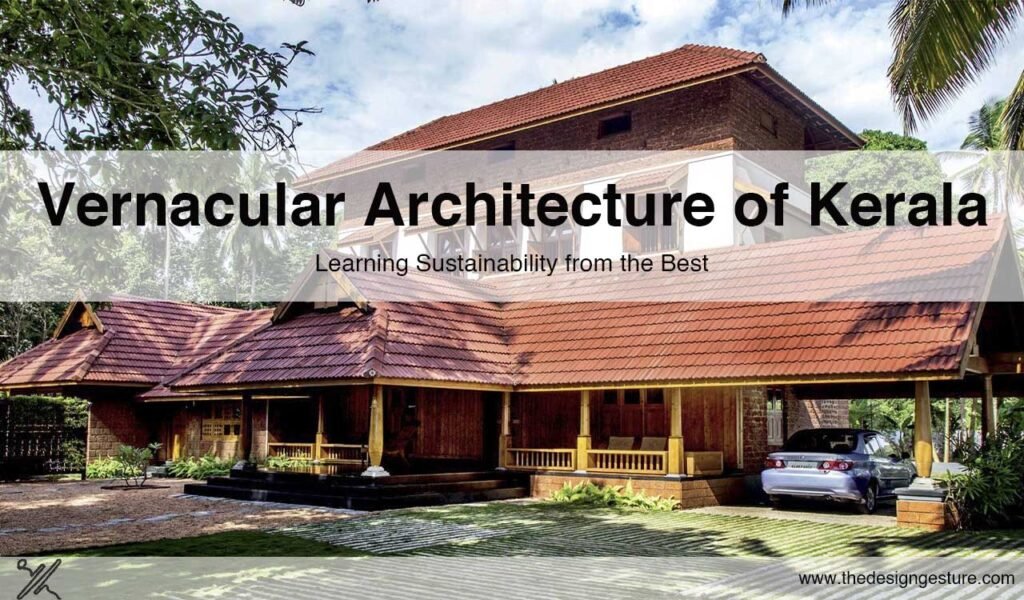
    The most distinctive visual form of Kerala’s architecture is the high, steep sloping roof with eaves constructed to shade the walls of the house and to repel the heavy thunderstorm, typically laid with tiles or thatch, and supported on a roof framework made of hardwood and timber. Structurally, the roof frame is supported on the pillars standing on a raised platform from the ground, for protection against moistness and insects in the tropical climate. Many times, the walls are also made of timber, locally available in Kerala. 

    Gable windows were introduced at either end of the roof to maximize attic ventilation of the room when the ceiling was incorporated for these spaces. Most structures of Kerala appear to be low height visually, because of high, steep sloping of roofs, which cover walls from rains and direct sunshine. 

    Prevention from Rain

    Kerala receives heavy rainfall for a significant part of the year which requires effective solutions to endure the extreme climatic conditions.

    Buildings should be placed at a high plinth to restrict water from entering inside. Sloping roof should be provided to avoid the accumulation of rainwater on the surfaces.

    Commonly Used Materials

    Kerala architecture uses local materials that are locally available and also sustainable. Some of the commonly used building materials in the Kerala area are bamboo, earth, lime, timber, leaves, and so on.

    Laterite

    Laterite is a hardened earth layer formed because of the weathering action of acid jewels. It is dug out from the earth and its compressive strength can be significantly higher than that of burnt clay bricks. It is non-porous and has poor water retention capacity. It is found 3 to 15 meters below the ground. The top one to two meters is soft, and the bottom merges with the clay layer. Laterite can be called the “Blessing of Kerala” since 80 percent of the state is covered with it. In Kerala, the foundations were erected with laterite blocks. 

    Laterite has been extensively used for constructing the superstructure. Using burnt bricks for construction was rare, except with a few palaces. Currently, the laterite blocks can be machine cut as well. The advantage of these machine-cut blocks is that they have much higher compressive strength. The disadvantage is that these have to be transported over a long distance, ergo the process involves further energy.

    Lime

    Lime, which was obtained from shells, was burnt in kilns and used as mortar in structures in Kerala. It was produced by beating it round with a stiff bristle encounter, after adding water. It was beaten with a special rustic tool in tanks specifically made for this purpose. This process helped to increase its strength and plasticity, reducing the amount of water to be added. This is beneficial as the strength of lime further improves when lower water is used, and when it’s air-dried. Many organic details were also added to increase the strength of the lime, hence the mortar. 

    In theory, it is believed that lime has a lot of disadvantages like slow setting, not having enough strength, and so on. But, in contrast, lime is significantly sustainable as a binding material, as various studies show that it is much lower energy-consuming when compared with cement. Cement is a high energy-consuming material with limestone as one of the main constituents for its manufacture. When cement is used as mortar in a wall, the bricks cannot be recovered for play, if the structure is demolished latterly. If lime is used, the bricks can be reused, which eventually makes lime mortar more sustainable.

    Granite

    Granite is the most common stone used for construction in Kerala. Traditional Kerala houses use a granite slab below the ground to avoid the risk of dampness. Whereas thatch or clay tiles on the sloped roof, keep it dry. 

    The state does not have deposits of limestone or sandstone. Granite is a hard stone and is used in the foundations. It has been infrequently used for the superstructure until lately. 

    In the olden days, it was a locally available material, but now big quarries have come up in the western ghats, many of whom are present in vulnerable and fragile areas. Granite that is being excavated from these places is not sustainable, because of the adverse impact it causes on our terrain as landslides and other natural disasters.

    Timber

    Timber is one of the most used structural materials in Kerala. It was extensively available in many kinds and with high durability as well. Teak, jack wood, Anjili wood, and Thembavu were some of the commonly used types of timber. 

    Structures with timber walls were constructed in Travancore till about 100 years ago. The vernacular architecture of Kerala considerably uses timber for walls, doors, windows, intermediate floors, and roofs. 

    The biggest advantage of timber is that by using them in our buildings, the carbon gets locked. Trees are the only things that can convert carbon dioxide in the atmosphere into oxygen. If timber is allowed to decay or used as firewood, then the carbon is released back into the atmosphere, completing the carbon cycle.

    Every timber that we use in our structures needs not be sustainable. However, also it is less sustainable if the source of the timber is from cutting down virgin forests.

    Earth/Mud

    In earlier times, several large structures were constructed using earth or mud. The sun-dried mud bricks may be used for the alternate story of a two-story structure, with the ground bottom made of laterite. They may also be used for the less important corridor of structures. Using earth blocks (without ramming or sun-dried bricks) was popular among the poorer sections of society. 

    Many structures constructed with laterite also use earth as mortar to save the cost of construction. The general print of the public is that a structure with earth blocks is sustainable. But most times, it need not be true. 

    The cost of the superstructure of a structure is only 15-20 percent of the overall cost of construction, meaning the rest of the structural units need not be sustainable at all. When the earth from the structure point is used, it becomes very sustainable. But if the material has to be transported over a distance, also the embodied energy will go over, reducing the sustainability factor. Strengthening of earth blocks by cement will also reduce the sustainability aspect. If interlocking earth blocks are used, also the sustainable character will be more since no cement mortar is involved.

    Influence of Vastu Shastra

    One can notice the strong influence of Vastu shastra’s study on the architecture of Kerala. The basic underlying belief is that every structure erected on earth has its own life, with a soul and personality which is shaped by its surroundings. The most important wisdom which Kerala has developed purely indigenously is Thachu-Shastra (Science of Carpentry) as the easy vacuity of timber and its heavy use of it.

    From cattle sheds to trees, everything used to be planned and laid according to the ancient texts of shastra.

    In traditional houses, the kitchen is strategically placed in the northeast corner as the prevailing winds blow from the southwest direction. These houses have pitched roofs and if the roof catches fire at any point, it will be blown away by the prevailing winds. A well would also be constructed close to it. In a house with a courtyard, the main living area is always in the southwest part, away from the fireplace. The puja room of the house is placed in the northeast corner and the idols face either east or west direction. 

    In two to three-storied houses of Noth Kerala, the northeast part is usually a single storey because of the kitchen. The bedrooms are present upstairs in the southwest direction.

    Conclusion

    There has been a rapid change in the architectural fraternity in the past two decades. The new trend has been fast-paced racing towards quantity over quality. Using craftsmen has declined considerably.

    Therefore, to get out of this present crisis, an architecture typology, like the vernacular architecture of Kerala, that suits the environment, climate, and the people, should be developed. A blend of vernacular architecture with modern needs seems an appropriate solution.

  • Xi’an Qujiang Art Center: an Interesting Cultural Sanctuary In A Glass Box  

    Xi’an Qujiang Art Center: an Interesting Cultural Sanctuary In A Glass Box  

    Xi’an Qujiang Art Center

    History and story of Xi’an Qujiang Art Center

    Architecture shapes the society in forms of structures, art, and built. Whereas society is a collaborative form of past events documented as history and shared as a culture today. These events have shared a larger part with architecture and the public both. This collaborative involvement has led to the initiative of preservation. History is passed down in a variety of forms in various cultures. Some prefer to write it down as part of manuscripts, some use verbal skills as storytelling passes on. In some parts, the structures and archaeology hold more value. Passing on these vital to the next generation is also a responsibility shared by architecture. Hence cultural sanctuaries enter the picture. 

    Each country is proud and respectful of its heritage and displays its affection in multiple forms. The core of the travel and tourism industry also runs on these bases. The tour planning and coordination also follow the historic trails. As we understand the denser, restored, and well-presented heritage, better the attraction for tourists. This historical architecture is also responsive to the climate they remain standing in today with few external supports. Religion and beliefs also participate in this coronation as they are also linked with the building and surroundings. 

    China as a nation has rich culture and history which has also been documented for several decades. Following the traditions and rituals, people offer their respect and gratitude towards the past. Beginning from their participation in the silk route across the world, engaged in a few battles till the religion spread across the land. This rich belonging of nature is showcased and exhibited in front of the world through, Xi’an Qujiang Art Center. The magic glass box stands tall enveloping the history of its nation within. This structure surprises its visitors with the charm of visuals along the journey of history. 

    Location

    Xi'an Qujiang Art Center
    Photo by Shiromio studio from AchDaily

    The project is located at the intersection of the Qujiang Cultural Industry Cluster and Central Culture Business District (CCBD), two important parts of the city (QCIC). It’s a remarkable presence that appears to float in the atmosphere like a technological marvel. It is located at the highest point of Liaoyuan and is close to the Xian Botanical Garden. As it approached the interior design, CCD blurred the lines between the building, landscape, and interior, injected tension and purity into the 5,500 square meters of large space, and developed an interactive space that blends futuristic, contemporary, and artistic aspects, which transports visitors to an imaginative world.

    Structure and design

    Xi'an Qujiang Art Center
    Photo by Shiromio studio from AchDaily

    The project is constructed in 2019, occupying an area of 10,200 Sq.m. Designing architectural firms are Gad and T.R.P.O. The structure resembles a glass display hung in the air and forms a distinctive visual marker next to the urban road. People are drawn to the location and encouraged to experience the design story through the activities taking place in the exhibition hall.

    After then, browsing itself is included in the show. The question of how to handle the interaction between the structure and the location provides the basis for the original design. An urban highway in Xi’an with considerable traffic is the South Third Ring Road, which is close to the location. The architect had such a setting prepared for such a traffic pulse. 

    How will people get to the site given the 10-meter green belt of the road’s height differential from the site? The lyrical response is provided by the landscaping. The route that winds through the belt has been designed with a gradual slope so that it “disappears” as the walker approach. The stroll experience develops into a means of communication with the location as well as a closer relationship between the location and the city.

    Art Center seems like a giant crystal “sanctuary” and is built in the majestic historical city of Xi’an with a modern and fashionable gesture. It provides stunning contemporary touches to the region with a rich history and significant culture. It wants to establish itself as a landmark for the city and set the era’s fashion. 

    Site grounds 

    Xi'an Qujiang Art Center
    Photo by Shiromio studio from AchDaily

    The landscape on the podium’s roof and the botanical garden on the site’s east side provide a continuous interaction when viewed from the exhibition hall. The designer’s story of the place is made up of the terrain and built form, which at that precise time naturally elicits the feeling and experience. The drop-off area’s space streamlining and landscape design cross over with one another. The architect doesn’t want visitors to enter the exhibition hall, so he lets them pass right past the first-floor landscape garden instead. People may reach the exhibition hall with four clear walls by ascending the 88-second straight staircase, passing through the landscape area, and then going down the steps. 

    This imaginative and poetic setting is not only a stunning gallery where wonderful works by artists are shown, but it also inspires interaction between viewers and the art along their journey from the entrance. There are certainly adaptable and adaptive “blank” spaces that can inspire the public’s creativity and the development of art. The journey to the location is not a simple one, but rather one of falling, twisting, surprise, and eventually opening up, which appears to correspond with the emotional experience of humans. On-site anchors hold the entire structure in place. The structure is incorporated with the land, and the base is tucked away behind the lush slope.

    The Exhibit 

    Xi'an Qujiang Art Center
    Photo by Shiromio studio from AchDaily

    The Beginning and Legacy of Ancient Chinese Murals is a permanent display. It has 88 panels (of which 67 are originals), spanning from the Neolithic to the Qing Dynasty, making it the first exhibition to methodically and thoroughly present the entire art history of early Chinese paintings through murals. The art from the Goddess Temple in Liaoning province, the earliest mural ever discovered in China, the palace mural from the Qin Dynasty, the first major unified empire in Chinese history, and the mural from the Tang mausoleum, that is being shown to the public for the first time, are the highlights of the exhibition.

    Gold items, jadeite, and Picasso artwork are now on display at the museum as part of the special show. We previously hosted the Maritime Silk Road Exhibition, the Dunhuang Murals Copying Exhibition, the Dong Bo Zhai Collection-Royal Gold Wares of the Ming Dynasty Exhibition, the Grand Canal Relics of the Sui Dynasty Exhibition, the Exhibition of Imperial Porcelain of the Ming and Qing Dynasties Exhibition, and many more.

    Our museum is committed to offering the general public a wide range of high-quality exhibitions. With the State Cultural Relics Bureau’s consent, our museum established the Mural Conservation and Restoration Center with the Shaanxi Provincial Institute of Archaeology to coordinate efforts to preserve, study, repair, and display the discovered murals.

    Interiors

    Xi'an Qujiang Art Center
    Photo by Shiromio studio from AchDaily

    The interior space maintains the building’s lightness, which gives it the appearance of a “floating crystal palace,” while also showcasing modern splendor through its layout, uses, and experiences. Its textured surfaces and incomplete buildings represent vast architectural ideas. At the corner of the entryway is an impressive huge irregular spherical artwork. Its asymmetrical design highlights the tension in the area by providing varied visual experiences to individuals at various distances. The adjacent audio/video room hovers above the waterscape, which combined with the artwork generates a dynamic of delicacy and solidity, resulting in a happy relationship. 

    Dramatic experiences are produced as individuals travel in 88 seconds up a very long escalator from 1F to 4F. The linear escalator appears to transport visitors into a time tunnel that is lit up at the top by a beam of light and is surrounded by towering stone walls that seal off the exterior world and block the sight line. Inside these 88 seconds spent mounting the escalator, as the light filters down from the bottom groove, such profound, timeless, and pure design helps individuals to find inner calm without being distracted. 

    Xi'an Qujiang Art Center
    Photo by Shiromio studio from AchDaily

     When you reach 4F, your range of view abruptly expands, offering breathtaking visual experiences thanks to the super-scale translucent space. Three levels separate the exhibition hall space. The entire building is a suspension framework. The functionality of the steel is put to use under the suspension design when the tension mode of the column switches from absorption to bearing tension. To create the illusion that there is almost no column in the interior area, the length of the suspension pillar is decreased to 200 mm.

    As a result, the exhibition space’s freedom may be unleashed and the sight line to the outside can be virtually completely unhindered, blurring the lines between inside and outside.

    The Qujiang Art Centre’s glass house, or exhibition hall, uses double-layer complete glass curtain walls to maintain the brightness and visibility of the exterior façade, allowing the building to connect with nature. The curtain walls are 2 meters apart from one another. To realize the environmental protection capability of temperature regulation, ventilation, and sound insulation, the top opening fan and bottom ventilator’s opening and shutting are controlled. The huge aluminum curtain wall’s flatness is guaranteed by the lightweight, high intensity, and high flatness of the cellular aluminum sheet. The illusion of floating is further enhanced by the surroundings’ reflections. 

    Xi'an Qujiang Art Center
    Photo by Shouquing Wu from AchDaily

    The area is filled with a massive golden mineral stone that appears to be erupting from it. This structure represents the sturdy center of the project, and the engraving of the “Grand Milestone” property development map on its surface demonstrates a cutting-edge method of informing the public. Different-sized holes let light through, which causes eye-catching dazzling dots to appear on the floor. The architect continues to reflect on the central idea of the space by thinking about how architecture and nature interact, how people communicate, and how experience itself is limitless. 

    Leaving the traces 

    Xi'an Qujiang Art Center
    Photo by CCD from AchDaily

    Once a mistake, document the history. Past is the best teacher without any fees or filters. Culture binds people and promotes growth. This agenda is carried forward by many countries, actively participating in their legacy-restoring missions. The supportive facilities are provided through the medium of building, hence architecture. The role and responsibility that the structure beholds are heavier than what it appears. Well-known titles to new start-ups in architecture are leaning towards the edge of supporting this cultural sanctuary motto and contributing to benefit of the population. 

  • Climatology in Architecture: An Important Aspect of Every House Design

    Climatology in Architecture: An Important Aspect of Every House Design

    Climatology is the scientific study of climate. Climatology in architecture is a study related to the climate and the built environment. Buildings do not exist in isolation; they exist in a specific geographic environment. As a scientific discipline, architecture strives to ensure the harmony and unity of architecture and the surrounding geographic environment. If this is not possible, the building will not produce maximum comfort for the user, thus it will not achieve its purpose.

    Climatology in Architecture
    Climate Responsive Architecture

    Climatic zones in India

    climatic zones in india
    Climatic Zone map of India– Climatology in Architecture

    India has a wide variety of climates. It can be roughly divided into five climate zones. The climate in India classified for different types of buildings is helpful to the functional design of buildings. Our country is divided into different regions, so the climatic difference from one region can be reflected in the Indian style house design, which justifies some special regulations for each region. The significant differences in climate data between these regions define unique thermal comfort requirements for buildings located in different areas.

    Hot and Dry

    house design
    House Design Strategies for Hot and dry Climate– Climatology in Architecture

    The hot and dry climate is characterized by the average monthly maximum temperature exceeding 30 ºC. The areas in this climatic zone in India are usually flat and the soil conditions are sandy or rocky. In this climate, it is imperative to control the movement of solar radiation and hot wind. Therefore, building design standards should provide adequate shade, reduce exposed area and increase heat capacity.

    Warm and Humid

    house design
    Passive design strategies for Warm and humid climate– Climatology in Architecture

    The warm and humid climate is characterized by high relative humidity, around 70-90%, and high rainfall, around 1200 mm per year. The temperature in summer usually oscillates between 25 and 35 ºC, in winter the temperature varies between 20 and 30 °C. The design of houses in India in this climate should aim to reduce heat gain by providing shade and promote heat loss by maximizing cross ventilation. It is also necessary to dissipate moisture to reduce discomfort.

    Temperate

    Temperate climates are characterized by temperatures that are neither too hot nor too cold. Total annual precipitation usually exceeds 1000 mm. Winter in this area is very dry. The design of houses in India in this climate requires reducing heat gain by providing shade and promote heat loss through ventilation.

    Cold

    house design
    Considerations when building a house in a cold climate– Climatology in Architecture

    Areas located in cold climates are at high altitudes. The temperature in summer oscillates between 20 -30 ºC, in winter it can oscillate between 3 ºC and 8 ºC, which makes it very cold. Cold weather requires the design of houses in India to have adequate insulation and penetration to resist heat loss and promote heat absorption by directly absorbing and capturing solar radiation in the living space.

    Composite

    Except for the fact that the composite area experiences higher humidity levels during the monsoon, most of the characteristics of the composite area are similar to those of the hot-dry climatic zone in India. Standards of design of houses in India standards are roughly the same as those for hot, dry weather (adequate shade, reduced exposure area, and increased heat capacity), except for the need to maximize cross ventilation during the monsoon.

    Impact of climatic factors on Building Design

    The climate in India affects the design of houses through various climatic factors. The five climatic zones in India as discussed earlier are influenced by the below-discussed factors. Even small variations in these factors cause major alterations in the design of houses in India. Therefore climatology in architecture plays an important role. Architecture and climate have always been linked in a way of mutual influence. As a provider of the shelter, the building deliberately changed the climate of the neighbouring area; traditionally, its design was shaped by the pressures and opportunities inherent in the regional climate.

    Topography

    The strength, direction, and moisture content of the airflow are greatly affected by terrain. Air can be diverted or channeled through mountains. Airflow is diverted upward, and when it cools, the releases its moisture. The descending air mass rarely produces precipitation, so precipitation characteristics vary greatly between locations on the windward and lee slopes of mountains. Air humidity will vary with the rate at which the moisture evaporates from the surface below, that is, it depends on the availability of water to evaporate.

    Solar Radiation

    climatology
    Solar control techniques– Climatology in Architecture

    The amount of light reaching any particular point on the ground depends on the time of day, the day of the year, the number of clouds, and the latitude of that point. The intensity of the sun changes with the time of day, peaking at noon and reaching a minimum at dusk. The solar energy naturally falling on the building can be used to heat the building without special equipment to capture or collect sunlight. Passive solar heating uses building materials such as large windows facing the sun and bricks that slowly absorb and release solar heat.

    The design of houses in India should be such that the longest wall extends from east to west and provides long exposure to the south, allowing solar energy to enter the home in winter. Well-insulated buildings with this structural feature can absorb energy from the sun and reduce heating costs by as much as 50%. Passive solar systems involve designing the structure itself in a way that uses solar energy for heating and cooling. The passive solar design also includes natural ventilation for cooling.

     Curtains and overhangs can also reduce the heat in summer while allowing plenty of sunlight in winter. Active solar heating systems involve the installation of special equipment that uses energy from the sun to heat or cool existing structures.

    Wind

    climatology in architecture
    House of light and wind– Climatology in Architecture

    The wind is air in motion. It is because of horizontal variations in air pressure. The greater the difference in air pressure amongst any places at equal altitudes, the stronger the wind will be. The triumphing wind is the wind direction most often determined for the duration of a given period. Wind tempo is the charge at which the air moves past a table sure object. The wind is the important factor of air float in houses. The pressure of many of the building envelopes and the outdoor environment differ, and that is why air float is possible.

    climate in india
    Airflow in House Design– Climatology in Architecture

    Adequate fenestration is wanted to harness this. Prime of the destructive effects is that of wind-load on high-upward thrust houses. In the format and introduction of high-upward thrust houses, the impact of wind-load should be taken into cognizance. Adequate provisions have to be made withinside the idea format and the load-bearing framework of the houses to make certain true sufficient energy and help in competition to wind-load.

    Humidity

    Humidity is the quantity of water vapour within the atmosphere. Relative Humidity ratio is taken among the real quantity of water vapour within the air and the most quantity of water vapour that the air can preserve at that given air temperature.

    Relative humidity refers to the relationship between the humidity in the air and the maximum acceptable humidity, expressed in percentage. The higher the relative humidity ratio, the more likely it is that water droplets will form on physical objects including buildings and other buildings, such as bridges, streets, etc. on the surface of the earth.

    In coastal areas and islands, climate and humidity are high, and the design of houses in India is based on the high adverse effects of water. They must be designed and constructed by method to minimize adverse physical and chemical effects of water to the minimum or even zero. This can be done by choosing waterproof and anti-corrosion materials and equipment.

    Precipitation

    climatology in architecture
    Moisture Management Strategies– Climatology in Architecture

    Rainfall is one of the most decisive factors that need to be considered in the design of houses in India, especially in the ceiling design. In rainy areas, the roof of the building should be designed as a gable roof to reduce the erosion of water and minimize the accumulation of water on the roof due to damage. Otherwise, the adverse effects of rainwater and its infiltration into buildings will increase. Information of precipitation rate, especially in the design of dams and other structures is required to determine the size of the spillway, etc.

    Sound

    climatology
    Noise control in Buildings

    If a site is provided, the designer selects the location of the building and there is a source of noise on one side of the site (such as a busy road), it is recommended to place the building as far away as possible from the noise source. For every doubling of the distance, the noise level will decrease by 6 dB. Architectural acoustics help reduce the impact of acoustic disturbances, which can negatively affect health, well-being, and overall quality of life.

    The noise in the space where the sound source is located can be divided into two parts: direct noise and reverb noise. If the screen is placed between the source and the listener, direct noise can be reduced. It is better to place the screen closer to the source. The use of sound-absorbing materials on room surfaces can reduce reverb noise.

    Application in various Climatic Zones

    Climatology in architecture is crucial in the design of houses in India since the climate in India is diverse. Special care and attention are required while designing houses in India to ensure that they respond to various climates. Comparison of climate data and thermal comfort requirements provides a basis for selecting building forms and building components suitable for the climate to create the necessary internal comfort.

    house design
    Passive House Design– Climatology in Architecture

    Building Design in Hot and Dry climate

    Planning

    In this climatic zone in India, outdoor conditions are very harsh and thus buildings and outdoor living spaces should be protected as much as possible from strong solar radiation and hot, dusty wind. A closed building compactly planned and introvert is best suited. When site conditions permit, the larger size of the building is better for facing north and south, because these elevations receive the lowest heat load from solar radiation.

    Roofs and Walls

    The use of overhanging roofs, balconies, shading equipment, surrounding trees and walls, and buildings are familiar techniques in the design of houses in India. By aligning the buildings close to each other, especially if the east and west walls are placed close to the other, mutual shading will reduce heat gain from external walls. For this reason, in the hot and dry climate, there is a tendency to have a cluster of the building complex, narrow roads and streets, porches, colonnades, and enclosed small courtyards to obtain maximum shade and freshness.

    Ventilation

    climatic zones in india
    Air movement in traditional house design- Climatology in Architecture

    During the day, the opening should be closed and covered. For hygienic reasons, the ventilation should be kept to an absolute minimum to minimize the entry of hot air outside the house.

    Traditional shelter

    Traditional shelters found in most desert areas have heavy earth walls, bricks or stones, and roofs of the same material, usually supported by beams that do not use vaults. Thick walls provide good heat capacity and safety and noise protection. During the long warm season, these structures tend to be too hot at night. During these times, the roof and patio were often used for sleeping outdoors.

    Building Design in Warm and Humid climate- Climatology in Architecture

    climatology
    Importance of Cross-ventilation in a warm and humid climate

    Under such climatic conditions, the design of houses in India often uses elongated open floor plans with rooms in a single row to achieve cross-ventilation. These rooms can be accessed from balconies or open balconies and also provide shade. Window and door openings are or should be as large as possible to allow air to pass freely. Sunshade and unobstructed air circulation are two basic requirements. The development density of hot and humid areas is always much lower than that of warm climate for three reasons:

    1. Allows air to circulate freely in the space between buildings
    2. Provides remote privacy because walls and screens cannot be used for this purpose
    3. Many activities are carried out outdoors

    Due to the considerable rainfall in these areas, pitched roofs are most often covered with corrugated iron, fiber cement, or shiny aluminum.

    Traditional Shelter

    In places where wood is scarce, single-story houses with earthen walls, the roof of wood, bamboo, or palm leaves, covered with straw, are typical. Wide protruding eaves obscured the walls. In areas where wood or flooring is more suitable for construction, traditional shelters are generally erected on stilts, constructed from local lumber or bamboo frames with woven mats and wood, or bamboo walls, floors, doors and shutters.

    Building Design in Composite climate

    Courtyard houses must be constructed in such a climatic zone in India. Buildings should be grouped in a way that takes advantage of the prevailing breeze in a short period when air movement is required. The medium density low rise development is suitable for these climates. This will ensure the protection of the outer space, mutual shading of external walls, shelter from the wind in cold seasons, shield against dust, and reduce the surface area exposed to sunlight. Radiation In hot and humid seasons, large and wide eaves are required.

    Balconies are used as outdoor residential areas to reduce sky glare, rain and shade, and can also become active in the dry season. It is only necessary to maintain a low wall temperature at night in the hot, dry season, but the same thermal performance will be useful in the cold season to keep the daytime heat during an uncomfortable cold night. Roof and external walls should be constructed of solid masonry or concrete to ensure a 9-12 hour heat transfer. Whether it is a cold or dry season, the heat capacity will have an advantage.

    Building Design in Cold climate

    Household wraps, moisture impermeable barriers, and effective caulking details are essential. Ventilation of the home is also essential to remove moisture from exterior walls and roof sheathing. Choose a construction site and home layout, and place your living room windows in the sun – that is, although bedroom windows may face north, they are within 30 degrees of true south. Choose a simple home plan with a steep roof, such as a standard gable.

    design of houses in india
    Building design in cold climate

    Slate and tile roofs are less prone to snow. Design of houses in India should have a roof with fewer skylights or skylight openings, vents, and chimneys near roof ridges or peaks must be used. The passive solar design also uses darker colored roofs to absorb heat and “thermal mass” products such as concrete, bricks, stones, and tiles that retain heat from sunlight during the day and release heat at night. Other items may include electronic sensing devices such as differential thermostats, operable dampers and vents, operable Low-E blinds, shutters, and insulated awnings. Plans with a sunroom are very suitable for capturing solar heat.

  • Printed Wonders: The Impact of 3D Printing on Architecture

    Printed Wonders: The Impact of 3D Printing on Architecture

    Introduction

    The extraordinary gift of 3D printing technology has been bestowed on the world of architecture by the quick rate of technical growth. In recent years, 3D printing has made significant strides across various industries. The integration of 3D printing in architecture has shifted how architects approach building design, construction procedures, and even sustainability. 3D printing’s ability to expedite manufacturing processes enables architects to create elaborate structures faster and more precisely than ever before.

    The Basics of 3D Printing

    3D Printing
    Layers of 3D Printing©specifyconcrete.org

    In the sphere of contemporary architecture, we have witnessed the fusion of two transformative concepts: sustainability and digital technologies. This dynamic duo is reshaping architectural practices beyond mere representation and into the very core of design and manufacturing processes. Architects are now familiar with terms like parametric design, adaptive design, Building Information Modeling (BIM), nanomaterials, and, notably, 3D printing. This multifaceted technology is also known as additive manufacturing and has altered the world of design. It operates by meticulously crafting 3D objects layer by layer, following precise digital models. While it initially gained prominence for rapid prototyping, 3D printing has matured to the point where it can produce fully functional end-products.

    Types of 3D Printing in Architecture

    Sand 3D Printing_sculpteo.com.jpg
    Sand 3D Printing©sculpteo.com

    In construction and architecture, three main 3D printing technologies have emerged. Firstly, robotic arm extruders, also known as contour crafting, function similarly to desktop Fused Deposition Modeling (FDM) 3D printers. They use rails to guide a robotic arm that extrudes concrete material to build structures layer by layer, particularly for large-scale projects. Another method akin to industrial 3D printing processes is Sand 3D Printing, pioneered by architect Enrico Dini’s D-shaped 3D printer. This technique applies layers of sand powder and solidifies them using a binder, offering a unique departure from traditional construction.

    For structures requiring robustness, Wire Arc Additive Manufacturing (WAAM) technology combines an industrial robot with a welding machine, effectively turning it into a 3D printer for creating durable metal architectural components. These 3d printing construction methods coexist with established techniques like Fused Deposition Modeling (FDM), Stereolithography (SLA), and Selective Laser Sintering (SLS). FDM uses heated thermoplastics for precise structures; SLA cures liquid photopolymer with a UV laser for intricate designs; and SLS fuses powdered material particles with a laser for sturdy parts suitable for prototyping and production. Together, these diverse 3D printing technologies redefine architecture and construction, offering precision, efficiency, and durability as their hallmarks.

    The Benefits of 3D Printing

    TERA Habitat by AI Spacefactory_architizer.com.jpg
    TERA Habitat by AI Spacefactory©architizer.com

    3D printing is rapidly revolutionizing construction with its numerous advantages. It significantly accelerates production, constructing homes in a day. These automated printers reduce human errors and efficiently use materials, minimizing waste and saving costs. Moreover, they enable innovative, intricate, and geometric designs that were once challenging with traditional methods. Architects can present physical 3D visuals to clients, ensuring personalized structures and addressing concerns. Large-scale 3D printers are even constructing entire buildings, reducing costs and timelines. Sustainability is a priority in modern architecture, and 3D printing aligns perfectly by using eco-friendly and recycled materials, reducing environmental impact, and optimizing resource use.

    Furthermore, 3D printing aids in disaster relief and affordable housing, swiftly providing shelter where needed. It also plays a vital role in architectural restoration and preservation by creating precise digital replicas. Material advancements introduce creative options like self-healing bio-concrete, reducing maintenance costs and increasing building lifespan. Lastly, the digital nature of 3D printing fosters global collaborative design, enabling teams worldwide to work together seamlessly and produce diverse and inclusive architectural designs.

    Boundaries of 3D Printing

    While 3D printing presents numerous opportunities, it also comes with challenges. Regulatory bodies and governments are working to establish standards and safety guidelines for 3D-printed structures. Ethical considerations, such as intellectual property rights and the responsible use of 3D printing technology, are also being discussed within the architectural community.

    3D Printing in Action

    3D Printing machine
    3D Printed Earth Wall Staircase©parametric-architecture.com

    Architects wield a versatile toolkit through 3D printing. Its applications span historical preservation, cost-effective housing solutions, parametric designs for energy efficiency, and rapid responses to emergencies. Beyond functionality, architects embrace 3D printing as a medium for artistic expression, seamlessly merging art and architecture. From art installations to furniture design, these diverse applications underscore the technology’s transformative potential within the field. Now, let us delve into the projects reshaping construction and design through 3D printing technology.

    Apis Cor House

    Apis Cor House_archdaily.com.jpg
    Apis Cor House©archdaily.com

    A pioneering achievement by 3D printing construction company Apis Cor saw the completion of Russia’s first on-site 3D printed house in just 24 hours. The house, designed in a unique circular shape, was constructed using Apis Cor’s mobile 3D printer, known for its precision and transportability. The house, with a floor area of 38 square meters, features an unconventional circular design with right-angle protrusions. Despite being built during the coldest time of the year, it necessitated the creation of a protective tent to maintain suitable temperatures for the concrete mixture used as “ink.”

    3d printing software
    3D Printing Process©archdaily.com

    The house’s roofing system, made with LOGICROOF polymer membranes and LOGICPIR hard polystyrene, can withstand heavy snow loads while remaining highly insulated. Additionally, innovative insulation materials and techniques contribute to a comfortable microclimate within the residence. Impressively, the entire project cost only $10,134, highlighting the cost-effectiveness of 3D printing construction. The Apis Cor House marks a significant advancement in 3D printing construction technology, demonstrating its potential for efficient and affordable home construction.

    Tecla House

    Tecla House_dezeen.com.jpg
    Tecla House©dezeen.com

    In Massa Lombarda, Italy, Mario Cucinella Architects and 3D printing specialists WASP have joined forces to create Tecla, a groundbreaking eco-friendly housing prototype. Named after a fusion of “technology” and “clay,” this home stands out for its use of 3D-printed clay sourced from a nearby riverbed. This transformative home features two interconnected dome-shaped structures, whose exteriors are formed by stacking an impressive 350 layers of 3D-printed clay. These undulating layers serve as an efficient thermal insulator and offer adequate structural stability. The compact interior maximizes functionality and comfort. Additionally, Tecla’s roof has strategically placed circular skylights for ample natural light, creating an inviting and organic ambiance.

    Tecla House Skylight_dezeen.com.jpg
    Tecla House Skylight©dezeen.com

    Tecla stands out through its utilization of a sophisticated multilevel modular 3D printer equipped with twin synchronized arms, each with the capacity to print within a 50-square-meter zone. This high-tech marvel empowers the swift assembly of housing modules in a mere 200 hours, all the while significantly curbing energy consumption and waste generation. The project seamlessly combines well-established building methods with modern engineering, producing homes designed for climate health and environmental sustainability, as well as being capable of adjusting to the shifts of changing weather conditions. This approach acts as a proactive response to global climate emergencies and satisfies the growing need for green, flexible housing solutions.

    MX3D Bridge

    MX3D Bridge_parametric-architecture.com.jpg
    MX3D Bridge©parametric-architecture.com

    A stunning stainless steel 3D-printed bridge stretches gracefully across Amsterdam’s Oudezijds Achterburgwal canal in the Red Light District. A Dutch studio, Joris Laarman Lab, collaborated with MX3D, an Arup engineering firm, to create a 12-meter-long pedestrian bridge. The bridge features an elegant, curved S-shaped design with intricate lattice-style perforations on its balustrades, all meticulously crafted using advanced parametric modeling software.

    MX3D Bridge Form_parametric-architecture.com.jpg
    MX3D Bridge Form©parametric-architecture.com

    The bridge took shape through the gradual addition of molten metal, with robotic arms fitted with welding equipment meticulously printing layer upon layer of the structure. The bridge was constructed with 4,500 kilograms of stainless steel, a material that was 3D-printed by robots at a factory over six months. Later, it was lifted into place over the canal. Additionally, the bridge is equipped with sensors that allow it to collect data for performance and maintenance, advancing data-centric design approaches for future projects.

    Traditional House of the Future

    Nanlong Village_dezeen.com.jpg
    Nanlong Village©dezeen.com

    In China’s Nanlong Village, professors John Lin and Lidia Ratoi from the University of Hong Kong embarked on the Traditional House of the Future project. They combined 3D printing with an old wooden house, reinvigorating it with inventive design. After scanning and deconstructing the original structure, 3D-printed walls extended the living space, creating new rooms. Once the 3D-printed elements were in place, the original wooden structure and tiled roof were reintegrated into the house, preserving its heritage.

    New 3D Printed Spaces_dezeen.com.jpg
    New 3D Printed Spaces©dezeen.com

    The Traditional House of the Future project combines 3D printing with ancient architecture, demonstrating its potential for flexible renovations. Beyond that, it champions the fusion of technology with local building practices and sustainability, reimagining old structures to suit modern lifestyles. This project redefines cultural preservation by drawing inspiration from rural China’s innovative vernacular house renovations. It’s a remarkable blend of tradition and technology, offering exciting possibilities for adaptive architecture that transcends time.

    Airlements Project

    Airlements_dbt.arch.ethz.ch.jpg
    Airlements©dbt.arch.ethz.ch

    Researchers at ETH Zürich and FenX AG are using cement-free mineral foam made from recycled waste in large-scale robotic 3D printing to create monolithic, lightweight, and instantly insulated wall systems. The project is named Airlements and features technology that optimizes thermal performance reduces energy consumption, and allows for future material recycling.

    3D Printed Segments_dbt.arch.ethz.ch.jpg
    3D Printed Segments©dbt.arch.ethz.ch

    The project features a 2-meter-tall wall prototype composed of four 3D-printed segments, each weighing 25kg and printed in under an hour. The corrugated texture of each piece contributes to the overall strength and structural integrity of the final structure. These segments can be filled with mineral foam and sealed with cementless plaster to serve as non-structural exterior walls, with potential applications expanding as research progresses. As the research advances, emphasis will be placed on improving the load-bearing capacity of these elements and refining the precision of the 3D printing system.

    Systems Reef 2

    3d printing software
    Systems Reef 2©dezeen.com

    Systems Reef 2 is a revolutionary 3D-printed air conditioning system engineered by Australian architectural firm BVN in partnership with the University of Technology Sydney. The system reduces carbon emissions by an astounding 90% when compared to its traditional air conditioning counterparts, thanks to its unique incorporation of recycled plastic.

    Fluid Ventilation System_dezeen.com.jpg
    Fluid Ventilation System©dezeen.com

    In pursuit of enhanced comfort for occupants beneath the system, the design team drew inspiration from frogs, known for breathing through their skin. Diverging from traditional designs, Systems Reef 2 boasts a unique structure with branch-like tubing, eradicating the presence of obstructive, sharp corners that typically impede airflow and escalate energy consumption. Systems Reef 2 also incorporates small pores that efficiently disperse cool air, creating a mist-like effect in the area below. Offering flexibility, efficiency, and sustainability, it presents a compelling showcase of 3D printing’s potential in the construction sector.

    The Future of 3D Printing in Architecture

    The future of 3D printing in architecture holds immense promise. In architecture, 3D printing empowers architects with unprecedented design freedom, cost-effective prototyping, and sustainable construction solutions, influencing the way buildings are conceived, constructed, and experienced.

    Researchers are exploring the integration of robotics and artificial intelligence to enhance precision and efficiency. Advancements in 3D-printed construction materials may lead to more sustainable, energy-efficient, and adaptable structures. These advantages extend beyond construction and are applicable across various industries. Businesses can incorporate different 3D printing technologies, including plastic, resin, and metal printing, to stay competitive. However, challenges like regulatory approvals, quality control, and integration into existing construction processes must be addressed. Architects and researchers are actively working to overcome these obstacles, ensuring an eco-conscious future for architecture.

    Conclusion

    3D printing technology stands as a profound force reshaping the landscape of architecture. Its impact spans from expediting rapid prototyping to facilitating sustainable building practices and even contributing to humanitarian endeavors. We have already seen the enormous benefits of 3D printing in countless areas, but its potential is not yet realized. This game-changing technology will continue to give architects, engineers, and designers the power to create structures that are not only visually stunning but also exceptionally sustainable, cost-effective, and universally accessible. Embracing 3D printing in architecture transcends being a mere trend; it represents a fundamental paradigm shift that will undeniably define the industry’s future.

  • Interesting Peep into Tiny Homes: Portable and Functional House Design

    Interesting Peep into Tiny Homes: Portable and Functional House Design

    Concept of Tiny Homes

    Tiny House Movement

    Tiny homes
    Photo by Maria Orlova from Pexels

    This is an architectural and social movement aimed at providing a simpler life in a smaller space. The people of all areas of life have determined that a large house, and more specifically, the great cost of the resulting life, is not necessary and harmful to their happiness. These people prefer tiny homes to reduce the financial and emotional weight of things.

    Types of Tiny homes

    Recreational Vehicles

    It is a motor vehicle or a trailer that includes houses designed for accommodation. RV types include coaches, campers, and caravans.

    Recreational Vehicles
    Photo by Kampus Production from Pexels

    The typical amenities of a camper include a kitchen, a bathroom, and one or more available to sleep. The RVs may vary from the basic bedrooms and kitchen, in luxurious, with features such as air conditioning (AC), water heaters, satellite televisions, and quartz receptors, and false ceilings, for example. Most campers are single.  

    Accessory Dwelling Unit

    Accessory Dwelling Units
    Accessory Dwelling Units

    Accessory dwelling units are also known as accessory apartments, second units, or granny flats— are additional lodging on single-family lots that are independent of the first dwelling unit. The separate living spaces are equipped with kitchen and loo facilities and might be either attached or detached from the residence

    Shipping Containers

    Built from multiple shipping containers, a shipping container house is designed often architecturally with all the amenities found in traditional home construction. This includes fully functional wet areas like kitchens, bathrooms, and laundry, plus a lounge or two, a business office, bedrooms, and verandas.

    South coast Shipping container House
    South coast Shipping container House

    Each home is uniquely designed to support the positioning, architectural plan requirements, and budget of the homeowner or builder. Shipping containers do an amazing job of keeping goods protected against wind and water. They will also heat up very quickly if there’s nothing to permit the nice and cozy air inside to flee. 

    Yurts

    Magical Yurt with spiral staircase
    Magical Yurt with spiral staircase

    Originally, a yurt may be a portable round, insulated tent used by nomadic groups of central Asia. They’re designed to be easily moved and are capable of keeping people comfortable in extreme weather. Due to its economic construction and high functionality, Yurt has gained a lot of fame recently. With the power to form all types of shapes and sizes, yurts provide you with flexibility over the look process and permit you to make it to best fit your needs. We’ve seen yurts in backyards of homes within the city and deep within the wilderness. They’re a good choice to consider when going tiny.

    Bus Conversion

    School bus Tiny Home
    School bus Tiny Home

    A school bus allows lots of natural light into your space because the walls are lined with windows. For times after you want more privacy, you’ll be able to add curtains. Many bus conversions cover their windows to feature insulation and privacy. This bus conversion takes advantage of the big amount of windows by keeping the coverings translucent. They add coverage, but also allow the taste of some light.

    Dimensions of Tiny Houses

    In recent years, tiny house plans have become more and more popular due to their versatility and environmental protection. They can be configured in any size, shape, and design to meet the needs of the owner. You can even build tiny homes on a trailer so you can take it home wherever you go. Although houses less than 1,000 square feet are considered tiny homes less than 400 square feet are considered small. They cannot exceed 8.5 inches wide, 40 inches long, and 13.5 inches high to be towed away.

    Layouts and Guidelines

    Apartments under 400 square feet are considered tiny homes, they vary in shape and size. The design and execution of tiny house plans are based on the needs of the owner. For example, a person might choose to live in tiny homes with wheels measuring 50 square meters. However, families with children can choose a larger model. A 350-square-foot house may have a roof that doubles as a deck to provide additional leisure space.

    Tiny House Plans
    Architecture design for home: Tiny House Plans

    A popular size is about 200 square feet, about the size of a dormitory. Tiny Homes prioritize the needs and wishes of owners who can build to their specifications. Living in a public micro-family environment also affects the size of the house. In many communities, facilities such as shared bathrooms and kitchens can change needs and thereby change the size of the home. However, despite the flexibility and customization options, not everyone is suitable for living in tiny house plans.

    Wall size

    If your house is less than 100 square feet or on a trailer, you can bypass certain building codes. In many cities, tiny house plans are not subject to the “Land Use Law” because they are too small to live in. In either case, for your safety, they must be structurally sound.

    Tiny House interior
    Tiny House interior

    The width of a standardized wall is:

    • A 2 × 4 is actually 3.5 inches wide.
    • A piece of oriented strand board or plywood packaging is approximately “thick”.
    • The outer cover (for aesthetic reasons) may vary, but 3/4 inch is average.
    • The thickness of the plasterboard on the inner wall is ½ inch.

    The inner wall is thinner than the outer wall. They are made of 2 x 4 plus 1/2 inch gypsum board on each side, for a total of 4.5 inches.

    Budget of Tiny Homes

    The budget of building a tiny house is based on various factors like materials, interior building materials, and tiny house appliances. Let’s compare the prices of standard houses, RVs, and tiny homes (or trailers). Tiny houses fall between these categories.

    Materials for building tiny homes
    Materials for building tiny homes

    If you plan to build your small house on wheels or on a piece of land, you will find that you will end up saving money and using less energy compared to most other living situations. It cannot be bypassed, but you should give priority to one of them. After you have decided which household features are most important to you and made a small house design plan, you can take the next step.

    Each type of tiny home caters to different preferences and needs, and the 6×12 enclosed trailer adds a unique dimension to the tiny house movement by emphasizing portability and compact living.

    Whether you are looking for the cheapest, lightest, or most environmentally friendly small house materials, making a list of materials before you start construction will save you a lot of trouble. The bill of materials can not only help you develop a meaningful budget, but also give you an idea of ​​the overall timeline of the project.

    Pros and cons of Tiny Houses

    Positive Facts


    Mortgage-Free

    If you are a millennial-focused on minimizing debt, it is not surprising that you are attracted to small RVs. The catch is that you simply must have enough savings to finance and build your own residence since most lenders typically won’t give loans for such small structures.

    Flexibility and Mobility

    Tiny homes could easily become a small manufactured home so it is moved easily, thus providing you with, the homeowner, the liberty to choose up and go – wherever and whenever.
    Customized Options

    Tiny houses made from recycled materials
    Tiny houses made from recycled materials

    Tiny homes can be customized with decor materials like granite, recycled glass, quartz, or mosaic tile for a fraction of what it’d cost to create during a traditional home. Luxury tiny homes are far more realistic than luxury homes.
    Low Utility Costs

    Electric, water, and gas bills are minimal since you’re living in such a little space. You’ll reduce or eliminate your bills completely if you select to put in solar panels.

    Challenges
    Limited Living Space

    Although builders have gotten creative with making the foremost of the space, living tiny means having barely enough room for you and your family to stay comfortably.
    Limited Storage

    Tiny House storage
    Tiny House storage

     If you have got 50 pairs of shoes or are someone who hoards books or video games, a little home might not be right for you. Living within your means and streamlining your possessions to only have what you utilize is vital to “living tiny.”

    Difficult to Entertain

    Hosting large parties or perhaps having some friends over for dinner may prove challenging in a very tiny home. The most suitable choice is to make an outside elbow room for entertaining guests.

    Tiny House Design in India

    Cuckoo’s Nest, Karnataka

    Architecture Firm: Between Spaces

    Area: 313.5 sq. mt.

    Location: Bangalore, Karnataka, India

    Cuckoo’s Nest/ Between Spaces
    Tiny house design in India: Cuckoo’s Nest/ Between Spaces

    It is built on a corner lot with roads on the west and north edges, a closed system, surrounded by silver areas and some palm trees. The task is to design a simple, practical, and modern tiny house plan for the elderly parents of the owner, the owner himself, and their two sons. The entire narrative of this house is structured around the idea of ​​playfulness and pragmatism.

    Tube Well House, Maharashtra

    Architecture Firm: Atelier Shantanu Autade

    Area: 400 sq. ft.

    Location: Ambajogai, Maharashtra, India

    Tube well House/ Atelier Shantanu Autade
    Tiny house in India: Tube well House/ Atelier Shantanu Aubade

    The structure of the west-facing front facade creates a posture similar to that of Indian Havelis. Mesh windows, protruding lattice boxes, and large overhangs can reduce surface temperature and regulate wind flow. In terms of structure, the vertical volume formed by slender pillars and long overhanging walls indicates the grandeur of the entrance.

    White Skube House, Kerala

    Architecture Firm: Srijit Srinivas-ARCHITECTS

    Area: 232 sq. mt.

    Location: Thiruvananthapuram, Kerala, India

    White Skube House/ Srijit Srinivas Architects
    White Skube House/ Srijit Srinivas Architects

    The curved shape of the finite floor plan makes it possible to organically create a curved cuboid. The architecture design of the home is painted white to increase the tranquility of the transformed Platonic form-highlighted by the chaos of the busy environment. The functional requirements of the narrow area are particularly demanding, including a car balcony that can accommodate two cars, a living and dining area, a kitchen and an adjacent work area, four bedrooms with en suite bathrooms, and a family suitcase on the upper floor.

  • Cinematic Wonders: The Extraordinary Influence of Architecture in Film

    Cinematic Wonders: The Extraordinary Influence of Architecture in Film

    Introduction

    The separate domains of Architecture and the Cinematic world intertwine in numerous ways, forging connections that extend beyond physical structures and delve into metaphorical realms. Cinema is an art form, with its tapestry of images, sound, and storytelling. Architecture exhibits the tangible as it expresses identity through physical construction with an everlasting presence. Filmmakers have utilised the power of architecture as a crucial element in their narratives, using built environments to establish atmosphere, enhance plotlines, and immerse viewers in captivating visual worlds.

    To comprehend the interplay of architecture and the film industry, it is essential to explore the constituent elements that define these two art forms and explore how their interconnectedness mutually enriches their respective worlds. 

    Unveiling Architecture’s Essence

    principles of design
    Principles of Design©www.archi-monarch.com

    The discipline of Architecture contains a set of fundamental elements and principles that guide design, composition, and creation of visually aesthetic and harmonious built environments. The book “Form, Space, and Order” by Francis D.K. Ching outlines these principles of design, presenting essential concepts used in architectural practice. Elements such as space, form, line, light, and texture provide the foundation for architectural expression.

    Space defines the boundaries and volumes, while form refers to the three-dimensional shape and structure. Lines create visual hierarchy and guide movement, while light shapes the atmosphere and highlights features. Texture adds depth and tactile qualities. Principles like rhythm, balance, proportion, emphasis, unity, and contrast ensure harmony, coherence, and visual interest. Architects skillfully employ these elements and principles to create functional, aesthetically pleasing, and meaningful spaces that enrich the human experience

    Cinematic Composition Revealed

    The Shining Composition
    The Shining Composition©www.mymodernmet.com

    Cinematic composition principles and elements merge to generate compelling visual storytelling. Principles include framing, rule of thirds, balance, movement, and rhythm. Elements encompass line, shape, colour, light, and texture. Framing guides the viewer’s focus, while the rule of thirds creates balance. Movement and rhythm add dynamism. Lines and shapes define visual structure. Colours evoke mood and emotion. Lighting sets the tone. Texture enhances realism. These components combine to craft captivating cinematic compositions that engage audiences in the narrative world.

    Architecture as Cinematic Settings

    Pscho
    Pscho©www.sensesofcinema.com

    Architecture in cinema goes beyond being a backdrop; it becomes a character itself, influencing the narrative. For example, in “Psycho,” the Bates Motel reflects Norman Bates’ disturbed psychology. Architectural symbolism and metaphor are powerful tools used to convey ideas visually. In “Shutter Island,” the disorienting and eerie interiors represent the complexity of the human mind. Settings in films mirror characters’ psychology and relationships. In “The Notebook,” the plantation house showcases faded love while the restored mansion represents youthful romance.

    Architecture as a narrative device adds depth and vibrancy to films. It creates extraordinary worlds that surround the audience in wonder and enhances the storytelling. Through careful selection of settings and the use of symbolism, architecture becomes a vital element in conveying emotions and messages on screen. 

    Set Designer and Architects: Collaborative Creativity

    The Birds
    The Birds©www.sfgate.com

    Set designers in cinema and architecture share a common passion for creating visually captivating environments. While architects primarily focus on designing functional and permanent structures, set designers to specialise in constructing temporary and adaptable sets for film and theater productions. Such as Alfred Hitchcock’s “The Birds” with its elaborate set design. Both disciplines require a keen eye for spatial composition, attention to detail, and an understanding of how space can shape the story and evoke emotions. 

    Set designers often draw inspiration from architectural principles and collaborate with architects to bring their vision to life on the screen. In some cases, architects transition into set design roles, leveraging their skills in crafting realistically stunning sets. Their work involves considering the practical aspects of construction, the aesthetics of the set, and the requirements of the script and the director’s vision. Whether in cinema or architecture, these professionals play a vital role in transforming spaces into immersive and compelling worlds.

    Architectural Aesthetics in Cinema

    The Great Gatsby
    The Great Gatsby©www.architecturaldigest.com

    Architecture in cinema serves as a visual feast for the audience, showcasing the aesthetics of different architectural styles and periods. Filmmakers meticulously recreate historical or contemporary architectural designs to transport viewers into specific time periods. From the Art Deco elegance of “The Great Gatsby” to the futuristic cityscapes of “Star Wars,” architectural styles contribute to the overall visual allure of a film. Furthermore, iconic landmarks like the Eiffel Tower in “Midnight in Paris” add authenticity and display cultural contexts. 

    Architectural composition and framework techniques are employed to enhance visual storytelling. The use of symmetry, leading lines, and framing elements within the cinematic setting can produce a sense of harmony, balance, or even tension. Through grand panoramic shots or intimate close-ups, filmmakers use architectural composition to guide the viewer’s eye and elicit certain emotions. 

    Architecture and Spatial Design in Film

    Architecture and spatial design are crucial in enhancing storytelling in cinema. Filmmakers strategically utilise architectural spaces to create specific moods, convey character traits, and advance the plot. The choice of locations and the arrangement of spaces can invoke a response and immerse viewers in the narrative. 

    Additionally, architectural manipulation is often employed for dramatic effect, whether it’s through the distortion of proportions, unconventional layouts, or the creation of fantastical environments. These techniques heighten tension, amplify emotions, and add visual impact to the storytelling. Moreover, spatial transitions and continuity are carefully orchestrated to maintain a coherent narrative flow. Smooth transitions between spaces, clever use of doorways, and seamless movement within architectural settings contribute to the seamless progression of the story and keep the audience engaged.

    Architectural Elements and Atmosphere on Screen

    Architectural elements, like lighting, shape the cinematic atmosphere by creating ambiance. Whether it’s the warm glow of a cozy living room or the stark lighting in a dimly lit alley, lighting accentuates the architectural details and enhances the emotional impact of a scene. Similarly, the choice of textures and materials within architecture can manufacture specific atmospheres, such as the gleaming facades of a futuristic city. These elements contribute to the visual richness of a film.

    Furthermore, the role of sound design and architectural acoustics play a notable role in immersing the audience. The reverberation of the sound within built spaces such as echoes in a cathedral, or the muffled sounds in a room all contribute to the sensory experience. This enhances the realism and emotional impact of a film.  These elements create a multi-sensory experience that adds depth and resonance to the cinematic storytelling. 

    Architecture across Film Genres

    Architecture plays a distinct role in shaping the visual aesthetics and narrative atmosphere of different film genres. In historical dramas and period pieces, meticulous attention is given to recreating architectural styles and settings that transport viewers to specific eras. Whether it’s the grandeur of ancient palaces or the opulence of Victorian mansions, the architecture serves as a visual representation of the time period and enhances the authenticity of the story. Let’s delve into iconic films to explore the role of architecture across different genres.

    Architecture in Horror and Thrillers

    the shining
    The Shining©www.movieweb.com

    In the realm of horror and psychological thrillers, architecture becomes a tool for conjuring a sense of dread and fear. Haunted houses, eerie mansions, and abandoned structures set the stage for terrifying encounters and psychological torment.”The Shining,” directed by Stanley Kubrick, masterfully uses architecture in its set design and location to create an unsettling experience. 

    The distinctive architecture of the Overlook Hotel becomes a character itself, with its grand interiors and labyrinthine layout amplifying the psychological tension. The hotel’s long hallways, symmetric patterns, and maze-like design reflect the characters’ descent into madness, while the vast, empty spaces and recurring motifs add to the sense of dread. By employing architecture as a visual device, “The Shining” creates an eerie atmosphere that heightens the emotional impact.

    Architecture in Fantasy Cinemas

    In fantasy films, architecture becomes a canvas for imaginative and otherworldly creations. Mystical realms are brought to life through innovative architectural designs. These imaginative structures and environments not only contribute to the visual spectacle but also help establish the unique world-building and fantastical elements of the genre.” Pans Labyrinth,” directed by Guillermo del Toro, masterfully utilises architecture in its set design and locations to depict two contrasting realms.

     The real world is portrayed through decaying structures like the old mill and maze-like mansion, reflecting the harshness of war. In contrast, the mythical labyrinth presents intricate and enchanting architectural landscapes, symbolizing the complexity of the story and adding to its mystical atmosphere. The architectural elements become integral to the narrative, highlighting themes of escapism and blurring the line between reality and fantasy. Overall, “Pan’s Labyrinth” exhibits visually stunning architecture that creates a thematically rich cinematic experience.

    Architecture in Science Fiction

    In science fiction, architecture represents futuristic cityscapes, or alien civilizations, that are brought to life through innovative architectural designs. Architecture in “The Hunger Games” films illustrates social inequality and oppressive regimes. The grandiose structures of the Capitol highlight the decadence of the ruling elite, while the utilitarian and discoloured architecture in the districts reflects the harsh living conditions of the oppressed. 

    District 12-www.wired.com.jpg
    The Hunger Game’s District 12

    Additionally, the architectural landscapes of the Hunger Games arena create visually captivating and treacherous settings that contribute to the intensity of the narrative. Overall, the built environment in the Hunger Games films plays a crucial role in shaping the world and enhancing the storytelling, conveying themes of power, hierarchy, and survival.

    Architecture in Romantic Comedies and Dramas

    The Grand Budapest Hotel
    The Grand Budapest Hotel©www.nytimes.com

    Romantic comedies and dramas use architecture to summon emotions and enhance the romantic ambiance. Charming city streets, picturesque landscapes, and iconic landmarks serve as scenery for heartfelt moments and passionate encounters.”The Grand Budapest Hotel,” directed by Wes Anderson, introduces viewers to a whimsical world through meticulous attention to architectural details. The hotel itself, with its ornate façade and colourful interiors, becomes a character in the film. Anderson’s symmetrical framing and precise camera movements showcase the grandeur of the hotel’s spaces.

    The Art Deco, adds layers of visual appeal and historical context.  Through its meticulous set designs and artifice, the film creates a unique visual aesthetic. “The Grand Budapest Hotel” demonstrates the power of architecture in a film by seamlessly integrating it into the narrative. Furthermore, the hotel’s grandeur juxtaposed with its slightly dilapidated state represents fading glory of a bygone era, mirroring the bittersweet nature of romantic films. The architecture becomes a visual reflection of longing for love and connection.

    Architecture in Psychological Thrillers

    inception
    Inception©www.wired.com

    In psychological thrillers, architecture takes reflects the mind, serving as a silent accomplice in the twisted games of the mind, blurring the boundaries of reality and illusion. In the film “Inception” by Christopher Nolan, architecture plays a pivotal role in the exploration of dreams and the manipulation of reality. The concept of shared dreaming is brought to life through meticulously designed dreamscapes that bend and fold with architectural precision.

     The cityscapes are surreal and gravity-defying, with buildings that curve and intersect, creating a sense of disorientation and the potential for mind-bending experiences. Architecture becomes a tool for the characters to navigate and manipulate the dream world, where they can construct and deconstruct environments to their advantage. From labyrinthine mazes to towering structures that crumble, the architecture in “Inception” becomes a visual representation of the subconscious mind, inviting the audience on a captivating journey through the realms of dreams.

    The Future of Architecture in Film

    Immersive cinema
    Immersive Cinema©www.insidehook.com

      The future of architecture in cinema holds exciting possibilities driven by advancements in technology and CGI. With the increase in the use of sophisticated tools and techniques, filmmakers can seamlessly blend real-world landscapes with computer-generated components. This allows architects and cinematographers to explore new avenues of experimentation and imagination, creating alluring virtual worlds that defy the limits of physical reality. 

    These virtual environments allow for unprecedented architectural creativity, showcasing futuristic designs, fantastical structures, and unconventional spatial experiences. As architecture continues to evolve, its impact on shaping future cinematic experiences will be profound. The seamless integration of architecture into narratives will enhance the visual spectacle, emotional resonance, and immersive qualities of films, creating cinematic experiences that transport audiences into extraordinary architectural realms.

    Cinema’s Influence on Architecture 

    Unlike the whimsical settings of cinema, architecture is confined by reality. Yet, cinema inspires architectural design to push boundaries and create revolutionary experiences for viewers. The journal article titled “The Existential Image: Lived Space in Cinema and Architecture” by Juhani Pallasmaa explores the interconnectedness of cinema and architecture through the lens of lived space and existential experience. Pallasmaa delves into the shared aspects of these two art forms, emphasizing the importance of human experience and perception in both disciplines.

    Guggenheim Museum Bibao-www,parametric-architecture.com.jpg
    Guggenheim Museum Bibaowww.parametric-architecture.com

    The arrangement of spaces, play of light and shadow, and sequencing of architectural elements can parallel the dynamic storytelling of cinema. Consider the iconic Guggenheim Museum in Bilbao, Spain, designed by Frank Gehry. The museum’s sinuous forms, dramatic curves, and dynamic volumes generate movement and rhythm, reminiscent of fluid camera movements in a film. Visitors experience a series of carefully choreographed spatial sequences that mimic the progression of a cinematic narrative, generating a sense of anticipation, discovery, and awe.

    Conclusion

    Cinema becomes a concept without the backdrop and influence of architectural design. Architecture’s role in cinema goes beyond aesthetics, becoming an integral part of storytelling and visual communication. Filmmakers use architectural environments to transport audiences, elicit feelings, and convey narrative subtext. The use of architectural styles, symbolism, and landmarks in cinema showcases the profound influence of the built environment. Pallasmaa discusses the symbolic significance of architecture in cinema, with architectural elements conveying deeper meaning and contributing to the overall narrative.

     The use of architectural landmarks as characters in films is also explored; highlighting how these structures can become iconic symbols within cinematic storytelling. As architects and filmmakers collaborate, architecture will continue to shape and enhance cinema. The intricate relationship between architecture and cinema enriches our viewing experiences, blurring boundaries and leaving a lasting cultural impact. Architecture in cinema transcends the realm of abstraction, teleporting viewers into tangible worlds of immersive storytelling and transformative experiences.