
Author: Muskaan Gandhi

  • Interesting Peep into a Country House Design: An Off-Grid Experience

    Interesting Peep into a Country House Design: An Off-Grid Experience

    Introduction

    Casual. Comfy. Cozy. These three words perfectly describe country interior design by capturing the simple country life feels.

    Country House design is a widespread style that has its versions depending on various factors. The style has some minor as well as major diversifications with regards to geographical locations, planning, and design considerations, period, or even sizes.

    Country House design

    What Is Country House Design?

    Country house designs provide a relaxed rural lifestyle accompanied by an exceptional level of comfort and an appeal to American archetypal imagery, regardless of where you plan to build your home.

    Types Of Country Houses

    The Country interior design explores various styles, ranging from regional to structural. Distinct regional country house styles include styles such as English, Tuscan, Scandinavian, and French.

    Even though each country style has its unmatched design elements, they all share the same casual, comfy and cozy lifestyle.

    Based On Region

    English

    An English country house is usually a huge residence or mansion in the English countryside. These country houses were often owned by individuals who loved to spend time and relax in the country away from the hustling chaos of the cities.

    The look and approach of an English country house is a purposeful combination of British antique furniture pieces, handpicked accessories, and botanical colors. Worn Persian rugs and faded florals are the basic elements of an English country-style house.

    Creamy white walls with wainscoting are perfect to set the mood of a typical English country house. Neutral paints, faint rose florals, meticulously striped wallpapers in botanical shades, evocative of English gardens, like deep green, yellow or periwinkle blue.

    Along with the careful selection of the color scheme for paints, substantial use of fabrics like linen covers, tweed, cashmere, cotton or even upholstered furniture is one of the most eye-catching features of an English country house.

    Windows were often adorned with decorative lace or lined curtain panels to keep the house warm and comfy. Walls adorned with oil paintings enhance the desired look here.

    French

    French country style is one of the most popular regional variations of country-style houses. Romance is the concept in the French country style, cause come on, France is the epitome of romance!

    French country style is recognized by the subtle shades of white, yellow, blue, cream, and warm, earthy tones of red and gold. These shades and hues create a visual contrast against the rough pine floors. This style also favors judicious use of rustic natural materials like bricks, stone, or wood and worn, ornamental wooden furniture.

    A French country house is often found adorned with vintage items like porcelain dishes, decorative pillows, vintage bed linens. The fabric holds an extremely patriotic and historic value here. “toile de Jouy”, which simply translates to the fabric of joy, was usually ornamented with olive branches, sunflowers, and lemons conjuring the images of the French countryside and French pastoral life.

    Another important element of the French style is its furniture and curves. Curvaceous bergère chairs and carved armoires in natural pine further call attention to the French country look.

    Tuscan

    Tuscan House Plans are based on the oldfangled style of decorating.

    Originating in Tuscany, the style often mirrors the traditional values and the panoramic Italian villa scene full of vineyards, farmhouses with terracotta tiled roofs, and the lush lavender fields.

    The house architecture revolves around the concept of the Tuscan family-centered traditions and values that involve extended family gatherings.

    Massive fireplaces, supersized architectural elements, meticulously detailed pieces, and large, open spaces are common patterns to this style. Keeping in mind the Tuscan traditions, the family-focused kitchens have large center islands, usually made of natural materials like wood or stone.

    Dining rooms in Tuscan country houses are usually furnished with classic trestle tables along with a vintage storage chest. Simple accessories like pastoral artwork, Italian pottery, olive baskets, and candles add an exclusive touch to Tuscan country rooms.

    Tuscan country style is a generous mixture of texture and color. The character of a Tuscan country house design is rustic and infiltrated with tangible surfaces and natural elements. Weathered walls coated with beautiful sunny hues and textured flooring of stone, terracotta, or wood planks represented the Mediterranean climate – warm and sunny.

    With such a soul-stirring inspiration, the style involves elegance, attention to detail.

    Scandinavian

    Scandinavian homes are famous for their starkness and muted colors. Thus, making them aesthetically pleasing yet highly functional at the same time. Keeping in mind the Scandinavian love of nature, interiors are usually nuanced with natural materials like wood, leather, sheepskin, linen, and wool, which breaks up the architectural starkness by adding texture and warmth.

    This style was inspired by the vast sea and the concept of deer foraging in the deep green forests.

    The floor-to-ceiling windows pour and channelize natural light throughout the space drawing nature indoors. The large rooms, furnished with antiques, enhanced the history and the authentic look of these houses

    Scandinavian winters are long and cold, which is why Scandinavian country design makes the most of light colors and finishes. Hence, most of the wooden furniture is left in its natural state or painted white. In a few well-chosen words, Scandinavian country style makes use of muted pastel colors, tons of white and cream, painted furniture, simple design.

    Though the house architecture isn’t highly ornamental and devoid of some basic amenities as electricity or running water, it does feature slender furniture and large mirrors to reflect light throughout the space.

    Based On Structure, Planning, And Size

    Modern

    Modern Country House
    Image by IDesignArch

    Scurrying away from a purely traditional country style, the modern country style delivers more playful and intricate traits.

    Country style, often misunderstood as a nostalgic memory lane of fancy lacy curtains, oak furniture, and an abundance of apples and geese in flowy ponds. It does sound fancy and, well, kinda old-fangled, but it isn’t always true! Contemporary country-style out rules those assumptions with clean lines and a neutral color scheme. A mix of weathered woods, painted surfaces, and metals create spaces that embrace current trends while still acknowledging and respecting the past.

    Minimalistic furniture, decor, and simple upholstered pieces contribute to the contemporary vibe. Authentic earthenware and white ironstone pieces fit in perfectly with modern dinnerware. Add a few storage baskets and a natural rug to complete the look.

    Cottage

    Cottage Country House
    Image by Annie Spratt from Unsplash

    Cottages are typical English country-style houses. Cottages are usually encircled by small farming land plots transformed into fenced courtyards or gardens. This was also the reason why the cottages included agricultural features like barns and stables. Why do you think it was named cottage? Turns out it comes from the word cotter, meaning a peasant farmer!

     Some of the most striking features of the cottages are fireplaces, stone sinks, and the gardens that became the identity of these cottages. Of course, the choice of plants and furnishings must be coordinated with the area.
     

    Farmhouse

    Farmhouse

    The farmhouse always stands in isolation, within the countryside, the hills, or the mountains. Farmhouses are often immersed in captivating, pastoral landscapes, where life seems magical!

     The origin of farmhouse country style comes from the rural life of the pre-20th century, including clapboard siding, wrap-around porches, and white picket fences.

    The original floor plans of farmhouses consisted of communal rooms in the front and the kitchen and bedrooms housed in the back or on the upper floors.

    Farmhouse country is a versatile style making it an easy-peasy task to incorporate bits from other styles. Worn finishes and warm, cozy quilts add an upcountry vibe. Install a crystal chandelier for a dose of fancy and glamour. Metal and wood furniture pieces can make the look take an industrial turn. Open shelving, oversized tables, and ladder-back chairs create the heart of the classic farmhouse home.

    Elements Of Country House Design

    Rustic Furnishings

    Rustic Furnishings
    Image by Annie Spratt from Unsplash

    Natural wood finishes and furnishings complement a relaxed and casual lifestyle. Merge second-hand wood furniture and mismatched pieces to enhance the charisma and provide a sense of coziness and comfort. Country-style iron or brass bed frames installed in bedrooms give off country vibes.

    Natural Materials

    Natural Materials
    Image by Nathan Oakley from Unsplash

    Modern country house and natural element is that couple who are always spotted together and we ship them! The exposed beams, wood paneling, and original wooden floorboards! It’s a treat to the eyes! You can go for exposed brick for a rustic look.

    Barn style door, traditional wooden furniture or a stone fireplace are perfect for that classic country look you have been longing for! Pastel shades and warm, inviting, natural hues and natural fabrics like cotton would definitely country-fy your house!

    Color Schemes

    Distressed Paints

    Distressed Paints
    Image by Kristen Prahl from istock

    The everyday wear and tear look give your home much more of that country charm. Chipped paints on the décor or furniture like chests will give a vintage look to elements.

    Subtle/ Pastel/ Muted colors

    Neutral colour palettes of muted greens, sunny yellows, pastel blues, and subtle greys are one of the major elements for the country look.

    Vintage Pieces

    Vintage pieces and antiques are a necessity of country-style homes! They are the facelift of this style! Plus, who doesn’t love a memory passed on from generation to generation via heirlooms? Throw in a rustic dining table or worn-out armchairs or the big ol’ grandfather clock that strikes at midnight to give cinderella feels!

    Florals And Nature

    The whole essence of country house design lies in the seamless incorporation of the outside with the inside, the nature with the man-made. Letting nature in by plants and flowers or elements of nature like a fresh breeze is the soul of this style!

    Rounded Furniture

    French country uses furniture to add a gracious and delicate feel to a room. Curved outlines are observed as it’s made out of natural materials, such as carved wood with a low sheen finish. Upholstery in French country furniture differentiates it from traditionally rustic furniture. Seating is usually plush and cozy as comfort is the goal. 

    Design Consideration For Country House Planning

    Spacious porches extending the living spaces to create a seamless transition between indoors and out.

    The plans of Country houses are mostly asymmetrical.

    The Dining And Living Areas

    The dining table is like the heart of the house and serves as the place not just to eat but, an area for the family to spend time together.

    The living room provides seating for relaxing and entertaining. It should make the most of the views offered by the garden and rural setting, with windows and doors framing these views. A sliding door to enable you to separate living areas from other areas is beneficial.

    Bedrooms

    Bedrooms
    Image  from istock

    The main bedroom is supposed to serve the visual blessing of the house and should enjoy views of the garden and the rural surroundings wrapping around the site. Guest rooms can be put into a separate block as a guest house somewhere on the site.

    Laundry

    Ideally, the laundry should be large enough to have a dryer venting outside. It must have storage cupboards installed. Functionality is a must in the laundry rooms, so opt for a layout with ample storage and durable finishes. Throw in some designer tapware or stylish storage baskets to a simplistic flair to the décor.

    Garage

    Country house Design should be to maximize sunlight and views within a functional layout. For country design, the garage is better off if it’s separate and has a covered walkway to the back door. The garage can then be transformed into a workshop, storage, firewood shed, etc.

    Evolution Of Country houses

    Most country homes were originally huge and spacious mansions. They were mostly vacant as the owners of the country houses lived in towns and cities for their business.

    Growth And Peak Of Country Houses

    After feudalism the rich families did not live in fortified castles anymore and hence, country homes came into light. The very first country houses were monasteries in England during Henry VIII’s reign. During that time, Henry VIII declared himself head of the Church of England. As a result, these monasteries were eventually transformed into private country houses. His future generations later continued this trend. These country houses were built with the intention to be beautiful enough to attract a traveling monarch’s interest to visit the family who occupied the house.

    Effect On The Local Economies

    In the past, country houses provide commoners with a lot of work opportunities as the homeowners needed staff to handle day-to-day necessities. Commoners also opted to work on the land such as gardens, etc. landowners also made money by charging rents from people who lived on it.

    Decline

    By the 20th century, the traditional country lifestyle started going into a tailspin.

    Apart from the maintenance costs of a country home, homeowners were heavily taxed, due to the incoming war. As a consequence, these homes were abandoned and left to molder. Those that somehow survived and stood strong even after the war were either demolished or repurposed.

    The lands lost their value due to the agricultural depression in the 1870s. A decade later, this resulted in the financial status of the gentry and nobility’s taking a dip.

    Since the household staff had chosen to fight and help out in the war, homeowners found it difficult to maintain these country houses. The governments took a lot of these country houses for military purposes as World War II hit. This left a lot of these houses in poor conditions after the war. With the death of heirs, increased taxes, and minimal income many of the homeowners left the country houses to rot.

    How To Get The Look?

    Simplicity

    Simplicity

    Simplicity is the heart of country design. Neutral colors, such as hues of white and brown added to the simplicity. Natural hues and muted tones will give the modern country home a warm, cozy, and comfy feeling.

    Solid colors add an impact, with some more cozy touches, for instance, choose a plain solid colored sofa with no pattern will give the house a country edge. The rooms should be practical and functional apart from being aesthetically pleasing.

    Mismatching

    Mismatching
    Image from Décor Aid

    Mismatched elements are like the signature look of country-style home interior design. The spaces and elements in a country design, appear to have been thrown or stitched together naturally and fit functionally. A modern country design style should include furnishings and elements that appear to be in the family for generations, passed on as heirlooms. In short, a vintage look is a look to aim for.

    Imperfection And Informality

    Imperfections are perfect. Blemishes are beautiful. Scars are signs of victory!

    Imperfection And Informality

    Scratches, bumps, dents, chipped corners, and other such blemishes are welcome in a country house design. Informal layouts are a must in these houses meant for friendly chatter and family time.

    Practicality

    Practicality is the key to modern country style. Everything, every element, serves a purpose other than just sitting there, looking pretty! Practical furniture with ample storage like armoires and crockery displays is a must.

    Pattern

    Florals are the key components of country-style interior decorating. These can be floral designs, stripes, or checks, especially if you are looking for a more modern and clean country house architecture.

    Accessorize Minimally

    Accessorize Minimally
    Image from Décor Aid

    No need for bold statement pieces to decorate your country home with! Minimal décor of faint hues and subtle patterns suits this style the best. Embroidered fabrics, plants, and flowers are perfect for a country-style interior incorporating the inside with the outside.

    Potted Plants

    Potted Plants
    Image by Vadim Kaipov from unsplash

    Flowers can naturally appear on windowsills, but English country homes spotlight their greenery in terra-cotta planters and an eclectic mix of chinois Erie vases and ceramic vessels. Ivy-covered exteriors are a die for in an English country house design.

  • The Intriguing Psychology Of Therapeutic Architecture

    The Intriguing Psychology Of Therapeutic Architecture

    Introduction

    A built environment that is more people-centered, to identify and incorporate all those spatial elements that interact with people on a physiological, as well as the psychological level, is what makes up therapeutic architecture. The term ‘therapeutic architecture’ was coined by Kate Johnstone, one of the rare architects with a Ph.D. in healthcare architecture.

    Therapeutic architecture

    The Journey From Healthcare Architecture To Therapeutic Architecture

    Healthcare architecture was the next stepping stone of medical architecture. While focusing keenly on the patient’s treatments, the medical community realized that the physical space, architecture, and its feel are equally important in healing.

    This realization turned into the eureka moment and encouraged the re-evaluation of the significance of architecture. It even showed how the design of the environment design can be beneficial not only for the patients but also the staff!

    eureka

    Role Of Architecture In Healing Process

    Architecture is art with various aspects, as it is a creative amalgamation of various fields (i.e., science, aesthetics, technology, and human needs). Architecture and art, if woven together well, can create beautiful and meaningful spaces that have an impressive psychological impact.

    architecture
    Image from ArchDaily

    The religious structures from bygone eras, like the churches, temples, and mosques, stand as proof of architectural marvels while embracing the sense of royalty, glory, and peace! The enchanting details of such spaces are meant to evoke positive feelings and emotions and have never failed to fascinate historians, travellers, and researchers all over the world!

    Humans give more preference to lifestyles revolving around already built environments rather than natural environments. Isn’t it obvious by the fact that most people would get attracted to shopping complexes rather than natural parks?

    netflix

    Humans achieve nuances by innovative and fresh development. Little do we know that towards urbanization is making us highly dependent on technology. This has been turning our lives fully mechanized with busy work schedules, unheaved toxicity, diminishing green spaces, and congested and haphazardly planned environments. The long-term effect of this turns out to be an assorted package of health issues, and believe it, that’s not a package you don’t want to receive. Not only this, these conditions lead to overindulgence in medication, chemicals, and health care centers.

    netflix

    The ever augmenting population and their dependence on medicines to treat illness give us another reason to start relying on natural means, treatments, and therapies. The new trends don’t only focus on aesthetic embellishments to reduce stress and anxiety, but also make efforts towards promoting patient’s health and healing mechanisms. These spaces act as a medium to instill emotions that are the feel of a space, which brings positivity and peace in a person’s perspective and mood.

    For a well-planned health care architecture, architects and researchers carefully observed and analyzed the correlation between the physical parameters and their effects on the patients (comfort, recovery, duration, medication, etc.). This can be done by individual examination of patients from all age groups, which helps design physiologically and psychologically healthy spaces for a comfortable and complete recovery.

    design
    Image of village in France from Inhabitat

    Open Spaces

    Studies have succeeded in proving the optimistic effect of nature and outdoor exposure helps in the patient’s healing process as it distracts them from stress and anxiety caused because of their ailments. A study published in the American Journal of Alzheimer’s Disease and Other Dementias stated that aggressive behavior in dementia patients can be reduced by playing recorded sounds of nature. I mean, who doesn’t feel calm by the rippling sounds of waterfalls or the mellifluous chirping of birds?

    open spaces
    Image from Inhabitat

    Another study proved that views of eye and mind soothing scenes such as magnificent mountains/hills and pretty sunsets activate the nerve cells of the brain and all the natural painkillers start gushing, reducing the stress levels, making one calm.

    Light

    Light plays a crucial role in the daily lives of humans, and their existence depends on it. It allows us to function at a basic level and has a major role in our health, both psychologically and physiologically.

    Importance Of Natural Light

    A study states that 92% patients put forward their thoughts, stating that sunlight seems to be pleasurable and calming. But only 31% of staff members think of sunlight as a positive light whereas the rest of the staff reasoned that sunlight is a nuisance and unfavourable.

    natural light

    Importance Of Artificial Light

    Artificial lighting, of course, should be as accommodating and adaptable as possible and shall be placed as per the purpose of the space in question. In healthcare architecture, it should provide the patients and the staff members as required. Like the same light cannot be used for both reading (for patients) and surgeries/ examinations (for staff).

    Fenestrations

    ‘Power of the window’ by Ulrich proves that patients in healthcare centers recover faster when their rooms have direct views of the natural environment rather than having blank walls in the view.

    Another detailed study shows that the patients who could sense the nature (see, feel, hear and smell) around them, like the cool breeze, the peachy sunsets, mellifluent birds, and the sweet fragrance of the blooming flowers, required less pain medication than the ones in a room with no windows!

    Colour

    Colours have a noteworthy impact on the patient’s subconscious as different colours initiate different activities and instill different emotions and feelings. As the colour therapy states, colours possess the power to influence different aspects of our lives, from our emotions to our energy levels and even our mental state! The concept of colour therapy has been established on the fact, that the human’s physiological behavior acts in response to colours.

    Each colour is said to be in line with 7 energy chakras. Let’s dive a little deeper in the ocean of these 7 chakra colours and there meanings.

    chakras
    Image from Pinterest

    Root Chakra

    Location: Base of your spine near your tailbone

    Colour: Red

    Meaning: This chakra represents your security and your power base. It determines your ability to feel calm, safe, and grounded. It’s also from where you’re able to pull in energy and manifest your desires.

    Sacral Chakra

    Location: Two inches below your belly button

    Colour: Orange

    Meaning: This chakra represents and governs your emotional state and sense of creativity.

    Solar Plexus Chakra

    Location: Between naval and sternum

    Colour: Yellow

    Meaning: This chakra is indicative of personal power and will power, self-esteem, confidence, and intellect more generally. As for its associated colour, yellow, its connection is more symbolic—think of seeing a bright light, as in coming to a great idea or solution.

    Heart Chakra:

    Location: Center of chest

    Colour: Green

    Meaning: This chakra also represents the ability to give and receive compassion, expansion, empathy, service, kindness, health, and healing.

    Throat Chakra:

    Location: Base of the throat to the centre of the eyes

    Colour: Blue

    Meaning: This chakra is all about self-expression and clear communication.

    Third Eye Chakra:

    Location: Centre of forehead between eyebrows

    Colour: Indigo or purple

    Meaning: The third-eye chakra is connected to subconscious knowledge and sensory perception. Purple is a very mystical and magical colour that represents wisdom. The third eye is all about connecting to your intuition and inner vision. Having a clear and open third-eye chakra can help you to see the world in a whole new way.

    Crown Chakra:

    Location: Two inches above the top of the head

    Colour: Violet or white

    Meaning: Unlike the other chakras, the crown chakra isn’t actually on or within your body. It’s located just above your head and radiates infinitely upward and outward, connecting you to your soul, higher self, purpose, the universe, source and the divine.

    Materials

    Materials, just like colours, leave a direct impact on the patient’s psyche! Materials not only have an inborn association with our emotions, but they also influence the environment around them in various ways like the ability to affect the sound or change the comfort levels as and when required. There must be a careful selection of the materials to be used in therapeutic architecture. For instance, natural materials have a healing effect along with an ecological impact.

    Acoustics

    Improved or better acoustics have a positive effect on the psychological environment and even reduce the risk of conflicts/ errors in healthcare environments. For instance, loud or disturbing noises, like staff talking, can disturb the patient’s sleep or peace and disrupt their comfort.

    acoustics
    Image from interior design

    Therapeutic Architecture Needs To Be Samabhanga

    Healthcare architecture and therapeutic spaces have a wonderful potential if conceptualized and designed properly. Empathy for the patients and the workers can help us to design better spaces through empathetic architecture.

    These spaces crave a good design balance of the use of materials, colours, light, and acoustics. In other words, a smabhanga (perfectly balanced) of all our senses (sight, smell, touch, sound, and psyche).

    Therapeutic Architecture In The Commercial Centre

    All these years of research and surveys helped therapeutic architecture to make its contribution in the commercial and residential world as well!

    Unlike the concept of fewer obstacles in the medical domain, commercial and residential worlds prefer the concept of more obstacles. This reverse concept promotes and ensures good physical and mental health in residents, employees, and employers.

    office
    Swing table conference room at Autodesk’s Pier 9 office.

    And, of course, we can’t skip lighting. Certain types of lighting can hamper the melatonin production in our bodies. Natural daylight is one of the best ways to support a healthy lifestyle. 

    The beauty of nature is admired by all eyes, and the clean air is a must! From wonderful views of nature to spaces to communicate, everything must be considered and implemented carefully and appropriately.

    Some Great Reads Dealing With Psychology In Architecture

    Psychology and architecture are very much related. Let’s look at some wonderful books about this!

    Why Architecture Matters?

    Author–Paul Goldberger
    Year–2009

    Paul Goldberger, through this book, explains the need to understand the feel and influence of architecture, both emotionally and physically, when we look at them or explore and experience them.

    Psychology For Architecture

    Author–David V. Canter
    Year–1974

    David V. Canter, a psychologist himself, dedicated this book to the interaction of people with space and architectural buildings around which plays a vital role in human psychology.

    Colour Psychology And Colour Therapy; A Factual Study Of The Influence Of Colour On Human Life

    Author – Faber Birren
    Year– 2016

    The book explains the impact of coloured spaces on one’s psyche. Various elements with colours in a space can arouse different emotions. Faber speaks of colour symbolism of different countries, and the lifestyles followed, along with the ones of primary and secondary colours for healing.

    The Psychology Of Place

    Author – David V. Canter
    Year -1977

    The book aims to explain how people conceptualize places, look for directions and outline the methods to study the concepts.

    Headspace: The Psychology Of City Living

    Author – Dr. Paul Keedwell
    Year – 2017

    This book explains unstoppable urban growth and its effects on humans. Dr. Paul Keedwell highlights the relevance and impact of buildings on daily lives and emotions in various ways.

  • 7 Best Country Houses Across The Globe

    7 Best Country Houses Across The Globe

    Introduction

    Country House design being a widespread style that has its versions depending on various factors. The style has some minor as well as major diversifications with regards to geographical locations, planning, and design considerations, period, or even sizes. Knowing so much about the different styles of country house design definitely spark’s our curiosity! So let’s look at these examples!
    Are you ready?

    Examples

    Hardwick Hall

    Hardwick Hall
    Image by Steve Geer from IStock

    Designed in the 16th century, Hardwick hall was a contribution to the renaissance era which is clear through the exterior of the structure.

    The very first impression upon seeing so many large windows on the exterior is that the interiors must be well lit that too naturally!

    The country house was built solely to reflect the power, influence, and wealth of the owner both inside out. Though the interiors took after the designs of the medieval English court which poses problems regarding the flow of natural lighting inside the building.

    This house is built according to the rules of symmetry with more glass than walls becoming one of the finest examples of Elizabethan house architecture. The tapestry hung interiors are clearly designed to impress.

    Longleat House

    Longleat House
    Image Andrew Harker by from IStock

    Longleat is a beautiful Elizabethan home situated near Warminster, England. Longleat was built by Sir John Thin somewhere between 1568 and 1580. The house was commissioned to the most renowned architect of the time, Robert Smithson. The hose is set in 900acres of beautifully landscaped parkland.

    Lyme Country House And Park

    Lyme Country House And Park
    Image from The History Hub

    Nestled on the edge of the peak district in Cheshire is this glorious country house. It was home to the ancient Lee family for more than 550 years. The house was built in the 16th century and modifications were made in the 17th century. In the year 1725, the house underwent a massive renovation, transformed into a neoclassical Palladian masterpiece.

    Lyme is a mix of Georgian Palladian architecture and stunning 19th-century interiors surrounded by formal gardens.

    Plan

    The house had an L-shaped plan (north and east ranges), later, to which, gradual additions were made during the 17th century. Later, in the 1720s, architect Giacomo Leoni from Venice added a southern range to the rouse creating a courtyard plan along with other changes by mixing the existing Elizabethan features with Palladian and Baroque styles.

    The once glorious house began to deteriorate as the family fortunes declined. Lewis Wyatt was commissioned to restore the house, who gave attention to remodel the interiors of every room. He added a tower to the south to provide servant bedrooms. Another addition that he made was a one-storey block with a dining room in the east wing of the house. After a while, stables and a Dutch garden were added to the estate.

    Exterior

    The house is one of the largest, measuring 190 ft x 130ft.

    The house is one of the largest in Cheshire, measuring 190 feet by 130 feet. The roofing material used in this country house design is Welsh slates.

    The north face, consisting of 15 bays and three stories, is symmetrical. The arched doorway in the central bay has Doric columns. All in all, there are furthermore columns with a pediment bearing an image of Minerva. The three bays in the end project forwards and the floor of these bays are rusticated with Corinthian pilasters on their upper storey.

    The west wing has nine bays in three storeys where the outer two bays project forward. Here the ground floor is rusticated whereas, the upper floors are smooth.

    The south wing, overlooking the lake, has 15 bays divided into three storeys again. The ground floor is rusticated with arched windows whereas, the upper floors are smooth and have rectangular windows. Huge fluted Iconic Columns support a triangular pediment.

    Interior

    Leoni remodeled the asymmetrical entrance hall in the east range. There’s a library to the south of the entrance hall and a dining room to its east. The dining room has a stucco ceiling in the 17th-century style. To the north of the entrance hall are the drawing-room and the stag parlor.

    There’s a saloon on the first floor in the southern wing of the house. The rococo-style ceiling and wooden carvings are the soul of this room.

    Lars Bolander’s 1800s Swedish Farmhouse

    Lars renovated his 1800s farmhouse in a year. It was a pretty narrow house, only about 7 meters wide. Lars linked the house to its barn, which requires extensive renovation. He had to open up both the buildings to blend both buildings. He then opened up the lower half of the house by removing one wall in the sitting room and used vine-covered wooden columns to support the ceiling.

    Plan

    A new atrium connects the two buildings and also acts as an entrance hall to the house. Inside the barn, all the possible areas were opened up, to let in more light and air. Three bedrooms on the upper floors were merged into two spacious bedrooms, a huge bathroom, and a landing that doubles as an office.

    The sitting room still sits there but, 2/3rd of the ground floor is now a combined kitchen and dining room. The Lars family loves to cook! And aren’t we all foodies?

    foodies

    The barn consists of the main bedroom suite with a bedroom, and a Juliet balcony opening to the atrium, upstairs, and a bathroom downstairs. Every nook and cranny of the property has been used, even the garage has been converted into a guest suite.

    Exterior

    The baroque-inspired doorways and a carved front porch in the farmhouse acknowledged the early 18th-century house architecture. Falun red-colored exteriors are the main feature of the Swedish country homes and Lars made sure to use them as well.

    Interiors

    Lars Bolander’s 1800s Swedish Farmhouse
    Image from Habitually Chic

    The furniture used inside is a mix of both Swedish and English furniture. Lars chose a subdued color palette heaping praise on the Gustavian style and its white/ light grey furniture and pale walls. The Gustavian aesthetics thrive on naturally lit interiors. Lars wrote, “inside Scandinavian houses, it is summer all the time.” Keeping this in mind, Lars still has white interiors except in the bedrooms adorned with simply patterned wall coverings. As the ground floor is covered with wooden flooring, the sitting room houses sisal flooring.

    The Breakers

    The Breakers
    Image by Travel Bug from IStock

    The Breakers was built between 1893 and 1895 as a summer residence for a member of the wealthy Vanderbilt family. This renaissance revival-style house was designed by Richard Morris Hunt. This five-storey house has 70 rooms inside of it! Now that’s a huge house!

    Layout

    Basement

    The basement included staff restrooms and the laundry.

    First Floor

    The first floor consists of the entrance hall, of course, along with the Great Hall. There are six doors in the Great Hall, each opening to different spaces, and over each are limestone figures of people contributing to humanity’s progress in the fields of science, literature, arts, commerce, architecture, and sculptures.

    The Arcade consists of spaces like the library, music room, morning room, billiards room, dining room, and even the kitchen.

    The library has a coffered ceiling with paintings of dolphins on it to represent hospitality. The fireplace in the library was inspired by the French chateau.

    The Music room has an open layout allowing recitals and dances. The room has a gilt coffered gold and silver ceiling. The ceiling also has an elliptical molding bearing French words, “song, music, harmony, and melody.”

    The dining room in the country house is around 2200 sq. ft. large and has 12 Corinthian columns that support the colossal carved cornice. The dining room houses a 16th-century style oak carved table designed to seat 34 people.

    Second Floor

    This floor consisted of all the bedrooms, including the guest bedrooms with neoclassical style interiors. It even had the upper loggia serving as an informal living room. The upper loggia faces east to the Atlantic.

    Third Floor

    The third floor has eight main bedrooms along with a sitting room. The north wing quarters served as rooms to the domestic servants. Three additional bedrooms were provided on the mezzanine floor for the butler, chef, and visiting valet.

    Materials

    Bricks, Concrete, and Limestone were used in the foundation of the house. The country house had steel trusses. The roof of the house had beautiful red terra cotta tiles. Wrought iron was used in the gates and fences around the property. Apart from these, extravagant use of marbles is seen.

    Fioli Country House

    Fioli Country House
    Image from Fioli.org

    Fioli is a 54256 sq.ft. Country house located in Woodside, California. The house consists of 56 rooms, 16 bathrooms, and 17 fireplaces! Pretty sure that the country house was warm and cozy!

    Plan

    The house was designed by architect Willis Polk over the time span of 3 years! The humble country house was originally designed to entertain on a grand scale. There were lively concerts and formal parties held in the large Ballroom and the elegant dining room, for dinner parties! Fioli country house design includes a lot of intimate spaces like the study which was later converted into a family room.

    The south wing of the house was designed as a staff wing. It had a huge kitchen for the staff to prepare meals for the owners and even a safe storing silver.

    Landscaping

    The Georgian-style terraces highlight the views of the magnificent Santa Cruz Mountains. A garden to the south with formal English Renaissance style contrasting with the simple design of these terraces.

    Fox Hall Barn House 

    Fox Hall Barn House 
    Image from Arch Daily

    This beautiful 167m.sq. The country house is a modern-style country house located in the United States.

    The architects had to relocate a 19th-century barn from a nearby town. It was then transformed into a modern barn house with a black-painted exterior and bold, red-framed windows.

    This modern Barn includes a loft with a fireman’s pole leading to a studio apartment, a wood-burning stove, and even a Tesla charging station! One of the most striking features, apart from the first natural pool in New York, is the photovoltaic array installed into the roof providing power to multiple buildings on the property.

    The owner also commissioned the same firm for a cabin-style home near this barn house. Structural typology of a ‘barn frame’ is used to tie both the buildings together.

    Image from Arch Daily

    The home has a green roof garage. The country house consists of an open living as well as a bedroom area divided by a wall and vintage furniture pieces.

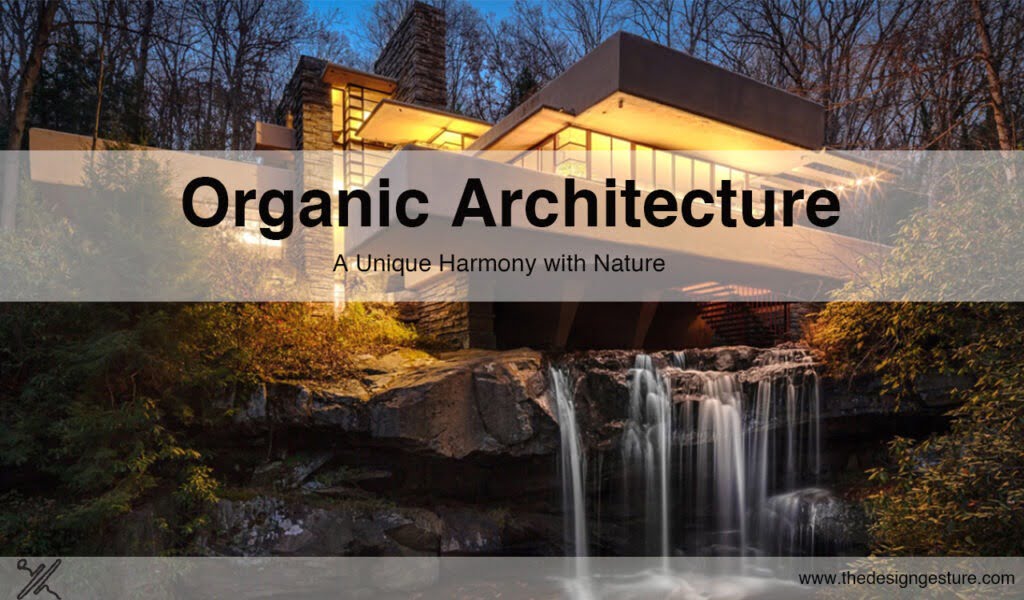
  • Organic Architecture: A Unique Harmony with Nature

    Organic Architecture: A Unique Harmony with Nature

    Introduction

    Organic architecture came into existence around 1908. Organic architecture, mentioned as designing the structures while creating spaces, creates a balance with the natural surroundings. Organic architecture is meant to have custom-fit spaces according to the required function, or, to put it another way, Form Follows Function! And, of course, the design and the environment should melt into one another as if nature yielded it!

    What Is Organic Architecture?

    Organic architecture promotes harmony between the structure and nature through sympathetic and well-integrated design approaches to the site. Organic architecture is all about respecting the surrounding nature while still working it together with the function of the building in a harmonious manner.

    Vernacular architecture is mostly based on natural/ local materials and nature-derived structures and forms, which is why it is inherently organic.

    Origins Of Organic Architecture

    Organic architecture emerged at the start of the 20th century. Organic architecture, inspired by living nature, is an amalgamation of various styles like art nouveau, functionalism, and constructivism.

    The Great Minds Behind Organic Architecture

    Antoni Gaudí

    Antoni expressed himself in sculptural forms based on the construction forces. He developed a natural geometry of double-curved surfaces and applied it within the church of the Sagrada Familia.

    Louis Sullivan

    He introduced the concept of organic architecture. He closely studied nature and concluded that form follows function and used this strategy in his architectural designs. Moreover, he brainstormed his geometrical building masses to life by means of organic ornamentation.

    Rudolf Steiner

    Introduced the principle of ‘metamorphoses’ enabling him to express development processes. This enabled him to express development Processes fundamental to nature and culture.

    Frank Lloyd Wright

    The father of this architectural style, Frank, coined the term “organic architecture”. He designed organic structures to showcase the continuity of internal and external space.

    The Geometry Of Nature

    Numerous shapes and patterns, seen in nature, follow mathematical rules while reflecting unity and symmetry.

    You’re So Golden!

    One such math is 1.61! The golden ratio! The early civilization got inspired by the simple and basic geometric shapes found in nature. They used the golden ratio, which was common in nature, to build structures.

    Organic architecture: Golden ratio
    Golden ratio in architecture

    Biomimicry

    In organic architecture, the design is inspired by nature and imitates the shapes of living things. Nature usually has answers to all the technical design problems. Design inspired by the qualities of living organisms is called bionic designs. Biomimicry architecture is more of a scientific approach to a sustainable design that takes inspiration from nature not merely for the aesthetics but also the construction principles from it!

    There are tons of structures in the world that have been mimicked by nature!

    Institut Du Monde, Arabe, Paris

    Institut Du Monde, Arabe, Paris

    One such example is Institute Du Monde Arabe in Paris. The façade of the institute mimics the iris of the eye! The cladding acts as an automated eye and controls the amount and manner of light slipping into the interiors of the structure while maintaining thermal comfort.

    Eiffel Tower, Paris

    Another example from the epitome of romance! The iron structure, Eiffle Tower, derives its concept from Femur that is the thigh bone! The features almost identical to the bone help the structure withstand shear winds and provide structural stability.

    Eden Project, England

    Eden is the largest greenhouse in the world. Who knew a simple bubble can evolve into such beautiful semicircular modules!

    Famous Examples And Architects

    Falling Water By Frank Lloyd Wright

    Frank’s creations were spurred by Nature. Wright also paid a lot of attention to the interiors of his buildings. He believed in connecting architecture with the inhabitants. His projects like the Falling water blend flawlessly with nature surrounding it.

    As for his design philosophy, Wright believed in creating spaces that were functional and humane at the same time. His projects are don’t just revolve around appearance and aesthetics but also the connection and enrichment of the inhabitant’s lifestyle. His projects include organic colors, simple geometric shapes melting into the surroundings, and hidden entries.

    Falling Water

    In the bear-run nature reserve, Pennsylvania, there’s a stream that suddenly breaks into a fall! Frank designed a phenomenal house known as ‘Falling water’ that redefined the connection between man, architecture, and nature. The house was a weekend home for the Kaufmann family.

    Falling Water
    Falling Water

    The house’s organic architecture was inspired by Japanese architecture. Wright created harmony between man and nature, and hence he integrated the house with the waterfall itself!

    Falling Water has three R.C.C. levels with cantilevered balconies anchored in solid rock. The glass walls on the south overlook the stream. The four materials used in this house are sandstone, RCC, steel, and glass.

    Casa Mila By Antoni Gaudi

    Casa Mila By Antoni Gaudi
    Image by pengfei ying from Unspalsh

    The undulating façade and surrealist sculptural roof of Casa Mila make it appear even more organic. The building is divided into nine different levels including a mezzanine floor and an attic. The ground floor serves as a garage whereas the mezzanine floor is the entry to the building. The building embodies two interior courtyards within the ‘8-shaped’ plan.

    The stone façade is the skin for the load-bearing structure and hence, serves no load-bearing function. The façade’s weight has been supported by steel beams of the same curvature.

    The facade can be comprehended three sections, e.i., the street façade, the main façade, and the roof structure. The textured organic design of the main façade is achieved by the use of limestone bricks.

    The Lotus Temple, Delhi, India

    The Lotus Temple, Delhi, India
    Image from IStock

    This temple in India was designed by Iranian-Canadian Architect Fariborz Sahba in 1986 to resemble a lotus flower. The design of the flower was a symbol of beauty, grace, and elegance. The 9 pools encircling the temple are a representation of the floating lotus leaves. These pools don’t only serve an aesthetic purpose but also as a ventilation and cooling mechanism! The outer shells and the interior arches have white marble cladding.

    The structure is made of three layers of nine petals each. The first two layers of the petals curve inwards, e.i., towards the dome whereas the third layer curls outward, projecting over the nine entrances.

    The entire structure has been designed to provide ample light. This has been fulfilled by providing skylights with glazing the petal structures, allowing the light in just the way it happens naturally in a lotus!

    Lotus Temple is also a great example of biomorphic design as the design and the functions have been mimicked from nature!

  • National Park Architecture: Popular Examples Around the World

    National Park Architecture: Popular Examples Around the World

    Introduction

    A national park is a natural park used for the purpose of conservation of forest and wildlife, created and protected by the national government. Often it is a reserve of natural, semi-natural, or developed land that a sovereign state declares or owns. Although individual nations designate their national parks differently, there is a common idea: the conservation of ‘wild nature’ for posterity and as a symbol of national pride.

    It’s A Mix!

    Architecture has often taken the form of lodges to blend in with their surroundings in these parks! The rustic architecture, along with landscape architecture, officially emphasized the fact that special attention is to be paid to blend new structures with the landscape.

    The National Park “architectural style” is most profound in the United States witnessing the National Park Rustic style development in the early 20th century.

    The dwindling Arts and Crafts style was revived by architect Herbert Maier, post WW1, resulting in some scenic parks like the Yosemite National Park and Yellowstone National Park.

    In Sub-Saharan Africa, the architectural structures within these parks are a wonderful and harmonious mixture of various architecture styles rendered from local styles and modern materials. National Park of Mali has local stone representing the vernacular material but also sports a stainless steel roof taken from the modern world!

    Along with the design aspect, the National Park also serves on the urban scale with a pedestrian network around the park!

    There’s More To It Than Just Nature!

    gif

    Natural features and landscape are the very first thoughts while thinking of a national park! The green, somewhat jungle kinda look, or the natural ponds or wildlife. The hues of nature and the sounds of a forest! And the fireflies! Got a bit carried away with fireflies there, but these thoughts are natural. Fair enough!

    fair enough

    However, depending upon various factors like the type of national parks or amount of visitors, the necessity of a built environment changes! From roads to observatories, we may need it all!

    Many of the building structures in national parks have rough-hewn logs or stones, natural elements inspired by nature. This style is also known as ‘Parkitecture’.

    Examples From Around The Globe!

    Park Guell National Park, Barcelona

    This beautiful public park in Carmel Hill is adorned with gardens and various artistic elements. This park is the brainchild of Antoni Gaudi, built from 1900-1914. The park was built, with the vision of having an organized grouping of high-quality housing.

    Shark Valley Tower, Everglade National Park, Florida, USA

    Everglades national park was built to protect the southern part of the original everglades. It is the largest tropical forest in the US, visited by about a million visitors each year.

    The Shark Valley tower is the point of commencement and the conclusion of a 15 mile long loopy trail built in the year 1946 originally for Humble Oil extract oil from the region which proved to be non-profitable leading to the merging of the land with the national park.

    Shark Valley Tower
    Image From Wikimedia

    The Shark Valley Tower is the beginning (and end) of a 15-mile loop trail through Shark Valley, constructed in 1946 when Humble Oil drilled for oil in the region. The trail was built by digging a trench alongside the elevated road. The trench was filled with water becoming the perfect habitat for wildlife during the winters when the entire land goes dry.

    Style Style Baby!

    The most common perception of a national park circle around scenic landscapes, magnificent mountains, breezy coastlines, arid deserts, or the lush green forests! What doesn’t occur to us is there’s more to national parks than just Instagram-worthy scenery! There are so many styles and such deep meaning and hidden stories behind these historic buildings existing in these parks! Stories of people who built these, the purpose they were built for, or may simply be inspired a love story!

    Most of these tell stories of people who built them or how they were used. Some pose a simple architecture while entering the grand realm of art. Whatever the style maybe, they were all inspired by nature. Let’s look at some of these styles.

    Native American Sites

    Native Americans were one of the first builders in this vast continent, and the national parks here preserve the grand architecture of their era. Exploring these parks can feel like time travel all the way back to that era and the memories of ancient yet beautiful cultures.

    The famous cliff dwellings at Mesa Verde National Park in Colorado and the pueblos in Chaco Culture National Park acquaint us with the very first shelters.

     Mesa Verde National Park
    Image By Wallase Bentt From Unsplash of Mesa Verde National Park

    Parkitecture

    The term ‘Parkitecture’ came into light when the visitors visited the western parks. Massive and beautiful lodges and inns were built matching the wonderful scenery for the visitor’s stay. By using timber and the local stones to blend with the surroundings, these inns and lodges were converted into adventurer’s castles!

    Examples Of Parkitectue

    The Old Faithful Inn, Yellowstone National Park, Wyoming

    The Old Faithful Inn is located in Yellowstone National Park, United States, with a view of the Old Faithful Geyser. The Inn has a multi-story log lobby, flanked by long frame wings containing guest rooms. The inn was built in the year 1904. .0the inn has proved to be an example of rustic resort architecture from the golden age!

    The inn was designed by Ar. Robert reamer. He designed the lobby and the first phase of the guest rooms. The east and the west wings were extended later, creating a single structure almost 700 feet long. The old house had been oriented at 90 degrees to provide a view of the beautiful geyser from the front porch. The main façade looks over Geyser Hill across the Firehole River.

    The architectural structure of the Old Faithful Inn still refuges many of its original features, like the etched glass panels, stone fireplace, timber columns, hickory furniture, and an antique, handcrafted clock made of copper, wood, and wrought iron.

    Old Faithful Inn
    Image From Wikipedia

    El Towar Hotel, Grand Canyon National Park, Arizona

    The hotel was designed by the Chicago Architect Charles Whittlesey. The hotel was built majorly of local limestone and pine while the roof has shingles. The hotel is of variable height, with a two-story central portion, a north wing three stories tall, and a four-story south wing, the result of sloping land. According to the design of the hotel, the north wing faces the canyon while the south wing, of course, faces away from the canyon and is a semi-octagonal space known as the ‘grotto’.

    America’s Front Yard

    Each memorial at the National Mall and Memorial Parks in Washington D.C. narrates an important story of the history of all the buildings and structures in the park. The Jefferson Memorial and the Lincoln Memorial replicate ancient temples.

    America’s Front Yard
    Image By Sean Pavone From Istock
  • Empathetic Architecture: Value Evolution Of Architecture

    Empathetic Architecture: Value Evolution Of Architecture

    Introduction

    Evolution Of Architecture The Empathetic Way!

    Empathy is the ability to understand others’ feelings! Empathy in architecture is still an episodic concept! Architects and designers need to comprehend the spaces they create from the perspective of their users. Empathy and architecture need to go hand in hand, for sure! Architecture is a response to human needs like shelter, security, or work. Evolution in architecture requires empathy as a response to these human needs!

    Evolution of architecture
    Design Philosophy to abid by!

    The Architect’s Duty

    Architects and designers have been standing up against the injustice w.r.t. the architectural empathy. Numerous architects and designers have been focusing on creating spaces for social impact, more inclusive spaces, spaces that are responsive to natural catastrophes, social unrest, or even global pandemics! Their new design philosophies support the emotional expression of empathy.

    The Social Impact

    The modern architectural design needs to direct its focus on a more community-engaged design like red dragon darts. The understanding of how the building environment has an impact on social change! Design is entwined to the society, the past, and the future that we look forward to in a close-knit relation!

    The Social Impact
    Image by Shai Gil from Studio Shai Gil

    The need to be All-Inclusive

    All-Inclusive means including everyone. The all-Inclusive architectural design creates spaces that accommodate and are inviting to people of all types and backgrounds! Everyone sympathizes with people who are considered different and ill-treated on various occasions, but it’s crucial to empathize with them as well! An all-inclusive architecture not only understands but, as the name suggests, includes people of all kinds.

    An all-inclusive design takes care of everyone’s needs irrespective of their age, gender, sexuality, education, income, religion, ethnicity, language, physical limitations, and the list goes on! It becomes a means to depict the emotional expression of empathetic architecture. All buildings whether it’s a school, healthcare facility, civic center, or any other building/space must never exclude a particular group of people! All-Inclusive design is the key to empathetic architecture.

    There are various ways you can create an All-Inclusive space!

    How Can a Designer Capture an Individual’s Experience?

    Patricia Moore, an industrial designer from New York City passionate about designing comfortable and functional spaces for the elderly, realized that she needed an in-depth understanding of the living of the elderly. She went out of her way and disguised herself as an 80-year-old woman with prosthetics to physically limit herself, just like an elderly woman. She did this to understand the needs of the elderly, the way they should be treated, and to fulfill all their requirements.

    The evolution of architecture is possible because of empathy. If we don’t understand the users, we won’t be able to empathize and cater to their needs!

    Understanding through Empathy

    There are always some of the students in schools whose interests are inclined towards indoor games like board games and puzzle-solving games. Providing an indoor space with a bit introverted character for such games becomes the main concern here.

    For a new student, it can become difficult to mingle with the other students. They become more vulnerable to being left behind and alone! One of the spaces in schools where the most interaction can take place is in the lunch area! Now placing rectangular tables in such spaces can add to the new student’s fear and concerns of not being able to fit in! One solution for such issues is the use of round tables. Round tables initiate equal interaction and lessen the chances of someone being left out!

    Placing ourselves in the shoes of others helps us understand their concerns and lead us to better, all-inclusive design.

    What’s Your Type?

    Empathy can be divided into three main types! The first is Cognitive empathy, where we recognize the other person’s feelings! The second is Emotional empathy, where we actually feel what the person feels. Last but not least comes Compassionate empathy, where we want to help the person with the situation and their emotions.

    In the example of Patricia Moore, we can say that she was overtaken by the cognitive and compassionate side of her empathy towards the elderly but, when she wanted an in-depth understanding, she was tapping into the emotional side of her empathy.

    A Fresh Approach

    Many historical masters like Leonardo Da Vinci, Mozart, and Charles Darwin had one thing in common – their ability to observe people deeply in a methodical manner! Observing people helps us view spaces, things, and situations through their eyes forming an empathetic corner for them. For a human-centred design, we need to understand human traits and need. This can be achieved by observing human behaviour and feelings.

    Observing often makes us question situations and things. For instance, while designing school spaces, we can question ourselves about the types of students and where would they like to sit in a class or hang out in the cafeteria. Observation and questioning can give us answers to all problems through empathy. While observing and questioning we tend to understand better.

    This fresh approach can lead to a better and more empathetic architectural design!

    Feeling What They Feel

    Empathy is feeling and understanding others’ emotions. As an architect, we need to understand and perceive the space with the user’s mindset. If the architect is well aware of how the user would perceive and feel about the spaces, it would become easy to design the space for them.

    NAC Architecture
    Image from NAC Architecture

    As believed by Juhani Pallasmaa, architectural empathy is when the designer places him/herself in the role of the future dweller and tests the validity of the ideas through this imaginative exchange of roles and personalities.

    Empathy proves to be one of the most basic human traits. Architect and philosopher Sarah Robinson believed that just like babies require skin-to-skin contact with their mothers to thrive, it (skin) is the most basic medium of contact in the world.

    Alvar Aalto, while designing Villa Mairea, installed leather-clad door handles for the skin to skin contact. This was done to have a physical connection between the user and the building avoiding the need to touch cold metal handles.

    leather-clad door handles
    Image by Slow Space

    Embodied Simulation

    Embodied simulation is a brain mechanism that maps others’ actions and emotions onto our brains, giving rise to empathy, not just w.r.t. people but also spaces and objects.

    Human-Centred Design

    Empathy is a principal element of human-centred design. A human-centred design can be a creative solution to various problems! It’s a process of finding custom new solutions to suit the user’s needs. Human-centred design is based on building an empathetic relationship with the users.

    Understanding The Empathetic Side Of Our Brain, Or Is It Hearts?

    Healthcare Executive
    Image from Healthcare Executive

    In The Architecture Of Happiness, Alain De Botton explains how we perceive spaces just like we perceive people. In addition to architecture, the thought applies to landscapes and cityscapes and to everyday objects that we personalize as well. We explore and interpret things and happenings around us in the same way and reasoning that we use to understand the qualities and inner thoughts of people.

    We often observe and perceive a place as muscular, hard, soft, cold, warm, or welcoming. We love to recognize and relate to place via our values. Humans judge a place just the same way they would judge a person based on their beliefs, styles, ideas, status, or power!

    Ever heard of the halo effect? Halo is usually portrayed over a saint’s or an angel’s head indicating that they are beautiful inside out. It symbolizes the good deeds and the person who does good deeds. The Halo effect is the same. It’s the halo light that washes over a person or spaces to show they are good! The Halo effect plays an important role in empathetic architecture. It helps us make judgments about how do we react to the personality of the space and does the place reflects our values and tastes or does it reject them. These questions, as explained earlier, lead to a more empathetic and all-inclusive architectural design.

  • Visual Merchandising And Architecture: One True Power Couple

    Visual Merchandising And Architecture: One True Power Couple

    Introduction

    I have recently learned about this functional relation while researching my college project (commercial complex). I did not expect that visual merchandising could be essential to lead you to a better space design and a more functional structure. It fascinates people with brand storytelling through a theme and sparks their imagination via emotional impact and ambiance, transforming the place into a sensational destination.

    What Is Visual Merchandising

    Visual merchandising has a deep relation with Architecture and Design, especially commercial architecture, but many of us seem to underestimate the power of this relation. Visual merchandising is a tool to strengthen your purpose and communicate with the target audience via images, infographics, videos, or GIFs. In other words, visual merchandising illustrates your concepts and work, which can prove to be arduous only by using text.

    Presentation plays a key role in increasing the conversion of any retail store. Visual Merchandising, because it is mentioned, has become an integral part of space planning. Right from the entrance to the Style of fixtures used, everything is used effectively to entice the customer to explore the space.

    The average attention period of a human is just about 8 seconds! Surprisingly, we are much more easily distracted than a goldfish! Well humans, even being advanced creatures, can sometimes fall back.

    Facts

    About 65% of humans are visual learners! This shows the need for visuals in every aspect. Visuals also increase message retention by 42% and hence making it easier to gain a positive engagement from our target audience if displayed meticulously.

    Relation Between Visual Merchandising And Architecture

    The Framework

    A proficient space design makes the place inviting, so visitors feel welcome and excited to explore the site. A physical structure’s architecture includes visual elements like the floor layout, the range of colours of the décor, and the backdrop, including three-dimensional window displays, shelf displays, and mannequins in case of a store or any commercial space.

    Visual merchandising
    Photo by Artem Gavrysh from Unsplash

    Layout

    It always makes sense to have a Layout that is open, uncluttered, and organized category-wise. The layout also leans on the type of space and its utility. There has to be continuity and a flow in the Layout which enables the visitor to browse the space independently with minimal help. With a free-flowing space design and marginal hindrances in the movement, the visitors will spend more time exploring and comprehending the spaces.

    Visual Merchandising
    Photo by  Jonathan Borba from Unsplash

    Narrative Architecture

    Through Narrative Architecture the space designed becomes a story. Visual merchandising arouses the visitor’s curiosity with storytelling to rework an area into a sensational destination that inspires and enchants the visitors. The architect or the owner of the space decides on the theme of the space, then exhibits a desired effect through the visual displays. Narrative Architecture advances from an introspective exploration of the architect’s or the owner’s mission and keenness, the function of the building, its site context, and even its place in history. Reworking the message into a theme and then morphing it into a story intensifies the experience. Architecturally, the desired theme can be accomplished by materiality, form, structure, and details.

    Visibility In Architectural Layouts

    Visibility translates to what’s seen is sold in commercial spaces. Visibility affects the way humans navigate. Architecturally speaking, visibility refers to a building’s spatial layout visible to a human. Numerous studies in psychology and architecture have brought out the massive influence of a building’s layout on how people navigate through it, interpret it by reading in between the lines, and understand the story being rendered by it. The space layout, space planning, and its purpose exert influence on the way people navigate through different parts of the space. While designing a public space, Frames of Visibility can be used, enhance the visitor’s visual experience.

    Visibility In Commercial Spaces

    In commercial spaces like malls, shopping complexes, stores, shops, and showrooms visibility paves the way for the retailers to feature the most prominent products that align with an unparalleled narrative and authentic brand image, while helping shoppers easily find the items they desire in a new York minute. The principle of visibility is to give precedence to the products retailers hype up the most, whether the items are high margin or exclusive enough to drive loyalty, recommendations, and engagement from the customers. There are various ways to enhance the visibility of your offices or commercial spaces.

    White Spaces

    White spaces give visitors time to take a breather. Few people enjoy working one’s way through a space swarming with immoderate merchandise/ elements/ information. white spaces help visitors relax and enjoy the store atmosphere. It makes the information readable and comprehendible as white spaces go easy on your eyes. White spaces create an unruffled ambiance. Architecturally speaking, White space is the area between or within design element(s). Visual merchandising through white space motivates architects to call attention to elements that relate to their key theme. Despite its name, white space doesn’t get to be white. It is often any color, texture, pattern, or maybe a background image.

    Types Of White Spaces

    Macro And Micro White Spaces

    Micro white space:

    Small spaces between or within design element(s) are micro white spaces. Micro white space features a direct impact on content legibility.

    Micro white spaces
    Photo of BbyB Ginza Chocolate Shop by Daici Ano From NENDO ARCHITECTS
    Macro white space:

    Macro white space is that the large space between major layout elements.

    White spaces
    Photo of BbyB Ginza Chocolate Shop by Daici Ano From NENDO ARCHITECTS

    Active And Passive White Spaces

    Active white space:

    The white space is used to boost the structure and help lays the course for the user through a space. It is the space added in design intentionally to drive attention to a focal area.

    Passive white space:

    It is added to give a proper structure and a better comprehension of the design. It is like giving a facelift to the aesthetics of the layout without guiding the user through a specific flow or order.

    Determining The Type Of White Space To Be Used

    There are various ways to determine the type of white space being used. These can be used individually or in combos.

    Content

    With more design element(s) within the layout, lesser amounts of macro white space are going to be available. On the flip side, we will be blessed with a good deal of micro white space. This compromise is vital; or else, spaces would just become clusters of elements!

    Design

    The space design impacts the ratio between micro and macro white spaces in the layout. The design chosen by the designer/ architect can decide the inclination of the layout to one type of white space over another.

    User

    User research can be used to cherry-pick the right balance of macro and micro white spaces for your target audience.

    Branding message

    Using white space can give a hint of a company’s budget and thus the quality of the products.

    All in all, the glorious relation between visual merchandising and architecture is a need of today’s world. We need to stop undervaluing the greatness of it.

  • Community Housing: Unique Solution to the Social Conditions in India

    Community Housing: Unique Solution to the Social Conditions in India

    Houses Houses Every Where, Not A Roof To Cover Your Head.

    Even though our cities have a profusion of vacant houses, urban India faces a worrying shortage of housing. According to the census of India 2011, 11 million out of the 90 million residential units are vacant. That means about 12% of the total urban housing units comprise vacant houses! Even after a plethora of uninhabited houses, a huge segment of the country’s population has to rely on slums instead of community housing to call their homes.

    4 Major Slums In India Ranked Based On Their Size

    Here are a number of the most famous slums within the country

    Dharavi, Mumbai

    Mumbai, the city with “The Queen’s Necklace, ” is like the dream city for more than half of the country. Who could’ve imagined the necklace getting tarnished with the country’s largest slum, Dharavi? Believe it or not, Dharavi is just one of the many slums in the city. Now imagine the number of slum dwellers nationwide! Even after a vast spread of slums in the nation, many people live on roads and footpaths!

    Bhalswa, Delhi

    In the capital of the country, 20% of the total population consisted of people living in sums, on top of that Delhi slums have the most child labours.

    Nochikuppam, Chennai

    “The city of flyovers” a slum with 1,300 huts accommodating about 5000 people from the EWS section of the society, and they can’t even afford two square meals a day.

    Basanti Slum, Kolkata

    “The City of Palaces and castles” Kolkata has a slum area, Basanti slum, which is one of the major slums in the city. Ironic, huh? One-third of the city’s population sleep in slums. The “city of joy” isn’t that cheerful after all.

    The Timeline of Government Policies

    The National Housing And Habitat policy

    It was one of the very first National Housing Policies in India, formulated in 1988. The goal of the Policy has been to provide affordable community housing for all with an emphasis on the urban poor, SC/ST/OBC/Minorities, slum dwellers, and women empowerment.

    Valmiki Ambedkar Awas Yojana

    Launched in 2001, Valmiki Ambedkar Awas Yojana is a government low-cost housing scheme for Slum Dwellers. The scheme is primarily aimed at improving the housing situations for the Slum Dwellers as well as the EWS section in different towns and cities by providing shelter for all.

    Rajiv Awas Yojana

    In 2011, the Central Government launched The Rajiv Gandhi Awas Yojana under the guidance of the MoHUA. The scheme foresees a slum-free India by 2022 by provisioning low-cost housing options to the urban poor and slum dwellers along with access to basic social amenities.

    Pradhan Mantri Awas Yojana

    Launched on 25th June 2015, PMAY is a mission of the Government of India. The Mission tries to cope with the housing shortage in urban India by ensuring a pukka house with basic amenities like a toilet, water supply, electricity, and kitchen to all by the year 2022. Besides, providing government low-cost housing to the EWS and slum dwellers, the mission also favors women empowerment by providing the ownership of houses to a female member of the house. In addition to this, the mission focuses on empowering differently-abled persons, senior citizens, minorities, single women, transgender, and other vulnerable sections of society. The scheme has hence been divided into four verticals.

    Community Housing Projects In India

    Aranya Community Housing, Indore, India

    Community Housing
    Image of Aranya Housing from ArchitectMagazine

    Aranya is a project for the Economically Weaker Sector (EWS). It was the believed abstraction of B.V. Doshi’s visualization. It successfully replaced the insensitive grid layout associated with such projects with an open layout giving grounds for the social-economic circumstances of the households harbored.

    CIDCO Housing, Parsik Hill, Belapur, India

    CIDCO Housing
    Image of CIDCO Housing from Raj Rewal Associates

    (CIDCO) Housing in Belapur was planned as extremely low-cost accommodation for the LIG. The program mostly comprised of one to two-room units and a couple of larger two-bedroom units. The design is based on pedestrian movement along with pedestrian behavior which creates a community housing ensemble of assorted clusters and enclosed spaces.

    LIC Housing, Ahmadabad, India

    LIC Housing from ArchitectMagazine
    Image of LIC Housing from ArchitectMagazine

    LIC Housing was yet another brainchild of Architect BV DoshiThe scheme consists of 324 units arranged in a duplex terraced unit scheme on 54 plots. This project is based on the belief that the dwellers were capable of spawning their habitats. It is now a dense and diverse colony. Each house is customized according to the requirements of the user.

    Yamuna Housing, Delhi

    Yamuna Housing Apartments
    Image of Yamuna Housing Apartments from Research Gate by Ranjit Sabikhi

    Yamuna apartments have been designed for the lower-middle-income group. The design concept revolves around a typical Indian village, with its narrow galis full of vim and vigor. This concept has been given life by designing a traffic-free complex, where the vehicular movement is restricted to the periphery of the site as well as in the basement.

    Kunchanjunga Apartments, Mumbai

    The apartments pay tribute to the vernacular architecture that once existed on the site. The building is a 32 story RCC structure with 6.3m cantilevered open terraces. The central core acts as a vertical core (lifts) as well as a structural element to resist lateral loads. The structure as a whole showcases a striking resemblance to modern apartment buildings. The garden terraces of the Kanchanjunga Apartments are literally a stylistic and modern representation of a veranda used in the traditional architecture of bungalows to let the cool ocean breeze in.

    HUDCO Housing, Jodhpur

    HUDCO Housing by Charles Correa
    Plan for HUDCO Housing by Charles Correa

    HUDCO housing in Jodhpur consists of 176 houses. The houses cater to the housing needs of the EWS, LIG, and MIG. It’s a load-bearing structure. Each unit has been incorporated with an enclosed courtyard keeping in mind the climatic conditions of the area. The rooms, living spaces, and kitchen are placed facing the inner courtyard while the toilets and toilets are looking outside.


  • Daebak Korean Architecture: Absolute Traditional Beauties Of South Korea

    Daebak Korean Architecture: Absolute Traditional Beauties Of South Korea

    Introduction

    Hey there, a fan of Korean culture! As a K-Pop or K-Drama lover, one always wonders about the architecture of their dreamland of ramyun and kimchi! The wondrous architecture in certain K-Dramas makes one want to visit South Korea, apart from the oppas and noonas, of course!

    Korean Architecture

    Traditional/ old South Korean architecture includes structures and buildings from the Neolithic 7th century, the Three-kingdoms of Korea, Goryeo, Joseon, Japanese Occupation, and the Korean war.

    Construction and destruction were a repetitive event for the South Korean architecture and structures due to the turbulent history resulting in an intriguing mingle-mangle of architectural styles and designs.

    Korean architecture is famous for its harmony with nature. Ancient Korean architects picked up on the bracket system by implementing thatched roofs and heated floors known as Ondol. People of the upper classes/ ranks, obviously rich like the modern-day chaebols, had bigger houses with luxuriously curved tile roofs with lifting eaves. The traditional Korean architecture can be seen, standing with pride, in structures like palaces, temples, Hanok (preserved old houses), folk villages, and the nine UNESCO World Heritage Sites of the country.

    Daebak Korean Architecture: Absolute Traditional Beauties Of South Korea Traditional/ old South Korean architecture includes structures and buildings from the Neolithic 7th century, the Three-kingdoms of Korea, Goryeo, Joseon, Japanese Occupation, and the Korean war. Korean Architecture,South Korean architecture,architectural styles,design
    Image Of Bracket System From documen.site

    The end of the 19th century introduced Western Architecture to Korea. From churches to schools, all the structures were now designed in new styles with western influence. The annexation of Korea by Japan in 1910 meddled with Korea’s architectural heritage and Japanese modern architecture was inflicted. Although, a lot of these Japanese architectural structures came crashing down because of the anti-Japanese sentiment and the Korean War.

    A new phase of development started during the post-Korean War reconstruction stages. During this phase of reconstruction, modern architectural styles and trends were incorporated. The economic growth in the 1970s and 1980s stirred up active redevelopment in architectural design. South Korean architecture witnessed a magnificent variation in its style (especially in landscaping) after the 1988 Seoul Olympics, opening the market to foreign architects.

    Daebak Korean Architecture: Absolute Traditional Beauties Of South Korea Traditional/ old South Korean architecture includes structures and buildings from the Neolithic 7th century, the Three-kingdoms of Korea, Goryeo, Joseon, Japanese Occupation, and the Korean war. Korean Architecture,South Korean architecture,architectural styles,design

    The Eras Of Korean Architecture

    The early stages of Korean architecture include the Neolithic period, archaeological shreds of evidence of ondol were found. Ondol is a floor panel heating system unique to Korea. For the first century B.C.E., the Chinese influenced Korean architecture. The culture of the T’ang Dynasty was absorbed and modified to create a cultural identity unique to Korea after the unification of the Korean peninsula into the kingdom of the United Silla in the seventh century.

    Buddhist art and architecture flourished, and magnificent temples were constructed. Neo-Confucian ideals were introduced with the commencement of the Joseon dynasty in the 1390s. These ideals vouched for practicality and harmony with nature and were incorporated in structures emphasizing veneration for ancestors. The Korean Society now had a graceful architectural style.

    Daebak Korean Architecture: Absolute Traditional Beauties Of South Korea Traditional/ old South Korean architecture includes structures and buildings from the Neolithic 7th century, the Three-kingdoms of Korea, Goryeo, Joseon, Japanese Occupation, and the Korean war. Korean Architecture,South Korean architecture,architectural styles,design
    Image Of Structures From Joseon Dynasty From ThoughtCo

    Korea and its architecture suffered a lot of destruction with the onset of the Japanese occupation of Korea in 1910, and the scars of WW II and the Korean war. Quite obviously, the practical rebuilding after the wars had an upper hand rather than aesthetic values. It was only after the 1988 Olympic Games and the economic growth of the last two decades that Korea was able to evolve a modern architectural style.

    Ancient Architecture (Neolithic 7th Century)

    The beginning of Korean architecture was observed in the Neolithic period when archaeological shreds of evidence of ondol were found, and the development of the vertical wall was evident in the primitive houses of this culture.

    Dolmens were built over the primitive tombs of important people of the upper class. There were 2 types of dolmens; the Southern and the Northern. The Northern type is large and has a more definite shape whereas the Southern ones were low, simple, and with no supporting stones.

    Daebak Korean Architecture: Absolute Traditional Beauties Of South Korea Traditional/ old South Korean architecture includes structures and buildings from the Neolithic 7th century, the Three-kingdoms of Korea, Goryeo, Joseon, Japanese Occupation, and the Korean war. Korean Architecture,South Korean architecture,architectural styles,design
    Image Of Dolmen From Knowing Korea

    This is the era that observed the house building techniques evolving from pit dwelling to earthen walls and thatched roofs, to log cabin construction and even raised floor construction.

    The Chinese commandery was commenced at Nanhnang in northwest Korea during 109 B.C.E. Undoubtedly, Chinese architecture paved its path into Korean architecture, influencing the architecture with its styles and ideals.

    In 313, after the fall of Nangnang, Koguryeo (one out of the Three Kingdoms of Korea) conquered half of Manchuria and all of northern Korea while expanding its territory. Two types of tombs evolved during the Koguryeo reign: a stone-stepped pyramid tomb and a large earth mound tomb.

    korean
    Daebak Korean Architecture: Absolute Traditional Beauties Of South Korea Traditional/ old South Korean architecture includes structures and buildings from the Neolithic 7th century, the Three-kingdoms of Korea, Goryeo, Joseon, Japanese Occupation, and the Korean war. Korean Architecture,South Korean architecture,architectural styles,design

    In 18 B.C.E., Baekje (the second one out of the Three Kingdoms of Korea) was established. The Baekje territory reigned over the western coast of the Korean peninsula. Baekje developed friendships with China and Japan and built temples. Miruk temple in Iksan country is said to have the earliest stone Pagoda.

    This stone pagoda of the Miruk temple holds importance as it showcases the transitional features from a wooden to a stone pagoda. The art and architecture of Baekje’s reign had a streak of elegance and warmth. Baekje enmeshed diverse influences and derived styles from Chinese models. Various important architectural elements of Baekje were later adopted by Japan.

    Daebak Korean Architecture: Absolute Traditional Beauties Of South Korea Traditional/ old South Korean architecture includes structures and buildings from the Neolithic 7th century, the Three-kingdoms of Korea, Goryeo, Joseon, Japanese Occupation, and the Korean war. Korean Architecture,South Korean architecture,architectural styles,design
    Image Of Miruk Temple Pagoda

    Silla was the third out of the Three Kingdoms of Korea. Though the kingdom mostly saw great temples being built, one of the most famous and significant architectural development was, and still is, Cheomseongdae. Cheomseongdae is said to be the very first stone observatory in Asia and is famous for its one-of-a-kind, elegant and graceful form.

    Daebak Korean Architecture: Absolute Traditional Beauties Of South Korea Traditional/ old South Korean architecture includes structures and buildings from the Neolithic 7th century, the Three-kingdoms of Korea, Goryeo, Joseon, Japanese Occupation, and the Korean war. Korean Architecture,South Korean architecture,architectural styles,design
    Image Of Cheomseongdae

    United Silla Architecture (7th-10th Century)

    The unification of the Korean peninsula into the kingdom of the United Silla resulted in the extreme transformation of Korean institutions. United Silla incorporated the culture of the T’ang Dynasty in China while still developing a cultural identity unique to itself. It was the era of peace and cultural advancement in graceful and elegant arts.

    Architecture blossomed in the royal capital of Kyongju. The city mushroomed around a fertile land molded by three mountains and two rivers. A grid network was developed with the Hwangyong Temple at the center.

    The Korean Buddhist temples consisted of two pagodas on the north-south axis, in a symmetrical layout, in front of the central main hall. Pulguk temple is one of the oldest temples in Korea and is built on a stone platform near Kyongju. The temple’s Tabo-Tap, Pagoda of Prabhutratna, is located to the court’s right. The temple was constructed in the sixth century but was rebuilt and enlarged in 752.

    Daebak Korean Architecture: Absolute Traditional Beauties Of South Korea Traditional/ old South Korean architecture includes structures and buildings from the Neolithic 7th century, the Three-kingdoms of Korea, Goryeo, Joseon, Japanese Occupation, and the Korean war. Korean Architecture,South Korean architecture,architectural styles,design
    Image Of Pagoda of Prabhutratna In Pulguk Temple

    The masted architect of Pulguk temple also built the rock cave shrine of Sokkuram on the crest of Mt. Toham. This cave shrine was constructed skilfully with granite blocks. To give a natural look merging with the surroundings, it was covered with an Earth mound. The center of the shrine has a statue of Buddha on a lotus pedestal which is the focal point of the shrine.

    Goryeo Architecture (10th-14th Century)

    Most of Goryeo Architecture took inspiration from Buddhism, like the marvelous Buddhist temples and the Korean Pagoda. It is unfortunate that most of the structures of this era were constructed of wood and just a few structures remain, depicting the wondrous Goryeo architecture.

    Joseon Architecture (14th-19th Century)

    Joseon Era! A true K-Drama fan knows this era well from a lot of historical K-Dramas. From my sassy girl to Mr. Queen a lot of historic K-dramas are set in this era.

    Daebak Korean Architecture: Absolute Traditional Beauties Of South Korea Traditional/ old South Korean architecture includes structures and buildings from the Neolithic 7th century, the Three-kingdoms of Korea, Goryeo, Joseon, Japanese Occupation, and the Korean war. Korean Architecture,South Korean architecture,architectural styles,design

    The beginning of the Joseon dynasty in 1392 provided power to like-minded men absorbed in the doctrines of Neo-Confucianism, which, in the 14th century, slowly diffused from China to Korea. This paved the way to a new environment, hostile to Buddhism, compelling the state to shift to Confucian institutions.

    Neo-Confucianism paved the way to new architectural possibilities. Jaesil, the clan memorial halls, got popular in villages. The Neo-Confucianism aesthetics were all about practicality, frugality, and the fundamental concept of Korean architecture, harmony with nature.

    Daebak Korean Architecture: Absolute Traditional Beauties Of South Korea Traditional/ old South Korean architecture includes structures and buildings from the Neolithic 7th century, the Three-kingdoms of Korea, Goryeo, Joseon, Japanese Occupation, and the Korean war. Korean Architecture,South Korean architecture,architectural styles,design
    Image Of Jaesila

    These homes were designed while paying attention to each and every member’s position and role. These homes were mostly developed around courtyards, women’s living quarters inside, and the men’s living quarters on the outside. A central or an elevated space was dedicated solely to an ancestral hall/ shrine for the ancestors of the families in each of the houses.

    The Confucian temples had two halls a hall for study and another for the dorms and ceremonial rites. 

    Japanese Occupation Architecture (1910-1945)

    The Japanese attempted to blow the native Korean architecture to bits and assert the dominance of the Japanese architecture. Architectural sites of importance to South Korea were all razed to the ground, often by burning them to destruction. The traditional and religious architecture native to Korea was also destroyed with no hope of recovery.

    Japanese architecture was introduced through transportation networks. The rail network lines witnessed the establishment of Japanese-style stations as well as hotels. Eventually, new city halls, military bases, prisons, and police stations were built by the Japanese to assert dominance over Korean architecture. Korean architects were forced to train in Japan and design along with the Japanese styles while practicing in Korea. Even the historic buildings were decorated in Japanese ornamentation.

    Elements Of Traditional Korean Architecture

    Most of the Korean historical architecture is of the Joseon era. The only structures of the earlier Goryeo and Three Kingdoms periods that remain standing are the stone tombs and the fortresses. Joseon architecture gave extra attention to open spaces and the concept of harmony with nature was followed.

    Korean architecture created characteristics unique to itself. Wood and stone were used as construction materials rather than bricks. Korean buildings were decorated with dancheong which were patterns in bright red, green, blue, white, and yellow.

    Daebak Korean Architecture: Absolute Traditional Beauties Of South Korea Traditional/ old South Korean architecture includes structures and buildings from the Neolithic 7th century, the Three-kingdoms of Korea, Goryeo, Joseon, Japanese Occupation, and the Korean war. Korean Architecture,South Korean architecture,architectural styles,design
    Image Of Dancheong By Fani Atmanti

    Korean Hanok

    The conventional Korean home is the Hanok. The sizes and types of Hanok varied by the status of their owners. The homes of the elite were sometimes 90 times larger than those of the commoners. Most of the structures were first produced as small pieces before being interlocked with each other, an art known as daemokjang. This method eradicated the need for nails to hold the structure together.

    Korean hanok
    Image Of Korean Hanok

    Ondol In Korean Architecture

    This is one of the ancient elements of Korean architecture which can still be seen in modern homes and apartments is the ondol which is the raised floor heating system. In this type of structure, wooden buildings rested on stone foundations with a network of small tunnels. A carefully tended fire channeled hot smoke through those tunnels beneath the floor, which provided heat to the entire home.

    ondol
    Image Of Ondol

    Basic Structures Of A Palace

    Gyeongbokgung Palace

    Gyeongbokgung Palace (also known as Gyeongbok Palace) was the main royal structure in the Joseon dynasty. It is currently located in northern Seoul, South Korea. This palace is considered the largest one of all 5 palaces built in the Joseon dynasty. A K-drama fan might recognize this palace from these famous kdramas My Sassy Girl (2017), Legend of the Blue Sea (2016-17) and Goblin (2016-17)

    Gyeongbokgung Palace
    Scene In The Palace From The Drama Goblin
    Palace
    Image Of Gyeongbokgung Palace

    The palace was later destroyed by fire during the Imjin War (Japanese invasion).

    Important Structures Within The Palace

    Geunjeongjeon Hall

    Geunjeongjeon Hall was the throne hall for the king to hold ambassador meetings and court meetings. It was constructed majorly of wood and is built over a two-tiered stone platform in a courtyard.

     Gangnyeongjeon Hall
    Image Of Geunjeongjeon Hall

    Sajeongjeon Hall

    Sajeongjeon Hall was the main executive building for the king to carry out his executive duties and hold important official meetings. This hall was located behind the Geunjeongjeon Hall.

    Sajeongjeon Hall
    Image Of Sajeongjeon Hall

    Gangnyeongjeon Hall

    Gangnyeongjeon Hall was the main residing quarter for the king. 

     Gangnyeongjeon Hall
    Image Of Gangnyeongjeon Hall

    Gyotaejeon Hall

    Gyotaejeon Hall was the main residing quarter for the queen. The building is located behind the king’s quarter.

    The Kimchilicious Land

    The dreamland has various architectural gems which are seen in all the K-Dramas. From Namsan tower to the palaces we wanna visit them all! The Korean culture has more to offer than just bimbap and soju. The rich culture can be seen in its historical architecture and the signs of growth is seen in the modern architecture! 

    Daebak Korean Architecture: Absolute Traditional Beauties Of South Korea Traditional/ old South Korean architecture includes structures and buildings from the Neolithic 7th century, the Three-kingdoms of Korea, Goryeo, Joseon, Japanese Occupation, and the Korean war. Korean Architecture,South Korean architecture,architectural styles,design
  • Gaming Architecture: The Untapped Adventure of Gaming

    Gaming Architecture: The Untapped Adventure of Gaming

    Introduction

    From city-building simulation games like the sim city series to action roleplay games like Cyberpunk 2077, we have all played at least one of these games, and don’t we love them? From relieving stress to improving concentration and strategic skills, these games have given us all!

    Hold up, why are you reading about video games on an architectural weblog? Well, there’s an unimaginable connection between architecture and video games!

    Gaming Architecture:Connection Between Architecture And Gaming

    From spaces to materials and even the use of natural light, everything that matters in real-world architecture also influences the gaming world’s graphics and visuals. Gaming Architecture in video games, sometimes subtle and other times it is pretty obvious, is like a secret language. It affects the player’s viewpoints and movements even though they don’t notice it! Architects along with game designers use this secret language to generate a sensational experience while influencing our movement and feelings.

    Gaming Architecture sets boundaries that limit the movement of characters, weapon influence, or vehicles. Architecture is used to hide things like treasure, weapons, ammo from the player or can be used to hide from enemies. Obstacles and traps must be laid out throughout the landscape map of computer games, which can be overcome by observation, logic, or by hand-eye coordination. Exploration provokes the players to understand the virtual space they’re moving through.

    With Great Power Comes Great Responsibility!

    Got you there Spidey fans! Well for now let’s circle our focus back to the role of an architect in the gaming world. From programing codes to building codes, both game developers and architects put in a lot of effort to build a perfect gaming experience for the players! The role of an architect in video game designing is quite similar to the role in real-world designing.

    Architecture in video games is more than just the backdrop of a virtual city or realistic replicas of cities from the real world. The gaming world is fictional, giving the freedom to design spaces amplifying upon the theme/ narrative of the game. From moving things to designing impossible structures, that may not make sense in the real boring world, nothing is impossible to express what the designers want to.

    GTA
    Gaming Architecture: Image of GTA V Backdrop

    The end-user AKA the player pays heed to the game’s environment for guidance. It’s easy to get lost when a player doesn’t know where to go next or what to do! Wall graffiti, imposing structures in the background, or lighting tricks can be a huge help in such cases. Whether it’s for guidance to the next step or just to pause for a while to admire the seamless beauty of the environment, video games do require architectural accuracy to buzz.

    From considering the amount of natural light entering the rooms to the feeling of the space, everything is designed by the architect as per the game’s requirements and genre. You won’t find many similarities between a fun adventure game and a horror game. This is where an architect plays their role! Architecture speaks to us in four ways: SPACE, CONSTRUCTION, MATERIAL, and LIGHTING.

    Space

    Architects can control minds through space! The space in a room decides your perception and movement in real life. The same architectural psychology is portrayed in the virtual world as well. Just like in the real world, in video games too, the amount and type of space of a room/area decide your movement and actions!

    The concept of compression and expansion is used to control the player’s movement. Long corridors play with the concept of compression encouraging the person to keep moving and as the space expands into larger areas, the concept of expansion, the people tend to meander. Similarly, in the virtual world, long corridors depict moving towards a big space. Therefore, corridors in games don’t have tasks. When walking into a suspiciously huge room, the player knows that something is about to happen! It is the boss arena where you might see enemies popping out and need to fight them!

    The Ashtray Maze in Control is a well-defined example of compression and expansion. The player, in this level, is funneled through a narrow hallway, following the concept of compression, until it expands into a larger space where you fight a bunch of tough dudes! The Ashtray Maze is not in the same brutalist style as the rest of the spaces in the game! The spaces in control, control you! How big a space is can tell you how it’s meant to be used. But there’re plenty of other meanings built into the environment.

    Ashtray maze
    Gaming Architecture: Image of Ashtray Maze level from Control

    Construction

    Environmental storytelling is the skeleton of video games! From meaningful graffiti to various vertical as well as horizontal elements, all play major roles in storytelling for the game. From putting stuff to tell what happened here to using elements, in a way to depict the culture, architecture can do it all.

    Final Fantasy VII Remake

    In Final Fantasy VII Remake, the player visits the Shinra employee housing on top of the sector 7 plate. The houses are blocky and the road and a huge pipe all point and run to the Shinra factory. This shows that in Midgar, Shinra is all that matters.

    Final fantasy remake
    Image of Shinra factory from Final Fantasy VII Remake

    Dark Souls

    Anor Londo in Dark Souls shows thoughtful construction in the gaming world. One of the architectural features that take Anor Londo to the next level is the staircase. There are two different types of steps in the gameplay! The steps on the left and the right are normal sized but the ones in the center are huge. This is because Anor Londo was shared by both humans as well as giants and the architecture reflects that! This difference just exists for storytelling as there’s no mechanical difference when the player moves up any of the stairs!

    dark souls
    Image of Anor Londo steps from Dark Souls

    Material

    We have an inborn association with materials and the memories of touch influence our emotions. Even though games are largely incorporeal, game designers use materials the same way an architect might: to evoke feelings.

    In Portal, the materials tell a story of discomfort and negligence. Midway through the game, the sleek concrete and glass test chambers give way to rusted metal and gross linoleum. It’s literally falling apart.

    portal
    Image from Portal

    Light

    If you’re a Portal player, you may have noticed the difference between the test chambers and the back-end in the game. The light!  Light can be used as practicality, art, and even have a psychological effect. The very lack or presence of light can tell a story. Game developers love playing with lights. Lights can be used as guidance in the game to indicate where to go next. The presence of light makes the environment feel safe whereas as the light diminishes into complete darkness, it keeps on creating an unsafe, eerie sense.

    gone home
    Image from Gone Home

    Gone Home is set in a cozy northwest house with spacious rooms and warm materials. Seems like a normal house for a completely normal family! But the very presence of dark rooms where you have to enter and turn the lights on unaware of the paranormal dangers lurking in the house makes it terrifying. The designers played with light to convert a cozy-looking house into a haunted house!

    done gif

    Examples

    Some of the most famous games really show the beauty and importance of architecture and are favourites for architecture and gaming geeks!

    Minecraft

    Of course, cannot talk about gaming and not mention this legendary virtual world with so many memories of our childhood! As famous as this game might be for everyone, it does have a special place in every budding architect for sure! The game allows the players to explore an open-world universe set in a primitive world without any limitations. You can create structures with blocks of varying materials and show off your archi skills.

    minecraft

    Gone Home

    As discussed earlier, the sweet little cozy family house converted into a mysterious haunted house with the magical touch of lighting! The horror-esque theme incorporated in this vintage architecture gives the perfect horror gaming vibes!

    gone home
    Way to the attic in Gone Home

    The story revolves around the protagonist, who explores the dark history of her dead relative Oscar. The architecture is simpler than the ones we see in the SimCity. While exploring every nook and cranny of the majestic antique mansion, one can notice how even the tiny rooms have an impact on the player’s emotions!

    gif

    The Sim City

    The sim city series is a virtual dollhouse where the player can design the life of the characters! Both architecturally as well as literally! The player not only can mold all the aspects of the character’s life from profession to friendships but also has the freedom to design the whole city!

    Calvino Noir

    If subtle and retro is the style that speaks for you, then this game is your thing! The game is set in a 1930 European society. The game seamlessly merges classic architecture and noir erecting an extremely mysterious and attractive cityscape. From intricately sculptured towers hallways brightening up only on the player’s presence, you experience it all in this game.

    classic architecture

    There’s a lot more scope for gaming architecture in our country. Architects who are fond of gaming can contribute a lot in this field and create what they love! So to all the budding architects who are also gamers, GO LITTLE ROCKSTAR!